

Three quotes land on the same desk. All three say 30 kW hybrid inverter, all three say 80 kWh of battery, and the prices differ by forty percent. Nothing in the documents explains the gap, because the gap is not in those two numbers. It is in a voltage window, a protocol list and a transfer time that two of the three vendors left out.
A hybrid inverter is not a product category you shop by wattage. It is a configuration decision across three interfaces, and the machine you receive is only as good as the weakest one. The knowledge base entry on hybrid inverters covers what the term means and how the box is built. This page starts one step later, on the part that decides whether the thing is useful on your site.
Three interfaces decide whether a hybrid inverter works
Every hybrid inverter is a junction. The same assembly is sold as a hybrid solar inverter or a solar hybrid inverter depending on the shelf, a label that changes nothing below. Power arrives from a PV array, moves to and from a battery, and leaves toward a building and a grid. Each path has its own electrical contract, and each contract lives in a different document, routinely quoted one at a time.
Interface | The number to ask for | What breaks when it does not hold |
|---|---|---|
PV DC input | MPPT count, MPPT voltage window, maximum DC input current per tracker, absolute maximum array voltage | String voltage above the window at −10 °C on a clear morning; the inverter faults at first light, in winter, on the best production day of the year |
Battery DC | Operating voltage window at the terminals, rated charge and discharge current, BMS protocol | Two products that are individually correct and jointly unusable |
AC and backup | Phase count, rated AC output, backup port rating, surge rating, transfer time, grid-code file revision | A backup port that carries the essential loads on paper and drops the compressor on the first real outage |
The third row is where the money hides. A single-phase unit and a three-phase unit are not interchangeable at the same kW, and a 3 phase hybrid inverter whose backup port is rated below the site's essential load will still transfer in milliseconds — into an overload. The protocol question is not administrative either: a BMS the inverter does not recognise typically leaves the system in a safe stop, discovered at 6 pm on the last day of the trip.
In the current Hua Power line, the HC-UPSRAP16I is a 6 kW unit with a 12 kVA surge rating and a 10 ms transfer, a PV tracker rated 27 A at 80–520 V with a 500 V open-circuit ceiling, and a 51.2 V battery window of 43.2–57.6 V. Read as a set, those numbers say: two strings of a 550 W module at about 13 A, not three — a third would ask for 39 A against a 27 A rating — and a battery that never leaves the inverter's window at either end of its own. Where the pairing gets harder, the failure is usually in the battery, and the high-voltage pairing guide runs the same checks for high-voltage packs.
How the power path runs through one day
The functional description — DC in, AC out, battery in the middle — is true and useless. What a buyer needs is the shape of a day: a 60 kWp roof array across three trackers, a 30 kW three-phase hybrid cabinet with 80 kWh of storage, a light-industrial building drawing 9 kW overnight and 14 kW at midday, a late shift lifting it to about 22 kW at 19:00, and a grid failure at 19:40.
The pack came into the morning at 20% of its 80 kWh, so 90% is 56 kWh away. At 09:00 the array makes 18 kW against a 9 kW building load: 9 kW, about 35 A at 256 V, is the whole surplus. By 12:30 it is 52 kW against 14 kW, a 38 kW surplus. Ramped in a straight line between those two readings — an assumption, though a different irradiance curve moves the arrival inside the same morning rather than out of it — the surplus puts in about 13 kWh in the first hour, 34 kWh by 11:00, and the full 56 kWh at about 11:45. The pack's 140 A charge ceiling, roughly 36 kW at 256 V, does not set that clock; the surplus only passes it around 12:15. It sets what follows: from 11:45 the pack sits at 90%, and a surplus that reaches 38 kW by 12:30 — more than the pack could accept even empty — is exported within the site limit or curtailed. The AC rating caps that export no matter how large the array is. A time-of-use tariff only moves that window; it does not change the interfaces.
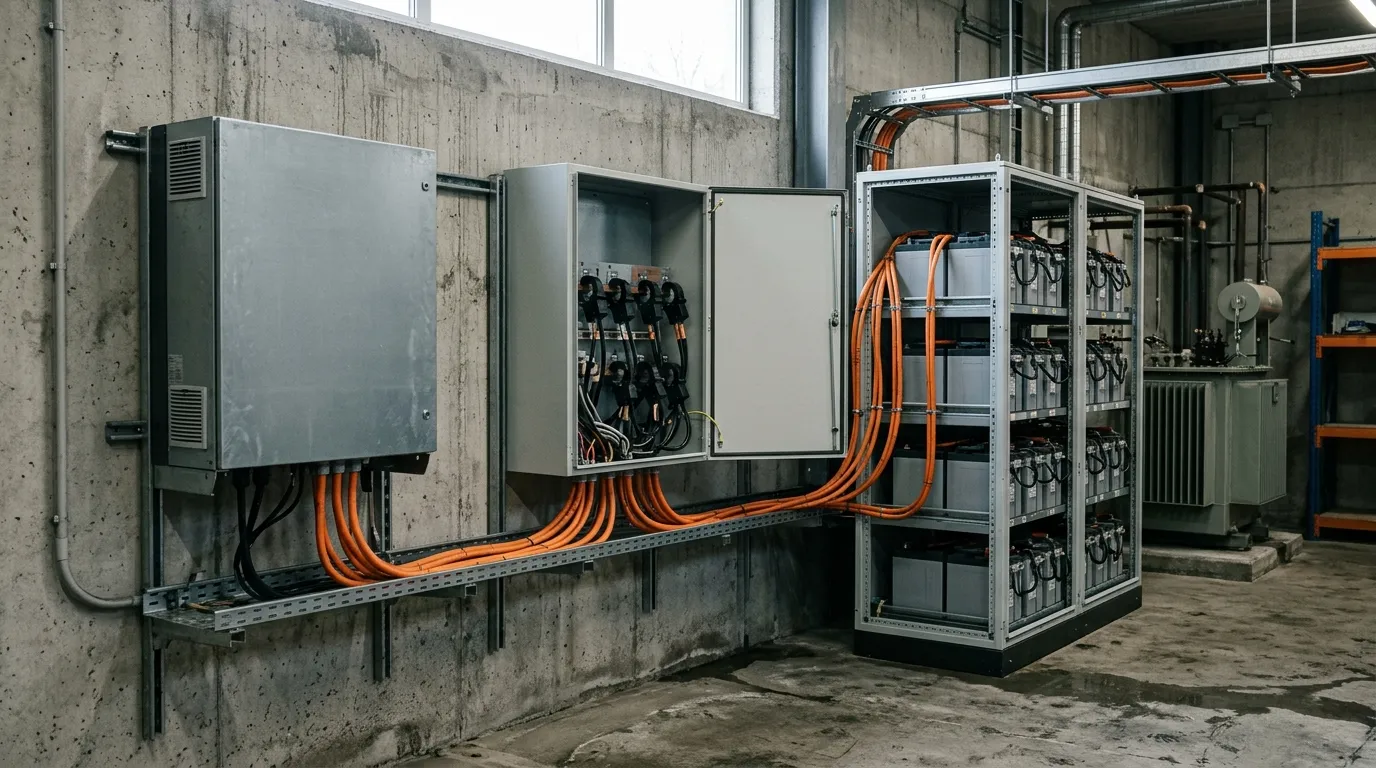
At 19:00 the building draws 22 kW and the battery carries it at 0.28C, inside its 0.5C rating. Forty minutes later the grid goes away, and transfer is under 10 ms — fast enough that servers and drives ride through and the lights do not blink.
Now the arithmetic that matters more than the transfer time. Essential loads — lighting, office HVAC, one production line, the server rack — total 11 kW, and the battery has about 57 kWh left. That is 5.2 hours, so the site rides to roughly 00:50. It is not an 80 kWh machine in any useful sense; it is a five-hour machine at 11 kW, and that sentence belongs in the proposal next to the nameplate rather than instead of it.
Transfer time answers a power question; duration answers an energy question. Confusing them is the most common way a backup specification survives review and fails on the night.
The two efficiency numbers that are not on the cover
Most grid-tied inverter datasheets lead with a peak efficiency between 97% and 98.5%. It is a real measurement at one operating point, and almost nobody operates there.
The number that matters comes from the protocol the California Energy Commission adopted for grid-tied inverters: efficiency measured at six AC power levels — 10%, 20%, 30%, 50%, 75% and 100% of rated output — at three DC voltage levels, for eighteen measurements, combined into a weighted average (Sandia National Laboratories PV Performance Modeling Collaborative). The weights are not uniform. Fifty-three percent of the score sits at 75% load, with 21% at half load and 12% at 30%.
That distribution is the tell. A machine can post a 98% headline and a 96.5% weighted figure, and the weighted figure is what the year pays. Typical grid-tied inverters exceed 95% across most operating conditions, but the curve is not flat, and the flat part is not where a commercial load sits at 08:00.
The second number is rarely printed at all: standby consumption, the power drawn while awake, connected and doing nothing useful. If a datasheet states 40 W, that is 350 kWh a year. Against the worked example above — a 5.2-hour outage that consumed 57 kWh — the annual idle draw is six times the energy that one outage delivered, which is the ratio on a site that sees one outage a year. On a residential system producing 6,000 kWh a year, it is close to 6% of the whole yield, spent on a load nobody modelled.
Hybrid, AC-coupled, or DC-coupled: the choice that moves the retrofit bill
The three architectures are not a hierarchy. They are three answers to "where does the battery connect", and the right one is decided by what already exists on the roof.
DC-coupled puts the array and the battery on one DC bus behind a single inverter, converting solar to stored energy once. Most efficient when both are new, least forgiving to retrofit: the existing inverter usually has no DC port for a battery.
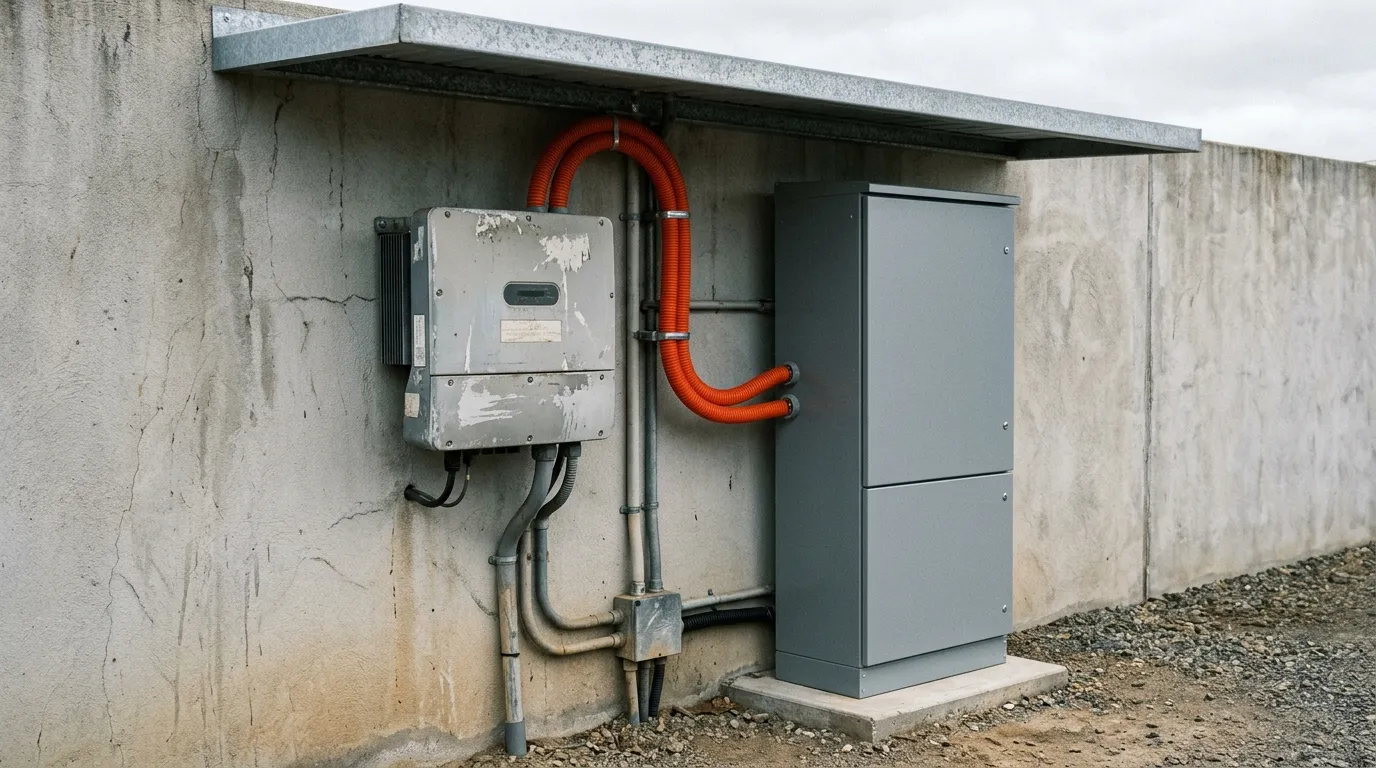
AC-coupled leaves the existing PV inverter alone and adds a battery inverter beside it, sharing the AC bus and coordinating through a meter. It costs a conversion and buys the thing most retrofits need — not touching a working array. The guide to AC-coupled solar retrofits works that case through.
Hybrid, as this article uses the word, is one unit with a PV input, a battery port and an AC connection, arbitrating internally: the same hardware family as a DC-coupled battery inverter, sold with the tracker included. It is not an off-grid inverter. An off-grid unit has no grid-tie function and no anti-islanding obligation, so it cannot legally parallel with a utility supply — which is why a hybrid carries the certification file below.
If the existing PV inverter is healthy and grid-tied, AC-coupling keeps it and the hybrid is the wrong purchase. If the inverter is being replaced anyway, or the site is new, the hybrid wins because you were buying that hardware regardless.
The knowledge base entry on AC- and DC-coupling has the loss arithmetic behind that choice.
Size the inverter on the backup port, not on the array
Most sizing errors start with the array: divide it by a DC-to-AC ratio borrowed from utility PV design, land on an inverter size, call it done. That ratio is a plant-economics tool, trading a little clipping on the sunniest days for a smaller inverter across the year. On a hybrid it is not the binding constraint: the machine is not primarily an energy converter but a switchboard with a battery attached.
Two numbers size it, and neither is the array.
The backup port, against the essential load list. Add up what must keep running, including starting currents. A small commercial case: 1.2 kW of lighting and office equipment, a 1.8 kW heat pump, a 0.9 kW well pump, and a cold-room compressor drawing 2.6 kW at start and 0.5 kW running. Continuous load is 4.4 kW; the worst simultaneous surge — the compressor starting while everything else runs — is 6.5 kW, because that adds 2.1 kW over its own running draw. A 5 kW hybrid inverter with a 10 kVA surge rating carries that. A 5 kW unit rated at 5 kVA does not, and the difference appears as a tripped backup output on the first hot afternoon. It is also the honest answer to what a 5 kW hybrid inverter is: 5 kW is the AC output rating, not the array size and not the battery size.
The charge path, against the solar window. If the battery must travel from 20% to 90% inside five hours, the energy is fixed by the battery and the charge power follows. A 20 kWh battery moving 14 kWh in five hours needs 2.8 kW average — about 55 A at a 51.2 V pack. If the inverter's charge limit is 30 A, the array can be twice the size and the battery still finishes the day short. The C-rate and depth of discharge guide carries that pair through to the warranty clause.
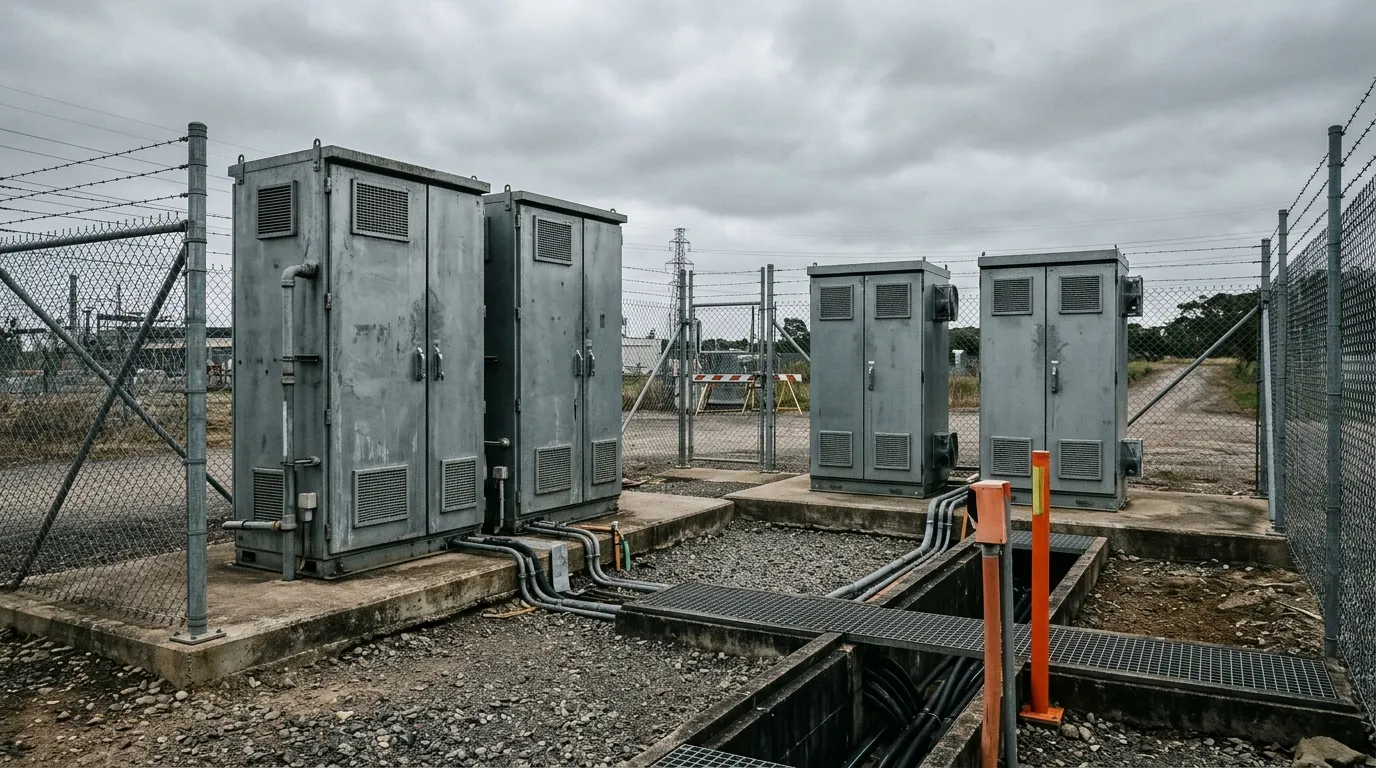
At commercial scale the same two numbers govern, just larger. The Hua Power HC-UPSAP80 is a 30 kW cabinet with 80.384 kWh of storage, a 60 kW PV input across three trackers, a 256 V battery window spanning 224–280 V, and a 30 kW backup output transferring in under 10 ms — a machine for a site whose essential load stays at or under 30 kW, not simply a machine for a 60 kWp roof.
Five things to verify on commissioning day
A specification is a promise; commissioning is where it becomes a fact. Five checks catch most of what goes wrong.
- Transfer time under real load. Not into a resistive bank, not at 10% load. Put the actual essential load on the backup port, open the grid breaker and measure. The datasheet number was measured at a condition the datasheet may not name.
- Backup at full load with the array dark. Do it after sunset. A machine that carries the load at noon is being helped by the array.
- Combined charge current. With PV and grid both charging, confirm the current the battery actually receives against the manual's limit. Some units derate the combined path, and the five-hour window quietly becomes seven.
- Export limit and meter orientation. If the site has an export cap, verify the meter or CT is oriented correctly and that the limit holds while the battery charges at full rate. A reversed CT reads import as export, and the inverter curtails production it did not need to curtail.
- Firmware and grid-code file versions, written down. Record both revisions in the handover document. Grid codes get revised, and the file that made the unit compliant at commissioning is the evidence you will want in year three.

What to ask before you accept the quote
Certification is the part of a hybrid inverter quote that is easiest to leave vague and most expensive to get wrong. In North America the interconnection function of a grid-tied inverter is evaluated under UL 1741, whose scope covers inverters, converters, charge controllers and interconnection system equipment for stand-alone and interactive systems (UL 1741, Edition 3), with the interconnection requirements themselves in IEEE 1547-2018. Safety of the power conversion equipment is a separate question, addressed internationally by IEC 62109-1 (IEC 62109-1:2010). A unit can hold one of these and not the others.
Eight questions to put in writing
Each one, answered in writing, separates a specification from a brochure.
Question | The answer that holds up |
|---|---|
What is the PV window per tracker, and the absolute maximum array voltage? | Numbers, plus what happens at the array's cold-temperature open-circuit voltage |
What is the battery voltage window at the terminals? | A range your battery stays inside at 0% and 100% state of charge |
Which BMS protocols are supported, at what firmware revision? | A named list, with the revision the test was run against |
What is the backup port rating, continuous and surge, at what ambient? | Both figures, with the temperature they were measured at |
What is the transfer time, measured under what load? | A time plus the load condition |
What is the weighted efficiency, to which protocol, and the standby draw? | A protocol name, a weighted figure, a no-load wattage |
Which grid-code files ship with the unit, and how are they updated? | A list by country, plus the update mechanism |
What does the warranty cover, for how long, and what voids it? | A term, a throughput or cycle cap, and the retention floor at end of term |
The sixth and eighth rows go unanswered most often, and they are the two that tell you whether the vendor is quoting a product or a paragraph. For a retrofit, add one: whether an existing generator can be signalled through a dry contact, and what happens when both try to serve the backup port.
How long does one last? Two clocks run at once. The inverter ages on capacitors, fans and the supply of replacement boards; the battery ages on cycles and depth of discharge, and where a pack in this line publishes a cycle figure it is 6,000–8,000 cycles to 80% state of health. Whichever expires first is the service life to put in the payback arithmetic.
The three interfaces are where this ends, in the same place it started. Decide the PV window against the coldest morning, the battery window against both ends of its own range, and the backup port against the load that must survive the outage — then buy the machine whose three numbers agree. The battery energy storage basics hub collects the rest of this cluster.
If you would rather have the three interfaces evaluated against a specific site, that is a sizing conversation with the engineering team rather than a catalogue lookup.