

Two quotes land on the same morning. One prices a 5.12 kWh battery. The other prices a 280 Ah battery. Neither number can be checked against the other until you know the voltage behind it — and a supplier who quotes only amp-hours is not being careless. They are choosing the unit that makes comparison hardest.
kWh vs Ah is the difference between energy and charge. An ampere-hour (Ah) counts charge: current multiplied by time, with no reference to voltage. A kilowatt-hour (kWh) counts energy: charge multiplied by voltage, divided by 1,000. Ah tells you how much charge moves; kWh tells you how much work that charge can do.
Both units are legitimate. They answer different questions, and a datasheet that gives you only one of them is answering only half of yours.
Ah counts charge, and charge has no voltage in it
One ampere-hour is the charge that flows when one ampere runs for one hour. In SI terms that is 3,600 coulombs, because the coulomb is defined as one ampere-second — NIST SP 330 (SI brochure, Table 4) lists the charge unit as C = A s. Notice what is missing from that definition: voltage.
So when a label says 100 Ah, it is making a statement about current over time. In first-order terms, that battery can supply 100 A for one hour, or 5 A for twenty hours. It says nothing about how much energy is stored, because energy also depends on the pressure the charge is delivered at.
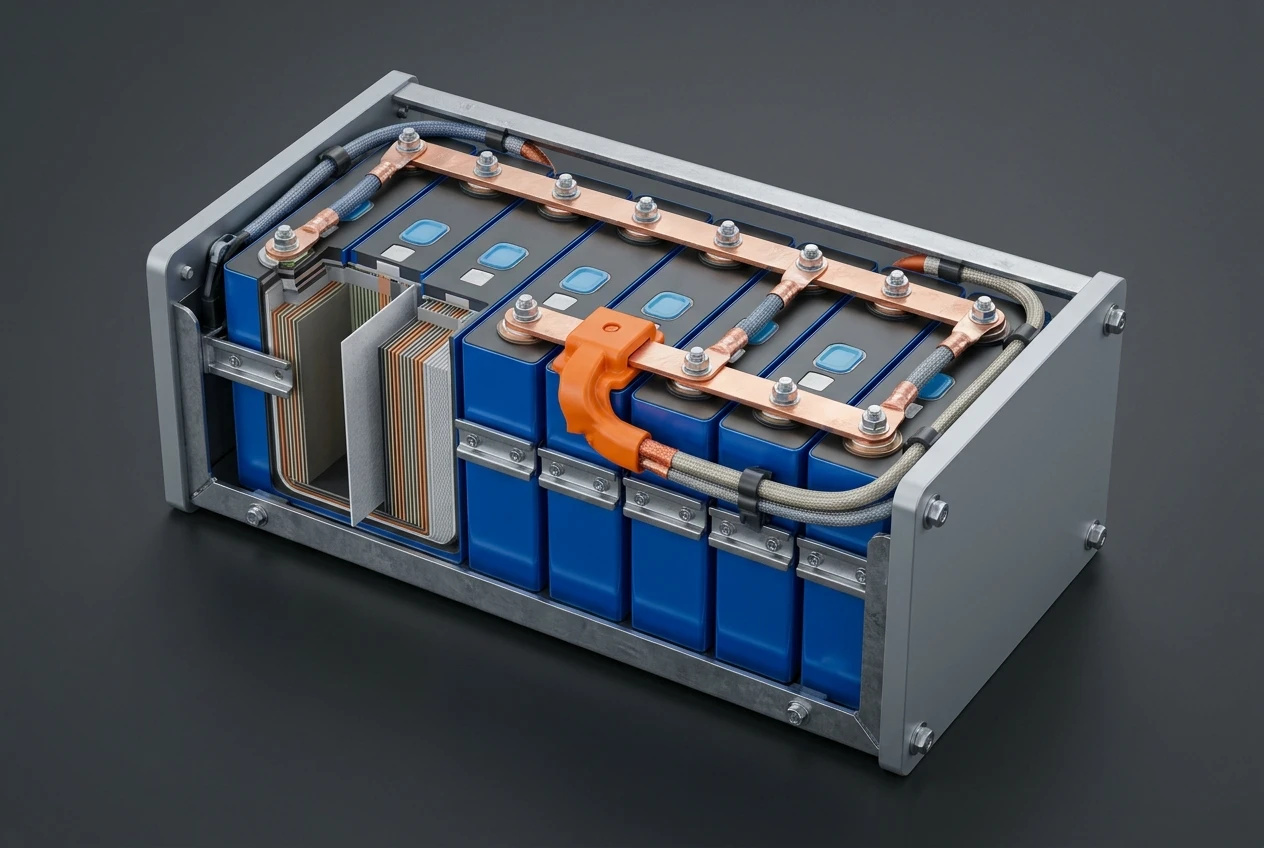
That is why Ah is the natural unit at cell and module level. Cell capacity is set by electrode area and chemistry, so cell datasheets are written in Ah. Module drawings specify Ah because busbars, fuses and contactors are rated in current, and a BMS enforces current limits rather than energy limits — the BMS overview covers that side of the system. Everything in that layer is current-shaped, and Ah is the current-shaped unit.
What an Ah figure will not do is tell you how long a load runs. For that you need energy, and energy needs the voltage. This is the step where a buyer who is comfortable with 12 V packs gets caught out on a 51.2 V rack: identical Ah, four times the stored energy.
kWh is the unit a project is actually sized in
Multiply charge by voltage and the answer changes category. Energy is Wh = Ah × V, and kWh = Ah × V ÷ 1,000. One kilowatt-hour is 3.6 megajoules: a kilowatt sustained for an hour.
Every commercial number in a storage project lives in that unit. The interconnection application is in kW and kWh. The arbitrage model, the degradation warranty, the incentive calculation and the container nameplate are all in kWh or MWh. Nobody signs a power purchase agreement in amp-hours.
The arithmetic is trivial; the part that trips people up is which voltage to put in it — the nominal voltage reference on this site walks through the LFP platforms, where a "48 V" battery may be 15 cells in series and a "51.2 V" battery is 16.
The runtime question is the one people actually ask. A 5.12 kWh module running a 2 kW load at 90% depth of discharge gives roughly 2.3 hours on the DC side — 5.12 × 0.9 ÷ 2, before inverter losses. Answer the same question in Ah and you need the current draw and the voltage before the arithmetic will close, which is why the kWh form survives a spec review and the Ah form turns into an argument.
kWh vs Ah in one table
The pattern repeats in every row: a fixed charge figure produces wildly different energy depending on the platform it sits on.
Unit | What it measures | Where it usually appears | How it gets abused |
|---|---|---|---|
Ah (ampere-hour) | Charge — current × time | Cell and module datasheets, BMS current limits, fuse and cable ratings, C-rate | Quoted alone, so a large Ah figure on a lower-voltage platform outranks a pack that stores more energy |
Wh (watt-hour) | Energy — charge × voltage | Portable packs, small appliances, energy-density comparisons | Compared across different internal cell voltages (mAh at 3.6 V presented as if it were 5 V) |
kWh (kilowatt-hour) | Energy at system scale | Container and cabinet nameplates, tariffs, revenue models, warranties | Quoted as nameplate and compared as if it were deliverable energy |
kW (kilowatt) | Power — energy per second | Inverter and PCS ratings, charge and discharge limits | Called "capacity", as in "a 5 kW battery" |
kVA (kilovolt-ampere) | Apparent power | UPS and inverter nameplates | Quoted without the power factor, so the real kW figure stays hidden |
The same charge, converted at five common platform voltages:
Platform | 100 Ah becomes | 280 Ah becomes | 314 Ah becomes | Typical use |
|---|---|---|---|---|
12.8 V (4S LFP) | 1.28 kWh | 3.58 kWh | 4.02 kWh | Small 12 V packs, vehicle auxiliary |
25.6 V (8S LFP) | 2.56 kWh | 7.17 kWh | 8.04 kWh | Light commercial, low-voltage stacks |
48 V (15S LFP) | 4.80 kWh | 13.44 kWh | 15.07 kWh | Legacy 48 V platforms |
51.2 V (16S LFP) | 5.12 kWh | 14.34 kWh | 16.08 kWh | Standard low-voltage storage module |
1,331.2 V (416S LFP) | 133.1 kWh | 372.7 kWh | 418.0 kWh | Container-scale DC blocks |
Five rows, same three charge figures, and a spread of more than 100× in energy. That is the entire problem with comparing batteries in Ah.
The conversion itself is one line: kWh = Ah × nominal voltage ÷ 1,000, and it runs both ways: Ah = kWh × 1,000 ÷ nominal voltage. Every disagreement about a capacity figure comes down to which voltage belongs in that line, and under what conditions the Ah figure was measured.
The same 100 Ah hides a four-fold spread
Take the same 100 Ah first: 1.28 kWh at 12.8 V and 5.12 kWh at 51.2 V. Nothing about the battery changes except the platform it sits on — four times the stored energy from an identical charge figure.
Two quotes, both honest, both technically accurate:
- Quote A: 280 Ah at 25.6 V — 7.17 kWh
- Quote B: 150 Ah at 51.2 V — 7.68 kWh
Quote B has 46% fewer amp-hours and 7% more energy. If the two quotes sit within a few percent of each other on price, the one with the smaller, less impressive-looking Ah number is the better buy per kWh. The comparison only becomes visible after conversion, and no sales sheet will do it for you.
The reverse case is the one that costs money in the field. A 200 Ah battery at 12.8 V (2.56 kWh) and a 100 Ah battery at 51.2 V (5.12 kWh) carry sticker numbers of the same order but twice the stored energy — with the smaller Ah figure belonging to the larger battery. Anyone ranking those two by amp-hours ranks them backwards.
From cell to container: one cell, four numbers
Here is where the unit choice stops being academic. Take a single 314 Ah LFP cell at 3.2 V nominal. It stores about 1.0 kWh.
Put 104 of those cells in series and you have a pack at 332.8 V nominal, still rated 314 Ah, holding 104.5 kWh. Stack four such packs in series per cluster and the string voltage rises to 1,331.2 V while the current rating stays at 314 Ah — 418 kWh per cluster. Put twelve clusters in parallel and the container is rated 3,768 Ah at 1,331.2 V: 5,015.96 kWh.
That last figure is the published nameplate of a 20 ft liquid-cooled battery container in the Hua Power line, the HC-UPSB5010L container battery, whose datasheet also states the configuration (1P104S, four packs per cluster, twelve clusters) and the operating window of 1,123.2–1,497.6 V.
The cell never changed. From one cluster to twelve, the Ah figure grew 12× and the energy grew 12× with it, at the same 1,331.2 V. All four numbers — 314 Ah, 3,768 Ah, 418 kWh, 5,016 kWh — describe the same hardware. Only the last one can be compared with another supplier's container, and only if both state the same conditions. The mechanics of how series strings and parallel branches move voltage and charge are covered in batteries in series versus parallel.

An Ah figure without a rate is not a specification
Capacity is not a fixed property of a battery. It depends on how fast you discharge it, how warm it is, and where you set the cut-off voltage.
The effect is strongest in lead-acid, where Peukert's equation describes how available capacity falls as discharge current rises. Lithium iron phosphate is flatter, but the dependency does not disappear: a cell measured at 0.2C and the same cell measured at 0.5C will not return the same number, and neither will the same cell at 0 °C and 25 °C. This is why the C-rate you plan to run at has to be the rate the capacity was quoted at.
Which gives a practical rule for reading any datasheet: a capacity figure without a rate, a temperature and a cut-off voltage is a marketing number.
"314 Ah" is a headline. "314 Ah at 0.5C, 25 °C, 2.5 V cut-off" is a specification you can hold a supplier to. The same discipline applies to kWh, and it is the most common omission in the quotes that reach a procurement desk.
That convention has a history worth knowing, because it explains why two "100 Ah" labels can disagree on a test bench. Lead-acid capacity was traditionally quoted at the 20-hour rate — a 100 Ah battery discharged at 5 A for twenty hours — and the habit outlived the chemistry. A rack-scale LFP module quoted at 0.5C, a two-hour discharge, is not stricter or slacker than that; it is simply a different test. The two numbers are not interchangeable, and a supplier who swaps one for the other has not lied, but has made the comparison impossible.
What a usable kWh figure still leaves out
Even a properly conditioned nameplate is not the energy you can sell. Four more factors sit between the label and the meter:
Deliverable AC energy ≈ nameplate kWh × DoD × round-trip efficiency × temperature derate × state of health
Run it on the container above with the conditions its own datasheet states — 90% depth of discharge and a ≥87% maximum efficiency, at 25 °C so no temperature derate applies — and the 5,015.96 kWh nameplate becomes at most 3,927 kWh at the AC terminals when the system is new: 22% below the figure printed on the brochure cover. At 80% state of health the same arithmetic lands near 3,142 kWh, a further 20% down and 37% below the nameplate. That last number is the one a revenue model should use.
Temperature sits in that chain too: the operating temperature range of a cabinet or container is not a comfort rating, it is a statement about when the capacity figure still holds and when the system derates.
None of this makes nameplate kWh dishonest. It makes it a starting point, and it means the honest comparison between two suppliers is a comparison of deliverable energy under identical assumptions — not of nameplate figures, and certainly not of amp-hours.
Five numbers to demand on the spec sheet
A quote that carries these five can be compared with any other quote. One that does not is a conversation, not an offer.
- Energy in kWh, with the conditions attached — discharge rate, ambient temperature, cut-off voltage and whether depth of discharge is included.
- Nominal voltage and the full operating window — so you can check it against the PCS you intend to buy.
- Ah together with the configuration — cell Ah, series count per string, parallel strings, e.g. 1P104S × 12 clusters.
- Depth of discharge and round-trip efficiency as measured, plus the degradation curve that supports the warranty to year 10.
- Certification and test reports, named precisely — IEC 62619 for the safety of lithium cells and batteries in industrial and stationary applications (IEC 62619:2022), ANSI/CAN/UL 1973 for the battery system (UL 1973:2022), and UL 9540A for thermal runaway fire propagation — the test method behind a UL 9540 system listing.
That fifth item carries a distinction worth knowing: UL 1973 is a safety standard whose scope covers abuse tolerance, and it explicitly does not evaluate capacity performance under various discharge conditions. A UL 1973 certificate tells you the battery is safe. It tells you nothing about whether the kWh figure is real — that is what items one to four are for.
Quick answers
How do you convert Ah to kWh — and back?
Multiply amp-hours by nominal voltage and divide by 1,000. A 100 Ah battery at 51.2 V is 100 × 51.2 ÷ 1,000 = 5.12 kWh. The same 100 Ah at 12.8 V is 1.28 kWh. Going the other way, kWh to Ah, divide the energy by the voltage instead: a 5.12 kWh module at 51.2 V is 5.12 × 1,000 ÷ 51.2 = 100 Ah, the same battery read backwards.
What does Ah stand for?
Ampere-hour: one ampere of current flowing for one hour, which is 3,600 coulombs of charge and no statement about voltage.
What is a watt-hour, then?
One thousandth of a kilowatt-hour — the same energy unit at the scale small packs are sold in. Since Wh = Ah × V, the 100 Ah module at 51.2 V holds 5,120 Wh and the same 100 Ah at 12.8 V holds 1,280 Wh. Wh appears on portable packs and power banks for a reason that keeps coming up: the number only means something once the voltage is stated.
Does a higher Ah rating mean a bigger battery?
Only at the same voltage. Across platforms it means nothing on its own, which is why 150 Ah at 51.2 V beats 280 Ah at 25.6 V on stored energy.
Why do some suppliers quote in Ah at all?
Because cells are bought and tested in Ah, and because on a lower-voltage platform a large Ah number looks impressive next to a competitor's smaller one. It is a real unit used in a way that flatters one side of a comparison.
Is 48 V the same as 51.2 V?
No. A 51.2 V pack is 16 LFP cells in series at 3.2 V nominal; a 48 V LFP pack is typically 15 cells. The 6.7% difference in voltage becomes a 6.7% difference in energy at the same Ah — which is exactly the sort of gap that disappears in a rounded quote.
Convert first, then compare
If you take one habit from this: never compare two batteries in different units, and never accept a capacity figure that arrives without its test conditions. Convert both to kWh at a stated rate and temperature, attach the DoD and round-trip efficiency, and only then look at the price.
The rest of the unit-level groundwork — voltage platforms, C-rate, depth of discharge, connection topology — is collected in the battery energy storage basics hub.
If you are already sizing at container scale, the container battery range shows how those numbers are published once the unit question is settled.