
A hybrid inverter is a single power conversion unit that combines a solar (PV) inverter and a battery inverter. It converts DC from solar panels to AC for the home or business, charges and discharges a battery, and manages grid interaction — grid-tied, off-grid, or both — in one device.
That one-sentence version captures the category, but the practical question is: do you need one? The answer depends on whether you already own a solar array, whether you want backup power, and your budget. This guide walks through how a hybrid inverter works, how it compares to a normal inverter, and what to check before buying — written for homeowners, installers, and distributors.
What Is a Hybrid Inverter?
In a conventional solar installation, two boxes do the work: a PV inverter converts direct current from the panels into alternating current, and — if there is a battery — a separate battery inverter manages charging and discharging. A hybrid inverter merges both jobs into one enclosure: it takes DC from the solar array, converts it to AC for the loads, charges the battery from surplus solar, and controls whether the system draws from, exports to, or isolates itself from the grid.
You will also see the term written as hybrid solar inverter or multi-mode inverter — "hybrid" refers to the two power paths meeting inside one converter, not to a hybrid vehicle.
The category is well established: SMA Solar, Sungrow, and Deye all build hybrid inverter lines, and most residential solar-plus-storage systems sold today use one. For distributors and installers, the appeal is a shorter equipment list, one communication interface, and a single system to monitor.
How Does a Hybrid Inverter Work?
The inverter has four jobs, and it switches between them continuously:
- Solar to loads: panel DC → AC, powering the building directly.
- Solar to battery: surplus DC charges the battery without an extra conversion step.
- Solar or battery to grid: when the battery is full and the building is covered, excess power exports to the grid (where net metering or a feed-in tariff applies).
- Battery to loads: at night or on cloudy days, the battery discharges through the inverter.
In grid-tied mode the inverter synchronizes to grid voltage and frequency and must disconnect within milliseconds when the grid drops — interconnection behavior defined by standards such as IEEE 1547 in North America. In off-grid or backup mode it forms its own voltage island, which is why hybrid inverters are the backbone of whole-home backup.
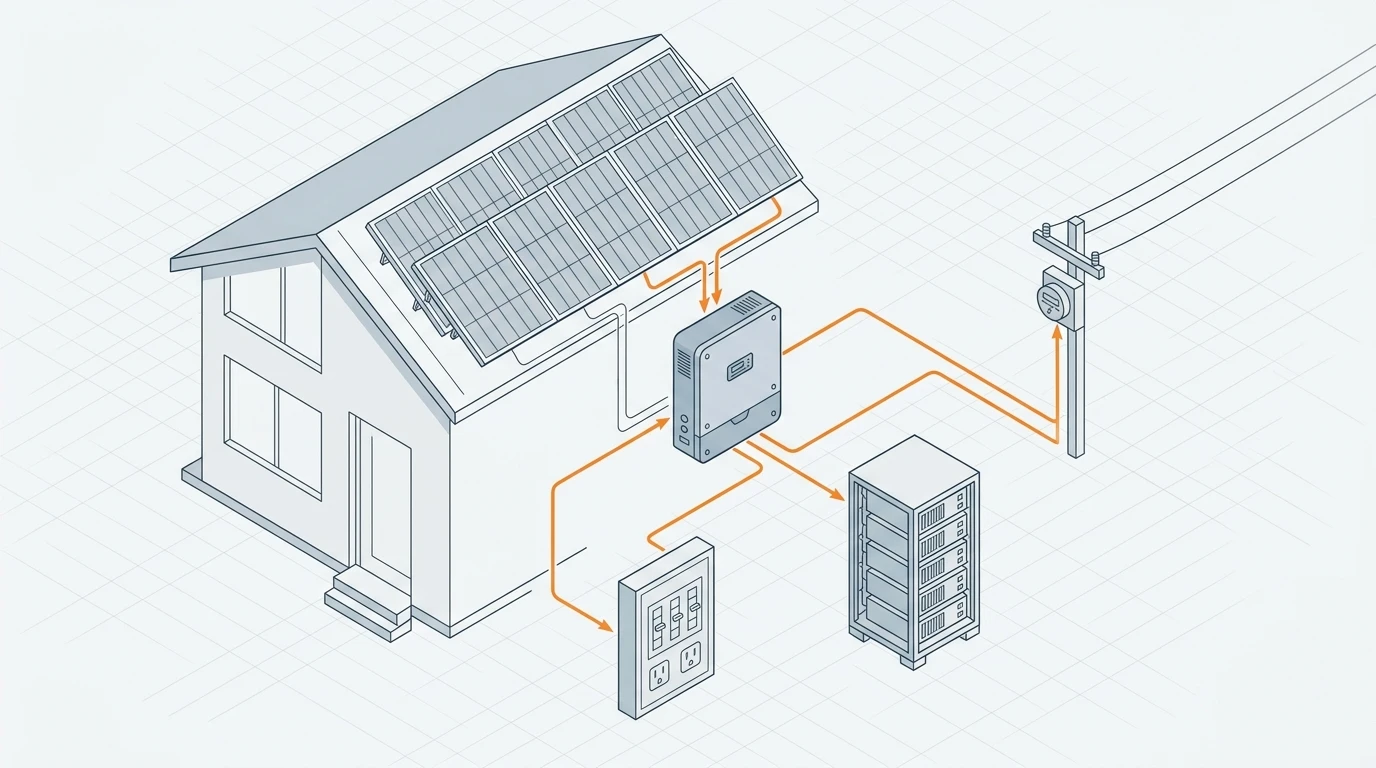
Image: the four power paths a hybrid inverter manages — PV, battery, loads, and grid.
One efficiency detail matters more than spec sheets suggest: because the battery charges directly from the DC side, the solar-to-battery path runs through a single conversion instead of two. Fewer conversions means fewer losses — the difference shows up in round-trip efficiency, typically several points higher than an AC-coupled battery charged from the same array.
A controller — inside the inverter or in a separate energy management system — decides when to charge, when to discharge, and how hard, based on the tariff, the state of charge, and, in commercial settings, the demand window the utility is measuring.
Hybrid Inverter vs Normal Inverter: What's the Difference?
"Normal inverter" is loose shorthand for a few things: a string inverter (one inverter per array, no battery), a microinverter (one per panel), or an off-grid inverter (designed to run without the grid). A hybrid inverter overlaps most with the string inverter — same central box, same AC output, but with battery ports and islanding built in.
Dimension | Normal (string) inverter | Hybrid inverter |
|---|---|---|
Battery connection | None (battery needs a separate inverter) | Built-in battery port, DC-coupled |
Grid dependency | Grid-tied only | Grid-tied, off-grid, or both |
Backup power | No | Yes, with automatic switchover |
Energy management | Export or curtail | Charge, discharge, and export scheduling |
Monitoring | Inverter only | Inverter + battery in one app |
Hardware cost | Lower | Higher (but replaces a second inverter) |
The practical difference is a trade-off: a hybrid inverter costs more than a string inverter alone, but it replaces the separate battery inverter you would otherwise buy — and it is the only way to get backup power from a single box. The comparison usually comes down to when you want the battery, not whether.
Do You Need a Hybrid Inverter to Add a Battery? AC vs DC Coupling
This is the question almost every solar owner asks: no — you do not need a hybrid inverter to add a battery. There are two legitimate paths.
AC-coupled retrofit. Keep your existing PV inverter and add a battery with its own inverter/charger on the AC side. This is the cheapest way to add storage to a working solar system — no roof or wiring work — at the cost of a second conversion step and a second device to manage. This is the configuration our AC coupling guide describes.
DC-coupled (hybrid). Replace the inverter with a hybrid unit and wire the battery on the DC side — the right choice for new installations, whole-home backup, and anyone who values higher DC-path efficiency. The two architectures are compared in detail in AC coupling vs DC coupling.
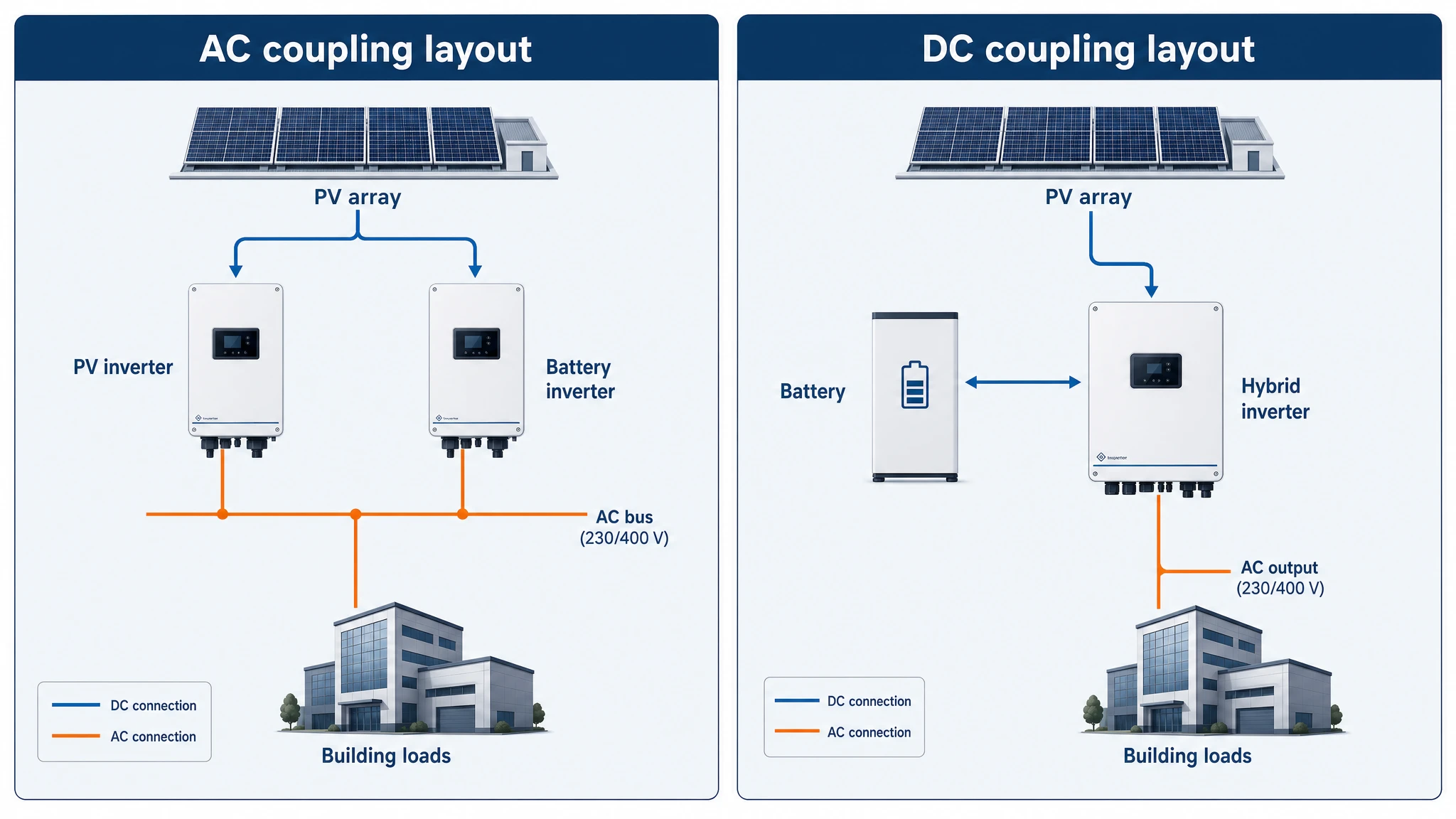
Image: the two ways to add a battery to a solar system.
Installer rule of thumb: if the existing inverter is under five years old and working well, an AC-coupled battery is usually the smarter retrofit; if you are designing from scratch — or you want backup power — a hybrid inverter belongs in the bill of materials.
Hybrid Inverter Pros and Cons: What Are the Downsides?
The strengths are easy to list: one box instead of two, simpler wiring, a single monitoring app, backup capability, and fewer conversion losses on the solar-to-battery path. For a new residential or light-commercial installation, it is the default recommendation for good reasons.
The downsides get less airtime, and they matter for budgeting:
- Higher upfront cost. More than a plain string inverter of the same size.
- Single point of failure. If the inverter fails, you lose solar and battery simultaneously. With separate units, one can keep working while the other is repaired.
- Replacement complexity. Swapping a hybrid unit means re-wiring battery communications and re-commissioning the system, not just unclipping a string inverter.
- Fixed sizing. Your battery port and MPPT capacity are what they are; expanding later may mean a bigger inverter, not just another module.
- Warranty terms vary widely. Compare them alongside price; battery and inverter portions are sometimes covered separately.
None of these are deal-breakers for most buyers — they are the trade-offs a distributor or installer should surface before the customer signs.
Hybrid Inverter Sizing: What to Check Before Buying
Sizing a hybrid inverter is not just watts. Run through this checklist before you commit:
- AC output power (kW). Should cover your largest expected load, or at least the loads you want on backup. Oversizing costs money; undersizing trips the breaker.
- Battery voltage compatibility. Most residential hybrids pair with 48V batteries, but high-voltage architectures exist. Match the inverter to the battery bank's nominal voltage — they are not interchangeable.
- MPPT inputs. Each tracker handles one roof orientation or string. Two trackers cost little more and give flexibility for east-west roofs or future expansion.
- Efficiency rating. Compare peak efficiency and European-weighted efficiency, not just the headline number.
- Certifications. In North America, look for UL 1741 listing and IEEE 1547 grid-code compliance; in Europe, IEC 62109 and the local grid codes. A listed inverter is the difference between passing inspection and re-engineering the design.
- Phase and voltage. US homes need 120/240 V split-phase; many imported units are single-phase only, which rules them out for whole-home US service.
- Warranty and local support. Check where the manufacturer services your region — a warranty that requires shipping a 30 kg unit overseas is worth less than it looks.
Battery-side ratings deserve the same scrutiny. Usable capacity depends on depth of discharge, and charge/discharge current is bounded by the battery's C-rate — two numbers that determine whether the inverter's rated power is actually reachable.
Hybrid Inverter Applications: Homes, Businesses and Microgrids
Residential is where hybrid inverters are most common: whole-home backup, higher self-consumption from a rooftop array, and participation in net-metering programs. The pattern is one hybrid inverter, one battery bank, and the house loads on the backed-up side of the panel.
Small commercial sites use the same architecture at larger scale — peak-demand shaving, backup for refrigeration or servers, and time-of-use arbitrage, with an energy management system shifting load against the tariff.
Off-grid and microgrid installations push hybrid inverters hardest: they must hold voltage and frequency on their own, synchronize a diesel generator, and manage battery state with no grid to fall back on — the territory covered by our hybrid microgrid energy storage solutions. This is also where EV charging and future expansion plug in, since the DC bus can grow with additional battery modules.
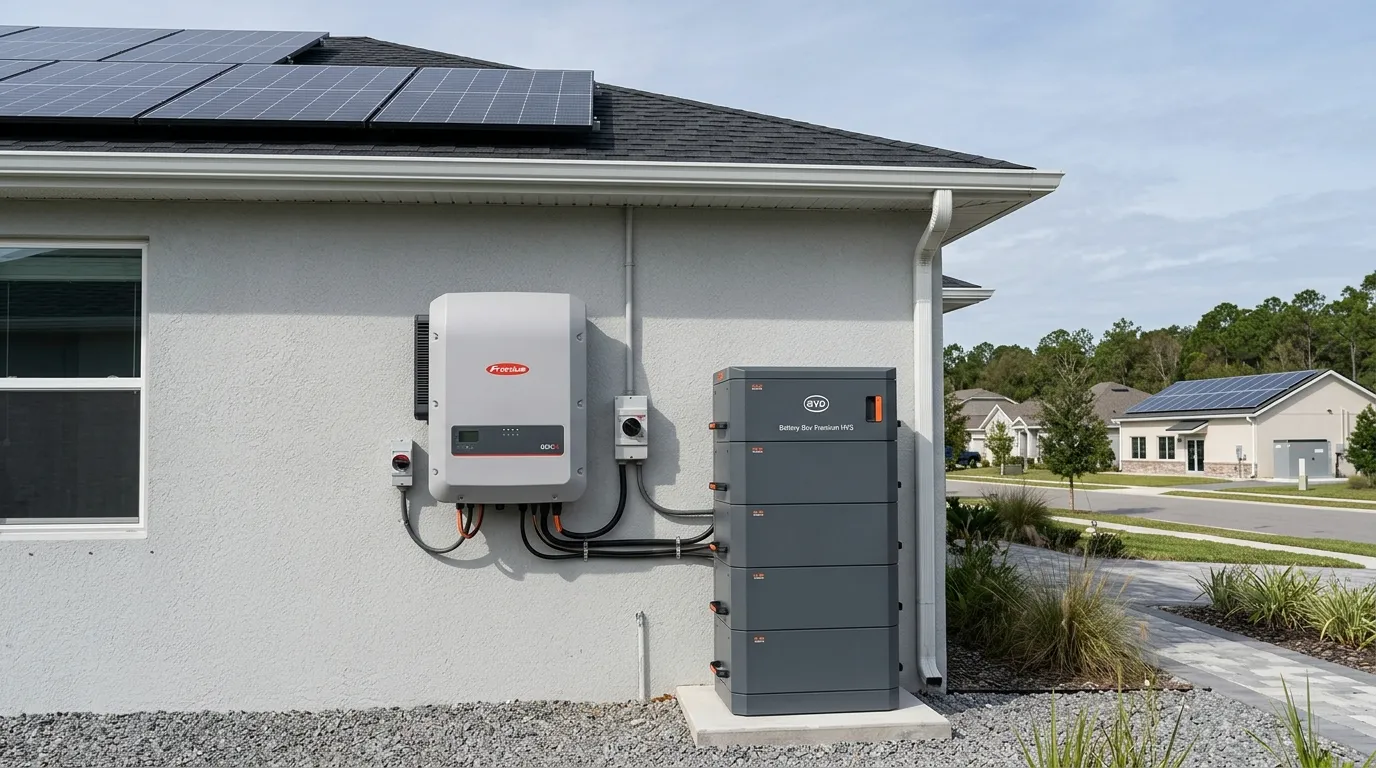
Image: hybrid inverter systems scale from whole-home backup to small commercial sites.
How Much Does a Hybrid Inverter Cost?
Hardware pricing depends on power rating, brand, certifications, and whether you buy retail or wholesale. As a market reference, retail listings for 48V split-phase hybrid inverters in the 7.6–12 kW class — the sizes that power a typical US home — run roughly $1,990–$3,150 at the time of writing, per SunGoldPower's current collection. Total installed cost is another matter: the battery bank usually costs as much as or more than the inverter, and labor and permits add on top.
For B2B buyers, the numbers that matter are on your own quote — wholesale pricing moves with volume, and certified multi-phase units carry a premium over single-phase imports. What rarely changes is the payback logic: the larger the gap between your import price and your feed-in or export rate, the faster self-consumption through a battery pays back. A hybrid inverter is rarely the cheapest box on the shelf; it is usually the cheapest way to get solar, battery, and backup into one system.
How Hua Power Implements Hybrid Inverter Technology
Hybrid architecture — solar input, battery, and power conversion managed as one system — is built into Hua Power's products in three places.
First, the PV + Battery ESS cabinets take the hybrid inverter idea to C&I scale: one outdoor enclosure integrating PV input, battery storage, MPPT, and PCS, from 30 kW to 500 kW and 64 kWh to 1.2 MWh. Because the solar battery storage system embeds the inverter instead of requiring an external solar inverter, a site gains solar coupling and battery management in one unit — with on-grid, off-grid, and hybrid modes switched automatically by the EMS. The containerized line takes the same approach, with PCS and BMS built in.
Second, for sites that already run a working PV inverter, Hua Power's AC-coupled cabinet (the HC-UPSA241, 105 kW / 241 kWh) connects to the AC side of the existing solar system — the retrofit path described earlier, letting a commercial site add storage without rewiring its DC side. The full energy storage cabinet range follows the same principle: flexible grid modes with seamless on/off-grid transfer.
Third, on the residential side, Hua Power's low-voltage and high-voltage LiFePO4 battery series are designed to pair with the leading hybrid inverter brands — Deye, Growatt, Victron, Solis, and more via CAN/RS485 — so an installer can build the exact hybrid system the site needs without forcing a battery-vendor lock-in.
Whatever the topology, the decision starts with the site: existing solar or new build, backup requirement, tariff structure. Hua Power's engineering team works through that checklist with distributors and integrators before proposing an equipment list — contact them with your project context and they will scope the configuration.