
What AC vs DC Coupling Actually Means in a BESS
In a battery energy storage system, "coupling" describes how the battery connects to the generation source — typically solar PV — and to the grid. The distinction is simpler than most articles make it sound.
Every solar panel produces DC electricity. Every battery stores DC electricity. The grid runs on AC. The question is: where do you put the inverter?
In AC coupling, you invert solar DC to AC immediately (at the PV inverter), run it through your AC switchgear, then invert it back to DC (at a dedicated battery inverter or PCS) to charge the battery. Three conversion steps: DC → AC → DC.
In DC coupling, solar DC flows through a charge controller or DC-DC converter straight into the battery on a shared DC bus. Only when the battery discharges to the grid or to AC loads do you invert once. Two conversion steps: DC → DC → AC — meaning just a single DC → AC inversion.
The difference in hardware is real. An AC-coupled system requires two separate inverters — a PV inverter and a battery inverter, or a PCS (power conversion system). A DC-coupled system can use a single hybrid inverter handling both solar and battery.
How AC-Coupled Storage Works
In an AC-coupled architecture, the battery and the PV array operate as independent subsystems connected through the facility's AC bus.
Here's the power flow: solar panels generate DC → PV inverter converts to AC → AC flows to switchgear → some goes to loads, surplus goes to the battery inverter → battery inverter (or PCS) converts AC back to DC → battery charges. When discharging, the battery inverter converts DC back to AC for loads or grid export.
Why would you choose this? Because it decouples generation from storage. You can source PV inverters from one manufacturer and battery inverters from another. You can add storage to an existing solar plant without touching the DC side — no rewiring of strings, no replacing the PV inverter. Both the solar and battery sides can draw from the grid independently, which matters for grid-charging applications and time-of-use arbitrage.
The trade-off is hardware count and conversion losses. Two inverters mean more equipment to maintain. Three conversion stages — DC (solar) → AC (inverter) → DC (battery inverter) — each step eats roughly 2–4% in semiconductor and transformer losses.
Our deep dive on AC coupling covers the architecture in more detail, including single-line diagrams and hardware selection criteria.
How DC-Coupled Storage Works
In DC-coupled systems, the solar array and battery share a common DC bus before the inverter.
The flow: solar DC → MPPT charge controller or DC-DC converter → DC bus → battery charges directly. When discharging, DC flows from the battery through the hybrid inverter, which converts to AC in one step for loads or grid export.
Why would you choose this? Because every conversion step you eliminate saves energy. At utility scale, shaving 4–8% off conversion losses translates to real money over a 15-year asset life. DC coupling also requires one inverter instead of two, which can lower upfront hardware costs — though the hybrid inverter itself is typically more expensive per kW than a standalone PV inverter.
DC coupling also enables black start capability in off-grid and microgrid applications — the battery can energize the DC bus and bring the system online without grid reference. This is critical for island-mode operations and remote mining or industrial sites.
The trade-off: DC coupling is harder to retrofit. Adding storage to an existing PV plant usually means replacing the PV inverter with a hybrid unit and rewiring strings, which adds labor cost and downtime.
Side-by-Side: AC vs DC Coupling at a Glance
Dimension | AC Coupling | DC Coupling |
|---|---|---|
Conversion stages | 3 (DC→AC→DC) | 2 (DC→DC→AC) |
Inverters required | 2 (PV inverter + battery inverter/PCS) | 1 (hybrid inverter) |
Round-trip efficiency | ~88–92% (extra conversion step) | ~92–96% (fewer conversions) |
Retrofit to existing PV | Easy — add battery inverter on AC side | Difficult — requires DC-side reconfiguration |
Grid charging | Yes — battery inverter charges from grid | Typically no — DC bus is PV-only |
Black start capable | Possible but complex (needs external reference) | Native in many hybrid inverters |
Multi-vendor flexibility | High — mix PV and battery brands | Lower — hybrid inverter ties both sides |
Best for | Retrofits, grid services, multi-vendor projects | New builds, efficiency-critical, off-grid |
Efficiency: The Real Numbers at System Scale
The efficiency debate deserves more nuance than "DC coupling is 4% more efficient." Here's what that actually means.
In AC coupling, three conversion stages at ~96% each compound to roughly 88.5% — but modern silicon carbide (SiC) and gallium nitride (GaN) power semiconductors in premium inverters push single-stage efficiency above 98%, yielding system-level round-trip figures closer to 94%. In DC coupling, two stages at similar per-stage efficiency land around 96%.
The gap is 2–4 percentage points, not the 8–10% that older literature sometimes claims.
But system-level efficiency isn't just conversion efficiency. It includes auxiliary consumption (cooling fans, BMS, EMS controllers), transformer losses, and self-discharge. A well-designed AC-coupled system with efficient transformers can close much of the gap. For a deeper look at how these losses compound, see our article on round-trip efficiency. The U.S. Department of Energy's energy storage program provides additional technical resources on BESS architecture and performance standards.
And there's a larger economic point that most residential content misses. At utility scale, the energy you'd "lose" through extra conversions during midday solar peaks is often energy you'd be clipping anyway — your PV array is oversized relative to your inverter capacity, and the marginal kWh during peak hours has near-zero value if you're hitting export limits. The efficiency argument matters most in capacity-constrained applications, not in oversupply scenarios.
When AC Coupling Wins
Choose AC coupling when:
- You're adding storage to an existing PV plant. This is the dominant use case for AC coupling. The PV side is already commissioned and operating. You don't want to touch the DC wiring. You add a battery container with its own PCS, tie it into the MV switchgear, and you're done.
- You need grid-charging flexibility. If your business case depends on charging batteries from the grid during off-peak hours and discharging during peak (time-of-use arbitrage), AC coupling is the natural choice — the battery inverter connects to the grid independently of PV generation.
- You want vendor independence. AC coupling lets you buy PV inverters from one supplier, batteries from another, and the PCS from a third. This matters for EPCs managing supply chain risk and for asset owners who want to avoid single-vendor lock-in.
- Your site has multiple generation sources. AC coupling makes it straightforward to combine solar, wind, diesel genesis, and grid connection on a common AC bus feeding a unified battery system.
When DC Coupling Wins
Choose DC coupling when:
- You're building a new solar-plus-storage plant from scratch. The efficiency advantage compounds over 15–20 years. The single-inverter architecture reduces points of failure and simplifies O&M. You can right-size the hybrid inverter for the combined DC capacity from day one.
- Every percentage point of efficiency matters. In markets with high electricity prices or limited solar resource, the 2–4% efficiency gain of DC coupling adds up. A 50 MW / 200 MWh system losing 2% less per cycle saves roughly 4 MWh per full cycle — that's ~1,460 MWh per year cycling daily.
- You need black start or island-mode capability. DC-coupled hybrid inverters can typically form a microgrid without grid reference. For remote industrial sites, mining operations, or island grids, this is a hard requirement.
- Footprint and equipment count are constrained. A single hybrid inverter replaces two separate units. In containerized BESS deployments where every square meter counts, this matters.
What About Hybrid Inverters?
The term "hybrid inverter" causes confusion. A hybrid inverter is fundamentally a DC-coupled device — it manages both solar DC input and battery DC charge/discharge on a shared DC bus, with a single AC output. But modern multi-port hybrid inverters also include an AC input for grid charging, essentially offering both AC and DC coupling in one unit.
This blurs the distinction. If your hybrid inverter accepts both DC solar input and AC grid input for battery charging, you're getting the efficiency of DC coupling with the grid-charging flexibility of AC coupling. The trade-off is higher hardware cost per kW and more complex EMS logic to manage the multiple power paths.
For C&I projects in the 100 kW to 5 MW range, hybrid inverters have become the default choice precisely because they deliver the best of both architectures.
Choosing the Right Architecture: A Decision Flow
If you're evaluating coupling architectures for a specific project, here's the decision sequence:
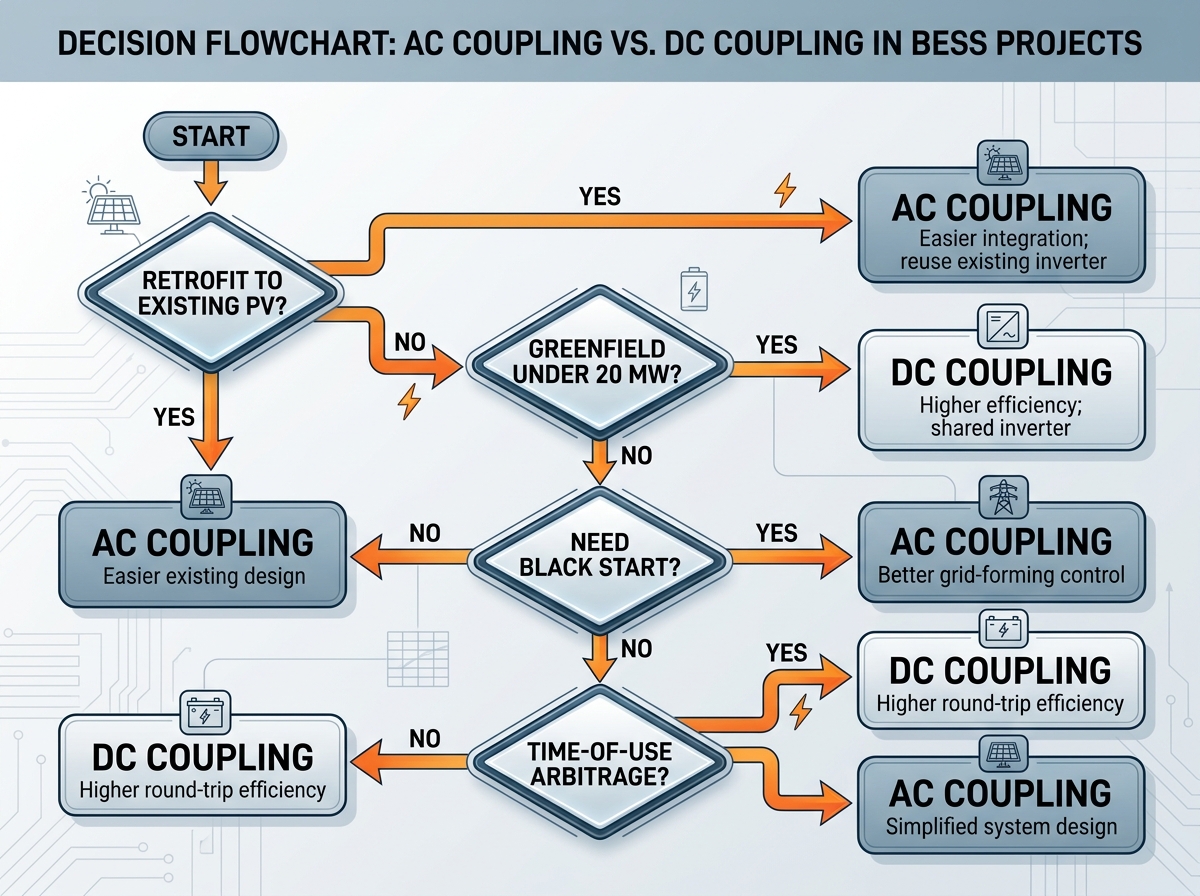
- Is this a retrofit to existing PV? → AC coupling is almost certainly the answer. The cost and downtime of reconfiguring existing DC wiring rarely justifies the efficiency gain.
- Is this a greenfield solar-plus-storage project under ~20 MW? → DC coupling with a hybrid inverter is the default choice. You get efficiency, simplicity, and the option of AC grid charging in most modern units.
- Is this utility-scale (>20 MW) with separate EPC contracts for PV and storage? → AC coupling gives you contractual and technical separation. The PV contractor commissions their scope. The storage contractor commissions theirs. They meet at the MV switchgear.
- Do you need black start or off-grid operation? → DC coupling or an AC-coupled system with grid-forming PCS. Verify the inverter's island-mode specification.
- Is your business case built on time-of-use arbitrage? → AC coupling's independent grid charging is simpler. Some DC-coupled hybrids can do this too — check the spec sheet.
How Hua Power Approaches System Architecture
At Hua Power, we manufacture both AC-coupled and DC-coupled BESS solutions because we've learned that the right architecture depends entirely on the project. Our containerized systems support AC coupling with dedicated PCS units for retrofit and multi-vendor projects. Our integrated cabinets use a DC-coupled hybrid architecture with optional AC grid-charging input for new-build C&I applications.
The pattern we see across hundreds of deployed megawatt-hours: project developers gravitate toward DC coupling for new construction and AC coupling for expansions. Neither architecture is going away. The skill isn't picking a side — it's knowing when to use each one.
For a deeper look at how your system's control architecture ties into coupling decisions, see our overview of the energy management system that orchestrates charge and discharge across both topologies.