

A high-voltage home battery system stores solar energy in a battery string that operates at 150–500 V DC instead of the 48 V DC used by traditional home batteries, which lets the same power flow through thinner cables with lower losses. This guide explains how these systems work, where they genuinely beat low-voltage designs, and how to decide — inverter first — whether one belongs in your house.
Solar batteries crossed a quiet divide in the last few years. The classic home battery ran at 48 V, the voltage of a golf cart. Today a large share of new residential storage ships as high-voltage systems — modular stacks of lithium cells wired in series to hundreds of volts. The shift is not a marketing fad: it changes cable sizes, inverter choices, efficiency, and how far you can expand the system later. It also changes the questions you should ask before you buy.
What is a high-voltage home battery system?
A high-voltage home battery is a residential energy storage system whose battery string operates well above the 48 V DC that older home batteries used, typically between 100 V and 500 V DC. The higher voltage is achieved by wiring battery modules in series — each module contains cells in a fixed series configuration, and stacking modules raises the string voltage step by step.
The Environmental and Energy Study Institute's energy storage explainer is one of many neutral references that describe the underlying concept: storage systems pair a DC battery with power electronics that convert stored energy into grid-compatible AC. In a high-voltage system, that conversion happens closer to the inverter, because the battery side already runs at a voltage the inverter can use directly. The practical consequences — thinner cables, smaller connectors, less conversion loss — follow from that single architectural choice.
Why does the voltage matter so much? Power is voltage times current. Deliver 5 kW at 48 V and you are moving roughly 104 A; deliver the same 5 kW at 400 V and you move roughly 12.5 A. Everything downstream of that difference — conductor size, breaker ratings, connector quality, and the resistive losses in every joint — scales with the current, not the power. That is the whole story of why high-voltage architecture exists for homes.
If you are new to the cell chemistry behind these systems, the lithium-ion family is worth a quick primer — nearly every high-voltage home battery today uses LiFePO₄ (lithium iron phosphate) cells, and our introduction to lithium-ion battery chemistry covers why that chemistry dominates stationary storage.
How a high-voltage battery is built: modules, voltage, and the DC bus
A high-voltage battery is assembled from identical modules that you stack and wire in series. Each module contains a fixed cell arrangement — for example, sixteen 3.2 V LiFePO₄ cells in a 1P16S configuration produce a 51.2 V module — and adding modules raises the system voltage in steps. A 20 kWh stackable system built on that module platform reaches roughly 172.8–460.8 V depending on how many modules are installed, which is representative of the current high-voltage residential class.
Three components do the heavy lifting in any high-voltage system:
- The battery management system (BMS) monitors every cell group for voltage, current, and temperature, balances the cells, and can disconnect the string if any parameter leaves its safe window. In a series string, the BMS is not optional — one weak cell affects the whole stack.
- The DC bus is the shared high-voltage rail between battery and inverter. Because the bus runs at hundreds of volts, wiring, fusing, and disconnects must be rated for that voltage class, and installation is typically done by a certified electrician.
- The inverter converts DC from the battery (and PV array) to AC for the home. High-voltage systems pair with hybrid inverters that accept a 100–500 V battery input directly, eliminating a DC-to-DC conversion stage that low-voltage designs need.
Lithium iron phosphate chemistry matters here because it makes the series architecture safe and durable. LiFePO₄ is thermally stable, tolerates thousands of cycles, and does not release oxygen under stress the way some other lithium chemistries can — Battery University's chemistry comparison explains the trade-offs between the main lithium-ion types. Long cycle life also matters for a stack you intend to expand: modules added later must match the existing string, and a chemistry with 6,000+ cycle ratings means the original modules are still healthy when you extend the system.
For a deeper look at the modular architecture itself — how stacking, parallel strings, and BMS coordination work in practice — see our modular high-voltage battery system breakdown.
High-voltage vs low-voltage home batteries: which fits your house
The honest answer is that both architectures store the same energy with the same cells; the difference is where you accept losses and how you pay for hardware. This table summarises the practical trade-offs:
Dimension | High-voltage (100–500 V) | Low-voltage (48 V) |
|---|---|---|
DC cable size | Small — 12.5 A at 5 kW, thin conductors | Large — 104 A at 5 kW, thick copper |
Inverter type | Hybrid HV inverter, direct battery input | LV inverter or added DC-DC converter |
Round-trip efficiency | Slightly higher, fewer conversion stages | Slightly lower, extra conversion in some setups |
Expansion path | Add modules to raise capacity in steps | Add parallel battery units or strings |
Installer requirements | High-voltage DC work, certified electrician | Simpler, sometimes DIY-friendly |
Typical use | Whole-home backup, large arrays, expansion plans | Small systems, retrofits, off-grid cabins |
The decision framework has three axes, and you should evaluate them in this order:
- Inverter platform first. If you already own (or are committed to) a specific inverter, its battery voltage range decides the architecture. A hybrid inverter that accepts 100–500 V battery input wants a high-voltage battery; a 48 V inverter wants a low-voltage battery. Trying to force a mismatch costs you a converter and its losses.
- Load profile second. Whole-home backup that must start air conditioning, heat pumps, or an EV charger draws high sustained power — exactly where high voltage's lower current helps. A small backup circuit for lights and electronics is fine at 48 V.
- Expansion plan third. If you expect to grow from 10 kWh to 30 kWh as you add solar or an EV, high-voltage modular stacking scales in place. If the system will never grow, the simplicity of 48 V has real appeal.
Most of the trade-offs above are covered in more depth across our residential energy storage hub, which collects the sizing, compatibility, and form-factor guides for home battery projects.
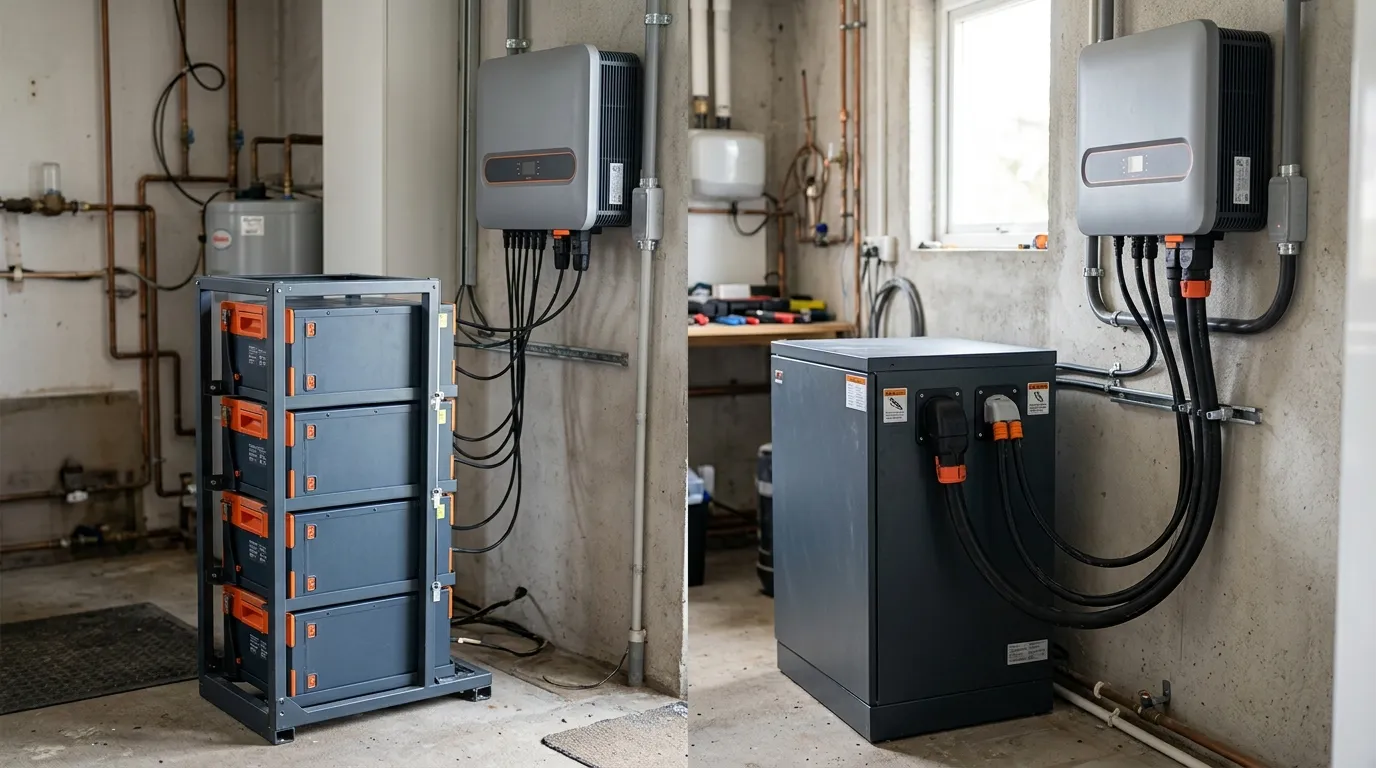
The same power flows through far thinner cables at high voltage — the most visible difference between the two architectures in a real installation.
Efficiency: where the claimed gains actually come from
"High voltage is more efficient" is the most repeated claim in this space, and unlike many marketing statements it has a concrete mechanism. Resistive loss in a conductor scales with the square of the current: P_loss = I²R. Halve the current and you cut the loss to a quarter. The numbers for a 5 kW draw make the point concrete:
Voltage | Current at 5 kW | Relative resistive loss (same conductor) |
|---|---|---|
48 V DC | ~104 A | 1 (baseline) |
200 V DC | ~25 A | ~1/16 |
400 V DC | ~12.5 A | ~1/64 |
At the same power, a 400 V string carries roughly an eighth of the current of a 48 V string. For a given loss budget, the conductor can be dramatically smaller — several size classes down — which is why high-voltage installations use visibly thinner battery cables.
There is a second, smaller gain on the conversion side. A low-voltage battery feeding a typical hybrid inverter needs its voltage boosted to the inverter's DC input range, an extra power-electronics stage that costs a few percent. A high-voltage battery feeds the inverter at close to its native input voltage, avoiding that stage. Combined with the cable savings, manufacturers quote round-trip efficiency — the share of energy that comes back out of the battery — in the high 80s to low 90s for modern systems, with high-voltage architectures posting slightly better numbers at high discharge rates.
The Union of Concerned Scientists' explanation of how energy storage works is a good neutral reference for the conversion and efficiency fundamentals if you want the system-level picture. The practical takeaway for a homeowner: efficiency differences between HV and LV are real but single-digit; they matter more for large daily throughput (whole-home backup, EV charging) than for a small emergency circuit.
Inverter compatibility: the constraint that decides everything
The single most common mistake in home battery projects is choosing the battery first and the inverter second. It should be the reverse. The inverter is the gateway: it defines the battery voltage range, the communication protocol, and the features you get (time-of-use shifting, backup switching, generator support, EV integration).
High-voltage batteries communicate with inverters over standard industrial buses — CAN and RS485 — and the current generation of hybrid inverters from the major solar brands accepts 100–500 V battery input. Most high-voltage battery manufacturers publish a compatibility list covering dozens of inverter models, and a well-designed stackable system is engineered to work across the main brands rather than locking you into one ecosystem. A useful rule of thumb: if your inverter's battery port accepts high voltage directly, buy a high-voltage battery; if it is 48 V, stay at 48 V unless you are willing to replace the inverter.
Compatibility also extends to monitoring. Modern systems expose state of charge, health, and per-module data through the inverter's app or the battery's own monitoring, and firmware updates keep the battery-inverter handshake current. For the full picture of what a residential battery needs to interoperate with, our residential battery energy storage solution page describes the inverter ecosystems and communication standards used in current home installations.
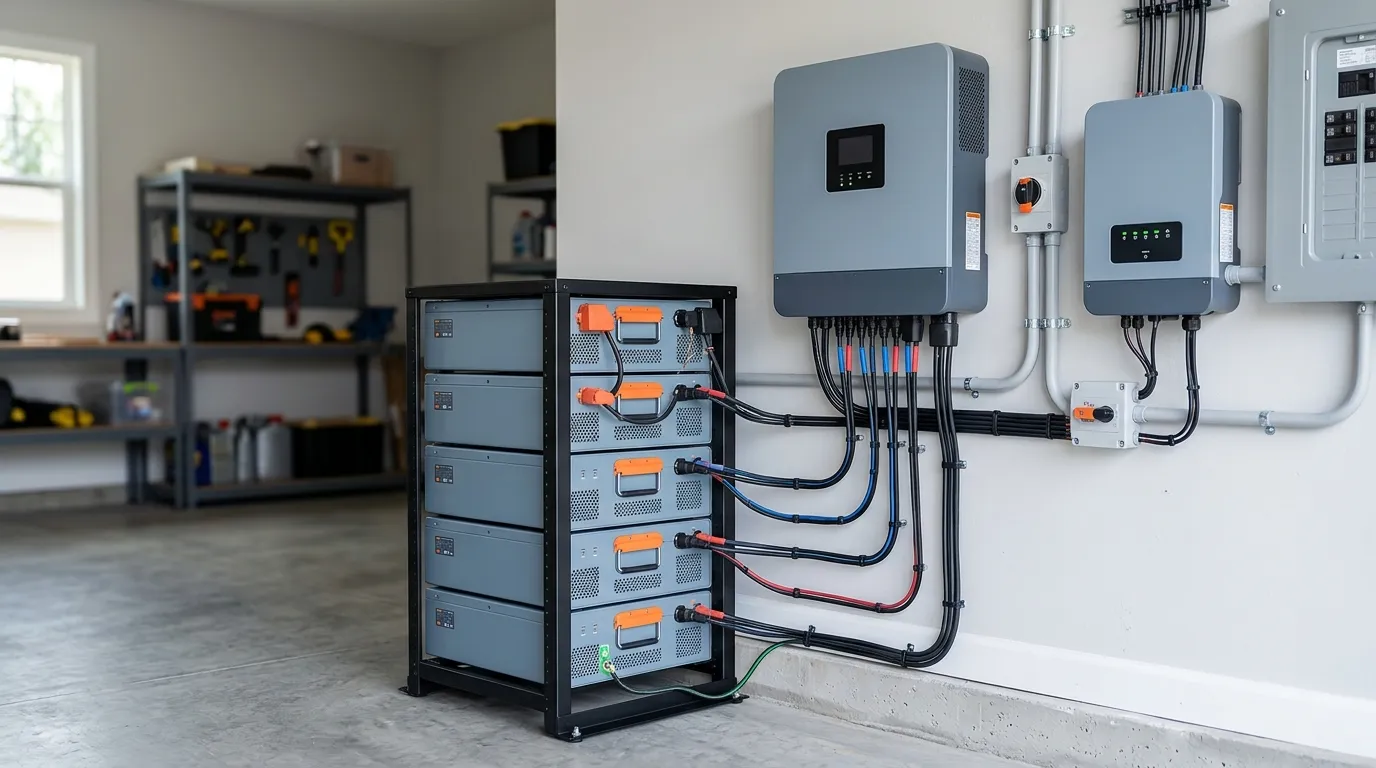
In a high-voltage system the battery feeds the hybrid inverter directly, which is why the inverter's battery voltage range decides the architecture.
Sizing and expanding a high-voltage system
Sizing a home battery is a load exercise, not a voltage exercise. You estimate the loads you want to cover — whole-home backup versus essential circuits — multiply by the hours you need them, and add a margin for days of cloudy weather if you are off-grid or want multi-day resilience. The voltage architecture does not change the arithmetic; it changes how granularly you can buy capacity.
That granularity is where high-voltage modular systems shine. Because capacity is added module by module on the same rack, a 10–20 kWh starting system can grow toward 40 kWh or more without replacing the inverter, the BMS, or the original modules. This is the strongest practical argument for high voltage in a home that will change: solar arrays grow, EVs arrive, and whole-home backup becomes more attractive as loads electrify.
If you are working through the numbers for your own house, our whole-home backup battery sizing guide walks through the load-inventory method step by step, and the battery capacity calculator on our site converts your load data into a first-pass kWh figure in minutes.
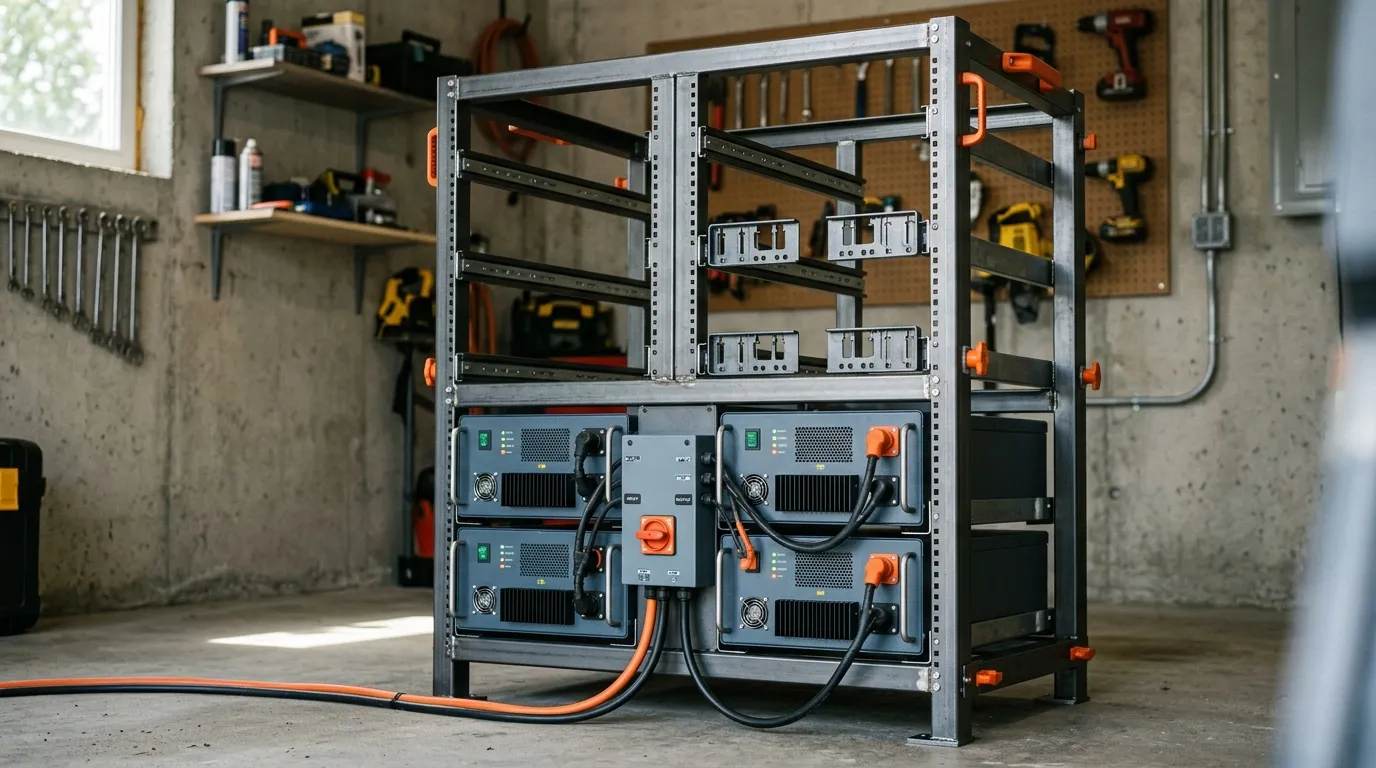
Capacity grows module by module on the same rack — the expansion path that makes high-voltage systems attractive for homes that will change.
Safety, standards, and what the certifications actually mean
A high-voltage DC string deserves respect, but the safety story of modern systems is a layered one, and the layers are what make residential high-voltage storage routine:
- Cell level. LiFePO₄ cells are inherently stable — they withstand overcharge, short circuit, and puncture far better than most lithium chemistries, and do not enter thermal runaway under normal fault conditions.
- Module and BMS level. The BMS continuously monitors cell voltage, current, and temperature, balances the pack, and disconnects the string on any out-of-range condition — this is the layer that makes a series string safe in a house. The BMS explainer in our knowledge base details how that protection is organised.
- System level. The assembled system — battery, inverter, and interconnects — is tested as a unit against UL 9540 in North America, with UL 1973 covering the stationary battery module itself, and IEC 62619 applying in international markets. These certifications cover thermal, electrical, and fire behaviour, including the DC arc and fault scenarios that are specific to high-voltage equipment.
Two installation details get less attention than they deserve. High-voltage systems must use components rated for the string voltage — including the enclosure and DC disconnects, which is why "high voltage battery enclosure" is a category of its own. And the inrush current at first connection, when the DC bus capacitors charge, is managed by pre-charge circuits inside the inverter or BMS; a correctly installed system handles it automatically, but it is why commissioning is a trained-electrician job.
For the authoritative view of what UL 9540 testing actually covers — thermal runaway containment, fire propagation, and system-level faults — the UL Solutions battery storage overview is the primary reference.
Stackable or wall-mounted: choosing the form factor
High-voltage residential batteries come in two main physical forms. Stackable systems are floor-standing racks of modules — the form that makes module-by-module expansion natural, and the dominant design for high-voltage storage precisely because stacking is how you raise voltage and capacity together. Wall-mounted units are fixed-capacity cabinets that hang on a wall, simpler to place in a garage or utility room, but typically not expandable beyond their shipped capacity.
The choice is mostly about space and growth. If floor space is available and expansion is likely, a stackable rack is the flexible option; if you want a fixed-size system tucked against a wall, a wall-mounted unit is cleaner. Our wall-mounted vs stackable battery comparison works through the placement, cost, and expansion trade-offs in detail.
What a high-voltage home battery costs in 2026
Pricing for high-voltage residential storage follows the same curve as the rest of the battery industry: falling hardware costs, with the installed price dominated by the battery, the inverter, and installation labour. The SEIA energy storage initiative tracks deployment and market context for the U.S. storage market, and Lazard's levelized cost of storage analysis documents the long-term decline in storage costs — the same forces that pushed lithium battery packs to historic lows over the past decade.
A realistic planning range for a complete installed high-voltage home system in 2026 is roughly $800–1,300 per kWh of usable capacity before incentives, depending on system size, inverter brand, and installation complexity — smaller systems sit at the top of the range because fixed costs spread over fewer kWh. Three cost levers are worth knowing:
- Depth of discharge (DoD). High-voltage residential batteries typically spec 90% usable DoD (some reach higher). Two systems with the same rated kWh can differ meaningfully in usable energy — compare usable kWh, not rated kWh, when pricing.
- Cycle life. LiFePO₄ systems rated for 6,000–8,000+ cycles translate to 16–22+ years at one cycle per day, which is what makes the per-kWh-cost-over-life calculation far more favourable than the sticker price suggests.
- Expansion cost. Because modular high-voltage systems grow in place, the second and third capacity steps are cheaper per kWh than the first — the inverter and rack are already paid for.
When you compare quotes, ask for usable kWh, the DoD assumption, and the cycle-life warranty in one line. Vendors that quote all three are comparing apples to apples; the stackable high-voltage product lines from manufacturers such as ours — the high-voltage energy storage system family runs 20–40 kWh on a single platform — exist precisely because expansion economics matter to homeowners.
When low voltage is still the right choice
For all the advantages of high voltage, low-voltage 48 V systems remain the right answer in a few situations. Small systems under about 10 kWh rarely benefit from the efficiency and cabling gains. Off-grid cabins and DIY builds often prefer 48 V because components are cheaper, more forgiving, and well documented by a huge community. And if your existing inverter is 48 V and you are not ready to replace it, adding a low-voltage battery is almost always the more sensible retrofit than forcing a voltage change.
The retrofit case deserves a special note: coupling a new battery to existing solar hardware is a separate decision from the voltage choice, and getting the coupling wrong quietly costs efficiency. Our guide to AC-coupled and DC-coupled solar retrofits covers when each coupling method fits.
FAQ
Is a high-voltage home battery safe?
Yes, when the system is certified and installed correctly. Modern high-voltage systems are tested as complete units to UL 9540 (North America) or IEC 62619 (international), use thermally stable LiFePO₄ cells, and are protected by a multi-layer BMS that monitors cell voltage, current, and temperature. Installation by a certified electrician is the remaining requirement — high-voltage DC work is not a DIY job.
What voltage do high-voltage home batteries run at?
Most residential high-voltage systems operate in the 100–500 V DC range, with many current platforms spanning roughly 150–460 V depending on how many modules are stacked. The exact voltage depends on the module cell configuration and the number of modules in the string.
Can I add modules to a high-voltage battery later?
With a modular stackable system, yes — that is the core design advantage. You add modules to the same rack and the BMS and inverter recognise the larger capacity. Expansion steps are typically cheaper per kWh than the initial install because the inverter and infrastructure are already in place. Check with the manufacturer that your specific model supports field expansion and that the firmware is updated.
How long do high-voltage home batteries last?
LiFePO₄-based systems are typically rated for 6,000–8,000+ cycles at 80% state of health — at one cycle per day, that is 16–22+ years of service. Warranties usually cover 10 years or a defined throughput, whichever comes first; the cycle-life rating matters more than the calendar warranty for daily-cycling whole-home systems.
Do I need a new inverter for a high-voltage battery?
You need an inverter whose battery input accepts high voltage — most current hybrid inverters from major solar brands do. If your existing inverter is a 48 V unit, adding a high-voltage battery means replacing it or adding a converter, which is usually not worth it.
High-voltage or low-voltage — which is cheaper?
Installed cost per usable kWh is comparable in 2026, with low-voltage slightly cheaper for small systems and high-voltage pulling ahead as systems grow, because expansion is cheaper and efficiency losses are lower at high throughput. Compare usable kWh and cycle-life warranty, not sticker price.
Next steps: choosing your system with confidence
Decide in this order: fix your inverter platform, define the loads you must cover, decide how much you expect to grow, and only then pick the battery architecture and size. For most whole-home projects in 2026, that sequence lands on a high-voltage modular system; for small, static, or 48 V-compatible setups, low voltage is the honest answer.
If you want a second pair of eyes on the numbers, our engineers work with homeowners and installers on exactly this decision — contact the team with your inverter model and load list and we will tell you which architecture fits.