

A lithium-ion battery is a rechargeable energy storage device that moves lithium ions between a positive cathode and a negative anode through an electrolyte. It delivers high energy density, long cycle life, and low self-discharge — making it the dominant chemistry in everything from smartphones to grid-scale energy storage systems.
What Is a Lithium-Ion Battery?
A lithium-ion battery stores and releases electrical energy through the reversible movement of lithium ions between two electrodes. When you charge the battery, lithium ions travel from the cathode to the anode and embed themselves there — a process called intercalation. During discharge, the ions flow back, releasing electrons that power your device or system.
This principle earned John B. Goodenough, M. Stanley Whittingham, and Akira Yoshino the 2019 Nobel Prize in Chemistry — a recognition that lithium-ion technology "created a rechargeable world."
Unlike disposable alkaline batteries, lithium-ion cells can be recharged hundreds to thousands of times. And unlike older rechargeable chemistries like nickel-cadmium, they don't suffer from memory effect — you can top them up at any state of charge without degrading capacity.
The Four Core Components
Every lithium-ion cell — whether it powers an EV, a phone, or a 5 MWh containerized BESS — contains four essential components that work together as a system.
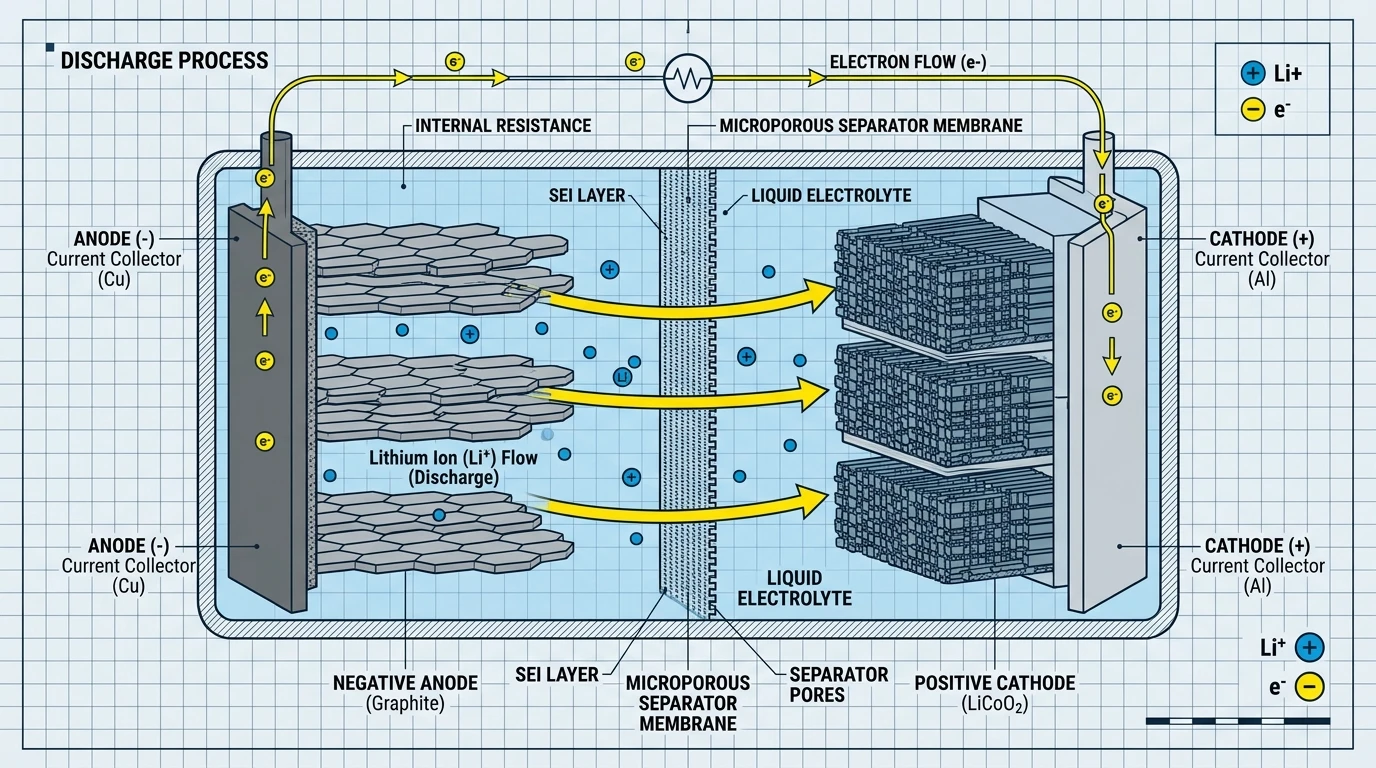
Cathode (positive electrode). The cathode is a lithium metal oxide — most commonly lithium cobalt oxide (LCO) in consumer electronics, or lithium iron phosphate (LiFePO₄ / LFP) and nickel manganese cobalt (NMC) in energy storage and EVs. The cathode determines the cell's voltage, capacity, and much of its safety profile.
Anode (negative electrode). Almost all commercial lithium-ion cells use graphite as the anode material. During charging, lithium ions intercalate between the graphite layers — a reversible structural storage mechanism that gives lithium-ion its long cycle life. Silicon anodes are an emerging alternative that promise higher capacity but face cycle-life challenges.
Electrolyte. A lithium salt (typically LiPF₆) dissolved in an organic solvent. The electrolyte is the medium through which lithium ions travel. It must be ionically conductive (to let ions pass) but electrically insulating (to force electrons through the external circuit, where they do useful work).
Separator. A thin, microporous polymer membrane between the cathode and anode. It physically prevents the electrodes from touching — which would cause a short circuit and potentially thermal runaway — while allowing lithium ions to pass through. Separator integrity is one of the most critical safety factors in battery design.
How Lithium-Ion Batteries Work
The working principle is elegantly simple: lithium ions shuttle back and forth.
During discharge: Lithium ions move from the anode (where they were stored), through the electrolyte, to the cathode. Simultaneously, electrons travel through the external circuit — powering whatever is connected to the battery. The cathode material absorbs the returning lithium ions.
During charging: An external voltage forces lithium ions out of the cathode, back through the electrolyte, and into the graphite anode. The electrons follow through the charging circuit.
This "rocking chair" mechanism is why lithium-ion cells maintain their structure through thousands of cycles — the electrodes act as hosts, not as reactants that get consumed. Degradation happens gradually through side reactions (electrolyte decomposition, SEI layer growth) rather than fundamental structural failure.
Key Performance Parameters
If you're evaluating lithium-ion batteries for a project — whether a commercial solar-plus-storage installation, a data center UPS, or a residential backup system — these five parameters define real-world performance.
C-rate. The rate at which a battery charges or discharges relative to its capacity. A 1C rate means the battery fully charges or discharges in one hour. A 0.5C rate takes two hours. Higher C-rates deliver more power but generate more heat and may reduce cycle life. For energy storage applications, 0.25C to 0.5C is typical — you're optimizing for energy capacity, not burst power.
Depth of Discharge (DoD). How much of the battery's capacity you use before recharging. A battery discharged to 80% DoD has 20% capacity remaining. Lithium-ion batteries typically tolerate 80-90% DoD without significant degradation, a major advantage over lead-acid (which shouldn't regularly exceed 50% DoD to maintain lifespan).
Cycle life. The number of complete charge-discharge cycles a battery can deliver before its capacity drops below 80% of the original rating. LiFePO₄ cells commonly achieve 4,000–6,000 cycles at 80% DoD. NMC cells typically deliver 2,000–4,000 cycles. This directly translates to years of service life — a LiFePO₄ battery cycling once daily at 80% DoD can last 10–15 years.
State of Health (SoH). The battery's current maximum capacity as a percentage of its original rated capacity. A battery at 85% SoH can only store 85 kWh even if its nameplate says 100 kWh. SoH declines gradually over a battery's life and is a key metric for warranty claims and replacement planning.
Round-trip efficiency (RTE). The ratio of energy you get out to energy you put in, expressed as a percentage. Lithium-ion systems typically achieve 90–95% RTE — meaning for every 100 kWh you charge, you get 90–95 kWh back. Lead-acid systems typically manage only 70–85%. That 10–20 point gap compounds with every cycle and is a primary reason lithium-ion dominates energy storage economics.
Lithium-Ion vs Lead-Acid: What's the Difference?
The question "how is a lithium-ion battery different from a regular battery" is the most common follow-up query — and for good reason. Lead-acid batteries have been the workhorse of backup power for decades. Here's how they compare:
Parameter | Lithium-Ion (LiFePO₄) | Lead-Acid |
|---|---|---|
Energy density | 90–160 Wh/kg | 30–50 Wh/kg |
Cycle life (80% DoD) | 4,000–6,000 | 300–600 |
Depth of discharge (daily) | 80–90% | 50% (recommended) |
Round-trip efficiency | 90–95% | 70–85% |
Weight (per kWh) | 6–11 kg | 22–30 kg |
Maintenance | None | Periodic watering (flooded) |
Upfront cost | Higher | Lower |
Lifetime cost per kWh cycled | Lower | Higher |
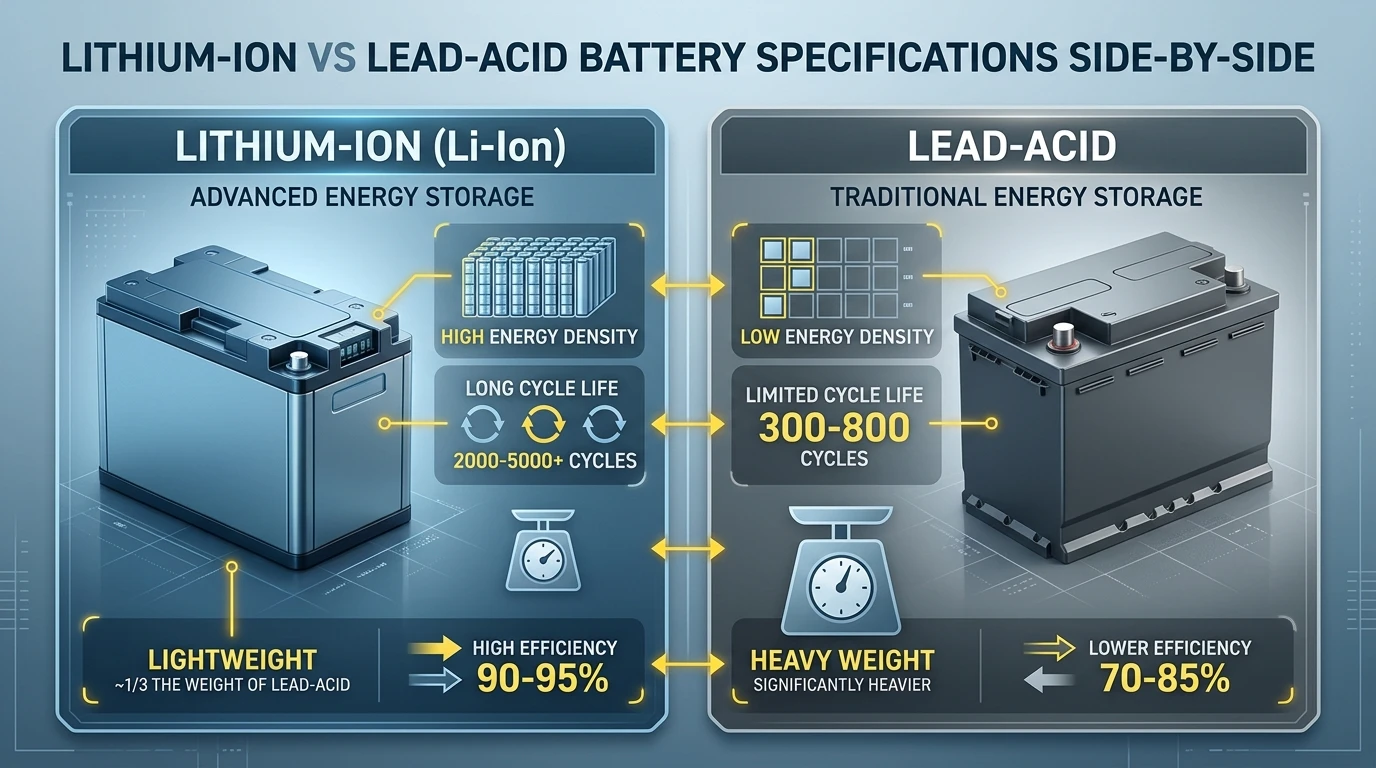
Lithium-ion wins on nearly every technical metric. Lead-acid's only remaining advantage is lower upfront cost — and even that disappears when you calculate lifetime cost per kilowatt-hour cycled. For more on how these two chemistries compare in real-world energy storage applications, see our guide on C-rate selection for commercial BESS, where we cover how discharge rates affect battery sizing decisions.
Common Lithium-Ion Chemistries
Not all lithium-ion batteries are the same. The cathode material defines the chemistry — and the performance characteristics:
- LCO (Lithium Cobalt Oxide). High energy density, used in smartphones and laptops. Relatively short lifespan and lower thermal stability. Rarely used in stationary energy storage.
- NMC (Nickel Manganese Cobalt). Balanced energy density, power output, and lifespan. Common in EVs and some BESS applications. The "workhorse" chemistry for mobility.
- LFP / LiFePO₄ (Lithium Iron Phosphate). Lower energy density than NMC, but superior thermal stability, longer cycle life, and cobalt-free (lower cost, fewer supply-chain concerns). The dominant choice for stationary energy storage — from residential wall-mounted units to utility-scale containers. Learn more in our LiFePO₄ (LFP) reference.
Safety note: LFP's strong phosphate-oxygen bond makes it far more resistant to thermal runaway than cobalt-based chemistries. This is why LFP has become the standard for indoor and building-attached storage installations.
Applications Beyond Consumer Electronics
Search results for "what is a lithium-ion battery" overwhelmingly focus on phones, laptops, and EVs. But lithium-ion's largest growth sector is stationary energy storage:
- Commercial & Industrial (C&I) storage. Peak shaving, demand charge reduction, and backup power for factories, warehouses, and commercial buildings. Systems range from 50 kWh to 500 kWh and often pair with rooftop solar.
- Utility-scale storage. Containerized BESS units at 1–5 MWh scale providing grid frequency regulation, renewable energy time-shifting, and capacity firming. The global installed base of grid-scale batteries grew significantly in recent years — the IEA reported that battery storage deployments are accelerating as costs continue to fall and renewable penetration rises.
- Residential storage. Home battery systems (5–16 kWh) paired with rooftop solar for self-consumption and backup. Adoption is accelerating in markets with time-of-use rates and feed-in tariff phase-outs.
- Data center UPS. Lithium-ion is rapidly replacing lead-acid in uninterruptible power supplies due to smaller footprint, longer lifespan, and lower cooling requirements.
If you're evaluating energy storage for any of these applications, understanding these battery fundamentals is step one. From there, specific parameters like Depth of Discharge and battery management systems become the factors that separate a well-designed system from one that underperforms. Explore the rest of the Battery Energy Storage Basics hub for more fundamentals guides.