

Here is the short version of the high voltage vs low voltage home battery question: your inverter decides the voltage class, not the marketing. Choose a high-voltage (HV) home battery — roughly 150–500 V DC — when you run a hybrid inverter with a high-voltage battery input, need whole-home backup with high surge loads, or plan to expand beyond ~15 kWh. Choose a low-voltage (LV) 48 V battery when you have an existing 48 V inverter, want a simpler retrofit or DIY-friendly install, or plan to grow the system by adding parallel units.
This guide comes from the engineering team at Hua Power, a battery manufacturer that builds residential storage in both voltage classes — which is exactly why we want you to pick the architecture that fits your house, not the one with the louder brochure. Below we compare the two classes across efficiency, cost, safety, and installation, then give you a four-step checklist you can actually work through. If you already read our high-voltage home battery systems overview, this article is the deeper "which to choose" comparison; if you are starting from scratch, both pages together give you the full picture.
What counts as high voltage vs low voltage?
The word "voltage" causes most of the confusion here, because people mix up three different numbers: the battery's DC voltage, the inverter's DC input range, and the AC mains voltage in your wall.
- Low-voltage (LV) batteries run at 12 V, 24 V, or 48 V nominal. Almost every modern LV home battery is a "48 V" unit — 16 LiFePO₄ cells in series give 51.2 V nominal. This is the classic golf-cart-voltage class that dominated residential storage for a decade.
- High-voltage (HV) batteries run from roughly 100 V up to 500 V DC. Most residential HV systems operate in the 150–400 V band; some newer modular stacks reach 400–500 V by wiring multiple modules in series. (800 V is a commercial and EV class — if a home product quotes 800 V, question it.)
- Your wall outlet runs on 120 V or 240 V AC. That is a completely different voltage class — AC distribution voltage — and "Is 240V considered high voltage?" is one of the most common search questions around batteries. For a homeowner the relevant line is the DC one: 60 V DC is the threshold above which most electrical codes treat a circuit as hazardous, which is why 48 V batteries can be worked on more casually and HV batteries cannot.
So when someone says "high voltage battery," they mean the battery string's DC voltage, not your wall supply. A 240 V AC circuit and a 400 V DC battery are both "higher than 48 V," but they live in different parts of the system and obey different rules.
How the two architectures actually work
Power is voltage times current. Deliver 5 kW at 48 V and you are moving roughly 104 A; deliver the same 5 kW at 400 V and you move roughly 12.5 A. Every component downstream — cable cross-section, breaker ratings, connectors, and the resistive losses in every joint — scales with current, not power. That single equation explains the entire design difference between the two classes.
A low-voltage system typically wires battery units in parallel and relies on the inverter (or a DC-DC converter) to step the battery voltage up to what the inverter needs. That extra conversion stage costs a little efficiency, and high currents mean thicker copper and more loss in long cable runs — but each battery unit stays small, cheap, and safe to handle.
A high-voltage system wires modules in series so the battery string lands inside the hybrid inverter's direct input window (commonly 150–500 V). No DC-DC conversion between battery and inverter, thinner cables, lower losses. The trade is that every module in the series string is now part of a hazardous-voltage circuit: the battery management system (BMS) has to be strict, the installer has to be certified, and modules must match the string exactly. The Environmental and Energy Study Institute's energy storage explainer covers the underlying concept — battery plus power electronics converting DC to grid-compatible AC — if you want the neutral fundamentals first.
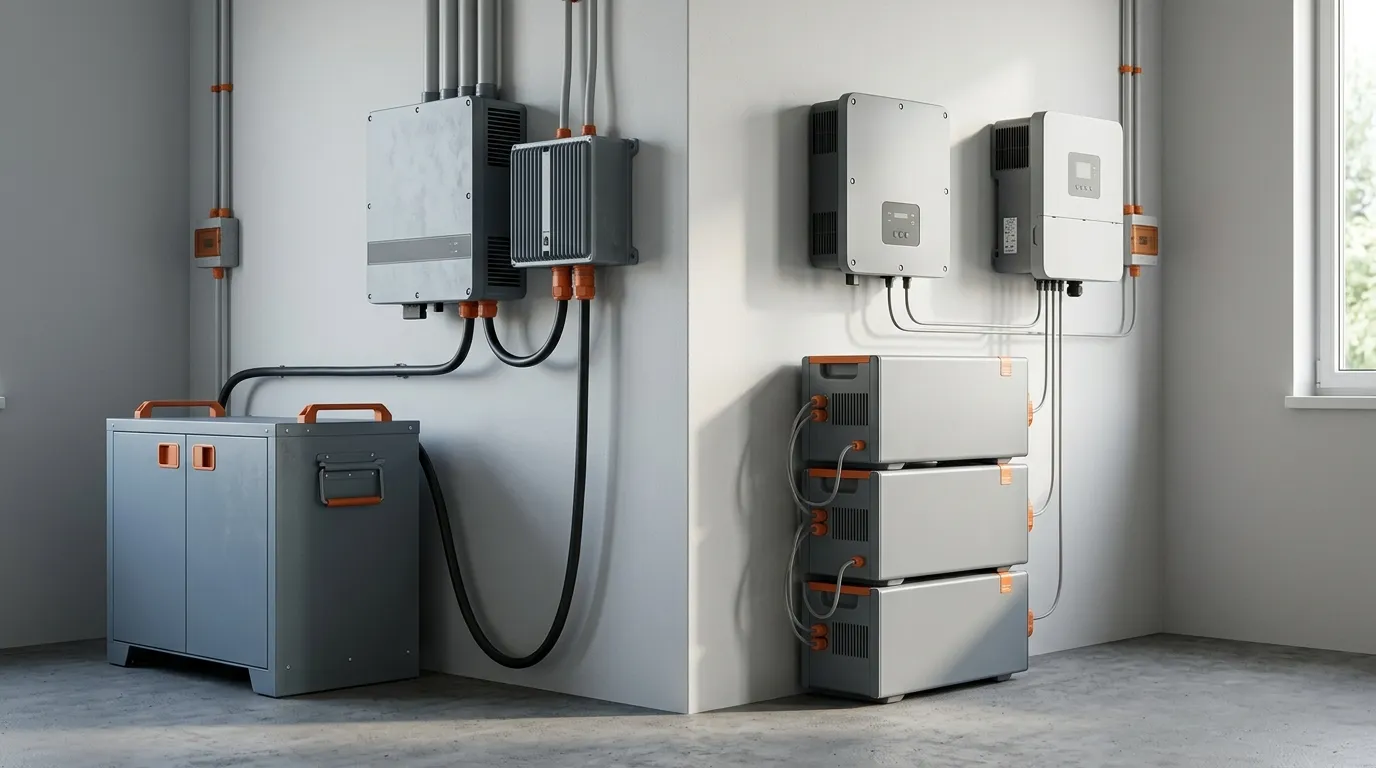
Above: the same house, two architectures — LV moves power with thick cable and an extra conversion box; HV wires modules in series straight into the hybrid inverter.
One more distinction worth naming: both classes can be AC-coupled or DC-coupled to your solar array. Voltage class and coupling topology are separate decisions. We cover that in detail in our AC vs DC coupled solar retrofit guide.
At a glance: HV vs LV home battery comparison
Dimension | High voltage (150–500 V DC) | Low voltage (48 V / 51.2 V DC) |
|---|---|---|
Battery string | Modules wired in series, single string | Units wired in parallel |
Typical inverter | Hybrid inverter with HV battery input (no DC-DC) | LV inverter, or LV battery + DC-DC converter |
Round-trip efficiency | Slightly higher — fewer conversion stages | Slightly lower in setups that need a DC-DC stage |
Cables & install | Thin conductors, but hazardous-voltage DC work by a certified electrician | Thick copper, but simpler and sometimes DIY-friendly |
Expansion | Add modules in series (same family required) | Add parallel units (brand/chemistry must match) |
Failure behavior | One weak module affects the whole string | A failed parallel unit can be isolated, system keeps running |
Upfront cost | Higher per kWh at small sizes | Lower per kWh at small sizes |
Best fit | Whole-home backup, heat pumps, EV charging, 15 kWh+ | Small systems, retrofits, off-grid cabins, phased growth |
Where high-voltage batteries genuinely win
Efficiency. With the battery feeding the inverter directly, an HV system skips one conversion stage. Real-world round-trip efficiency for quality LiFePO₄ systems lands in the mid-90s percent; the gap between a good HV and a good LV setup is usually a few points at most, and it shows up most when the battery is doing a lot of heavy cycling. If your system cycles daily, those few points compound into real money over ten years.
High sustained and surge loads. Starting a heat pump or air conditioner, charging an EV, or running a whole-home backup draws power in bursts. At 48 V, a 10 kW burst means 208 A — big cables, big breakers, and converter stress. At 400 V the same burst is 25 A, which is why whole-home backup designs converge on HV.
Expansion in a small footprint. Adding modules in series raises capacity without multiplying cable runs or parallel branches. A 20 kWh stack can grow toward 30+ kWh in the same wall space. For an installer, one serial string is also fewer failure points than four parallel cabinets.
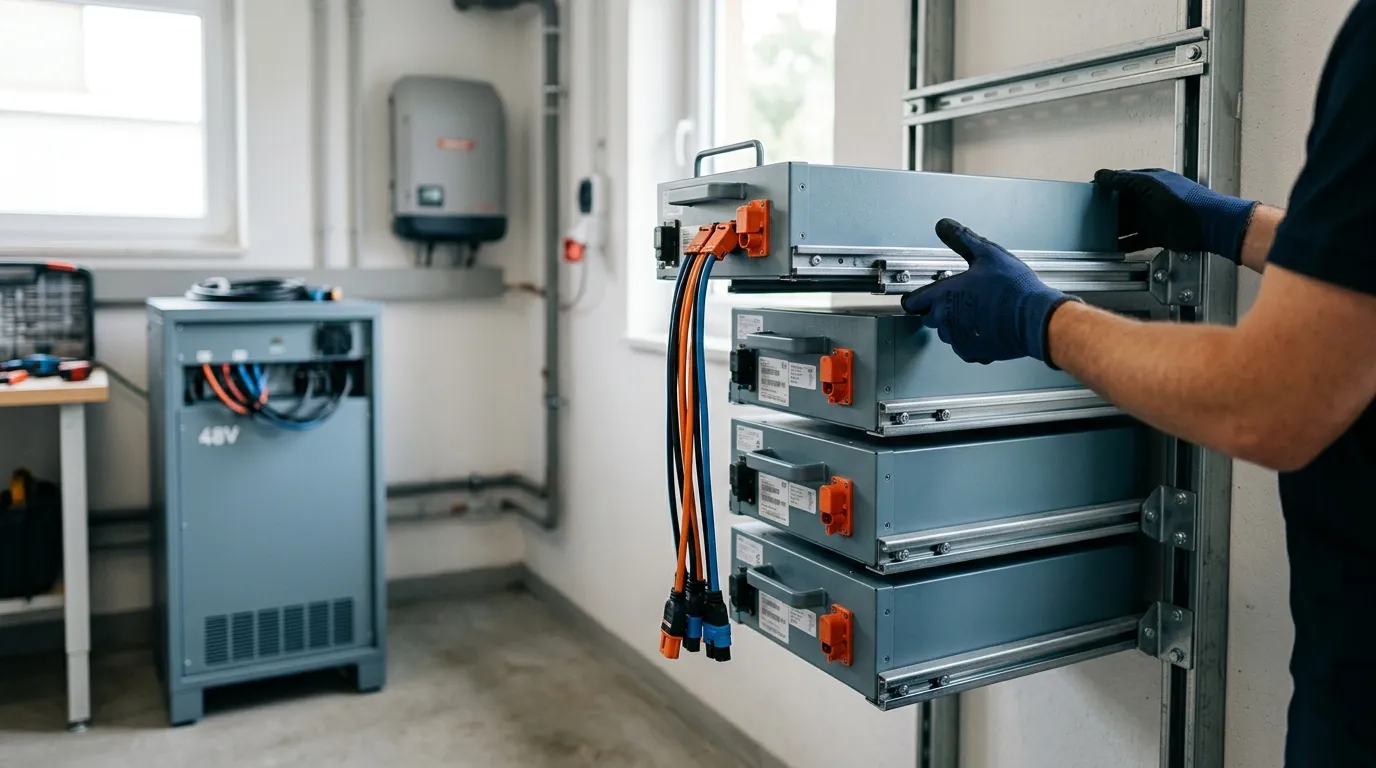
Above: module-by-module growth is the high-voltage expansion path — same rack, same footprint, more kWh.
Cable and materials savings. Thinner conductors, smaller conduits, and lighter connectors matter most in retrofit situations where conduit paths are already tight.
Where low-voltage batteries genuinely win
Installation access. Below 60 V DC, the work is dramatically more forgiving. Many 48 V systems are installed by solar companies without high-voltage DC endorsements, and enthusiasts genuinely do self-installs (with local code permission). HV systems require a certified electrician comfortable with hazardous-voltage DC — that can mean higher labor cost and longer lead times in some regions.
Upfront cost at small sizes. A 5–10 kWh 48 V cabinet is typically cheaper per kWh than a comparable HV stack, because the HV architecture's series modules, stricter BMS, and high-voltage isolation hardware cost money that only amortizes at larger capacities. If you need 10 kWh and will never need 30, LV often wins on price.
Fault isolation and phased growth. With parallel units, one unit can be taken offline for service while the rest keep working — and you can add a second unit later without touching the first one's internals. With a series string, one weak module drags the whole string down and every addition must match the existing modules exactly.
Existing-inverter compatibility. If your house already has a 48 V inverter (common in older solar retrofits, RVs, and off-grid setups), the battery decision is already made for you: an LV battery is the only drop-in choice.
Cost: what the numbers actually say
Almost every comparison article on this topic says "HV is more expensive, LV is cheaper" and stops there. The picture is more useful than that.
Installed home battery pricing varies a lot by region and installer, but there are solid anchor numbers. SolarReviews' 2025 battery cost comparison puts the industry average at about $855 per kWh (before installation and labor), with most systems between $550 and $995 per kWh; installed, a typical home system runs $12,000–$20,000+ — see their battery buying guide. Add installation and permits and the practical band works out to roughly $1,000–$2,000+ per usable kWh in the US as of 2025–2026. Within that band, the pattern that matters is:
- Small systems (≤10 kWh): LV is usually cheaper per kWh. You are buying one simple cabinet.
- Mid-size (10–20 kWh): The classes converge. An HV stack's per-kWh cost falls as you add modules; an LV setup needs more parallel units, each with its own BMS and wiring.
- Large (20+ kWh) and whole-home: HV tends to come out ahead on both hardware and labor, because one serial string replaces multiple parallel cabinets and cable runs shrink.
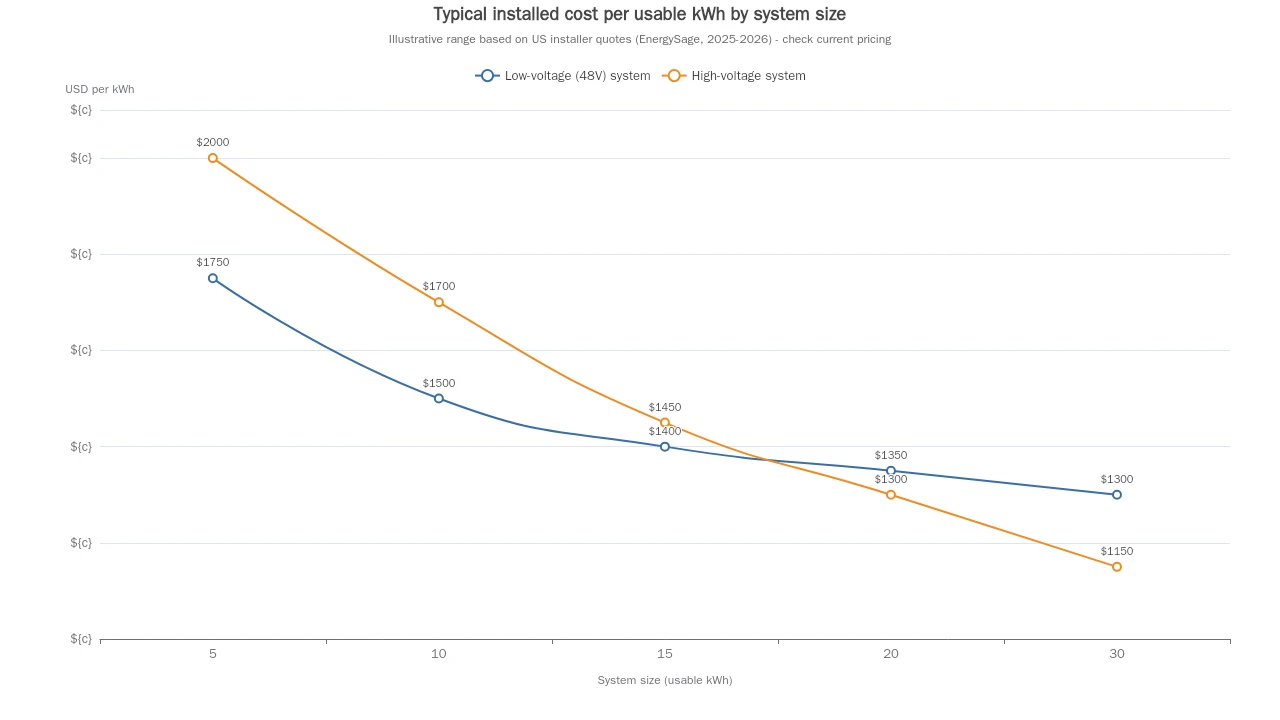
Above: the crossover around 15–20 kWh — LV is cheaper to buy small, HV gets cheaper as the system grows.
Then there is the ten-year view. If the efficiency gap is a couple of percentage points and the system cycles daily, an HV system returns a bit more of every kWh you put through it — worth a few hundred dollars of lifetime value per 10 kWh of throughput, not a headline number but not nothing either. Real-world round-trip efficiency for quality LiFePO₄ systems typically lands in the mid-90s percent per manufacturer datasheets, so check the datasheet figure rather than trusting a brochure. And both classes should outlast the payback period if the chemistry is right: LiFePO₄ (lithium iron phosphate) is the standard for stationary storage today, with cycle ratings in the thousands — Battery University's lithium-ion comparison explains why this chemistry dominates. Warranty terms differ more between brands than between voltage classes — expect 10–15 years with cycle or throughput limits either way. Prices move; treat these as planning numbers, check current quotes, and make sure the quoted price includes inverter, installation, and permits. As of August 2026, we deliberately do not publish a single "$/kWh" figure for our own systems here — installed price depends on your site and region, and a fake number helps nobody.
Safety, codes, and installation
Safety is where the two classes genuinely differ, and it is not a marketing point.
- Hazard thresholds. Codes and work rules draw a line around 60 V DC: below it, ordinary insulation and training are mostly adequate; above it, circuits are treated as hazardous and work is restricted to qualified personnel. A 400 V DC battery string is unambiguously in the second world — arc-flash risk, strict fusing, labeled disconnects.
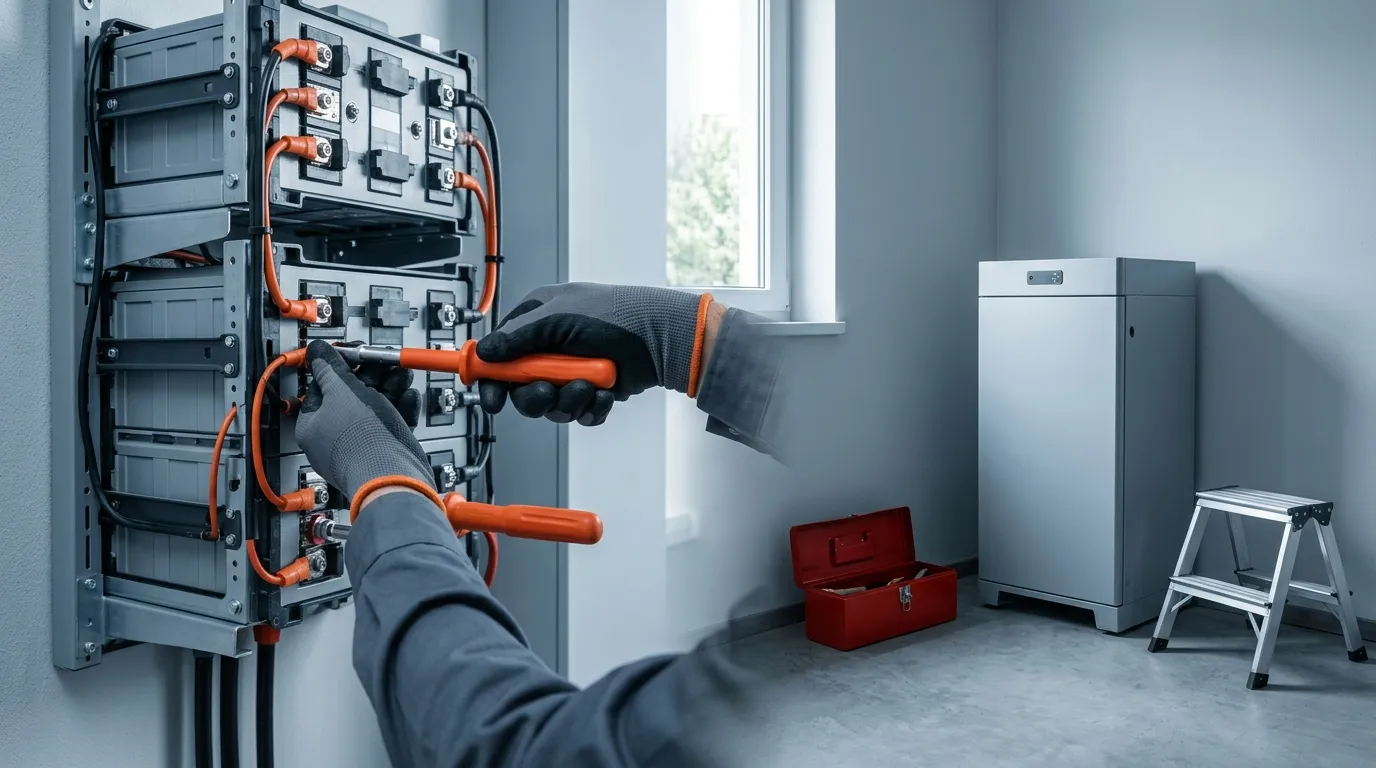
Above: the practical difference — HV modules live in the certified-work zone; a 48 V cabinet stays approachable.
- Certification. In North America, residential energy storage should carry UL 9540 (the system standard for energy storage equipment; UL's 9540 overview explains the scope), with cells and modules backed by UL 9540A fire-safety testing. When you compare quotes, ask for the certificate numbers, not adjectives. NFPA 855 and the NEC's energy storage articles (Article 706 in the 2023 NEC) set installation limits on capacity, spacing, and ventilation.
- Why HV batteries fail, honestly. The common failure modes in HV systems are the same as in LV ones — cell defects, thermal runaway, and BMS failures — but the consequences are amplified by series voltage and energy density: a failed cell takes down the whole string, and a bad connection in a high-current DC circuit can arc. That is why a good BMS is non-negotiable and why modules in a string must be the same make, model, and age. The BMS is the component that detects over-voltage, over-temperature, and imbalance and disconnects the string — our BMS explainer walks through what it actually does.
- What happens if you pair the wrong voltage. Use a battery outside the inverter's input window and you get one of two outcomes: the inverter refuses to start (the common case — a protective feature, not a bug), or, in a mismatched DIY wiring, components are stressed past rating. Never mix 48 V and HV modules, never mix chemistries, and never "test" a battery on an inverter that does not list its voltage range in the datasheet. If a battery is rated above the inverter's maximum input voltage, the inverter's input stage — not the battery — is the thing at risk.
How to choose: a 4-step checklist
Work through these in order. Skipping step one is how people end up with a great battery and a dead-end system.
1. Read the inverter's datasheet first. Find the battery voltage range (usually labeled "battery voltage" or "BAT input") and its DC current limits. A hybrid inverter with a 150–500 V battery input wants an HV battery. A 48 V inverter wants an LV battery. If you do not have an inverter yet, pick the battery class first and buy an inverter that matches it — do not buy an inverter and a battery and hope.
2. Write down your load profile, not just your kWh. Whole-home backup with heat pump, well pump, or EV charging needs kilowatts, and kilowatts are where HV earns its keep. A backup circuit for lights, internet, and a fridge is fine at 48 V. Total the surge (starting) watts of the biggest loads — that number, divided by battery voltage, tells you the current your system must move.
3. Decide your 5-year expansion plan honestly. Plan to add 10 kWh later? An HV stack grows module by module in the same footprint. Plan to stay at one size forever? The simplicity and price of LV win. Planning to add a second location (garage + house)? Parallel LV units across locations are easier to manage.
4. Check your install constraints. Who installs batteries in your area, and are they certified for high-voltage DC? What does your utility or jurisdiction require for interconnection and permitting? If the only qualified HV installers are booked out months, that is a real cost. If you intend to self-install (where codes allow), 48 V is effectively your only responsible choice.
When you have an inverter family or a load list, our whole-home backup sizing guide and the battery capacity calculator turn step two into numbers. And because the two classes also differ in physical form — wall-mounted stacks versus floor cabinets — our wall-mounted vs stackable battery comparison is worth reading before you commit to a form factor. The rest of the residential energy storage hub collects all of these guides in one place — bookmark it and you will always find the next step.
Three scenarios, three answers
The cabin retrofit (needs ~8 kWh, off-grid, owner-installed). A 48 V LiFePO₄ cabinet, a small LV hybrid inverter, and a weekend of work. Every component is available, serviceable, and cheap to replace. HV would add certification, an electrician, and cost for zero benefit at this size. → Low voltage.
The whole-home system (needs 20–30 kWh, runs a heat pump, plans an EV). Peak draw will hit 10 kW+ on winter mornings. An HV stack feeding a 150–500 V hybrid inverter moves that power at a fraction of the current, expands module by module, and keeps cables small through a tight utility room. → High voltage.
The existing-inverter upgrade (already owns a 48 V inverter, adding storage to an old PV system). The decision is made by what you own: an LV battery is the drop-in, and a second LV unit later gives you parallel expansion. → Low voltage.
Quick answers to common questions
Is 240V considered high voltage? For wall power, no — 240 V AC is ordinary residential mains. "High voltage" in the battery world means the DC string voltage (150–500 V DC), a different circuit with different rules. See the definition section above.
What causes HV battery failure? The same root causes as any lithium battery — cell manufacturing defects, thermal runaway, BMS faults, and damaged connections — with consequences amplified by series voltage and energy density. Strict BMS monitoring, matched modules, and certified installation are the mitigations.
What happens if you use a battery with too high voltage? A properly configured inverter will refuse to start (protective behavior). In a mis-wired system, the inverter's input stage gets stressed beyond rating. Match the battery to the inverter's listed input range — never exceed it.
Can I expand a high-voltage system later? Yes, if you stay within the same product family: modules stack in series to raise capacity. Add modules of the same model and age-class; mixing generations in one string is the classic expansion mistake.
Bottom line
There is no universal winner, and any article that tells you one class is "better" is selling you something. High voltage wins when the system is big, the loads are heavy, and growth is planned — typically 15 kWh and up with whole-home backup ambitions. Low voltage wins when the system is small, the install must be simple, or you already own 48 V hardware. Start from your inverter, size the loads, plan the expansion, check the installers — in that order — and the right class picks itself.
Both voltage classes are part of Hua Power's residential line, and our engineers will happily tell you which one you should not buy if that is the honest answer. If you are sizing a system and want a second opinion on the architecture, talk to our engineering team.