

Most people find this page holding half of a system. You've either picked an inverter and now need a battery that will actually talk to it, or you own a battery and are trying to work out which inverters won't fight it. Either way the question underneath is the same: will these two devices agree once they're wired together, or will you get a screen full of BMS communication faults?
The honest answer is that no, not every home battery works with every inverter — but the pairing rules are more predictable than the forum horror stories suggest. Compatibility comes down to three things you can check before you buy: the voltage class, the communication protocol, and the coupling method. Get those three right and the pairing works; get one wrong and it either won't commission or will run in a degraded, warranty-voiding mode.
This guide explains those three axes in plain language, then gives you a 25-brand compatibility list split into low-voltage and high-voltage tables, a callout for the brands that deliberately lock you into their own battery, and a pre-purchase checklist. Where it matters, we link to the manufacturer's own approved-battery documentation so you can verify against the source, not a marketing claim.
The short version: Match three things — voltage class (a 48 V "low-voltage" battery needs a 48 V inverter; a roughly 100–600 V "high-voltage" battery needs an HV inverter), communication (closed-loop over CAN or RS485 if the inverter and battery share a protocol like the widely-used Pylontech CAN standard, otherwise open-loop voltage control), and coupling (DC-coupled behind a hybrid inverter, or AC-coupled alongside an existing one). Open, "battery-agnostic" inverters (Sol-Ark, Deye, Victron, Growatt, Luxpower, GoodWe) accept many third-party batteries. Closed ecosystems (Tesla, Enphase, SolarEdge, Huawei, Sungrow) only take their own.
The three things that decide compatibility
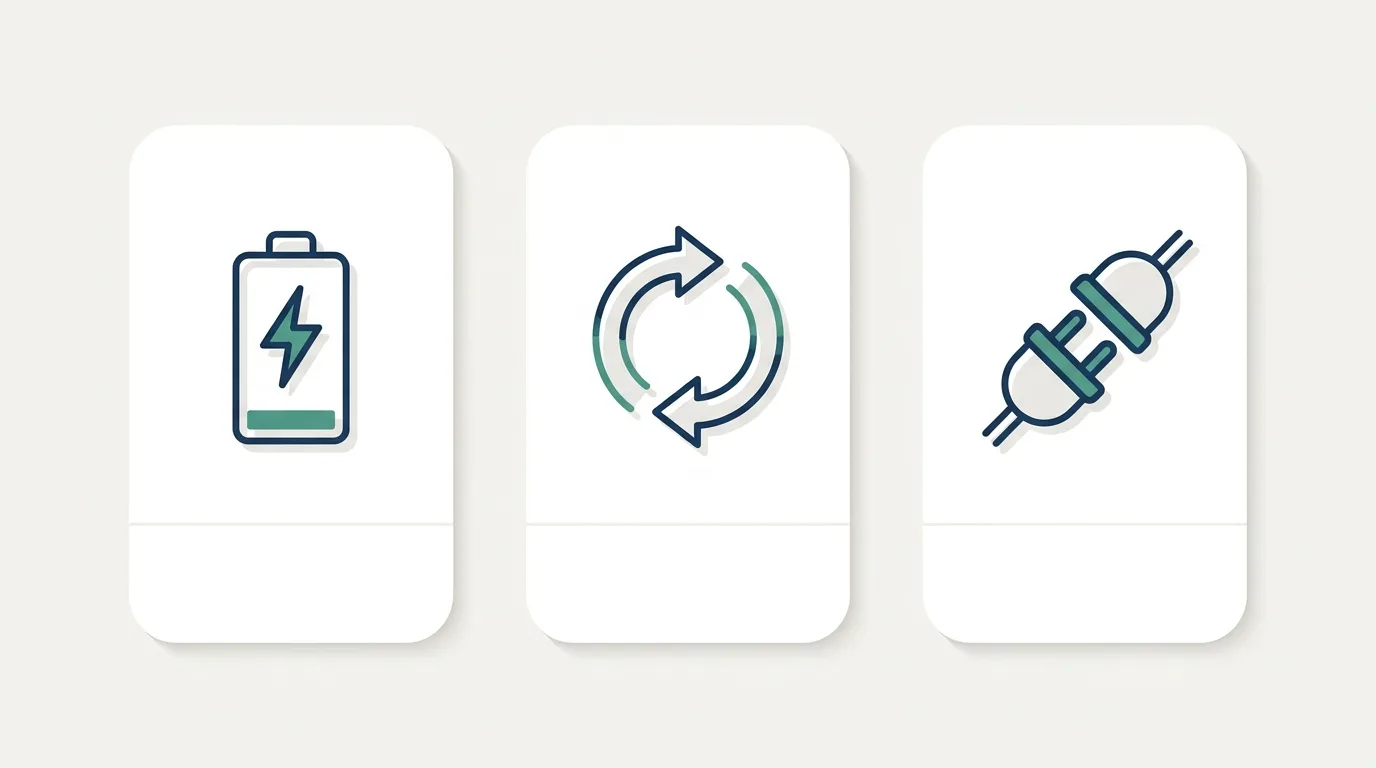
Before comparing brands, screen every pairing against these three axes — a mismatch on any one is enough to stop the system commissioning.
Before you look at a single brand name, understand the three filters every pairing has to pass. A battery and inverter can be the two best products on the market and still be incompatible if they disagree on any one of these.
1. Voltage class: low-voltage (48 V) vs high-voltage
This is the first and hardest filter. Home batteries split into two voltage families, and they are not interchangeable:
- Low-voltage (LV), nominally 48 V (real range roughly 40–58.4 V for a "48 V" pack; many LFP packs sit at 51.2 V nominal). This is the dominant class for off-grid, hybrid, and DIY-friendly systems. LV is generally safer to handle and easier to install.
- High-voltage (HV), roughly 100–600 V. HV batteries stack modules in series to reach a few hundred volts. Running at higher voltage means lower current for the same power, which is more efficient over long cable runs and pairs naturally with modern HV hybrid inverters.
An inverter is built for one class or the other. A 48 V hybrid inverter physically cannot charge a 400 V stack, and an HV inverter won't even see a 48 V battery. So step one is always: is your inverter an LV (48 V) or an HV unit, and does the battery match? Some brands (Solis S6-HV, for example) sell HV-only models that will reject any low-voltage battery outright.
If you want to sanity-check how a pack's amp-hours translate to usable kWh at 48 V vs a higher voltage, our Ah ↔ kWh converter does the arithmetic.
2. Communication: closed-loop vs open-loop
Once the voltage class matches, the two devices need to talk — or at least agree not to. This is where most "it won't commission" problems actually live.
- Closed-loop communication opens a data link from the battery's BMS to the inverter, almost always over CAN bus (fast, 250 kbit/s–1 Mbit/s) or RS485/Modbus (slower but longer-range). The battery tells the inverter its real state of charge, its temperature, and exactly how many amps it may charge or discharge at that instant. This is the safe, accurate mode you want — but it only works if both devices speak the same protocol.
- Open-loop communication means no data link at all. You manually program voltage thresholds into the inverter, and it charges and discharges by voltage alone, blind to what the BMS knows. It works as a fallback, but it can't react in real time and carries a higher risk of over-charge or premature cut-off.
The catch is the protocol whitelist. Inverters don't speak "CAN" generically — they speak specific battery protocols, and most maintain an approved-battery list of the BMS protocols they've been tested against. The de-facto standard in the LV world is the Pylontech CAN protocol; a large share of 48 V batteries emulate it, which is why so many "agnostic" inverters can run so many different batteries in closed-loop. Deye, for instance, selects Pylontech CAN as protocol mode "00." If your battery's protocol is on the inverter's list, you get closed-loop; if it isn't, you're limited to open-loop even if the plug fits.
3. Coupling: DC-coupled vs AC-coupled
The third axis decides how the battery attaches to your home — and it's the one competitor guides skip.
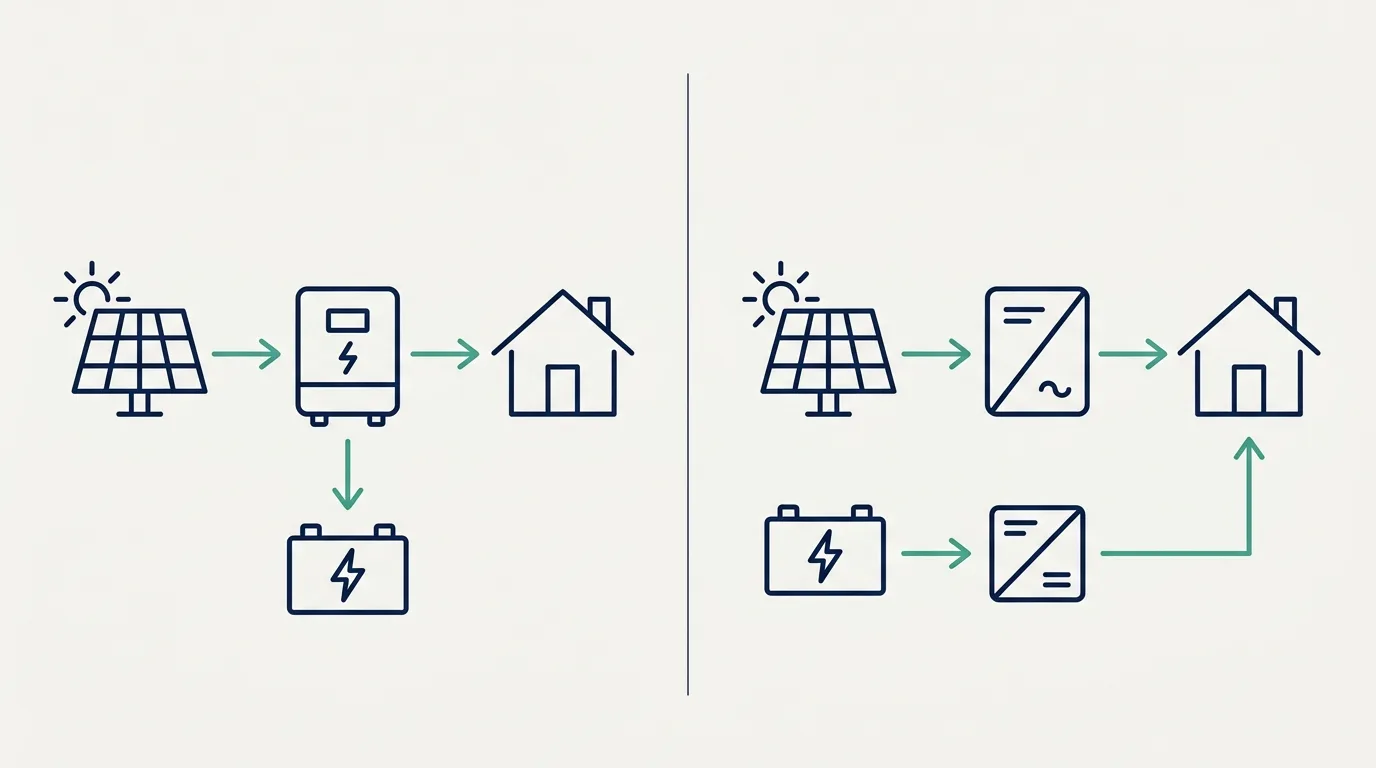
DC-coupled runs the battery through one hybrid inverter; AC-coupled adds a battery with its own inverter beside the solar you already own — the usual retrofit path.
- DC-coupled batteries sit on the DC side of a hybrid inverter. One inverter manages both solar and battery — the way a PV + battery storage system is wired. It's the most efficient path (fewer conversions) and the standard for new installs — but the battery must be compatible with that specific hybrid inverter.
- AC-coupled batteries have their own built-in inverter and connect on the AC side, working alongside an existing solar inverter rather than through it. This is the usual answer for a retrofit — you already have a grid-tie solar inverter and want to add storage without replacing it. Tesla Powerwall is the classic AC-coupled unit: it works next to almost any UL-1741-certified solar inverter precisely because it isn't trying to communicate with it.
The retrofit question — "can I add a battery to the inverter I already own?" — almost always resolves on this axis. If your existing inverter isn't a hybrid with a compatible battery port, an AC-coupled battery (or an all-in-one that brings its own inverter) is the clean way in.
Closed-loop vs open-loop: what actually changes
Because this is the single most-searched compatibility qualifier, it's worth being concrete about what you gain and lose.
Closed-loop (CAN / RS485) | Open-loop (voltage only) | |
|---|---|---|
Data link | Battery BMS ↔ inverter | None |
Charge/discharge limits | Set live by the BMS | Fixed, programmed by you |
State of charge | Accurate, from the battery | Estimated from voltage |
Protocol requirement | Must be on the inverter's approved list | None — any voltage-compatible battery |
Safety & longevity | Best — real-time protection | Workable, higher over-charge risk |
Typical use | Matched, modern LFP systems | Mixed-brand or legacy setups |
The practical takeaway: closed-loop is what you should be aiming for, and the way you secure it is by confirming the battery's BMS protocol appears on your inverter's approved list before you buy — not by assuming a CAN cable will sort itself out. Open-loop is a legitimate fallback for older or mixed-brand systems, but you give up the BMS's real-time protection.
The 25-brand home battery inverter compatibility list
How to read the tables below. "Third-party battery?" answers whether the inverter is designed to work with batteries other than the manufacturer's own. "Closed-loop" indicates whether closed-loop communication is generally available for compatible third-party packs — subject, always, to the specific model, firmware version, and the inverter's current approved-battery list. Treat this as a shortlist-builder; the manufacturer's live documentation is the authority for your exact model.
On sourcing: rows with a linked document cite the manufacturer's own approved-battery or compatibility page (verified 2026). The rest are compiled from manufacturers' public documentation and installer guides and reflect the general behavior of the current model range — always confirm the exact model and firmware against the maker's live approved-battery list before you buy.
Low-voltage (48 V) inverters
These are the hybrid and off-grid inverters that pair with 48 V / 51.2 V batteries. Most are "battery-agnostic" and support closed-loop with any pack that speaks a listed protocol (usually Pylontech-compatible CAN).
Inverter brand | Class | Comms | Third-party battery? | Closed-loop | Notes |
|---|---|---|---|---|---|
Victron (MultiPlus, Quattro) | 48 V LV | CAN (BMS-Can) | Yes | Yes, listed packs | Battery-agnostic via GX device; see Victron's battery compatibility database |
Sol-Ark (12K/15K/30K) | 48 V LV | CAN / RS485 | Yes | Yes | "48 V battery-agnostic"; maintains a certified partner list |
Deye (SUN-…SG) | 48 V LV | CAN / RS485 | Yes | Yes (Pylontech mode 00) | OEM behind many rebadged all-in-ones |
Growatt (SPH / SPA LV) | 48 V LV | CAN / RS485 | Yes | Yes, listed packs | Published [approved battery list](https://us.growatt.com/upload/file/SPH_10kTL_HU(-US)_compatible_battery_list.pdf) |
Luxpower (SNA / LXP) | 48 V LV | CAN / RS485 | Yes | Yes, selectable | DIY-popular; protocol chosen in settings |
EG4 (6000XP, 18kPV) | 48 V LV | CAN / RS485 | Yes | Yes | Own published battery-compatibility list |
Schneider (Conext XW Pro/SW) | 48 V LV | CAN (Xanbus) | Yes | Select packs | Established off-grid platform |
MPP Solar (LV6548 etc.) | 48 V LV | RS485 / CAN | Yes | Yes (Pylontech since 2019) | Off-grid / DIY staple |
Voltronic (Axpert King/Max) | 48 V LV | RS485 / CAN | Yes | Varies by model | OEM inside many budget all-in-ones |
SRNE | 48 V LV | RS485 / CAN | Yes | Yes, listed packs | Common in low-cost hybrids |
Renogy | 48 V LV | RS485 / CAN | Yes | Within own ecosystem | RV / home retail brand |
SMA (Sunny Island) | 48 V LV | CAN | Yes | Managed-battery list | Sunny Island is the 48 V storage line |
Outback (Radian, SkyBox) | 48 V LV | Voltage / limited | Yes | Mostly open-loop | Legacy off-grid; often voltage-controlled |
Studer (Xtender) | 48 V LV | Xcom / limited | Yes | Mostly open-loop | Premium off-grid; voltage-based typical |
Must | 48 V LV | RS485 | Yes | Limited | Budget off-grid inverters |
High-voltage inverters
HV hybrid inverters need a stacked HV battery. Some keep an open interface for third-party HV packs; others accept only their own.
Inverter brand | Class | Comms | Third-party battery? | Closed-loop | Notes |
|---|---|---|---|---|---|
GoodWe (ET / EH HV) | HV | CAN | Yes, open HV interface | Yes, listed packs | Approved-battery doc; requires ARM firmware v14+ — see GoodWe's compatibility overview |
Fronius (GEN24 Plus) | HV | Modbus / CAN | Limited list | Yes, listed packs | BYD Battery-Box, LG RESU FLEX, Fronius Reserva |
Solis (S6-HV) | HV (150–400 V) | CAN | Yes, listed packs | Yes | S6-HV models are HV-only — reject 48 V batteries |
Growatt (WIT / HV) | HV | CAN | Yes, listed packs | Yes | HV counterpart to the SPH LV line |
Deye (HV models) | HV | CAN | Yes | Yes | HV variant of the hybrid range |
Sofar (HYD-HV) | HV | CAN | Yes, listed packs | Yes | Common in EU residential |
SolaX (X3 Hybrid HV) | HV | CAN | Mostly own (T-BAT) | Yes | Leans toward its own battery line |
Sungrow (SH-RS/RT) | HV | Proprietary bus | No — SBR only | Own battery | SH inverter + SBR battery share one bus, per Sungrow's approved battery declaration |
SolarEdge (Home Hub) | HV (~400 V) | Proprietary | No — own battery only | Own battery | DC-coupled SolarEdge Home Battery exclusively |
Huawei (SUN2000) | HV | Proprietary | No — LUNA2000 only | Own battery | Locked to the LUNA 2000 line |
All-in-one / AC-coupled units (bring their own inverter)
Brand | Type | Third-party inverter? | Notes |
|---|---|---|---|
Tesla Powerwall | AC-coupled all-in-one | Works alongside any UL-1741 solar inverter | Not a third-party battery host — see Tesla's compatibility table |
Enphase (IQ Battery) | AC-coupled | Its own IQ ecosystem | Microinverter-based; closed, though opening to some string inverters in select EU markets |
That's 25 distinct inverter brands across the three groups — the majority open to third-party batteries, a meaningful minority locked to their own.
Which inverters lock you in
Five names deserve a specific warning, because their compatibility answer is essentially "only us":
- Tesla Powerwall — an all-in-one battery and inverter. It's wonderfully flexible on the AC side (it retrofits next to almost any solar inverter) but you cannot buy a Powerwall battery and pair it with a third-party inverter, nor add a third-party battery to it.
- Enphase IQ — a fully AC-coupled ecosystem built around microinverters and Enphase's own IQ Battery. Third-party batteries are not supported.
- SolarEdge Home — the DC-coupled Home Battery works only with SolarEdge's own inverters, and vice versa.
- Huawei — SUN2000 hybrid inverters accept only the LUNA 2000 battery.
- Sungrow — the SH-series hybrid inverter and SBR battery are designed as a matched pair on a single communication bus; the inverter won't adopt a foreign HV pack.
None of this makes these bad products. But if you value the freedom to choose your battery independently — or to keep the inverter you already own — a battery-agnostic platform (Sol-Ark, Deye, Victron, Growatt, GoodWe, Luxpower) plus a broadly-compatible battery is the architecture that keeps your options open.
How to verify compatibility before you buy
Don't take a spec sheet's word for it. Run every candidate pairing through this five-point check:
- Match the voltage class. LV battery (48 V) → LV inverter; HV battery (100–600 V) → HV inverter. This is a hard gate — a mismatch cannot be fixed in settings.
- Find the inverter's approved-battery list. Nearly every serious brand publishes one (we've linked several above). If your battery — or its BMS protocol — is on it, you're in closed-loop territory.
- Confirm the communication protocol. Both devices must speak the same one (Pylontech CAN is the common LV denominator). If they don't, you're restricted to open-loop voltage control.
- Check the firmware version. Compatibility is often gated on firmware — GoodWe, for example, requires ARM firmware v14+ for certain batteries. Ask the installer to confirm the inverter is up to date.
- Verify certification. Look for UL 9540 / UL 9540A (system-level fire safety) and UL 1973 / IEC 62619 (the battery itself). A non-approved pairing can also void the warranty on both units — the single most expensive mistake in this whole process.
- Match power and phase, not just energy. Compatibility isn't only about the battery talking to the inverter — the inverter also has to serve your loads. For whole-home backup in North America, confirm the inverter does 120/240 V split-phase and has enough continuous kW plus surge headroom to start motors (well pumps, AC compressors). A battery can be perfectly compatible and still leave you short if the inverter is undersized for the job.
If any of these can't be answered with a "yes," treat the pairing as unconfirmed until the manufacturer says otherwise.
Where iHuapower fits
iHuapower designs its home batteries for exactly the compatibility landscape above — to be the pack that pairs, rather than the one that limits you:
- Low-voltage line — the wall-mounted HC-UPSRB5 / HC-UPSRB10 / HC-UPSRB16 (5.12 / 10.24 / 16 kWh, 51.2 V LiFePO4) and the HC-UPSSLV20I / 30I / 40I stackable series (20–41 kWh). These sit in the 48 V class and communicate over CAN and RS485, the same interfaces the agnostic hybrid inverters above expect.
- High-voltage line — the HC-UPSSHV20I / 30I / 40I stackable series (20–41 kWh) for homes on an HV hybrid inverter, where the higher voltage improves round-trip efficiency.
- All-in-one — the HC-UPSRAP16I (6 kW / 16 kWh) integrates the inverter, so the compatibility question largely disappears — a clean retrofit or new-build option, comparable in concept to an AC-coupled Powerwall.
Because compatibility ultimately depends on your specific inverter model, firmware, and its current approved-battery list, ask for iHuapower's up-to-date certified-inverter list for the exact model you're pairing before ordering — the same due diligence step 2 above asks of any battery brand. If you're still weighing a wall-mounted pack against a stackable tower, our guide to residential energy storage systems walks through that choice.
Frequently asked questions
Are all batteries compatible with all inverters? No. A battery and inverter must match on voltage class (48 V vs high-voltage), share a communication protocol for closed-loop operation, and be coupled correctly (DC via a hybrid inverter, or AC alongside an existing one). Mismatch any one and the system either won't commission or runs in a degraded open-loop mode.
Do I need a compatible inverter for my battery? Yes — unless you buy an all-in-one or AC-coupled unit that brings its own inverter. For a DC-coupled battery, the hybrid inverter must support that battery's voltage class and protocol.
How do I know if a battery is compatible with my inverter? Check the inverter manufacturer's approved-battery list, confirm the battery's BMS protocol is supported (Pylontech CAN is the common low-voltage standard), verify the inverter firmware is current, and match the voltage class.
Can I add a battery to my existing solar inverter? Sometimes. If your inverter is a hybrid with a compatible battery port, yes — DC-coupled. If it's a standard grid-tie inverter, you'll add storage via an AC-coupled battery or an all-in-one that includes its own inverter.
What is closed-loop battery communication? A live data link (over CAN bus or RS485) that lets the battery's BMS tell the inverter its real state of charge and its exact charge/discharge limits — safer and more accurate than open-loop voltage control, but it requires both devices to speak the same protocol.