

"Whole-home backup" is the phrase every battery brochure leads with, and it's the one that trips people up most. It sounds like a single decision — buy the big battery, back up the whole house. It's actually two decisions that have to be made together, and getting one right while getting the other wrong is the most common way a "whole-home" system quietly becomes a partial one.
The two decisions are how many kilowatt-hours (kWh) you store and how many kilowatts (kW) the system can push out at once. Size the kWh for how long you want to last; size the kW for what you want to run at the same time. Most sizing guides spend all their words on the first number and wave at the second — which is exactly why so many homeowners end up with a battery that has energy to spare but drops the air conditioner the moment its compressor kicks in.
This guide does the arithmetic the brochures skip. We'll define the two numbers, separate whole-home from essential-loads backup honestly, then walk one real house all the way through — from the utility bill to a final spec in both kWh and kW. If you want the general method first, start with our home battery sizing method and come back here for the whole-home version.
The short version: Whole-home backup sizing has two axes. For energy (kWh), take your daily whole-home use (~20–30 kWh for an average US home), divide by your usable fraction (depth of discharge × round-trip efficiency ≈ 0.8), and multiply by the days of autonomy you want — that's why true whole-home backup usually lands at 20–40+ kWh, and multi-day off-grid at 60–100 kWh. For power (kW), add up the continuous draw of everything that can run at once (often 8–12 kW for a whole house) and make sure the inverter's surge rating covers your biggest motor start (a central AC compressor can spike to 6,000–9,000 W). Size both, or your whole-home system is only whole-home until the AC starts. A modular battery lets you cover essentials now and stack up to whole-home later.
The two numbers whole-home backup turns on: kWh vs kW
Before any math, lock these two units in, because whole-home backup is the exact scenario where confusing them bites hardest.
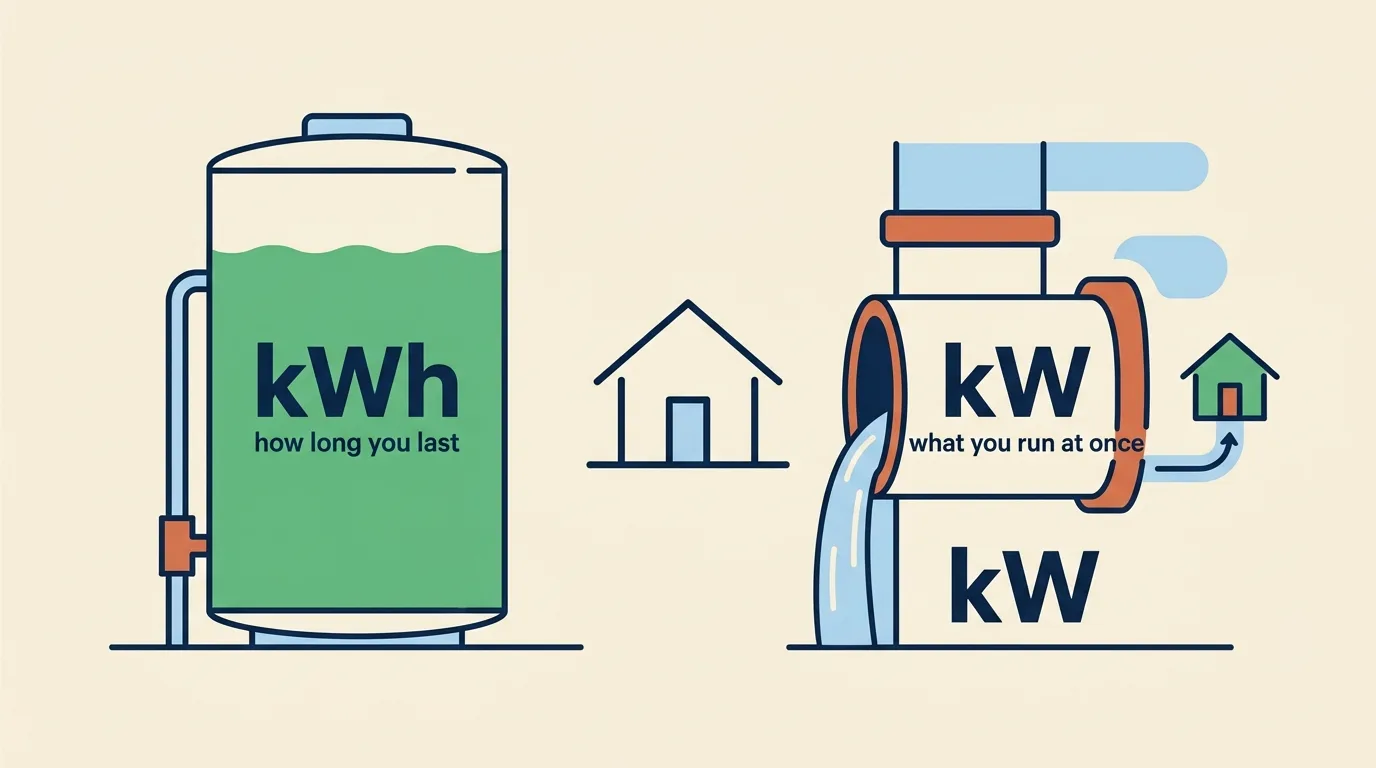
Energy decides how long you last. Power decides what you can turn on. Whole-home backup needs both to be big — a large tank behind a narrow pipe still browns out.
- Kilowatt-hours (kWh) = the size of the tank. This is energy — how much the battery stores, and therefore how long it runs your loads. A 30 kWh battery holds thirty times what a 1 kW load burns in an hour.
- Kilowatts (kW) = the width of the pipe. This is power — how much the system can deliver at any instant, set by the inverter. If your loads try to pull more kW than the pipe allows, the stored kWh behind it are irrelevant; the system can't serve them and it trips.
The test worth memorizing: energy decides how long you last; power decides what you can turn on. An essential-loads battery gets away with a narrow pipe because you've deliberately turned most of the house off. Whole-home backup is defined by the opposite — you leave the house on — so the pipe has to be wide enough for everything running at once, and wide enough to survive the surges when motors start. This is why the kW number, not the kWh number, is where whole-home systems most often fall short.
Everything below sizes both. We start with kWh because it's the number in the keyword and on the quote, then give kW its own step because it's where whole-home sizing quietly goes wrong.
First, be honest about what "whole home" means
"Whole-home backup" gets used for three genuinely different jobs, and the right battery size swings by a factor of three depending on which one you actually want.
- Essential-loads (critical-loads) backup. A subpanel carries a chosen set of circuits — fridge, a few lights, internet, furnace fan, well pump, maybe one AC zone. Everything else goes dark. This is what most "whole-home" systems installed today really are, and it's often the smart choice: 10–20 kWh and a modest inverter cover it.
- Managed whole-home backup. The battery backs the entire main panel, but a smart panel or the inverter's load-management logic sheds big loads automatically — it won't run the electric range, dryer, EV charger and AC all at once, but everything is available one or two at a time. This is the sweet spot for most homes wanting the "whole-home" experience without off-grid-sized cost: roughly 20–30 kWh and an 8–10 kW inverter.
- True unmanaged whole-home / off-grid. Every circuit live, no shedding, ready to run for days without the grid. This is the expensive end: 40–100 kWh and a large or paralleled inverter stack.
Decide which of these you're buying before you size, because a quote for "whole-home backup" can honestly mean any of the three. The rest of this guide sizes the middle and upper cases — if you only need essentials, our general sizing method is the faster path.
Step 1 — Find your whole-home daily energy use
Everything downstream starts from one number: how many kilowatt-hours your home uses in a day. Two ways to get it.
The fast way — from your utility bill. Find your monthly kWh (it's on every bill) and divide by 30. For reference, the average US residential customer buys about 10,791 kWh a year — roughly 899 kWh a month, or ~30 kWh a day — according to the U.S. Energy Information Administration. Your own figure is what counts: a small, efficient, gas-heat home might be 12–18 kWh/day; an all-electric home with a heat pump, AC and an EV can top 50.
The accurate way — add up the loads that stay on. Whole-home doesn't mean maximum — nobody runs the oven, dryer and AC around the clock. Estimate what actually accumulates over a backup day. For each load, watts × hours per day ÷ 1,000 = kWh/day.
Load | Typical power | Hours/day (outage) | Energy/day |
|---|---|---|---|
Refrigerator + freezer | 150 W avg (cycling) | 24 | ~3.6 kWh |
Central AC / heat pump | 3,000 W | 6 | 18 kWh |
Well / water pump | 1,000 W | 1 | 1 kWh |
Lights + outlets | 300 W | 6 | 1.8 kWh |
Internet / networking | 30 W | 24 | 0.7 kWh |
Cooking (range/microwave) | 1,500 W | 1 | 1.5 kWh |
Washer + misc | 500 W | 1 | 0.5 kWh |
Whole-home daily total | ~27 kWh/day |
Cut the AC hours (or shed it to a single zone) and the same house drops to ~15 kWh/day — which is the whole point of the "managed" tier. Whatever number you land on, write it down; it drives both remaining steps.
Step 2 — Size the kWh: the days-of-autonomy formula
Here's the piece most guides skip. You never get a battery's full nameplate to your appliances — some capacity is held back to protect the cells (depth of discharge), and some is lost turning DC into AC (round-trip efficiency). So nameplate has to be corrected up to hit your target.
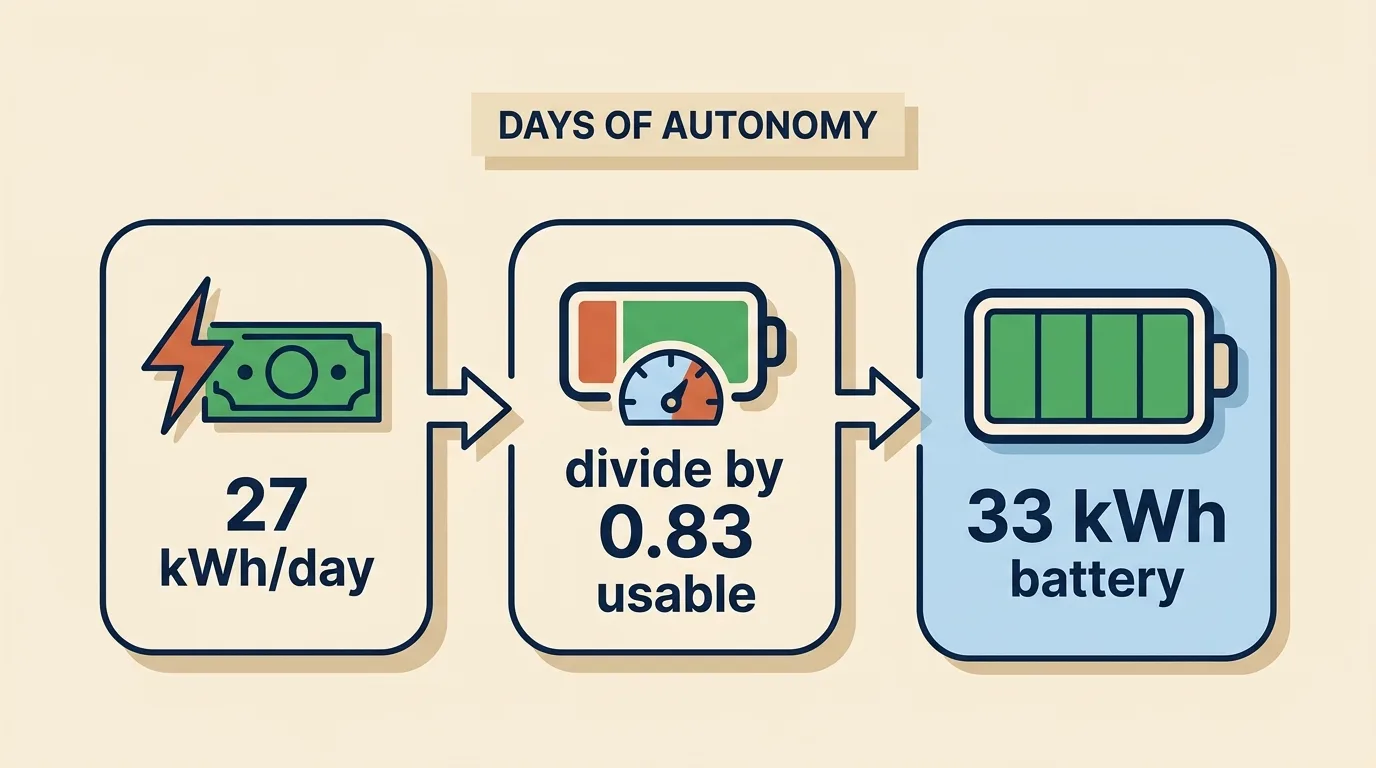
Required nameplate kWh = daily use ÷ (DoD × efficiency) × days of backup. The two correction factors are why a "27 kWh/day" home needs more than 27 kWh of battery.
The formula:
Required nameplate kWh = Daily kWh ÷ (DoD × efficiency) × days of autonomy
- Depth of discharge (DoD): the usable fraction. Quality LFP (LiFePO4) batteries allow ~90% (0.9); older lead-acid, half that. Chemistry matters here — LFP is why modern sizing math is so much friendlier.
- Round-trip efficiency: ~90–95% for a good inverter/battery pair. Use 0.92. (Drawing down already-stored energy strictly only costs the one-way discharge/inversion loss, but we apply the full round-trip figure to stay on the conservative side.)
- Days of autonomy: how long you want to last with no recharge. One day covers a typical overnight-to-next-day outage; two to three days is storm-grade; more than that, you'll want solar (next section).
Worked example — the 27 kWh/day home, 1 day of autonomy:
Required nameplate = 27 ÷ (0.90 × 0.92) × 1 = 27 ÷ 0.828 ≈ 32.6 kWh nameplate
So a home that uses 27 kWh needs roughly 33 kWh of nameplate battery to run a full whole-home day — not 27. Want a two-day storm buffer? Double it to ~65 kWh. Trim to the managed 15 kWh/day profile and one day needs only ~18 kWh. That single formula, with your own three numbers, is the honest core of whole-home battery sizing — and it's why "how many kWh to run a whole house" doesn't have one answer.
You can sanity-check any candidate system against your real loads with our battery backup duration calculator, which applies the same DoD and efficiency deratings so you're comparing usable hours, not nameplate fantasy.
Step 3 — Size the kW: continuous and surge
This is the step that turns whole-home backup into partial backup when it's skipped. Your battery can hold a week of energy and still be useless if its inverter can't push enough kW for the loads you switch on.
There are two power numbers to satisfy:
Continuous power — the steady draw of everything running at the same time. Add up the running watts of your simultaneous loads. A whole house with AC, fridge, pumps, lights and some cooking commonly lands around 8–12 kW of realistic peak continuous draw (the average home idles near ~1.2 kW but spikes far higher when the big loads coincide). Your inverter's continuous rating must clear this — or a smart panel must guarantee the big loads never stack.
Surge (starting) power — the brief spike when a motor starts. Inrush current is typically 2–6× the running watts for a second or two, and it's the number that trips undersized systems:
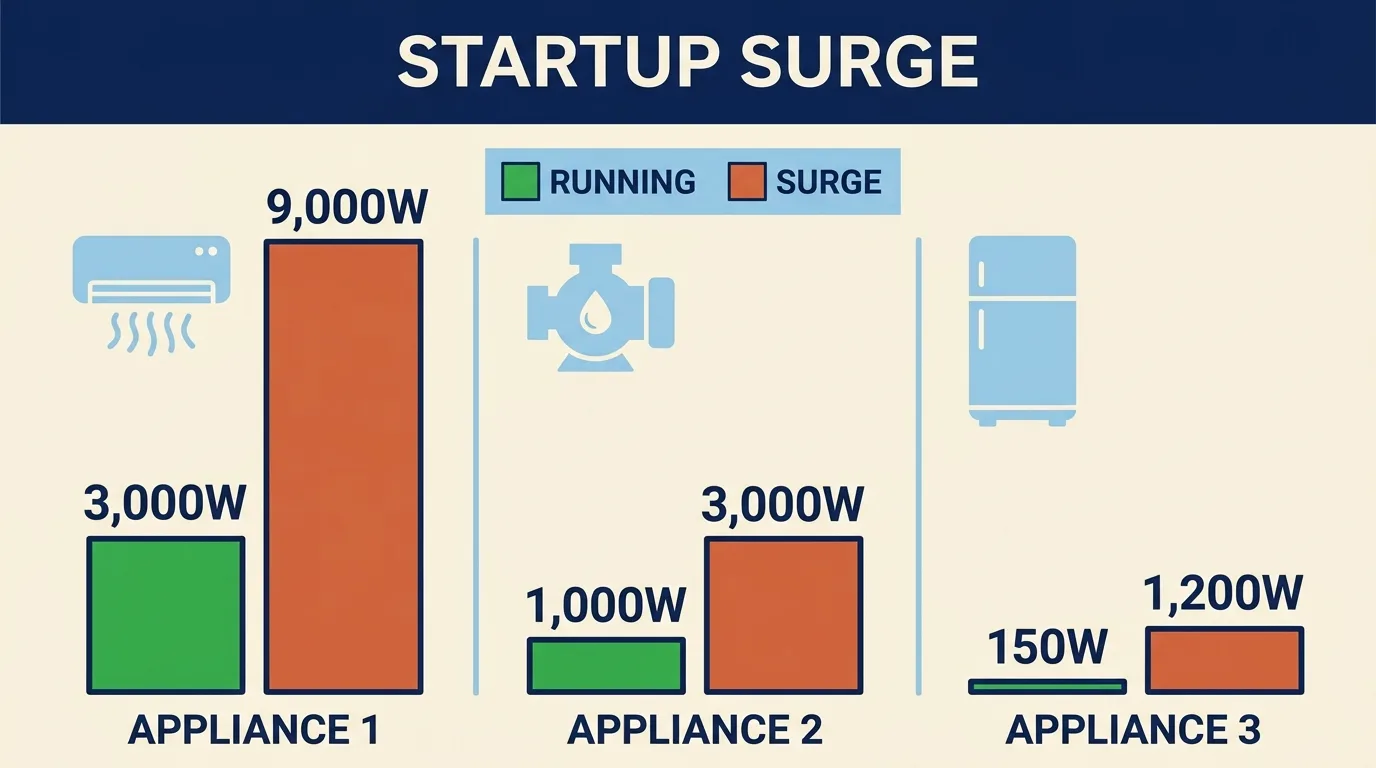
Motor-driven loads draw a brief startup surge of 2–6× their running watts. The inverter's surge rating — not its continuous rating — is what has to absorb these.
Appliance | Running watts | Startup surge |
|---|---|---|
Central AC compressor (3-ton) | ~3,000 W | 6,000–9,000 W |
Well pump (1 HP) | ~1,000 W | ~3,000 W |
Sump pump | ~1,100 W | ~3,400 W |
Refrigerator | ~150 W | ~1,200 W |
Deep well / large HVAC | higher | higher still |
An inverter rated 8 kW continuous might handle your steady load fine, then stall when the AC compressor demands 8,000 W of surge on top of the fridge and pumps already running. That's the classic whole-home failure. Two ways to avoid it: pick an inverter whose surge rating (often 1.5–2× its continuous rating, for a few seconds) covers your largest motor start stacked on the running load, or use a soft starter on the AC to cut its inrush. Either way — size the surge, not just the average. A whole-home system that can't ride through an AC start isn't a whole-home system.
Putting it together: one house, both numbers
Sizing is done when you have a kWh answer and a kW answer for the same house. Let's finish both for our example home.
Energy (kWh): 27 kWh/day ÷ 0.828 × 1 day ≈ 33 kWh nameplate (Step 2).
Power — continuous (kW): add up the loads that can realistically run at the same time:
AC 3,000 + fridge 150 + well pump 1,000 + lights 300 + cooking 1,500 + networking 30≈ 6,000 W → ~6 kW continuous
A modest whole-home like this sits near 6–7 kW; a larger all-electric home with an EV charger climbs toward the 10–12 kW end.
Power — surge (kW): now stack the worst motor start on top of what's already running. When the AC compressor fires, roughly 3 kW of other loads are still on, and the compressor itself adds a 6,000–9,000 W inrush:
~3,000 W running base + ~9,000 W AC inrush ≈ 12 kW for ~2 seconds
The spec: roughly 32–40 kWh of LFP storage behind an inverter rated ~7–8 kW continuous with ~12 kW+ surge — or a managed setup that sheds the range/dryer/EV so a smaller inverter never sees them stack. Notice both numbers were sized independently: the kWh answer told us nothing about the kW answer, and vice versa. That's the whole lesson.
"How many batteries do I need?" is the wrong question
Searchers ask "how many batteries to power a house," but the honest reframe is: count kWh, not units. A "battery" can be 5 kWh or 16 kWh, so unit-counting tells you nothing. Convert your target kWh into whatever unit size you're comparing:
Your kWh target | In 5 kWh units | In 10 kWh units | In 16 kWh units |
|---|---|---|---|
~15 kWh (essentials) | 3 | 1–2 | 1 |
~30 kWh (managed whole-home) | 6 | 3 | 2 |
~50 kWh (large / short off-grid) | 10 | 5 | 3 |
~80 kWh (multi-day off-grid) | 16 | 8 | 5 |
The takeaway: decide the kWh first, then divide by the module size — and size for capacity, not a fixed "number of batteries," so the number can grow later as an EV or heat pump changes the math (more on that below).
If you have solar, the math changes
Everything above assumes no recharge — you're drawing the battery down and never topping it up. Add solar and the question flips: you no longer size for full autonomy, you size for the net daily deficit.
During a daytime outage, panels can both run the house and refill the battery. What matters is whether a day's solar harvest covers a day's consumption:
Net daily deficit = daily consumption − daily solar harvest
If your array produces 30 kWh on a decent day and the house uses 27, you're net-positive — the battery mainly bridges nights and cloudy stretches, so a 20–30 kWh battery can carry a home essentially indefinitely through an outage. Without solar, that same home needs a battery sized for every full day you want to survive, which is why battery-only backup for multi-day outages gets large (and pricey) fast. If riding out long outages is the goal, pairing storage with PV is almost always cheaper than buying enough battery to brute-force it — and it's the difference between "three days of backup" and "backup until the grid returns."
Battery vs generator, and what it costs
Generator or battery? A standby generator delivers effectively unlimited runtime as long as it's fed fuel, which makes it attractive for very long outages — at the cost of fuel, noise, maintenance, emissions and no daily-use value. A battery is silent, maintenance-light, works with solar and earns its keep every day on time-of-use rates or self-consumption, but its runtime is capped by kWh unless solar refills it. Many storm-prone homes end up with both: a right-sized battery for the first day (the common, short outages) and a generator as the multi-day backstop.
Cost, honestly. Installed residential storage generally runs on the order of $800–$1,300 per kWh of installed capacity all-in, so a managed whole-home system (say 30 kWh) commonly lands in the $20,000–$40,000 installed range before any incentives, and essentials-only systems far less. One 2026 change worth knowing: the federal 30% Residential Clean Energy Credit covered battery storage of 3 kWh or more, but per the IRS it is "not available for any property placed in service after December 31, 2025." Check current state and utility incentives, which often remain — but don't budget around the expired federal credit.
The modular strategy: essentials now, whole-home later
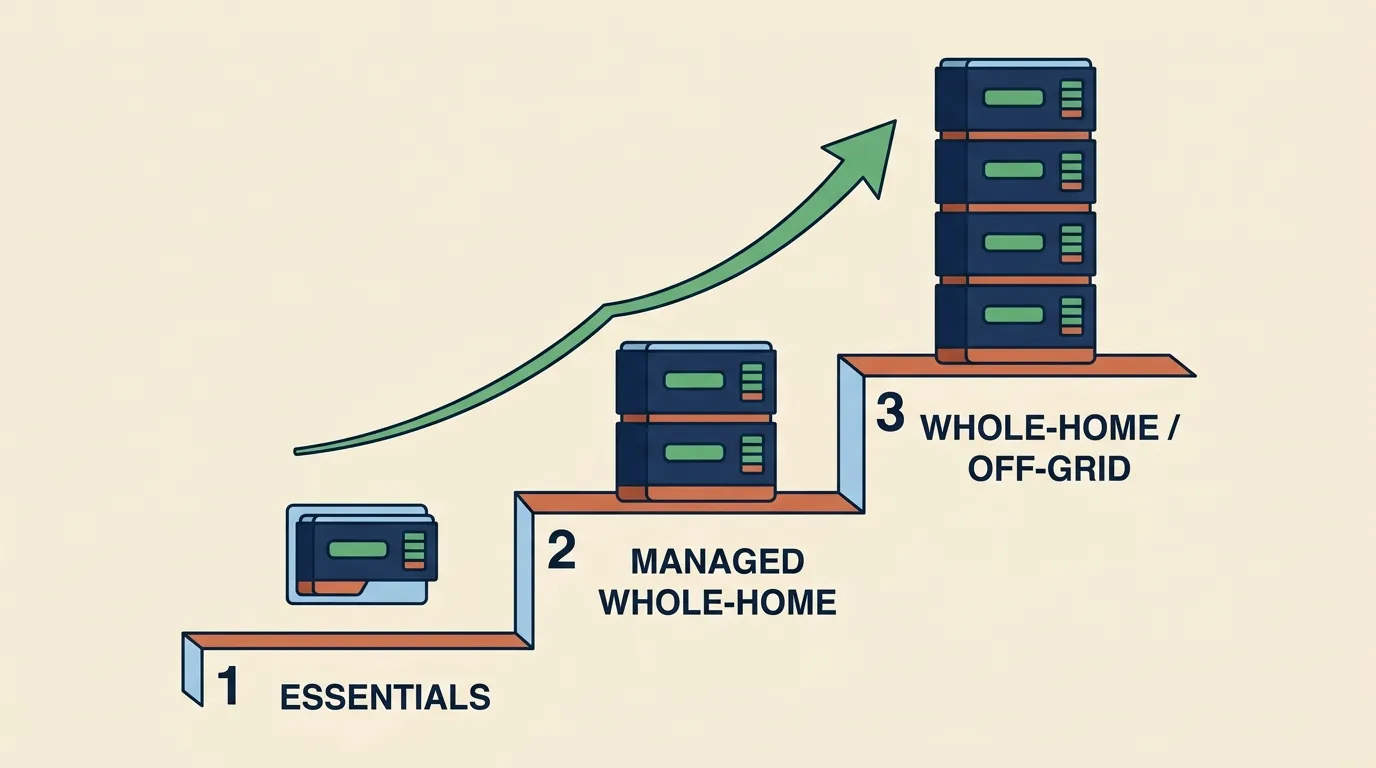
You don't have to buy the final number on day one — size for today's essentials and stack toward whole-home as your needs grow.
Here's the practical resolution to all this math: you don't have to buy your final whole-home number on day one. The smartest whole-home path for most homes is to size for today's essentials, then stack to whole-home as budget and needs grow — provided you choose a battery built to expand.
That staged approach is how iHuapower's low-voltage residential range is built: wall-mounted LFP units that start at essentials size and parallel up to 16 units as needs grow, so you expand the same system instead of replacing it. When you already know you're at the whole-home tier, the high-voltage stackable range scales to 20–40 kWh in one rack for larger all-electric homes, and the all-in-one HC-UPSRAP16I puts a 6 kW inverter and 16 kWh in a single cabinet — a tidy managed-whole-home starting point. All of it pairs with 20+ hybrid-inverter brands, so your kW choice from Step 3 isn't locked to one ecosystem.
The point isn't which model — it's that sizing whole-home backup is a staged decision, not a one-shot bet, and a modular battery is what makes staging possible.
Quick-reference whole-home sizing table
Backup goal | Battery (nameplate kWh) | Inverter (continuous kW) | Notes |
|---|---|---|---|
Essentials only (fridge, lights, internet, one zone) | 10–16 kWh | 5–6 kW | Subpanel; smallest, cheapest |
Managed whole-home (shed big loads) | 20–30 kWh | 8–10 kW | Sweet spot for most homes |
True whole-home, 1 day, all loads live | 32–48 kWh | 10–12 kW + surge | No shedding; larger inverter |
Whole-home, 2–3 day storm buffer | 50–80 kWh | 10–15 kW | Or add solar to shrink this |
Off-grid / multi-day, no solar | 80–100+ kWh | 12–20 kW | Solar strongly recommended |
Treat these as starting points, then run your daily kWh, DoD, days of autonomy and surge loads through Steps 1–3 to confirm.
FAQ
How many kWh does it take to run a whole house? An average US home uses ~30 kWh/day, so true whole-home backup for one day lands around 32–40 kWh of nameplate after DoD and efficiency corrections. Trim the loads (managed backup) and 20–30 kWh does it; add days of autonomy and it climbs proportionally.
What size inverter do I need for whole-home backup? Enough continuous kW for everything running at once (often 8–12 kW for a whole house) and enough surge headroom for your biggest motor start — a central AC compressor can spike to 6,000–9,000 W. Size both; the surge rating is what most people miss.
Can a battery run my central air conditioner? Yes, if the inverter's surge rating covers the compressor's startup spike stacked on your running load, or you fit a soft starter to cut the inrush. Energy (kWh) is rarely the problem for AC — power (kW surge) is.
How long can a battery power a house? Runtime = usable kWh ÷ your load. A 30 kWh LFP battery (~24 kWh usable) running a 1.5 kW average load lasts ~16 hours; running a full 6 kW whole-home load, ~4 hours. Our backup duration calculator does this with realistic deratings.
Do I need whole-home backup, or just essentials? Most homes are well served by managed whole-home or essentials backup — full unmanaged whole-home costs the most for the least incremental benefit. Decide the job first (see the three tiers above); it changes your size by 2–3×.
Can I add more battery later? Yes — with a modular, expandable system. Sizing for kWh capacity (not a fixed "number of batteries") and choosing a battery that parallels or stacks lets you cover essentials now and grow to whole-home as needs change.
Get your numbers checked
Whole-home backup sizing comes down to two honest numbers: the kWh that decides how long you last and the kW that decides what you can run at once. Work Steps 1–3 with your own bill and loads, and you'll have a spec you can hold any quote to.
If you'd like a second set of eyes, send us your daily kWh, your must-run loads and your biggest motor starts and our engineering team will size a whole-home (or start-small-and-stack) system to match — inverter kW included, not just battery kWh.