

Most battery guides use the word "modular" and then move on. That is a mistake, because modular is the whole point. A modular high voltage battery system lets you buy the storage you need today — say 20 kWh for whole-home backup — and add capacity years later by stacking more packs onto the same tower, under the same battery management system, without ripping anything out.
Do it with high-voltage architecture and you also get lower current, thinner cabling, and higher end-to-end efficiency. This guide explains how modular HV stacking actually works, how it compares to low-voltage systems, how to size one, and which inverters it pairs with — with real numbers from a system you can actually buy.
What is a modular high voltage battery system?
A modular high voltage battery system is a home (or light-commercial) energy storage system built from identical battery packs that stack in series to reach a high DC operating voltage — typically a few hundred volts, versus the ~48–51.2 V of a low-voltage system. "Modular" means capacity is added in discrete blocks; "high voltage" means those blocks are wired in series so system voltage climbs as capacity grows.
It helps to name the hierarchy, because vendors use these words loosely:
- Cell — the smallest unit. In home storage this is almost always a LiFePO4 (lithium iron phosphate) cell at 3.2 V nominal. Lithium-ion chemistry fundamentals are covered well by the U.S. Department of Energy's alternative-fuels battery primer.
- Pack (module) — a group of cells in a single enclosure. iHuapower's residential packs are a 1P16S configuration: 16 cells in series, giving 51.2 V and 5.12 kWh per pack.
- Stack (tower) — several packs bolted together and wired in series. This is the "modular" unit you grow over time.
- Cluster — one complete stack governed by a single BMS, connected to the inverter.
Because the packs are wired in series, each one you add raises both the stack's energy (kWh) and its voltage (V) at the same time. That single fact is what separates a true high-voltage modular system from a low-voltage one — and it drives almost every trade-off below.
How modular HV stacking actually works
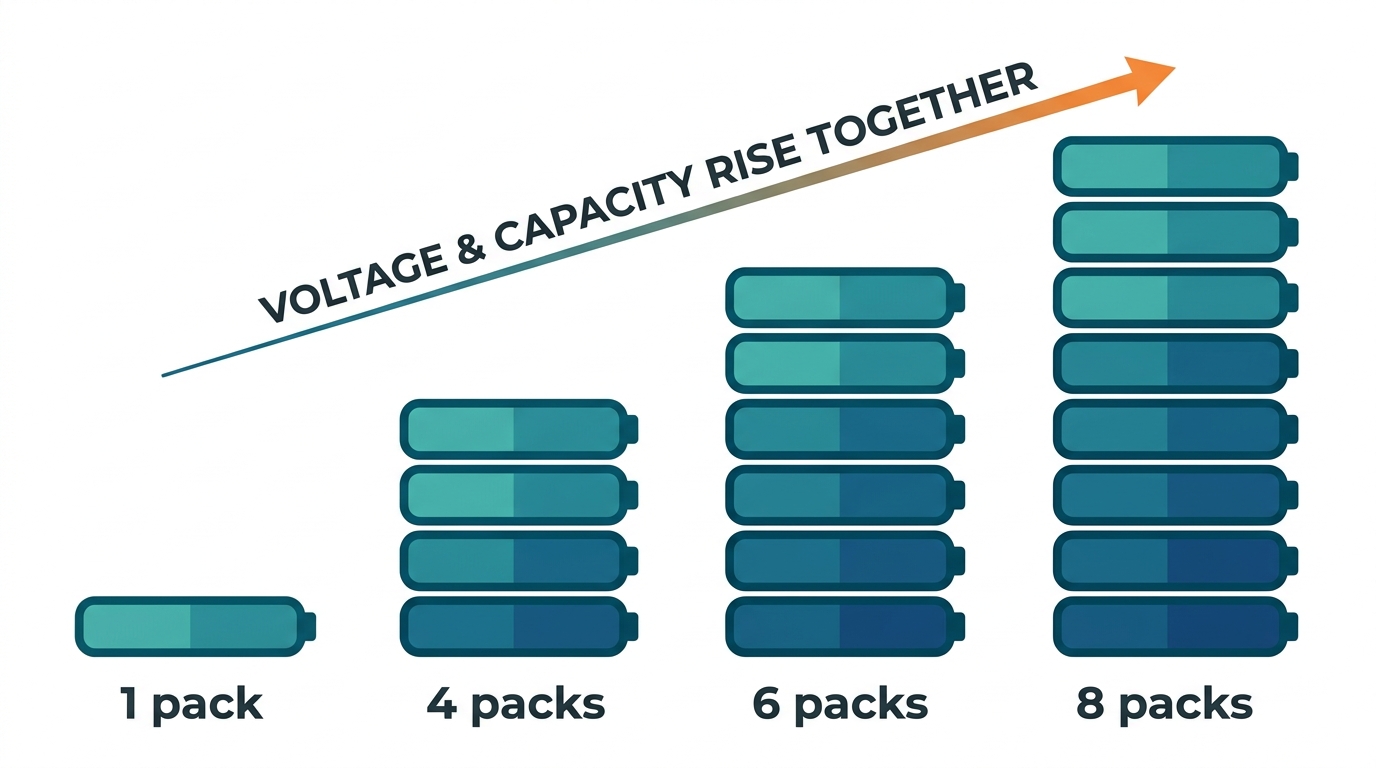
Start with one pack: 51.2 V, 5.12 kWh. Stack four in series and the maths is simple — voltage and capacity both multiply by four:
iHuapower model | Packs in series | Usable capacity | DC voltage range |
|---|---|---|---|
HC-UPSSHV20I | 4 | 20.48 kWh | 172.8–230.4 V |
HC-UPSSHV30I | 6 | 30.72 kWh | 259.2–345.6 V |
HC-UPSSHV40I | 8 | 40.96 kWh | 345.6–460.8 V |
(All three share the same 3.2 V / 100 Ah LiFePO4 cell, 1P16S pack, and 0.5C rating. Source: iHuapower product specifications.)
This is the difference between series and parallel stacking that trips up so many buyers:
- Series (what HV systems do) — packs are chained positive-to-negative, so voltages add. Four 51.2 V packs become ~205 V. Capacity in kWh rises too, but the defining change is the voltage climbing into the hybrid-inverter's high-voltage window.
- Parallel (what LV systems do) — packs sit side by side at the same 51.2 V, and only capacity (amp-hours) adds. Voltage stays flat, so current has to rise to deliver the same power.
One BMS oversees the whole cluster — monitoring every cell's voltage and temperature, balancing charge across packs, and isolating faults. That is why you can add a pack later without re-commissioning the entire system: the BMS simply enrols the new module into the stack it already manages. (In practice, mixing packs of very different age or state of health in one series string isn't recommended — pair expansions with your installer so the BMS balances cleanly.)
High voltage vs low voltage home battery
This is the comparison every buyer runs into, so here it is straight. Both use the same safe LiFePO4 chemistry; the difference is architecture.
High voltage (e.g. HC-UPSSHV series) | Low voltage (~48–51.2 V) | |
|---|---|---|
System voltage | ~170–460 V | ~48–51.2 V |
Current for same power | Lower | Higher |
Conduction (I²R) losses | Lower → higher efficiency | Higher |
Cabling | Thinner conductors, less copper | Thicker cables, larger lugs |
Best fit | Whole-home, high-power loads, big solar, EV charging | Smaller backup, tight budgets, simple single-phase |
Inverter | HV hybrid inverter required | LV battery inverter |
Scaling | Add packs in series (V + kWh rise together) | Add packs in parallel (kWh only) |
The physics behind the efficiency line is worth understanding, because it is the honest reason to go high-voltage. Power equals voltage times current (P = V × I). To move a given amount of power, a higher voltage needs proportionally less current — and resistive heating losses in cables and connections scale with the square of current (I²R). Halve the current and you quarter that loss. That is why HV systems generally run a point or two higher on round-trip efficiency and can use noticeably thinner cabling.
When low voltage still wins: if you only need a few kWh of essential-loads backup, you're on a tight budget, or you have a simple single-phase setup, a low-voltage system is cheaper and perfectly adequate. iHuapower makes both — see the low-voltage residential range if that's your situation. Choose high voltage when you're backing up a whole home, running heavy loads (heat pumps, well pumps, AC, an EV charger), or pairing with a large solar array.
Modular vs fixed single-unit batteries
Even among high-voltage systems, there's a second choice: a modular stack you can grow, versus a fixed single-unit battery sized once at purchase.
The modular case is mostly economic. A fixed unit forces you to guess your future needs and pay for them up front. A modular system lets you:
- Right-size for today. Install 20 kWh now for daily solar shifting and outage backup.
- Expand on your timeline. Add packs when you buy an EV, add a heat pump, or your family grows — up to 40 kWh on the same tower.
- Spread the cost. Capacity becomes an operating decision instead of one large capital hit.
- Future-proof the install. The inverter, wiring, and floor space are already there; expansion is packs, not a new project.
This "start small, stack later" flexibility is the single biggest reason homeowners choose modular HV — and the thing generic guides gloss over.
Key benefits of a modular high voltage system
- Higher efficiency from lower current and reduced I²R losses (see the physics above).
- Less copper, easier runs — thinner DC cabling for the same power.
- Scalable capacity — 20 → 30 → 40 kWh without replacing the system.
- Single-BMS simplicity — one brain manages the whole stack and every expansion.
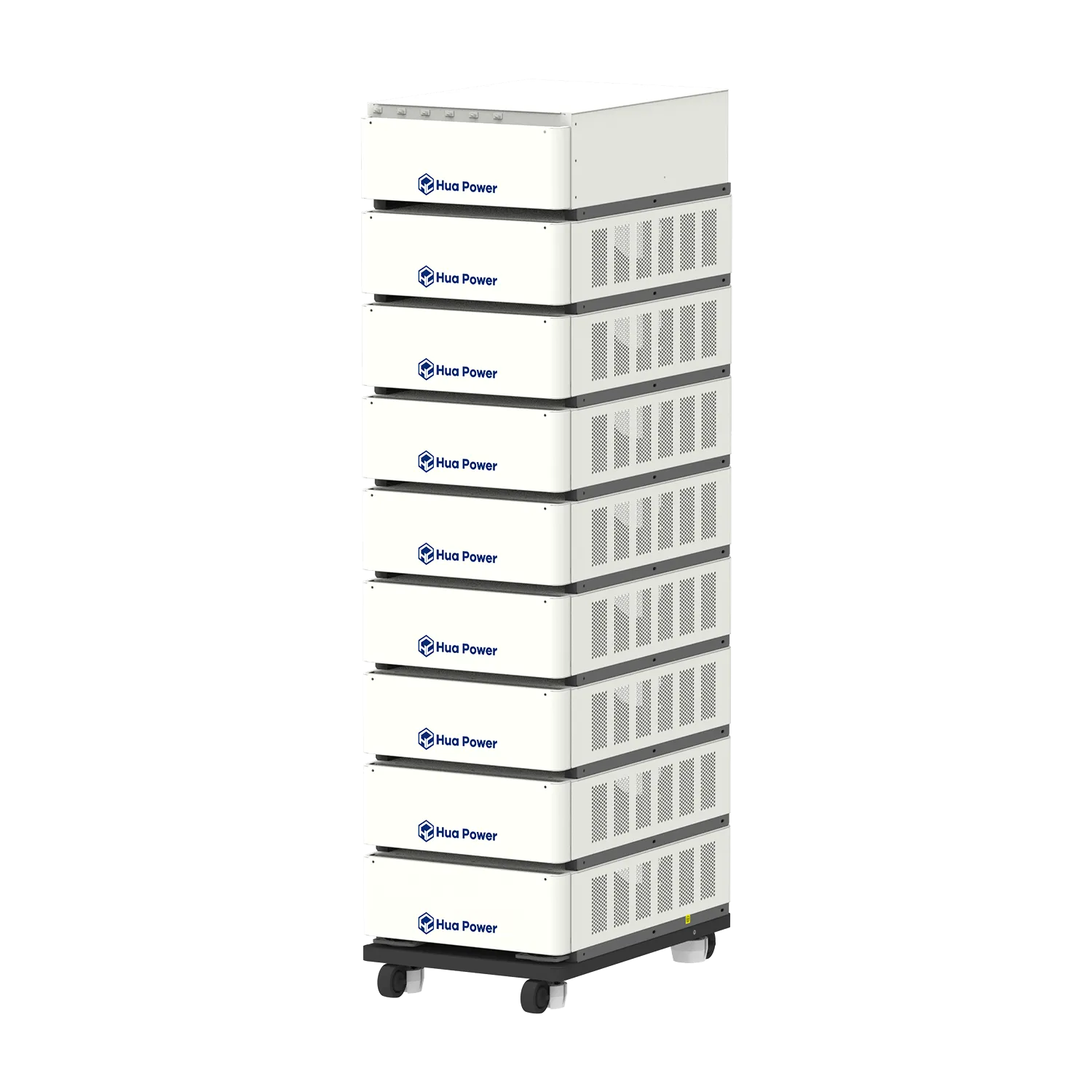
- Compact footprint — the HC-UPSSHV stack is a slim floor-standing tower (~422 mm wide) that grows vertically, not across your wall.
- High-power capability — HV pairs naturally with high-output hybrid inverters for demanding whole-home loads.
Safety and certifications
High-voltage DC deserves respect, and a good system is engineered around that. iHuapower's HC-UPSSHV stacks use LiFePO4 chemistry, which is the most thermally stable mainstream lithium chemistry — it resists thermal runaway far better than the NMC cells used in many EVs and some older home batteries (Battery University's lithium-ion types overview explains the chemistry trade-offs).
On top of the chemistry:
- Battery Management System (BMS): continuously monitors per-cell voltage, current, and temperature; balances cells; and disconnects on fault.
- Cell balancing keeps the series string even, which protects both capacity and cycle life.
- Thermal design: fan-assisted cooling with a rated operating range of −20 °C to 50 °C (de-rating above 45 °C).
- Build & protection: IP20 rating for indoor installation, C1 anti-corrosion, and operation up to 2,000 m altitude.
- Certification: CE and UN 38.3 (the transport-safety test standard for lithium batteries).
One honest note: because system voltage runs into the hundreds of volts DC, a modular HV battery is not a DIY install. It must be commissioned by a qualified installer who can handle HV DC safely and configure the inverter's battery parameters correctly.
How to size a modular HV battery system
First, a distinction that trips up most buyers: kWh is energy (how much you can store), kW is power (how fast you can use it). Capacity sizing is about kWh; making sure the system can run your heaviest simultaneous loads is about kW. You need enough of both.
Sizing comes down to what you want the battery to do. Rough residential guidance:
- Essential-loads backup (10–20 kWh): fridge, lights, Wi-Fi, a few circuits through an outage. The HC-UPSSHV20I (20.48 kWh) covers most homes here.
- Whole-home backup + daily solar shifting (20–35 kWh): run the majority of the house and store a full day's excess solar. HC-UPSSHV30I (30.72 kWh) is the sweet spot.
- Whole-home + EV charging or heavy loads (35–40 kWh+): HC-UPSSHV40I (40.96 kWh) for high daily throughput and large solar arrays.
Two quick methods to get concrete:
- From daily usage: find your average daily kWh (utility bill ÷ days), then decide how many days of autonomy you want. Storing your solar excess for self-consumption is usually the biggest value driver — the U.S. DOE's solar-plus-storage basics is a good primer on why.
- From backup runtime: add up the loads you must keep running and how long. Our battery backup duration calculator turns kWh into hours for a given load, and the Ah ↔ kWh converter helps if you're working from amp-hour figures.
Remember these are LiFePO4 packs rated at 90% depth of discharge, so usable capacity is close to the nameplate figure — and rated for ≥6,000 cycles at 80% state of health, i.e. well over a decade of daily cycling.
Inverter compatibility
A high-voltage battery only works with a high-voltage hybrid inverter — and the match has to be exact. The rule is simple: the battery's DC voltage window must sit inside the inverter's battery-input window. An HC-UPSSHV40I swings 345.6–460.8 V, so the inverter has to accept that range. HV stacks are DC-coupled to the hybrid inverter, which handles both solar and battery on the DC side for higher efficiency, and are available for single- or three-phase homes depending on the inverter you pair.
Two ratings matter beyond voltage: continuous power (what the system delivers all day — the HC-UPSSHV packs are rated 0.5C) and surge power (the brief spike to start motors like an AC compressor or well pump). Size both to your loads, not just kWh.
Most major HV hybrid inverter brands — for example Sol-Ark, Deye, GoodWe, Growatt, SolaX, Sungrow, and Solis — offer models with a battery window that suits residential HV stacks. Because compatibility varies by model, always confirm the tested list for your exact stack before ordering — the wrong pairing is the most common and most expensive mistake in a home storage project. For the deeper logic of matching a battery to an inverter (voltage windows, continuous vs. surge power, single- vs. three-phase), our inverter selection guide walks through it, and the battery C-rate guide explains how power ratings interact with capacity. When in doubt, send us your inverter model and we'll confirm the fit.
What does a modular HV battery system cost?
Pricing depends on capacity, your inverter, and local installation, but a useful frame is cost per kWh. Residential lithium storage typically lands somewhere around $400–$750 per kWh of usable capacity installed, varying widely by region, incentives, and installer — so a 20–40 kWh HC-UPSSHV system spans a broad range once inverter and labour are included. The modular advantage is financial as much as technical: you pay for 20 kWh now and add packs later, turning one large capital outlay into a staged one. For a firm figure on the HC-UPSSHV series in your market, request a quote with your target capacity and inverter.
A note on lifespan and warranty: the ≥6,000-cycle rating means well over a decade of daily cycling, and home LiFePO4 systems are generally backed by a multi-year (commonly ~10-year) warranty. Confirm iHuapower's exact warranty terms for the HC-UPSSHV series when you request specs.
iHuapower HC-UPSSHV series at a glance
The HC-UPSSHV series is iHuapower's modular high-voltage residential line — a slim indoor tower you size today and stack later.
Spec | Detail |
|---|---|
Models | HC-UPSSHV20I / HC-UPSSHV30I / HC-UPSSHV40I |
Capacity | 20.48 / 30.72 / 40.96 kWh |
Voltage range | 172.8–230.4 / 259.2–345.6 / 345.6–460.8 V |
Chemistry | LiFePO4 (3.2 V / 100 Ah cells) |
Pack building block | 51.2 V / 5.12 kWh (1P16S) |
Depth of discharge | 90% |
Cycle life | ≥6,000 cycles (80% SOH) |
C-rate | 0.5C |
Cooling | Fan-assisted, −20 °C to 50 °C |
Protection | IP20 (indoor), C1 anti-corrosion |
Comms | CAN / RS485 / Wi-Fi / Ethernet |
Certification | CE, UN 38.3 |
Explore the full high voltage energy storage range, see the HC-UPSSHV40I for the largest single-tower option, or browse the wider residential energy storage hub for sizing and backup guides. Prefer an integrated battery-plus-inverter unit? See the all-in-one residential ESS.
Frequently asked questions
Does stacking batteries increase voltage? In a high-voltage system, yes. Packs are wired in series, so each added pack raises system voltage. Four 51.2 V packs make ~205 V; eight make ~410 V. In a low-voltage (parallel) system, stacking adds capacity but keeps voltage flat.
Is high voltage or low voltage better for home solar? High voltage is generally better for whole-home backup, high-power loads, and large solar arrays — it's more efficient and uses thinner cabling. Low voltage is fine (and cheaper) for small essential-loads backup and simple installs.
How much capacity can a modular HV system reach? The HC-UPSSHV series stacks from 20.48 kWh (4 packs) to 40.96 kWh (8 packs) on a single tower — enough for whole-home backup plus EV charging in most homes.
Can I add battery packs later? Yes — that's the point of a modular system. You can expand the same tower under the same BMS. Plan expansions with your installer so packs balance cleanly; mixing packs of very different age in one string isn't recommended.
Are high-voltage LiFePO4 batteries safe? LiFePO4 is the most thermally stable mainstream lithium chemistry, and the BMS adds cell-level monitoring and fault isolation. The main caution is the HV DC itself, which is why these systems must be installed by a qualified professional.
Which inverters work with a high-voltage battery? Only high-voltage hybrid inverters whose battery-input voltage window overlaps the stack's range (e.g. 345.6–460.8 V for the HC-UPSSHV40I). Always confirm the exact compatibility list before buying.
How long does a modular HV battery last? The HC-UPSSHV packs are rated for ≥6,000 cycles at 80% state of health — well over ten years of daily cycling for a typical home.
The bottom line
A modular high voltage battery system gives you two things at once: the efficiency and clean cabling of high-voltage architecture, and the buy-as-you-grow flexibility of modular capacity. Start at 20 kWh, stack to 40, and let one BMS manage it all — matched to an HV hybrid inverter and installed by a professional.
If you're weighing HV against low-voltage, or trying to size a system for whole-home backup, talk to iHuapower's engineering team — send your daily usage and inverter model and we'll spec the right stack.