

Here is the thing most comparisons get wrong: wall-mounted vs stackable is not a battery question — it's an installation and scaling question. Both form factors can use lithium iron phosphate (LiFePO4) cells, similar usable depth of discharge (typically around 90%), and comparable cycle-life ratings of 6,000 cycles or more. What actually differs is where you can put the battery, how you grow it, and how much energy you can ultimately stack up.
Get that framing right and the decision becomes simple. A wall-mounted battery is a fixed, wall-hung unit — compact, often available with outdoor-rated protection, and ideal when floor space is tight and you need roughly 5–16 kWh of backup. A stackable battery is a floor-standing tower built from identical packs you stack on top of each other, expandable to 20–50 kWh (and beyond) by adding modules over time.
This guide compares the two honestly — with real specifications, real capacity and voltage numbers, named products, and a scenario-by-scenario decision framework. We build both form factors, so we have no reason to steer you toward one. The right answer depends on your wall, your floor, and your future.
Quick answer
- Choose wall-mounted if you want a compact, tidy installation (garage or exterior wall), outdoor placement where the system is appropriately rated, and a fixed capacity of about 5–16 kWh for essential-load or whole-home backup.
- Choose stackable if you want to start smaller and expand later, need 20–50 kWh of usable energy, prefer module-level serviceability, and have a bit of floor space indoors.
- A third option — rack-mounted batteries — exists too, but that's a server-rack format aimed at installers and larger sites, not a typical single-family home. More on the three-way distinction below.
What is a wall-mounted battery?
A wall-mounted battery is a self-contained energy storage unit designed to bolt directly to a wall — inside a garage, utility room, or (if the unit is weather-rated) on an exterior wall. It looks like a sleek, flat cabinet. You mount it, connect it to a compatible hybrid inverter, and the system is ready for commissioning.
Wall-mounted residential units are commonly low-voltage (48V-class, nominally 51.2V) systems. This architecture is relatively simple and compatible with a broad ecosystem of 48V-class hybrid inverters. The trade-off is capacity: a single wall unit typically holds 5–16 kWh, and you expand by hanging a second unit and wiring it in parallel rather than by growing one enclosure.
To put real numbers on it, iHuapower's residential wall-mounted line (the HC-UPSRB series) spans three sizes:
Model | Usable capacity | Weight | Cycle life |
|---|---|---|---|
HC-UPSRB5 | 5.12 kWh | 48 kg | ≥6,000 cycles |
HC-UPSRB10 | 10.24 kWh | 87 kg | ≥6,000 cycles |
HC-UPSRB16 | 16.08 kWh | 117 kg | ≥8,000 cycles |
All three use LiFePO4 cells, are rated for 90% depth of discharge, and are protected to IP65. This provides dust protection and resistance to water jets, making outdoor installation possible when local installation requirements are met. They also carry a C3 anti-corrosion rating for humid or near-coastal sites, and use quick-connectors plus CAN/RS485 communication to pair with common inverters — DEYE, Growatt, SMA, Victron, Goodwe, SOLIS and others.
Named example you'll recognise: the Tesla Powerwall is the archetypal wall-mounted home battery — a fixed, wall-hung unit you add to in whole increments rather than expand internally.
The wall-mounted watch-out is physical: a 16 kWh unit can weigh around 117 kg (258 lb). It has to be lag-bolted into studs or masonry that can carry the load, and when you outgrow it, your only path is a second unit beside the first — which can lead to "wall sprawl" in a small garage.
What is a stackable battery? (and how it differs from rack-mounted)
A stackable battery is a modular tower: identical battery packs that physically stack on top of a base, with each pack mechanically and electrically connected to the system below. You can buy the capacity you need today and add compatible packs later, subject to the system's configuration limits and manufacturer requirements.
Two quick clarifications, because the SERP is full of confusion here:
- Stackable ≠ rack-mounted. A stackable tower is a self-supporting, floor-standing stack aimed at homeowners. A rack-mounted battery is a 19-inch server-rack module that slots into a cabinet — a format installers use for larger residential and light-commercial systems. Same modular idea, different mechanical standard.
- Stackable comes in two voltage architectures. Low-voltage (LV, 51.2V nominal) stacks use a similar architecture to many 48V-class wall-mounted batteries and pair with compatible low-voltage hybrid inverters. High-voltage (HV) stacks connect battery packs in series to create a higher-voltage battery string, typically around 170–460V for the configurations discussed here. This can reduce current for a given power level and improve system-level power conversion efficiency when paired with a compatible HV hybrid inverter — the choice for bigger homes and future growth.
Here's iHuapower's stackable residential range (HC-UPSSHV high-voltage / HC-UPSSLV low-voltage), so you can see how capacity scales pack-by-pack:
Model | Packs / tower | Usable capacity | Voltage platform |
|---|---|---|---|
HC-UPSSxV20I | 4 packs | 20.48 kWh | HV 172–230V / LV 51.2V |
HC-UPSSxV30I | 6 packs | 30.72 kWh | HV 259–346V / LV 51.2V |
HC-UPSSxV40I | 8 packs | 40.96 kWh | HV 346–461V / LV 51.2V |
HC-UPSSLV50I | 10 packs | 51.2 kWh | LV 51.2V |
Every pack is a 1P16S LiFePO4 module. The towers are fan-cooled, rated IP20 for indoor installation, and provide a rated cycle life of ≥6,000 cycles at 90% DoD under the specified test conditions.
Named examples: the BYD Battery-Box and Pylontech stack systems are the best-known modular towers, and industry players like Enphase and Generac PWRcell offer their own modular takes.
The stackable watch-out is the mirror image of wall-mounting: a fully-loaded 50 kWh tower weighs up to ~500 kg, needs a stable floor and indoor space, and — because it's IP20 — it cannot live outdoors uncovered.
Wall-mounted vs stackable battery: side-by-side comparison
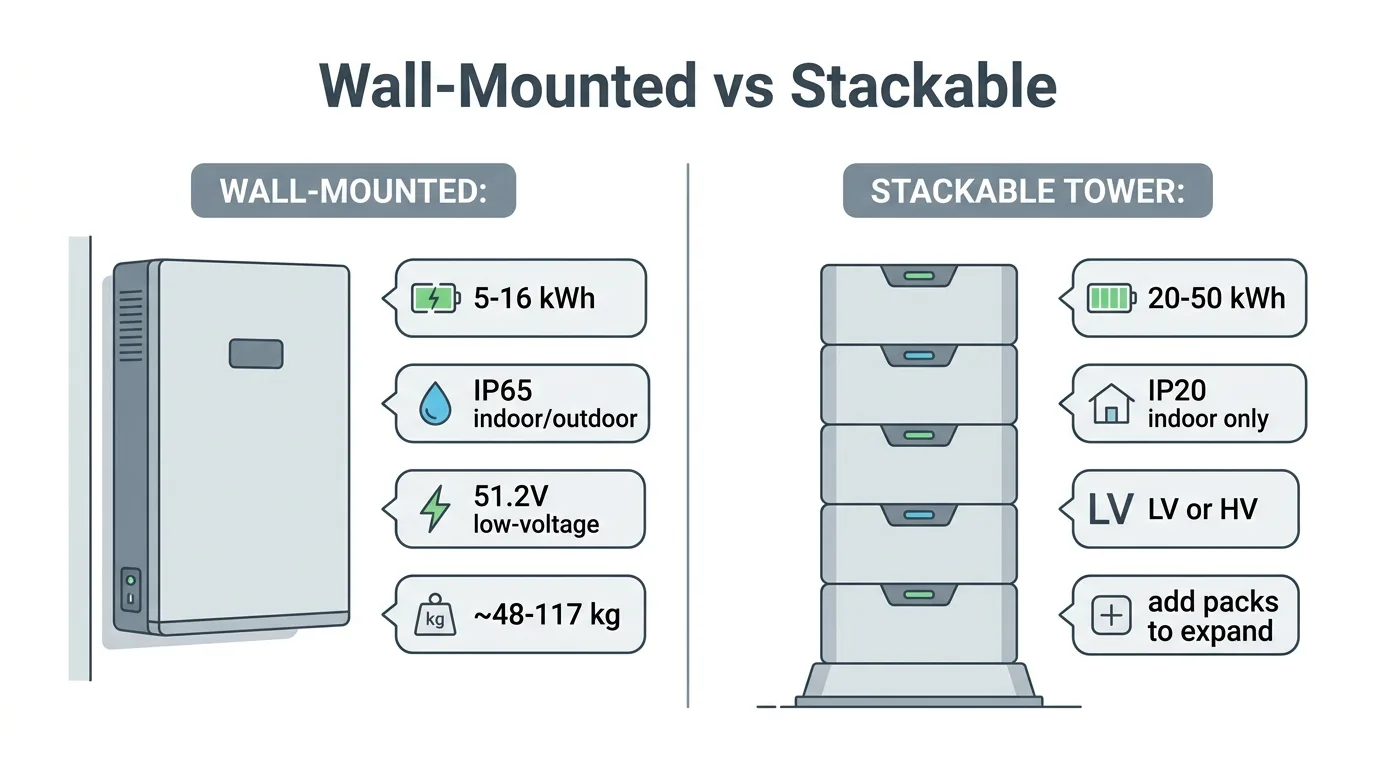
Dimension | Wall-mounted | Stackable tower |
|---|---|---|
Typical usable capacity | 5–16 kWh | 20–50 kWh (per tower) |
Continuous power | ~5–7 kW/unit (inverter-bound) | ~10 kW+ (HV, inverter-bound) |
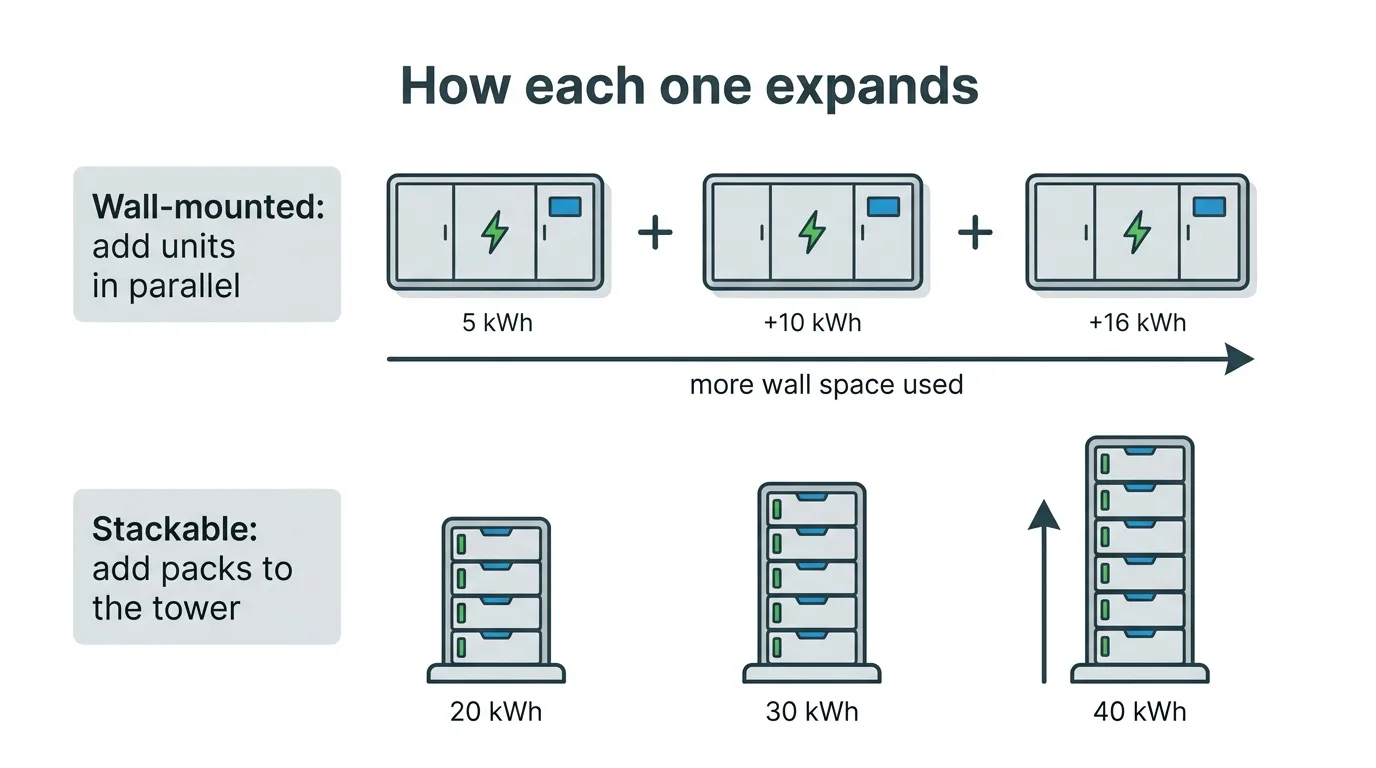
How it scales | Add a second unit in parallel | Add packs to the same tower |
Voltage platform | Low-voltage (51.2V) | Low- or high-voltage (up to ~460V) |
Footprint | Wall space, ~0 floor | Floor space, ~0.3 m² |
Weight | ~48–117 kg per unit | ~210–500 kg per tower |
IP rating / placement | IP65 — indoor or outdoor | IP20 — indoor only |
Cooling | Sealed / passive | Fan-cooled |
Serviceability | Replace the whole unit | Swap a single pack |
Cycle life | ≥6,000–8,000 | ≥6,000 |
Depth of discharge | 90% | 90% |
Round-trip efficiency | ~90–95% (system) | ~90–95%; HV edges higher at scale |
Typical warranty | ~10 yr / throughput-based | ~10 yr / throughput-based |
Indicative price | ≈ $350–600/kWh* | ≈ $300–550/kWh* |
Best fit | Compact, outdoor, fixed backup | Expandable, indoor, high-capacity |
<sub>*Indicative equipment cost per kWh only; installed price varies widely by market, inverter and labour. Always get a per-kWh quote for your configuration.</sub>
Two things jump out. First, the batteries themselves are nearly identical on chemistry, DoD, efficiency and cycle life — so don't expect one form factor to "last longer" than the other. Second, the real fork in the road is footprint + IP rating + how you scale. That's the decision, and the rest of this guide unpacks it.
Space, capacity and scalability
This is the axis that decides most installs.
Wall-mounted saves floor space but caps your ceiling. If your garage floor is full and you have clear wall, a wall unit is perfect — until you need more than ~16 kWh. Then you're hanging a second unit and paralleling it, which works but eats more wall and adds a second point of maintenance. Wall systems can parallel several modules (iHuapower's design allows up to 8 recommended), so they're not a dead end — but each step is a discrete new box.
Stackable saves wall space and scales gracefully. The modular tower is built for the homeowner who wants to start at 20 kWh and grow to 40. You add packs to the existing tower, the BMS re-balances, and your usable capacity climbs without a forklift upgrade. For a household adding an EV, a heat pump, or more solar over the next few years, that phased path is the whole point — and it means your upfront spend amortises over time.
If your needs push past ~50 kWh — a large off-grid home or a small business — you've effectively crossed into commercial territory, where floor-standing cabinets and cabinets-in-parallel take over. (If that's you, our C&I battery storage sizing guide covers the 100–500 kWh tier.)
Installation, siting and cost
Placement is gated by the IP rating, and this is where wall and stack genuinely diverge:
- Wall-mounted (IP65) can be installed outdoors — an exterior garage wall, a carport, a side yard — which is a lifesaver when you have no indoor space to spare. The sealed enclosure helps protect the battery from dust and water ingress, while the system's thermal design determines whether cooling is passive or active.
- Stackable (IP20) must be installed indoors — a garage, basement, or utility room — because its IP20 enclosure is intended for indoor installation and does not provide protection against outdoor weather exposure. The upside of that fan is steadier thermal performance under heavy cycling.
If you live somewhere hot, humid or coastal, note the corrosion class too: wall units rated C3 tolerate tougher outdoor atmospheres than an indoor-rated C1 tower. (The indoor-vs-outdoor siting logic scales up to commercial gear as well — see outdoor vs indoor energy storage cabinets.)
On cost, be skeptical of anyone quoting form factor as "cheaper" without numbers. The cells cost roughly the same per kWh in both — you're buying the same LiFePO4. The real cost differences are:
- Installation labour. Wall-mounting a 100+ kg unit into structural studs is more rigging work than standing a tower on a floor; stacking packs is largely tool-free.
- Balance-of-system. HV stackable towers can improve inverter efficiency at higher capacities, trimming lifetime energy losses.
- Phasing. Stackable lets you spread the spend — buy 20 kWh now, add 20 kWh in two years — instead of paying for capacity you won't use yet.
Installed residential storage broadly lands in the four-figures-per-kWh range depending on market, inverter and labour; treat form factor as roughly cost-neutral on the battery itself and let installation and scaling drive your total. Always get a per-kWh quote for your specific configuration.
Maintenance, serviceability and single-point-of-failure
A quiet but important difference: what happens when something fails.
With a single wall-mounted unit, the battery is one sealed block. If a fault takes it offline, your whole storage system is down until it's serviced or replaced — a genuine single-point-of-failure. That's fine for many homes, but worth knowing if the battery is your backup lifeline.
A stackable tower spreads that risk across packs. If one pack faults, you (or your installer) swap that one module and the tower keeps running on the rest. For homeowners who value resilience and easy field service, modularity is a real advantage — and it's why the format dominates larger residential systems.
On safety, both form factors benefit from LiFePO4's headline advantage: it is far more resistant to thermal runaway than the nickel-based (NMC) chemistry used in some older wall units, which is why LFP now dominates residential storage. Whatever you choose, look for cells and systems tested to recognised standards — UL 9540A is a key test method for evaluating thermal runaway and fire propagation characteristics of battery energy storage systems, and it matters most for indoor or garage installs where an IP20 tower will live.
Low-voltage vs high-voltage: which architecture?
This choice rides along with form factor, so it's worth a moment.
- Low-voltage (51.2V) — all wall units and LV stacks. Simplest, safest to work around, and compatible with the enormous 48V hybrid-inverter market (DEYE, Growatt, Victron, etc.). Ideal up to ~20–30 kWh.
- High-voltage (170–460V) — HV stackable towers only. Series-connected packs raise the string voltage, which improves conversion efficiency and current handling at larger capacities, and pairs with HV hybrid inverters. Ideal when you're building toward 30–50 kWh or want maximum efficiency.
Rule of thumb: small and simple → low-voltage wall or LV stack; large and future-proofed → high-voltage stack. Match the battery's voltage platform to your inverter — an LV battery must be paired with a compatible LV inverter, while an HV battery requires a compatible HV inverter and communication architecture.
One more integration note that cuts across form factor: AC-coupled vs DC-coupled. If you're adding storage to an existing solar array, an AC-coupled setup is the simpler retrofit; if you're building solar and storage together, a DC-coupled hybrid inverter is usually more efficient. Both wall and stackable batteries can work either way — it's the inverter, not the battery's shape, that decides.
Which should you choose?
Your situation | Best form factor |
|---|---|
Floor space is tight; you have clear wall | Wall-mounted |
No indoor room — must install outside | Wall-mounted (IP65) |
You need ~5–16 kWh for essential-load backup | Wall-mounted |
Coastal / humid site, outdoor install | Wall-mounted (C3) |
You want to start small and expand later | Stackable |
You need 20–50 kWh now or soon | Stackable |
You value swapping a single module on failure | Stackable |
You're chasing max efficiency at high capacity | High-voltage stackable |
Adding an EV, heat pump or more solar over time | Stackable (phased) |
If your honest answer is "a bit of both" — say, a compact outdoor unit now with a plan to expand a lot later — that's the conversation to have with your installer before you buy, because the inverter you choose locks in your path.
How iHuapower's residential batteries fit
Because we manufacture both form factors, we size to the constraint rather than the catalogue:
- Compact, outdoor, fixed backup → HC-UPSRB wall-mounted (5.12 / 10.24 / 16.08 kWh). IP65, C3-rated, LFP, 90% DOD, and inverter-agnostic across the major 48V hybrids. The right call for space-constrained and outdoor installs.
- Expandable, indoor, high-capacity → HC-UPSSLV / HC-UPSSHV stackable (20–50 kWh). Add packs as you grow, choose LV for simplicity or HV for efficiency at scale, with per-pack serviceability.
- Beyond 50 kWh → our C&I cabinets, where the same LFP platform continues up into the hundreds of kWh.
The point isn't which line we sell you — it's matching your wall, your floor and your five-year plan to the form factor that fits.
FAQ
Which is better for home solar backup — wall-mounted or stackable? Neither is universally better. For a compact 5–16 kWh backup with limited space or an outdoor install, wall-mounted wins. For 20–50 kWh with room to expand and indoor space, stackable wins. Both use the same LiFePO4 cells and pair with hybrid inverters for solar self-consumption.
What's the difference between stackable and non-stackable (sealed) batteries? A stackable battery is modular — you add or swap individual packs, and a single failed pack doesn't take down the whole system. A non-stackable (sealed wall) unit is one block: to expand you add a whole second unit, and a fault affects the entire battery. Stackable trades a slightly larger footprint for expandability and serviceability.
Can you place wall-mounted batteries side by side to get more capacity? Yes. Wall units expand by installing additional modules in parallel — iHuapower's design supports up to 8 recommended. It works well, but each unit is a separate box needing its own wall space, versus a stackable tower that grows within one footprint.
Do stackable batteries need floor space? Yes — they're floor-standing towers with roughly a 0.3 m² footprint, and because they're typically IP20 they must be indoors (garage, basement, utility room). Wall-mounted units free the floor entirely and, if IP65-rated, can go outside.
High-voltage or low-voltage stackable — which should I pick? Low-voltage (51.2V) is simpler, safer to work around, and pairs with the common 48V inverter ecosystem — great up to ~20–30 kWh. High-voltage (170–460V) improves efficiency and current handling at larger capacities and pairs with HV hybrid inverters — better when you're building toward 40–50 kWh. Match the battery to your inverter's voltage class.
Is one form factor cheaper? On the battery itself, no — both use the same LiFePO4 cells at similar cost per kWh. Your total cost is driven by installation labour (wall-mounting heavy units vs. standing a tower), balance-of-system, and whether you phase the purchase. Stackable's ability to add capacity later can lower your upfront outlay. Always get a per-kWh quote for your exact configuration.