

Search "48V LiFePO4 battery" and you get a wall of product grids that all look the same: 65% lighter than lead-acid, 10× the lifespan, thousands of cycles, and a price that seems too good until you notice the next listing is half as much. What almost none of them tell you is what actually separates a battery that lasts fifteen years from one that quietly dies in three — or the single naming quirk that confuses nearly every first-time buyer.
This guide fixes both. It's written for homeowners sizing their first solar or backup battery and for the installers who wire these systems every week. We'll start with the "48V vs 51.2V" question (they're the same battery), then read a real spec sheet line by line, expose the three things the spec sheet hides — the BMS, the cells, and inverter compatibility — and finish by matching the numbers to actual products you can buy. By the end you'll be able to look at any 48V listing and tell, in about a minute, whether it's honest.
In a hurry? If you already know your size and just want buyable options, our low-voltage residential battery range lists the 5–51 kWh models. If you want to buy the right one, read on.
The short version: A "48V" LiFePO4 battery is really 51.2V nominal — sixteen 3.2V lithium iron phosphate cells in series (16S). It's the standard voltage for whole-home solar and backup because higher voltage means lower current, thinner cables and less loss than 12V or 24V. When you compare units, the headline kWh and Ah tell you size, but the BMS continuous-current rating, the cell grade, and closed-loop comms with your inverter decide quality. Match the battery to a 48V hybrid inverter (most DC-coupled brands work; AC-coupled microinverter systems usually don't), size it to your daily kWh, and insist on a real spec sheet with UL/IEC certifications — not a marketing grid.
First: "48V" and "51.2V" are the same battery
This is the question that trips up almost everyone new to home storage, so let's kill it first. A 48V LiFePO4 battery and a 51.2V LiFePO4 battery are not two products — they're two names for the same thing.
LiFePO4 (lithium iron phosphate, often shortened to LFP) cells have a nominal voltage of 3.2V each. Put sixteen in series — the industry calls this 16S — and you get 16 × 3.2V = 51.2V nominal. "48V" is the older, rounded shorthand carried over from lead-acid systems, which stacked four 12V batteries. The battery industry kept the "48V" label because that's what inverters, chargers and installers already called the class, even though lithium's real resting voltage is 51.2V.
So when a listing says 48V and the spec sheet says 51.2V, nothing is wrong. What matters is the operating range those cells swing through as they charge and discharge:
State of charge | Pack voltage (51.2V nominal) | Per cell | What's happening |
|---|---|---|---|
Full / charge target | ~57.6V (up to 58.4V) | 3.60–3.65V | The charge voltage your inverter must be set to |
~90% resting | ~54.4V | 3.40V | Comfortable top of daily cycling |
50% | ~51.2V | 3.20V | The "nominal" midpoint the class is named for |
20% | ~50.4V | 3.15V | Getting low; plan to recharge |
Empty / cutoff | ~43.2–44.8V | 2.70–2.80V | BMS disconnects to protect the cells |
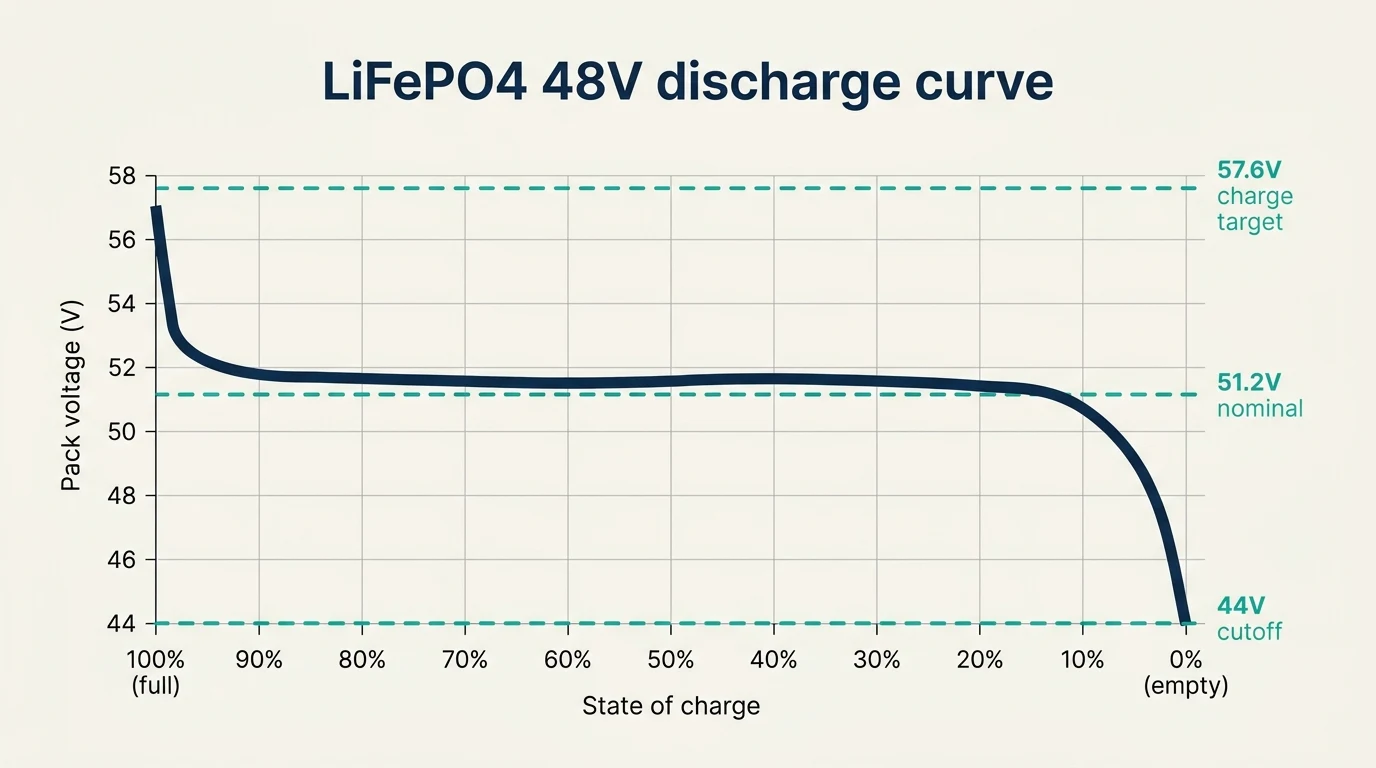
The 51.2V nominal name comes from the flat middle of the curve — LFP holds near 51.2V across most of its usable range, which is why voltage alone is a poor fuel gauge.
Two practical takeaways. First, the number that matters most on that chart is the charge voltage (~57.6V) — set your inverter or charger wrong and you'll either never fill the battery or push it past safe limits. Second, notice how flat the middle of the range is: LFP holds close to 51.2V across most of its usable capacity, which is exactly why voltage alone is a poor fuel gauge and why a good battery reports state of charge over comms instead.
Why LiFePO4 won home storage
If you're choosing a home battery in 2026, the chemistry decision is largely made for you: LiFePO4 has become the default for residential storage, and for three concrete reasons.
- Cycle life. A quality LFP home battery is rated for 6,000 to 8,000+ full cycles to 80% of original capacity. Cycle it daily and that's roughly 15–20 years. Lead-acid gives you a few hundred to maybe 1,500 cycles; that's the difference between one battery and four or five over the same period.
- Usable capacity (depth of discharge). LFP can safely discharge to 90–100% of its rated capacity. Lead-acid you only want to pull to about 50% before you damage it — so a "10 kWh" lead-acid bank really gives you 5. A 10 kWh LFP battery at 90% DoD gives you about 9 kWh usable. You buy far less nameplate for the same real energy.
- Safety and efficiency. LFP is the most thermally stable lithium chemistry — far more resistant to thermal runaway than the NMC (nickel-manganese-cobalt) chemistry used in phones, EVs and some older home batteries. It's also ~95% round-trip efficient, versus 80–85% for lead-acid, so less of your solar is lost to heat on the way in and out.
The short version: LFP costs more per kWh up front than lead-acid and slightly less than NMC, but its lifespan and usable-capacity advantages make it the lowest lifetime cost for a battery that cycles every day. That's why the whole 48V residential market has standardized on it.
How to read a 48V LiFePO4 spec sheet
Every 48V listing leads with two numbers. Get these straight and you can compare any two batteries honestly.
kWh is the size of the tank. Kilowatt-hours measure energy — how much the battery stores and therefore how long it runs your loads. Home batteries cluster around 5, 10 and 16 kWh per module.
Ah is the same number in different clothes. Amp-hours measure charge capacity, and the two are linked by voltage:
kWh = Volts × Ah ÷ 1,000
So a 51.2V battery built on 100Ah cells is 51.2 × 100 ≈ 5.12 kWh; 206Ah ≈ 10.24 kWh; 314Ah ≈ 16.08 kWh. If a listing gives you Ah but not kWh (common on rack batteries), that one formula converts it. Our free Ah ↔ kWh converter does it for you if you'd rather not do the arithmetic by hand.
Three more numbers decide whether the battery fits your loads:
- Usable vs rated kWh. Rated is the number on the box; usable is rated × depth of discharge. At 90% DoD, a 10.24 kWh battery delivers about 9.2 kWh you can actually touch. Honest spec sheets state both — vague ones only quote the bigger number.
- Continuous discharge current (and C-rate). This caps how much power you can pull at once. A 51.2V battery rated for 150A continuous delivers about 51.2 × 150 ≈ 7.7 kW — enough to start an air conditioner or run a well pump. A cheap unit with a 50A BMS on the same cells can only give you ~2.5 kW, no matter how many kWh are inside. This is where a lot of "bargain" batteries quietly fall short, so read it carefully.
- Peak/surge current. Motors (pumps, compressors, fridges) draw 3–7× their running wattage for a split second at startup. Check that the battery's surge rating covers it.
What the spec sheet hides (where quality actually lives)
Here's the part the product grids never show you, and the reason two "48V 100Ah LFP" batteries can differ in price by 3× and in lifespan by 5×. When merchants and forums argue about which cheap Amazon unit to trust — a debate you can watch play out in threads like DIY Solar Forum's long-running buyer-beware discussions — this is what they're really arguing about.
1. The BMS (battery management system). The BMS is the brain: it balances the sixteen cells, disconnects on over/under-voltage, over-current and temperature faults, and (on good units) reports state of charge to your inverter. Two things separate a real BMS from a token one:
- Continuous current rating — the true ceiling on power output, discussed above. A battery is only as strong as its BMS lets it be.
- Active vs passive balancing. Passive balancing bleeds off energy from high cells as heat — cheap, slow, and it does nothing while discharging. Active balancing shuttles charge from strong cells to weak ones, keeping the pack matched over years. Sixteen cells in series are only as good as the weakest one, so balancing quality is longevity.
2. The cells. "LiFePO4" on the label says nothing about whose LFP. Grade-A cells — from tier-one makers like CATL, EVE or REPT — are matched, fully tested, and rated for the cycle life on the box. Grade-B cells are factory seconds: cosmetic rejects, capacity mismatches, or cells that failed a test bin. They're cheaper, they're everywhere in no-name batteries, and they're the usual reason a "6,000-cycle" battery loses a third of its capacity in two years. A manufacturer that states its cell source is telling you something the reseller who won't can't.
3. Overstated capacity. The oldest trick: a battery sold as "100Ah" that delivers 80. Because a sealed pack is hard to test, dishonest listings inflate the number. Your defense is to check for third-party certification — **UL 1973 (battery safety), **UL 9540 (system safety), IEC 62619, and UN38.3 (shipping) — because certified cells are tested to their rated capacity. If a listing shows a rock-bottom price and no certifications, assume the capacity is optimistic.
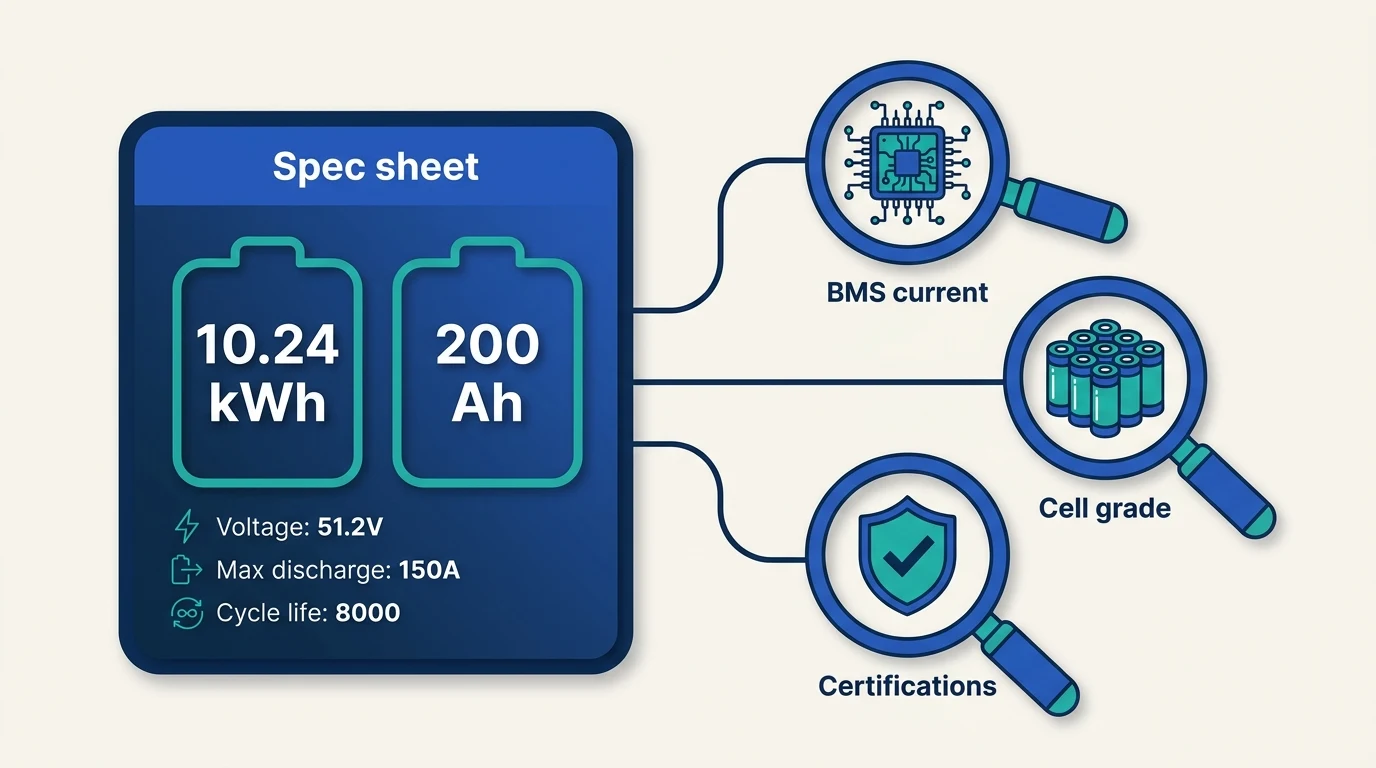
The headline kWh and Ah are the easy part — the BMS current rating, the cell grade, and the certifications are where a good 48V battery separates from a bad one.
The uncomfortable truth is that none of these three live on the marketing grid — you have to open the real datasheet. As a rule: if a seller won't publish the BMS continuous-current rating, the cell manufacturer, and the certifications, treat the low price as the warning it is.
Form factor: wall-mount, server-rack, or stackable
48V LFP batteries come in three physical shapes, and the right one depends on where it lives and how big it needs to grow.
Form factor | Looks like | Best for | Typical size |
|---|---|---|---|
Wall-mounted | A flat Powerwall-style box on the wall | Clean indoor/garage installs, whole-home backup, tidy solar retrofits | 5–16 kWh per unit |
Server-rack | 3U modules that slide into a 19" rack | Installers and prosumers who want to stack modules and hot-swap; growing fast | ~5 kWh (100Ah) per module |
Floor-standing / stackable | Modules stacked into a tower | Larger homes and off-grid; highest capacity in one footprint | 20–50 kWh per tower |
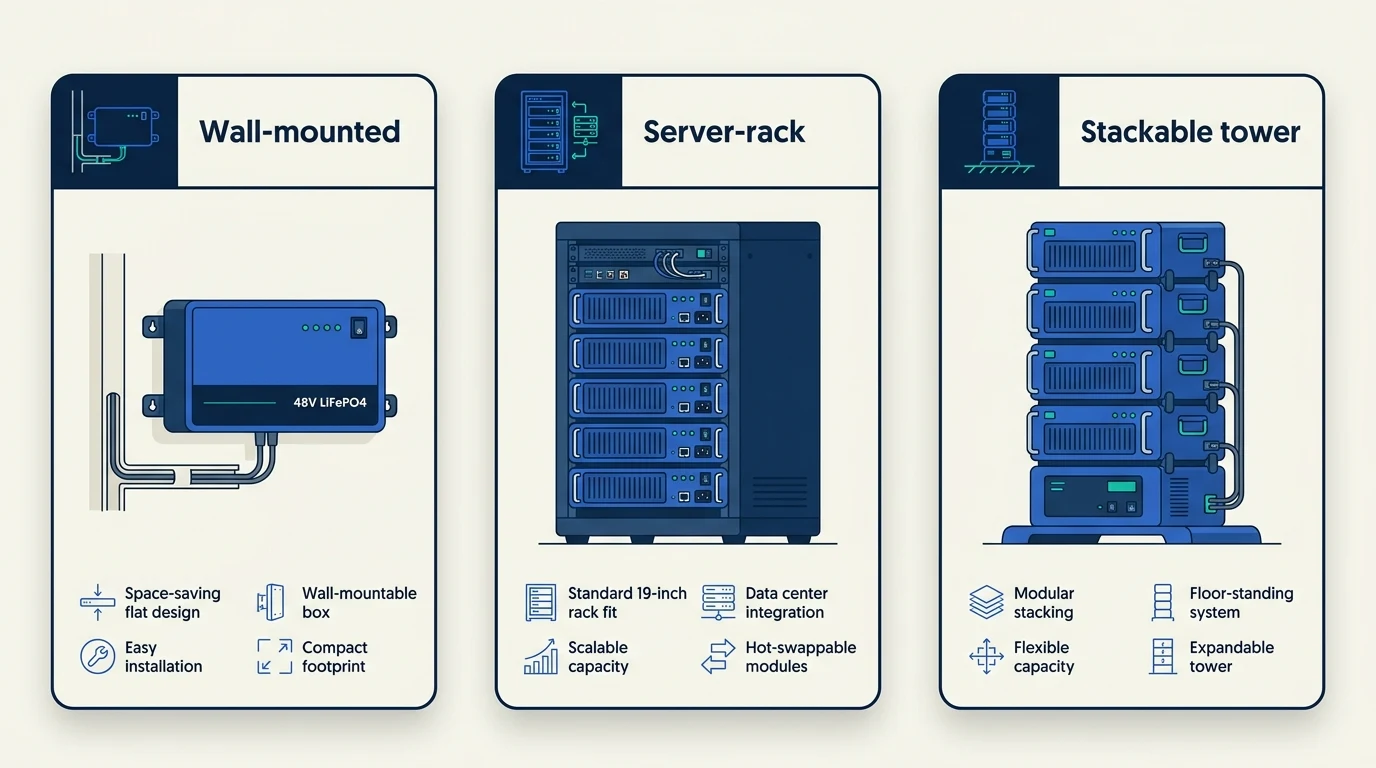
Same 51.2V cells, three packages: wall-mounted for tidy home installs, server-rack for easy stacking, floor-standing towers for the largest whole-home and off-grid jobs.
Server-rack batteries (the "48V server rack battery" you'll see searched a lot) are popular with the DIY-solar crowd because they're modular and easy to parallel. Wall-mounted units win on looks and simplicity for a typical home. Stackable towers are the answer once you pass ~16 kWh and want whole-home or off-grid capacity in a single footprint. All three use the same 51.2V cells — the choice is about installation and how you plan to scale, which brings us to the next point.
One 48V module is usually enough to start, not to finish. The value of a modular line is that you buy for today's job and add matched modules later — most good residential batteries parallel up to 8–16 units. If you're weighing a single wall box against a stackable tower, our residential energy storage guides walk through the trade-off.
Your battery is only as smart as your inverter
This is the most expensive mistake in home storage, and it has nothing to do with the battery's specs. A 48V battery does nothing on its own — it needs a 48V hybrid inverter to turn its DC into the AC your house uses, to charge it from solar or grid, and to switch to backup when the power fails. Get the pairing wrong and a perfectly good battery underperforms or won't work at all.
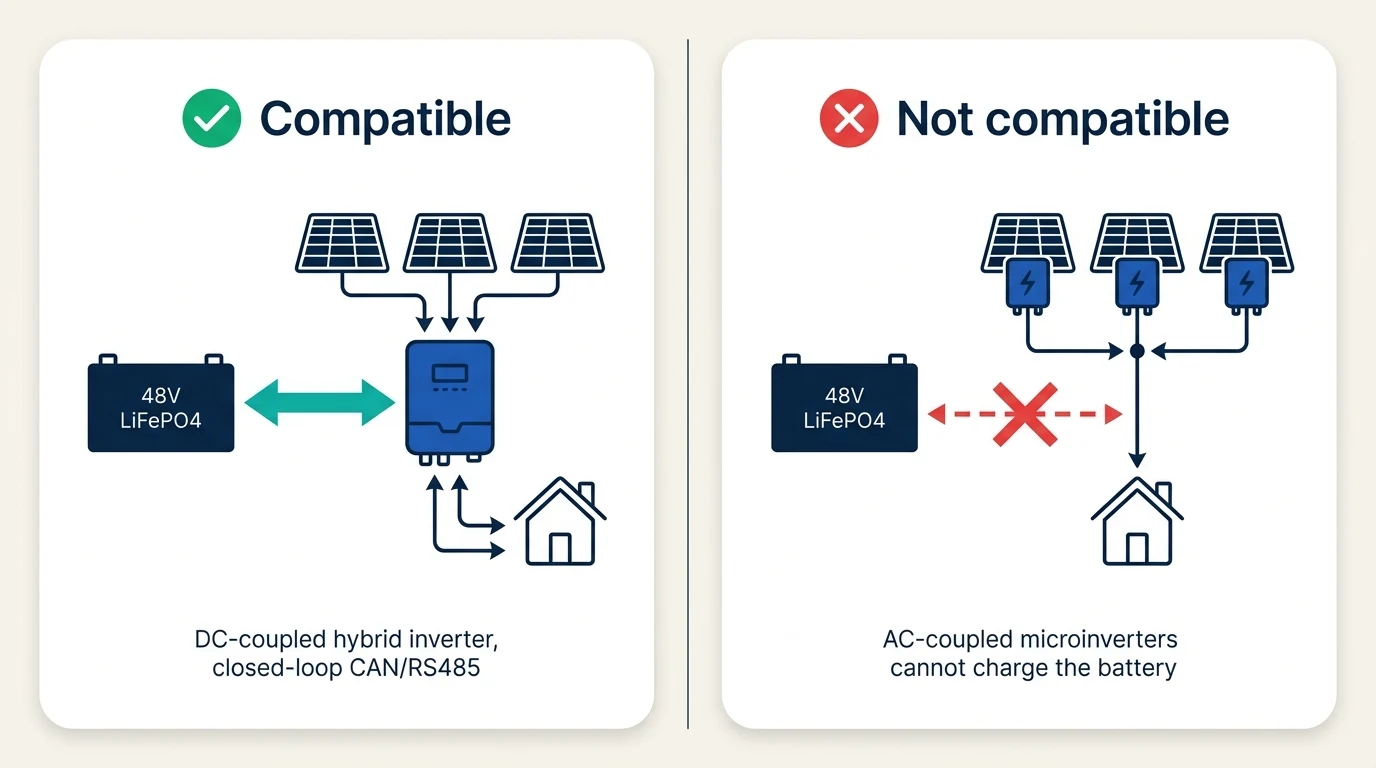
A 48V battery pairs with a DC-coupled hybrid inverter over closed-loop CAN/RS485 comms; AC-coupled microinverter systems (SolarEdge, Enphase) usually can't charge it directly.
Two compatibility layers matter:
- Voltage and coupling. The inverter must be a 48V DC-coupled hybrid or off-grid unit set to the LFP charge profile (~57.6V charge, ~44V cutoff). Most string-inverter and hybrid brands are — Deye, Growatt, Victron, Sol-Ark, SMA, Goodwe, Luxpower, Solis and others. The important exception: AC-coupled microinverter systems (SolarEdge, Enphase) generally cannot charge a 48V DC battery directly, because there's no shared DC bus. If you have an existing microinverter array, confirm the path before you buy either component.
- Closed-loop communication. The best setups let the battery's BMS talk to the inverter over CAN bus or RS485, sharing real state of charge, temperature and charge/discharge limits. This "closed-loop" comms is far safer and more precise than the inverter guessing from voltage alone. It only works when both sides speak a compatible protocol — which is why batteries publish a compatible-inverter list, and why you should check yours is on it.
Practically: pick your inverter and battery as a pair, confirm the battery appears on the inverter's supported list (and vice-versa), and make sure the continuous power you need (kW) is within both the inverter's rating and the battery's discharge current. Getting this right is the difference between a system that just works and a week of firmware troubleshooting.
Sizing and charging a 48V bank
How much capacity? Size from your own daily use, not a rule of thumb. Read your monthly kWh off your utility bill and divide by 30 for a daily figure, then decide the job: essential-loads backup (fridge, lights, internet — usually 5–10 kWh), whole-home backup including AC and electric heat (16 kWh and up, often stacked), or solar self-consumption (size to your daily surplus, typically 10–16 kWh). Our battery backup duration calculator lets you test a specific set of circuits against a given battery size, with depth-of-discharge and inverter losses built in.
How many batteries to reach 48V? This one confuses people: you do not wire several 12V batteries in series to make 48V. A modern 48V LFP battery is already 51.2V internally (16S). You buy one 48V module and, if you need more capacity, add more in parallel — same voltage, more Ah. Series stacking is only for high-voltage systems, which are a different product class.
Charging. Set your charger or inverter to the LFP profile: ~57.6V absorption (up to 58.4V), no float needed, and a low-voltage cutoff around 44V that the BMS enforces anyway. One real gotcha: LFP cannot charge below about 0°C (32°F) without damage, so cold-garage and outdoor installs need a battery with low-temperature charge protection or built-in self-heating. Discharging in the cold is fine; it's charging that's the risk. For long-term storage, leave an LFP battery at ~40–60% state of charge, not full.
How to avoid a bad 48V battery
Pulling the buyer-beware thread together into a checklist you can run against any listing. If a seller can't answer these, that is the answer:
- Does it publish the BMS continuous-current rating? Not just peak — continuous. This caps your real power. A 51.2V/150A battery gives ~7.7 kW; a hidden 50A BMS gives ~2.5 kW on identical cells.
- Does it name the cell manufacturer and grade? "Grade-A CATL/EVE/REPT" is a claim they'll stand behind; silence usually means grade-B seconds.
- Does it carry real certifications? UL 1973 / UL 9540 / IEC 62619 / UN38.3 — these gate insurance, permits and shipping, and prove the cells were tested to rating.
- Does it state usable and rated kWh, plus DoD? Honest sheets give both; inflated ones quote only the big number.
- Is it on your inverter's compatibility list (and does it do closed-loop CAN/RS485)?
- What's the real warranty — years and cycle/throughput terms, from a company that will still exist to honor it?
The honest way to compare prices across all of this is cost per usable kWh — divide the total price by the usable energy (rated kWh × depth of discharge), not the nameplate. It lets you line up a certified grade-A battery against a bargain listing on the same scale, and it's usually where the "cheap" unit stops looking cheap once you account for its shorter life and shallower usable capacity.
A 48V LFP battery is a 15-year purchase. The price gap between an honest one and a bargain-bin one is small next to the cost of replacing a dead battery in year three — spend the extra minute on the datasheet.
Which iHuapower 48V LFP battery fits you
We build 48V (51.2V) LiFePO4 residential batteries, so here's how our own line maps to the sizing above — with the numbers this guide told you to check, published rather than hidden.
Your situation | Model | Capacity | Real discharge | Cycle life | Form |
|---|---|---|---|---|---|
Apartment / essential-loads backup | HC-UPSRB5 | 5.12 kWh | 100A (~5 kW), up to 5 kW inverter | ≥6,000 cycles | Wall-mount, IP65 |
Typical home essentials / evening solar | HC-UPSRB10 | 10.24 kWh | 150A (~7.7 kW), up to 5 kW inverter | ≥8,000 cycles | Wall-mount, IP65 |
Larger / all-electric / EV home | HC-UPSRB16 | 16.08 kWh | 155A (~7.9 kW), up to 7 kW inverter | ≥8,000 cycles | Wall-mount, IP65 |
Battery + inverter in one box | HC-UPSRAP16I | 16.08 kWh | 6 kW built-in, 10 ms UPS switchover | ≥6,000 cycles | All-in-one, 9 kW MPPT |
Whole-home / off-grid (stacked) | HC-UPSSLV 20–50I | 20.5–51.2 kWh | 0.5C, low/high-voltage clusters | ≥6,000 cycles | Stackable tower |
(The amp figure is the battery's own discharge ceiling; in normal use the paired inverter sets your usable kW, and each battery is specced with headroom above its recommended inverter so the battery is never the bottleneck.)
Every wall-mounted unit is built on 51.2V, 16S LiFePO4 with 90% depth of discharge, an intelligent BMS with cell balancing and circuit-breaker protection, IP65 enclosures, quick-connect terminals, and CE / IEC 62619 / UN38.3 certification. They parallel up to 16 units (8 recommended for a home) for capacity you add as you grow, and they're compatible with 20+ hybrid-inverter brands — Deye, Solis, Growatt, Luxpower, Victron, Goodwe, SMA and Afore among them — so the battery fits your inverter rather than locking you to one ecosystem. The low-voltage residential battery range covers the 5/10/16 kWh wall units and the stackable systems; the all-in-one residential system bundles the inverter for a simpler install.
Not sure which capacity your loads point to? Send us your daily kWh and the loads you want to back up and our application engineers — the people who size and commission these systems every week — will confirm the fit and the right inverter to pair.
FAQ
Is a 48V and a 51.2V LiFePO4 battery the same thing? Yes. "48V" is the rounded legacy name; 51.2V is the true nominal voltage of sixteen 3.2V LFP cells in series (16S). Same battery, two labels. You'll see both used interchangeably on the same spec sheet.
How many LiFePO4 batteries do I need in series for a 48V system? None — a modern 48V LFP battery is already 16 cells in series internally (51.2V). You buy one 48V module; to add capacity you connect modules in parallel (same voltage, more amp-hours), not in series.
What voltage should I charge a 48V LiFePO4 battery to? About 57.6V absorption (roughly 3.6V per cell), up to 58.4V maximum. There's no float stage like lead-acid, and the BMS enforces a low-voltage cutoff around 44V. Always set your inverter/charger to the LFP profile.
How long does a 48V LiFePO4 battery last? A quality unit is rated 6,000–8,000+ cycles to 80% capacity — roughly 15–20 years cycling once a day — versus a few hundred to ~1,500 cycles for lead-acid. Cell grade and BMS balancing determine whether it actually reaches that.
Is a 48V LiFePO4 battery better than lead-acid? For daily-cycling home storage, clearly: 5–10× the cycle life, ~90% usable capacity vs ~50%, ~95% efficiency vs 80–85%, and a fraction of the weight. Lead-acid only wins on up-front price, which its short lifespan erases.
Can I use a 48V LiFePO4 battery with any inverter? It must be a 48V hybrid/off-grid inverter set to the LFP charge profile. Most DC-coupled brands (Deye, Growatt, Victron, Sol-Ark, SMA, Goodwe, Luxpower, Solis) work; AC-coupled microinverter systems (SolarEdge, Enphase) usually cannot charge a DC battery directly. Check the battery's compatible-inverter list and, ideally, use closed-loop CAN/RS485 comms.
What's the difference between a wall-mount and a server-rack 48V battery? Same 51.2V cells, different packaging. Wall-mount units are tidy and simple for a typical home; server-rack modules slide into a 19" rack and are easier to stack and expand, which is why installers and DIY-solar users favor them. Stackable towers cover the largest whole-home and off-grid jobs.