

Most commercial battery projects do not fail on technology. They stall on paperwork — and specifically on two mistakes that happen in the first two weeks, before anyone opens a catalogue.
The first is sending twelve monthly utility bills instead of twelve months of interval data. A monthly bill tells you how much energy you used and what your peak demand was. It cannot tell you how long that peak lasted, whether it happened once or forty times, or how fast the load ramped into it. Those three things decide the size of the battery, and none of them is on the bill.
The second is not having a single-line diagram. Without it, no supplier can see where the battery connects, what protection already exists, or how much capacity is left on the service — so the electrical portion of the quote becomes a range, and ranges do not survive a budget committee.
This page is the data checklist that fixes both. It is the practical version of a commercial BESS project requirements document — not a specification of what you want to buy, but an inventory of what you have to know before you can specify it. It is organized as six input groups, in the order they gate each other, with the exact artifact to request, the format that makes it usable, who usually holds it, and what goes wrong when it is missing. Work through it once and you will have a project file that a supplier can size and price without guessing.
Why the data pack decides the project, not the product
A battery quote is a function of its inputs. Give an engineer your peak demand, your tariff and your available space and you get a configuration with a price and an energy model. Give them a bill and a wish, and one of two things happens: the quote comes back padded to cover the unknowns, or it does not come back at all.
This is not a sales tactic. Behind every C&I quote there is arithmetic — a power number derived from your load shape, an energy number derived from how long your load stays high, and a set of derating factors that turn that energy number into a nameplate capacity. Each of those has an input, and each input has an owner on your side: you, your utility, your electrical contractor, or your AHJ. The whole job of this checklist is to name them.
If you are still mapping the landscape, the C&I battery storage guides hub covers applications and system architecture. This page assumes you have decided to look at storage and now need to assemble the file.
The six input groups, in the order they gate each other
The order matters. Load data comes first because it invalidates everything downstream: change the load shape and the power rating, the energy rating, the tariff strategy and the cabinet count all move. Tariff comes second because it decides what you are trying to reduce. Everything after that is engineering and administration.
Order | Group | What it answers | Who holds it |
|---|---|---|---|
1 | Load profile | How big is the peak, how long does it last, how often? | You (meter / utility portal) |
2 | Tariff | Which line item are we attacking, and under what rules? | You (bill) + utility (rate sheet) |
3 | Sizing inputs | What nameplate do those two numbers require? | Derived — you and your supplier |
4 | Site and electrical | Can this equipment physically and electrically go here? | You, your electrical contractor, AHJ |
5 | Interconnection | Will the utility let it operate the way you need? | Utility + your interconnection consultant |
6 | Commercial | What does the project have to return, and under what contract? | You, finance, insurance |
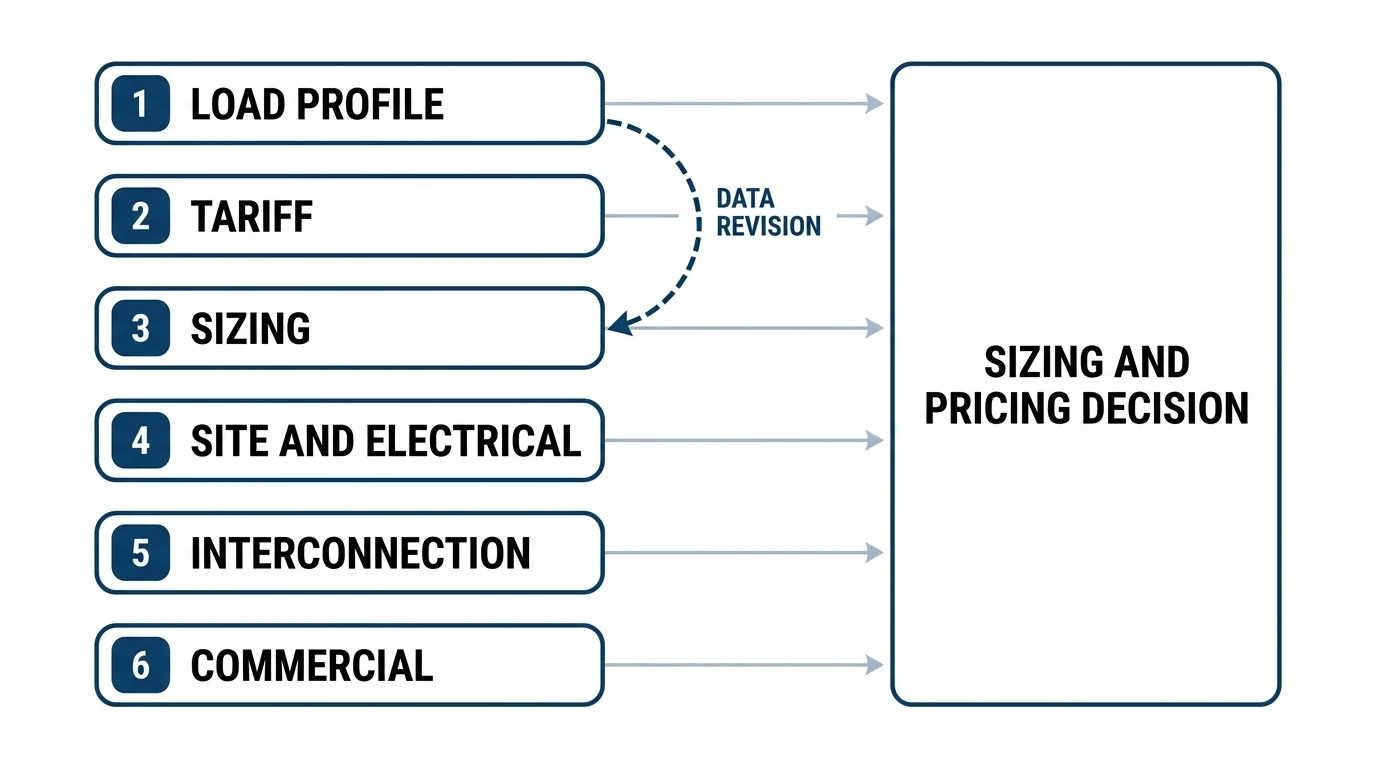
Two things about this diagram are worth stating plainly. The feedback loop is real: many of the projects we see come back to step 3 after the interval data lands, because the peak they were sizing for was a single 15-minute event rather than a daily pattern. And step 5 can override step 3 — an export limit or a non-export requirement caps the system regardless of what the load data asked for.
Group 1 — Load profile: interval data, or nothing
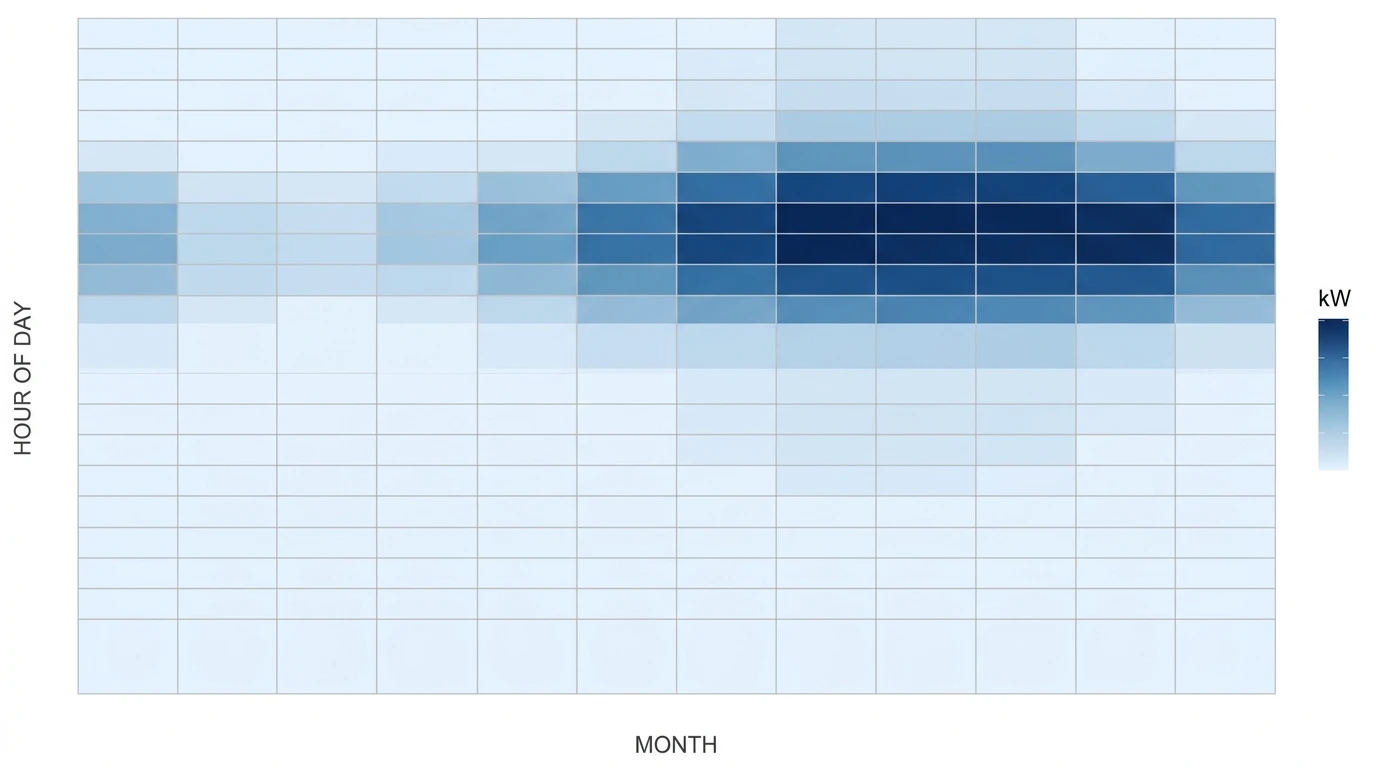
This is the section that determines whether the rest of the exercise is real. Ask for twelve consecutive months of interval data at 15-minute resolution, in kW per interval, as a CSV or spreadsheet export from the meter or the utility's usage portal.
Why that specific format:
- Fifteen-minute resolution matches how demand is billed. Most commercial demand charges are set by the highest 15-minute average in the billing period. Hourly data smooths away exactly the spike you are trying to shave.
- Twelve months covers a full seasonal cycle — summer cooling peaks and winter heating peaks are usually different events with different durations. Twenty-four months is better if your meter has it, because it catches a second summer and any annual shutdown that flattens your baseline.
- kW per interval, not kWh per interval. Both work, but kW is what the sizing math needs and it removes one conversion step where units get mixed up. If your portal only exports kWh per interval, multiply by four to get average kW for that interval — and label the column so nobody downstream repeats the conversion.
A full year at 15-minute resolution is 35,040 intervals. That number is worth keeping in mind as a sanity check on any file you receive: a "year of data" with 8,760 rows is hourly data wearing a 15-minute label.
The five quality checks to run before you send anything
Interval exports are dirty more often than not. Run these before the file leaves your building:
- Missing intervals. Count the rows. Gaps usually cluster around meter outages, communication failures or a meter change. State how many are missing and whether they were interpolated.
- Estimated versus actual reads. Most portals flag estimated intervals. Utility estimation can flatten a peak or invent one; a battery sized on estimated data is sized on fiction.
- Daylight saving. A spring-forward day has 92 intervals, a fall-back day has 100. Confirm the export's timezone and whether it is local or UTC, and say which — a one-hour shift moves the peak into a different tariff window.
- Sign convention and on-site generation. If you have PV, the meter may show export as negative kW. Decide explicitly whether you want the meter profile (net of PV) or the facility profile (gross load). They size very different batteries.
- Units and scaling. Confirm kW versus kVA, and whether the export is per-interval energy or average power. A factor-of-four error here survives all the way to the quote.
What gets computed from it
Once the data is clean, five numbers come out of it, and each one drives a decision:
Metric | How it is derived | What it decides |
|---|---|---|
Peak demand (kW) | Highest 15-minute interval in the period | The ceiling you are trying to beat |
Load factor | Average kW ÷ peak kW | Whether you have a spike problem or a volume problem |
Baseload (kW) | 5th percentile of the interval set | Whether a battery can ride through a whole shift |
Peak duration | Hours per day above a candidate threshold | The energy rating (kWh), not the power rating |
Ramp rate | Largest kW change between consecutive intervals | Whether your PCS needs fast response, and how the EMS must forecast |
That fourth row is where most projects get their answer wrong. A site with a 1,240 kW peak that lasts eleven minutes needs a very different system from a site with a 1,240 kW peak that sits there for three hours. The first is a power problem; the second is an energy problem. Both look identical on a monthly bill. If you want the dispatch side of this in more depth, sizing a peak-shaving battery walks through the control strategy; this page stays on the inputs.
Group 2 — Tariff: the four clauses that change the answer
You are not reducing "electricity costs" in the abstract. You are reducing one or more specific line items, and which ones exist on your bill determines whether a battery earns anything at all. Pull the actual rate sheet — not just the bill — because the clauses that matter live in the tariff document, not in the summary.
Clause | What to capture | Why it changes the system |
|---|---|---|
Demand charge | $/kW, and whether it is billed on the highest 15-minute interval, on a monthly maximum, or averaged over several intervals | This is the primary revenue line for most C&I storage. Its measurement basis sets the resolution your battery must control to. |
Time-of-use windows | On-peak, mid-peak, off-peak hours, weekday vs weekend, seasonal variants | Decides when the battery discharges for arbitrage and when it can recharge without creating a new peak |
Ratchet clause | Whether billing demand is floored at a percentage (often 60–80%) of the highest demand in the prior 11 or 12 months | If a ratchet exists, one bad afternoon sets your bill for a year. It raises the value of never letting a peak through, and it raises the required reliability of the control system. |
Coincident vs facility peak | Whether demand is billed whenever it occurs, or only during the utility's system peak window | Changes dispatch entirely. A coincident-peak tariff means the battery must be ready during a window you do not control. |
Four more items are worth grabbing while you are in the tariff, because each one can move the answer by a few percent and each one is regularly missed:
- Power factor penalty or kVA billing. If demand is billed in kVA, the battery's inverter can also supply reactive power and the sizing math changes. For how demand charges are structured in general, see our guide to demand charge management; what you need here is the specific clause language from your own rate sheet.
- Standby or supplemental service charges for customers with on-site generation.
- Riders and adjustments — these are frequently 10–20% of the effective rate and are easy to omit from a savings model, which then overstates payback.
- Export compensation. Whether you are credited at avoided cost, at a net-metering rate, or not at all. This decides whether any energy should ever flow to the grid.
One practical note: the rate schedule name and number matter more than the bill total. Give your supplier "Rate Schedule C-3, Secondary Voltage, demand ratchet 70%" and they can pull the same document you did. Give them a dollar figure and they cannot.
Group 3 — Sizing inputs and the derating chain
This is where the load data and the tariff become a nameplate capacity. Two numbers come out of it — power (kW) and energy (kWh) — and they are derived differently.
Power (kW) comes from the reduction target: how many kW you want to hold below your threshold. If your peak is 1,240 kW and you want to cap billed demand at 940 kW, you need 300 kW of discharge capability at the meter.
Energy (kWh) comes from how long you must sustain that discharge, plus a derating chain that turns delivered AC energy into a nameplate DC capacity. Every step in the chain is a real loss, and each one has an input the buyer should confirm rather than accept:
Step | Typical value | The input you should confirm |
|---|---|---|
Discharge window | Site-specific — read it off the interval data | Hours per day above your candidate threshold |
Depth of discharge (DoD) | 90% usable for LFP C&I systems | The datasheet's usable-energy figure, not the marketing kWh |
Round-trip efficiency (RTE) | ≥85% system-level for LFP cabinets | System RTE, not cell RTE |
Auxiliary load | ~3% of throughput for thermal management | Whether the datasheet's RTE already includes HVAC draw |
End-of-life capacity | 80% state of health at warranty end | Whether your savings model assumes beginning-of-life or end-of-life capacity |
A worked example you can reproduce
Take a plant with a 1,240 kW peak, an average load of 575 kW (load factor 0.46), and a target of shaving 300 kW during a window that runs about 2.5 hours on the worst days.
- Required AC energy per event: 300 kW × 2.5 h = 750 kWh
- Beginning-of-life nameplate, with DoD and RTE: 750 ÷ (0.90 × 0.85) = 980 kWh
- Add 3% auxiliary: 980 ÷ 0.97 = 1,010 kWh
- End-of-life-compliant nameplate, adding the 80% SOH floor: 1,010 ÷ 0.80 = 1,263 kWh
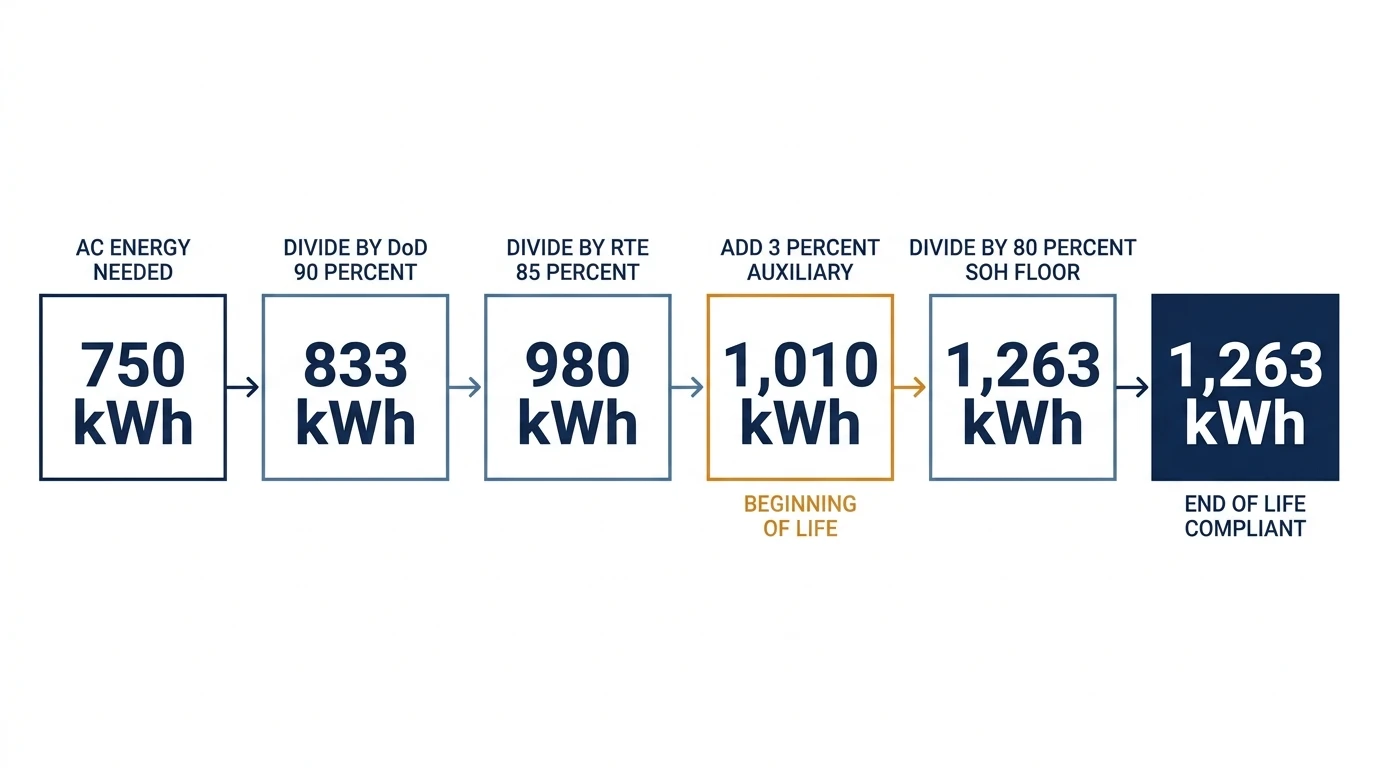
Those last two numbers are the same project and differ by 25%. Which one you use is a commercial decision, not an engineering one: if your savings model claims a constant 300 kW shave for ten years, you must size to the end-of-life figure. If you accept a declining shave in the final years, the beginning-of-life figure is defensible — but the model should say so, because a finance committee will ask.
This is also where duration selection bites. A 0.5C system discharges its full energy in two hours; a 0.25C system takes four. If your peak sits for 2.5 hours, a 2-hour system is operating at the edge of its capability by design, and you should know that before you compare prices. The C-rate and duration selection guide covers how to choose between them, and it is the constraint that decides whether the nameplate you derive above is the nameplate you can actually use.
Group 4 — Site and electrical constraints
Load and tariff decide what the battery must do. Site data decides what can actually be installed, and it is the group most often assembled last and most often responsible for a redesign.
Electrical inputs:
- Single-line diagram of the existing service — the most valuable single document in this checklist. It shows the service size, transformer rating, main breaker, existing distribution, and where a new feeder can be landed.
- Available breaker space and spare capacity at the point of connection. If the service is fully subscribed, the project may need a service upgrade, and that changes both budget and schedule.
- Transformer headroom. A battery that charges at 300 kW adds 300 kW of load during charging. Confirm the transformer can carry it, or plan charging around it.
- Existing protection and relay settings, plus the coordination study if one exists. Adding a storage system changes fault current at the point of connection.
- Metering and CT arrangement — the system's EMS needs to see the same demand signal the utility bills on, which means a CT at the right point.
- Grounding and bonding as installed, and whether the site has a documented grounding study.
The electrical interface requirements for storage systems are codified in Article 706 of the NEC, published by NFPA as NFPA 70. You do not need to read it to fill in this checklist, but your electrical contractor does, and the article is the reason a single-line diagram is not optional.
Physical inputs:
- Footprint and access. Measure the actual available wall or pad, including service clearance in front of the equipment and door swing. A row of five cabinets is a wall-length commitment, not a cupboard.
- Floor loading for indoor rooms and pad construction for outdoor installations.
- Ambient temperature range and sun exposure. Equipment ratings are conditional: our C&I cabinets are rated for −20 °C to 50 °C operation with derating above 45 °C, so a plant room that hits 47 °C in August is operating outside the flat part of the curve.
- Elevation, if the site is above roughly 2,000 m — confirm the derating with the supplier rather than assuming.
- Ventilation and thermal management for indoor rooms; a liquid-cooled cabinet moves its heat somewhere, and that somewhere is your room.
- Fire separation and hazard mitigation. NFPA 855 governs how storage systems are sited and separated, and local amendments vary. Capture the AHJ's requirements early: separation distance from property lines, exposure to adjacent occupancies, and whether the site falls under a threshold that triggers additional analysis.
- Noise, if the installation is near a property line or occupied space.
Deciding between an indoor room and an outdoor pad is its own exercise — outdoor vs indoor cabinet placement covers the trade-offs — but either way the physical inputs above are what the decision consumes.
Group 5 — Interconnection and export limits
This group decides whether the utility will let the system behave the way your savings model assumes, and it is the group with the longest lead time. Berkeley Lab's annual interconnection queue study tracks how long generator projects wait and how many withdraw before reaching commercial operation, which is the best public measure of how backlogged interconnection has become. Read its scope before you apply it: that dataset covers transmission-level generation queues only. A behind-the-meter C&I system is governed by your utility's own distributed-generation interconnection rules, and its timeline is set by your state's rule and your utility's study queue, not by this dataset.
Inputs to collect:
- Service agreement and rate schedule governing generation or storage at your site.
- Export permission: full export, export-limited to a kW figure, or non-export (zero-export) with a control scheme that enforces it. This is a hard cap on system size regardless of what the load data asked for.
- Anti-islanding and protection requirements, including any relay settings the utility specifies.
- Metering requirements for the storage service, and whether a second meter is needed.
- Queue position and application status, if an application has already been filed, plus the study phase it has reached.
If your site is behind a non-export requirement, note the operational consequence: the EMS must guarantee zero export at all times, which means it cannot discharge into a load that has already dropped. That constraint belongs in the sizing model, not in the commissioning punch list.
Group 6 — Commercial and contractual inputs
The last group does not change the engineering, but it changes which engineering gets bought.
- Budget band, even a rough one. It determines whether the conversation is about a two-cabinet system or a container.
- Incentive eligibility — federal and state programs change often, and the Department of Energy's Office of Electricity energy storage program is the right starting point for federal program context. Eligibility sometimes depends on commissioning date, which makes schedule a financial input.
- Insurance requirements. Some carriers impose their own requirements on lithium-based storage, independent of code. Ask before you specify.
- Warranty terms you need, especially the throughput (MWh) guarantee — the total energy the manufacturer warrants the system to deliver over its life. A cycle-count warranty and a throughput warranty are not the same promise, and the difference shows up in year eight.
- O&M scope and cost, and who holds the EMS. If the EMS is licensed rather than owned, that is a recurring cost in the model.
- EPC scope split — what the battery supplier delivers versus what your contractor installs. The boundary is usually the AC terminals, but confirm it, because that boundary is where schedule disputes live.
- Critical-load list, if backup power is in scope. kW and required duration for each block of load you would want to ride through an outage. A resilience-driven system is sized from the critical load, not from the monthly peak, so the two calculations can land on very different hardware. If backup is a goal, say so at intake — a peak-shaving system and a backup system sized for the same site are rarely the same system.
- Certification evidence you will be asked for. In the US that means UL 9540 for the system and UL 9540A test data at module, unit or installation level for the enclosure; other markets have their own schemes. Request the certificates with the data pack rather than at submittal, because an AHJ will ask for exactly these.
- Commissioning evidence you will require. Capacity and round-trip efficiency tests at acceptance are the only way to prove the system delivers the nameplate you paid for; Sandia's energy storage publications include the test protocols those acceptance criteria are usually drawn from.
- Target in-service date and the tariff or incentive deadlines attached to it.
What a missing input costs you
This table is the reason to finish the checklist rather than send what you have. Each row is a real pattern, not a hypothetical.
Missing input | What the supplier must assume | Typical consequence |
|---|---|---|
Interval data (bills only) | Peak duration from an industry average | System sized for the wrong duration — too big, or too small to hit the target |
Single-line diagram | A generic AC interface | Electrical scope quoted as an allowance; change orders after award |
Tariff clause language | A standard demand-charge structure | Savings model misses a ratchet or a rider; payback overstated |
Coincident-peak definition | Non-coincident, dispatch whenever | Battery is empty during the window that is actually billed |
Export limit / non-export status | Full export permitted | System redesigned at interconnection review; 2–4 month slip |
Ambient temperature range | A 25 °C design point | Thermal derating discovered at commissioning, in the worst month |
End-of-life capacity basis | Beginning-of-life nameplate | Warranty claim in year 8 that the contract does not cover |
AHJ fire requirements | Model-code separation distances | Layout change after permit review; footprint no longer fits |
None of these is exotic. Every one of them appears in projects that were otherwise well run, and every one of them is cheaper to resolve before a quote than after.
If you want the sequence for the procurement steps that follow this data pack — RFQ structure, bid comparison, factory acceptance — the C&I BESS procurement guide covers that stage.
From data pack to cabinet configuration
Once the inputs are in hand, the mapping from numbers to hardware is short. Three examples, using the same arithmetic as the worked example above:
Input set | Requirement | Configuration |
|---|---|---|
300 kW shave, 2.5 h, beginning-of-life sizing | 1,010 kWh | 5 × HC-UPSA241 (125 kW / 241.152 kWh each) = 625 kW / 1,205.8 kWh |
Same load, end-of-life-compliant sizing | 1,263 kWh | 5 × HC-UPSA261L (125 kW / 261.248 kWh each) = 625 kW / 1,306.2 kWh |
1 MW shave, container-scale site | ~1,550 kWh delivered at 1,000 kW (about 1.5 h at beginning of life) | 1 × HC-UPSA2089L (1 MW / 2.089 MWh, 20 ft container) |
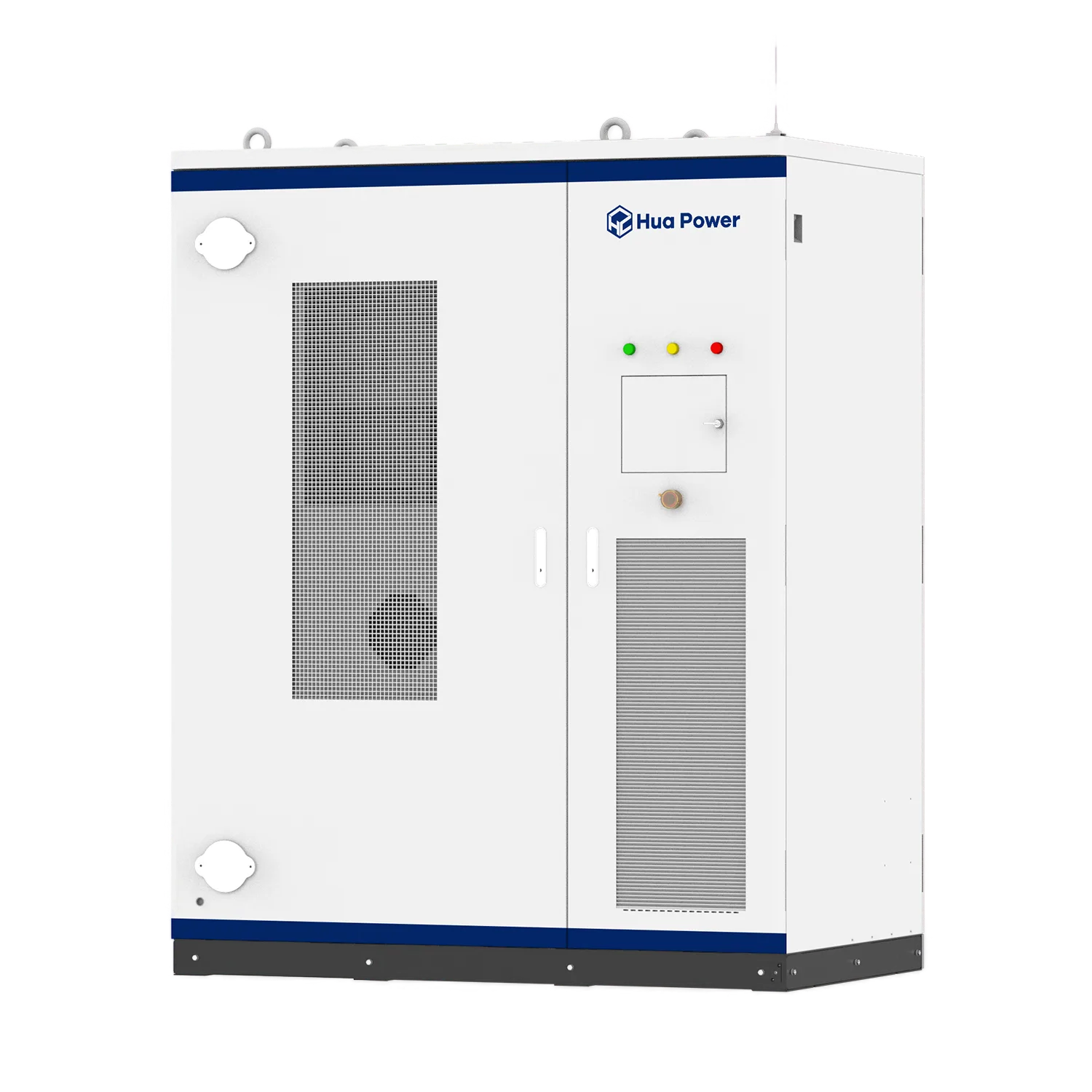
The first two rows are the same project with different commercial assumptions, and they land on different hardware: the air-cooled HC-UPSA241 clears the beginning-of-life requirement with margin, while the liquid-cooled HC-UPSA261L clears the stricter end-of-life figure in the same five-unit count — but not in the same footprint. At 1,560 × 1,350 mm per unit against 1,880 × 1,100 mm, a five-unit row of 261L cabinets is about 1.6 m narrower (7.8 m against 9.4 m) and 250 mm deeper. Which one is right depends on what your savings model promises, not on which is "better."
The container row is the same derating chain read backwards. One 2.089 MWh container delivers about 1.55 MWh of AC energy at beginning of life and 1.24 MWh at the 80% end-of-life floor, so a single unit is roughly an hour and a half at 1 MW — a firm two hours at that power needs two of them.
Two physical notes that come straight out of the site group. The HC-UPSA241 is 1,880 mm wide, so a five-unit row is about 9.4 m of wall before service clearance — measure that wall before you commit to the configuration. And if the site needs more than two hours of duration, the answer is usually battery cabinets (HC-UPSB241, 241.152 kWh) paired with a separate PCS rather than more all-in-one units, because duration and power then scale independently — PCS and inverter selection covers how to size that pairing.
The checklist you can hand to a client
Everything above, compressed into an intake list. The owner column is the part that makes it actionable — most data requests stall because nobody knows who to ask.
# | Item | Format | Owner |
|---|---|---|---|
1 | 12 months of interval data | 15-min kW, CSV, labeled timezone | Facility / utility portal |
2 | Data quality note | Missing intervals, estimated reads, meter changes | Facility |
3 | On-site generation inventory | PV kW, inverter count, commissioning dates | Facility |
4 | Twelve months of bills | PDF, all pages including riders | Finance |
5 | Rate schedule document | Full tariff sheet, schedule name and number | Utility |
6 | Demand charge basis | Measurement interval and any averaging | Utility |
7 | Ratchet clause | Yes/no, percentage, lookback period | Utility |
8 | Coincident peak definition | Window hours, season | Utility |
9 | Power factor / kVA terms | Penalty threshold or kVA billing basis | Utility |
10 | Reduction target | Target kW and desired window | Facility |
11 | Single-line diagram | Current, as-built, stamped if available | Electrical contractor |
12 | Service and transformer ratings | kVA, main breaker, spare capacity | Electrical contractor |
13 | Protection and relay settings | Coordination study if it exists | Electrical contractor |
14 | Site layout and dimensions | Plan drawing with service clearance | Facility |
15 | Ambient temperature range | Min/max, indoor or outdoor, sun exposure | Facility |
16 | Interconnection status | Application filed, export limit, non-export requirement | Utility / consultant |
17 | AHJ fire and separation requirements | Local amendments, thresholds | AHJ / permit expediter |
18 | Budget band and target in-service date | Range and date | Finance |
19 | Critical-load list (if backup is in scope) | kW and duration per load block | Facility |
20 | Certification evidence | UL 9540 / 9540A or local equivalent | Supplier / AHJ |
If you want a first-pass number before the file is complete, the battery sizing calculator will get you into the right order of magnitude from a monthly peak and a duration.
Twenty items. Most sites can assemble seventeen of them in a week; the three that take longer — interval data with a quality note, the tariff sheet, and the interconnection status — are also the three that change the answer most.
FAQ
Can I just send twelve months of utility bills instead of interval data?
No. A bill gives you one demand number per month with no duration attached to it. Two sites with identical monthly peaks can need systems that differ by 40% in energy, and the bill cannot tell them apart. If interval data genuinely does not exist — a brand-new meter, for example — the fallback is temporary logging: a clamp meter or a power logger on the service for two to four weeks, timed to include your busiest period, and clearly labeled as a short sample rather than a year.
What if my meter only gives me hourly data?
Hourly data is usable for a first-pass estimate but it smooths the 15-minute peak that demand charges are actually billed on, so it will understate the shave you can capture. Ask the utility for the 15-minute channel — most commercial meters record it even when the portal's default export is hourly. If it truly is not available, say so explicitly in the data pack so the sizing carries a stated uncertainty instead of a hidden one.
Does a commercial battery need an export limit?
Not always, but you must find out before sizing rather than after. Many service agreements now require non-export control for behind-the-meter storage, and an export limit caps the system regardless of your load. Confirm the requirement with the utility, and confirm that the proposed EMS can actually enforce it — a zero-export scheme is a control function, not a setting.
How long does interconnection take?
Long enough that it should start before you choose hardware. Berkeley Lab's queue study publishes wait times and withdrawal rates by region and year, but for transmission-level generators — read it as an indicator of how backlogged interconnection is, not as a forecast for your site. A behind-the-meter C&I system is interconnected under your state's distributed-generation rule and your utility's own study queue. The practical implication is that interconnection status belongs in the data pack at the same level as load data — it can override the sizing conclusion in either direction.
Do I need all six groups before requesting a quote?
No, and waiting for all six wastes time. Groups 1 and 2 plus the single-line diagram (item 11 in the checklist above) are enough for a credible preliminary configuration and budget range. Groups 4 through 6 refine it into a firm price. What you should not do is request a firm price without Group 1 — that is the request that produces either a padded number or silence.
Send the pack, get a real number
If you have the six groups assembled — or even groups 1, 2 and a single-line diagram — our engineering team will size a configuration against your actual interval data and tell you where the numbers do not support the savings you are hoping for. That second part is the useful one: a sizing exercise that only ever confirms the project is not a sizing exercise.
Start with the C&I energy storage solutions overview for system scope.
Or send your data pack directly through the inquiry form and we will come back with a power rating, an energy rating and the assumptions behind both.