

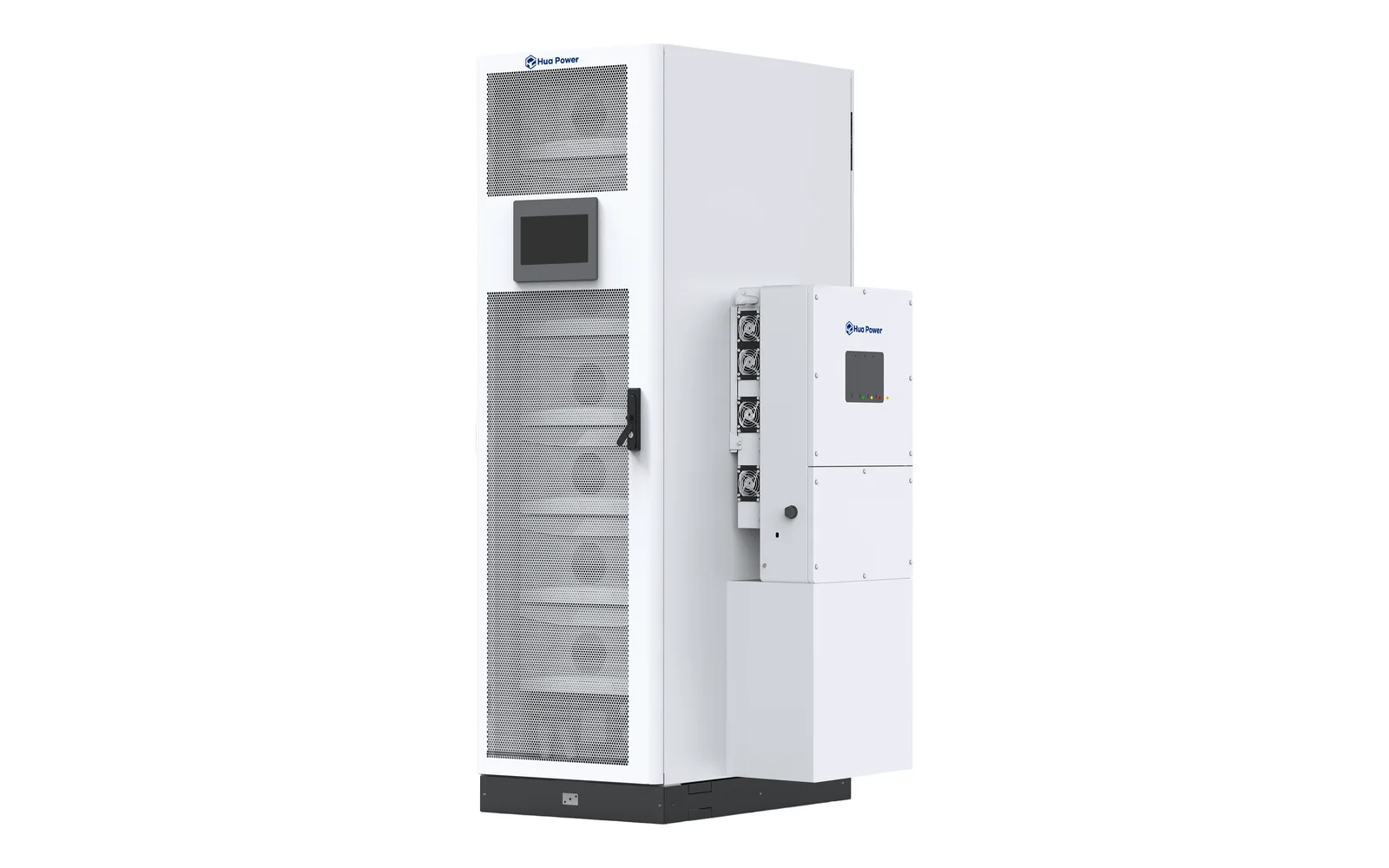
A commercial and industrial (C&I) battery energy storage system (BESS) is typically a 10–15 year asset. This procurement framework focuses on making the right decisions before equipment ships, installs, and enters service.
Most guides that claim to cover commercial and industrial (C&I) battery energy storage system (BESS) buying only cover a slice of it. One explains sizing. Another explains inverters. A third lists certifications without saying which ones your utility actually asks for. Buyers end up stitching four or five partial pages together and still miss the parts that cause the expensive problems — the warranty clause that doesn't transfer, the certification gap that stalls interconnection, the vendor that can't service the system three years after the sale.
This guide is the whole journey in one place. It's a vendor-neutral framework for the people who have to sign off on a C&I battery purchase: energy and facility managers, EPCs, and procurement engineers. It walks through eight decisions in the order you actually have to make them, and it ends with two things no competitor guide gives you — a copyable RFP checklist and a weighted vendor scorecard you can take straight into a bid evaluation.
The short version. Good BESS procurement runs in sequence: (1) define the use case, because it drives every number downstream; (2) size power (kW) and energy (kWh) separately; (3) spec the core hardware — PCS, chemistry, cooling, enclosure; (4) operationalize certification (UL 9540/9540A, NFPA 855, UL 1741 SB, IEEE 1547, or the IEC equivalents), not just collect logos; (5) confirm grid interconnection early, because it sets your timeline; (6) read the warranty and performance guarantee as two different documents; (7) model total cost of ownership, not sticker price; (8) vet the vendor as a process, not a gut check. If you're importing from an overseas manufacturer, there's a ninth layer — destination certs, Incoterms, lead time, and cross-border after-sales — that most buyers discover too late.
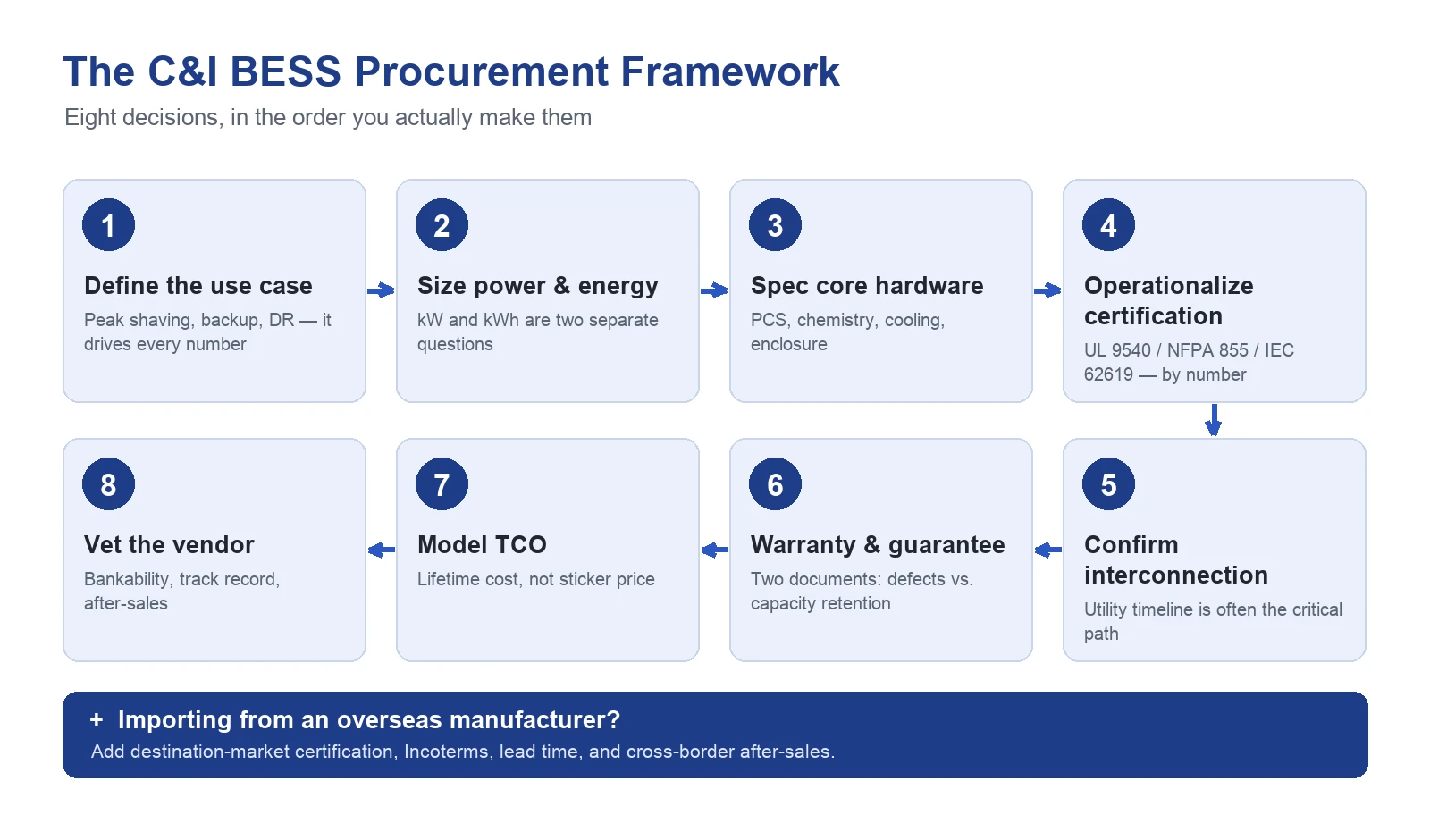
The eight decisions, in the order you actually make them. Each one narrows the next — which is why the sequence matters as much as the answers.
Before the framework: who you are and when to start
The right first question isn't "which battery?" — it's "where am I in this project, and who else has to sign off?"
- Energy or facility managers own the business case and usually the budget. Your risk is buying a system that technically works but doesn't hit the ROI the project was approved on.
- EPCs and integrators own the design and the install. Your risk is a spec that passes on paper but fails inspection, or a lead time that blows the construction schedule.
- Procurement engineers own the comparison and the contract. Your risk is comparing quotes that aren't actually comparable — different scopes, different certifications, different warranty math dressed up to look alike.
When to start this framework: as soon as you know a battery is likely, not once you're ready to sign. The two decisions that most often derail a project — certification/interconnection and lead time — have to be verified before you commit to a vendor, because they can't be fixed after equipment ships. Treat procurement as running in parallel with design, not after it.
If you're still scoping whether storage makes sense at all, start with the C&I energy storage overview and come back here when you're closer to a purchase.
Decision 1: Define the use case before you spec anything
Every number downstream — capacity, power rating, cooling, cycle life — is derived from what the system is actually for. Spec the hardware before you've pinned the use case and you'll size for the wrong duty cycle.
The common C&I applications, and what each one demands of the system:
Use case | What it does | What it demands |
|---|---|---|
Peak shaving | Cuts demand charges by discharging during your monthly peaks | High power (kW) for short bursts; modest energy; precise dispatch. See commercial peak shaving with energy storage. |
Load shifting / self-consumption | Stores cheap or solar energy, uses it when power is expensive | High energy (kWh); daily deep cycling; cycle life matters most |
Backup / resilience | Rides through outages | Fast transfer time; enough energy for your critical-load runtime |
Demand response | Earns revenue by curtailing on grid signal | Reliable dispatch, telemetry, aggregator-grade controls. See demand response energy storage. |
Grid services / arbitrage | Sells flexibility to the market | High cycle count; strong round-trip efficiency; robust EMS |
Most real C&I systems do two or three of these at once — for example, peak shaving on weekdays and backup on nights and weekends. That's fine, but write it down explicitly, because a system optimized for one duty (short high-power bursts) is sized differently from one optimized for another (deep daily cycling). The use case is the first line of your RFP, not an afterthought.
Decision 2: Size it — power (kW) and energy (kWh) are two questions
The single most common spec-sheet mistake is treating "size" as one number. It's two, and they're independent:
- Energy (kWh) — how much you can store and discharge in total. This decides how long the system can run.
- Power (kW) — how fast you can push energy in or out at any moment. This decides how hard it can hit a peak.
A 500 kWh battery paired with a 100 kW power stage discharges over roughly five hours; the same 500 kWh paired with a 250 kW stage empties in about two. Same energy, completely different capability. Your use case tells you which one binds: peak shaving is usually power-limited, load shifting is usually energy-limited.
The ratio between them — expressed as C-rate or duration (a "2-hour system," a "4-hour system") — is the number that actually matters, and it's the one generic guides skip. Get your required power draw and required runtime from your own interval meter data before you look at any product. For the full method, including how to read your load profile, see how to size a 100, 200, or 500 kWh system.
Procurement note: demand every quote states both kW and kWh, and the usable kWh at a stated depth of discharge (DoD) — not just the nameplate. A 522 kWh nameplate at 90% DoD delivers ~470 kWh usable. Two quotes with the same nameplate can differ 10–15% in what you actually get to use.
Decision 3: Spec the core hardware
Four hardware decisions sit under the capacity numbers. Each has its own trade-off, and each is covered in depth in a dedicated guide — here's what you're deciding and why it belongs in procurement.
Power conversion system (PCS / "inverter"). Match it to your power (kW), not your battery's kWh. The two architecture calls that matter most are AC- vs. DC-coupling (DC-coupling reaches ~98% round-trip efficiency for new-build PV+storage; AC-coupling around 90–94% but is simpler for retrofits) and string vs. central topology (string tolerates partial failure and scales incrementally; central is cheaper upfront but a single point of failure). Full detail in commercial battery inverter selection.
Cell chemistry and quality. For C&I stationary storage, LiFePO4 (LFP) is the default — it trades some energy density for a materially safer thermal profile and longer cycle life than NMC. But "LFP" on a datasheet isn't enough. Ask for the cell manufacturer and grade (Grade A cells vs. reclaimed/B-grade is a real and invisible difference), the cell format and capacity (e.g. 3.2V / 314Ah prismatic), and the rated cycle life at a stated retention — a credible C&I cell rates ≥6,000–8,000 cycles at 80% state of health (SOH). A vendor who won't name the cell supplier is telling you something.
How Hua Power Implements LFP Technology
Hua Power standardizes 3.2 V / 314 Ah large-format LFP cells across its residential and commercial ESS platforms. Combined with an in-house Battery Management System (BMS) and optimized thermal management, these systems are engineered to maximize cycle life, maintain accurate state-of-charge estimation, and deliver reliable performance under daily cycling conditions.
Cooling: liquid vs. air. Air cooling is simpler and cheaper for moderate duty; liquid cooling holds cells at a tighter, more uniform temperature, which matters for high C-rate cycling, dense footprints, and cycle-life preservation. This is a duty-cycle decision, not a "newer is better" one — see liquid-cooled vs. air-cooled BESS.
Enclosure: outdoor vs. indoor. Drives your IP rating (IP54 is typical for outdoor C&I cabinets), footprint, install cost, and fire-siting requirements. See outdoor vs. indoor energy storage cabinet.
Don't spec these in isolation. Cooling depends on duty cycle, which depends on use case; enclosure depends on cooling and site; the PCS depends on your power number. That interdependence is exactly why this framework runs in order.
Decision 4: Operationalize certification — don't just collect logos
Every spec sheet claims to be "certified." The question that matters isn't whether a system is certified — it's which standard, verified how, and asked for by whom. Here is the stack that actually governs a C&I install, and what each piece does:
Standard | What it governs | Who asks for it |
|---|---|---|
Safety of the complete energy storage system — battery, PCS, enclosure together | AHJ / fire marshal, for permitting | |
UL 9540A | Fire-propagation test method (thermal-runaway behavior) | AHJ / fire marshal, increasingly mandatory |
Installation and siting — spacing, separation, ventilation | AHJ, drives your site layout | |
Test procedure verifying the PCS meets grid-interconnection requirements | Utility, for interconnection approval | |
The underlying grid-interconnection performance requirements (UL 1741 SB is the test for it) | Utility | |
Safety of industrial lithium cells/batteries (the international counterpart to UL 1973) | International markets, buyers outside North America | |
Transport safety — required to legally ship lithium batteries | Freight forwarder, customs, everyone |
Two practical points buyers miss:
- UL 1741 SB verifies IEEE 1547-2018 — they're not two separate hoops, one is the test for the other. But UL 9540 is a separate, system-level requirement that a UL 1741-listed PCS alone does not satisfy. Confirm both.
- The stack is regional. UL/IEEE/NFPA is the North American stack. Most of the rest of the world references IEC standards and national grid codes instead — IEC 62619 for cell safety, EN 50549 for grid connection in Europe, and country-specific interconnection codes elsewhere. For a European project, confirm EN 50549 plus the destination country's national grid code rather than assuming a US UL/IEEE listing transfers.
Operationalize it in the RFP: ask for certifications by document number and listing, not by the word "certified." "Provide the UL 9540 listing number, the UL 9540A test report, and the UL 1741 SB certificate" is a request a compliant vendor answers in a day. Silence or vagueness here is the single most reliable early warning sign in a bid.
For a rigorous, vendor-neutral reference on procurement scope, the US DOE Federal Energy Management Program publishes a Battery Energy Storage System Procurement Checklist — written for federal buyers, but a useful cross-check for any commercial-scale purchase.
Decision 5: Confirm grid interconnection early — it sets your timeline
Interconnection is where projects lose months. The utility has to approve connecting a bidirectional resource to its grid, and that process runs on its clock, not yours. A certification gap discovered here — a PCS that isn't UL 1741 SB listed for your utility's requirements — can send you back to re-spec equipment after you've already ordered it.
Confirm three things before you commit to a vendor:
- The utility's specific interconnection requirement for your service class and system size — which standards, which application track (many utilities have a fast track below a size threshold), and the typical approval timeline.
- That the quoted PCS actually holds the listing your utility asks for — verified by certificate number, not vendor claim.
- Your AC service voltage and phase (208V, 400V/415V, or 480V, three-phase at C&I scale) matches the PCS output rating. A mismatch here is a simple, easy-to-miss interconnection blocker.
Put the interconnection timeline on your project schedule as a hard dependency. It is more often the critical path than equipment lead time.
Decision 6: Read the warranty and the performance guarantee as two documents
This is where the most expensive surprises hide, and it's the one area even good competitor guides handle poorly. A warranty and a performance guarantee are different promises, and a strong-sounding quote can be weak on either:
- Product warranty — covers defects and failures. Read the term (years), what's covered (cells, PCS, BMS, enclosure — often different terms each), and crucially whether it's transferable if the site or owner changes, and whether it survives if the manufacturer exits the market.
- Performance / capacity guarantee — promises the battery retains a stated capacity (e.g. ≥70% SOH after 10 years or a stated cycle count). This is what protects your business case. Check whether it's guaranteed by calendar years, cycle count, or throughput (MWh) — and what conditions void it (operating temperature, C-rate, DoD limits).
Questions that separate a real guarantee from marketing:
- Is the capacity guarantee backed by liquidated damages (LD) clauses — a defined remedy if the system underperforms — or just a promise to "make it right"?
- What are the exclusions? Cycling above a rate, operating outside a temperature band, or exceeding a throughput cap can quietly void coverage.
- Who honors it, and how are claims serviced — especially if the manufacturer is overseas (see Decision 9)?
- Does the warranty assume a maintenance regime you're contractually obligated to follow?
Get both documents in full before signing — not the summary table in the proposal. Two quotes at the same price can carry a five-figure difference in real risk once you read the actual terms.
Decision 7: Model total cost of ownership, not sticker price
The lowest quote frequently owns the highest lifetime cost. TCO over a 10–15 year life is what you're actually buying. The pieces:
- Capex — equipment, PCS, EMS, enclosure, plus install, interconnection, and commissioning.
- Efficiency losses — every point of round-trip efficiency (RTE) is energy you pay for but never deliver, on every cycle, for the system's life.
- Degradation and augmentation — capacity fades; some contracts require you to add cells over time to hold a guaranteed capacity. A guarantee that's held by augmentation has a cost you should see quantified.
- O&M — monitoring, service visits, spare parts, and (for liquid systems) coolant maintenance.
- End of life — decommissioning and recycling.
A worked example — what an RTE gap actually costs. Take two competing quotes for a system that delivers ~470 kWh usable per cycle, cycling once a day across ~350 operating days — about 164,500 kWh delivered per year. Say their system-level round-trip efficiency differs by 5 points (one rated 90%, the other 85%):
- At 90% RTE: 164,500 ÷ 0.90 ≈ 182,800 kWh drawn from the grid annually.
- At 85% RTE: 164,500 ÷ 0.85 ≈ 193,500 kWh drawn.
- Difference: ~10,700 kWh/year of extra energy purchased to deliver identical output.
Using an illustrative electricity price of $0.12/kWh, that's about $1,285/year — over a 15-year life, roughly $19,000 in extra energy cost alone, before degradation, before any augmentation clause, before the difference in warranty risk. The lower sticker price rarely survives that math. Model TCO on your own rate and cycling frequency; a system that cycles twice a day doubles the efficiency gap.
Decision 8: Vet the vendor as a process
By this point you can compare systems. Now you compare the companies behind them — because a 10–15 year warranty is only worth as much as the company standing behind it in year 8. Turn due diligence into a repeatable process, not a gut feel:
- Track record — number and scale of deployed C&I projects, ideally in your region and use case. Ask for references you can actually call.
- Financial stability / bankability — will they exist to honor the warranty? For financed projects, lenders may require the manufacturer be on an approved (bankable) list.
- Manufacturing control — do they make their own cells/modules or integrate someone else's? Either can be fine, but you should know, and know the cell supplier.
- After-sales and spare parts — service response time, spare-parts availability, and remote monitoring/diagnostics via the EMS.
- Documentation — a vendor that answers certification and warranty questions by document number, fast, is showing you how they'll behave after the sale.
A weighted vendor scorecard
Score each shortlisted vendor 1–5 on each criterion, multiply by the weight, and sum. Adjust the weights to your project — a financed utility-adjacent project weights bankability higher; a resilience project weights service response higher.
Criterion | Weight | Vendor A | Vendor B | Vendor C |
|---|---|---|---|---|
Certification completeness (for your market) | 20% | |||
Warranty + performance guarantee strength | 20% | |||
Total cost of ownership (not sticker price) | 15% | |||
Track record in your use case / region | 15% | |||
Financial stability / bankability | 10% | |||
After-sales, spare parts, service SLA | 10% | |||
Lead time and delivery reliability | 5% | |||
EMS / monitoring capability | 5% | |||
Weighted total | 100% |
The scorecard's real value is forcing the conversation before the bid comes in: agreeing the weights with your stakeholders is how you avoid a decision that quietly defaults to lowest price.
Decision 9: Buying from an overseas manufacturer
A large share of the world's competitive C&I battery capacity is manufactured in China, and buying direct from the manufacturer often means better pricing and a shorter supply chain than buying a rebadged system through a local integrator. But it adds a layer generic buyer's guides — most written for a single home market — skip entirely. If you're importing, add these to the framework:
- Destination-market certification, not the factory's home standard. A system certified to Chinese GB standards is not automatically UL 9540 or IEC 62619 compliant for your market. Confirm the specific units you're quoting hold the destination certifications. A manufacturer that ships internationally engineers to the destination stack; one that only serves its home market retrofits for export.
- Incoterms. Know exactly what the price includes — EXW, FOB, CIF, and DDP shift very different amounts of shipping, insurance, customs, and duty risk onto you. A "cheaper" EXW quote can cost more landed than a DDP one.
- Lead time and shipping. Ocean freight adds weeks; factor manufacturing lead time plus transit into your project schedule as a hard dependency, and ask what happens to your delivery date if a cell shortage hits.
- Cross-border after-sales. This is the real question: how is warranty serviced across a border? Local service partner, regional spares depot, remote diagnostics via the EMS, or return-to-factory? Get the answer in writing before you sign — it's the difference between a two-day fix and a two-month one.
This is exactly where a manufacturer with real international deployment experience separates from a domestic-only supplier. It's structural, not marketing: a company that has already shipped, certified, and serviced systems in your region has solved these problems before.
Your RFP checklist
Copy this into your request for proposal. Every item is a question a serious vendor answers without friction — and a screen for the ones who can't.
System scope
Compliance & grid
Commercial
Vendor
How Hua Power maps to the framework
After completing the procurement framework above, the Hua Power C&I portfolio can be mapped against the resulting power, energy, cooling, and deployment requirements. Match your required power to the model, then confirm energy, cooling, and enclosure against your use case:
Model | Power (kW) | Energy (kWh) | Cooling | Typical fit |
|---|---|---|---|---|
HC-UPSAP112 | 50 | 112 | Air | Small commercial site, single building |
HC-UPSAP241 | 125 | 241 | Air | Mid-size C&I load |
HC-UPSAP261L | 125 | 261 | Dense footprint, hard-cycling duty | |
HC-UPSAP522L | 250 | 522 | Liquid | Larger C&I facility or combined-application system |
HC-UPSSP723 – HC-UPSSP1205 | 300–500 | 723–1,205 | Air | Heavy industrial load, distributed/multi-string deployments |
All models in the C&I lineup are based on 3.2 V / 314 Ah LiFePO4 cells with a rated cycle life of ≥8,000 cycles at 80% SOH. Standard features include IP54 enclosures, C3-M anti-corrosion protection, aerosol / FK-5-1-12 fire suppression, IEC 62619 and UN 38.3 compliance, and integration with the Hua Power Visual Energy Management Platform.
On the overseas-manufacturer questions from Decision 9: Hua Power has deployed 400+ ESS projects across 30+ countries — including a 500 kW / 1 MWh PV+ESS site in Portugal and a 500 kW / 1.044 MWh on-grid system in Guangzhou — with systems engineered to the destination market's certification stack rather than a single home-market standard.
From framework to a specific recommendation
The eight decisions get you to a specification, a certification checklist, a TCO model, and a scorecard. Turning that into an exact model and configuration depends on your load profile, your utility's interconnection requirements, your destination market, and your use case mix.
Need help turning this framework into a project-specific specification? Send your load profile, target market, and primary use case, and Hua Power's engineering team will provide a recommended system configuration, certification guidance, and a procurement-ready BOM. If you're still scoping the project, the C&I energy storage overview puts the whole system in context.
Frequently asked questions
What should a C&I BESS procurement process cover? Eight decisions in sequence: define the use case, size power and energy separately, spec the core hardware (PCS, chemistry, cooling, enclosure), operationalize certification, confirm grid interconnection, read the warranty and performance guarantee, model total cost of ownership, and vet the vendor. If you're importing, add destination certification, Incoterms, lead time, and cross-border after-sales as a ninth layer.
What's the difference between a BESS warranty and a performance guarantee? A product warranty covers defects and failures — check its term, per-component coverage, and whether it's transferable. A performance (or capacity) guarantee promises the battery retains a stated capacity, such as ≥70% state of health after 10 years, and is what protects your business case. Check whether it's backed by liquidated-damages clauses or just a promise, and what conditions void it.
Which certifications does a commercial battery storage system need? For North America: UL 9540 and UL 9540A (system and fire safety), NFPA 855 (installation/siting), and UL 1741 SB with IEEE 1547-2018 (grid interconnection). Internationally: IEC 62619 (cell safety), EN 50549 or the national grid code (Europe/other), and UN 38.3 for transport everywhere. Ask for each by document or listing number, not by the word "certified."
How do I size a C&I battery system? Size power (kW) and energy (kWh) as two separate questions. Power decides how hard the system can hit a peak; energy decides how long it can run. Your use case determines which one binds — peak shaving is usually power-limited, load shifting energy-limited. Derive both from your own interval meter data before comparing products.
How do I compare BESS quotes fairly? Normalize them first: same usable kWh at the same DoD, same certification scope, same warranty basis, and full TCO rather than sticker price. Then score the vendors on a weighted matrix — certification, warranty strength, TCO, track record, bankability, after-sales, lead time, and EMS capability — with weights agreed with your stakeholders before the bids arrive.
What's the risk of buying a BESS from an overseas manufacturer? The main risks are certification mismatch (home-market standards aren't automatically valid in yours), unclear landed cost (Incoterms shift shipping/customs/duty risk), longer lead times, and cross-border warranty servicing. All are manageable — confirm destination-market certifications on the specific units, clarify Incoterms, schedule lead time as a hard dependency, and get the after-sales service model in writing. A manufacturer with real deployment experience in your region has already solved these.
What is total cost of ownership for a battery storage system? TCO is the full 10–15 year cost: capex (equipment plus install, interconnection, commissioning), efficiency losses on every cycle, degradation and any augmentation required to hold a guarantee, O&M and spare parts, and end-of-life decommissioning. It routinely reorders a ranking based on sticker price — a small round-trip-efficiency gap alone can add five figures over the system's life.
What is the most common mistake in BESS procurement? Treating power (kW) and energy (kWh) as the same specification.
When should utility interconnection be confirmed? Before selecting a vendor or placing an equipment order.
What should an RFP require from a BESS supplier? Certification documents, usable kWh at stated DoD, warranty terms, TCO breakdown, and after-sales support details.