
Demand charge management is the practice of holding a site's highest interval of net load below what the tariff would otherwise record, so that the monthly demand charge — priced per kilowatt of peak, not per kilowatt-hour of energy — is calculated on a smaller number. It is a billing problem before it is a battery problem.
Two factories can use the same megawatt-hours in a month and get bills tens of thousands of dollars apart. The shape of the load on one afternoon explains it.
The Two Meters Behind One Bill
A commercial bill measures two quantities. Energy counts volume: kilowatt-hours over the period, at cents each. Demand counts intensity: the highest average power drawn in one metered interval — the tariff's maximum demand, usually over 15 minutes — at dollars per kilowatt for the month.
EPRI's storage valuation guide writes the demand term as the maximum applicable net load at the point of interconnection, multiplied by the demand rate, over the hours the charge covers — max(applicable net load) × demand rate. Net load is what the meter sees after on-site generation or battery output; applicable is whatever hours the tariff names.
Line on the bill | Unit | What it measures | What moves it |
|---|---|---|---|
Energy charge | $/kWh | volume consumed over the period | total consumption, and its timing if the tariff has time blocks |
Demand charge | $/kW per month | highest average power in one interval | the shape of the load on its worst interval |
Ratchet adjustment | $/kW per month, on a floor | a percentage of a peak set months earlier | a peak you already ran |
Some tariffs bill kilovolt-amperes instead, which makes power factor part of the design; Texas rules allow a kWh, kW or kVA basis. Where energy is time-differentiated too, that is a separate mechanism — the time-of-use tariff.
Why One Quarter Hour Can Cost More Than the Month
Average demand divided by peak demand is the load factor. A plant peaking at 400 kW and averaging 120 kW runs at 30%: it pays for 400 kW in a month that held it for fifteen minutes, and rents headroom for the other 43,000-odd minutes.
That decides who benefits from demand charge management. A three-shift operation runs above 70% and has little to recover. A plant with a crusher, an induction furnace or simultaneous EV chargers can sit at 25%, paying for capacity it uses for a fraction of one percent of the month. Rising energy prices do not change that.
The Ratchet: When One Month Bills the Next Eleven
A ratchet turns one bad afternoon into a year of charges. The Public Utility Commission of Texas defines it in §25.244(b)(1) as "a provision in a TDU's tariff for retail distribution service that allows a customer to be billed based on the greater of the peak demand by that customer in the current month or some fixed percentage of the peak demand for that customer during previous months."
Read it as a floor: an 850 kW peak in August, an 80% ratchet and an illustrative $14 per kW-month rate mean eleven months billed at the greater of the actual peak and 680 kW, so an October peaking at 500 kW is still billed at 680.
No battery | 150 kW shaved in August | |
|---|---|---|
Billed demand, August | 850 kW | 700 kW |
Ratchet floor, following 11 months | 680 kW | 560 kW |
Billed demand, September–July (peak 500 kW) | 680 kW | 560 kW |
Kilowatt-months billed over the year | 8,330 | 6,860 |
Cost at $14/kW-month | $116,620 | $96,040 |
That is $20,580 a year, and where it comes from is the point: the 150 kW shave is billed once at full value and eleven more times at 80%, so 1,470 kilowatt-months of exposure are removed by 150 kW of hardware — 9.8 times its rating. Without a ratchet, the same hardware would have to shave 150 kW every month.
The setting month therefore deserves care: commissioning loads or a first production run will be remembered by the tariff. The percentage and look-back come from the tariff rather than from physics, so 80% over eleven months is an illustration, not a norm.
Load factor even shapes the rule: the same Texas section bars a ratchet for a nonresidential secondary-voltage customer whose annual load factor is 25% or below — a regulator deciding that where load is spiky enough, the floor has no cost basis.
Four Ways to Move a Peak
Four strategies share the heading and change different things.
Strategy | What it changes | Reaches the billing determinant? | Repeats monthly? |
|---|---|---|---|
Curtailment | the load, turned down | yes, if that load ran in the interval | yes, at a cost in output |
Load shifting | when the work happens | yes, if it leaves the demand window | yes, where the process allows |
On-site storage | net load at the meter | yes — the meter sees the discharge | yes, within available energy |
Efficiency | the load, permanently | yes, and cuts energy too | permanently, once |
Only storage and efficiency change the number without asking the plant to behave differently at the peak. Curtailment and shifting take the saving out of production flexibility — the flexibility a plant needs on the days its load is highest. Storage works on the customer side of the meter: because the determinant is net load at the point of interconnection, discharging during the peak interval lowers what the utility records without touching a process. That mechanism is set out under peak shaving; what it leaves open is the sizing target.
Sizing to a Billed Demand, Not a Load Curve
A battery sized from a load curve is sized to "the peak". Sized for demand charge management, it is sized to the tariff's definition of the billing determinant, and two details change the answer.
The measurement interval. A 15-minute determinant is an average, so a battery that responds in three seconds and is empty in ninety barely moves it; the discharge has to hold for the interval. A 30-minute determinant roughly doubles the energy.
The demand window. Energy matters only inside the hours the charge applies. A tariff measuring weekday afternoons from noon to six needs a battery full at noon and refillable overnight — far smaller than one defending the peak around the clock — and where the determinant is a coincident system peak rather than the site's own maximum, the design needs the system peak hours instead.
Energy then comes from event statistics, not a typical day, which is why LBNL's study of demand charge savings found the result so customer-specific. Against a 700 kW target and an 850 kW peak, twelve months of intervals might show 34 intervals above target across 11 days, the worst of them 90 minutes long and 225 kWh over the threshold. That last figure sets the battery.
A 150 kW discharge clips 850 to 700. Delivering 225 kWh at 97% inverter efficiency draws about 232 kWh from the cells; at 90% depth of discharge that is roughly 258 kWh nameplate, and refilling it at 88% round-trip efficiency takes about 256 kWh from the grid.
That last number is where designs fail quietly. Over four hours, 256 kWh is 64 kW of extra load — and if charging lands while the site sits near 700 kW, the meter records 764 kW: under the original 850 kW peak, but above the 700 kW target. Charging must fall outside the demand window, or slow until the total stays under target.
Dispatch: Forecast, Floor and the Second Peak
The controlled variable is not the battery's output. It is the number the meter will record at the end of the interval — a rolling average the controller must predict and hold down, not a threshold it can react to.
Four requirements follow. A threshold band with hysteresis, so the system does not hunt. A state-of-charge floor held for the second peak, because peaks arrive in pairs and a battery that spent everything at 14:00 has nothing at 16:30. A forecast that pre-charges ahead of the window, since a full battery at the start is worth more than a fast response inside it. And telemetry at the settlement interval, because a saving that cannot be reconciled against the bill cannot be defended when a ratchet floor is disputed.
All four belong to the energy management system, not to the cells.
Where Demand Charge Management Stops
Three mechanisms price capacity, and they are not interchangeable. Each has a different buyer, obligation and clock.
Demand charge | Demand response | Capacity market | |
|---|---|---|---|
Who pays for the capacity | you, through the tariff | a utility or ISO/RTO | the ISO/RTO, through auction |
What is bought | capacity to serve your peak | a reduction, on request | availability in a future delivery year |
When | every billing period, automatically | an event or price signal | forward auction, years ahead |
Priced as | $/kW-month | $/kW of reduction or a bill credit | $/MW-day |
Obligation | none — you simply pay | perform when called | be available, or pay |
The DOE Federal Energy Management Program describes demand response as a short-term, voluntary decrease in consumption, generally triggered by compromised reliability or high wholesale prices and paid through a rate discount, a bill credit or other remuneration. It also notes that the seven ISO/RTOs either run programs or let owners bid into their markets for energy, capacity or other grid-support services.
The design-relevant difference is who chooses the hour. A demand charge cannot be declined, only reduced; demand response and capacity are products you sell, so the grid picks the timing. Where the grid's call and your own peak land in the same summer afternoon, one discharge serves both; where they do not, energy reserved for an obligation is unavailable for the peak, and on a ratcheted tariff the missed peak is billed for a year. The context for that side is the wholesale energy market.
Six Lines to Find in the Tariff First
Before modeling, pull these from the rate schedule; each changes the hardware or the control logic.
- Billing demand — interval length, kW or kVA, highest interval or an average of the highest.
- The demand ratchet — percentage, look-back, and months covered.
- The demand window and season — which hours count, whether summer and winter differ.
- Whose peak is billed — the site's own maximum or a coincident system peak.
- Standby, supplemental or charging charges — what the utility charges for the storage you add.
- The power factor clause, on a kVA determinant — an inverter supplying reactive power moves the billed quantity a second way.
The failure is the reverse: size against an annual peak, then find the tariff measured a different window, on a different basis, with a ratchet on top.
How Hua Power Sizes and Dispatches for Demand Charge Management
Hua Power is a battery energy storage system integrator founded in 2015 and headquartered in Shenzhen, with more than 400 projects deployed and annual production capacity above 2.4 GWh. Demand charge work starts from the rate schedule and twelve months of interval data, because the billing determinant, not the load curve, is the target.
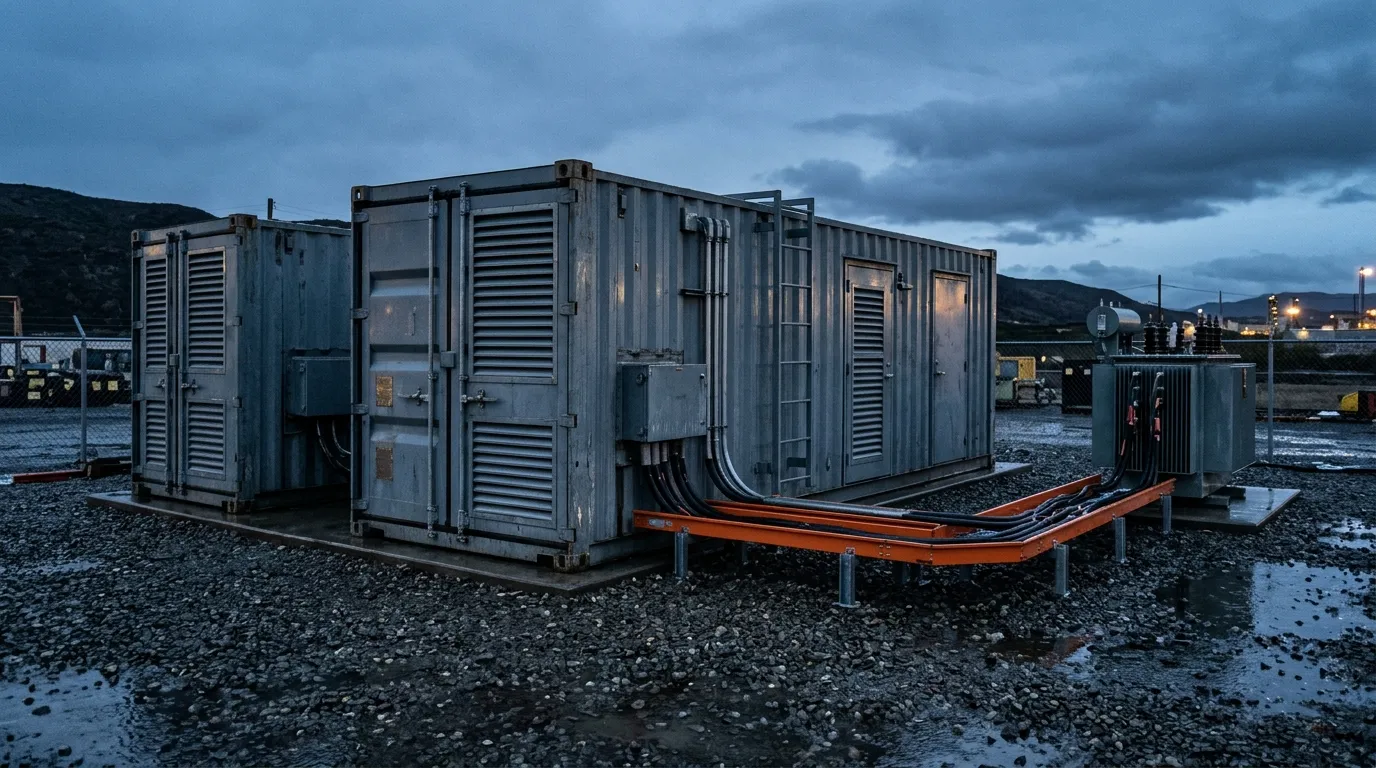
Commercial and industrial sites run on the cabinet platform where the reduction is in the hundreds of kilowatts, and on the containerized platform where the shave or duration pushes into megawatt-hours; the commercial and industrial energy storage cluster covers how the two are chosen. The energy management system is configured with the tariff's demand target, a state-of-charge floor for back-to-back peaks, and a charging schedule outside the demand window. Metered demand is logged at the settlement interval, so savings reconcile against the bill.
Platform options are on the commercial and industrial solution page. Sizing starts with the same two documents every time: send the rate schedule and twelve months of interval data, plus the reduction you are considering.