

Ask two developers what a utility battery "costs" and you'll get two different answers. One quotes the sticker price — dollars per kilowatt-hour of capacity. The other quotes the number that actually decides whether the project pencils out: the levelized cost of storage (LCOS), the all-in cost of every megawatt-hour the system will ever discharge across its life.
The gap between those two numbers is where good projects are won and bad ones are lost. A cell that is 10% cheaper up front but delivers 30% fewer lifetime cycles is not a bargain — it is a more expensive megawatt-hour wearing a cheaper price tag. This guide breaks down how LCOS is calculated for utility storage, what a competitive number looks like in 2025, and the six levers that move it.
What LCOS is (and why $/kWh capex lies)
LCOS is the average cost of storing and re-delivering one unit of energy, spread across the entire life of the asset. Conceptually:
LCOS = (total lifetime cost of the system) ÷ (total lifetime energy discharged) — both discounted to today's dollars.
That single ratio folds in everything a capex number ignores: how many times the battery can cycle before it wears out, how much energy is lost on every round trip, how much you'll spend on maintenance and augmentation over 15–20 years, and the cost of the capital tied up in the project.
Two systems can carry the identical $/kWh sticker and land 40% apart on LCOS, because LCOS is decided by the denominator — lifetime throughput — as much as the numerator. This is exactly why utility buyers, IPPs, and project-finance teams underwrite storage on LCOS, not on the price of a container.
LCOS vs LCOE — a quick clarification
LCOE (levelized cost of energy) measures what it costs a generator — solar, wind, gas — to produce a megawatt-hour. LCOS measures what it costs a battery to time-shift one: to move cheap midday solar into the evening peak, or to hold a megawatt in reserve for frequency response. A storage project doesn't generate energy; it moves it. LCOS is the metric built for that job, and it is the one you compare against the spread you expect to capture, not against a generator's LCOE.
The LCOS formula, decoded
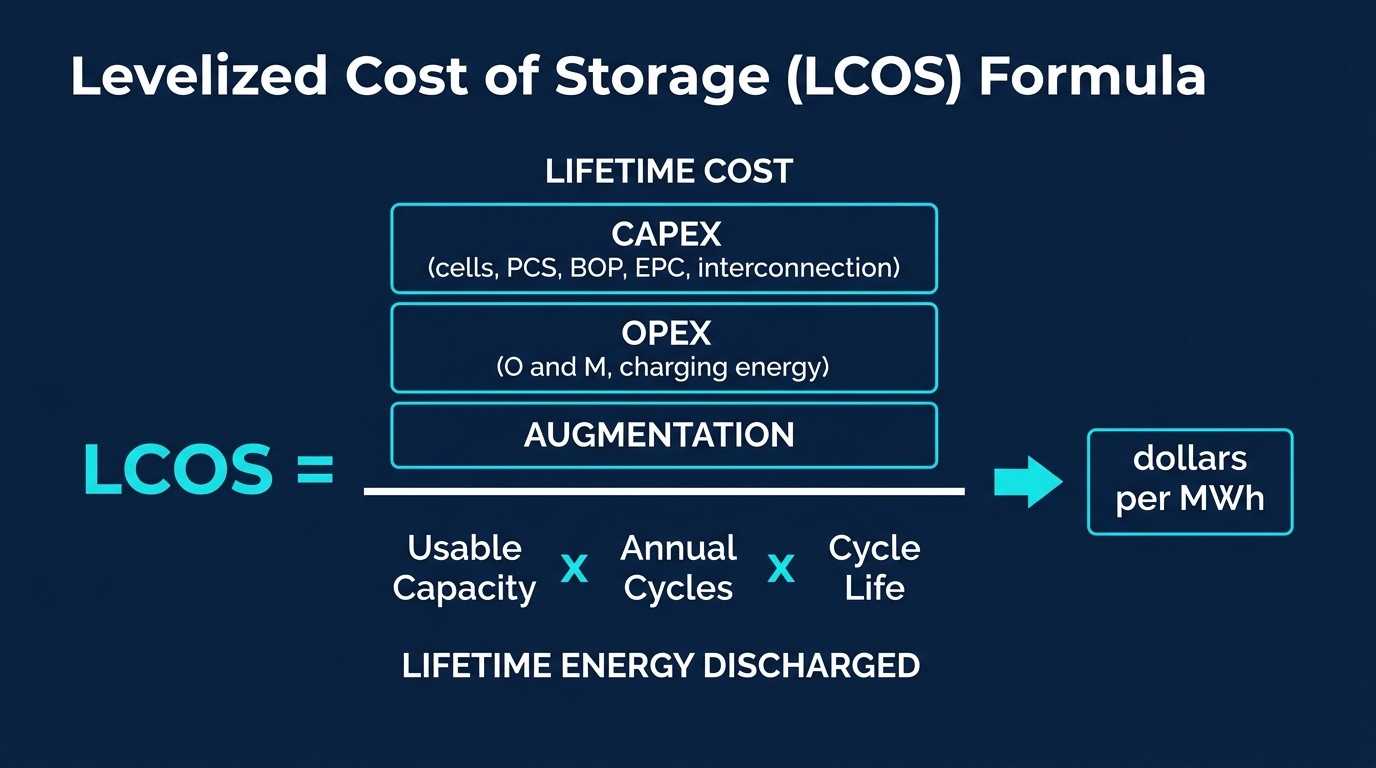
Break the ratio into its two halves and the cost drivers become obvious.
The numerator — lifetime cost (discounted):
- Capital cost (capex): battery cells and racks, the power-conversion system (PCS), balance of plant, thermal management, EPC and installation, and grid interconnection. Even for longer-duration systems, the non-cell costs — installation, interconnection, and balance of plant — often rival the equipment itself, so the cheapest cell rarely means the cheapest project.
- Operating cost (opex): O&M, insurance, site and land, and — critically for storage — the charging energy you must buy. Because no battery is 100% efficient, you purchase more energy than you sell; that round-trip loss is a recurring cost, not a one-time one.
- Augmentation: batteries fade. To hold a firm MWh rating over 15–20 years, most utility projects budget to add capacity periodically. That planned spend belongs in the numerator.
The denominator — lifetime energy discharged (discounted):
- Usable capacity = nameplate × depth of discharge. You only ever sell the usable slice.
- Annual cycles — how often the system is charged and discharged (one cycle a day ≈ 365/year; frequency-regulation duty can be far higher).
- Cycle life and degradation — how many of those cycles the cells survive before capacity falls below the guaranteed floor, and how fast they fade along the way.
Everything is discounted at the project's weighted average cost of capital (WACC). A higher discount rate front-loads the capex and shrinks the value of energy delivered in later years — which is why financing terms move LCOS almost as much as the hardware does.
A worked example: 100 MW / 400 MWh, 2025
Take a mainstream 4-hour utility system and run illustrative numbers (rounded, for intuition — not a quote):
Input | Value |
|---|---|
Capacity | 400 MWh (100 MW × 4 h) |
All-in capex | ~$150/kWh → $60M |
Usable depth of discharge | 90% |
Cycles per year | 365 (one per day) |
Project life | 15 years |
O&M | ~$3/kWh-yr → ~$18M lifetime |
Augmentation | ~$12M lifetime (top-ups around years 5 and 10) |
Denominator: 400 MWh × 90% DoD × 365 cycles × 15 years ≈ 1.97 million MWh discharged over the life (with augmentation holding capacity roughly flat). This is a simplified pre-discounting calculation; the actual LCOS denominator should discount future discharged energy to present value.
Numerator: $60M capex + $18M O&M + $12M augmentation ≈ $90M.
Undiscounted, that's ≈ $46/MWh. Now apply a real-world 8% WACC. Discounting works against storage here: the $60M capex lands in year 0 at full weight, but the energy — and the O&M and augmentation savings against it — arrives over 15 future years and shrinks when pulled back to today. Discount both sides and the PV numerator is ~$77M against ~1.13 million discounted MWh, lifting LCOS to roughly $65–70/MWh — right on top of the market benchmarks below.
(This simplified pass deliberately excludes the charging-energy cost and cell degradation; both are real and both push LCOS up, which is exactly why round-trip efficiency and cycle life — the levers below — matter so much.)
The lesson isn't the exact figure. It's the sensitivity: halve the cycle life and LCOS nearly doubles; drop the WACC two points and it falls sharply. LCOS is a leverage machine.
What actually drives LCOS — the six levers
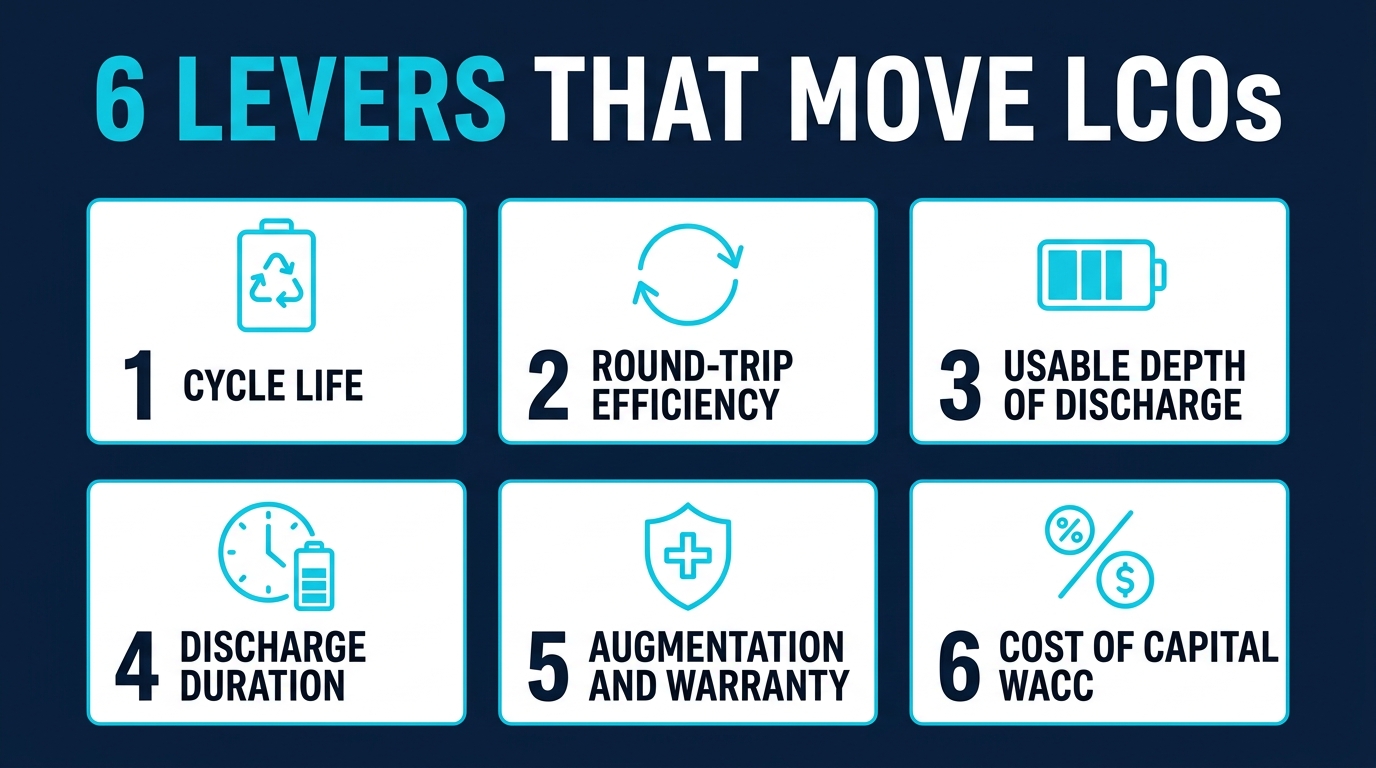
- Cycle life & degradation. The single biggest lever. Every extra thousand cycles spreads the same capex across more delivered energy. LFP cells rated for 8,000+ cycles versus 4,000 can significantly reduce the effective capital cost per delivered MWh, provided the additional cycle life is usable under the project's actual operating conditions. See cycle life.
- Round-trip efficiency (RTE). Every point of efficiency is energy you don't have to buy back. Moving from 85% to 88% RTE trims the charging-energy line item across every cycle for two decades — small per-cycle, enormous cumulatively.
- Usable depth of discharge. A 90% usable DoD sells about 13% more energy per cycle than an 80% design on the same nameplate — free denominator with no extra capex.
- Discharge duration & throughput. Longer-duration systems amortize the power hardware (PCS, transformers, interconnection) over more energy, lowering the effective $/kWh. Matching duration to the actual duty cycle — arbitrage, peak shaving, or frequency regulation — keeps the asset earning.
- Augmentation & warranty strategy. A credible, low-cost augmentation path and a long capacity warranty protect the denominator in years 8–15, when a poorly specified system is already fading.
- Cost of capital. Clearer revenue models — capacity auctions, tolling agreements, contracted revenue — lower the WACC, and a lower WACC flows straight through to LCOS. This is why bankability and hardware quality are two sides of the same coin.
Notice that four of the six levers live in the hardware spec sheet — cycle life, RTE, usable DoD, and augmentation-readiness — not in the purchase price. That is why the cheapest system on a $/kWh basis is so rarely the cheapest on LCOS.
Where utility LCOS sits in 2025
The market has moved fast, and downward. Globally, the all-in capex to build a long-duration (4-hour-plus) utility-scale battery project sits around $125/kWh outside China and the US — roughly $75/kWh for the core equipment and ~$50/kWh to install and connect it — which translates to an LCOS near $65/MWh on real project parameters, according to Ember's 2025 storage cost analysis.
In the United States, Lazard's June 2025 LCOE+ analysis puts a 100 MW, 4-hour standalone system in a wider band — roughly $83/MWh in favorable "energy community" locations up to $192/MWh at the top end, reflecting local interconnection, labor, and financing costs. Lazard attributes the 2025 declines to cheaper cells from battery oversupply, longer lifetimes, higher efficiencies, and lower financing costs as revenue models mature.
The takeaway for a developer: a competitive 2025 utility LCOS is a two-digit number per MWh in the most favorable markets and comfortably under ~$150/MWh in most others — and the projects hitting the low end got there through long cycle life, high efficiency, and low-cost capital, not by buying the cheapest cell. Duration matters too: shorter-duration systems spread fixed power-side costs over less energy, so a 1-hour system's LCOS runs well above the 4-hour figures quoted here.
How to specify hardware that minimizes LCOS
Because the biggest LCOS levers are locked in at procurement, the spec sheet is where the number is really set. When evaluating utility-scale energy storage systems, pressure-test four things:
- Rated cycle life at a stated SOH and DoD — not a bare "cycles" figure. Hua Power's utility containers (e.g. the 5.02 MWh HC-UPSB5010L) are rated at ≥8,000 cycles to 80% SOH on LFP cells, which directly stretches the LCOS denominator.
- Round-trip efficiency — a system-level ≥87% RTE keeps the recurring charging-energy cost down for the life of the asset.
- Usable DoD — a 90% usable window sells more energy per cycle from the same footprint.
- Thermal design — liquid cooling holding cell temperature uniformity within ±2°C slows degradation, protecting the denominator in later years. Certifications (UL 9540A, NFPA 855) protect bankability, which protects the WACC.
The same discipline applies whether the asset is a 100 MW+ generation-side project or a behind-the-meter commercial & industrial system — the LCOS math is identical; only the revenue side changes.
Common LCOS mistakes to avoid
- Underwriting on $/kWh alone. It ignores the denominator entirely. Always convert to LCOS before comparing bids.
- Using cycle life without conditions. "6,000 cycles" at 100% DoD and 45°C is a very different asset from "8,000 cycles to 80% SOH" under managed thermal conditions. Normalize the assumptions.
- Forgetting charging energy and augmentation. These recurring costs can rival capex over 15 years; leaving them out flatters the number.
- Ignoring WACC. Two identical systems financed at 6% and 10% have materially different LCOS. Model the actual capital stack.
The bottom line
For utility storage, LCOS — not the capex sticker — is the honest measure of what your energy will cost. And the levers that move it most are set the day you sign the supply contract: cycle life, round-trip efficiency, usable depth of discharge, and a thermal design that keeps the cells alive to year 20. Get those right and a two-digit-per-MWh LCOS is within reach; get them wrong and no discount on day one will save the number.
Weighing storage economics for a specific project? Hua Power's engineering team can model LCOS against your duty cycle, revenue stack, and financing assumptions using real utility-scale system parameters — get in touch to run the numbers.