

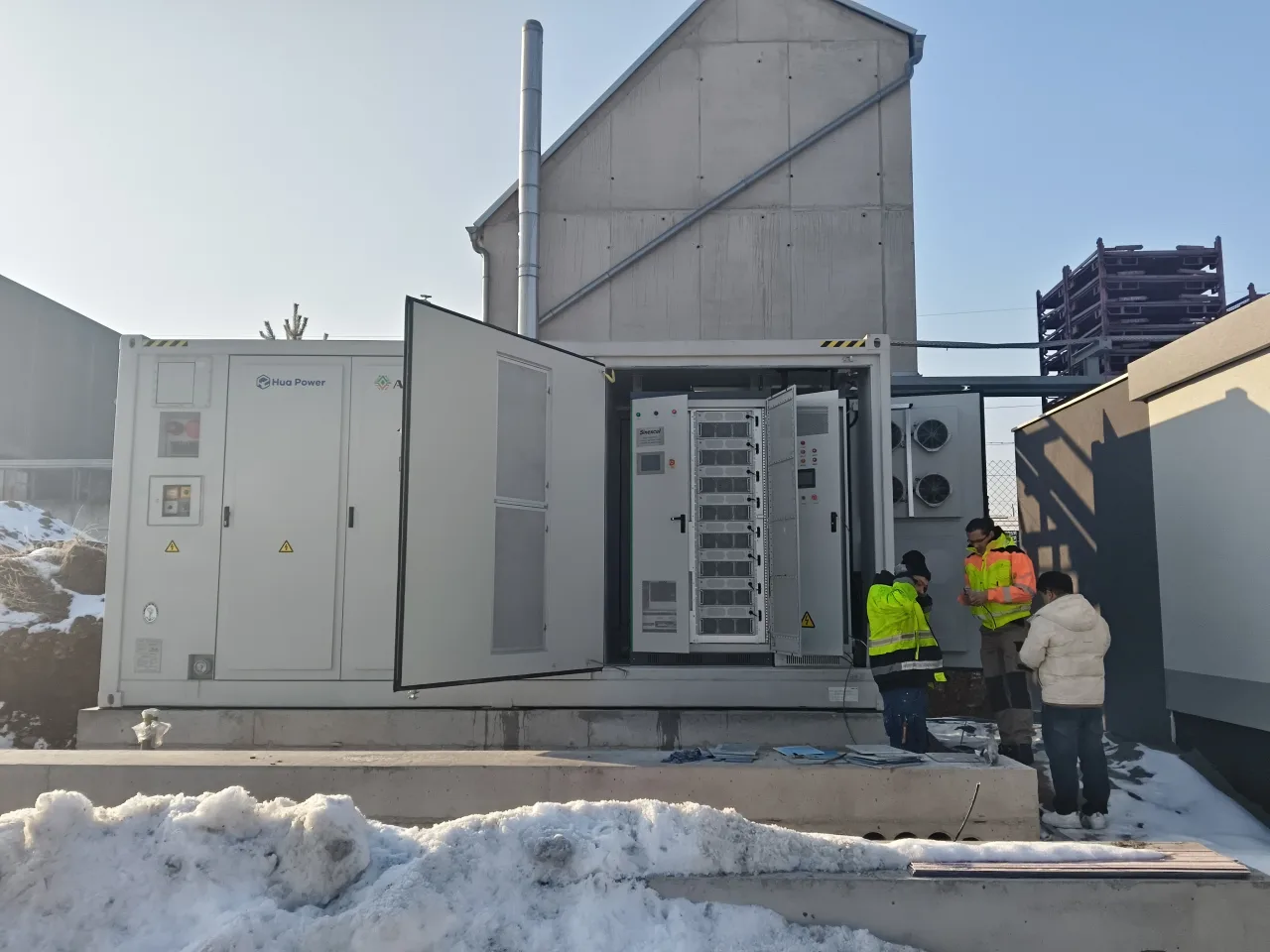
Peak shaving doesn't lower how much energy you use — it lowers the costliest few minutes of how fast you use it.
If you run a factory, cold store, data center, or any large commercial site, look closely at your electricity bill. A big slice of it — often 30–70% for C&I customers — isn't for the energy you consumed at all. It's a demand charge: a penalty for your single highest moment of power draw in the month.
Peak shaving is the practice of using a battery to flatten that moment. The battery discharges for the few minutes or hours your site spikes, holding your metered demand below a target, then recharges when power is cheap. You use the same total energy — you just stop paying for the expensive spike.
This guide is written for the people who actually have to make the call: energy and facility managers, EPCs, and procurement engineers. It covers what demand charges really are, how a battery shaves them, how to size the system from your own meter data, a fully worked ROI example you can copy, and which Hua Power cabinet fits which job.
The short version: Demand charges are billed on your highest 15-minute power draw, so a single spike sets your bill for the whole month. A battery sized to your peak's height (kW) and width (hours) can shave 20–50% off that demand charge, typically paying back in 3–5 years (faster with incentives). Size power first, energy second — peak shaving is usually power-constrained — and let an EMS hold the threshold automatically.
Demand charges 101: why your bill spikes
To shave a peak you first have to understand what you're being charged for. A commercial electricity bill has two main moving parts:
- Energy charge ($/kWh) — what you pay for total energy consumed over the month. This is the part everyone understands.
- Demand charge ($/kW) — what you pay for your highest rate of power draw, measured as the single highest 15-minute rolling average in the billing period.
A useful analogy: the energy charge is the water you used; the demand charge is the size of the pipe you required at your thirstiest moment. You can use modest total energy and still get hit with a large demand charge if you have one sharp spike — a bank of compressors all starting together, a furnace cycle, an EV-charging surge.
Three details decide how much a battery can save you, and weaker guides skip them:
- The 15-minute interval is unforgiving. Your demand charge is set by one worst interval. Shave that one interval and the whole month's demand charge drops. (For the mechanics of demand charges, time-of-use, and the charge types below, Energy Toolbase's demand-charge guide is a solid reference.)
- Ratchet clauses make one spike haunt you. Many tariffs set your billing demand to a floor — commonly 70–80% of your highest peak over the prior 11–12 months. A single bad summer afternoon can inflate your demand charge through the following winter. That turns "never let a peak through" from a nicety into real money.
- Coincident vs facility peak. Some tariffs bill your highest demand whenever it occurs (non-coincident / facility peak). Others bill your demand during the utility's system peak window (coincident peak). They call for different dispatch strategies — confirm which one your rate uses before you size anything.
Demand-charge structures themselves vary — flat, tiered ($/kW by threshold), daily ($/kW/day), and time-of-use demand. Each changes the optimal way to dispatch a battery, which is why the sizing step later starts with your tariff and your meter data, not a rule of thumb.
What peak shaving is (and how a battery does it)
Peak shaving is simple in principle: when your site's power draw climbs toward a threshold you've set, the battery discharges to supply the difference, so the grid only ever "sees" demand up to that ceiling. When demand falls — overnight, or any off-peak window — the battery recharges.
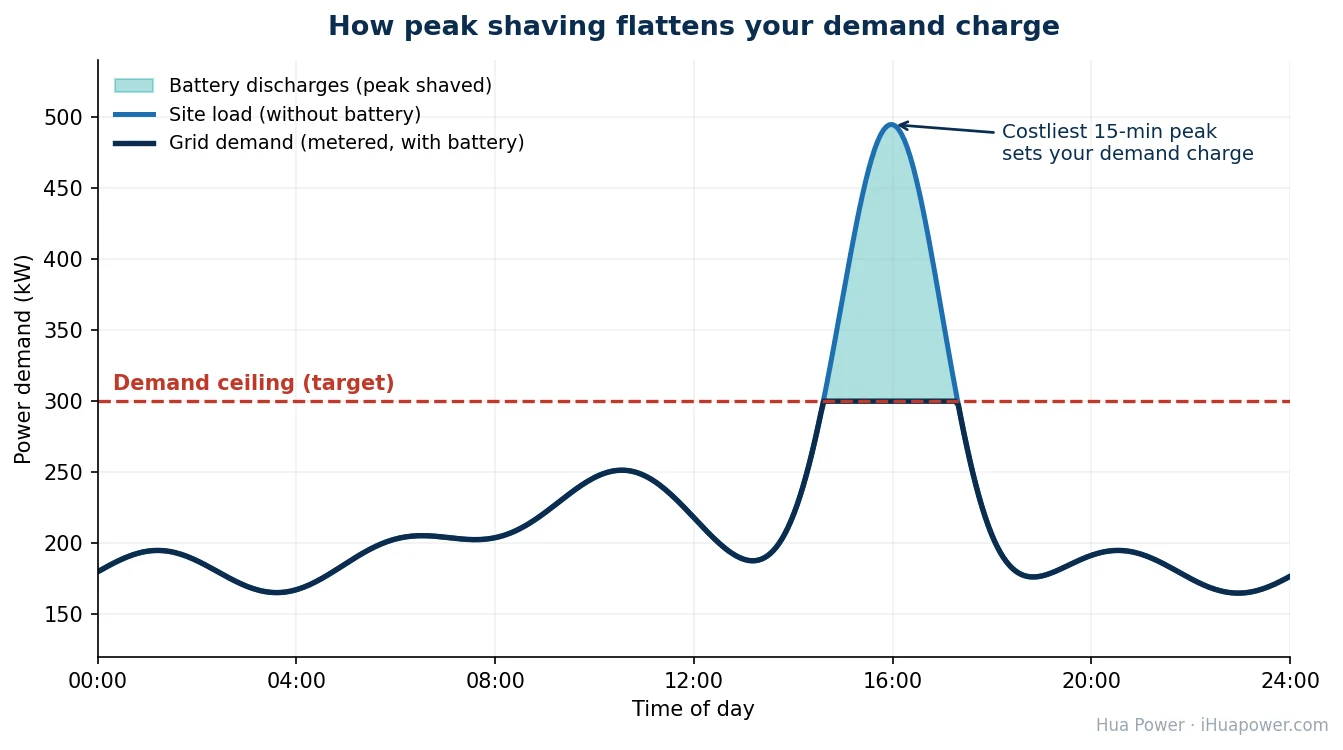
The battery fills the gap above your demand ceiling, so the meter never records the spike.
The hardware doing this is a behind-the-meter (BTM) battery energy storage system: lithium-iron-phosphate (LFP) cells, a power conversion system (PCS) that converts DC to AC, and an energy management system (EMS) that watches your load and decides when to discharge. The EMS (Energy Management System) is the intelligence layer that determines when and how the battery charges and discharges — more on it below — because shaving a 15-minute peak means acting before the peak fully forms, not after.
It's worth separating peak shaving from its cousins, because the words get used loosely and they target different parts of your bill:
Strategy | What it targets | Mechanism | When it wins |
|---|---|---|---|
Peak shaving | Demand charge ($/kW) | Discharge to hold grid demand below a ceiling | High demand charges; sharp, short peaks |
Load shifting | TOU energy charge ($/kWh) | Move consumption from on-peak to off-peak hours | Big peak/off-peak price spread |
Energy arbitrage | Energy price spread ($/kWh) | Charge when cheap, discharge when expensive | Volatile or wide TOU pricing |
Demand response | Incentive payments | Curtail on a utility/ISO signal | Programs available in your market |
The good news: a well-controlled BESS does several of these at once. The same battery that shaves your demand peak can shift load and capture arbitrage on the same day — what the industry calls value stacking. (EIA tracks how US storage is used across exactly these applications.)
The EMS: the brain of peak shaving
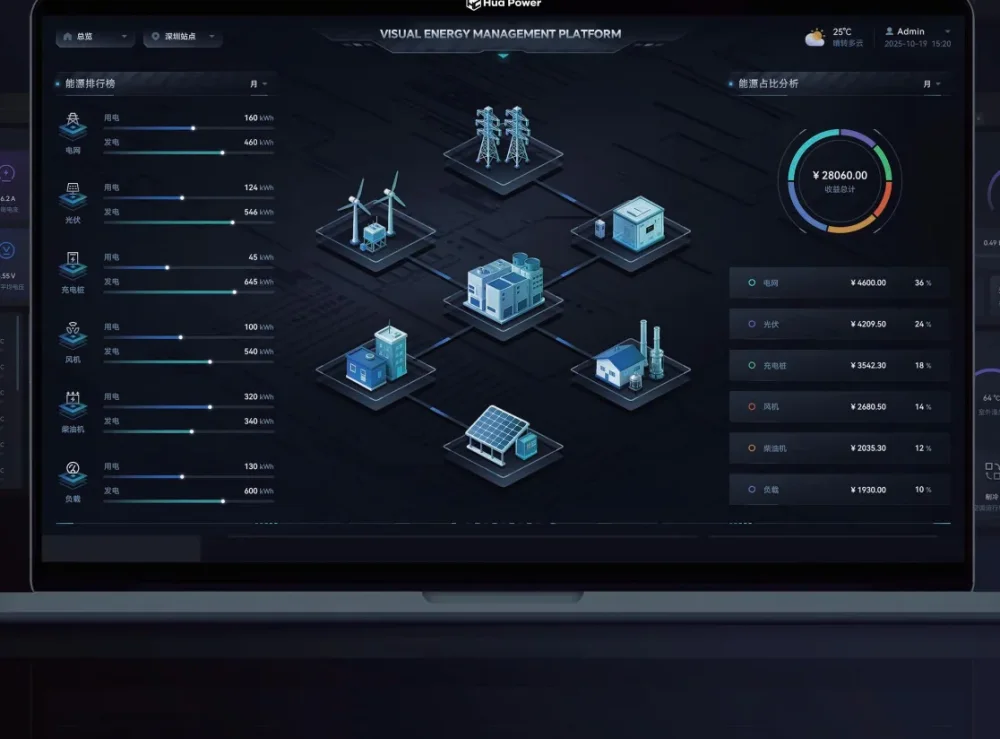
Hua Power's Visual Energy Management Platform — the EMS that monitors load, forecasts peaks, and dispatches the battery in real time.
A battery without intelligence is just stored energy. What turns it into demand-charge savings is the EMS deciding exactly when and how hard to discharge.
A good peak-shaving EMS does four things:
- Predicts demand peaks. It learns your load pattern and predicts when you're about to cross your threshold — so it starts discharging before the 15-minute interval registers a spike, not after.
- Maintains the configured demand limit. It tracks the rolling demand and modulates discharge to keep the meter pinned just under your target ceiling.
- Manages the State of Charge (SoC) reserve. It keeps enough charge in hand to cover the whole peak window, so the battery isn't empty halfway through the afternoon — the failure mode that allows demand to exceed the configured threshold and resets your demand charge for the month.
- Stacks value. Between peaks, it runs load-shifting and arbitrage, and can respond to demand-response signals, so the asset earns from more than one stream.
Hua Power's systems are built around exactly this: the company's background is in millisecond-level grid-response control (originally for European grid-frequency regulation), and that same fast EMS runs the Visual Energy Management Platform that handles peak shaping, forecasting, and dispatch for C&I sites. The EMS responds in real time to changing site loads, enabling precise control of the configured demand limit.How to size a peak-shaving battery
This is where most guides wave their hands. Sizing is the engineering core, and it comes down to two numbers that are easy to confuse:
- Power (kW) — how much peak you can shave. Set by the inverter/PCS rating.
- Energy (kWh) — how long you can hold the shave. Set by the battery capacity.
The single most important insight: peak shaving is usually power-constrained, not energy-constrained. You need enough kW to cut the spike's height and enough kWh to cover its width — and the cheapest "big kWh" battery is the wrong buy if it can't deliver the kW.
A four-step method using your own data:
- Pull your 15-minute interval data. Download it from your utility's online account portal (often a Green Button export), or ask your account rep for a 12-month 15-minute CSV. Plot a week. You're looking for the shape of your peaks — how high above your baseline, and how long they last.
- Set your shave target (kW). Decide the demand ceiling you want to hold. Your shave power = (your typical peak) − (your target ceiling). If you peak at 480 kW and want to hold 300 kW, you need 180 kW of discharge power.
- Size the energy (kWh) to the peak's width. Measure how long demand stays above your target ceiling. If you're above 300 kW for about two hours, you need roughly 180 kW × 2 h = 360 kWh delivered. Gross that up for usable depth-of-discharge (~90%) and RTE (~88%) to get the nameplate you actually buy: 360 ÷ (0.9 × 0.88) ≈ 450 kWh nameplate.
- Check the C-rate and duration. A battery's C-rate ties power to capacity. Often a higher-power cabinet with ~2-hour duration beats oversizing energy you'll never use — confirm the model can deliver your kW for the full width of the peak.
Hua Power's C&I cabinets are optimized for approximately two-hour duration applications and 90% depth-of-discharge, which puts them in the ~2-hour-duration band that fits most commercial peak windows. (For a deeper walk through capacity selection, see 100, 200 or 500 kWh capacity selection; if your duty is heavy and continuous, cooling matters too — see liquid-cooled vs air-cooled BESS.)
Matching the size to a product
Once you know your shave target (kW) and required duration (kWh), you can map straight to a cabinet. Hua Power's C&I ladder, with usable energy at 90% DoD and ~2-hour duration:
Model | Power (kW) | Capacity (kWh) | Usable (≈90% DoD) | Cooling | Typical shave target |
|---|---|---|---|---|---|
HC-UPSAP112 | 50 | 112.5 | ~101 kWh | Air | Small site, ≤50 kW shave |
HC-UPSAP241 | 105 | 241 | ~217 kWh | Air | Mid commercial, ~100 kW shave |
HC-UPSAP261L | 125 | 261 | ~235 kWh | Liquid | Dense/hard-cycling, ~125 kW shave |
HC-UPSAP522L | 250 | 522 | ~470 kWh | Liquid | Large C&I / factory, ~180–250 kW shave |
HC-UPSSP723–HC-UPSSP1205 | 300–500 | 723–1,205 | ~650–1,085 kWh | Air | Heavy industrial / multi-MWh |
All models use LFP cells rated for ≥8,000 cycles at 80% State of Health (SoH), run multiple operation modes (peak shaving, load shifting, backup), and connect grid, PV, and generators simultaneously — and the platform is modular, so you parallel cabinets as your shave target grows. Need to shave 400 kW? Two HC-UPSAP522L in parallel, or a distributed HC-UPSSP1205. (Which enclosure — outdoor or indoor — is a separate decision; settle it in outdoor vs indoor energy storage cabinet.)
A worked ROI example you can copy
No competitor on the first page of search shows the actual math. Here it is, fully — swap in your own numbers.
The facility: a manufacturing site that peaks at 480 kW, wants to hold 300 kW (a 37.5% shave), on a tariff with a $20/kW/month demand charge and a peak that lasts about 2 hours a day.
Step 1 — Demand-charge savings. Shave = 480 − 300 = 180 kW. Savings = 180 kW × $20/kW × 12 months = $43,200/year.
Step 2 — Add load-shifting / arbitrage. The same battery shifts ~360 kWh/day from on-peak to off-peak. At a $0.15/kWh TOU spread over ~350 operating days, net of ~88% RTE, that's roughly $16,000/year more. (RTE is a real cost — utility-scale Li-ion fleets average around 82%; a modern C&I system runs a little higher.) Two honest caveats: this stream is highly tariff-dependent — a site with a thin TOU spread captures far less — and it's additional capture, not a free add-on. The capacity the EMS reserves to guarantee the peak shave isn't simultaneously available for arbitrage, so on peak days the two streams compete for the same kWh.
Step 3 — Total annual benefit ≈ $43,200 + $16,000 = ~$59,000/year.
Step 4 — The system and its cost. The shave needs 180 kW of power and ~360 kWh delivered (≈450 kWh nameplate after the DoD and efficiency gross-up). That fits an HC-UPSAP522L (250 kW / 522 kWh, ~470 kWh usable) with headroom on both power and energy. Installed system costs vary depending on project size, system configuration, region, and installation scope. Contact Hua Power for a project-specific quotation and financial assessment.
Step 5 — Payback. At ~$260k CapEx and ~$59k/year benefit, simple payback is ~4.4 years. Apply the US federal Investment Tax Credit (30%) and CapEx drops to ~$182k → payback ~3.1 years — and the asset keeps earning for its full ≥8,000-cycle life. Net it down slightly for aging: an LFP system loses roughly 1–2% of capacity a year, so model the savings fading at that rate rather than staying flat — it adds a few months to the payback, not years.
What changes the answer most: your demand charge rate (a $40/kW tariff halves the payback), whether a ratchet clause is inflating your bills, your TOU spread, and incentives. Plug your own meter data and tariff into these five steps and the verdict falls out.
Incentives and financing
Incentives can compress payback by a third or more:
- Federal ITC (30%). The Investment Tax Credit now applies to standalone storage (extended by the 2022 Inflation Reduction Act), with potential bonus adders. MACRS accelerated depreciation adds further value for taxable entities.
- State and utility programs. California's SGIP offers per-kWh rebates; New York, Massachusetts and others run their own storage incentives. Availability and amounts change — confirm current programs for your state before modeling.
Treat incentives as the accelerator, not the reason: a peak-shaving project should pencil out on demand-charge savings alone, with incentives turning a good payback into a great one.
Which facilities benefit most
Peak shaving pays best where demand charges are high and peaks are sharp and predictable:
- Manufacturing — heavy machinery, motor start-up surges; large, repeatable peaks.
- Cold storage & refrigeration — compressor cycling drives spiky demand.
- EV charging sites — fast chargers create severe short spikes that wreck demand charges.
- Data centers — high, steady load with costly demand components and a resilience bonus.
- HVAC-heavy commercial buildings — hotels, malls, hospitals with afternoon cooling peaks.
If your load is flat and your demand charge is low, peak shaving saves less — be honest about your load shape before investing. Your interval data tells you immediately.
Notes for EPCs and procurement
A few things to lock down before you buy:
- AC- vs DC-coupling. Retrofitting storage to an existing site or adding to existing solar usually favors AC-coupling; a new PV+storage build can be more efficient DC-coupled. Hua Power's all-in-one cabinets support PV, grid, and generator inputs for either path.
- Cycle life vs daily cycling. Peak shaving cycles the battery roughly once a day. At ≥8,000 cycles, that's over 20 years of daily cycling before reaching 80% SOH — so for LFP cabinets, calendar aging, not cycle count, is usually the binding constraint. Daily peak shaving is well within spec, but factor a modest annual degradation into multi-year savings models.
- Interconnection & O&M. Confirm utility interconnection requirements early, and account for O&M and end-of-life in total cost of ownership.
- Warranty and certifications. Check the cycle/SOH warranty and that the system carries the right safety and grid-code certifications for your market.
When you're ready to scope a purchase, the C&I BESS procurement framework lists everything to confirm first, and the C&I energy storage overview puts peak shaving in the context of the wider system.
How to get a site-specific recommendation
The method above gets you from your electricity bill to a shave target, a system size, and a payback estimate. Turning that into a final spec — exact model count, AC/DC coupling, enclosure, and incentive stack — depends on your interval data, tariff, and site.
Hua Power has deployed 400+ ESS projects, including C&I peak-shaving and PV+storage installations across 30+ countries (such as a 500 kW / 1 MWh PV+ESS site in Portugal and a 500 kW / 1.044 MWh on-grid system in Guangzhou). Send your load profile and tariff and the recommendation will be grounded in your real numbers — talk to our team to start.
Frequently asked questions
What is peak shaving in energy storage? Peak shaving is using a battery to reduce your site's highest moments of power draw. When demand approaches a set ceiling, the battery discharges to supply the difference, so the grid meter never records the spike. Because demand charges are billed on your single highest 15-minute interval, flattening that interval cuts the charge for the whole month.
How does peak shaving reduce demand charges? Demand charges ($/kW) are set by your highest 15-minute power draw. A battery discharges during that spike to hold your metered demand below a target, lowering the kW figure the charge is based on. Shaving 180 kW off a peak on a $20/kW tariff saves 180 × $20 × 12 = $43,200 a year.
What's the difference between peak shaving and load shifting? Peak shaving targets the demand charge ($/kW) by capping your highest power draw. Load shifting targets the energy charge ($/kWh) by moving consumption from expensive on-peak hours to cheap off-peak hours. A modern BESS does both — and energy arbitrage — on the same day.
How do I size a battery for peak shaving? Start with your 15-minute interval data. Your power (kW) is the height of the peak you want to remove (peak minus target ceiling); your energy (kWh) is that power times how long the peak lasts, adjusted for usable depth-of-discharge and Round-trip Efficiency (RTE). Size power first — peak shaving is usually power-constrained.
What's the payback period for a commercial peak-shaving battery? Typically 3–5 years, and faster where demand charges are high or incentives apply. It depends on your demand-charge rate, peak shape, TOU spread, system cost, and the 30% federal ITC. Run your own numbers through the five-step example above rather than trusting a generic figure.
Does daily cycling for peak shaving wear out the battery? Less than you'd think. Hua Power's LFP cabinets are rated for ≥8,000 cycles at 80% SoH — over 20 years of once-a-day cycling. At that rate, calendar aging usually matters more than cycle count, so daily peak shaving is well within spec.
Can I combine peak shaving with solar? Yes. Charging the battery from solar instead of the grid improves the economics and raises self-consumption. Hua Power's all-in-one cabinets accept PV, grid, and generator inputs, so a single system can shave peaks, store solar, and provide backup.
What is a behind-the-meter battery system? "Behind-the-meter" means the battery sits on your side of the utility meter, serving your facility directly (as opposed to front-of-meter, grid-scale storage). Peak shaving, load shifting, and backup are all behind-the-meter applications.