

What "50kW Hybrid Storage Cabinet" Actually Means
If you typed "50kW hybrid energy storage cabinet" into a search engine, you're probably not shopping for a residential solar battery. You're looking at commercial-scale equipment — the kind that shaves thousands off a factory's monthly demand charges or keeps a cold-storage warehouse running through a grid outage.
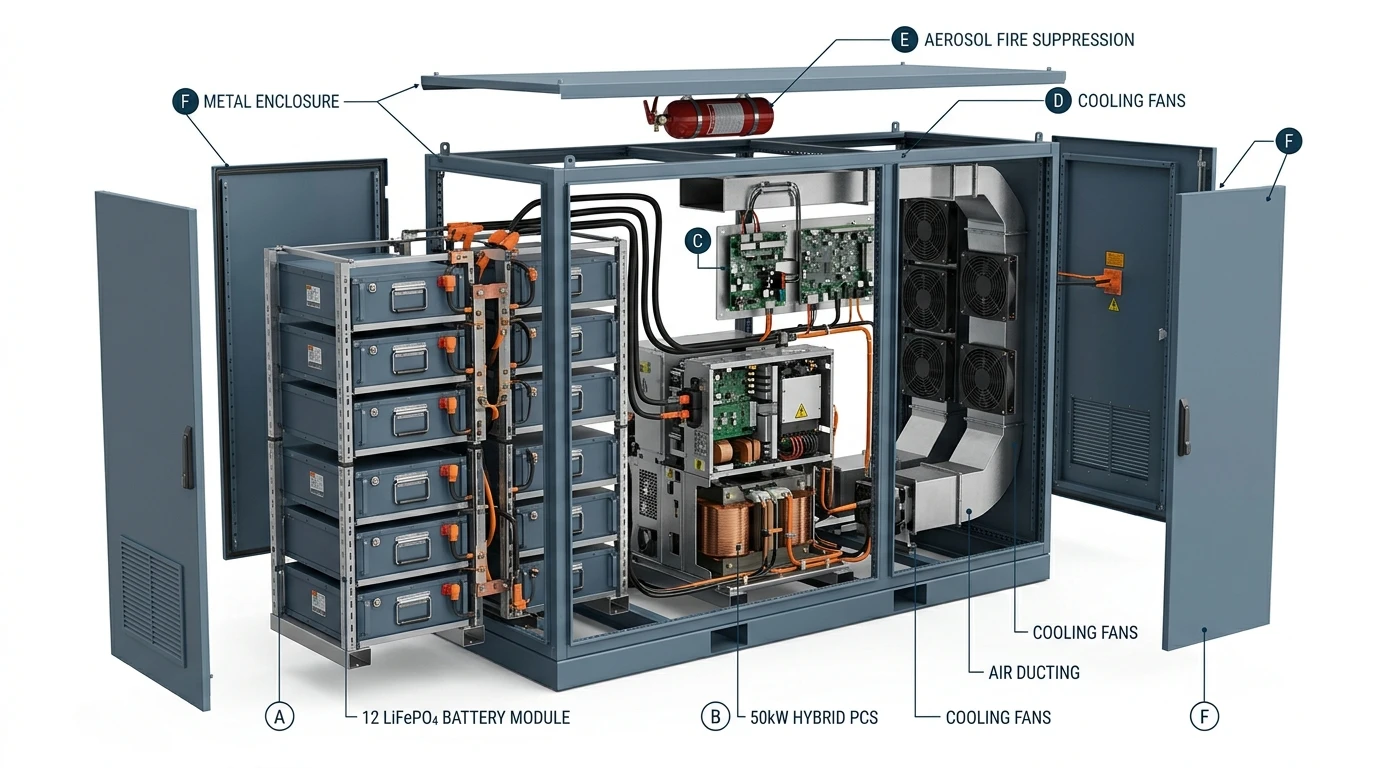
A 50kW hybrid energy storage cabinet is a self-contained, outdoor-rated enclosure that packages three things into one unit: lithium iron phosphate (LiFePO4) battery modules, a hybrid power conversion system (PCS) capable of both grid-tied and off-grid operation, and the control systems — BMS, EMS, and communication interfaces — that make them work together. The "hybrid" in the name means it handles power flow in both directions: charging from the grid or solar during low-rate periods, discharging to your loads when rates spike or the grid drops. For a look at production-scale hardware, Hua Power's commercial BESS cabinet range spans 300kW to 1.2MWh in outdoor IP54 enclosures — the 50kW class sits at the entry end of this product family.
This is not the same thing as a "50kW solar system" for a house. Google's related questions for this query still show residential confusion — "how long will a 50kW battery last," "how many solar panels for 50kW" — but a 50kW cabinet is a three-phase, 400V-class piece of industrial infrastructure. It ships on a pallet, sits on a concrete pad, and connects to your facility's main distribution board. If you're comparing it to anything residential, you're in the wrong product category.
For a deeper look at what BESS OEM manufacturing involves — from factory evaluation to the full RFQ-to-delivery process — start with our OEM manufacturing guide. This article focuses specifically on the 50kW hybrid cabinet as a product category: what's inside, how to evaluate one, and what customization you can actually get from an OEM partner.
What's Inside a 50kW Hybrid Cabinet — System Architecture
Every manufacturer's cabinet looks different from the outside, but the internal architecture follows the same logic. Understanding it will help you read a spec sheet without getting lost in acronyms.
Battery Modules and Cell Chemistry
The energy storage core is a rack of LiFePO4 battery modules, typically configured for a total capacity between 50 kWh and 200 kWh at the 50kW power level. LiFePO4 dominates this segment for several reasons: manufacturers commonly claim 6,000 or more cycles at 80% depth of discharge (ask for the test conditions behind that number — cycle-life claims depend on temperature, charge/discharge rate, and end-of-life criteria), it runs thermally stable enough for outdoor cabinets without active liquid cooling in most climates, and it carries no cobalt supply-chain exposure.
Cell format varies by manufacturer. Some use the now-standard 314Ah prismatic cells that Chinese cell makers pushed to volume in 2024–2025. Others, like SUVPR's cabinet line, use BYD blade cells — a longer, thinner form factor originally developed for EV packs that packs more densely into a cabinet footprint. The cell format affects energy density and thermal behavior, but from a buyer's perspective, the more important question is whether the manufacturer discloses their cell supplier. A few will name CATL, BYD, or EVE directly; most won't. If they won't tell you whose cells are inside, that's a flag — not necessarily a dealbreaker, but a flag.
Power Conversion System
The PCS is the cabinet's muscle. At 50kW, you're looking at a three-phase, 400V AC bidirectional inverter. It rectifies AC to DC for charging and inverts DC back to AC for discharging, with manufacturers typically claiming round-trip efficiency in the 94–96% range at the PCS level (system-level RTE including battery and auxiliary losses will be lower — see the evaluation section below).
What separates a commodity PCS from a proper one shows up in three places on the spec sheet. First, overload capability — can it sustain a short-duration overload (common specs range from 110% for 10 minutes to lower percentages for longer periods), or does it trip near its rated limit? Industrial loads spike, and a cabinet that can't ride through a motor start may not serve its intended application. Second, switchover time — in off-grid or backup mode, how fast does the PCS pick up the load after grid failure? Systems targeting sub-20 ms transfer are competitive for many critical loads, but the actual requirement depends on what equipment you're protecting. Third, grid code compliance — does the PCS support the specific grid interconnection standards for your target market and installation configuration? A cabinet tested to EU grid codes (e.g., EN 50549, VDE-AR-N 4110 at the relevant voltage level and member-state implementation) may need additional evaluation for North America (IEEE 1547) or South Africa (NRS 097-2-1). Grid-code applicability depends on voltage level, project configuration, utility requirements, and jurisdiction — confirm with your installer or consultant, and ask for the test documentation, not just a certificate logo.
BMS and EMS — The Brains
The Battery Management System monitors cell-level voltage, temperature, and state of charge, and it's the layer that decides when to throttle or disconnect. Active balancing (which redistributes charge among cells rather than dissipating excess as heat) is increasingly common, though whether it is the right approach depends on pack architecture and control strategy — ask your manufacturer to explain their balancing method and why it suits their design. Look for multi-level fault detection and support for over-the-air firmware updates. A BMS that can't be updated without a technician on site is a BMS that ages faster than the cells it protects.
The Energy Management System sits one layer above. It's the dispatch logic — deciding when to charge from solar, when to discharge to the grid, when to hold reserve for backup. Some EMS platforms are cloud-connected with multi-site portfolio visibility; others are local-only with a touchscreen interface on the cabinet door. Neither is strictly better — a cloud EMS adds remote monitoring and OTA capability but introduces a cybersecurity surface. Ask what dispatch strategies are built in (peak shaving, TOU arbitrage, self-consumption maximization, demand response) and whether you can program your own.
Cooling, Fire Protection, and the Enclosure
Cabinet cooling and ingress protection vary by design. Forced-air cooling with IP54 outdoor ratings is a common configuration at this power level. IP54 means dust-protected and splash-resistant — suitable for outdoor installation in many climates, but not for flood zones or corrosive coastal environments without additional treatment. Confirm the specific IP rating and cooling method for the model you are evaluating; some designs use liquid cooling for higher ambient temperatures or tighter thermal management.
Fire protection has evolved rapidly in this segment. Integrated aerosol fire suppression inside the cabinet, triggered by multi-sensor detection (smoke, heat, gas), is now a common offering, though the specific system and detection logic vary by manufacturer and model. If you are deploying in a jurisdiction that has adopted NFPA 855 or an equivalent local code, verify with your AHJ what fire-protection evidence is required for permitting — code adoption and enforcement vary by state, county, and municipality in North America. Ask the manufacturer whether the fire suppression system has been evaluated as part of the cabinet's overall safety testing rather than as an isolated component.
The communication bus — typically RS485 and CAN for internal component communication, with an Ethernet or 4G uplink for remote monitoring — is the last piece. If the cabinet speaks only proprietary protocols, integrating it into a broader site controller or SCADA system will cost you custom engineering hours.
Where 50kW Hybrid Cabinets Earn Their Keep — Use Cases
A 50kW cabinet doesn't make economic sense everywhere. It makes the most sense where the spread between peak and off-peak electricity rates is wide, where demand charges are punitive, or where grid reliability is poor enough that downtime costs real money.
Peak shaving is still the most common application. A manufacturing facility with a 200 kW baseline that regularly peaks at 280 kW for two hours each afternoon can deploy a 50kW/100kWh cabinet to reduce the peak to approximately 230 kW — the cabinet discharges its rated 50 kW during the spike for up to roughly two hours (before accounting for round-trip losses and operating reserve). The cabinet cannot eliminate an 80 kW excess; it offsets up to 50 kW, subject to its available stored energy, operating limits, and control response time. For a plain-English explanation of how peak shaving works in battery storage, see our peak shaving knowledge base entry. Depending on the utility tariff and site-specific load profile, avoided demand charges can meaningfully reduce the payback period — illustrative scenarios with favorable tariff spreads often show three- to five-year returns, but a formal project analysis is required for any specific site.
Time-of-use arbitrage is sometimes layered on top: charge when electricity is cheap, discharge when it's expensive, pocket the spread. The economics of this depend entirely on your local tariff structure. A facility paying $0.08/kWh off-peak and $0.22/kWh on-peak has a $0.14 spread to work with. At 50kW discharge for four peak hours daily, that's 200 kWh shifted per day — about $28 in daily savings, or roughly $10,000 per year. Real numbers will vary by market, and degradation and round-trip losses eat into the margin, but the math is straightforward.
Backup power changes the calculus entirely. A cold-storage warehouse losing power for six hours doesn't just lose six hours of revenue — it loses an entire inventory of temperature-sensitive product. A 50kW/150kWh cabinet can hold critical loads for several hours, long enough for most grid outages in developed markets. In markets with less reliable grids — parts of Southeast Asia, Africa, the Middle East — the same cabinet might cycle daily, serving as primary power during frequent brownouts rather than rare-emergency backup.
Solar self-consumption is the use case driving most of the "hybrid" in hybrid cabinets. A commercial building with 100 kW of rooftop solar that exports 60% of its generation back to the grid at wholesale rates is leaving money on the table. Adding a 50kW hybrid cabinet captures that excess solar during midday, discharges it during the evening rate peak, and improves the solar ROI without changing a single panel.
Certifications That Matter — By Target Market
Every manufacturer's website lists certifications. Most buyers don't know which ones are table stakes and which ones actually open doors in their market.
Table Stakes (Without These, Don't Proceed)
UN 38.3 — transport safety testing for lithium batteries, defined in Section 38.3 of the UN Manual of Tests and Criteria. If the cabinet ships with batteries installed (most do), every battery module inside needs this. It's the bare minimum for international shipping.
IEC 62619 — safety requirements for industrial lithium batteries. This is the international baseline for stationary storage. A CB test certificate from an accredited lab (TÜV, SGS, Intertek) is stronger than a self-declared compliance statement.
CE marking — required for the EU market. But "CE" alone on a spec sheet means nothing without knowing which directives it covers. For a hybrid cabinet, relevant directives typically include the EMC Directive (2014/30/EU) and the Low Voltage Directive (2014/35/EU).
Market-Specific Requirements
Market | Key Standards | What They Cover |
|---|---|---|
European Union | EN 50549-1/-2, VDE-AR-N 4110 | Grid connection requirements for generation units (applicability depends on voltage level, configuration, and member-state implementation) |
United States | UL 9540 (system safety), UL 9540A (fire test method), IEEE 1547 | System safety listing, fire propagation evaluation, grid interconnection |
United Kingdom | G99, G100 | Grid connection for generation, export limitation |
Australia | AS/NZS 4777.2 | Grid connection of inverter energy systems |
South Africa | NRS 097-2-1 | Grid connection for embedded generation |
Middle East | IEC + local utility/adopted specs | Varies by country and utility within the GCC |
UL 9540A deserves a closer look if you're targeting the US market. It is a fire test method — not a standalone product certification. It evaluates whether thermal runaway in one battery module propagates to adjacent modules. A result showing no propagation at the unit level is an important input for permitting, but the authority having jurisdiction (AHJ) makes the final call on what level of testing is required. A cabinet that has only cell-level UL 9540A data, without module-level or unit-level results, may face additional questions during permit review. Always confirm what your local AHJ and fire marshal expect.
How to Verify — Not Just Trust
Ask for documentation that shows the scope of certification: which model numbers are covered, which issuing body performed the evaluation, and the report or listing reference number. A certificate alone tells you an evaluation happened; a test report summary tells you under what conditions, in which lab, and at what test level (cell, module, or unit). If a manufacturer cannot or will not share evidence of third-party evaluation for a standard they claim, verify through the certification body's public listing directory or ask your AHJ what evidence they require before accepting that standard for permit review. Legitimate confidentiality concerns sometimes limit what a manufacturer can share pre-NDA, but a reputable supplier should be able to provide a report summary, listing reference, or direct you to the issuer's public database.
How to Evaluate a 50kW Hybrid Cabinet Manufacturer — An OEM Buyer's Framework
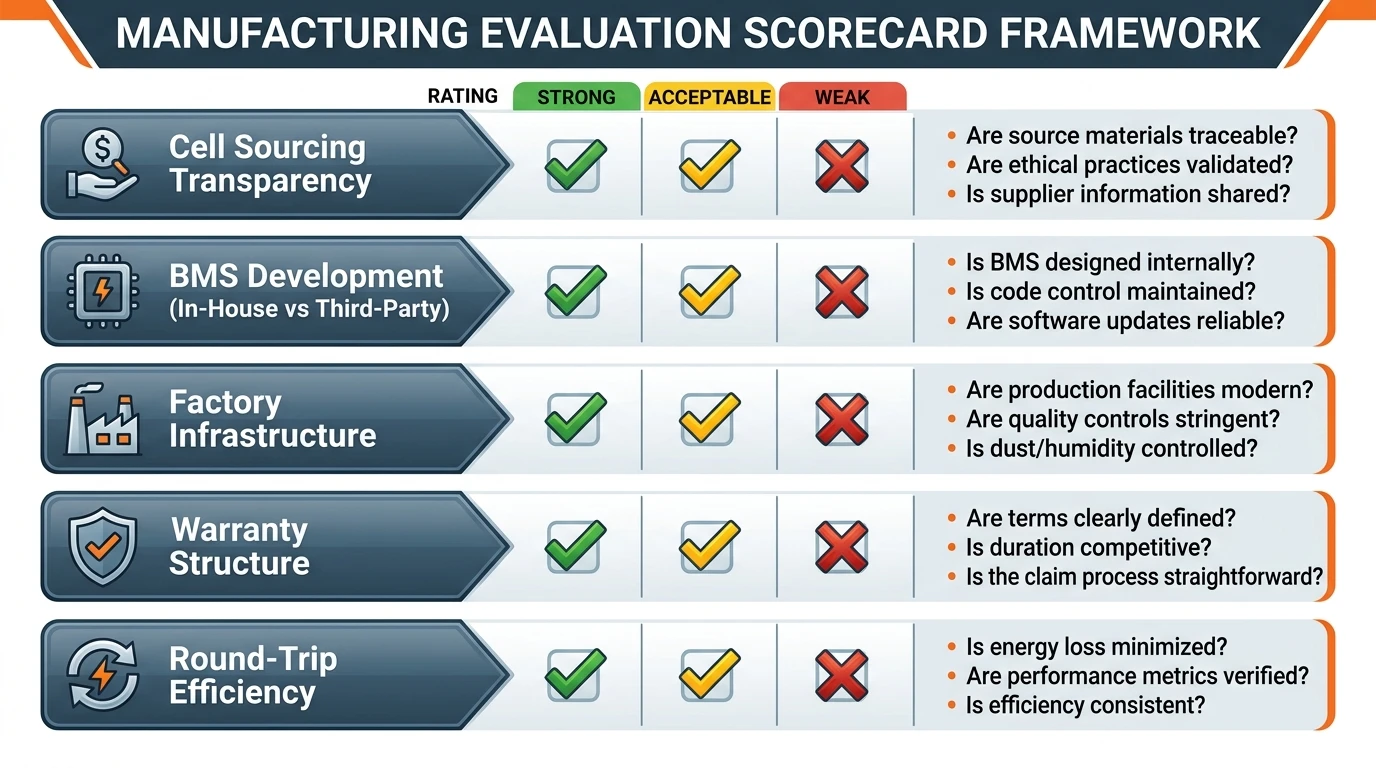
This section is the reason this guide exists. Not one page ranking for "50kw hybrid energy storage cabinet" provides a framework for actually choosing a manufacturer. Every result is a product page saying "we're great, contact us." Here's how to evaluate systematically.
1. Cell Sourcing Transparency
Start here. Ask who supplies their cells and whether the supplier relationship is documented in a long-term supply agreement. A manufacturer that buys cells on the spot market is exposed to availability risk and price volatility — and consistent cell characteristics matter for BMS calibration, so frequent supplier changes can introduce additional engineering effort.
Major cell makers — CATL, BYD, EVE Energy — have extensive production scale and longer public cycle-life validation track records than smaller producers. If the manufacturer uses cells from a major supplier, they'll typically tell you. If they're vague about it, the cells are likely from a smaller producer. That's not automatically disqualifying, but it means you should ask for independent cycle-life test data, not just the cell datasheet.
2. BMS — In-House or Third-Party?
A manufacturer that develops its own BMS controls the battery's entire safety and performance logic. A manufacturer that buys a third-party BMS and integrates it is dependent on that supplier for firmware updates, bug fixes, and compatibility with new cell chemistries.
In-house BMS development signals deeper engineering investment but is harder to verify. One proxy question: "Can you customize the BMS parameters for our application, and what is the typical turnaround?" A manufacturer with in-house BMS can often turn around parameter changes (charge/discharge curves, protection thresholds, communication protocol mapping) more quickly than one relying on a third-party supplier's engineering queue — but the actual timeline depends on the specific change, the supplier's workload, and your volume, so treat any generic time estimate as a starting point for discussion, not a commitment.
3. Factory Audit — What You Can Learn Remotely
If you can't visit the factory in person — and most international buyers can't for every supplier they're evaluating — ask for a live video walkthrough. Not a pre-recorded tour video (those are easy to stage at someone else's facility). A live video call where you direct what you want to see.
Things to look for: Are battery cells stored in temperature- and humidity-controlled areas, or stacked in cardboard boxes on the production floor? Is there a dedicated testing area with cycling equipment and thermal chambers, or does "testing" mean powering the unit on and checking if the lights come on? Are assembly stations documented with standard operating procedures, or is it tribal knowledge?
For context on what a properly resourced BESS factory looks like, Hua Power's manufacturing floor spans 50,000 m² and includes automated production lines with inline quality checks at every station — cell grading, module welding inspection, end-of-line system testing, and a dedicated burn-in room. That's the kind of infrastructure you're looking for evidence of, not the square footage claim itself.
4. Warranty Structure and Degradation Guarantees
A "10-year warranty" means less than how it's structured. The key parameters:
- Throughput warranty: Guaranteed total energy throughput over the warranty period. For illustration, a manufacturer might warrant 40 MWh of throughput per 100 kWh of installed capacity. This figure covers cycling degradation and is often more meaningful than the calendar warranty term alone — ask for it explicitly. The specific number varies by cell chemistry, depth-of-discharge assumptions, and manufacturer.
- Capacity retention: Guaranteed minimum remaining capacity at end of warranty (e.g., 70% at year 10). Below 70%, and the economics of most C&I applications break down.
- What voids the warranty: Some manufacturers void coverage if the cabinet isn't connected to their cloud EMS for continuous monitoring. Others require annual on-site inspections by their technicians. Know what you're committing to.
- Claim process: Who pays for shipping if a module needs replacement? How long from claim to replacement unit on site? A warranty that takes four months to honor is a warranty that costs you four months of revenue.
5. Round-Trip Efficiency — The Spec Everyone Ignores
Round-trip efficiency (RTE) — the ratio of energy out to energy in — sits quietly on every spec sheet, and most buyers skip over it. They shouldn't. A cabinet with 94% RTE loses 6% of every kilowatt-hour that passes through it. A cabinet with 88% RTE loses 12%. Over 10 years and thousands of cycles, a four-percentage-point difference in RTE compounds into tens of thousands of dollars in lost energy — money you never see on an invoice because it simply never reaches your loads.
Ask for RTE measured at the system level (AC input to AC output, not DC battery terminals only) and at the rated power, not at some optimized sweet spot. A PCS that's 96% efficient at 30% load but drops to 92% at full rated power is not a 96%-efficient system.
What Customization Can You Actually Get — OEM vs. ODM vs. White-Label
Not all 50kW hybrid cabinets are equal in how much you can change. The customization spectrum runs from off-the-shelf to fully bespoke, and each level comes with different minimum order quantities, lead times, and engineering costs. The following are typical ranges observed in the Chinese BESS OEM market as of mid-2026; actual MOQs, lead times, and cost structures vary by manufacturer, product complexity, and commercial terms.
White-label is the fastest path to market: a standard cabinet design that already exists, tested and certified, with your company's logo on the enclosure and your brand on the documentation. Manufacturers commonly quote MOQs of 1–5 units and lead times of 4–8 weeks for existing designs. The trade-off is zero product differentiation — your competitor can buy the same cabinet from the same factory with their logo on it.
OEM customization adds configurable options on top of the base platform. You might choose cell capacity (e.g., 100 kWh vs. 150 kWh at the same 50kW power rating), enclosure finish and color, BMS parameter tuning for your specific application profile, or branded HMI software. MOQs in this tier often fall in the 5–10 unit range, lead times may stretch to 8–12 weeks, and engineering costs are sometimes absorbed by the manufacturer if volume is sufficient — but this varies widely. Confirm all three numbers (MOQ, lead time, NRE policy) with each manufacturer.
ODM means the manufacturer designs and builds a cabinet to your specification from scratch — or adapts their platform significantly enough that it's effectively a new product. This is where you specify things like a particular PCS brand you've standardized on across your portfolio, a custom enclosure footprint to match your existing site layouts, or integration with your proprietary EMS platform. MOQs for ODM are higher (often 20–50+ units), lead times can extend to 10–16 weeks, and non-recurring engineering (NRE) charges typically apply.
Contract manufacturing — you provide the complete design, BOM, and test specifications — exists at the 50kW scale but rarely makes economic sense unless your annual volume is substantial enough to amortize the NRE and certification costs across many units. Below some threshold, those fixed costs usually outweigh any per-unit savings. Discuss this option directly with the manufacturer if your volumes justify it.
For most buyers reading this guide, the OEM level — a proven platform with configurable options — hits the sweet spot of speed to market, customization, and unit economics. For a detailed framework covering spec definition, factory audit checkpoints, and quality verification, see our C&I OEM manufacturing sourcing guide. Our OEM manufacturing hub also covers the full RFQ-to-delivery process.
What a 50kW Hybrid Cabinet Actually Costs — TCO Beyond the Unit Price
The unit price of a 50kW hybrid cabinet from a Chinese OEM manufacturer — as an illustrative range based on mid-2026 market observation — typically falls between $15,000 and $50,000, depending on battery capacity, PCS brand, and certification package. These are not quoted prices; actual pricing depends on volume, specification, certification scope, incoterms, and commercial terms negotiated with each manufacturer. The spread is wide enough to be useless as a budgeting number without context, so let's break down what drives it.
Battery capacity is the largest cost driver. A 50kW/50kWh system (one-hour duration) might cost $15,000–$25,000; a 50kW/200kWh system (four-hour duration) can push past $40,000. For directional context, global lithium-ion battery-pack prices averaged $115/kWh in 2024 — the largest single-year decline since 2017, according to BloombergNEF. This is a pack-level average spanning EV and stationary-storage applications, not a LiFePO4 cell-price quote; it is cited here as a broad market indicator, not a specific stationary-storage procurement benchmark. Pack assembly, BMS electronics, enclosure fabrication, and certification testing add cost on top of the bare cell level — how much depends on configuration, volume, and certification scope.
Transportation and logistics are a material but variable share of the landed cost. As an illustrative range based on mid-2026 single-container routing, ocean freight from Shenzhen or Shanghai to Rotterdam might run $800–$1,500; to Los Angeles or Houston, $1,200–$2,000. A 50kW cabinet typically ships in a single wooden crate weighing 1–2 tonnes. Add import duties (country- and HS-code-specific), port handling, and last-mile trucking with a forklift at the delivery end — these can add 5–15% to the total, but the actual figure depends heavily on destination, incoterms, and customs classification. Obtain a freight forwarder quote for your specific route.
Installation is the cost buyers most consistently underestimate. Site preparation — a concrete pad, electrical connection to the main distribution board, grid interconnection application, and commissioning — can range from $5,000 to $15,000 or more depending on site conditions, local labor rates, and whether trenching, conduit, or switchgear upgrades are needed. If the local utility requires a grid impact study before approving interconnection, budget an additional few thousand dollars and 8–16 weeks for the study and review cycle, though timelines vary substantially by utility and jurisdiction. These are illustrative planning figures; obtain firm quotes from local contractors and confirm interconnection requirements with your utility early.
Ten-year TCO for a representative 50kW/100kWh system is illustrated below. Important scope note: The following figures are illustrative internal estimates prepared in mid-2026. They assume FOB China pricing, a single-destination ocean-freight scenario, straightforward site conditions, and minimal ongoing maintenance in a temperate climate. They expressly exclude import duties and taxes, permitting and grid-study fees, transformer or switchgear upgrades, financing costs, and project-management overhead. Ranges are wide because configurations, markets, and site conditions vary substantially. These numbers are not a market benchmark and cannot replace a formal project quotation. Use them as a starting point for your own budget model, not as a price commitment.
Cost Category | Illustrative Range (see scope above) |
|---|---|
Cabinet unit cost (FOB, mid-2026) | $25,000–$35,000 |
Shipping and logistics (single destination) | $3,000–$5,000 |
Installation and commissioning (excl. grid study) | $8,000–$12,000 |
Maintenance (10 years, minimal, temperate) | $5,000–$10,000 |
Energy losses (RTE gap vs. ideal) | $4,000–$8,000 |
Illustrative 10-year TCO | $45,000–$70,000 |
Revenue or savings from peak shaving, TOU arbitrage, or solar self-consumption are site-specific and are not netted against this TCO. For a well-sited system operating under a favorable tariff, avoided costs can substantially exceed the TCO over the system's service life, but the exact payback period depends on local rates, load profile, cycling strategy, degradation, and financing terms — a formal project-specific analysis is required.
Common Mistakes When Sourcing a 50kW Cabinet (And How to Avoid Them)
After years of watching buyers navigate this process — from initial inquiry to commissioned systems — a few mistakes repeat predictably.
Mistake 1: Buying the spec sheet, not the manufacturer. A 50kW/100kWh cabinet with 6,000-cycle LiFePO4 cells and IP54 enclosure sounds the same from ten different factories. The difference is in what happens 18 months later when a BMS fault trips the system offline on a Sunday afternoon. Does the manufacturer have an English-speaking support engineer who answers the phone? Do they have a replacement module in stock, or is it a six-week build-to-order? Ask these questions before you place the order — not after.
Mistake 2: Ignoring grid interconnection until after delivery. A cabinet that's certified for the EU won't automatically meet utility interconnection requirements in South Africa or Australia. The time to start the grid application process is when you sign the purchase order, not when the cabinet arrives at the port. In some jurisdictions, the utility review alone takes longer than the cabinet's manufacturing lead time.
Mistake 3: Under-specifying the battery capacity relative to the power rating. A 50kW PCS with only 50kWh behind it discharges to empty in one hour at full load. That's enough for short-duration peak shaving but useless for 4-hour demand response windows or overnight backup. Most C&I applications benefit from at least a 2:1 energy-to-power ratio — 100kWh behind 50kW, giving you two hours at full discharge or longer at partial load.
Mistake 4: Skipping the live factory walkthrough. Certificate photos, ISO 9001 logos, and polished marketing videos do not prove manufacturing quality. A 30-minute live video call where you see the production floor in real time, direct the camera to the testing area, and ask to see a unit being cycled on the burn-in rack — that proves it. Manufacturers that refuse a live walkthrough usually have something to hide.
For a complete vendor evaluation framework with RFP checklists and certification verification steps, read our C&I BESS procurement decision guide.
Ready to specify a 50kW system? Explore our OEM manufacturing capabilities to understand the full partnership process — from initial spec to commissioned system — or contact our engineering team with your project requirements.