

Most storage suppliers show you the same four things: a rendered cabinet, a booth photo, a wall of certificates, and the word "factory". If you are sourcing a container or an OEM cabinet, none of that answers the question you actually have — is there a production line behind this company that can build my order, and what physically happens on it between a cell arriving in a crate and a system leaving on a truck?
This is a walk through the BESS manufacturing process at the Hua Power factory in Jinhua, Zhejiang, one production step at a time. Each section covers the same three things: what the step does, what a visiting buyer should ask to see, and what the failure looks like when a supplier is quietly skipping it. Where the detail is specific to this plant it comes from the company's own published figures and certificates; where it is standard practice across the industry, it is described as such — a walkthrough is only useful if you can tell the two apart.
If you never visit, the same sequence works as a document checklist: every station below produces a record, and the absence of a record is the finding.
Where the Hua Power BESS factory actually is
The company was founded in 2015 and is headquartered in Shenzhen. Manufacturing is a separate site: an intelligent production facility in Jinhua, Zhejiang, which came online in 2018 at 500 MWh of annual capacity. Hua Power's published company profile now quotes 2.4 GWh+ of annual production capacity across 50,000 m²+ of floor area — roughly five times the 2018 line, and the number worth reconciling against factory footprint when a capacity claim looks generous.
What to confirm | Figure published by Hua Power | Where to verify it on site |
|---|---|---|
Legal entity and founding year | 2015, Shenzhen HQ | business licence at reception |
Manufacturing site | Jinhua, Zhejiang | site address vs. the one on the certificate |
Floor area | 50,000 m²+ | site plan, walk the fire lanes |
Annual capacity | 2.4 GWh+ | line count × shift pattern |
Track record | 400+ projects across 30+ countries | reference list with contactable buyers |
Engineering depth | 45% of staff in engineering; 120+ R&D and production staff | org chart, talk to a process engineer unaccompanied |
That last row matters more than its position suggests. A battery energy storage system manufacturer that assembles bought-in subassemblies needs a fraction of the engineering headcount of one that writes its own BMS firmware. Hua Power states that the BMS and the EMS platform are developed in-house — the EMS is marketed under the Visual Energy name — and that cell selection, pack design, PCS configuration and commissioning are all handled by the same organisation. Whether that is true is testable in about ten minutes: ask the engineer who signs the factory test report to explain a BMS protection threshold, and see whether they reach for a supplier datasheet or answer from memory.
One structural point before the walk: the range spans air-cooled and liquid-cooled cabinets, and 20-foot container systems — three different enclosures built to different tolerances. Ask which of them your order is, and which line it will run on. A supplier that cannot answer that has not scheduled you.
Step 1: Cell incoming inspection
Everything downstream inherits whatever arrives in this room. This is where a factory's quality ceiling is set, and it is the step most often compressed when order books are full.
Cells arrive in a state of controlled ignorance: same part number, same nominal capacity, meaningfully different internal resistance. Incoming inspection therefore does three jobs — verify the shipment against the purchase order and the cell maker's test data, scan and log the batch identity, and grade cells on open-circuit voltage and internal resistance so that a module is built from cells that will age together. LFP chemistry, which is what the Hua Power C&I and container lines are built on, is forgiving on thermal stability but unforgiving on imbalance: one weak cell in a 16-cell series string sets the limit for the whole string.
What to ask for:
- the incoming inspection record for the specific cell batch in your bill of materials, with voltage and internal-resistance distributions
- the cell manufacturer's name and the qualification report, not just "grade A"
- the rejection rate at this station over the last three months — a factory reporting zero rejects is not inspecting
The failure mode is a supplier who buys cells through a trader and cannot name the cell maker. Document tracing stops there, and so does any warranty argument eighteen months later. The cluster guide on telling a real Chinese BESS factory from a trading desk covers the paper trail for that case.
Step 2: Module assembly
A module is a mechanical and electrical assembly built to survive a decade of thermal cycling: cells stacked to a fixed compression, busbars welded or bolted to the terminals, a cell connection system carrying voltage-sense and temperature-sense harnesses, and a housing that will be lifted, stacked and vibrated in transit.
Laser welding is the standard joining method for the busbar and harness plates, and it is also the step where process drift is invisible afterwards. A cold weld looks like a weld. The controls that catch it are weld parameter logging per joint, pull or shear testing on coupons from each shift, and end-of-line checks on every module — voltage, internal resistance, insulation and a functional test of the sense harness.
Ask to see, for a module of the type in your order: the weld parameter record for a production day you pick, the coupon test results for that same day, and the module end-of-line file for a serial number you point at on the rack. If the factory can pull that file in under five minutes, the traceability system behind it — an MES, not a shared drive — is real. If somebody has to walk to an office and come back with a spreadsheet, it is a reconstruction.
Cycle life and round-trip efficiency numbers get quoted freely in this industry; what makes them credible is the process behind them. Hua Power publishes ≥8,000 cycles at 80% state of health across the range, and a system round-trip efficiency of ≥85% for the cabinets and the 20-foot containers alike, rising to ≥87% on the two largest battery containers (4.18 MWh and 5.02 MWh) — figures that only hold if module-level sorting and welding control are actually being done.
What you cannot check from published material is how much of this line is automated. Hua Power describes the Jinhua site as an end-to-end intelligent manufacturing line running a four-stage workflow from engineering sign-off through system integration and QC — but the split between robotic and manual stations, the station count and the cycle time at the bottleneck stay off the website. That gap is worth closing on the floor: which stations on your order's line are robot-fed and which are hand-loaded benches, how many shifts the line runs, and how long the slowest station takes per module. Those answers are how 2.4 GWh a year turns into a delivery date — a supplier who can only answer with an adjective is describing a brochure, not a line.
Step 3: Pack and rack build
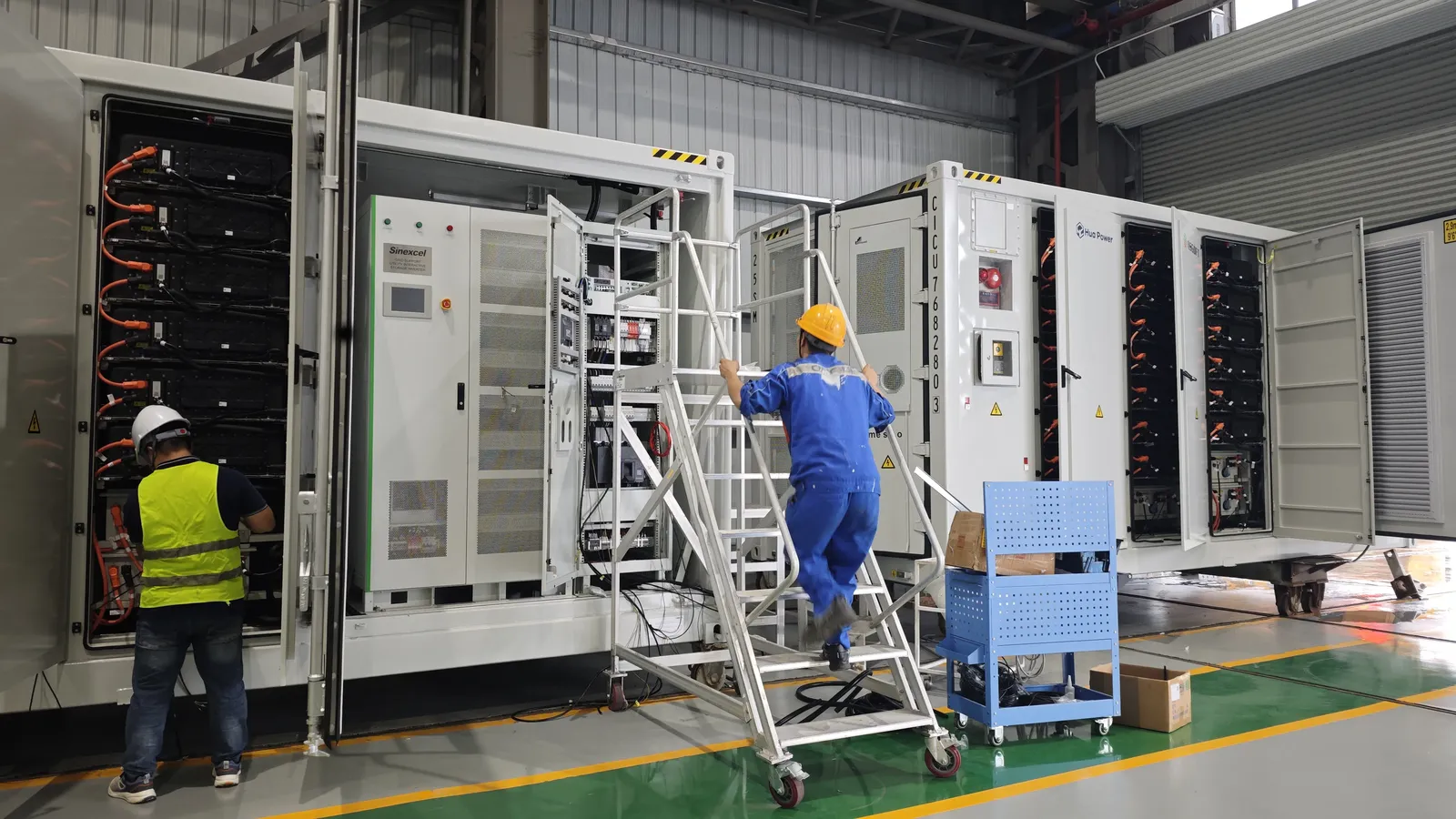
Modules become a rack, and a rack becomes an electrical system. Three things happen here that buyers consistently under-inspect.
Busbar torque. Every bolted joint in a high-current path has a specified torque, and a loose joint becomes a hot joint. The control is a calibrated torque tool with a logged value per joint, not a worker's judgement. Ask what the torque specification is, what the tool calibration interval is, and whether the values are recorded per rack or per shift. "We torque to spec" with no record is not a control.
Electrostatic control. BMS boards and sense harnesses are electronics. Wrist straps, grounded benches and packaging are cheap; skipping them produces intermittent faults that surface in year two at a site 8,000 km away.
Insulation and hipot testing. Before a rack is energised it gets an insulation resistance test and a dielectric withstand test. Both produce a number per rack. Both should be in the file you receive.
This is also where the product form factor becomes visible: a cabinet built around one rack and one built around a stack of them differ in serviceability, not just capacity.
Step 4: Enclosure, thermal and fire integration
The enclosure is the last physical barrier between a cell failure and the outside world, and it is where a BESS differs most from a battery pack.
Thermal management comes first. Air-cooled cabinets move conditioned air across the rack face; liquid-cooled cabinets run coolant plates between modules. The trade is maintenance simplicity against thermal uniformity, and it shows up in the derating curve: Hua Power's cabinet range is rated −20 to 50 °C with derating above 45 °C, while the liquid-cooled products are specified for full-power operation to 45 °C. Ask for the derating table, not the headline temperature.
Fire protection is the part that separates a serious enclosure from a painted box. The configuration on the Hua Power cabinet platforms is aerosol or FK-5-1-12 suppression with gas detection and explosion venting; the two smaller 20-foot containers use FM-200 or FK-5-1-12, while the utility-scale battery containers use a dry-pipe sprinkler system with an optional aerosol stage. The layered logic — detect, isolate, vent, suppress — is what a fire test actually validates, which is why the certification question in step 7 is not a formality.
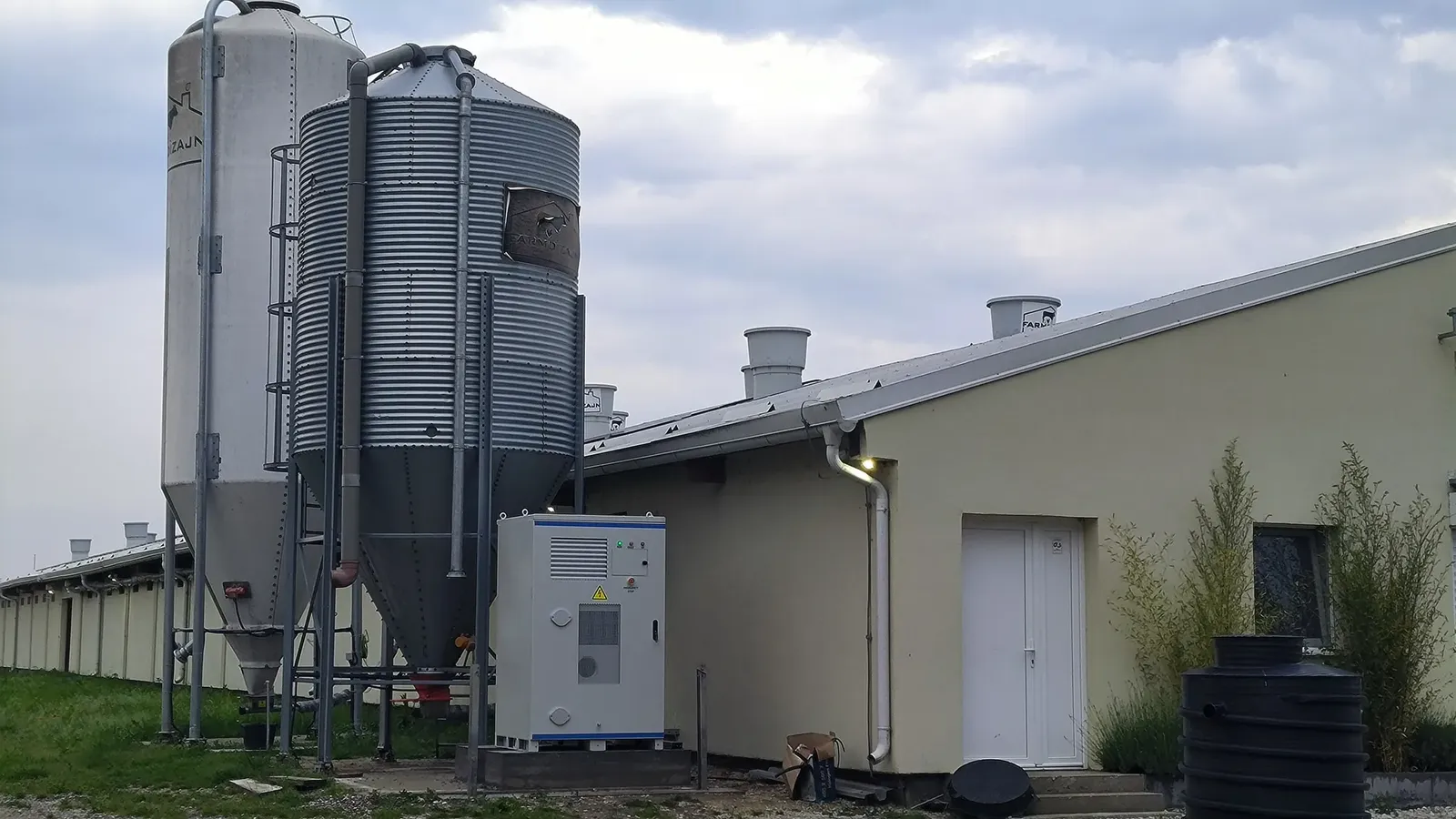
Ingress protection and corrosion class are the two numbers that decide whether a cabinet survives its site. Corrosion class tracks the platform rather than the enclosure type: the integrated cabinet platforms are rated IP54 / C3-M, with the 800 V integrated cabinet at IP55 / C4, while the split-cabinet and container ranges are all C4 — IP54 for most, IP55 for the 800 V split cabinets and the B4180L container. If your site is coastal or your enclosure sits in a wash-down area, that difference is the whole specification.
Step 5: BMS and PCS integration
A rack is not a system until the controls are in it. Two subsystems do the work, and one question decides how much of the factory you are actually buying.
The BMS owns cell-level protection: overvoltage, undervoltage, overcurrent, overtemperature, insulation monitoring, balancing and state estimation. The question is who wrote the firmware. Hua Power states that its BMS is developed in-house with active balancing, multi-fault detection and over-the-air update capability. That matters commercially: alarm thresholds, balancing strategy and firmware roadmap are negotiable with the party that built them, and functional-safety questions land on the manufacturer rather than a third-party support queue.
The PCS owns conversion. On the 400 V cabinet platforms the PCS is rated at 98.5% peak efficiency with a specified total harmonic distortion on the backup side; the 800 V platforms are specified at ≥99%. Whatever the datasheet says, the integration test is what proves the two subsystems talk to each other — setpoints accepted, SOC and SOH reported, alarms propagated, and the unit behaving correctly at the grid-code settings your market requires.
That last point is where a European or Australian buyer should spend their time. Hua Power holds 30+ grid-code certifications across European and APAC markets — EN 50549-1/-2/-10, VDE-AR-N 4105/4110/4120, G99 B/C/D, CEI 0-16/0-21, AS 4777 and others. Ask to see the certificate for your grid code with the model and firmware version on it, not the whole portfolio.
Step 6: Aging, burn-in and factory acceptance test
This is the step that most differentiates factories, and the one where the published material across the industry is thinnest.
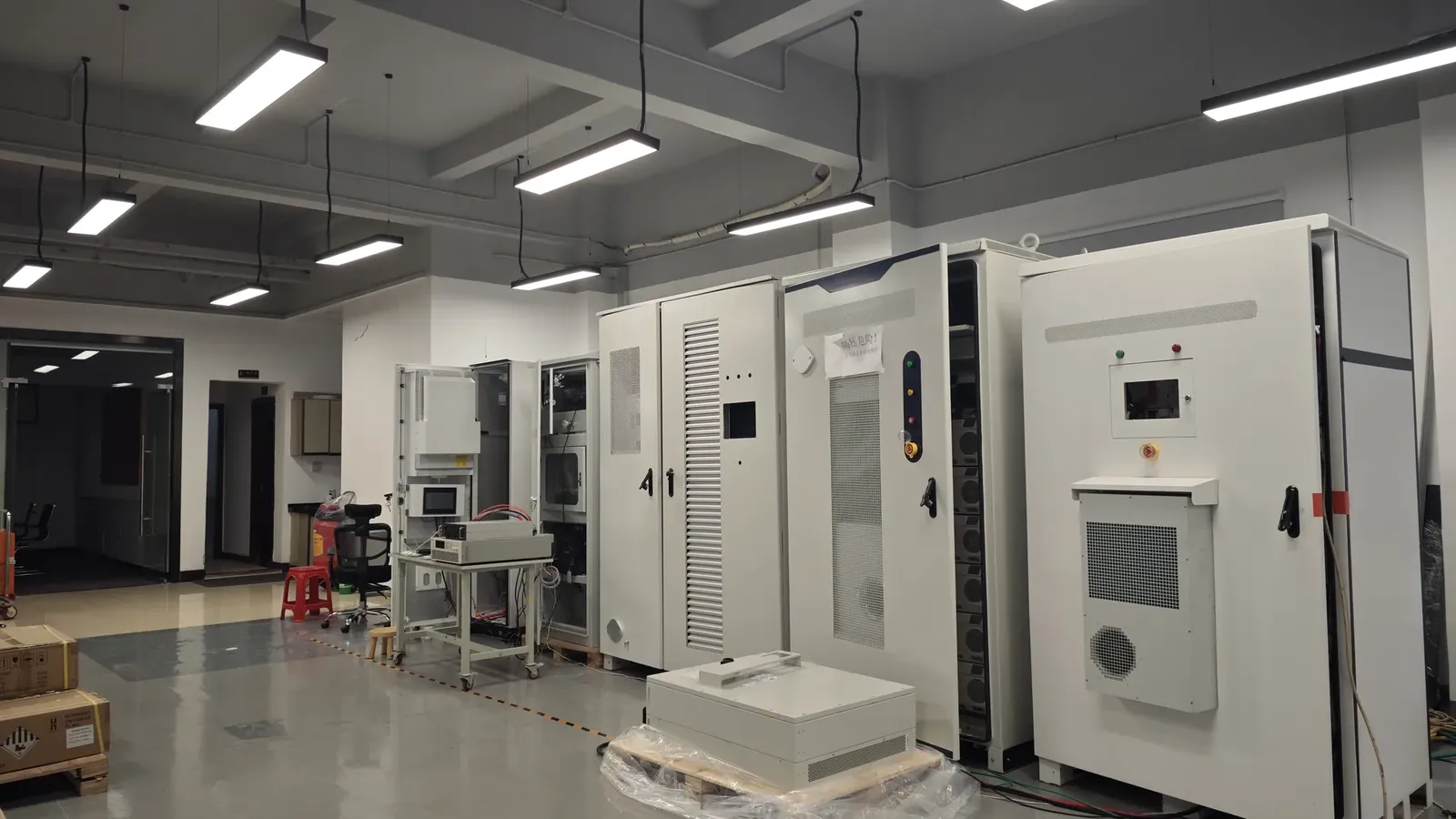
Aging, or burn-in, is a controlled charge-discharge period before the unit is allowed to ship. Its purpose is not to prove the system works — the end-of-line test did that — but to catch the small population of units that fail early, and to let cell voltages settle so that capacity can be measured accurately. A factory that ships units straight from end-of-line testing is transferring infant-mortality failures to your site.
Factory acceptance testing (FAT) is where your contractual rights live. A defensible FAT programme covers the battery rack, the PCS, the BMS, the container or cabinet services, emergency shutdown at rack and system level, and EMS integration, and it ends with a capacity test and a round-trip efficiency measurement at a stated rate and temperature. The Energy Storage Integration Council methodology is the most widely used reference for structuring that duty cycle.
Two positions are worth holding:
- 100% of units tested, not a sample. Sampling is defensible for commodities. For a system where one defective rack can take down a container, it is not.
- You or your inspector witness it. Ask for the FAT procedure in advance, mark the points you want to witness, and require the raw data files, not a summary PDF.
Witness rights are cheap to negotiate at contract stage and impossible to obtain afterwards. They belong in the purchase order, not in the commissioning week.
Failure analysis is the other half of this station. When a unit fails a test, the factory should be able to show a closed-loop corrective action — a root cause, an affected batch range, and what changed — rather than a rework note. That discipline is what ISO 9001 is supposed to institutionalise, and what a process FMEA is supposed to predict — which is why the certificate in the next section is worth checking rather than admiring.
Step 7: Documentation, packing and dispatch
The last station produces a box of documents, and that box is what your project team will rely on for the next fifteen years.
A complete shipment file contains the unit serial numbers and their position in the system, the rack and module birth records with cell batch traceability, the FAT report with raw data, the BMS and PCS configuration files as shipped, the insulation and hipot records, and the transport documentation. UN 38.3 is not optional here: lithium cells and batteries shipped internationally require a test summary covering Part III, sub-section 38.3 of the UN Manual of Tests and Criteria, and the IATA battery guidance for the current DGR edition sets out the conditions under which manufacturers must make that summary available to shippers. A factory that cannot produce it on the day is a factory that has never shipped to your market.
Packing is a specification, not a formality. Cabinets ship in timber crates with desiccant and shock or tilt indicators; containers ship with the doors sealed and the internal environment controlled. Ask what the shock indicator threshold is and who reads it on arrival — if nobody reads it, the indicator is decoration, and transit damage becomes your claim to prove.
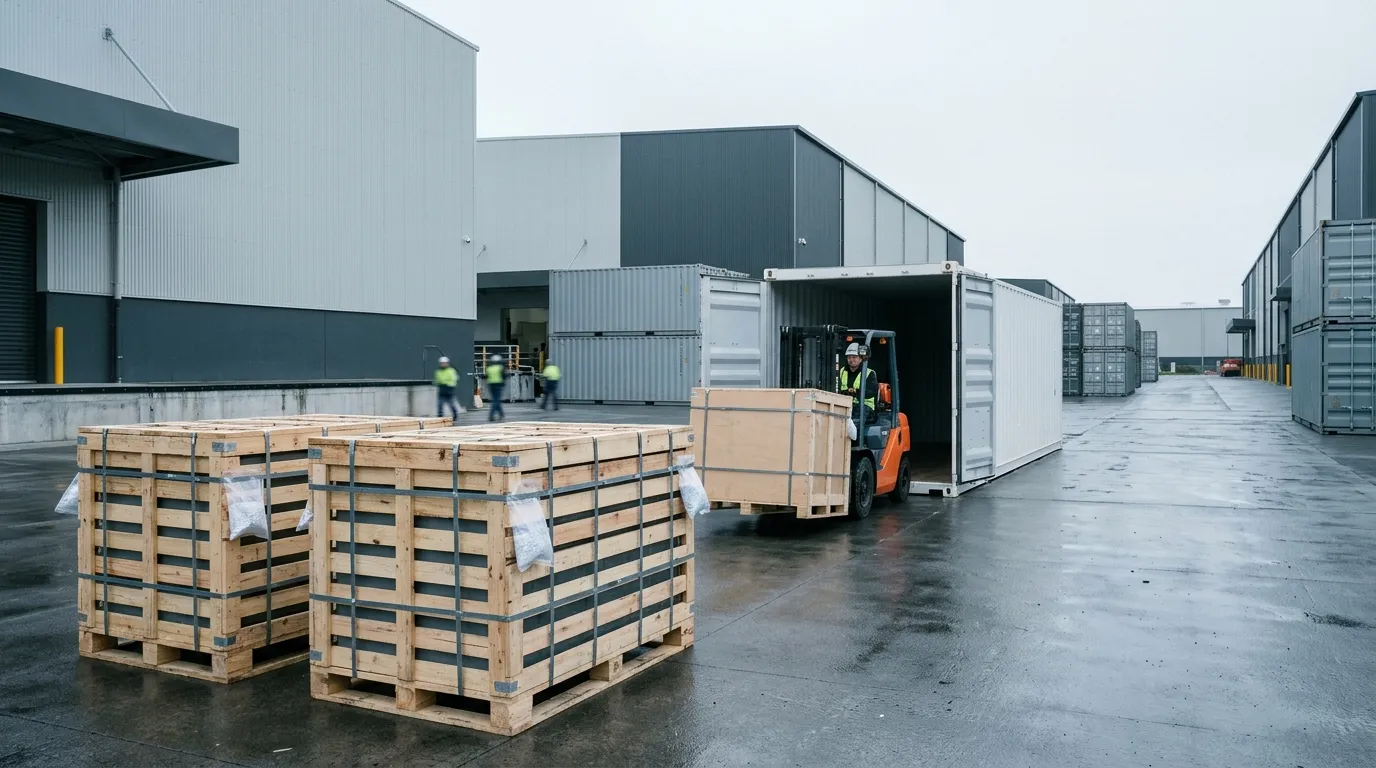
Illustrative: a generic export-packing scene, not a photograph of a specific shipment.
The certification file: what each certificate actually proves
Certificates are the most photographed and least read documents in a supplier meeting. Each one answers a narrow question, and a serious buyer reads them as a set.
Certificate | What it actually proves | What it does not prove |
|---|---|---|
ISO 9001:2015 | the quality system is documented, audited and corrective actions close | that the product is safe or the process is capable |
IEC 62619:2022 (IECEE CB) | cells and batteries for industrial use passed the safety test series | system-level behaviour in a container |
CE marking, EMC (TÜV Rheinland / TÜV NORD) | the product meets the EMC directive for the declared configuration | grid-code compliance or fire performance |
UN 38.3 | the cells and batteries pass transport testing | anything about operation |
UL 1973 / UL 9540A / UL 9540 | US-market cell, module and system safety, and thermal runaway propagation behaviour | European regulatory acceptance |
NFPA 855 | the installation standard your site design must meet | that the equipment complies with it by itself |
IEC 62933-5-2 | system-level safety expectations for grid-integrated storage | that your installation is compliant |
30+ grid codes | the PCS can be configured for those networks | that your specific firmware build is certified |
Two practical habits. First, check the certificate holder's legal name against the entity you are contracting with — it is often the manufacturing subsidiary, which is fine, but you should know before you sign. Second, verify the certificate in the issuing body's database rather than trusting the PDF; an IEC 62619 CB certificate, for example, is checkable in the IECEE CB scheme's public certificate database, and the UL listings are searchable in UL Product iQ.
Hua Power's published certificate set covers ISO 9001:2015 for the Zhejiang manufacturing entity, an IEC 62619:2022 CB test certificate, CE EMC certificates from TÜV Rheinland and TÜV NORD for the hybrid and PCS product families, and the UL family for the container line serving North America, together with UN 38.3 transport testing across the range. Read as a set, that is what a BESS factory audit should end with — a certificate you have reconciled against the contracting entity, the model and the market, rather than a wall of frames.
What a tour should change in your decision
A factory tour is not a confidence exercise. It should end with a changed document — a clarified specification, a witness point added to the FAT plan, or a supplier removed from the shortlist.
Five questions worth carrying onto the floor:
- Which line will my order run on, and what is it running this month?
- Who signs the factory test report, and can I meet them?
- Show me the traceability file for a unit that shipped last month, end to end.
- What was your scrap and rework rate last quarter, and where did it concentrate?
- If a rack fails FAT, what happens to it, and who decides?
And three observations that should end an evaluation regardless of how good the meeting was: a production floor that is clean, quiet and empty of work in progress; test data that exists only as a summary; and an engineer who cannot explain a protection threshold without a datasheet.
If you are sourcing under your own brand, the walk also tells you where your customisation actually lands — enclosure branding and firmware splash are a different production commitment from a changed module configuration or a new certification path. That distinction is the subject of the cluster's C&I OEM sourcing guide, and the scoring framework for the whole evaluation sits in the 10-point BESS supplier checklist. More guides on manufacturing and sourcing are collected in the OEM and white-label manufacturing hub.
Buyers who want to see the line before they commit normally ask for it with a live project brief rather than a general enquiry: a walk of the line your order would run on, a witness point on a unit inside your own production window, and a conversation with the process engineer who would own the order. That request goes through the contact page — put the scope, the notice period and who covers the trip in writing, because none of it is worth assuming. If you would rather start from the specification, the containerised system range shows how the platforms are configured.