

What "Hua Power vs Sungrow vs Trina" is actually comparing
Nobody searches this phrase for fun. It shows up when a buyer has two bankable brand names on a shortlist and one factory quote beside them, and wants to know whether those three things are even the same purchase. They are not.
Sungrow and Trinasolar are two of the largest solar equipment companies in the world, and both sell battery storage under their own name: Sungrow as an inverter, PCS and BESS supplier, Trina through Trina Storage, built on its own LFP cells. Hua Power is a mid-size Chinese manufacturer that builds storage cabinets and containers and also builds them under other companies' brands. Put the three in one table and you are comparing a product decision against a business-model decision — which is why most BESS supplier comparisons go wrong before the first spec sheet is opened.
This is from Hua Power. We are one of the three companies in this comparison, so treat our framing with the suspicion it deserves. What we can do is keep the numbers sourced, state where we lose, and tell you which projects should not shortlist us at all.
The short version: if your project needs a ranked, bankable integrator because a lender or an insurer is going to review the supply contract, Sungrow or Trina Storage is the safer shortlist. If you are building a product line, sourcing C&I cabinets in the 100 kWh to 1 MWh range, or want your own nameplate on the equipment, the brand-integrated model is the wrong shape for that purchase — and that is the purchase Hua Power is built for.
If you are earlier in the process, the OEM and white-label sourcing guides cover the surrounding decisions: engagement models, factory evaluation, certification planning and commercial terms.
Three BESS suppliers at a glance
Sungrow | Trina Storage | Hua Power | |
|---|---|---|---|
What it mainly sells | Inverters, PCS and integrated BESS for utility and C&I | Utility-scale BESS built on its own LFP cells | C&I cabinets, split cabinets, 20 ft containers, residential |
Utility-scale reference product | PowerTitan 3.0: 7.14 MWh of batteries plus 1.78 MW of PCS in one 20 ft container | Elementa 3 DC system at 6.25 MWh, paired with the 13.8 MVA Electra AC platform | HC-UPSB5010L: 5,015.96 kWh DC block in a 20 ft container; HC-UPSA2089L: 1 MW / 2.089 MWh integrated |
C&I product | PowerStack series: 229 kWh / 110 kW to 257 kWh / 125 kW per cabinet | Potentia C&I cabinet at 261 kWh / 125 kW, launched for the domestic market first | HC-UPSAP241 at 125 kW / 241.152 kWh; HC-UPSAP80 and HC-UPSAP112 at 30 and 50 kW |
Cells | Stacked cells to its own design (661 Ah and 684 Ah); fabrication partner not named on the launch page | In-house LFP cells: 314 Ah in Elementa 2, 587 Ah in Elementa 3 | Sourced 314 Ah LFP cells; no cell line |
PCS | Sungrow's own power electronics, integrated inside the container | Separate AC platform (Electra) | Own PCS in integrated models; DC-only blocks without PCS |
Parallel capability | PowerStack C&I: 25 units on-grid, 10 off-grid, per Sungrow's PowerStack documentation | Block-level integration up to 50 MWh with the Electra platform | Cabinets parallelable to MWh scale; 20 ft containers for larger sites |
Commercial model | Branded product through its own channel | Branded product through its own channel | White-label, OEM and ODM |
Wood Mackenzie 2026 comprehensive ranking | 1st | Tied 5th | Not in the top ten |
Product rows come from each vendor's own published pages, linked below. Ranking scope and date are explained in the next section.
Market position: what the rankings actually say
There are two Wood Mackenzie views in circulation, and buyers mix them up constantly: a market-share ranking by shipment volume, and a scored comprehensive ranking. Both were refreshed in 2026, and they answer different questions.
The shipment view — Global energy storage system integrator market share 2026, covering 2025 — has Tesla and Sungrow in the top two positions for the third consecutive year, with BYD moving up five places to third. Chinese integrators took 76% of the global market, and eight of the world's ten largest integrators are now headquartered in China. The top three's combined share fell from 36% to 30% — which, in Wood Mackenzie's own reading, reflects rapid overall market growth and the rise of mid-tier vendors rather than any weakening at the top.
The scored view is the 2026 Global BESS Integrator Comprehensive Ranking, published in July 2026, which scores ten criteria — technology maturity, R&D, safety, vertical integration, supply-chain resilience, ESG and financial strength — instead of volume. Sungrow ranked first, ahead of Tesla and CATL. BYD ranked fourth, Envision and Trina Storage shared fifth, and Fluence, LG, Canadian Solar and Wärtsilä completed the top ten. It only covers factory-assembled AC-integrated systems, so DC blocks fall outside its scope entirely.
For a buyer, the more useful signal is neither list. It is the policy direction both reports describe. In North America, the One Big Beautiful Bill Act introduces Foreign Entity of Concern thresholds for projects claiming the 48E investment tax credit: non-FEOC sourcing must reach 55% of project costs in 2026 and 75% by 2030. In Europe, the Net Zero Industry Act, the Industrial Accelerator Act and the EU Batteries Regulation are raising the bar for import-dependent suppliers and rewarding local manufacturing capacity. Both trends point the same way — Chinese-built equipment is getting harder, not easier, to place in the two largest Western markets, regardless of how good the container is.
That risk lands on us harder than on anyone else in this comparison. Both competitors sit in Wood Mackenzie's global top five and hold supplier rankings a lender can check; Hua Power holds neither, and has no US manufacturing base. For a US project with a tax-credit stack attached, the honest answer is that we are the riskier counterparty on policy exposure before we are the riskier one on product.
Trina Storage's own disclosures run on a third track: it has held BloombergNEF's Tier 1 energy storage supplier ranking for ten consecutive quarters as of Q2 2026, and reported more than 20 GWh of cumulative global deliveries by the end of 2025. Tier 1 is a bankability screen used by lenders, not a quality award.
Hua Power is not in the top ten of either ranking, and one of our flagship products would not have been eligible for the comprehensive one even if we had shipped more of it: the HC-UPSB5010L is a DC block. Our AC-integrated HC-UPSA2089L would qualify on scope and is still not ranked. Buyers should treat that as a real fact about bankability, not a technicality — if a ranking is a hard requirement in your procurement rules, we are out before the datasheets get read, and it is better to know that now.
Product architecture: the frontier moved, and we are behind it
Until recently all three companies were converging on the same box: a 20 ft container carrying about 5 MWh, built from 314 Ah LFP cells, liquid-cooled. That is no longer the frontier, and pretending otherwise would be the least useful thing this article could do.
Sungrow's current utility product is PowerTitan 3.0, launched for Europe in January 2026: a 20 ft AC block that integrates 1.78 MW of PCS with 7.14 MWh of batteries, supporting a 2 to 8 hour duration, with silicon-carbide PCS at up to 99.3% efficiency and a stated system RTE of 92%. Sungrow's own launch release for the same platform quotes full power at 55 °C without derating. If your spec sheet still shows 6.9 MWh and 1.72 MW, that was the August 2025 MEA configuration; the figures above are what Sungrow has published since January 2026, and the platform itself has not changed.
Trina's current platform is Elementa 3, a 6.25 MWh DC system on 587 Ah cells, paired with the 13.8 MVA Electra AC platform for blocks up to 50 MWh and 13.8 MVA, with 96% full-chain system efficiency, 10 ms full-power response, grid-forming and black-start.
Our container is the previous generation. The HC-UPSB5010L is a 5,015.96 kWh, 20 ft liquid-cooled DC block on 314 Ah cells, rated at 0.5C or 0.25C, IP54 / C4, −30 °C to 50 °C, up to 4,000 m, with a stated round-trip efficiency of at least 87%. It is a good product at a mature specification. It also carries roughly 30% less energy per container than a PowerTitan 3.0 and 20% less than an Elementa 3, which is the sort of difference that shows up in civil works, cable runs and site area before it ever shows up in a datasheet argument.
Sungrow PowerTitan 3.0 | Trina Elementa 3 | Hua Power HC-UPSB5010L | |
|---|---|---|---|
Container | 20 ft | DC unit plus separate AC platform | 20 ft |
Energy per 20 ft | 7.14 MWh | 6.25 MWh | 5.016 MWh |
PCS | 1.78 MW, integrated inside the container | Electra AC platform, separate | DC block, PCS external |
Cell format | Large-format LFP, maker not named | In-house 587 Ah LFP | 314 Ah class, sourced |
Stated efficiency | 92% system conversion efficiency | 96% full-chain system efficiency | ≥87% round-trip, DC block boundary |
Operating envelope | Full power at 55 °C without derating | — | −30 to 50 °C, up to 4,000 m |
"—" means the vendor's public page did not state it. We did not fill those cells from memory, and neither should your comparison sheet.
Three lessons survive the update, and they matter more than the megawatt-hours:
Where the PCS lives changes what a number means. PowerTitan 3.0 sells an AC block — conversion is inside the container, and 7.14 MWh plus 1.78 MW is one quantity to design around. Elementa 3 is a DC unit with a separate AC platform. Our 5010L is a DC block too. Comparing a DC figure with an AC figure compares different amounts of equipment, and the AC number already contains the conversion losses.
Every efficiency number has a boundary. Our ≥87% is a DC round-trip on the battery container. Sungrow's 92% is a system conversion efficiency and Trina's 96% is a full-chain number that includes the AC platform. Those are three different measurements. Ask what boundary each figure covers before you let any of them into a scoring sheet.
Who makes the cell decides what happens when allocation tightens. Both competitors sit a full cell generation ahead of us and both control the design. Trina builds Elementa around its own LFP cells, 314 Ah in the second generation and 587 Ah in the third. Sungrow's PowerTitan 3.0 runs on stacked cells of its own design at 661 and 684 Ah, a structure Sungrow says it originated, with the fabrication partner unnamed. Hua Power buys 314 Ah cells on the market. That is the single least flattering line in this comparison, and it is also the one that decides who gets allocation when the market is tight.
Safety evidence: what you can actually verify
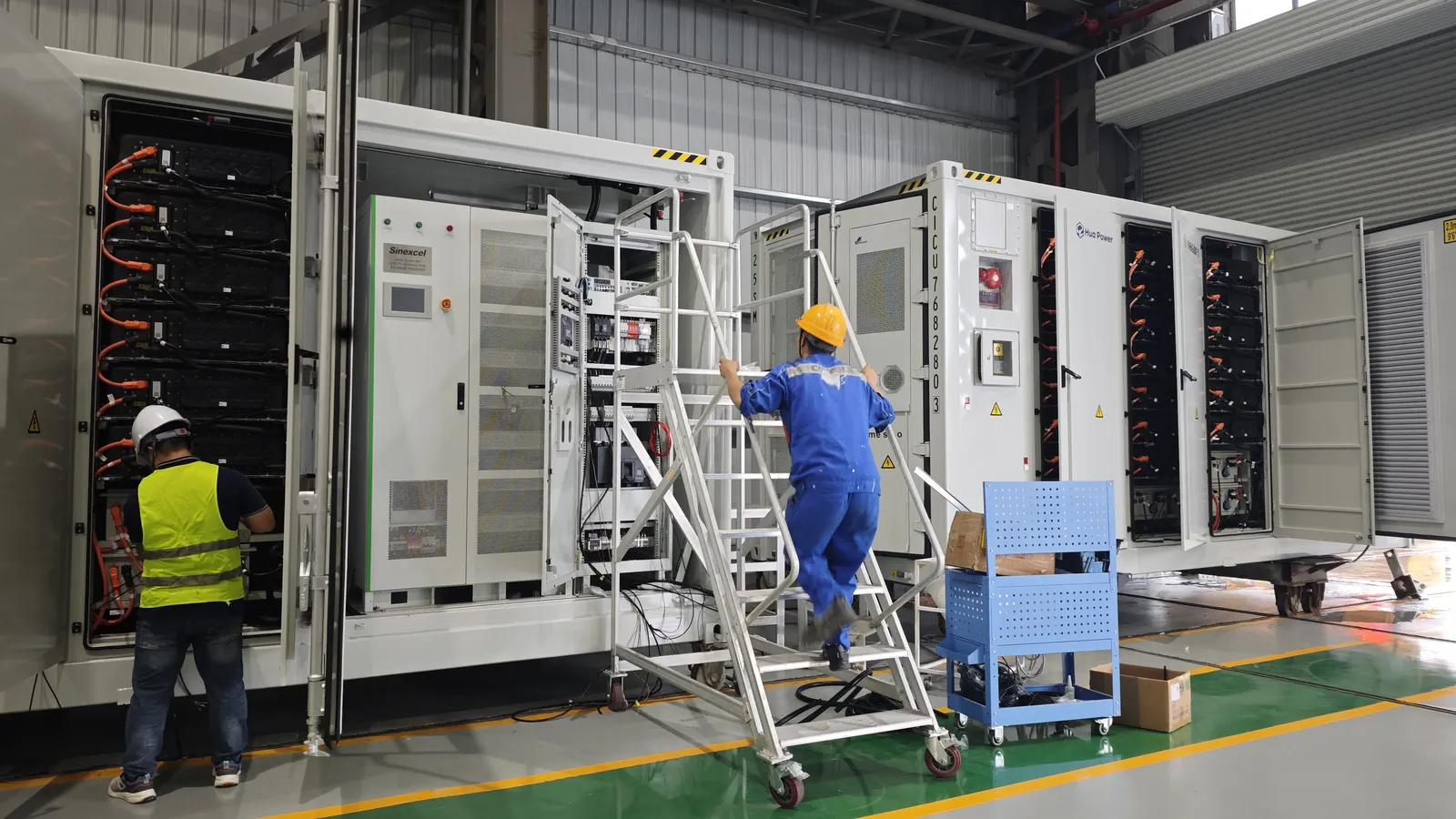
Every BESS vendor says it has multi-level fire protection. What separates them is whether they will tell you what was burned, under which standard revision, and who watched. Two of the three companies here now do, in terms that are not equivalent — which is the part worth comparing.
Trina Storage published a full-container test on its Elementa 2 Pro: a 5 MWh large-scale fire test carried out under NFPA 855:2026 and UL 9540A:2025-11 conditions, in a 1:1 site layout, supervised by TÜV Rheinland and the fire engineering consultancy Hiller, with the company reporting zero thermal propagation and structural integrity maintained. Its Elementa 3 announcement adds a 120-minute fire-resistance rating and six-fold electrical protection. Whether or not you buy Trina, that is the shape of evidence a serious buyer should ask for: a named standard revision, a named third party, and a stated outcome.
Sungrow's published detail, on the PowerStack C&I datasheet, specifies the detection and suppression package — flammable gas, smoke and heat detection, alarm sounder, FK-5-1-12, water pipeline as standard, aerosol optional — alongside IEC 62619, IEC 63056, IEC 62040, IEC 62477 and IEC 61000 listings. That datasheet is the thinnest of Sungrow's published safety evidence, and since October 2026 it has not been the whole of it.
In October 2026 Sungrow published a full-container large-scale fire test on PowerTitan 3.0, run by UL Solutions to UL 9540A:2026 and CSA/ANSI C800-2025, with Fire Risk Alliance as witness and Jensen Hughes observing. The array was 28.56 MWh of PowerTitan 3.0 containers plus a 7.4 MW medium-voltage substation, at 100% state of charge, with the initiating container installed back-to-back against its neighbour, every active suppression and thermal management system disabled, and the roof pressure-relief panels fully open. Thermal runaway did not propagate to any adjacent container or to the substation; the peak internal temperature in the initiating container reached 1259.8 °C, and after 7.5 hours of uninterrupted monitoring all five containers were still structurally intact.
Hua Power's cabinets use aerosol or FK-5-1-12 suppression; the 20 ft container line uses a dry-pipe sprinkler, with aerosol available as an option. The UL stack sits on one product, not the whole line: the HC-UPSB5010L carries UL 1973, UL 9540A and UL 9540, and is listed as compliant with NFPA 855, NEC 2023 and NFPA 70E. The HC-UPSB4180L is an IEC product (IEC 62619, IEC 63056, IEC 62933) and is not a UL-listed container — a distinction that is easy to blur in a brochure and expensive to discover at permitting.
Here is the gap we are not going to paper over: we have UL 9540A test reports, but we have not published a full-container large-scale fire test write-up comparable to what Trina and Sungrow have now published. If your AHJ, insurer or technical adviser expects a published full-scale test at a named standard revision, both competitors hold better public evidence than we do. The UL 9540A evidence checklist sets out what a credible submission actually contains.
Certification and grid codes by market
Certification is where a comparison across regions stops being clean, because the same product is certified differently depending on where it lands.
On the cabinet side, multi-market products are certified against grid codes rather than safety standards alone: EN 50549-1/-2/-10, VDE-AR-N 4105, 4110 and 4120, G99 at B, C and D levels, CEI 0-16 and 0-21, and AS 4777 for Australia. Hua Power's 241 kWh and 261 kWh cabinets carry that set, plus CE-LVD and CE-EMC listings.
On the container side, the US market is walled off by a different stack: UL 1741 SB and IEEE 1547 for interconnection, UL 1973 for the battery, UL 9540A as the test method, UL 9540 for the system, NFPA 855 for installation and NEC 2023 alignment. Sungrow's North American C&I datasheet carries that full stack — UL 1741 SB, IEEE 1547:2018, UL 1973, UL 9540A, UL 9540, NFPA 855 and NFPA 69 — on a 257 kWh cabinet. Ours carries none of it. On our line, the UL stack applies to the HC-UPSB5010L only, and our cabinets hold European, UK and Australian grid codes rather than a US interconnection listing. If your project is in the United States and your scope includes cabinets, that is a disqualifier for our cabinet range, and it is better found at shortlist stage than at submittal.
Two things worth checking with any of the three vendors. First, a certificate is issued to a legal entity, not to a product family in general — in a white-label arrangement the holder is usually the manufacturer, not your brand, so the agreement has to say what you are allowed to reference and whether the file can be re-issued. Second, the standard revision matters: UL 9540A has moved, NFPA 855 has moved, and a 2019-era report is not evidence against a 2026 requirement.
The business model difference: brand vs OEM
This is the part of the comparison that actually decides the purchase, and it is the part the search phrase hides.
Sungrow and Trina sell branded systems through their own channels. You buy a product with their name on the door and their warranty behind it, and their service organisation is the one that answers. That is a real advantage: a single accountable party, a certificate that matches the nameplate, and a lender who recognises the counterparty.
Hua Power's model is to build the same class of equipment and put your name on it — white-label, OEM or ODM, depending on how much of the design you want to own. The advantage is that you control the product, the pricing to your customers, and the relationship with the end site. The cost is that you also inherit the integration and service obligations that a brand would otherwise carry for you.
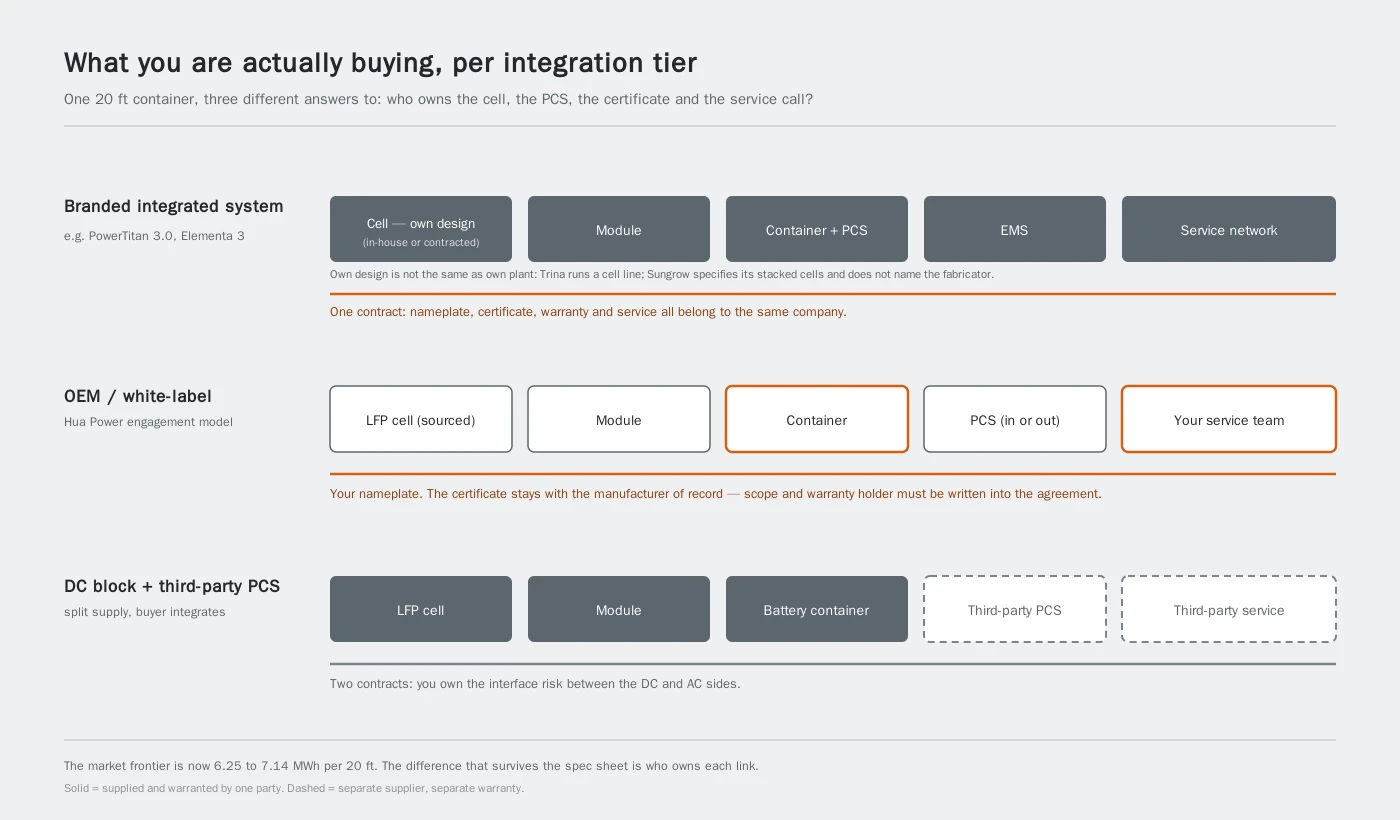
The middle lane is where most white-label deals go wrong: the certificate stays with the manufacturer of record, the warranty holder is a contract term rather than a nameplate, and the service call lands on whoever signed the OEM agreement. None of that is unsolvable — it is why white-label BESS programmes in Europe spend their first month on documentation scope rather than on price. It just has to be written down before the first unit ships.
Minimum order quantity is the question OEM buyers ask first, and it is not a catalogue number. It moves with enclosure tooling, cell batch size, the certification scope you want in your name and whether your first order is a pilot or a production run. Ask a prospective manufacturing partner to price the structural items separately: tooling or NRE, first-article approval, certification transfer, and the batch size at which unit cost actually steps down. A supplier that answers "it depends" without naming those four is telling you it has not done this before.
One more dimension worth comparing: what the system is managed by. Above the container, the EMS decides how the asset earns. Sungrow runs iSolarCloud for monitoring and dispatch. Hua Power's platform is branded Visual Energy. Trina pairs its DC platform with a separate AC and control layer. For a single-site C&I project this rarely decides anything; for a portfolio with revenue-grade dispatch it decides a lot, and it is the one dimension where a proprietary, closed EMS can become a lock-in you did not price.
Price, lead time, and what is not public here
None of the three companies publishes a price per kWh, and this article is not going to invent one. BESS pricing is quoted per project because the number depends on the cell price at the time of the order, whether the PCS is inside the container, the certification scope for your market, the warranty length, the service model, and whether you are buying a standard product or a custom build. Any published figure that looks like a market price is a historical average wearing a current date.
What you can compare is the structure of the quote. Ask each vendor to break the price into cells, enclosure and thermal management, PCS, EMS, certification for your specific market, commissioning, freight and warranty reserve. A quote that arrives as a single number per MWh hides exactly the differences that decide whether the project works in year eight.
The other thing to ask for is the delivery schedule in writing, with transformer and switchgear separated from the battery supply. Those items have been the binding constraint in more projects than cells have.
Who answers what, after the signature
The questions that decide the purchase are mostly not spec-sheet rows. They are about what happens once the equipment is on site and the person who sold it has moved on. Here is the same comparison as a table, before the three vendor sections that follow.
Sungrow | Trina Storage | Hua Power | |
|---|---|---|---|
Certificate holder | Sungrow | Trina Storage | The manufacturer of record — your brand only if the agreement assigns it |
Warranty holder | Sungrow, one chain across PV, PCS and storage | Trina Storage | Whoever signs the OEM agreement |
Who answers the year-four service call | Sungrow's own network, 520 service outlets | Trina Storage's own service organisation | Our factory, plus channel partners |
Cell supply | Stacked cells to Sungrow's design (661 and 684 Ah); fabrication partner not named | In-house LFP cells, 587 Ah in Elementa 3 | 314 Ah cells bought on the open market |
Published full-container fire test | 28.56 MWh array including a 7.4 MW substation, UL 9540A:2026, no propagation | 5 MWh container, adjacent-cell temperatures published, no propagation | None published; UL 9540A reports held but not written up |
Rows one to three are commercial terms — get them in writing. Rows four and five are public documents you can read before the first call.
When Sungrow is the better choice
We would rather you picked the right supplier than picked us, so here is the honest list.
Choose Sungrow if your project is utility-scale and financed. It ranked first in Wood Mackenzie's 2026 comprehensive ranking, and its shipment share has sat in the global top two for several years. That is not a comment on engineering quality; it is what a lender's technical adviser expects to see.
Choose Sungrow if you are building in Europe. It retained first place in the European BESS market in 2025, with BYD climbing from fifth to second behind it — which means local service depth, grid-code familiarity and a supply chain already tuned to those markets.
Choose Sungrow if container density is what you are buying. PowerTitan 3.0 puts 7.14 MWh and 1.78 MW into a 20 ft box with silicon-carbide conversion at up to 99.3% efficiency and full power at 55 °C. If your constraint is site area or interconnection cost per MWh, that is a materially better number than ours.
Choose Sungrow if you need a service footprint we do not have. Sungrow describes a network of 520 service outlets worldwide. If your O&M contract promises a four-hour response in three countries, the answer is a company with depots in three countries — and that number is the difference between a contract we can sign and one we should not bid on.
When Trina Storage is the better choice
Choose Trina if cell supply security is your main risk. It makes its own LFP cells — 314 Ah in Elementa 2, 587 Ah in Elementa 3 — and builds them into its own platform. When allocation tightens, a company that owns the cell line has one fewer supplier to negotiate with.
Choose Trina if your AHJ needs adjacent-container temperature readings, not just a pass. Both Trina and Sungrow now publish full-container tests, and they answer different questions. Trina's 5 MWh Elementa 2 Pro test, run to NFPA 855:2026 and UL 9540A:2025-11 conditions under TÜV Rheinland and Hiller supervision, reports cell temperatures below 43.9 °C in the back-to-back container and below 23.9 °C in the side-by-side one — measured numbers a fire engineer can work with when setting spacing. Sungrow's record covers a much larger array with the substation included; Trina's is the one that reports what the neighbouring cells actually measured. Elementa 3 adds a 120-minute fire-resistance rating claim on top.
Choose Trina if bankability screening is a gate. Ten consecutive quarters on BNEF's Tier 1 list, a Wood Mackenzie top-five position in 2026, and more than 20 GWh of cumulative deliveries by the end of 2025 is the kind of record that gets a supply contract through a credit committee without a fight.
Choose Trina if you want the highest energy per container with a separated AC platform. Elementa 3's 6.25 MWh DC unit plus the 13.8 MVA Electra platform gives you the option to size DC and AC independently — useful when the project is long-duration and the PCS requirement is modest.
Where Hua Power is genuinely weaker
Six things, stated plainly.
We are not ranked, and one of our products is not even in scope. For a financed utility-scale project, that can end the conversation before anyone reads a datasheet.
Our container is a generation behind on density. 5.016 MWh per 20 ft against 6.25 to 7.14 MWh from the two companies above. On a large site that difference is real money in pads, cabling and land.
We hold no BNEF Tier 1 listing. The Tier 1 screen is used by lenders, and its absence is a real obstacle in project finance, not a marketing inconvenience.
Our service footprint is thinner. We support from the factory and through partners. A company shipping at Sungrow's volume has depot density we do not, and for a multi-country O&M obligation that difference is decisive.
We do not make our own cells — and neither does Sungrow, but that is where the similarity ends. Trina runs its own LFP cell line, now at 587 Ah. Sungrow does not operate a cell plant, but it co-develops a proprietary 684 Ah stacked cell and publishes the format and the design claim. We buy 314 Ah cells on the open market and publish neither a design claim nor a fabrication partner. On the one dimension that decides allocation when the market tightens, we are the weakest of the three, and the answer has to sit in the contract rather than the datasheet: ask for the cell supply agreement behind the quote, and ask what happens if the cell model changes mid-contract.
Our UL scope is narrow, and there is no US cabinet. UL 1973, UL 9540A and UL 9540 apply to the HC-UPSB5010L, not to every container or cabinet in the range, and the cabinets have no UL or IEEE 1547 listing at all. If your project is in North America, the only part of our range that fits is the container line.
When Hua Power is the right call
When you are buying C&I, not utility-scale. Cabinets from 64 kWh to 522 kWh, split cabinets at 300, 400 and 500 kW with 600 to 720 kW of PV input, and 20 ft containers when the site grows. The HC-UPSAP241 at 125 kW and 241.152 kWh is the workhorse: 0.5C, 768 V, at least 8,000 cycles to 80% state of health, IP54 / C3-M, parallelable to MWh scale, and a grid-code certificate set covering most of Europe, the UK and Australia.
When you want your own nameplate. White-label, OEM and ODM across cabinets, containers and residential products. If you are a distributor building a storage line, an EPC standardising equipment across a portfolio, or a brand owner who does not want a supplier competing for the same end customer, that is the model we are built around.
When 314 Ah and 5 MWh per container are the right answer. Projects with transport or lifting limits, sites laid out around 20 ft modules rather than 40 ft blocks, and buyers who would rather run a mature cell format with a decade of field data than be first on a 587 Ah line. Older density is not automatically a worse purchase — but it should earn its place on your sheet, not be waved through.
When your own engineering team is doing the integration. A DC block like the HC-UPSB5010L, or the 1 MW / 2.089 MWh HC-UPSA2089L with integrated conversion, lets you specify the PCS and EMS yourself instead of buying a closed system.
When the factory needs to answer to you, not to a brand. What "manufacturer" means in China's storage trade is a useful primer before you audit anyone, us included: the five supplier types look identical on a website and behave completely differently when a rack underperforms in year four.
The project record we can point to includes a 10 MW / 69 MWh installation in California, 19.2 MW / 46.9 MWh in Indiana, and 6 MW / 10.32 MWh in the Czech Republic, across more than 400 projects. It is a smaller record than either of the other two companies. It is a real one.
How to run a BESS supplier comparison yourself
Five questions separate a real comparison from a brochure stack. A BESS manufacturer comparison that stops at capacity tables and warranty years will not answer any of them.
- What boundary is each number measured at? DC or AC, cell or system, beginning of life or end of warranty. A 5 MWh DC block and a 7.14 MWh AC block are not the same quantity of equipment, and the difference is not in your favour if you assume it away.
- Who is the manufacturer of record on the certificate? And does the document name your brand, or only theirs?
- What is the published fire test evidence, at which standard revision, supervised by whom?
- Who answers the service call in year four, from where, and within what response time?
- What happens if the cell supplier changes? Ask for the supply agreement, not the assurance.
The BESS supplier evaluation checklist turns those five into a scoring sheet you can run across a shortlist in an afternoon, and if you are weighing cooling architectures at the same time, liquid-cooled versus air-cooled cabinets covers where the cost difference actually shows up.
Bottom line
If the project is utility-scale, financed, and reviewed by a lender's technical adviser, shortlist Sungrow and Trina Storage and treat Hua Power as a price reference rather than a candidate. Sungrow if you want the highest energy density, one vendor across PV, PCS and storage, and a top-ranked counterparty; Trina if cell integration and the more granular fire-test data are the deciding factors.
If you are building a product line, sourcing C&I cabinets, or you want equipment that carries your name and your warranty terms, the brand-integrated model is the wrong shape and this stops being a product comparison at all. That is the purchase we make sense for — and the one where being unranked matters least.
If your shortlist genuinely looks like this one, send the project brief to our engineering team and ask us the five questions above. We will answer them in writing, including the ones we lose.
FAQ
Is Hua Power a real BESS manufacturer?
Yes, with a caveat worth knowing. Hua Power was founded in 2015, operates a 50,000 m² plant with 2.4 GWh per year of capacity, and has delivered more than 400 projects. It is not in the Wood Mackenzie top ten and holds no BNEF Tier 1 listing, so "real manufacturer" and "bankable counterparty" are two different answers here. Verify the first with a factory audit and the second with your lender.
Is Sungrow or Trina better for battery storage?
They are strong in different places. Sungrow ranked first in Wood Mackenzie's 2026 comprehensive integrator ranking and has the denser container — 7.14 MWh and 1.78 MW in 20 ft — with one warranty chain across PV, PCS and storage. Trina Storage tied fifth, makes its own cells up to 587 Ah, and publishes the more granular fire-test data: cell temperatures in the adjacent containers, not just a pass. For a project where site area and single-vendor scope dominate, Sungrow is usually the easier fit; where cell supply and published safety evidence drive the decision, Trina is.
What does "Hua Power vs Sungrow vs Trina" actually compare?
It compares two business models, not three products. Sungrow and Trina sell branded systems through their own channels with their own certificates and service organisations. Hua Power builds the same class of equipment for other companies to sell under their own brand. Once you know which of those two purchases you are making, most of the specification questions answer themselves.
Can I white-label a Sungrow or Trina system?
Neither company publishes a white-label or OEM programme that we could find; both sell branded products through their own channels. That is not a criticism of their equipment — it is a statement about the shape of the purchase. If white-label is a hard requirement, it disqualifies them at the model stage, and the comparison should move to manufacturers who offer it.
Every vendor figure in this comparison was checked against the public source linked beside it on 5 November 2026. Product generations and rankings in this industry change roughly once a year; re-check before you quote any of it.