

What You Are Actually Buying From a China BESS Supplier
Two quotes for a 5 MWh container land in the same inbox on the same day. One is priced at the Chinese equipment benchmark. The other is priced at what the same box costs once it is standing on your site — and the distance between them is not a discount, it is a list of costs that nobody itemised. Neither quote tells you where the money went, and that gap is the most expensive piece of missing information in a storage procurement.
So before the numbers, the layer. "China BESS supplier" describes four quite different businesses, and which one you are talking to decides how much of the price is cost and how much is someone else's margin:
- A cell manufacturer's system arm. Cells come off a line the company also sells to its competitors; the container is built around its own cell format.
- A system integrator. Buys cells and PCS on the market, owns the enclosure, thermal design, BMS/EMS logic and the warranty.
- A white-label OEM. Builds to your specification and puts your badge on it — the sourcing guide side of that arrangement sits in our OEM and white-label sourcing guides.
- A trading company. Owns no line, adds a margin and a lead time, and is the usual source of quotes that look nothing like each other on identical-looking paperwork.
In practice that first tier is a short list. A handful of Chinese manufacturers — CATL, BYD, EVE Energy, Hithium and Gotion among them — make most of the cells that reach stationary projects, and they meet the market either through their own system arms or through the integrator and OEM tier below them. That structure is the reason a "China price" is not one number.
This article is a full BESS cost breakdown for the second and third of those: the seven lines an equipment quote is built from, the four mechanisms that genuinely make the Chinese cost base lower, and — the part most supplier content skips — the point at which the saving stops and becomes someone else's cost.
A Full BESS Cost Breakdown: The Seven Lines Every Quote Is Made Of
Every containerised quote, from any country, decomposes into the same seven lines. What changes between suppliers is which of them are inside the price, at what specification, and with what evidence attached.
# | Line | Typical share of equipment cost | What actually moves it |
|---|---|---|---|
1 | Cells and modules | 45–60% | Cell format (280Ah → 314Ah → 500Ah+), grade, and purchase timing against the carbonate cycle |
2 | BMS | 5–8% | Whether it is developed in-house or bought in; balancing architecture |
3 | PCS | 8–15% | Bidirectional inverter rating, grid-code firmware for your market, in-house vs third-party |
4 | Enclosure and thermal management | 12–20% | 20-ft standard shell vs custom; liquid cooling vs air; fire suppression package |
5 | Balance of plant | 8–15% | Transformer, switchgear, DC wiring, auxiliaries, cable routing |
6 | EMS and software | 3–6% | Local control, remote monitoring, licences, site integration effort |
7 | Testing and certification | 3–8% | Which markets, which standards, and whether the certificate covers this model |
The shares are engineering ranges, not a published index, and they move with chemistry and capacity. The reason to hold them in your head is that they tell you which line a supplier is quietly using to hit a headline number.
Public system-level data gives the scale of what those seven lines add up to. BloombergNEF's 2025 cost survey put the global average for a turnkey system at US$117/kWh, after a 31% decline from 2024 — with China averaging US$73/kWh against US$177/kWh in Europe and US$219/kWh in the US (Energy-Storage.News). Ember's project-level work outside China and the US found entire 4-hour-plus projects being built for around US$125/kWh all-in, of which roughly US$75/kWh is Chinese-made core equipment and US$50/kWh is installation and grid connection (Ember).
Source 1 — Cell Cost: Scale, LFP Chemistry and the Carbonate Cycle
Start with battery cost per kWh at the cell, because that is where the Chinese advantage is largest and least mysterious.
The chemistry choice did most of the early work. Stationary storage overwhelmingly uses lithium iron phosphate, and the LFP supply chain — precursor processing, cathode, anode, cell — is concentrated in China to a degree that has no parallel in the industry: "China's market dominance sits between 95 and 100% and will continue to be for the coming years," with over 85% of global BESS installations drawing on Chinese cells (Energy-Storage.News). LFP also removes nickel and cobalt from the battery cost per kWh conversation entirely, which is why metals price spikes hit EV packs harder than storage packs.
Scale is the second half. BloombergNEF's 2025 price survey found average cell prices at US$74/kWh and packs at US$108/kWh globally, with stationary storage packs the cheapest segment ever recorded at US$70/kWh — a 45% year-on-year fall (Energy-Storage.News). The survey credited exactly what a manufacturer would tell you: China's stationary-cell capacity, estimated at 557GWh a year, is roughly double global demand in the segment. Ember put Chinese domestic LFP battery cell price levels at around US$40/kWh by November 2025.
That is the floor, and it is not a permanent one. By early March 2026, mainstream 314Ah cells in China were quoted close to RMB0.4/Wh, up about 30% from January and over 50% from the 2025 low of RMB0.26/Wh, driven by lithium carbonate breaking through RMB180,000/tonne and tight supply during the transition to larger formats (Energy-Storage.News). System prices followed: mainstream LFP systems passed RMB0.61/Wh in February 2026, roughly 10.9% above the December 2025 level. Anyone budgeting a 2026 project on 2025 bess prices is budgeting on a downward trend that has already reversed once.
The useful question is not "how cheap are Chinese cells" but "where in the carbonate cycle am I signing". A quote dated in a rising month ages in your favour; a quote dated in a falling month buys you six weeks of regret.
Source 2 — Standardisation: Enclosures, Cell Formats and the Real Discount
The second source of saving is less talked about and easier to verify: standardisation.
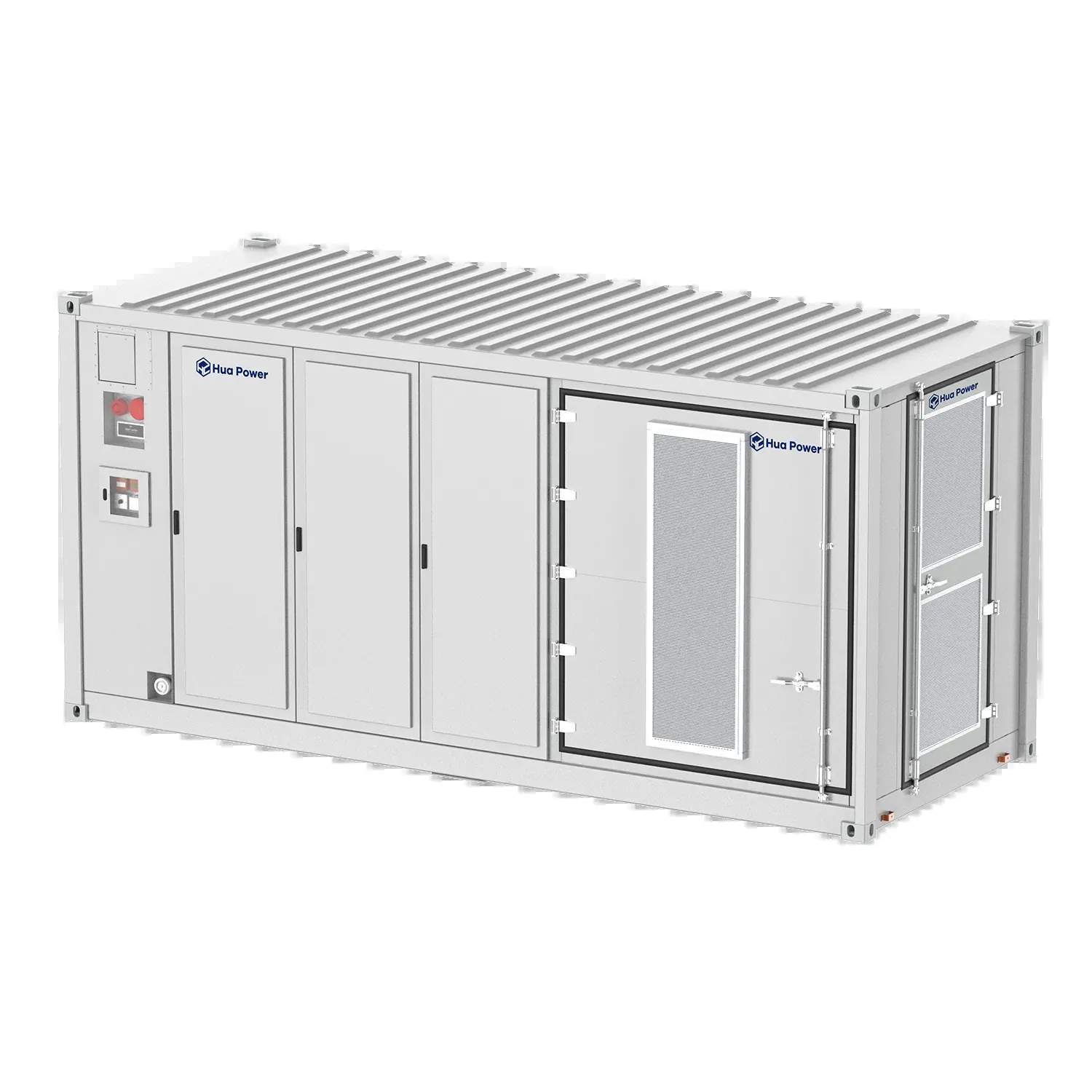
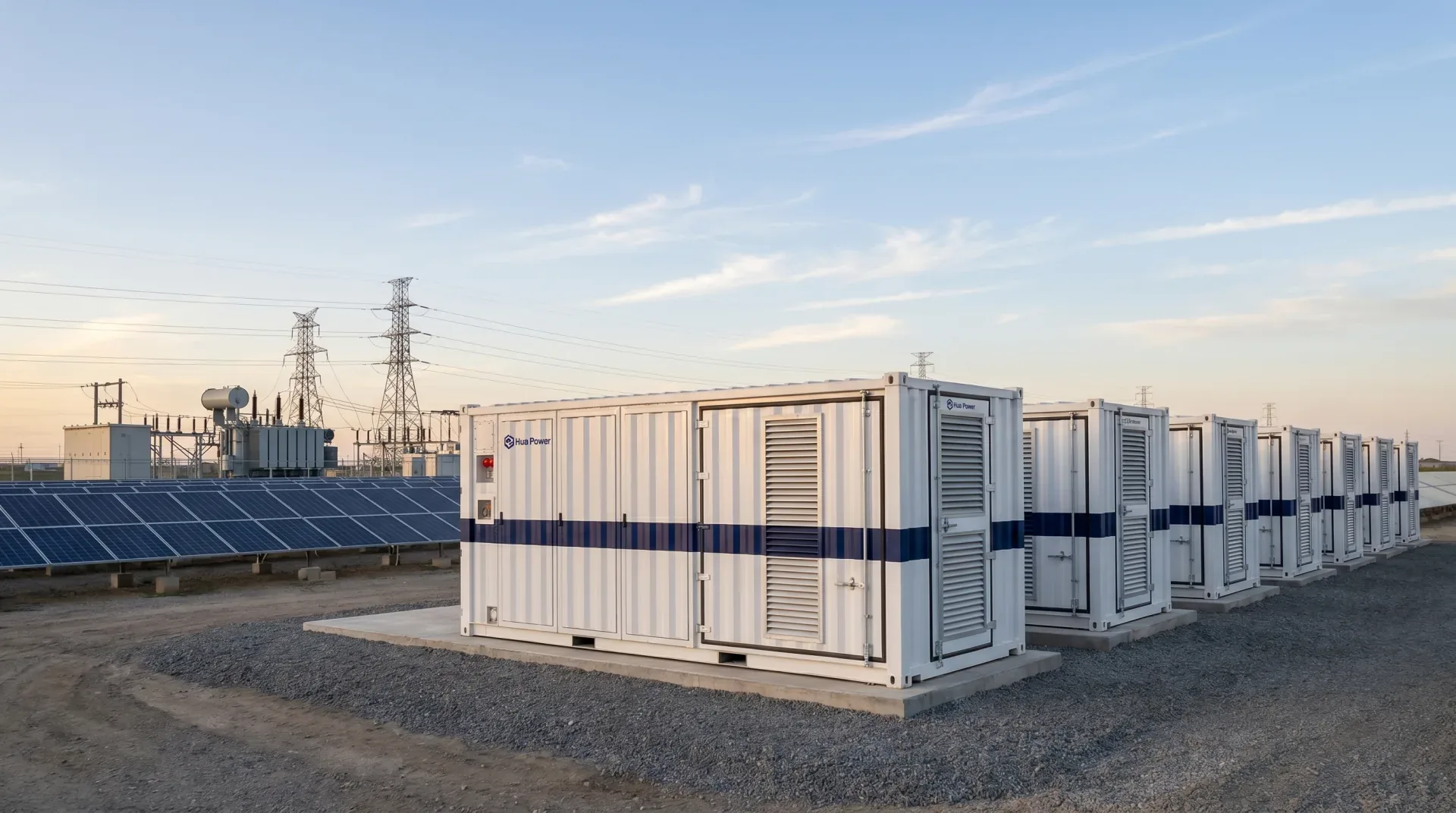
Cell makers converged on one prismatic format and then grew the capacity inside it — 280Ah, then 314Ah in late 2022, now moving to 500Ah+ — without changing the module envelope. Integrators converged in parallel on a 20-foot, 5 MWh liquid-cooled container. The result is that a buyer specifying a standard 5 MWh container is not paying for engineering. They are paying for steel, cells and assembly, which is why "5 MWh BESS container price" is a meaningful search and why the same buyer specifying a custom enclosure is not.
Two specification numbers ride on that convergence. Higher energy density per cell is what lets the same 20-foot footprint hold more MWh, and round-trip efficiency is the number that decides how much of the cheap energy you actually get to sell twice — neither is on the invoice, and both change what the $/kWh is worth.
The cost effect is measurable. BNEF found DC-side systems using 300Ah-or-larger cells were 50% cheaper than systems built on smaller cells (Energy-Storage.News). Ember's decomposition explains where that lands: the enclosures account for close to 90% of the US$75/kWh core equipment cost, with PCS and EMS making up roughly 10% (Ember).
One definitional caution if you read that against the seven-line table above: Ember's "enclosure" is the finished DC block with the cells already inside it, not the steel shell on line 4 of the split. That is why a near-90% share and a 12–20% line can both be right — they are measuring different things at different levels.
The box you are buying is not packaging around the product. In a standardised container, the box is the product economics: it is the reason a standard enclosure usually beats a bespoke one on cost even when the bespoke version looks better on a data sheet. Our own line of energy storage containers is built on that premise.
Source 3 — Vertical Integration: The Lines You Stop Paying For
BESS container price differences between two Chinese suppliers with the same cell suppliers usually come down to how many of the seven lines the supplier owns.
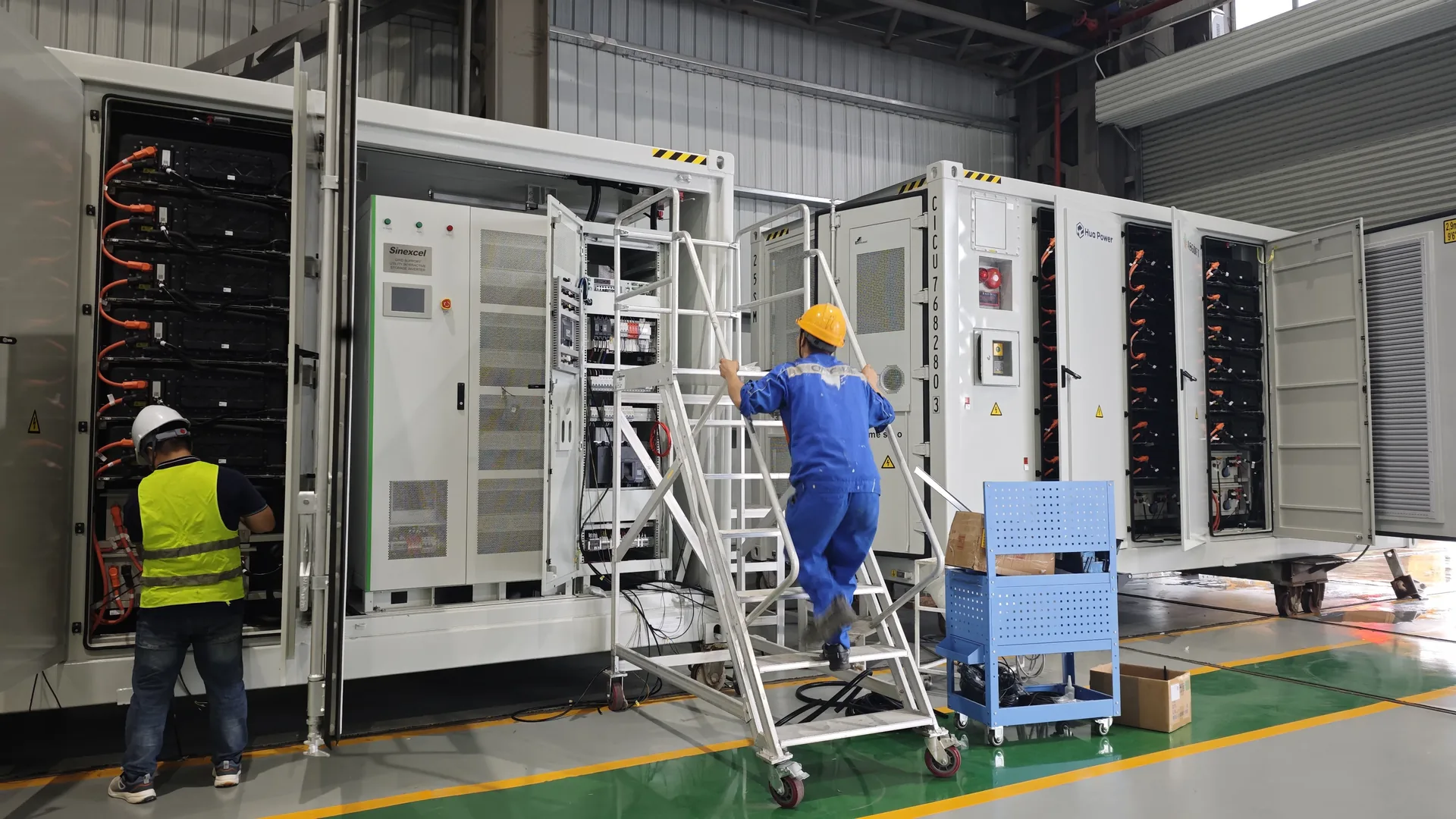
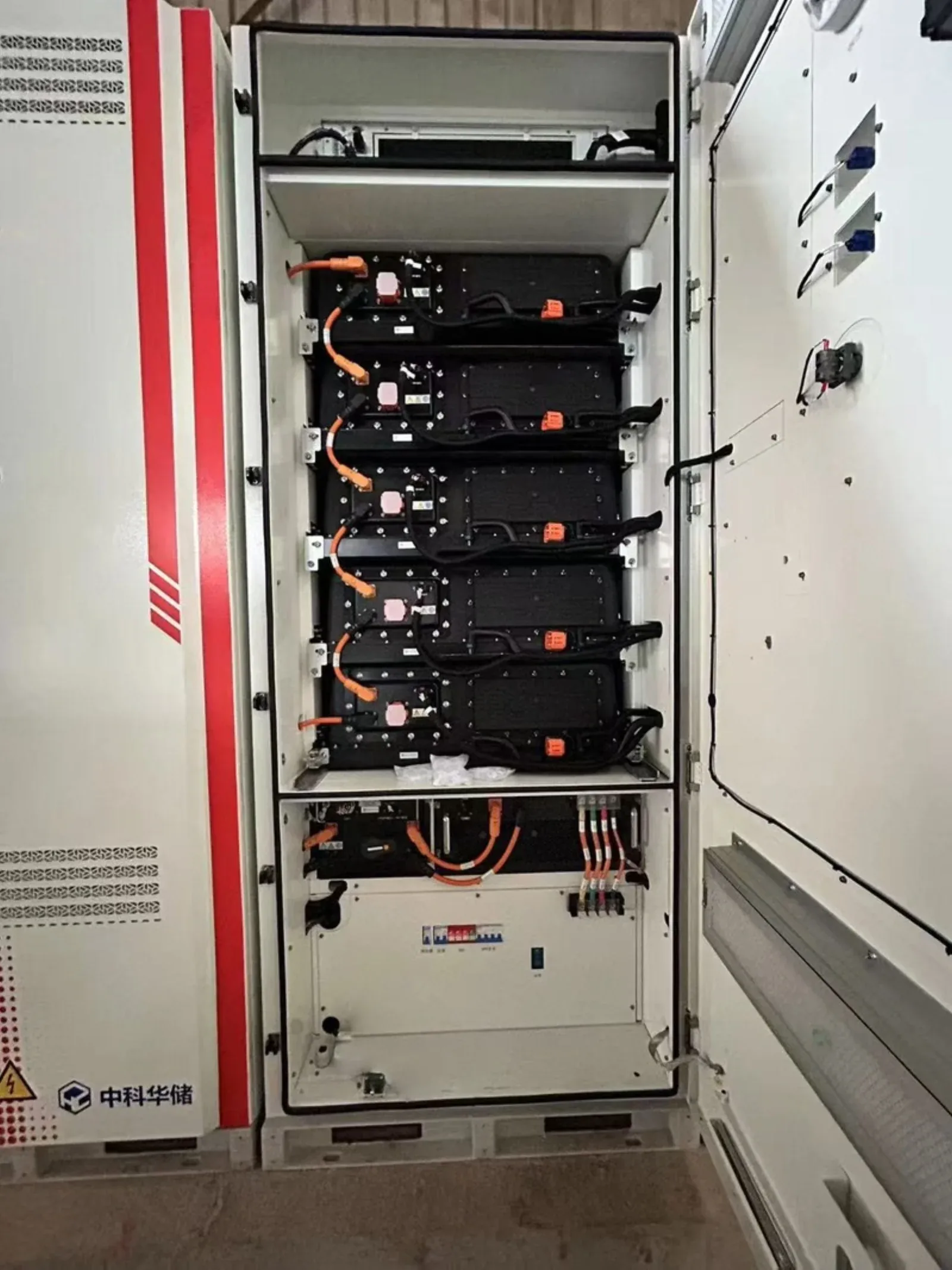
A vertically integrated manufacturer runs cells, modules, BMS logic, PCS integration, enclosure fabrication and EMS under one quality system. What that removes from your quote is not manufacturing cost — it is the commercial layer between every pair of those steps: distributor margins, second-party re-testing, duplicated engineering, and the schedule buffers each intermediary keeps. Chinese integrators also bring new products to market faster than the rest of the industry for the same reason, which is roughly how the 5 MWh container became the standard unit while non-Chinese integrators were still announcing their first ones.
What you can actually verify as a buyer is more useful than the marketing claim:
- one factory audit covers the whole chain, not just the final assembly;
- cell batch test reports and the module-level traceability behind the certificate;
- one counterparty for performance warranty, instead of a chain of pass-through obligations;
- fewer re-packing and re-testing steps between cell and container.
Vertical integration does not buy you site work, grid studies, permits, local labour or faster transoceanic logistics, and any supplier implying otherwise is selling you a diagram. The process side of choosing between an OEM, an ODM and a full white-label arrangement is covered in our C&I OEM sourcing guide.
Source 4 — Purchase Structure: MOQ, Terms and the Landed-Cost Bridge
The fourth source is not engineering at all. It is the structure of the purchase, and it is where much of the apparent spread between quotes comes from.
Order size is the first lever. Volume pricing in this industry is real, and the minimum order quantity attached to a quote is usually a production-slot decision rather than a policy: a single container order competes for cell allocation against multi-hundred-MWh programmes, and that competition shows up in both the price and the delivery date.
Three unit conventions get mixed into one comparison. A bess cost per kWh figure may mean battery-only, container-only, or turnkey installed. A bess cost per mwh figure is usually the utility-scale expression of the same equipment. A capex-per-MW figure describes the power side and says almost nothing about duration. Two quotes are comparable only when the unit, the duration, the scope and the Incoterm match — and in practice they rarely do.
The Incoterm is the part that changes your BESS landed cost most, because it decides who pays freight, insurance, duty and clearance:
Term | Supplier's price includes | Your exposure |
|---|---|---|
EXW | Nothing beyond the factory gate | Inland haulage in China, export clearance, ocean and dangerous-goods freight, insurance, import duty, port handling, inland delivery |
FOB | Inland haulage and export clearance | Ocean freight, insurance, duty, port handling, inland delivery |
CIF | Ocean freight and insurance to your port | Duty, port handling, inland delivery, and the risk of a carrier that is not the one you would have chosen |
DDP | Everything to your named place | Only what the supplier could not classify, plus the VAT treatment your finance team has to unpick |
The spread is not small. Ember's US$75/kWh for core equipment explicitly assumes delivered from China to countries with low import duties; move the same container to a market with a 25% tariff and the duty line is larger than the installation line (Ember). Domestic Chinese tender data shows how far the same equipment can travel in price: Huadian's 6 GWh procurement settled at an average bid of CNY 0.473/Wh (US$65/kWh), with more than 80% of bidders below CNY 0.5/Wh (ESS News) — a domestic, ex-works, volume-price world that a single-container order does not live in.
Payment structure is a cost line too. A 30% deposit against a letter of credit for the balance is cheaper for the supplier than 60-day terms, and that cost is inside the price whether it is itemised or not. The procurement and total-cost-of-ownership side of this is already covered in our C&I BESS procurement guide; the point here is narrower — terms are negotiable, and the cheapest quote is often the one with the least financing in it.
Ask a supplier what their ex-works price excludes, not what it includes. The exclusions are the part of the quote that actually reaches your budget; the headline number is the part everybody compares and nobody buys.
What Your Specification Choices Do to the Price
A quote is a specification with a number on it. Before you negotiate the number, it is worth knowing which line each specification choice moves — because most of the scope arguments in a BESS procurement are really cost-line arguments:
Specification choice | Line it moves | Which way |
|---|---|---|
Continuous C-rate and depth of discharge | Cells and modules (line 1) | A harder duty cycle needs more cell content for the same nameplate energy. Ember notes manufacturers typically oversize installed capacity by at least 10% to guarantee a 0–100% state-of-charge window — that oversizing is in your price |
Duration | Lines 3–5, spread over more kWh | PCS, BOP and site scope are sized to power, so the same equipment serves more energy in a 4-hour system than a 2-hour one. Published $/kWh figures are only comparable at equal duration |
Liquid or air cooling | Enclosure and thermal management (line 4) | Liquid cooling adds cost to the box and is the default in the 5 MWh standard format; on smaller systems it is a genuine either/or |
Cycle-life guarantee and augmentation | Cells plus warranty reserve | 6,000 cycles at 80% state of health is a different product from 8,000. The guarantee, and any augmentation schedule behind it, is priced somewhere whether or not it is itemised |
PCS architecture and redundancy | PCS (line 3) | One central PCS is cheaper per kW; multi-PCS or string architecture costs more and removes a single point of failure |
Standard or custom enclosure | Line 4, plus the standardisation discount | A custom shell resets engineering, tooling and certification scope. The discount described above is what you give up |
None of these six is a "good" or "bad" choice. They are the levers that explain why two quotes for the same 5 MWh of storage can differ, and knowing which line you are paying for is the difference between negotiating a price and negotiating a specification.
Where the Saving Stops: Duty, Certification and Site Work
Here is the part a cost advantage article written by a Chinese supplier has an obligation to state plainly: the equipment price advantage and the project cost are not the same number.
Duty. The United States is the clearest case, and it is the only destination this article prices. USTR's September 2024 modification to the Section 301 action raised the tariff on lithium-ion non-EV batteries — HTS subheading 8507.60.0020 — to 25 percent, applicable to entries on or after 1 January 2026, and expressly declined to carve out particular battery types: the direction "broadly covers all lithium-ion batteries" (Federal Register). On a US$75/kWh equipment cost, a 25% duty adds roughly US$19/kWh before clearance, brokerage and inland delivery. That single line can erase the entire Chinese equipment discount against locally assembled alternatives that qualify for different treatment — and it is a policy variable, not a supplier choice.
Compliance. In the EU, Regulation (EU) 2023/1542 replaced the old Batteries Directive and layers producer-responsibility, collection, recycling and documentation obligations onto anyone placing industrial batteries on the market, regardless of origin (European Commission). Certification is the other half, and it is model-specific: UN 38.3 for transport, IEC 62619 for industrial cells and batteries, UL 9540/9540A and NFPA 855 in North America, CE marking, plus grid-code firmware for the market you are connecting in. Testing is a real cost, and it is repeated whenever the model changes — which is why the certificate scope, not the certificate logo, is what you should be checking.
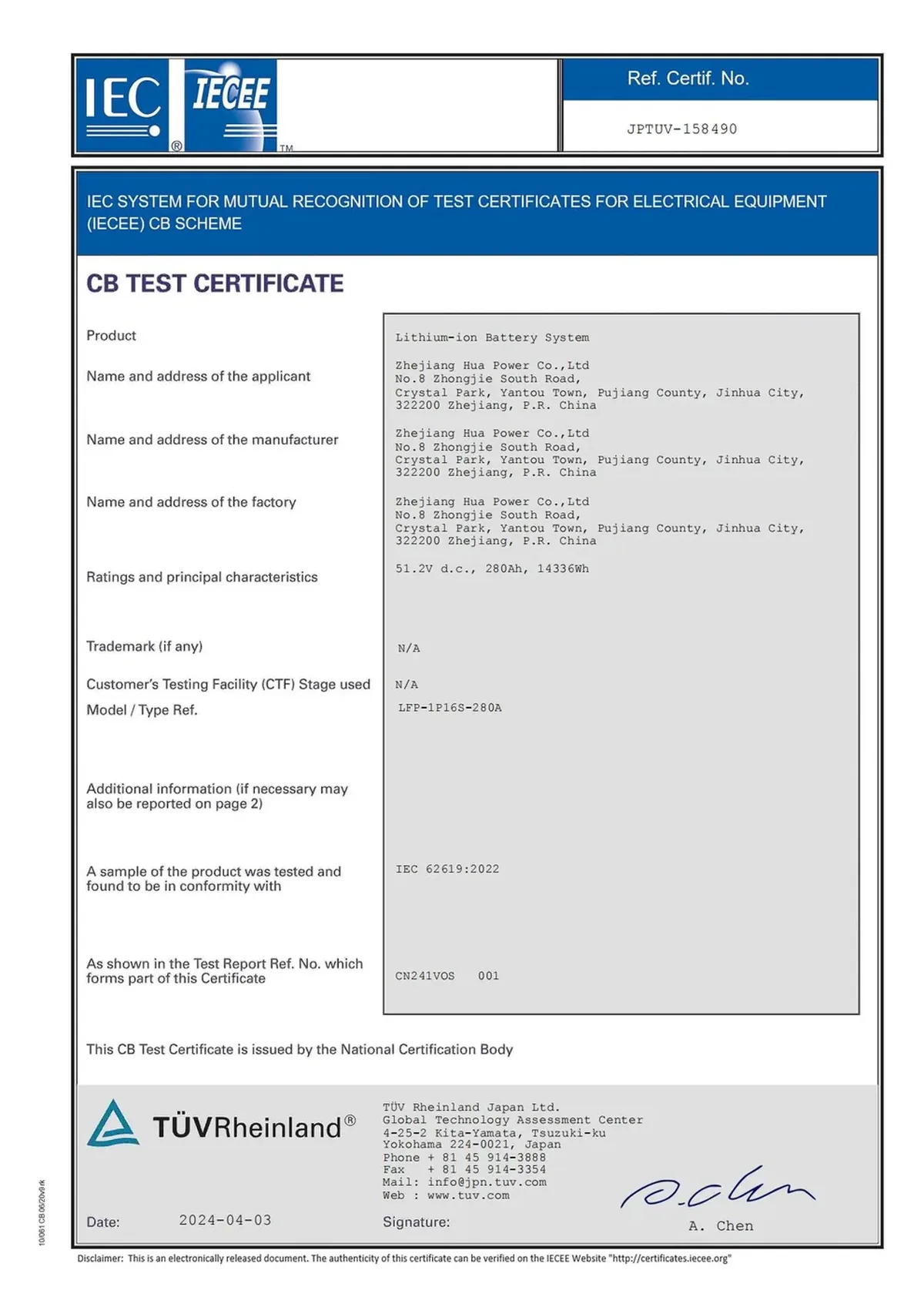
Our IEC 62619:2022 CB test certificate, Ref. JPTUV-158490, issued 3 April 2024 for model LFP-1P16S-280A — a 51.2 V, 14.3 kWh system. That is exactly the point: this certificate covers that model, not a 5 MWh container.
Site work. Ember's US$125/kWh all-in breaks into US$75/kWh of delivered equipment and about US$50/kWh of EPC and grid connection in markets outside China and the US (Ember). That second half is local labour, civil works, interconnection studies and commissioning — none of which gets cheaper because the container crossed an ocean. Ember puts roughly 40% of total project value into that local content even when the equipment is imported, and the grid-connection fee alone is the single largest source of variation between projects.
The market-entry overlay for European projects is set out in White-Label BESS in Europe, which is where the compliance package above becomes a project schedule.
Warranty service is the last quiet line. A ten-year performance warranty administered from another continent has a cost — spares stock, response time, who pays for the crane — and a supplier that has not priced it has simply moved it into your risk register.
A Worked Example: One 5 MWh Container, EXW vs Landed
Numbers make the bridge concrete. The figures below are illustrative and labelled, not a quote, and they use public averages rather than any specific tender.
Line | EXW (factory gate) | Landed in the US | Note |
|---|---|---|---|
System equipment, 5 MWh container | US$73/kWh | US$73/kWh | BNEF 2025 China turnkey system average (Ember's delivered core-equipment figure is US$75/kWh) |
Ocean freight, dangerous goods | — | ~US$3–6/kWh | Depends on route, season, class-9 handling |
Insurance and port handling | — | ~US$1–3/kWh | Ad valorem plus terminal charges |
Import duty | — | ~US$19/kWh | 25% Section 301 on non-EV lithium-ion batteries (HS 8507.60.0020) from 2026 |
Inland delivery and offloading | — | ~US$2–5/kWh | Distance and crane arrangement |
Delivered equipment | ~US$73/kWh | ~US$98–106/kWh | Still before installation |
EPC and grid connection | — | ~US$50/kWh | Ember's ex-China, ex-US typical value; its full range runs from about US$30/kWh with cheap grid connection to US$100/kWh in extreme cases, so treat the project total as a range rather than a ceiling |
Project cost | — | ~US$148–156/kWh | Compare with Ember's US$125/kWh all-in in low-duty markets — this is a US-basis floor, not the benchmark |
The table is doing one job: showing that a 25% duty, a class-9 ocean leg and a US interconnection study are not footnotes to a cheap container. For a project that earns money from arbitrage, the ROI and payback numbers are calculated from this all-in figure, not from the ex-works one — which is why a 20% cheaper container rarely moves a payback period by 20%. A data-centre or telecom backup project values uptime rather than arbitrage, but it buys the same seven lines; what changes is which of them you are willing to trade away. If you are building the underlying revenue model, the levelised maths belongs on the LCOS page rather than here — this article stops at the cost of the goods and the cost of getting them onto your site.
How to Sanity-Check a Chinese BESS Quote
Six questions separate a cheap BOM from a cheap system. Ask them before the technical review, because the answers change what the technical review is worth.
Question | A weak answer looks like | Why it matters |
|---|---|---|
Cell grade and batch test report for this order? | "A-grade, top brand" with no document | Cell grade is the largest single line in the quote |
Certificate scope: which model numbers, which standards? | A folder of logos, no model list | Certification is model-specific and repeated |
What is excluded from the price? | Silence, then a change order | Exclusions are where low quotes become average ones |
Incoterm, and who owns risk at each leg? | "We can do everything" | Landed cost lives here |
Warranty: term, throughput cap, who pays service? | Term only, no mechanism | Cross-border service is a real cost line |
What is the delivery date based on? | A date, not a schedule | Cell allocation is tight in a rising price month |
Two boundaries are worth keeping straight. Which suppliers exist in this market is a different question from this one, and how to vet a supplier end to end is a third — the sourcing guides collected in the OEM and white-label hub linked at the top of this article cover both, and this article deliberately stays on the cost axis so none of the three gets watered down.
The commercial conclusion is short. China's cost advantage is real and structural on four fronts — cell scale, standardised enclosures, vertical integration and purchase structure — and between them those four move most of the equipment side of the quote: cells and modules, PCS, enclosure and thermal management, and balance of plant. On everything that arrives after the factory gate — duty, certification and site work — there is no advantage at all; it is a cost you inherit later and often discover at change-order time. Read a quote with that split in mind and the spread between two "5 MWh" numbers stops being confusing and starts being negotiable.
Price, duty and policy figures in this article are current as of their cited publication dates (BNEF and Ember, December 2025; the USTR Section 301 notice of September 2024; the March 2026 cell-price reporting linked in Source 1). Energy storage policy and cell pricing move faster than article reviews, so check the cited source before you budget against a number.
If you want the cost structure of a specific specification taken apart line by line — cells, PCS, enclosure, certification scope, freight and duty for your destination market — send us the specification and the destination, and we will answer it with the lines named.