

A frequency regulation project in Europe is a contract to hold active power in reserve so that a transmission system operator can keep the grid at 50 Hz. It is sold in three tiers — FCR, aFRR and mFRR — through national or cross-border auctions, and it is sized in megawatts of available power, not in megawatt-hours of stored energy. That single sentence explains why battery developers keep mispricing these projects: the revenue is attached to a capability, and the capability is defined by someone else's specification.
The numbers are smaller than most people expect. Belgium buys 86 MW of FCR for an entire country. The Netherlands buys 123 MW. Poland buys 197 MW. The continental synchronous area's total FCR requirement is about 3,000 MW — roughly five or six large combined-cycle units — and the nine-country FCR Cooperation clears only part of it; the rest is bought nationally by the synchronous-area countries outside the cooperation. Europe's frequency regulation projects are not a continent-scale market. They are a dozen shallow pools with hard technical gates, and the winners are the developers who understand which gate they are standing in front of.
This article documents ten of them. Each entry names the operator, the country, the product, the published volume and the response specification, and links to the primary source. Nothing here is a vendor claim, and nothing is projected. The images are illustrative renderings, not photographs of a named project or of a customer installation.
What a European Frequency Regulation Project Actually Is
Three products, one purpose, three different speeds. FCR (Frequency Containment Reserve) arrests the frequency deviation and is activated automatically and proportionally to the deviation itself, with full activation required within 30 seconds. aFRR (automatic Frequency Restoration Reserve) is dispatched by a setpoint signal from the control room and must reach full activation within five minutes — the time limit set in the European framework; its balancing energy crosses borders through the PICASSO platform. mFRR (manual Frequency Restoration Reserve) is called manually and typically activates within 12.5 to 15 minutes, covering the long imbalances the first two layers cannot hold, with its energy exchanged through the European mFRR platform, MARI.
The commercial difference matters more than the technical one. FCR pays for availability only: the unit holds a symmetric block of power in both directions and is paid a capacity price, while the energy actually delivered is small. aFRR pays twice — a capacity price for standing by and an energy price for every megawatt-hour delivered — which is why batteries with short duration can still earn there. mFRR is an energy product with long delivery windows, and batteries rarely dominate it.
Every one of these markets runs on the same legal scaffolding: the Electricity Balancing Guideline, Commission Regulation (EU) 2017/2195, which created the European platforms for exchanging balancing energy, and the System Operation Guideline, Commission Regulation (EU) 2017/1485, which sets the dimensioning rules for FCR and the limits on how much reserve can cross a border. The methodologies that define each platform go through ACER, the EU agency for the cooperation of energy regulators, which is why a national market change usually arrives with a European decision attached. The buyers are transmission system operators. The sellers are balancing service providers — increasingly battery owners, either bidding directly or through an aggregator.
If you need the mechanism explained from first principles rather than as a procurement list, the cluster hub on grid frequency regulation with battery storage covers the physics, the control cascade and the battery-side design consequences, and the knowledge base entry on frequency regulation covers the terminology. This page stays at the level of who buys what, and how much.
How These Ten Case Studies Are Built
Three rules, applied without exception.
First, volumes come from the operator or from the European network of operators, not from industry commentary — the one exception is Germany's FCR figure, which is quoted from an aggregator's reference table because the German TSOs publish demand inside a joint auction platform rather than in a single national statement. Second, a procurement requirement is never presented as a contracted volume, or the other way round: an 86 MW requirement and 1,104 MW of contracted capability are different kinds of number, and mixing them is how bad investment cases get built. Third, every figure carries the year it belongs to, because these markets are re-dimensioned annually or half-yearly.
What this list deliberately does not contain: named battery plants with capacities attached. Those claims are easy to write and hard to verify from a primary source, and a wrong megawatt figure in a procurement document costs more than a missing one. The "project" here is the procurement project itself — the auction, the platform, the service definition — each of which is documented by the operator running it.
The Ten Europe Frequency Regulation Projects at a Glance
Section | Market | Operator | Product | Published volume | Full activation | Source year |
|---|---|---|---|---|---|---|
1 | Continental Europe (9 countries) | 12 TSOs, FCR Cooperation | FCR, 4-hour symmetric blocks | ~3,000 MW minimum for the CE synchronous area | ≤ 30 s | 2026 |
2 | Germany | 50Hertz, Amprion, TenneT DE, TransnetBW | FCR | 562 MW | ≤ 30 s | 2021 reference |
3 | Germany | Same four TSOs | aFRR, positive and negative | Set per LFC block, tendered in 4-hour blocks | ≤ 5 min | 2026 |
4 | Netherlands | TenneT | FCR | 123 MW for 2025 | ≤ 30 s | 2025 |
4 | Netherlands | TenneT | FRR (aFRR + mFRR) | 1,304 MW forecast | ≤ 5 min (aFRR) | 2025 |
5 | Belgium | Elia | FCR | 86 MW, of which 26 MW core share | ≤ 30 s | 2025 |
6 | Nordics | Statnett, Svenska kraftnät, Fingrid, Energinet | FCR-N | ≥ 600 MW for the synchronous system | ≤ 30 s | 2024 |
7 | United Kingdom | NESO | Dynamic Containment (high and low) | ≥ 1 GW enduring requirement | 1 s full delivery | 2025 |
8 | United Kingdom | NESO | Dynamic Moderation and Dynamic Regulation | No standing volume; procured per EFA block | 1 s (DM) / 10 s (DR) full delivery | 2025 |
9 | Ireland | EirGrid and SONI | DS3 services incl. Fast Frequency Response | 1,104 MW FFR contracted (Gate 8) | 2 s | 2023 |
10 | Poland | PSE | FCR and aFRR | 197 MW FCR; 400–500 MW aFRR per direction | ≤ 30 s / ≤ 5 min | 2026 |
The "Section" column is the number of the passage below that each row is summarised from; the Dutch entry appears twice because one section covers two products. The range is the story: 86 MW at the bottom, a 3,000 MW requirement across the continental synchronous area at the top, and a technical gate that tightens as you move down the table. What follows takes each section in turn, in table order.
#1 Continental Europe: The FCR Cooperation Across Nine Countries
The largest frequency regulation project in Europe is not a power plant. It is a procurement arrangement: twelve transmission system operators in nine countries buy their FCR through one common optimisation, run by the FCR Cooperation under the Electricity Balancing Guideline.
The participating operators are APG (Austria), Elia (Belgium), Swissgrid (Switzerland), 50Hertz, Amprion, TenneT Germany and TransnetBW (Germany), Energinet (western Denmark), RTE (France), TenneT Netherlands, ELES (Slovenia) and ČEPS (Czechia). The cooperation began in 2017 with Austria, Belgium, Germany, the Netherlands and Switzerland; France joined the same year, western Denmark and Slovenia in 2021, Czechia in March 2023.
The design is worth understanding because it sets the template every other market reacts to. Products are daily and symmetric — upward and downward reserve are bought together, in four-hour blocks — with gate opening seven days ahead at 11:00 CET and gate closure the day before delivery at 08:00 CET. Bids may be divisible or indivisible, and an indivisible bid is capped at 25 MW in every participating country. All offers go into a common merit order, and where no constraint binds, every provider is paid the same cross-border marginal price.
Two constraints prevent the optimisation from simply buying the cheapest megawatt anywhere. Each LFC block carries a core share — a minimum volume that must be procured from units inside that block — and each block has an export limit capping how much of its requirement can be covered from abroad. Both exist because of the System Operation Guideline's limits on exchanging FCR, and both are why a Belgian battery can earn a Belgian price rather than the continental one. The total FCR requirement for the continental synchronous area sits at about 3,000 MW, as LCP's market note on Poland's storage build-out sets out when explaining why national pools are so shallow.
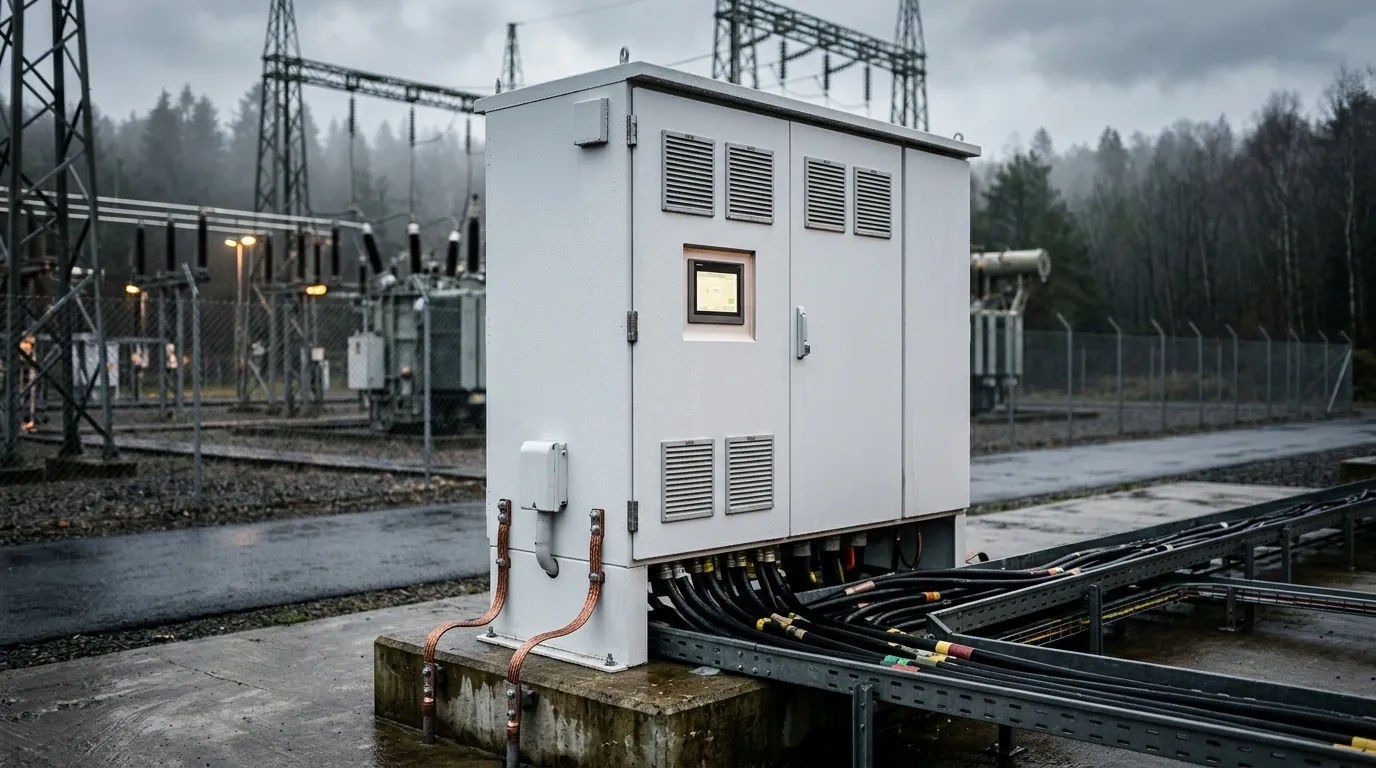
Illustrative rendering, not a photograph of a named project or a customer site. Four-hour symmetric blocks, 30-second activation: the physical asset behind an FCR bid is a cabinet-scale unit like this one, held at partial state of charge for most of its life.
#2 Germany: 562 MW of FCR on a Joint Platform
Germany's FCR requirement has sat in the 550–600 MW range for years — 562 MW in the reference year most aggregators still quote — and it is procured by the four German transmission system operators through regelleistung.net, the joint auction platform they share. Because Germany is inside the FCR Cooperation, a German bid competes against Austrian, Swiss, Dutch, French, Danish, Slovenian and Czech offers, subject to the German core share and export limit.
For a battery developer, Germany's FCR market is the most liquid entry point in Europe and also the most crowded. The product is technically undemanding — a symmetric block with 30-second full activation, energy throughput low enough that cycle life is not the binding constraint — which means the competition is almost entirely on price. The German FCR price has been the reference price for the whole cooperation for a decade, and the Next Kraftwerke explainer on FCR remains the clearest public description of how the national demand translates into the cooperation's common merit order.
One structural detail that catches newcomers: a German project does not "win German FCR". It wins a block inside a cross-border optimisation, and the settlement price it receives may be set by an Austrian or Dutch bid. Revenue models built on a national price series are wrong from the first line.
#3 Germany: aFRR, the Deeper of the Two German Pools
Germany runs a second, larger auction alongside FCR. aFRR is tendered in the same daily rhythm, in four-hour blocks, with positive and negative direction priced separately, and with the energy leg settled on its own market and — since the European platform went live — coordinated across borders through PICASSO.
The economics differ from FCR in the way that matters for storage. Because aFRR pays for energy as well as capacity, a battery earns twice from the same asset: once for standing by, once for delivering. That makes the German aFRR market the natural first target for a new grid-scale system, and it is where most of the German battery fleet's balancing revenue has come from. It is also where the competition has tightened fastest, because a four-hour block is comfortably inside the capability of a two-hour battery.
The mechanics, the prequalification path and the revenue arithmetic are covered in detail in our guide to aFRR battery storage in Germany; the point to carry into this list is that Germany alone offers two structurally different products, and a project sized for one is not automatically right for the other.
#4 Netherlands: 123 MW of FCR and a 1.3 GW Reserve Forecast
TenneT's Dutch control area bought 123 MW of FCR for 2025, a volume calculated from its share of the continental requirement (about 4.1%) and then constrained by the 30% core-share rule — which is why the Dutch core share landed at roughly 37 MW. TenneT re-dimensions the requirement every year and publishes the result openly on TenneT's ancillary services page alongside the FCR dimensioning table, so any single year's figure — including the 2025 one used here — is a snapshot, not a standing number.
The bigger Dutch pool is the frequency restoration reserve. TenneT publishes an FRR forecast of 1,304 MW for both halves of 2025, covering aFRR and mFRR together, and recalculates the requirement every half year before procuring it in daily auctions. That recalculation is the feature to watch: a market that re-dimensions twice a year can shrink, and a project underwritten on today's volume can find itself bidding into a smaller pool twelve months later.
The Netherlands is also unusual in how central mFRR is to the battery case. Where German and Belgian batteries concentrate on FCR and aFRR, Dutch projects have made manual reserve a genuine revenue line — a difference we examine in the mFRR battery storage Netherlands analysis.
#5 Belgium: 86 MW, With 30% Reserved for Domestic Units
Elia's Belgian control area is the smallest pool in this list: 86 MW of FCR required for 2025, down from 93 MW in 2024, with a core share of 26 MW (28 MW in 2024). Elia publishes both numbers, plus the dynamic FRR needs, on its capacity volumes and needs page — a rare case of a TSO presenting requirement and constraint side by side.
Eighty-six megawatts is a thin market, and the core share makes it thinner still for anyone outside Belgium: roughly a third of the requirement is effectively reserved for units connected in the Belgian LFC block. For a developer, that arithmetic defines the strategy. A Belgian project is not competing for 86 MW; it is competing for something closer to the 60 MW that remains contestable, against a domestic fleet that already knows the prequalification route.
Belgium's value in this list is as a calibration case. If a market of this size still attracts battery investment — and it does, largely on the strength of the country's capacity mechanism and its co-located FCR revenue — then the constraint on European frequency regulation projects is not volume. It is the cost of prequalification relative to the megawatts you can actually sell.
#6 Nordics: 600 MW of FCR-N and an FCR-D Built on the Reference Incident
The Nordic synchronous area splits FCR into two products with different logic. FCR-N covers normal operation and keeps the frequency inside a ±100 mHz band; its volume is at least 600 MW for the synchronous system, distributed among Statnett, Svenska kraftnät, Fingrid and Energinet. FCR-D covers disturbances and is dimensioned not on a fixed annual volume but on the reference incident — the largest single outage the system must survive.
The frequency bands are where procurement meets engineering. FCR-N operates between 49.9 and 50.1 Hz; FCR-D upward between 49.9 and 49.5 Hz, downward between 50.1 and 50.5 Hz. Providers must deliver a response that follows the deviation linearly, and the Nordic technical requirements for FCR provision put a hard ceiling on concentration: a single point of failure may not carry more than 70 MW of FCR-N or FCR-D in either direction, and 100 MW when both products are provided together.
That ceiling is a design instruction, not a footnote. A 100 MW battery in Norway cannot sell all of its capacity as FCR from one grid connection point; the portfolio has to be split across connection points, or the extra capacity has to earn somewhere else. The Nordic dimensioning methodology explains why: the products are sized against system events, and a single large provider becoming the system's answer to its own reference incident is a risk the operators will not accept.
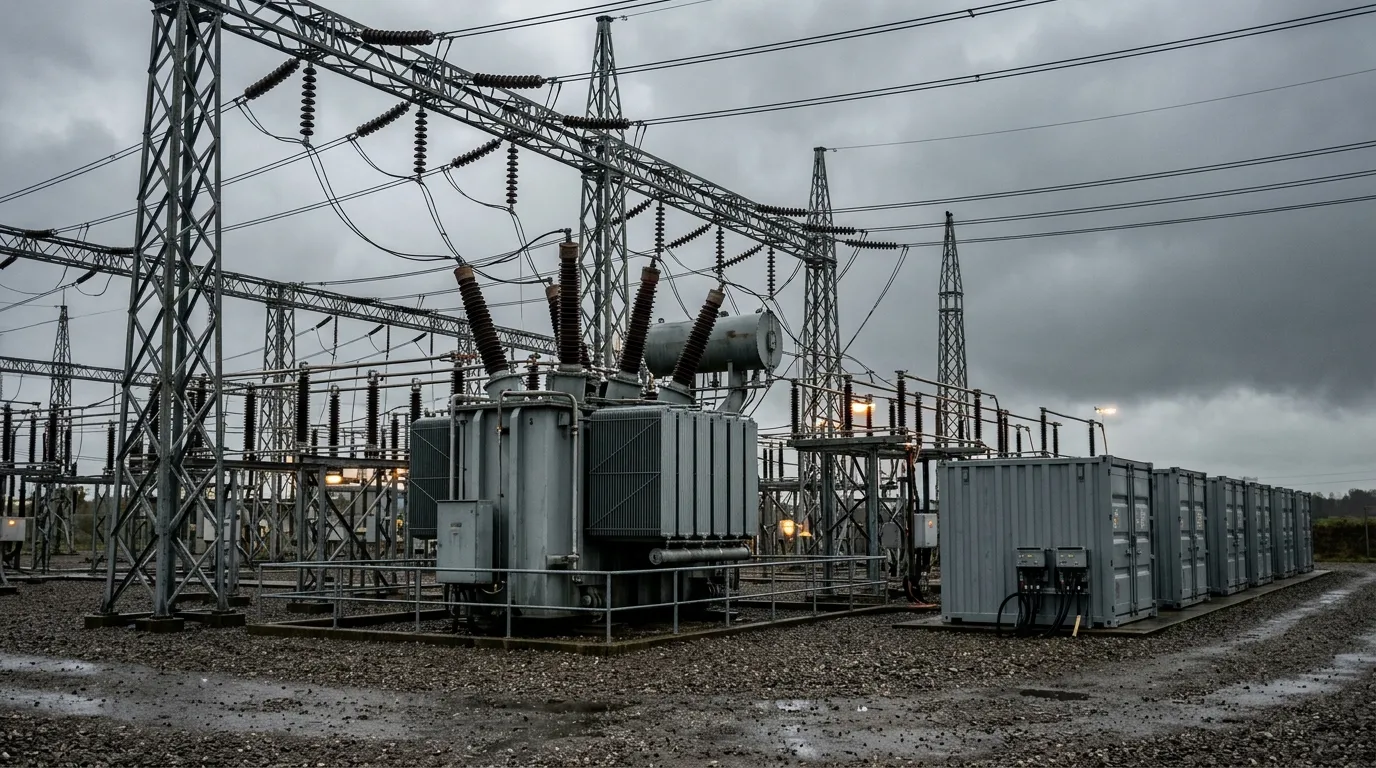
Illustrative rendering, not a photograph of a named project or a customer site. A Nordic ceiling of 70 MW per single point of failure turns the connection point — not the battery — into the unit of project design.
#7 United Kingdom: Dynamic Containment, Procured in One-Second Blocks
Britain left the FCR model behind and built something tighter. Dynamic Containment is NESO's post-fault service: it must begin delivering within 0.5 seconds of a frequency change and reach full delivery within one second, holding that delivery for 15 minutes on an energy-limited asset. NESO states an enduring requirement of at least 1 GW across the high and low frequency services, procured separately, in four-hour EFA blocks, with payment for availability only — and it is open to energy-limited assets such as batteries provided they follow the state-of-energy rules.
The service definition in NESO's dynamic response provider guidance is unusually explicit about what a battery has to do: a minimum of 1 MW and a maximum of 100 MW of response per unit, aggregation allowed when units sit behind the same GSP group, an operational baseline notified ahead of real time, and a fifteen-minute delivery obligation for energy-limited assets. That last clause is the sizing constraint in disguise — a one-second service with a fifteen-minute obligation is not a power product, it is a power-and-energy product with a very specific ratio, and at 50 MW those fifteen minutes come to 12.5 MWh of usable energy.
Dynamic Containment is the clearest example in Europe of a market designed around what batteries can do rather than adapted from what thermal plants already did. It is also the fastest: one second to full delivery is roughly thirty times quicker than FCR's 30-second requirement, and it changes what counts as a good inverter. The dynamic containment battery UK analysis covers the procurement history and the price path.
#8 United Kingdom: Dynamic Moderation and Dynamic Regulation
NESO runs two further dynamic services alongside Dynamic Containment, and the three form a stack rather than alternatives. Dynamic Moderation acts pre-fault on small deviations, between ±0.015 Hz and 0.2 Hz, initiating within 0.5 seconds and reaching full delivery within one second, with a 30-minute delivery obligation. Dynamic Regulation is the slower pre-fault service: initiation within 2 seconds, full delivery within 10 seconds, 60 minutes of sustained delivery.
The same NESO service specification sets out all three, including the shared rules that make the stack work: separate procurement for high and low frequency, 1 MW minimum per response unit, 100 MW maximum, four-hour EFA blocks, availability-only payment, and a deadband of ±0.015 Hz where no delivery is required. The older Dynamic Firm Frequency Response product has been phased out in favour of this suite.
For a developer, the stack is the argument for building more energy behind the same inverter. A single battery can sell containment, moderation and regulation across different blocks of the day, provided its state-of-energy management is good enough to keep all three commitments without breaching the recovery rules. That is a software problem more than a hardware one, and it is where most British projects differentiate.
#9 Ireland: DS3 and a Two-Second Fast Frequency Response
Ireland built its own architecture, and it is the most battery-friendly in Europe by design. The DS3 programme replaced a system-services regime that had been designed for synchronous generation with one that pays for the specific capabilities a low-inertia grid needs — fast frequency response, inertial response, ramping margin, reactive power — and batteries qualify for several of them at once.
Fast Frequency Response is the headline product: a response delivered within two seconds of a frequency event, following the trajectory the operators specify. The DS3 system services protocol defines that required response trajectory and, for energy storage, the recharge limitations that must be agreed with the transmission operators — the clause that turns a battery from a generator into a managed energy buffer.
Volumes are contracted rather than auctioned daily. In the Gate 8 regulated arrangements, the total contracted volume for Fast Frequency Response in the Ireland jurisdiction was 1,104 MW, against 1,753 MW for secondary operating reserve and 2,145 MW for tertiary operating reserve (the TOR2 lot; TOR1, procured as a separate lot, adds 2,016 MW), as EirGrid's Gate 8 procurement summary records. Those are contracted capabilities across the whole portfolio, not the real-time requirement, and reading them as market size is the most common error made about Ireland.
#10 Poland: 197 MW of FCR and 400–500 MW of aFRR After the 2024 Reform
Poland is the newest of the ten, and the fastest-moving. PSE separated the balance-responsible party and balancing-service-provider roles in June 2024, which is what allowed batteries to participate directly rather than only through a supplier, and joined the PICASSO platform for aFRR energy exchange in July 2025, as PSE's Article 60 balancing report records. The result is a market that went from structurally closed to fully European in thirteen months.
The volumes are still small. FCR sits at 171 MW and rises to 197 MW in January 2026; aFRR runs at around 400 to 500 MW in each direction, per Modo Energy's analysis of the Polish aFRR market. Capacity is bought in a day-ahead auction settled pay-as-cleared at the marginal accepted offer, and the energy leg clears through PICASSO at the European marginal price.
Poland is the clearest illustration of why response speed is a commercial asset rather than an engineering preference. A battery that reaches full output in well under a second can hold both an FCR block and an aFRR block, and can move between them as prices diverge — which is precisely the capability described in our note on sub-20 ms response in battery storage.
What These Ten Europe Frequency Regulation Projects Have in Common
Three patterns hold across all ten, and they matter more than any single entry.
The first is that the product is almost always four hours long. FCR in the cooperation, aFRR in Germany, Dynamic Containment in Britain, aFRR in Poland — the auction unit is a four-hour block, sometimes six or twelve of them per day. A battery that can only sustain full output for thirty minutes is not competing for the same blocks as one that can hold two hours, and the difference shows up in how many blocks per day a unit can stack.
The second is that every market has a concentration rule. Core shares in the FCR Cooperation, a 70 MW ceiling per single point of failure in the Nordics, a 100 MW cap per response unit in Britain, recharge limitations in Ireland. These rules exist to stop any one provider from becoming a single point of failure for the system, and they cap the value of scale: past a certain size, a project has to be split into separately prequalified units rather than enlarged.
The third is that all of them are shallow relative to the battery fleet arriving. Belgium at 86 MW, Poland at 197 MW, the Netherlands at 123 MW of FCR — a single 100 MW project can move the clearing price in any of them. The revenue consequence is examined in our walkthrough of frequency regulation revenue stacking, and the short version is that frequency regulation alone rarely underwrites a project in 2026. It contributes a floor.
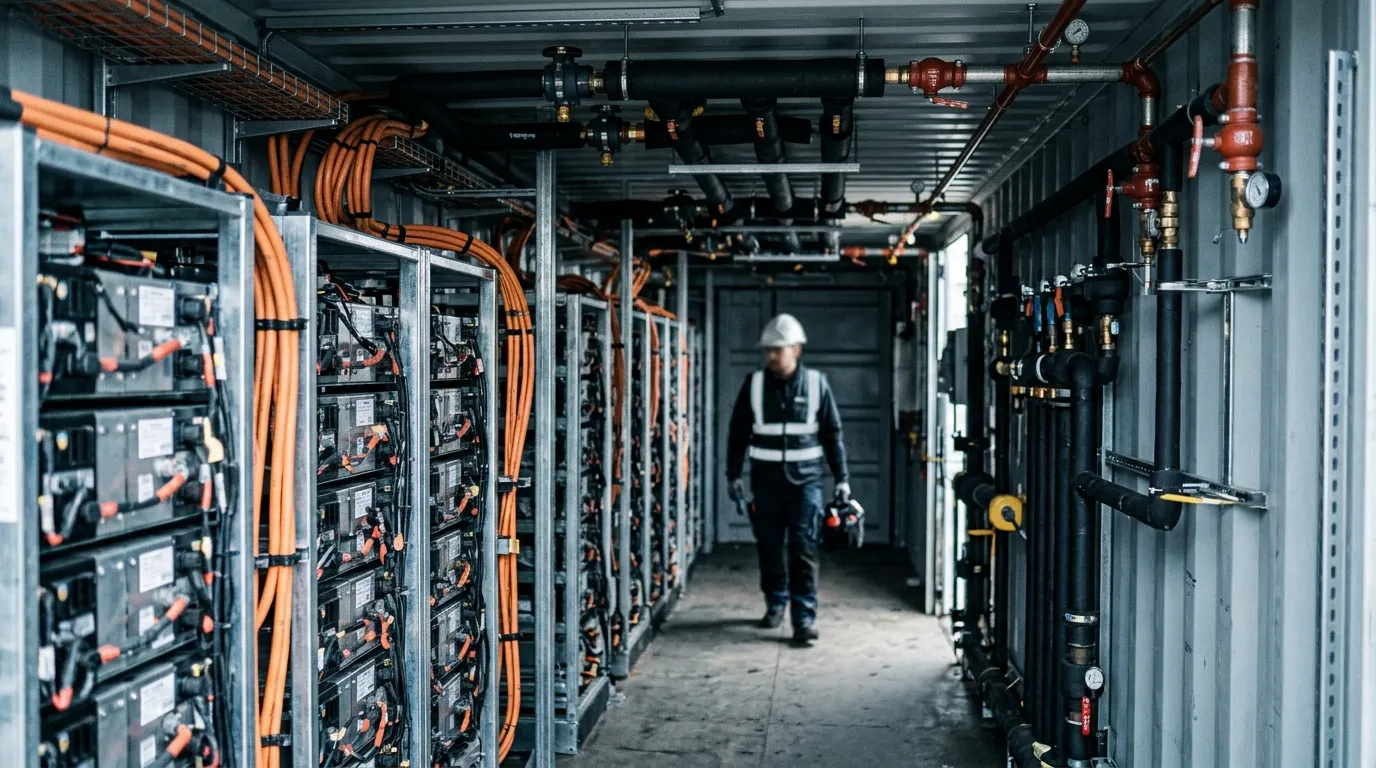
Illustrative rendering, not a photograph of a named project or a customer site. Concentration rules cap how much of a container's output can be sold from one connection point — which is why portfolios are split, not enlarged.
Sizing a Battery for European Frequency Regulation
Four parameters decide whether a system can serve these markets, and they interact.
Power-to-energy ratio. A 15-minute delivery obligation at full power, which is what Dynamic Containment requires of an energy-limited asset, sets a hard floor of 0.25 MWh per MW of contracted response. A 30-minute obligation doubles it. Systems built for FCR alone can run leaner, but then they cannot enter the markets that pay for energy as well as capacity.
C-rate and continuous rating. Frequency regulation is a partial-state-of-charge duty cycle with frequent small movements and occasional full-output events. The relevant number is not peak C-rate but continuous bidirectional capability at the state of charge the asset actually holds. Our guide to battery C-rate selection covers how that requirement propagates into cell and module choice.
State-of-charge management. Every one of these markets requires the unit to keep a reserve of energy in both directions. The lower the usable SoC band, the smaller the sellable megawatt — a 2 MWh battery managed between 20% and 80% SoC offers 1.2 MWh of symmetric capability, not 2 MWh. Aggregators model this explicitly; developers who do not tend to overbid the first month and underdeliver the second.
Control and telemetry. Setpoint tracking, sub-second measurement, and a communications path the operator will accept during prequalification. For grid-scale projects this is where the equipment choice becomes visible: a containerised system with an integrated EMS and a documented Modbus or IEC 61850 interface is easier to prequalify than a set of cabinets assembled on site with a third-party controller. Hua Power builds grid-scale cabinets and 20-foot containers for exactly this duty — the 1 MW / 2.089 MWh container is one example of the ratio these markets reward — but the specification work comes first, and it should be written before any supplier is shortlisted.
Prequalification and Procurement: What to Ask Before You Bid
Prequalification is the real gate, and it is per product, per connection point, per country. A unit qualified for FCR is not qualified for aFRR. A unit qualified in Germany is not qualified in the Netherlands.
The evidence a transmission operator will ask for is consistent across markets even where the paperwork is not: a test or simulation demonstrating the required response trajectory, proof of sustained delivery for the full product duration, a state-of-energy or recharge strategy, a communications interface the control room can use, and a redundancy arrangement so that a single failure does not remove the contracted volume. In the Nordics the last item is quantified — 70 MW per single point of failure. In Britain it appears as the aggregation rules and the state-of-energy compliance requirement.
Four questions are worth settling before the first bid, because each one changes the system design rather than the paperwork. Which product, in which direction? How long must full output be sustained? What happens to the contracted volume when the asset is at the edge of its energy band? And who is the counterparty — the operator directly, or an aggregator holding the balancing-service-provider contract?
Our frequency regulation RFP template turns those questions into a document a procurement team can issue. It is written for the buyer's side of the table, which is where most of the avoidable cost in these projects originates. If what you need instead is the commercial scope of a grid-frequency application rather than a document, the grid frequency regulation solution page sets out what a delivered system includes.
Where These Numbers Come From
All volumes in this article are procurement requirements or contracted capabilities as published by the operator named in each entry, and each carries the year it applies to. Where a figure is a forecast — TenneT's 1,304 MW FRR — it is labelled as one. Where a figure is a contracted total rather than a real-time requirement — Ireland's 1,104 MW of Fast Frequency Response — it is labelled as one.
Two limitations should be stated plainly. The German aFRR requirement is not published as a single national number; it is set per LFC block and tendered in blocks, so no single figure is quoted here. And the German FCR figure of 562 MW is taken from an aggregator's reference table rather than a TSO statement, because the four German operators publish demand through the joint auction platform instead.
Markets in this list are re-dimensioned annually or half-yearly. Any figure here should be re-checked against the operator's page before it goes into an investment case — which is why every entry links to that page rather than to a summary of it.