

aFRR (automatic Frequency Restoration Reserve, Sekundärregelleistung in German) is Germany's largest ancillary service market: roughly 2,000 MW procured per direction, several times the depth of the FCR market, and the biggest single revenue pool for grid-scale battery storage in the country. Batteries have flooded into it — prequalified battery capacity grew from about 0.33 GW to 1.2 GW per direction between early 2024 and early 2026 — yet the market still has more headroom than its saturated sibling. This guide explains how the market works, what it pays, what it takes to qualify, and how developers, EPCs, and BESS suppliers should approach it in 2026.
Why aFRR Is Germany's Biggest Battery Storage Market
Every balancing market in Germany exists to hold the continental European grid at 50 Hz. When generation and consumption drift apart, the four transmission system operators (TSOs) — 50Hertz, Amprion, TenneT, and TransnetBW — activate reserves in a fixed sequence. FCR stops the frequency deviation within seconds. aFRR then takes over automatically and steers frequency back to 50 Hz, relieving FCR. mFRR handles longer imbalances. Of the three, aFRR is the largest by volume and by TSO spend, which makes it the natural entry point for battery storage.
The numbers explain why. Germany procures roughly 1.9 GW of aFRR per direction, compared with only about 550 MW of FCR. The market is also three times deeper in money terms, because aFRR pays two ways: a capacity price for being available and an energy price for every megawatt-hour actually delivered.
Batteries are the ideal technology for this job. They respond in milliseconds, far inside the 30-second response window; they are bidirectional, so one system can sell positive and negative aFRR; and they follow setpoint signals with precision that thermal plants cannot match. That is why prequalified battery capacity in aFRR more than tripled between early 2024 and early 2026, from about 0.33 GW to roughly 1.2 GW per direction, according to the ISEA Battery Revenue Index data reported by pv magazine. Demand of about 1.9 GW per direction still leaves room — unlike FCR, where prequalified battery capacity (about 1.35 GW) now exceeds the requirement (0.53–0.56 GW per product) by more than two to one.
The window is closing, though. Every new grid-scale BESS that enters the market competes for the same fixed procurement volume, and capacity prices are already under pressure. The opportunity in 2026 is not the easy revenue of 2022 — it is a structural one: participate properly, stack revenues across markets, and size the system so it can earn in aFRR today and elsewhere tomorrow.
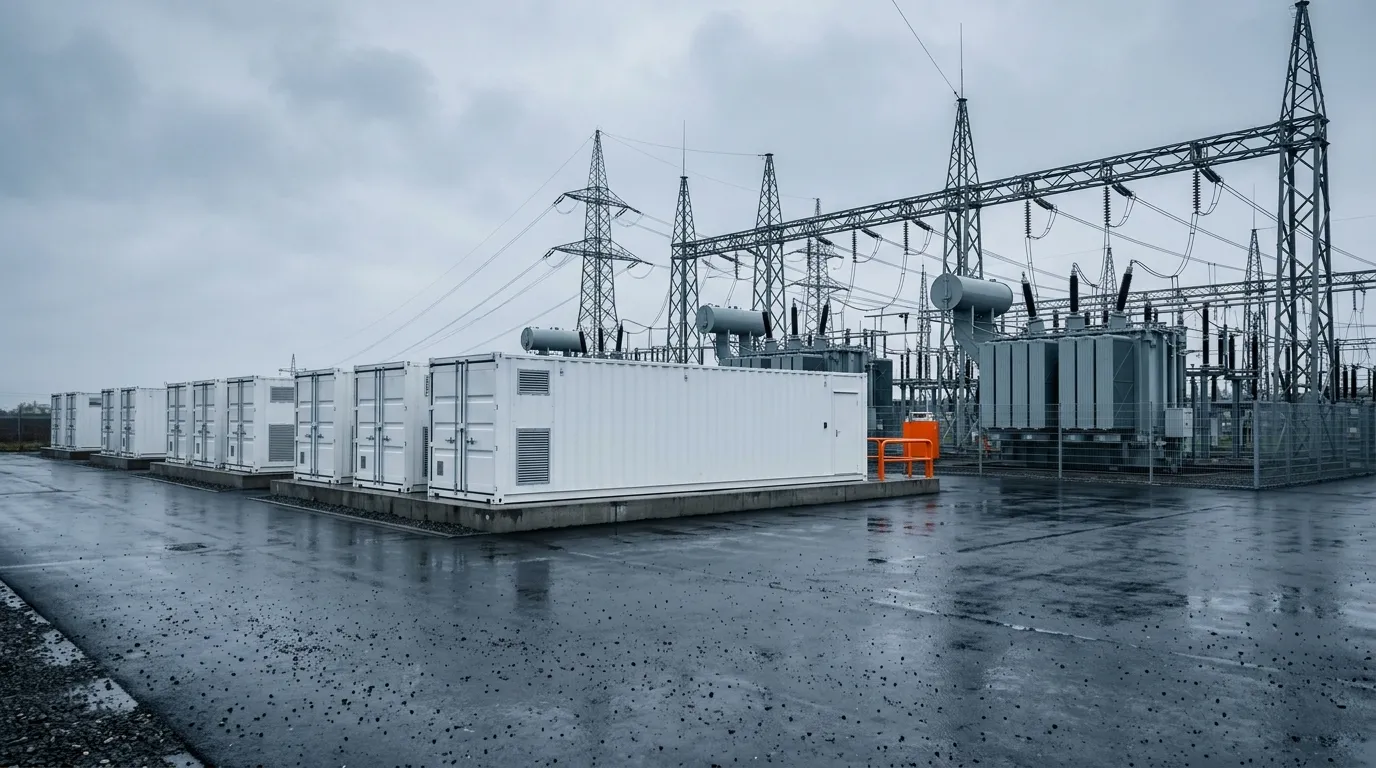
Utility-scale BESS containers sit directly behind the substation fence — the physical reality behind the aFRR revenue numbers.
How the German aFRR Market Works
The German aFRR market is really two coupled markets running on one platform. The four TSOs procure balancing capacity and balancing energy through the joint auction platform regelleistung.net, under rules set by the Bundesnetzagentur and the EU Electricity Balancing Guideline.
The capacity market (Leistungsmarkt). Every day, day-ahead, the TSOs auction aFRR capacity in six four-hour time slices. Positive and negative direction are tendered and priced separately, so each day holds twelve products. Bids must be at least 1 MW — a threshold lowered from 5 MW in July 2018 — and smaller units can pool through an aggregator to reach it. The capacity price (Leistungspreis) is settled pay-as-bid: winners receive exactly the price they bid, and bids are ranked in a common merit order list (MOL) from cheapest to most expensive until the requirement is covered. The Next Kraftwerke explainer on Sekundärreserve and Amprion's balancing market page both describe this auction design in detail.
The energy market (Arbeitsmarkt). Since November 2020, balancing energy for aFRR has been traded separately on the Regelarbeitsmarkt, fully decoupled from the capacity market. Winning capacity is no longer a precondition for bidding energy — operators can place "free bids" right up to the energy auction's gate closure. The energy price (Arbeitspreis) has been settled pay-as-cleared since summer 2022, and since June 2022 activations have been coordinated cross-border on the European PICASSO platform, which optimises aFRR dispatch across countries against a common merit order. For a battery operator this decoupling is a gift: a system that loses the capacity auction can still earn in the energy market, and one that wins capacity can choose when to deliver energy versus trade on the spot market.
Activation and delivery. When frequency deviates, the TSO's load-frequency controller sends setpoint signals to contracted units automatically. An aFRR unit must show a response within 30 seconds and reach full activation within five minutes — the EU-mandated full activation time — and it must be able to sustain the contracted power for the entire four-hour product length, as 50Hertz spells out in its reserve-type specifications. Units communicate with the TSO control room in real time and are dispatched against their energy-price bids in the merit order.
This is the core of our guide to grid frequency regulation with battery storage — the same market family that includes FCR and mFRR, which we look at next.
aFRR vs FCR vs mFRR: Where the Money Flows
The three balancing products form a chain, not a menu. FCR stops the deviation, aFRR restores the frequency, mFRR relieves both in prolonged events. For battery storage the practical differences are what matter.
Dimension | FCR (Primärregelleistung) | aFRR (Sekundärregelleistung) | mFRR (Minutenreserve) |
|---|---|---|---|
Full activation | ≤ 30 s | ≤ 5 min (EU-mandated) | 12.5–15 min |
Activation | Automatic, frequency-proportional, decentral | Automatic, TSO setpoint signal | Manual / scheduled by TSO |
Product structure | Symmetric, one direction | Positive and negative, separate | Positive and negative, separate |
German market depth | ~550–600 MW | ~1.9 GW per direction | ~2.4 GW total |
Capacity price | Pay-as-cleared | Pay-as-bid (MOL) | Pay-as-bid |
Energy price | None (capacity only) | Pay-as-cleared via PICASSO | Pay-as-cleared via MARI |
Battery suitability | Excellent, mild cycling | Excellent, real energy delivery | Rarely used by batteries |
EU cooperation platform | FCR Cooperation | PICASSO | MARI |
Saturation risk 2026 | High — battery supply > 2× demand | Moderate, but rising | Low for batteries |
The revenue logic differs fundamentally. FCR pays only for availability — activation is mostly micro-cycling with negligible energy throughput, so it is gentle on cells. aFRR pays for availability and for energy actually delivered; the cycles are real and the energy management matters. mFRR, with its 12.5–15-minute activation and manual dispatch, is rarely economic for batteries in Germany, which is why most storage investors ignore it — although across the border, the Dutch market has made mFRR a meaningful battery revenue stream, which we cover in our analysis of mFRR battery storage in the Netherlands.
For a developer deciding where to start, the practical answer in 2026 is aFRR. FCR is technically the easiest entry but structurally full: battery supply alone is more than double the German requirement, and prices have trended down for years as a result. aFRR still has depth, pays two revenue streams, and is connected to the European platform that keeps the energy market liquid. The European framework that governs all of this — including PICASSO and the cross-border activation rules — is defined in the ENTSO-E Electricity Balancing Guideline.
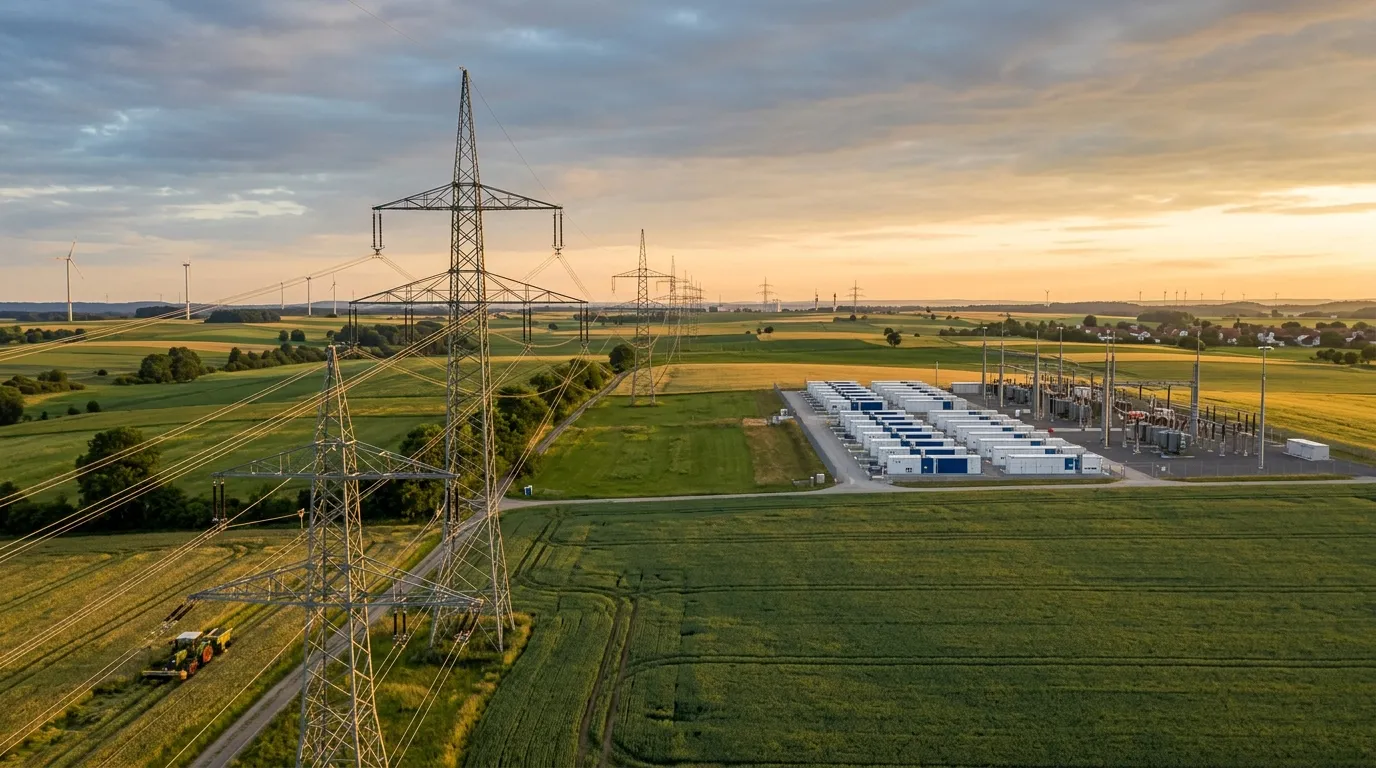
FCR stops the deviation, aFRR restores the frequency — all of it moving over the transmission infrastructure pictured here.
What It Takes to Qualify: Prequalification for BESS
You cannot bid on regelleistung.net without prequalification (Präqualifikation). It is a technical suitability certificate, obtained per product — FCR, aFRR positive, and aFRR negative are separate processes — at the TSO responsible for the unit's connection zone. The detailed conditions are defined in Annex D2 of the German TSOs' Transmission Code 2007. The process runs through the TSOs' central PQ portal and typically looks like this:
- Application. Register the technical unit with its master data, connection situation, and the products you want to offer.
- Technical proof. The unit performs a defined activation test — the "double-hump" profile with holding and delivery phases — demonstrating response time, control quality, and sustained delivery.
- BESS-specific evidence. For storage, the TSO needs proof of state-of-charge (SoC) management that guarantees deliverability: the system must be able to hold its contracted power for the full four-hour product length, which means the energy management system has to reserve headroom and rebalance the SoC band. For FCR, units with limited energy reservoirs must additionally satisfy the 15-minute criterion.
- IT integration. Real-time communication with the TSO control room (Leitwarte), including setpoint processing on a seconds grid for aFRR.
- Rahmenvertrag. Once the tests pass, the operator signs a framework agreement with the TSO. Only then can bids be placed.
Two details surprise most first-time entrants. First, redundancy is mandatory: if a called unit fails to deliver, the operator must substitute from another unit — the TSOs call it the "reserve of the reserve" — and repeated non-delivery can draw penalties up to exclusion from the market. Second, the timeline: prequalification realistically takes weeks to months, so it belongs in the project schedule from day one, not as an afterthought.
Most investors never touch this process directly. Aggregators such as Next Kraftwerke, Entrix, and a dozen others run the PQ process and pool small units into the 1 MW minimum. The trade-off is commercial: the aggregator takes a revenue share or a fixed fee, and contract terms — floors, notice periods, freedom to switch markets — decide how much of the market revenue actually reaches the asset owner.
Prequalification also interacts with hardware choices. A system's C-rate, energy-to-power ratio, and EMS quality determine whether it can pass the tests and keep passing them under real dispatch, which is why we treat C-rate selection for battery storage as a market-entry decision rather than a technical footnote.
Revenue Reality 2025–2026: Prices, Energy, and the Battery Flood
The 2022 energy-crisis windfalls are gone, and 2025 data shows why conservative modeling is the only defensible approach. The ISEA Battery Revenue Index (RWTH Aachen, developed with Enspired and published via pv magazine in January 2026) models revenue potential for an optimally marketed German storage system with one megawatt of power and two megawatt-hours of capacity, at two cycles per day. Its 2025 findings:
- Cross-market revenue fell 16% — from about €309,000 to €259,000 per MW per year for the 2-hour system (the 1-hour system dropped 17.2%, from €183,000 to €151,000).
- aFRR capacity became the revenue anchor. Single-market aFRR capacity potential rose 39.3% to over €146,000 per MW per year, overtaking FCR as the largest single revenue component.
- aFRR energy collapsed. Single-market energy revenue fell 66.4% — from €227,000 to €76,500 per year — as batteries saturated the energy market's merit order.
- FCR kept sliding. Single-market FCR potential fell 6.9% to about €106,000; within the optimised cross-market schedule, FCR revenue fell by more than 90% and is now barely used.
- Arbitrage moved from intraday to day-ahead. Day-ahead auction potential rose 17.4% to about €91,000, while intraday continuous fell 16%, a shift partly driven by the introduction of 15-minute day-ahead products.
The structural driver behind all of this is supply. Prequalified battery capacity in aFRR grew from about 0.33 GW to roughly 1.2 GW per direction between early 2024 and early 2026, against demand of about 1.9 GW per direction. In FCR, battery supply (≈1.35 GW) is more than double the requirement (0.53–0.56 GW per product). Every additional 100 MW of flexibility entering the market pushes capacity prices down — the effect is measurable, and it compounds as the connection queue clears.
What this means for a 2026 entrant: the capacity price is the dependable leg, the energy price is a volatile bonus, and arbitrage is the flexible leg that fills the gaps. Anyone building a business case on 2022 peak prices, or even on 2024 averages, is modelling a market that no longer exists. The transparent route is to check current activated balancing volumes and prices on the TSOs' transparency platforms, such as Netztransparenz, and to build scenarios, not point estimates. The full ISEA 2025 breakdown is worth reading in the original pv magazine article.
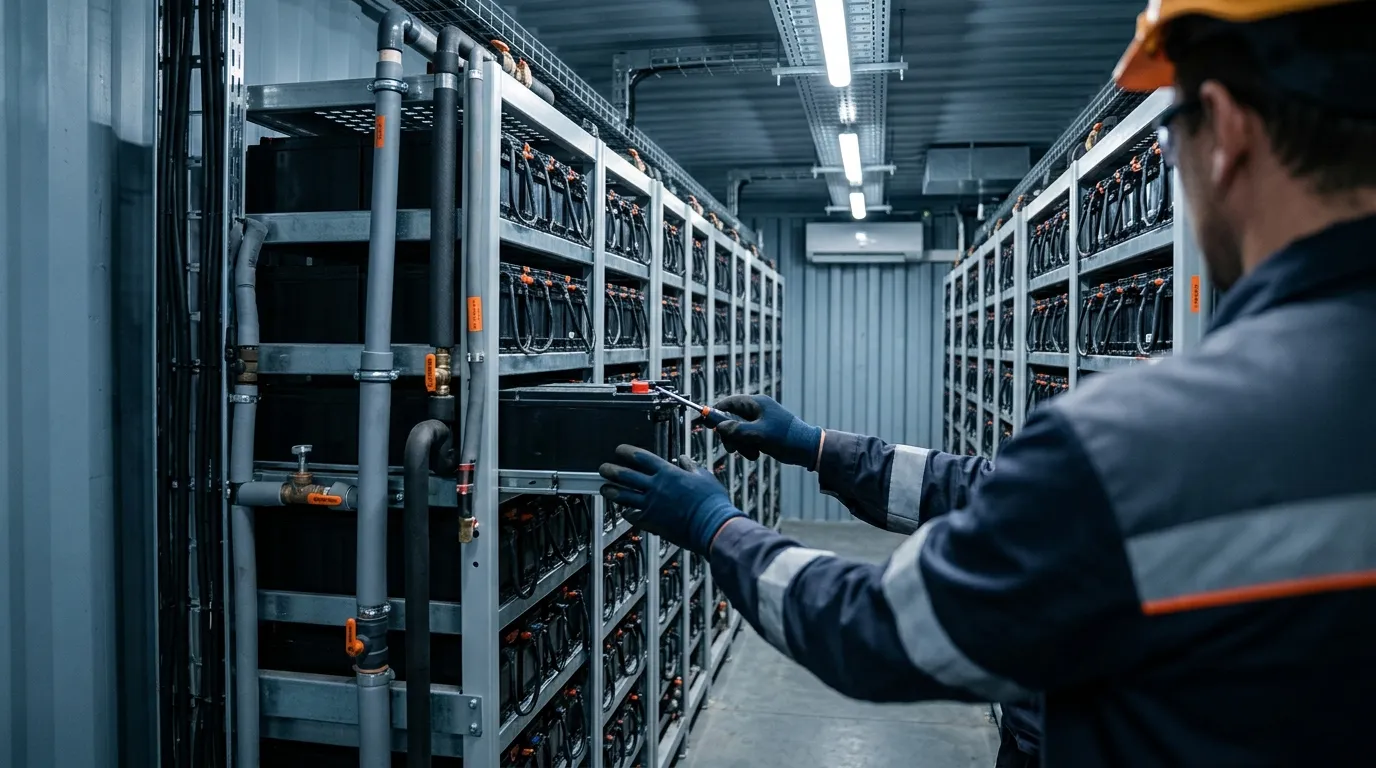
The equipment that earns these revenues: liquid-cooled racks sized for sustained four-hour aFRR delivery, not just short bursts.
Sizing and Designing a BESS for aFRR Participation
The four-hour product length is the single most important design constraint. A battery that must deliver its contracted power for four hours cannot simply be the cheapest 1C system available; it needs the energy, thermal, and control architecture to sustain delivery, then rebalance.
Practical design guidance:
- Energy-to-power ratio. The 4-hour sustain requirement pushes toward either a larger energy buffer or a disciplined SoC band. Most German utility-scale aFRR players run 1–2 hour systems with an EMS that keeps the state of charge inside a band wide enough to honour both directions. Ratio choice is a revenue-versus-CAPEX trade, not a fixed rule.
- C-rate and response. The 30-second response and 5-minute full activation are easy for any modern PCS — response is measured in milliseconds — but the control quality (how precisely the unit follows the setpoint) is what the prequalification test measures. Precision comes from the PCS and EMS combination, not from the cells.
- SoC management. This is the make-or-break function. The EMS must forecast dispatch, reserve headroom, and rebalance the battery — including using the energy market and spot trades to restore state of charge after deliveries. Systems without an EMS that can do setpoint tracking and SoC rebalancing in one loop will fail the test or bleed revenue.
- Thermal management. aFRR delivers real energy, not micro-cycles. Sustained power in both directions generates heat; liquid-cooled container systems handle the duty cycles better than passive designs and preserve cycle life, which matters when 20%+ of revenue depends on availability.
- Metering and telemetry. The TSO requires certified metering and real-time data links. These are project costs often underestimated in early budgets.
- Grid connection. None of this works without a connection — and German grid connection queues are long. Grid compliance (and the growing list of technical requirements at the connection point) is its own discipline; we cover the requirements in our guide to EU grid connection compliance for BESS.
Containerised battery energy storage systems built for grid services — such as the utility-scale, liquid-cooled containers produced by BESS manufacturers like Hua Power Engineering — are designed around exactly these constraints: sub-second response, bidirectional power, EMS setpoint tracking, and thermal management sized for sustained dispatch. Whether you buy from a manufacturer, an integrator, or a trader, the questions above are the ones that separate a system that passes prequalification from one that spends six months failing it.
Revenue Stacking: aFRR in a Multi-Market Strategy
No serious German storage asset runs on a single market anymore. The six four-hour slices make daily switching possible: a battery can hold aFRR capacity in the slices where capacity prices are strong, trade day-ahead arbitrage in the off-peak slices, and return to FCR when its price recovers. The ISEA data confirms this is not theory — the optimised cross-market schedule shifted capacity away from FCR into aFRR precisely because relative prices moved.
The building blocks:
- aFRR capacity: the dependable base load in the stack — pay-as-bid, paid whether or not you are activated.
- aFRR energy: bonus revenue when dispatched, increasingly volatile as the merit order fills.
- Day-ahead and intraday arbitrage: buy cheap, sell dear. 2025 showed day-ahead spreads strengthening; intraday continuous weakening.
- FCR: gentle on cells and a useful filler, but structurally price-depressed.
- The Regelarbeitsmarkt's free bids: energy bids without capacity — a pure option that costs nothing to keep open.
The aggregator contract decides how much of this the asset owner actually keeps. Floors, revenue-share splits, market-switch freedom, and notice periods belong in any due diligence. A battery that is prequalified for multiple products and free to move between markets captures the stack; one locked into a single market or a restrictive contract is a price taker on a depreciating asset.
The same flexibility logic applies to demand-side resources and hybrid plants: any flexible capacity that can respond to grid signals within minutes can participate in Germany's balancing and flexibility markets. Our overview of demand response with energy storage walks through how that works beyond the frequency markets.
How to Enter the German aFRR Market: A Roadmap
For a developer, EPC, or supplier planning a German grid-scale project, the path looks like this:
- Fix the TSO zone early. The connection point determines which TSO prequalifies the unit. Prequalification is per TSO; know which one you are dealing with from the grid-connection application onward.
- Apply for grid connection immediately. Connection queues are measured in years, not months, and the regulatory framework makes the application the long pole of the whole project. Start it before the market analysis is finished.
- Decide aggregator versus self-marketing. Below ~10–20 MW, an aggregator usually wins on complexity alone; above it, self-marketing with a trading desk becomes viable. Either way, keep multi-market freedom in the contract.
- Prequalify in parallel with construction. Start the PQ application as soon as the system design is frozen — the weeks-to-months timeline does not wait for commissioning.
- Model conservatively, in scenarios. Base case: aFRR capacity at recent VWAP levels, energy revenue at a fraction of 2024 levels, arbitrage at 2025 levels, with downside scenarios that assume further battery entry. If the project survives the downside, it is financeable.
- Plan for revenue drift. Re-check the mix quarterly. The market reprices every day; the assets that keep winning are the ones whose owners re-optimise the stack.
The same market family also works through grid frequency regulation solutions sold as complete packages — the grid frequency regulation solution page on the ihuapower site gives an overview of how containerised BESS is packaged for FCR and aFRR duty. Whether you plan to build, buy, or supply, the sequence above is the one that survives contact with the actual market.
The aFRR Opportunity in One Page
Germany's aFRR market is the deepest balancing market in Europe for battery storage, and it is still the best entry point for storage in Germany — but only for participants who treat it as a competitive, repricing market rather than a fixed revenue stream. The essentials: two coupled markets (capacity pay-as-bid, energy pay-as-cleared via PICASSO), daily four-hour products in both directions, prequalification at the connecting TSO, and 2025 revenue reality where aFRR capacity is the anchor, energy is volatile, and arbitrage fills the gaps. Prequalified battery capacity is closing on demand, so the window for comfortable margins is finite.
That is why the operational playbook matters more than the market guide: size for the four-hour product, invest in SoC management and thermal control, keep multi-market freedom, and model conservatively. If your project economics hold under a downside scenario, the market will do the rest — and if you are supplying the systems, the same parameters are what your customers will ask for first.
Ready to look at hardware? The energy storage container range is a starting point for grid-service-capable systems, and our team can discuss configuration, prequalification support, and delivery timelines for German and European projects.