

Battery storage operators in the Netherlands have a new revenue line to evaluate this year: mFRR, the manual frequency restoration reserve that TenneT calls up when automatic balancing runs out. Aggregators advertise capacity payments of €1,200–2,400 per MW per month, yet the information needed to judge the opportunity is scattered across TSO documents, Dutch-language sales pages and statistics tables. This guide assembles the full chain in English: what mFRR is, how the Dutch market works, what a battery must deliver, what it pays, what it costs, and how to decide whether to take part.
mFRR (Manual Frequency Restoration Reserve) is a balancing product that the transmission system operator activates manually to restore grid frequency after large or sustained imbalances. In the Netherlands, TenneT activates it directly — hence the term mFRRda — when the automatic reserve cannot cover the deviation on its own. For a battery, participation means committing capacity in exchange for a monthly payment and being ready to ramp within 15 minutes.
What is mFRR and where does it sit in the reserve stack?
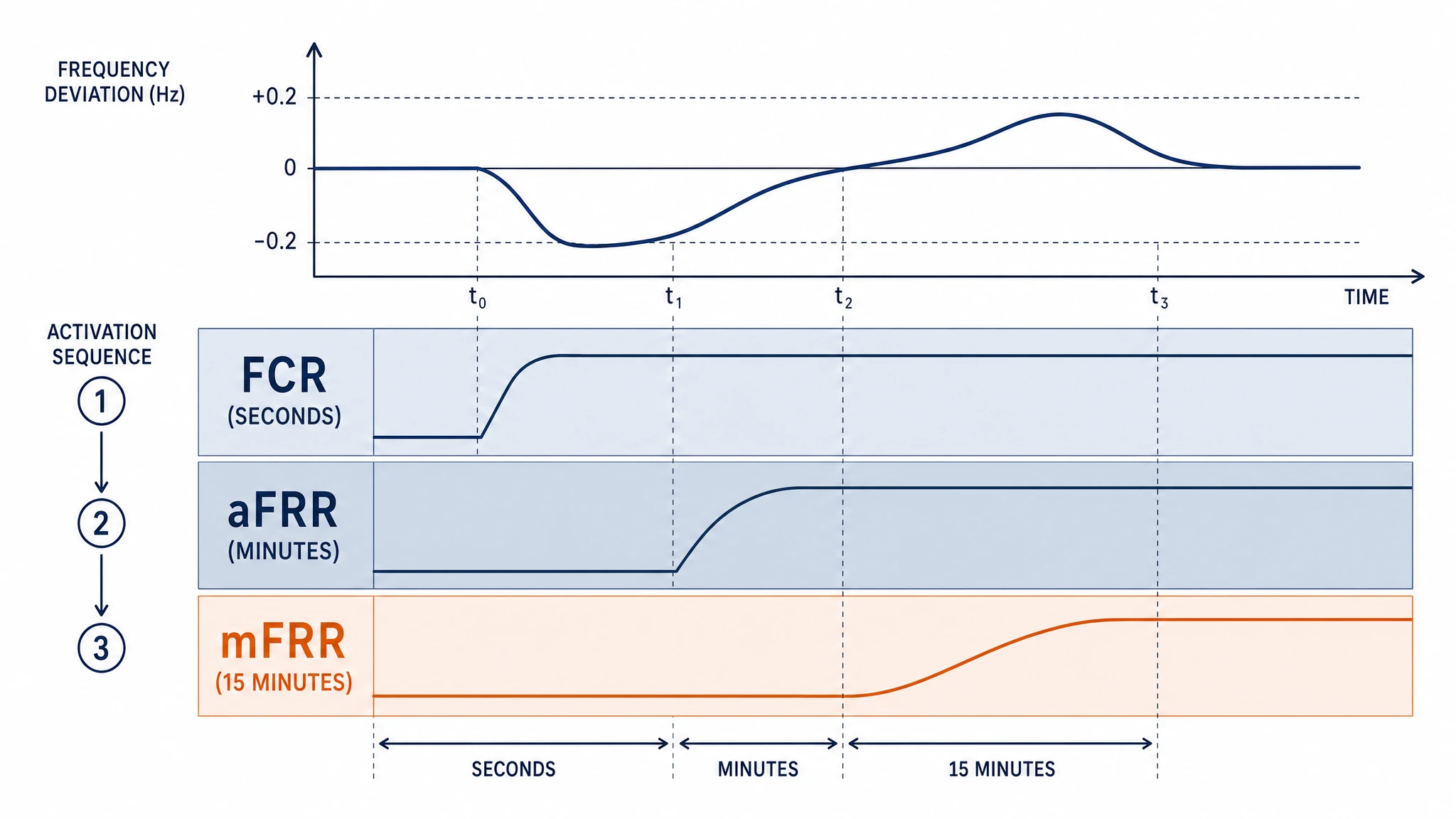
European grids hold 50 Hz by stacking three reserve layers with different speeds and activation logic:
- FCR (Frequency Containment Reserve) stabilises frequency automatically within seconds. It is the first line of defence and the least profitable for batteries per MW of committed capacity.
- aFRR (Automatic Frequency Restoration Reserve) restores frequency automatically over a few minutes via the European PICASSO platform. It is the workhorse product for many Dutch battery projects and consumes the most cycles.
- mFRR (Manual Frequency Restoration Reserve) is the manual layer. TenneT activates it within 10–15 minutes for large or long-lasting deviations that automatic reserves cannot absorb, and it is dispatched in two directions — mFRR UP (increase output) and mFRR DN (reduce output or charge). TenneT describes it as the reserve used in incidents and substantial sustained power deviations, on top of normal balancing.
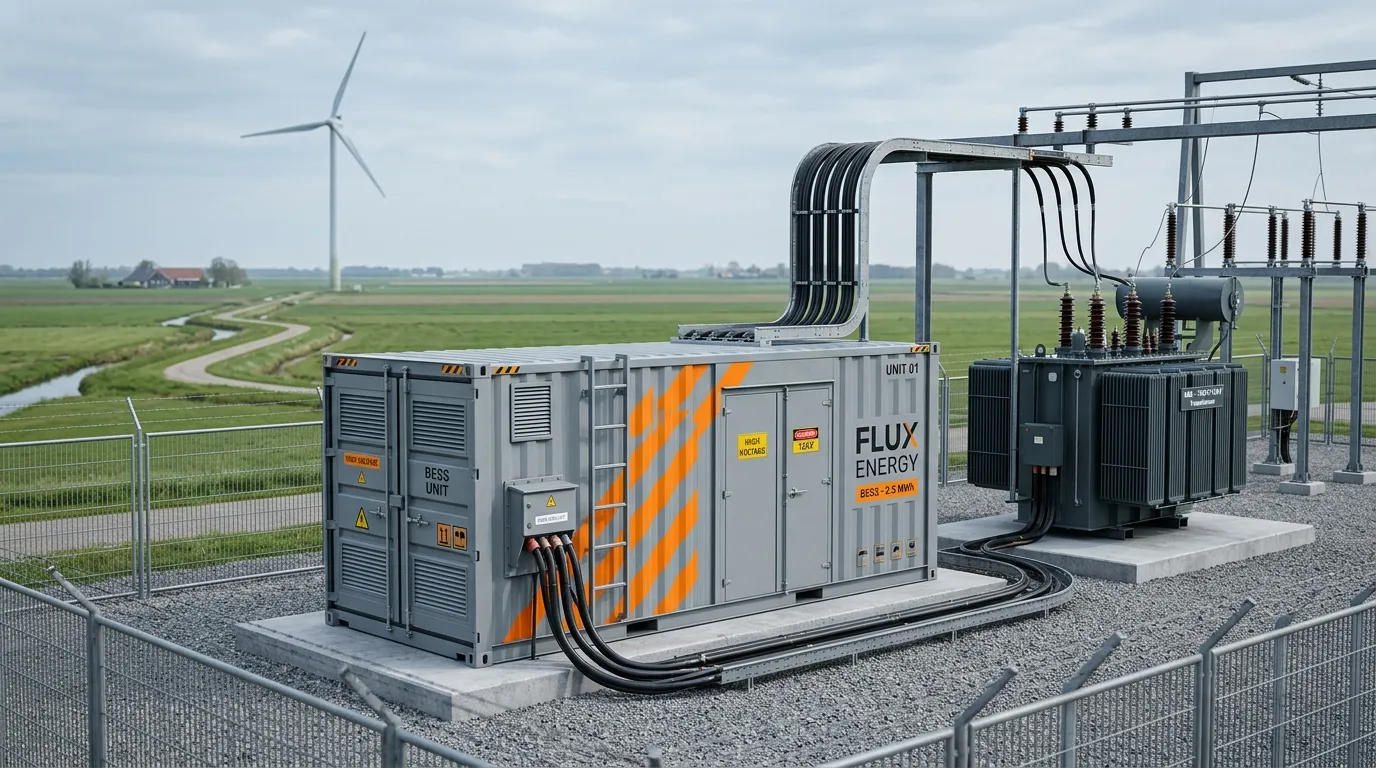
A battery fits this product naturally: it can ramp from zero to full output in seconds, hold it for the required window, and switch between UP and DN behaviour within the same contract. What TenneT needs from mFRR — fast, schedulable, reversible capacity — is almost exactly what a grid-scale battery delivers. That is why the mFRR question for asset owners is rarely "can my system do this" and almost always "is this the best use of it".
How the Dutch mFRR market works: TenneT, mFRRda and the road to MARI
TenneT is both the Dutch transmission system operator and the operator of the balancing market. Balancing Service Providers (BSPs) — often aggregators pooling hundreds of small assets — bid reserve capacity into TenneT's procurement, and bids are ranked by merit order: cheapest first, regardless of who offers it. When a deviation occurs, TenneT activates the winning bids until balance is restored.
Two institutional details matter for anyone modelling Dutch mFRR today:
Direct activation (mFRRda) is the Dutch norm. TenneT can activate mFRR directly by dispatching contracted bids, rather than waiting for balance-responsible parties to fix their own positions. The full set of rules, contract terms and product specifications lives in TenneT's mFRRda document package — the authoritative reference if you need the exact prequalification and settlement logic.
Europe is merging the market through MARI. The Manually Activated Reserves Initiative is ENTSO-E's platform for exchanging and activating mFRR across borders, in line with the EU balancing guideline. Since its go-live, European mFRR products have been moving toward a shared activation mechanism, which means Dutch mFRR prices are increasingly coupled with neighbouring balancing areas — a German or Belgian imbalance can now set the price TenneT pays for Dutch mFRR capacity. For a battery owner this cuts both ways: a deeper, more liquid market, but also more volatile revenue expectations than the old purely national market.
Can my battery participate? Requirements and the aggregator route
The participation requirements are modest for a grid-scale system, and deliberately so — TenneT wants more liquidity, not less:
- Minimum bid size: 1 MW per product and direction. Most commercial battery containers meet this on their own; anything smaller joins via an aggregator.
- Activation time: within 10–15 minutes. A battery dispatches essentially instantly, which makes prequalification straightforward compared with thermal assets.
- Prequalification: your BSP must prove the asset can deliver the contracted product, including metering and telemetry requirements.
- Balance responsibility: every connection point needs a Balance Responsible Party (BRP); the aggregator usually handles this as part of its service.
If your system is below 1 MW — or you simply do not want to run a trading desk — the aggregator route is the standard entry point. Aggregators pool small assets into bids, take care of prequalification, metering and settlement, and pay you a share of the revenue. The trade-off is a margin on every euro earned, plus contract terms that you should read as carefully as the revenue share. For the system design side — sizing, inverter response, and how a frequency-regulation battery is configured — our guide to grid frequency regulation with battery storage covers the ground that this market guide does not.
How much does mFRR pay? 2026 numbers and a worked example
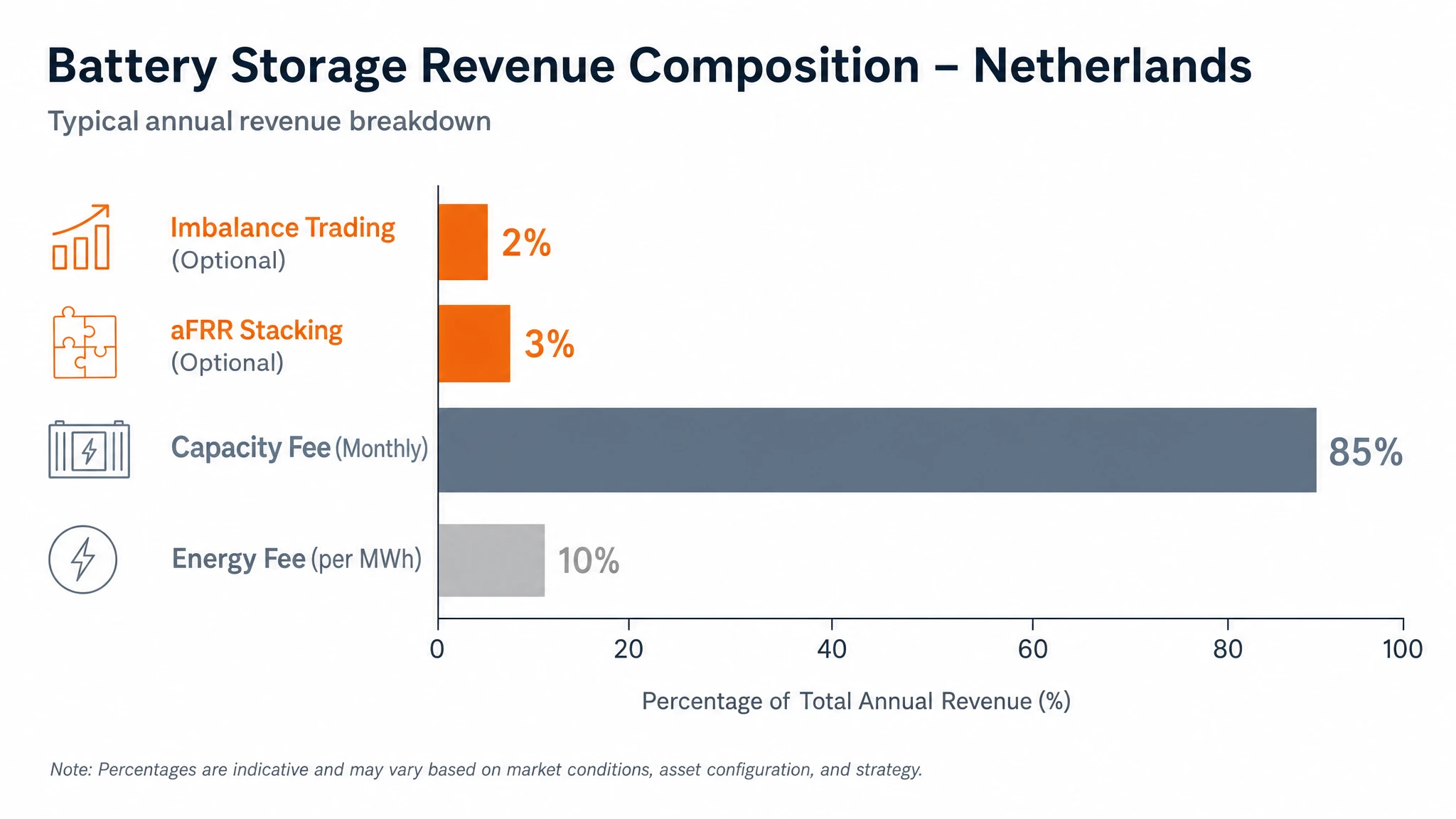
Dutch mFRR compensation has two parts: a capacity fee — a fixed monthly payment for being available — and an energy fee paid per MWh actually activated. Aggregator-published ranges for 2026 put the capacity fee at roughly €1,200–2,400 per MW per month, with activation energy compensated in the region of €150 per MWh (mFRR compensation explained). The wide capacity range reflects contract vintage, auction conditions and whether the capacity is contracted bilaterally or traded on the platform.
A worked example for a 10 MW battery:
Component | Low case | High case |
|---|---|---|
Capacity fee / month (10 MW) | €12,000 | €24,000 |
Capacity fee / year | €144,000 | €288,000 |
Energy fees (200 MWh/yr activated) | +€30,000 | +€30,000 |
Total annual mFRR revenue | ~€174,000 | ~€318,000 |
Two things to notice. First, mFRR is a capacity product first: most of the value sits in the availability payment, because actual activations are relatively infrequent in a normal year. Second, the range is wide enough that the number on an aggregator's sales page tells you little — the contract terms, the contracted price, and your share after the aggregator margin decide what lands in your account. Ask for the current contracted fee level and the settlement history before modelling anything.
By way of scale: a 10 MW battery committing the same capacity to aFRR typically competes for higher per-MW payments, but pays for them in far more cycling. That trade-off is the subject of the next section — and it is why a single 1 MW minimum-bid threshold means even a modest 1 MWh battery container system can enter mFRR while it evaluates its options.
mFRR vs aFRR vs FCR: stacking, not choosing
The instinctive question — "which reserve should my battery join?" — is the wrong one. The products are not substitutes; they consume different amounts of cycle life and pay in different currencies:
FCR | aFRR | mFRR | |
|---|---|---|---|
Activation | automatic, seconds | automatic, minutes | manual, 10–15 min |
Cycle consumption | low–medium | high | low |
Revenue structure | capacity-dominated | capacity + frequent energy | capacity + occasional energy |
Typical role for BESS | niche, small volumes | core stacking layer | insurance-style capacity layer |
aFRR pays the highest per-MW fees among the three and is the layer most Dutch battery projects anchor on — but every aFRR activation cycles the cells, and the degradation cost is real. mFRR, by contrast, pays less per MW and asks almost nothing in wear. That makes the two complementary: a battery can bid its capacity into both products and let the market decide which gets activated, subject to the commitment rules of each contract. Many projects also layer the onbalansmarkt (imbalance market) and day-ahead arbitrage on top, selling the same physical flexibility several times over.
The honest summary: mFRR alone will not carry a project's economics, and any model that treats it as the primary revenue stream is likely wrong. As a third or fourth layer in a stack — alongside aFRR, imbalance trading and arbitrage — it is a cheap, low-wear addition. If your site also has flexibility that responds to price signals rather than frequency, demand response with energy storage is the adjacent product family worth comparing before you commit capacity.
The costs and risks the sales pages skip
Every aggregator page leads with the capacity fee. Few mention what it costs to earn it:
Grid fees (nettarieven) can swallow a large share of gross revenue. Dutch transport tariffs are charged on grid use, and a storage unit pays in both directions — when it charges and when it discharges — which the sector has long flagged as a double charge. The issue is on the regulator's desk: ACM, the Dutch market authority, supports a TenneT proposal for a reduced transport tariff for storage that relieves congestion, with discounts up to 65% on the table, and the government has committed €416 million to batteries in large solar parks. Until the tariff structure changes, nettarieven are a line item you must model per connection point — they vary by region and by grid operator, and they can differ by more than the mFRR capacity fee itself.
Activations consume cycle life. mFRR activations are full-power ramps; a portfolio that gets called often enough will degrade faster than a pure arbitrage profile. The effect is modest for mFRR's low activation frequency, but it compounds when mFRR sits on top of an aFRR-heavy stack.
The contract is an obligation, not an option. mFRR capacity contracts commit you to availability: if the battery is down during the contracted window, you pay penalties or lose the capacity fee. Check the termination and renegotiation terms — early-exit clauses vary, and a contract signed at the top of the fee range can look different after a year of falling prices.
Opportunity cost is the silent one. Capacity committed to mFRR cannot run arbitrage in the same window. In a year of volatile day-ahead prices, the foregone trading margin can exceed the capacity fee — the reverse of the sales-page story.
None of this is a reason to avoid mFRR. It is a reason to model it honestly, with the fees, the degradation and the foregone arbitrage in the same spreadsheet.
The Dutch battery storage market in numbers
The market context matters because mFRR participation is a bet on how the Dutch grid will develop — and the direction is unambiguous. CBS, the national statistics office, counted 84 large battery systems (≥1 MWh) at the end of 2024, with 350 MW of power and 620 MWh of storage capacity — up from 40 systems, 229 MW and 343 MWh a year earlier. The number of systems more than doubled in twelve months.
Industry data points the same way. Energy Storage NL, the sector association, adds that known project data puts the category at at least 860 MWh, with more than 3,000 MWh under construction and further exponential growth expected through 2025–2026. Its 2025 market research with Ecorys puts the total Dutch battery market at 1 GWh of storage capacity in 2024, 2.1 GWh expected in 2025, and more than 15 GWh of projects in the pipeline — while warning that the Netherlands risks lagging behind Germany, Spain and the UK without clearer storage policy. For the first time, in 2024, more than half of Dutch electricity came from renewables — the milestone that drives both the grid congestion pressure and the demand for balancing capacity that mFRR serves.
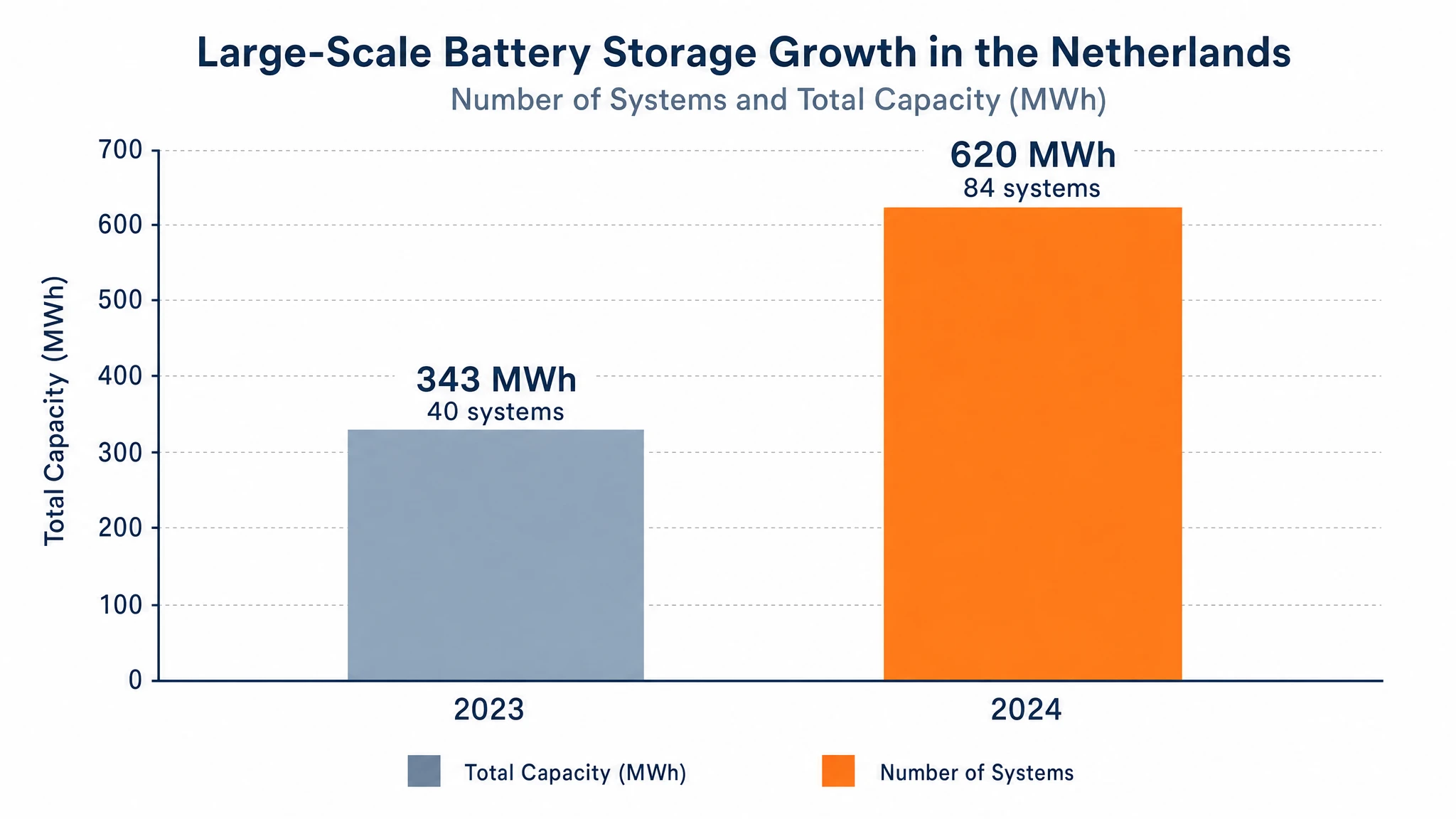
For a battery owner, the read-across is simple: a rapidly growing fleet competing for the same balancing contracts, against a background of rising balancing demand and grid congestion. Early movers locked in capacity contracts at attractive fees; the window is not closed, but the market is no longer uncontested.
A practical decision framework for asset owners
If you own or are building a battery in the Netherlands and mFRR is on the table, work through five steps before signing anything:
- Establish your grid and tariff position. Check the connection point, the applicable nettarieven, and whether a reduced storage tariff applies — the EU grid connection requirements for BESS and the Dutch connection codes determine what your site can do before any market question arises.
- Model the full stack, not the single product. Put mFRR, aFRR, imbalance trading and day-ahead arbitrage in one model, with conservative capacity-fee assumptions and a degradation cost per cycle. If mFRR only works at the top of its advertised fee range, treat that as a warning, not a forecast.
- Choose your route to market. Below roughly 10–20 MW, the aggregator route is usually right — you trade margin for operations, metering and settlement. Larger portfolios can justify their own BSP capability; at that scale, contract design and bidding strategy become internal competences, not vendor services.
- Read the contract like a bank. Availability obligations, penalty mechanics, indexation, early termination, and what happens to your capacity fee if prices fall — every clause is a priced term.
- Start small and measure. Enter mFRR with part of the portfolio, keep aFRR and arbitrage running on the rest, and compare realised revenue per MWh and per cycle across six months before committing more.
If the modelling points to participation, the practical next step is equipment that is built for it: commercial battery storage systems differ in inverter response, auxiliary load and BMS behaviour, and those differences show up in prequalification and in realised availability.
The bottom line for battery storage owners
mFRR in the Netherlands is a real, low-wear revenue stream that most battery portfolios should evaluate and many should include — as a supporting layer, not the headline. The product fits batteries unusually well, the entry requirements are modest, the market is Europeanising through MARI, and the fleet data shows both growth and competition. What decides the outcome is the work the sales pages skip: nettarieven, degradation, contract terms and the opportunity cost of committed capacity. Model the stack, read the contract, start small, and let mFRR do what it does best — pay you monthly for being ready.
If you are evaluating frequency-regulation participation for a new or existing BESS project, our engineering team works with commercial and industrial battery storage systems that are designed for reserve markets from day one — get in touch through the contact page and we will walk through the modelling with you.