

Three bidders answer the same tender for "20 MW of frequency regulation". One can hold 20 MW for fifteen minutes. Another can hold it for four hours. A third can only deliver it if the site's own load is above a certain level. All three are compliant, because the document asked for a number and nothing else. Two years later the asset underperforms, the availability deductions start, and everyone discovers the argument was never about the battery. It was about what the buyer failed to write down.
That is the whole case for treating a frequency regulation RFP template as a comparability instrument rather than a shopping list. If you want the market mechanics behind the service, the wider set of frequency regulation guides covers revenue, markets and hardware; this one stays on the document.
Why frequency regulation RFPs fail before the technology does
Three failure modes account for most bad frequency regulation procurement, and none of them is technical.
The first is a single capacity number. "MW" tells you nothing until you know whether it means what the unit can prove on a test day or what it can hold for a full product period. Those two numbers differ by a factor of two or more on a battery, and the difference is where bids become incomparable.
The second is performance written as adjectives. "Fast response", "high availability", "suitable for frequency regulation" cannot be tested, so at evaluation they get scored by whoever wrote the most confident prose. A specification that cannot fail a test cannot pass one either.
The third is eligibility described instead of evidenced. Lists of certificates and years of experience feel rigorous, but unless each line names a document, a signatory and a format, the evaluation team is comparing promises — and a promise with no document behind it does not survive a document check.
Fix those three and the rest of the document writes itself. The sections below follow the order a tender actually needs them in, and each one names the fields that make bids comparable.
Start with the service, not the hardware: FCR, aFRR, mFRR
A frequency response tender in Europe sits under two regulations: the Electricity Balancing Guideline, Commission Regulation (EU) 2017/2195, which sets common principles for procuring and settling frequency containment reserves, frequency restoration reserves and replacement reserves, and the System Operation Guideline, Commission Regulation (EU) 2017/1485, which carries the prequalification obligations for balancing service providers. The platforms that connect national markets are run as TSO implementation projects: PICASSO for automatic frequency restoration reserves and MARI for manual ones, both under the ENTSO-E electricity balancing framework.
Those two regulations tell you which service you are buying. The national terms tell you what it costs to deliver. The German prequalification conditions are the most explicit public example, and they set the delivery clocks that most of your technical annex will end up mirroring.
Service | How it is activated | Full activation obligation (DE) | Energy obligation (DE) |
|---|---|---|---|
FCR — frequency containment reserve | Locally, from measured frequency; no TSO signal | ≥50% within 15 s and 100% within 30 s for deviations ≥200 mHz, rising at least linearly between 15 s and 30 s | Marketable power must be sustainable for 2 hours; ≥15 minutes of energy at prequalified power |
aFRR — automatic frequency restoration reserve | TSO setpoint over the aFRR platform (PICASSO) | Setpoint achieved within 5 minutes | Marketable power sustainable for 4 hours; ≥60 minutes of energy at marketable power, ≥15 minutes at prequalified power |
mFRR — manual frequency restoration reserve | Manual TSO instruction, exchanged via MARI | Setpoint achieved within 12.5 minutes | Same FRR energy rules as aFRR |
Two things about that table matter more than the numbers. First, the clocks start at different events — FCR starts when frequency moves, aFRR and mFRR start when the setpoint changes — so "response time" in a tender must state its trigger, or the bids are measured from different starting lines. Second, the energy obligation is expressed twice, once against prequalified power and once against marketable power. Copy both, because they are the two numbers that protect you at settlement.
If your project is in Great Britain rather than the EU balancing market, the service ladder is different and faster: Dynamic Containment is a post-fault product with a deadband of ±0.015 Hz, 5% delivery at the ±0.2 Hz knee and 100% at ±0.5 Hz, with full delivery required in at most one second and no faster than half a second. Those figures come from NESO's service description for Dynamic Containment. The UK Dynamic Containment requirements are worth reading before you copy a continental annex into a GB tender.
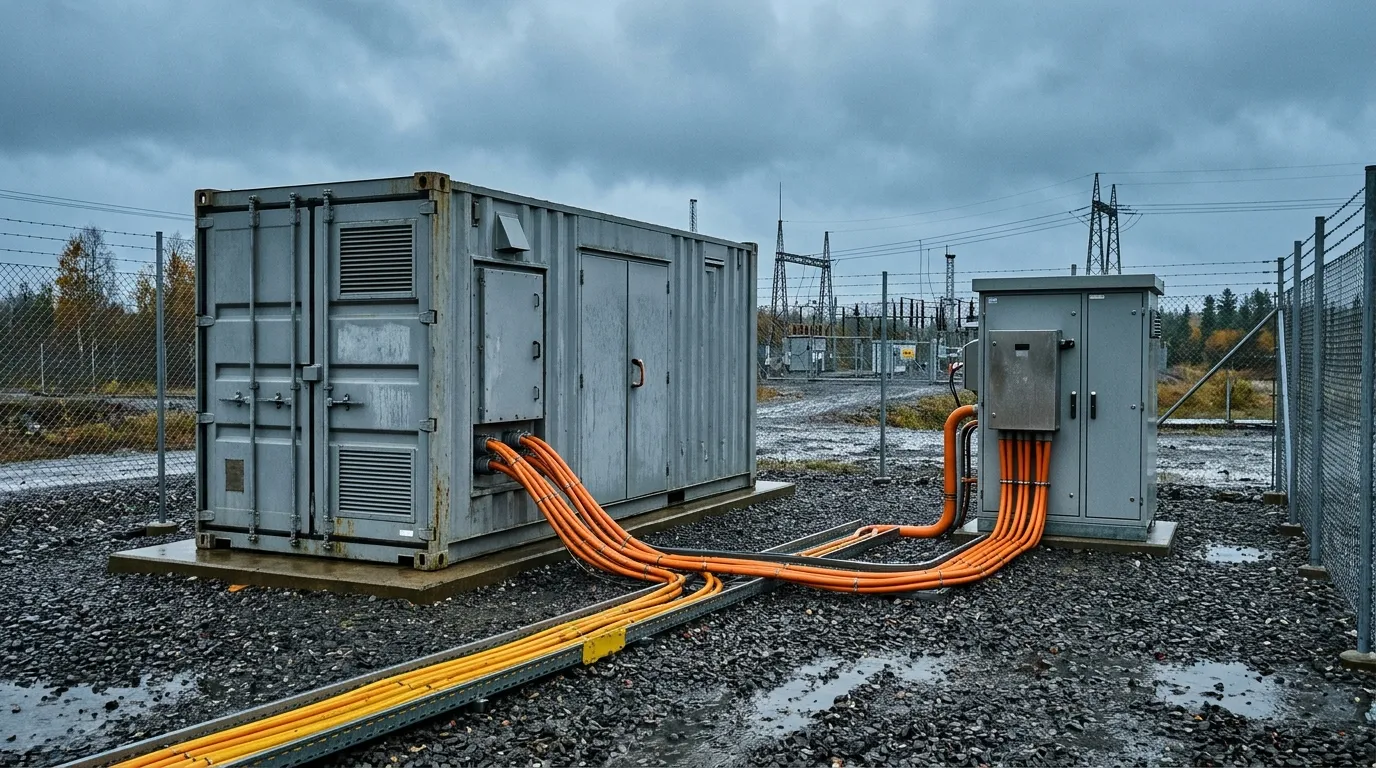
What the tender buys is a delivery obligation at a connection point, not a box.
RFP section 1–3: scope, term and the two numbers behind every megawatt
Most battery storage RFPs lose their first point of comparability in the scope section. Write it as a location plus an obligation, not as a description of a site.
Fields that must be answered, not assumed:
- Connection point and control area. The asset is prequalified by the TSO whose load-frequency control area it connects to, regardless of voltage level. Name the TSO and the connection point in the scope, not in an annex nobody reads.
- Unit structure. Is the bid for a single reserve providing unit, a group across connection points, or part of a pool? Each has different measurement and backup obligations, so the answer changes what the bidder must prove.
- Product periods and delivery windows. State which product time slices you are buying and how often availability is assessed.
- Contract term, extension and termination. Include the notice period and what happens to prequalified capacity at termination.
Then the two numbers. Ask every bidder to declare, separately and in MW:
- Prequalified power — what the unit demonstrated on its operating test.
- Marketable power — what it can hold continuously for the full product period, which in Germany means four hours for FRR and two hours for FCR.
A bid that gives you only the first number is not conservative; it is incomplete. The second is the one that decides whether the asset still delivers in hour three of a long activation, and it is also the number the bidder can defend to its own financiers.
Field | What you ask for | Why it belongs in the RFP |
|---|---|---|
Prequalified power (MW) | Declared per unit and aggregated | Anchors the qualification and the energy test |
Marketable power (MW) | Declared per unit, with the duration it is sustained | Anchors availability and penalties |
Energy at prequalified power (MWh) | At least 15 minutes for FCR and FRR in Germany | Prevents a unit passing on a short test it cannot repeat |
Energy at marketable power (MWh) | At least 60 minutes for FRR | Sets the recharge and headroom argument early |
Round-trip efficiency (%) | Measured at the meter, stated at a defined load point | Feeds the energy payment and the arbitrage case |
RFP section 4: bidder eligibility that a TSO would also accept
The most common self-inflicted wound in this category is inventing a qualification standard that runs parallel to the TSO's. You end up rejecting a bidder the TSO has already prequalified, or accepting one whose evidence the TSO will later refuse.
The rule: your eligibility section should require the route and its evidence, not a second technical bar.
Minimum content:
- Role and route. Balancing service provider acting directly, or an aggregator bidding on behalf of asset owners? Name which, and require the pool composition in the bid, not after award.
- Connecting TSO and control area. With the prequalification reference and its grant date.
- Prequalification status and validity. Ask for one of three states: granted (with date and expiry), in progress (with the TSO's acknowledgement and expected decision), or not started (with a dated plan). In Germany a granted prequalification runs for five years, so an expiring one is a real risk to price in.
- Grid connection evidence. The confirmation from the connecting network operator that the unit is connected and metered as declared. Without it the prequalification cannot close, so it belongs in the bid pack.
- Comparable portfolio. Same service, same country or a market with equivalent obligations, with MW, years in operation and the identity of the offtaker. Resist "similar projects" as a category.
- Financial standing and security. Performance bond, parent guarantee or letter of credit, sized against the penalty exposure rather than the contract value.
If the aFRR tender or mFRR tender allows a pool, add two lines that prevent most disputes: how backup is provided within the pool, and who is the single point of control for setpoint following. The Dutch mFRR route is a useful reference for how aggregator access is actually structured in a market where it is common. In parallel, the evidence that the asset can legally connect at all sits with EU grid connection compliance for BESS, which is where the RfG classification and EN 50549 test reports come from.
RFP section 5: the performance schedule you must not leave to the bidder
This is the section that decides whether the contract is enforceable, and it is the one that takes the most work to fill.
Write every row with three things: what you require, how it will be measured, and what evidence proves it. The table below folds method and evidence into one column so it stays readable on a page; keep them as separate columns in your own document, because a row whose evidence cell is empty is a wish, not a specification.
Parameter | What to specify | How it will be measured |
|---|---|---|
Full activation time | Seconds or minutes to setpoint, with the trigger named | Operating test time series; setpoint step |
Ramp shape | Linear ramp where the product requires it (FCR rises at least linearly from 15 s to 30 s) | Test log, evaluated per activation |
Setpoint accuracy and deadband | Steady-state error band, deadband width | Stationary period of the test |
Technical availability | Percentage per month, with the definition of an unavailable minute | Metering and telemetry records |
State of charge window | Operating band, minimum reserve before activation, recharge rule | SCADA time series, sampled at stated resolution |
Cycling and degradation | Annual throughput allowance, capacity fade limit, who pays beyond it | Warranty counter and annual capacity test |
Round-trip efficiency | Value at a defined load point and temperature | Metered, at commissioning and annually |
Telemetry and control | Protocol, sample resolution, latency budget, redundancy, cyber requirements | Control system test with the TSO |
Metering | Accuracy class, measurement point, redundancy, data ownership | Meter certificate and settlement reconciliation |

Every row needs a measurement setup behind it, or the requirement is only a preference.
Two notes on how to write these without creating a fight.
First, never state a response time without stating the trigger and the measurement point. A datasheet figure of "under 20 ms" often refers to the inverter's internal loop, not to power at the meter after the plant controller and the setpoint path. Before you copy that number into a tender, read how a sub-20 ms claim is verified at FAT, which separates the four clocks that hide behind one figure. Requiring "≤20 ms at the meter, measured on a setpoint step, evidence = FAT report plus commissioning log" is a specification. Requiring "fast response" is a preference.
Second, split the technical schedule from the commercial one. Degradation, efficiency and availability belong in the technical schedule because they are measured; what you pay when they are missed belongs in section 7.
Where vendors can support this section, ask for the evidence pack rather than the brochure: a datasheet with the measurement conditions, third-party test reports, and a list of the grid codes the product is certified against. On the hardware side, a grid-interfaced cabinet with VSG (virtual synchronous generator) capability, such as the HC-UPSA241 (125 kW, 241.152 kWh, certified against EN 50549-1/-2/-10 and VDE-AR-N 4110/4120 among others), or a container unit such as the HC-UPSA2089L (1 MW, 2.089 MWh in a 20 ft frame), is the kind of object these rows describe; whether it satisfies your tender is a different question, answered by the test evidence, not by the model number. The hardware-side procurement framework covers the equipment decision itself.
RFP section 6: the prequalification evidence chain
Prequalification is the TSO's process, not yours. What you can do is demand that the bid pack contains the same evidence chain, in the same order, so that a bid which cannot be prequalified fails at evaluation rather than after award.
The German process is a clean template because its components are published. The connecting TSO checks four things: an IT concept covering data exchange and security, a deliverance concept describing how the unit is operated and controlled, an operating test documented in a log submitted with the application, and a control system test performed with the TSO to confirm data points and setpoint following. Certificates, including the connecting network operator's confirmation, complete the file, and submission runs through a shared prequalification portal. The prequalification requirements published by the German TSOs set out the documents and the sequence.
Translate that into bid-pack fields:
- An index mapping each prequalification element to a document in the pack.
- Test logs with raw time series and the stated resolution — FCR and aFRR tests run on 1–4 second values in Germany, so a minute-average summary is not the same evidence.
- A clear statement of what is prequalified at unit level and what at pool level, because they are not interchangeable.
- Named signatories: who certifies the test, who accepts the IT concept, who owns the meter data.
- For a project not yet prequalified, a dated plan with the TSO's acknowledgement. Do not accept "prequalification will be obtained after award" without a schedule — the process takes months, and the tender timetable usually does not have them.
If you are buying in Germany, the market-entry path and its timing are covered in aFRR prequalification in Germany; use it to sanity-check the dates bidders give you.

The operating test is the part of the evidence chain that cannot be written after the fact.
RFP section 7: capacity payment, energy payment and a penalty that bites
Frequency regulation is bought as a service with two cost drivers, and a single blended price hides both. Require two columns.
- Capacity availability payment — per MW per product period, paid for being available, independent of activation.
- Energy payment — per MWh delivered when activated, priced against an index you name.
- Optional performance element — a multiplier or bonus tied to measured delivery quality, if you want to reward accuracy rather than punish error.
Then make the penalty structure explicit, because this is where the contract either works or turns into a negotiation every month:
- Availability threshold and sliding scale. State the monthly availability you require, the deduction per percentage point below it, and the point at which the shortfall becomes a breach.
- Cap and termination trigger. A cap protects the bidder's financiers and yours; an uncapped deduction is usually priced back into the bid.
- Make-good. Whether a shortfall can be cured in the following period, and whether cured shortfalls still attract a deduction.
- Commercial versus technical unavailability. The distinction matters: a unit that is unavailable because the operator chose to charge for arbitrage is a different event from a plant failure. Write both definitions and treat them differently.
- State of charge obligations. Set the minimum reserve before an activation window, the recharge rule, and who bears the cost of recharging. Without this clause, the availability metric is gameable.
One more thing belongs here: the performance score. Most European balancing regimes adjust payment by a measured delivery quality, which behaves like a multiplier on revenue rather than a fixed deduction. That changes what a bid is worth, and it changes how hard a bidder will push its state-of-charge band. How the revenue stack changes what a bid is worth works through the arithmetic; the tender consequence is that you should ask for the bidder's assumed score, not just its price.
RFP section 8: metering, baseline and the settlement argument you will have
Every frequency regulation contract eventually produces a dispute about whether the asset delivered what it was paid for. The answer is decided by things you can write down now: the measurement point, the data access clause, and — for load-side or aggregated units measured against an expected output rather than a setpoint — the baseline.
Baseline. A baseline is a projection of expected output submitted in advance, against which delivery is measured. Where the unit is a battery delivering against a setpoint, or a reserve delivering on measured frequency deviation, delivery is measured directly and no baseline is used. A baseline matters for load-side units, for aggregated pools whose response is inferred from a site total, and for services measured against expected output: without one, no one can separate a contracted response from a coincidental change in output. Write the methodology only where it applies — but write it before the bid, not after the first dispute; where it applies, require the bidder to state it in the bid and to fix it for the term unless both parties agree to a change.
Metering. Specify the measurement point (settlement meter, not inverter telemetry), the accuracy class, redundancy, and who owns and retains the data. State the retention period and the granularity you expect to audit.
Settlement granularity. Name the settlement period in the contract and require the bidder's systems to support it. This is not a formality: as the European platforms move to their target design, balancing energy product time slices shorten from four hours to 15 minutes, and a reporting setup built around hourly averages will not survive that.
Disagreement procedure. A short clause saves months: notice period, joint meter read, independent expert, and which records prevail. Add an audit right with a defined notice and a confidentiality obligation.
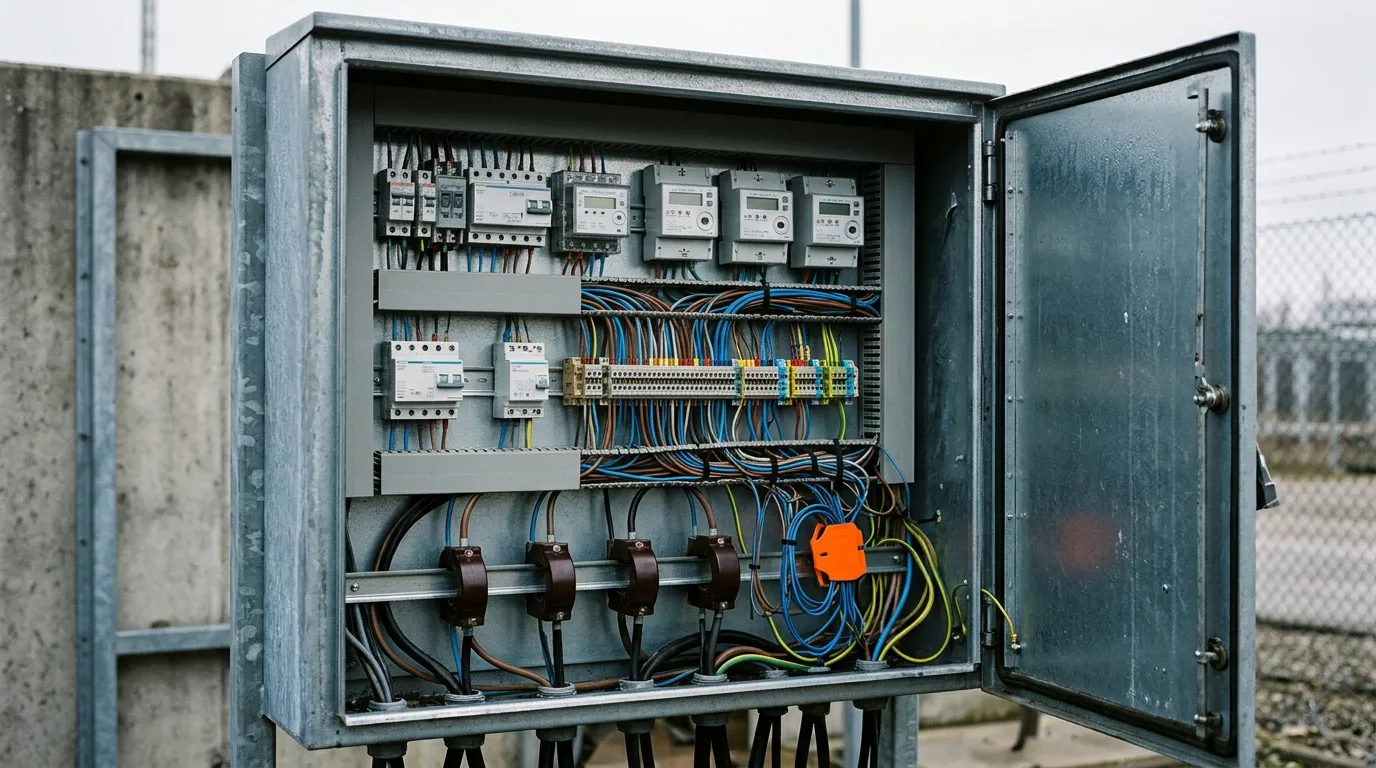
Settlement is decided at the meter and the cabinet behind it, not in the plant controller.
The eight omissions that void a bid
These are the gaps that turn a tender into a re-run. Each of them, if left blank, makes a bid unevaluable — not weak, but impossible to score.
- A capacity figure with no duration. Without prequalified and marketable power, the strongest and weakest bids look identical.
- No definition of availability. If "available" is not defined to the minute and to a measurement source, the penalty clause cannot be applied.
- No state-of-charge rule. Batteries that must recharge will underdeliver during long events; the contract has to say who manages that and how.
- No degradation allowance. A cycling limit that is not written becomes a warranty dispute in year three.
- No evidence list. Eligibility criteria without named documents produce a pack nobody can score.
- No metering specification, and no baseline method where one applies. Delivery cannot be proven, so payment becomes discretionary.
- No penalty cap or cure mechanism. Serious bidders price uncertainty; the ones that do not are the ones you will be arguing with.
- A timetable that ignores prequalification. Award dates that assume prequalification can happen after signature select for bidders who have not done it.
A one-page frequency regulation RFP template you can paste into your tender pack
If you need the short version, this is the structure. Each row is a section of your document; the third column is what makes it evaluable.
Section | Content | Comparability device |
|---|---|---|
S1 Scope | Site, connection point, TSO and control area, product type | Named obligations, not descriptions |
S2 Volume | Prequalified power, marketable power, energy at both | Two numbers, both declared |
S3 Term | Start, product periods, extension, termination | Fixed assessment cadence |
S4 Eligibility | BSP (balancing service provider) route, prequalification status, ANB (connecting network operator) confirmation, portfolio, security | One document per claim |
S5 Performance | Activation time, ramp, accuracy, availability, SoC (state of charge) band, cycling, efficiency, telemetry, metering | Requirement + method (evidence folded in) |
S6 Evidence | Prequalification pack index, test logs, signatories, dated plan | Same pack shape for every bidder |
S7 Commercial | Capacity payment, energy payment, performance multiplier, deductions, cap, cure | Two price columns, one penalty formula |
S8 Measurement | Baseline method where one applies, meter point, granularity, retention, audit, dispute | Named records, named owner |
S9 Submission | Price schedule, clarification window, NDA, evaluation weights | Published weights, gates stated up front |
BSP = balancing service provider. ANB is the German name for the connecting network operator (Anschlussnetzbetreiber); outside Germany, use the national equivalent and keep the document name in the local language.
RFP section 9: submission mechanics, clarification window and NDA
The last section of the document is administrative, and it carries no engineering content — so it is easy to leave until the technical annex has already gone out, which is exactly when a missing clarification window costs the most.
State the price schedule format first: the same two columns as section 7, per MW per product period and per MWh delivered, with the index named, so prices can be compared without re-keying them into a spreadsheet.
Then the clarification window. Name the deadline for written questions, the channel they go through, who answers them, and the commitment that every question and every answer is circulated to all bidders at the same time. A clarification round conducted privately with one bidder is how a tender ends up in dispute before it is awarded.
Finally the NDA: whether bidders sign it before the data room opens or only before clarification begins, what it covers, and how long the confidentiality obligation lasts after the process closes.
Publish the evaluation weights in this section too, or point to where they are published, and publish them before the clarification deadline — bidders who cannot see the weights price the residual risk instead of the requirement.
Scoring bids without re-litigating the specification
Once the document is written properly, evaluation gets easier: compliance is pass/fail, and only the residual judgment calls are scored.
Two-stage scoring works well here. Hard gates first — prequalification status with a valid date, grid connection confirmation, security in place, evidence pack complete. Fail any gate and the bid is not scored, which is the entire point of writing gates.
Then weight the rest, with weights you publish in the tender: price for capacity and energy (typically the largest single weight), delivery risk measured by the credibility of the prequalification timeline, evidence quality measured by how much of the performance schedule is backed by test data, and service depth measured by the operating and maintenance commitments behind availability.
What you should not score is technical compliance you already specified. If activation time is a requirement, a bid that fails it is non-compliant; giving it a lower technical score instead of rejecting it is how a tender ends up awarding to the bidder who could not meet the spec.
Frequently asked questions
What are the grid frequency limits in the UK? Great Britain's statutory limit is ±0.5 Hz around 50 Hz, with operational limits at ±0.2 Hz. Dynamic Containment is designed around that: a ±0.015 Hz deadband, 5% delivery at the ±0.2 Hz knee and 100% at ±0.5 Hz.
What is the maximum allowable frequency variation in a power system? It depends on the synchronous area, and you should not copy one area's number into another's tender. In continental Europe, FCR obligations are written around deviations of 200 mHz, where a unit must reach 100% of its FCR capacity within 30 seconds; in Great Britain the statutory figure is ±0.5 Hz. State the number you are contracting against, and its source, in the technical annex.
Do I need to run my own prequalification process? No. Prequalification belongs to the connecting TSO. What the tender should do is require evidence of that process, with dates and documents, and refuse bids that treat it as a post-award task.
How much time should the tender allow? More than most schedules assume. Prequalification involves concepts, an operating test, a control system test and certificates, all reviewed by the TSO before a bid can be dispatched at all. Ask bidders for a dated plan and treat an unplanned timeline as a delivery risk, not a paperwork issue.
Can an aggregator bid on my volume? Yes, if the tender allows a pool and defines it. Require the pool composition, the backup arrangement and the single control point in the bid, and confirm who carries the availability obligation when one unit in the pool drops out.
Where does the hardware decision fit? After this document, not before it. The tender defines what must be proven; the equipment choice is how a bidder proposes to prove it. If you want a second pair of eyes on whether your draft is deliverable, our engineering team can review the specification against the services you are buying before it goes out.