

On 1 October 2025, PJM stopped dispatching the RegD signal. The fast-response signal that the first wave of US grid batteries was built to follow was retired, replaced by a single Reg signal, a 30-minute commitment period, and a performance score calculated on precision alone. Nothing about those batteries changed. The product they had been designed around did.
That is the first thing to understand about frequency regulation revenue stacking: a stack is not a list of markets you add together. It is a set of claims on one machine, and the claims are written by someone else's rulebook.
Frequency regulation revenue stacking means selling more than one grid service from the same battery — availability, energy and delivery accuracy — while respecting the physical limits that make those claims overlap. The word "stack" hides the hard part. Each added stream is a claim on the same converter, the same megawatt-hours and the same control loop, and the market settles all three separately.
This is the structural companion to our grid frequency regulation with battery storage cluster, which covers which products exist in Germany, the Netherlands and Great Britain. Here the subject is the layer beneath: how a stack is composed, what it consumes, and how to underwrite it without overstating it.
Frequency Regulation Revenue Stacking: What You Are Actually Selling
Strip the acronyms away and a regulation product sells one or more of three things.
Availability is megawatts held ready for a defined window, paid whether or not the operator calls on them. Frequency containment reserves are almost purely availability: a symmetric band held continuously, with activation energy small enough to barely register in revenue.
Energy is megawatt-hours delivered or absorbed on dispatch: paid per MWh inside a restoration reserve, or sold as a day-ahead or intraday position and closed at two different prices.
Accuracy is a score measuring how closely the resource followed the dispatch signal — how much of the requested movement it delivered, how fast, with how much error. It decides what fraction of the availability payment is settled.
The third commodity explains why stacking is scored at all. In 2011 the US Federal Energy Regulatory Commission issued Order No. 755, finding that paying every cleared resource the same rate regardless of how much regulation service it actually provided was unjust and unduly discriminatory. The order required two payments: a capacity payment including the marginal unit's opportunity cost, and a performance payment reflecting the service delivered while following the dispatch signal. It also named the quantity being paid for — mileage, the amount of regulation movement a resource provides.
That reform is why speed and accuracy are priced separately, and why a badly tuned battery can under-earn its own datasheet.
Permission came later. Order No. 841 required every FERC-jurisdictional RTO and ISO — ERCOT, which is not FERC-jurisdictional, sits outside it — to build a participation model under which storage is eligible to provide all the capacity, energy and ancillary services it is technically capable of, dispatched as both seller and buyer, paying the wholesale locational marginal price for energy it absorbs, with a minimum size no higher than 100 kW.
What Order 841 did not do is decide whether those services compose cleanly. That is left to physics and tariffs, and it is where most stacking plans fail.
Why Two Streams Are Not Twice the Revenue
The arithmetic everyone runs first is additive: regulation revenue plus arbitrage plus capacity. It is wrong for a reason that has nothing to do with markets.
Start with a symmetric product. When a battery bids ±5 MW of a symmetric reserve, it promises 5 MW up and 5 MW down. To keep both promises at the same instant, the converter must sit at zero and swing five megawatts either way. The bid says five. The footprint on the machine is ten.
A 10 MW inverter holding that commitment has no envelope left for anything else while it runs — the remaining flexibility exists only in time, not in megawatts.
Asymmetric products change the picture, which is their commercial value. Where a market lets you sell positive and negative reserve separately, you can commit one direction and keep the other for a different service, at a lower price per direction. That difference decides whether your arbitrage schedule runs inside a reserve commitment or only around it.
Time is the second half of the constraint: commitments are blocks, and you can only reallocate at the boundary. National Energy System Operator, which runs the GB system, buys Dynamic Regulation at 10 seconds' notice for up to 60 minutes, Dynamic Moderation at one second for up to 30 minutes, and Dynamic Containment at one second for up to 15 minutes as a post-fault service — all in both directions (NESO service table). PJM's redesign cut its regulation commitment from an hour to 30 minutes. Shorter blocks make stacking easier, because you get more chances to reposition, and make poor forecasting more expensive.
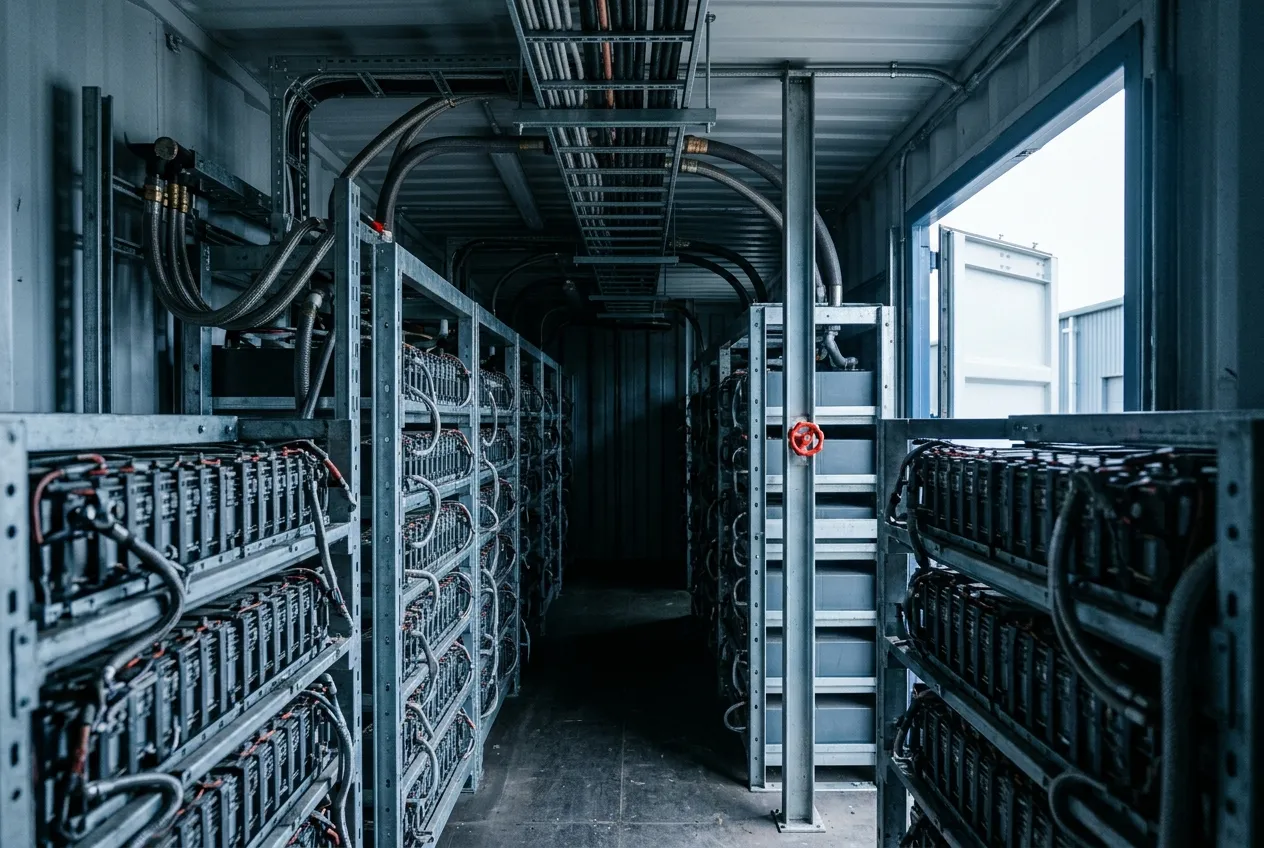
The third limit is attention. A battery following a continuous regulation signal moves energy wherever the grid needs it, at the operator's cadence; a battery running an arbitrage position is trying to hold a schedule. When one control layer does both, the schedule wins at exactly the wrong moments — the hours when both services want the same megawatt-hours. That is a control-architecture problem before it is a market problem, which is why the EMS layer decides the stack more than the price forecast does.
The State-of-Charge Budget
Megawatts are the visible constraint. Megawatt-hours are the binding one, and the arithmetic fits on a napkin.
Take an illustrative 10 MW / 20 MWh unit — roughly two hours at full power, the duration class most European grid batteries are built to. It commits 5 MW symmetric, which as above occupies the full 10 MW envelope while the commitment runs. Assume the market requires state of charge management to keep the unit inside a 30–70 % band so both directions remain deliverable.
That band is 6 to 14 MWh, so the usable swing is 8 MWh. Divide by the committed 5 MW and you get 1.6 hours of continuous one-directional response. A four-hour block cannot be served by energy alone at that commitment. It can only be served if activations are sparse and the unit recovers between them.
That fits containment-type products, which are mostly idle and move little energy. It does not fit signal-following products, the ones paid for energy as well as availability: a signal that leans one way for an hour eats the band, and the recovery rule becomes a revenue term rather than housekeeping.
Duration and stack breadth trade against each other: a one-hour system can hold a large availability position but cannot follow a signal for long, while a four-hour system can carry both at a higher cost per megawatt.

The Performance Score Is a Multiplier
Every market that adopted pay-for-performance had to answer one question: how do you score a resource that was available but inaccurate? The answers differ, and they change behavior.
PJM's 2025 redesign is the clearest example. Under the Regulation Redesign Phase 1 rules effective 1 October 2025, the RegD signal is terminated, RegD-only resources carry their historic score forward after a signal-conversion test, the regulation performance score moves to a 100 % precision calculation, and the historic score is averaged over 200 half-hour intervals rather than 100 hours. Self-de-assignment produces a zero performance score for the remainder of the commitment period. Phase 2 then splits the bidirectional product into separate RegUp and RegDn products, each with its own requirement, clearing price, performance score and mileage; its go-live moved from 1 October 2026 to 1 December 2026, as filed and approved by FERC (Phase 2 FAQ). Confirm the current guidance before modeling either phase as the steady state.
Read that last clause as an operator and the intent is obvious. The score is carried into settlement, follows the resource forward, and can be zeroed inside one commitment period. A resource capable of 50 MW of regulation but scoring poorly earns on a fraction of it — the penalty applies to the cleared megawatt, not the marginal megawatt-hour.
This is the part of stacking no vendor revenue model captures. A stack that splits a battery's attention between a signal and a trading position does not lose a little accuracy — it loses the multiplier on everything it cleared while distracted. European prequalification carries the same logic: a failed test, or an availability breach inside a committed block, becomes penalty payments and remediation time rather than simply zero revenue.
Response time is a separate question from score. If you need the measurement definition — the four clocks behind a "sub-20 ms" datasheet line — that is covered in what sub-20 ms response actually measures. The failure that costs money is rarely a slow switch; it is a score carried low for a month.
Four Architectures, Four Failure Modes
Most stacking plans are one of four architectures in disguise. Naming yours makes its failure mode visible.
Architecture | What it commits | Revenue shape | Failure mode |
|---|---|---|---|
Simultaneous, co-optimized | Megawatts reallocated every interval under SoC and commitment constraints | Highest theoretical, most volatile | Score dilution and slow state-of-charge drift, visible only in settlement |
Time-sliced | Whole blocks sold to one product, remainder traded | Predictable per block | Entering a block in the wrong state of charge |
Residual / hierarchical | A symmetric band as base layer, headroom traded | Band is the floor, headroom the upside | Headroom that exists on paper but not in practice |
Behind the meter | Demand-charge reduction plus a contracted grid service | Split between a bill and a market | Aggregator contract terms, not physics |
German aFRR is the archetype of the two-part product behind the time-sliced row — capacity won at auction, energy paid on activation — and our aFRR market guide for Germany covers the auction mechanics and 2025–26 price behavior. Products with long delivery obligations make the residual row worse: Dutch mFRR is a capacity-led product whose activations are rare but long when they come, as our mFRR Netherlands analysis sets out — the availability fee carries most of the value, and the delivery obligation still has to be honored in full.
What Changed in 2025–26
The US fast-regulation premium was redesigned, not abolished. PJM kept the product but changed what it rewards: shorter commitments, precision-only scoring, no benefit factor. Fast-signal assets were re-tested and re-scored, and raw speed fell in value relative to steady accuracy.
European balancing became more platform-shaped. The EU balancing framework — Commission Regulation (EU) 2017/2195 — sets the rules under which capacity and balancing energy are procured and exchanged across borders. The capacity leg and the energy leg of a restoration reserve are priced in different places, at different times, under different competition, so a stack built on the capacity leg alone is exposed to whichever auction clears last.
Frequency response supplied about 87 % of GB battery revenue across 2020–2022, per Modo Energy's market research; over the twelve months to April 2026 a typical two-hour GB battery earned roughly £73,000 per MW per year across three or more stacked streams. The migration is furthest along where arbitrage already dominates: Modo puts ERCOT's arbitrage share at 76 % in June 2025, up from 25 % a year earlier — ERCOT being the energy-only market in Modo's own classification — and CAISO, which Modo classes as a bilateral, resource-adequacy market rather than an energy-only one, at 91 %.
The pattern is consistent enough to plan around. Frequency regulation is where a battery earns first, because it is the service a battery is uniquely good at. It is rarely where a mature asset earns most.
How to Underwrite the Stack
Battery storage revenue stacking is only as good as the underwriting behind it. Frequency regulation is one line in the stack; ancillary services more broadly — reserves, reactive power, capacity accreditation such as PJM's RPM or a GB capacity agreement — are the others, and this article prices the regulation leg only.
Use your own price series, per product. A blended dollars-per-kilowatt-year figure hides which stream carries the asset. Rebuild the stack from cleared prices for each product in each block, then apply your own capture rate.
Haircut by measured score, not nameplate. Apply the tested score to the cleared megawatt before you count revenue. If the market publishes historic scores, use the distribution rather than the average — the downside case is what a lender asks about.
Stress the scarcity hour. Arbitrage and regulation want the same megawatt-hours, and they want them when the system is tight. Model the worst correlated hour, not the average one. A stack that works 8,000 hours a year and fails in the 40 that pay for the project is not a stack.
Check the double-offer and recovery rules. Whether the same megawatt can be offered twice, how fast you must return to mid state of charge, and whether recovery energy is charged are tariff terms that change revenue more than most forecast improvements.
Count equivalent full cycles, not dispatch events. Regulation cycling is shallow and frequent; arbitrage is deep and rare. Only a cycle-life figure at a stated state of health lets you compare them, and that is the number for the degradation model.
Then there is the layer that decides how much modeled revenue the owner keeps: the contract. Revenue share or fixed fee, a floor price, the right to switch markets, who owns performance risk, and what happens at a redesign. These terms routinely move more value than a year of optimization. A stack the owner cannot operate is a stack the aggregator operates for them, on the aggregator's terms.
What the Hardware Must Prove
A frequency regulation battery storage system is a set of promises about a machine, so the machine has to be able to make them. Four things get tested, and only one is the cell.
Envelope and headroom. Rated power, the symmetric footprint a reserve commitment consumes, and how much envelope survives at the temperature the site actually runs at.
State-of-charge control. The ability to hold a band, recover to mid without overshoot, and refuse a dispatch that would breach the band rather than accept it and fail the block.
Signal chain. Metering class, telemetry cadence, and latency between receiving a setpoint and changing output — measured end to end.
Evidence. Prequalification is a market process with its own tests, and it is not the same as a certificate. A unit can hold every grid-code certificate it needs and still fail a prequalification test on metering configuration.
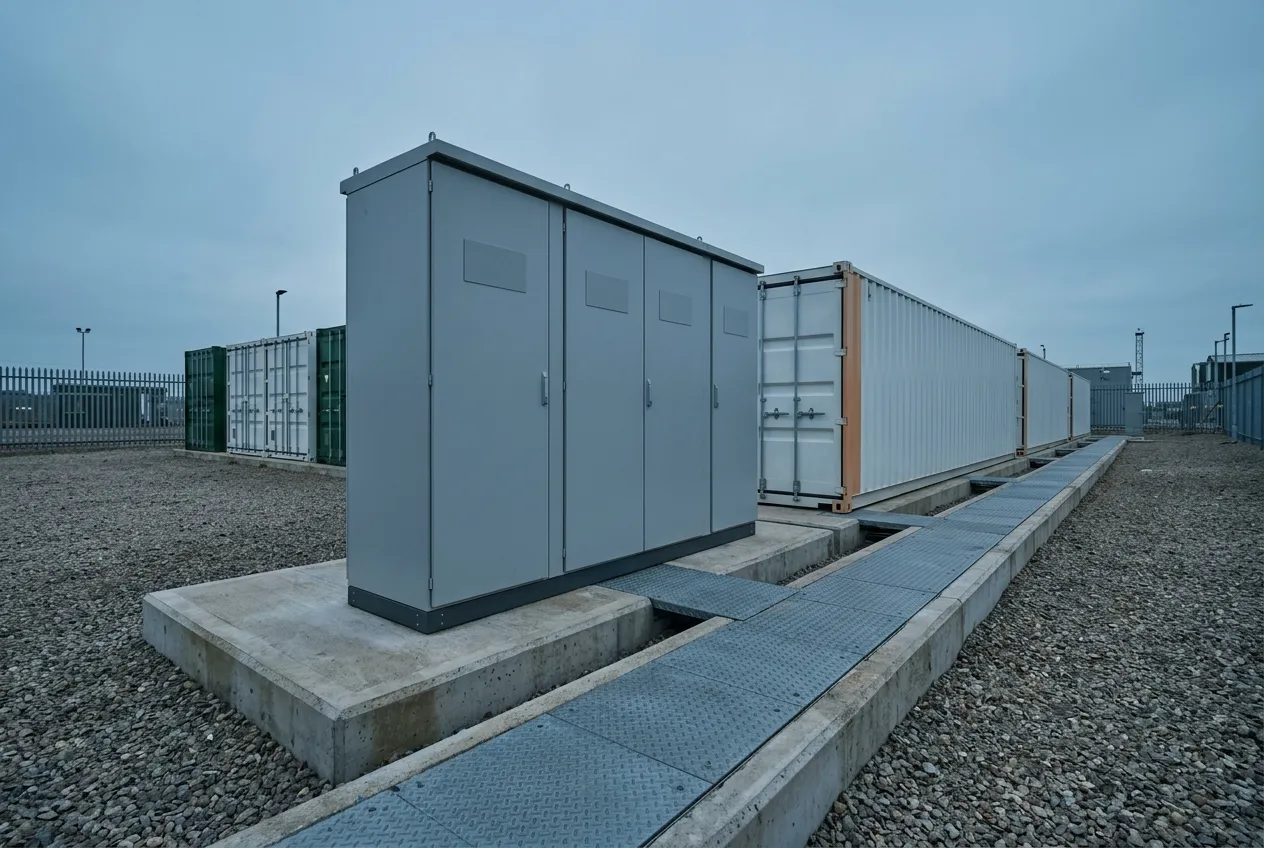
For C&I-scale positions, and as the building block of a larger plant, the relevant class is a grid-tied cabinet around 125 kW / 240 kWh with an envelope wide enough to hold an asymmetric position. Hua Power's HC-UPSA241, for example, is rated 125 kW at 241.152 kWh in the current catalogue, with a 0.5C cell configuration, ≥85 % round-trip efficiency, ≥8,000 cycles at 80 % state of health, and grid certifications spanning EN 50549-1/-2/-10, VDE-AR-N 4110 and 4120, G99 B/C/D and CEI 0-16/0-21 — the set European and UK markets ask for before a prequalification test is scheduled. Some published pages still carry the pre-2026 105 kW rating for this model; the current catalogue supersedes it. The catalogue cites more than ten European frequency-regulation projects with sub-30 ms response and over 100 MWh of cumulative deployment.
None of that is a prequalification claim. It is the specification starting point, and the HC-UPSA241 product page lists the full parameter set. If you are specifying a cabinet for a stacked position, our engineering team can walk the envelope and state-of-charge arithmetic through your market's tariff — start that conversation.
Five Questions Before You Sign
- Which megawatts are committed in which interval, and what envelope does each consume? A symmetric bid of P consumes 2P. Sum envelopes before you sum revenue.
- What score is used, how is it measured, and what happens when it falls? Get the methodology, the historic distribution and the settlement consequence.
- What is the recovery rule after activation, and is that energy charged, paid or free?
- What does the contract take — revenue share, floor, switching rights, notice, performance risk?
- What happens when the product is redesigned? Assume at least one redesign per asset life and check that hardware and contract both survive it.
A stack that answers all five is not a forecast. It is a position you can defend in a credit committee, and that is the only kind of stacking that survives a market cycle without being rewritten.