

Connect batteries in series and the voltage adds up while the capacity stays the same. Connect them in parallel and the capacity adds up while the voltage stays the same — that is the short answer to batteries in series vs parallel, and almost every real battery bank you will ever touch uses both at once. This guide goes past the middle-school version of "positive to negative is series" and shows you how the choice plays out in an actual battery energy storage system: how to wire it, what the numbers really do, and the mistakes that quietly destroy packs.
This is a fundamentals guide from Hua Power Engineering, a manufacturer of LiFePO4 battery systems. We build the modules that end up in these configurations, so the examples below lean on real energy-storage hardware rather than a flashlight. Start with the battery energy storage basics hub if you want the wider vocabulary first.
Batteries in Series vs Parallel: The Short Answer
Series | Parallel | |
|---|---|---|
Voltage | Adds up (2 × 12V = 24V) | Stays the same (2 × 12V = 12V) |
Capacity (Ah) | Stays the same | Adds up (2 × 100Ah = 200Ah) |
Energy (kWh) | Unchanged | Unchanged |
Current capability | Same as one battery | Adds up |
Weak-cell behavior | The weakest battery limits the whole string | A weak battery is partly carried by the others |
Typical use | Reaching an inverter's DC voltage window | Extending runtime / total capacity |
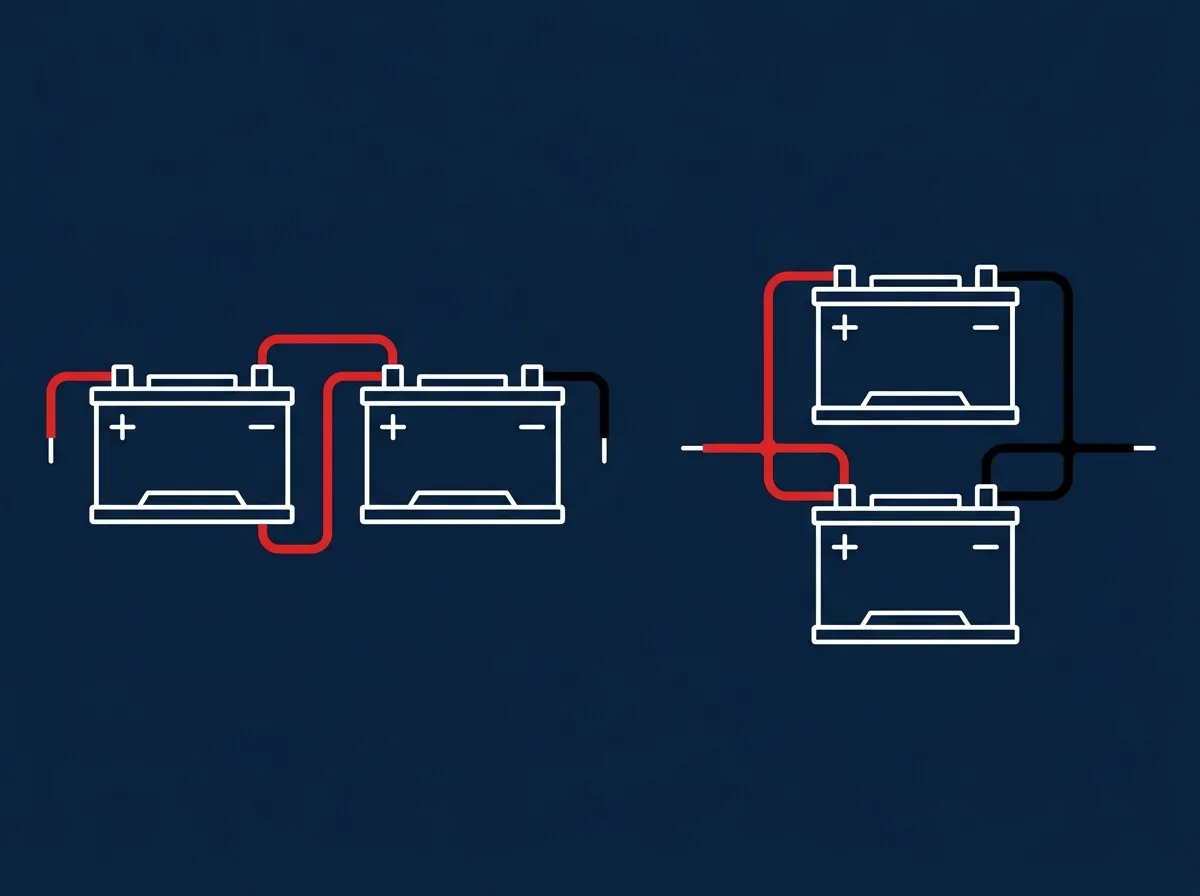
So "is it better to wire in series or parallel?" has no universal answer — it depends on what your equipment needs. If your inverter wants a higher DC input voltage, you go series. If you need more energy at a fixed voltage, you go parallel. Most storage systems need both, which is why the industry's standard building block is the series-parallel bank.
What Happens When You Wire Batteries in Series
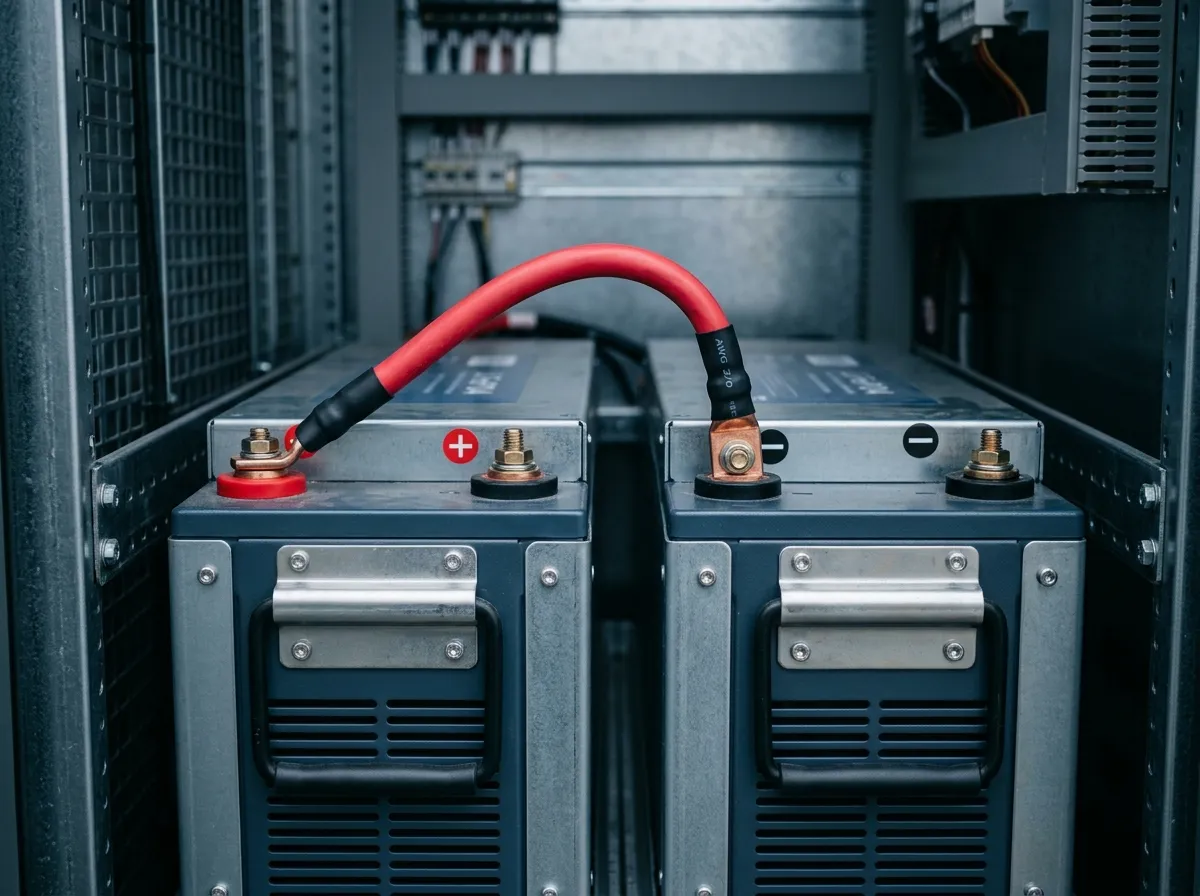
In a series connection you daisy-chain the batteries — the positive terminal of one to the negative terminal of the next. The current has only one path to follow, so it flows through every cell in turn.
Two consequences follow directly from that single path:
- Voltage adds. Two 12V batteries in series give 24V; four give 48V. This is exactly how a 48V battery bank is built from individual 12V blocks, and it is the reason nominal voltage is the first number to check before you buy anything.
- Current does not add. The same current passes through every battery in the string, so the pack's amp-hour rating equals one battery's. You raised the "pressure," not the "pipe size."
The catch is balance. Because every battery shares one current path, the weakest battery sets the ceiling for the whole string — the classic "a chain is only as strong as its weakest link." If one cell in a series string lags in state of charge or has higher internal resistance, it will hit its upper or lower voltage limit first and drag the rest of the string with it. That is why series strings need cell balancing, and why the chemical choice matters: LiFePO4 holds a much flatter voltage curve than lead-acid, so balancing has to be managed electronically rather than left to chance.
What Happens When You Wire Batteries in Parallel
In a parallel connection you tie all the positives together and all the negatives together. Now the batteries share the load, and the arithmetic flips:
- Capacity adds. Two 100Ah batteries in parallel give 200Ah at the same 12V.
- Voltage stays put. Parallel never changes the voltage — it only buys you time.
- Current capability adds. Each battery supplies part of the total current, so the bank can deliver more amps than any single unit.
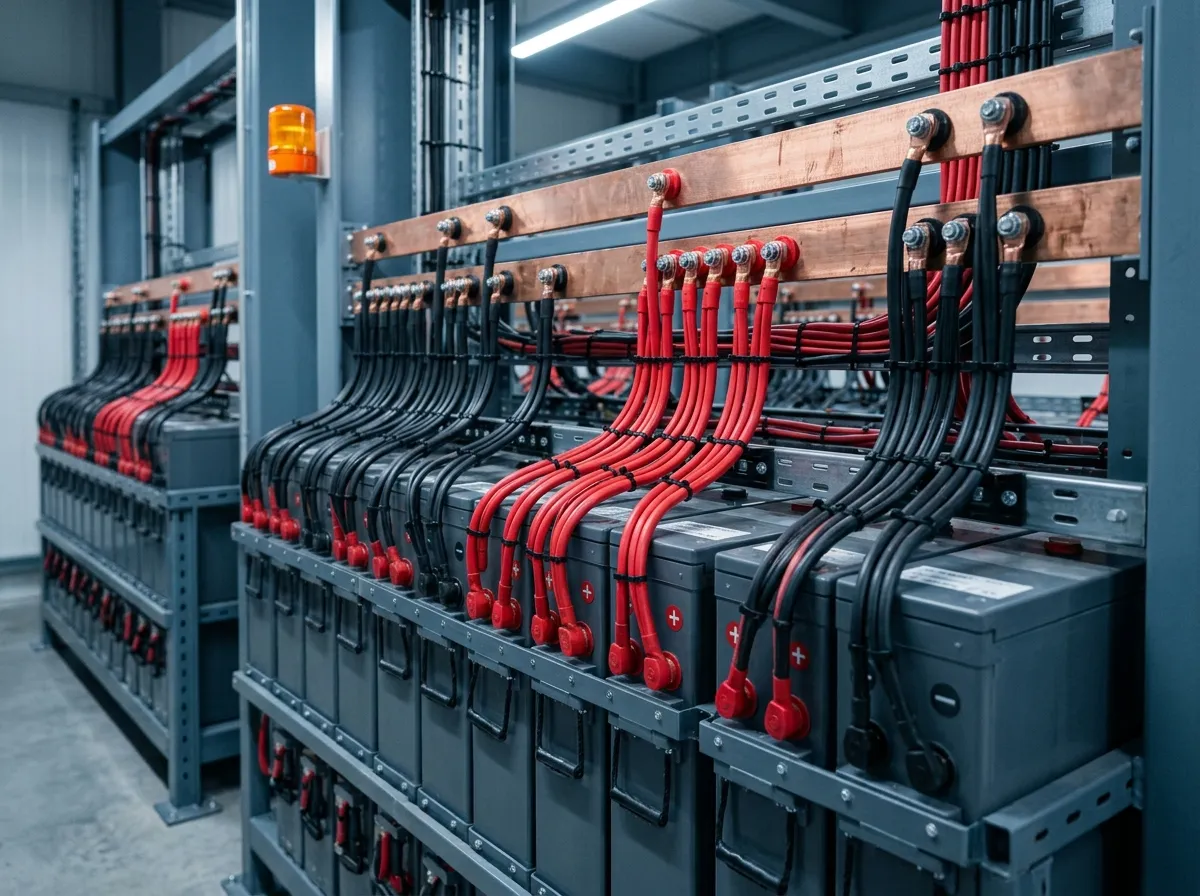
The catch here is current sharing. For the batteries to split the load evenly, they have to see the same resistance to the load — which is mostly about wiring, not the batteries themselves. If one battery's cable is a little shorter or its lug a little looser, it will carry more than its share, run hotter, and age faster than its neighbors. Unequal cabling is the single most common reason a "parallel bank" delivers less than the sum of its parts. Our guide to LiFePO4 batteries covers how that chemistry behaves under these shared-current conditions.
Series-Parallel: When You Need Both
Real systems rarely choose one or the other. They stack the two ideas:
- Series-connect a group of cells or modules to reach the voltage the equipment wants.
- Parallel-connect several of those strings to reach the total energy and current the site needs.
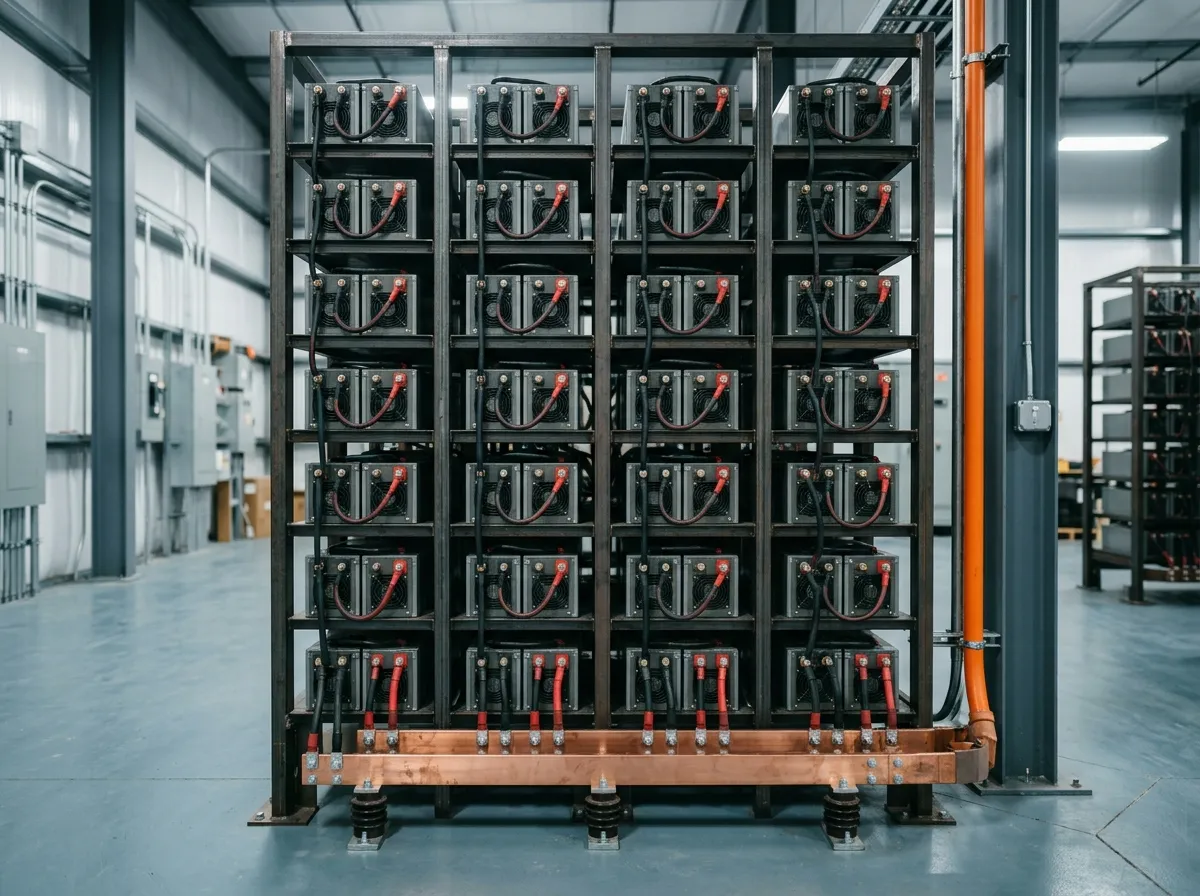
This is the "series-parallel" or "series strings in parallel" arrangement, and you will find it at every scale — from a home rack to a shipping-container battery. It gives you an independent knob for voltage and an independent knob for capacity, which is exactly what a system designer needs. Sizing it correctly is its own exercise; our walkthrough on scaling a high-voltage battery system shows how the string count and module count trade off against each other.
Wiring Does Not Change Total Energy (kWh)
Here is the misconception that costs people money: changing from series to parallel does not create or destroy energy. It only rearranges how that energy is delivered.
Take four 12V, 100Ah batteries. Each holds 12V × 100Ah = 1.2 kWh, so the set holds 4.8 kWh no matter how you wire it:
Configuration | Voltage | Capacity | Energy |
|---|---|---|---|
4 in series | 48V | 100Ah | 48V × 100Ah = 4.8 kWh |
4 in parallel | 12V | 400Ah | 12V × 400Ah = 4.8 kWh |
2 series × 2 parallel | 24V | 200Ah | 24V × 200Ah = 4.8 kWh |
Same energy, three different voltage/capacity combinations. The reason this matters is that people expect series wiring to "give more power." It gives more voltage; the runtime you get depends on the energy, the load, and the efficiency of the inverter — not on the topology. If you want to run the numbers for your own load, the battery kWh calculator does the voltage × amp-hour math for you, and Battery University's reference on series and parallel configurations covers the same principle from the cell side.
How to Wire a Battery Bank: Step by Step
Whether you are wiring two batteries or twenty, the procedure is the same. Work with everything de-energized, one cable at a time.
- Confirm the target voltage and capacity. Add up the voltages of the batteries you plan to put in series — that sum has to land inside your inverter's DC input window. Add up the capacity of the parallel strings — that is your runtime budget.
- Match the batteries first. Use identical model, age, and chemistry. More on this below, but decide it before you pick up a wrench.
- Series-connect one string at a time. Positive of battery 1 to negative of battery 2, and so on. At the ends of the string you have one free positive and one free negative — those are your string terminals.
- Bring every string back to a common point. Use a busbar rather than stacking lugs on one terminal. A busbar gives each string the same connection point, which is the cheapest way to make parallel strings share current evenly. The same logic applies to the cables: keep each string's positive and negative cable the same length and gauge, so no string sees a shorter, lower-resistance path than its neighbors. This is the equal-length rule, and it is the difference between a balanced bank and one string doing all the work.
- Fuse every string individually. A short in one parallel string can be fed by all the others, so each string needs its own DC fuse or breaker sized to its own current — not one big fuse on the whole bank. Correct current ratings are what keep the fuse from nuisance-tripping on inrush or failing to protect on a fault.
- Torque and verify. Loose connections are resistance, and resistance is heat. Torque every terminal to spec, then recheck after the first charge/discharge cycle.
The choice between a lower-voltage bank and a higher-voltage one is partly a wiring question — fewer, thicker cables versus more, thinner ones — and that trade-off is covered in our comparison of high-voltage vs low-voltage home batteries.
The Battery Matching and BMS Rules You Cannot Skip
The physics of series and parallel wiring is simple. Keeping a real bank healthy is where most installations fail, and it comes down to matching and management.
Match the batteries. Series strings are limited by the weakest member, and parallel strings reward equal resistance, so mixing is expensive:
- Never mix old and new batteries in the same string. The older cell has higher internal resistance and will make the new ones work against it.
- Never mix capacities or chemistries within a string. A 100Ah cell next to a 200Ah cell means the small one is chronically over- or under-charged.
- Prefer batteries from the same production batch, with matched internal resistance, when you can.
Let the BMS do the balancing. Series strings need active or passive balancing so no cell drifts out of range, and parallel strings need monitoring so one bad string does not silently drain its neighbors. On LiFePO4 packs, this is the job of the battery management system — it watches per-cell voltage, temperature, and current, and it will disconnect the pack rather than let a cell be damaged. Our explainer on the battery management system covers what to look for, and why a cheap BMS on an expensive bank is a false economy. Charging a bank is the stress test for all of this: it is when imbalance shows up first, which is why "charging batteries in series vs parallel" behaves differently — series charging depends entirely on balancing, while parallel charging depends on matched rest voltages.
Where This Shows Up in Real Energy Storage Systems
In a commercial or industrial system, the series-parallel idea repeats at several levels at once.
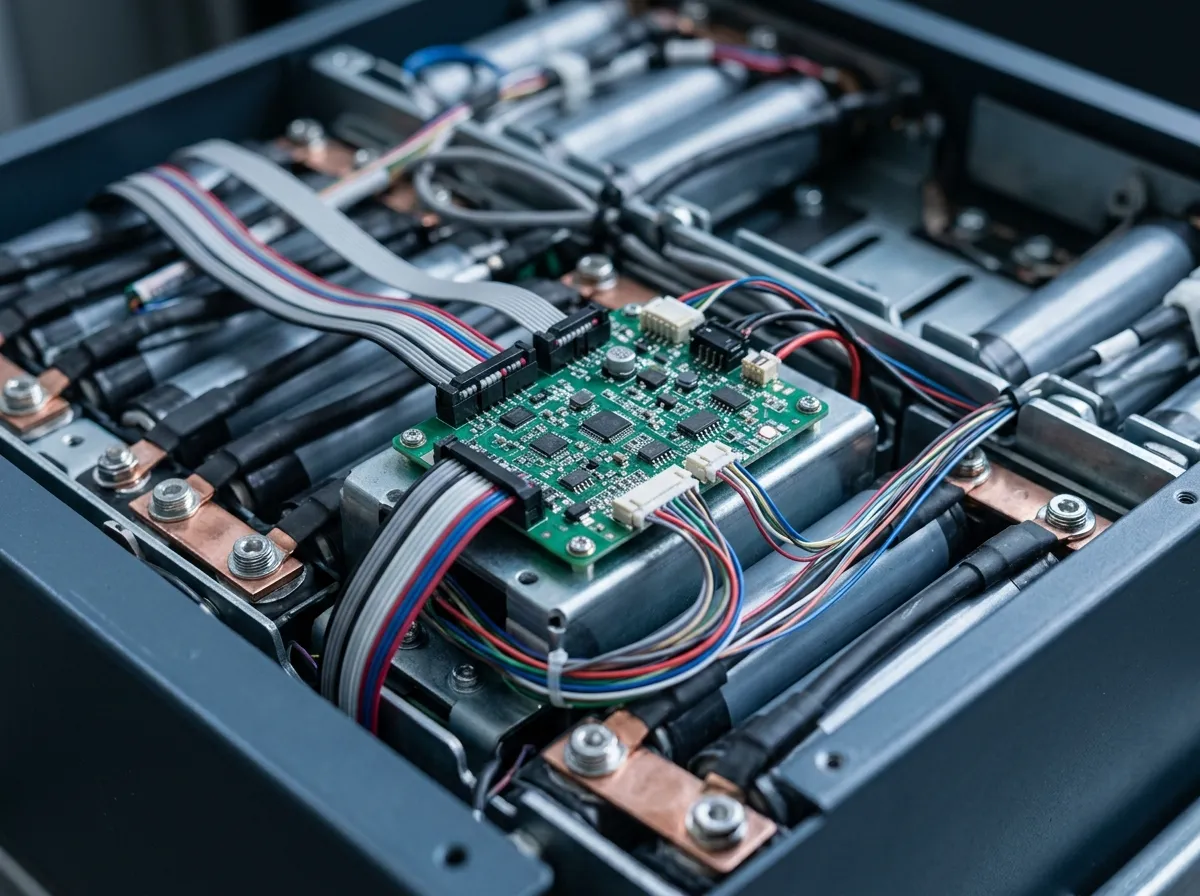
At the module level, cells are wired in a fixed internal pattern — for example 16 cells in series, one parallel group per position (16S1P), giving a low-voltage module. At the string level, those modules are series-connected to build the DC voltage the power conversion system needs. At the rack or container level, several strings are paralleled to reach the energy the site was designed for.
You can see the pattern in Hua Power's own lineup. A low-voltage residential unit like the HC-UPSRB16 is a single 51.2 V wall-mount module that stays in parallel at the system level. A high-voltage stack such as the HC-UPSSHV20I builds its voltage by series-connecting modules. And at the container scale, the HC-UPSB5010L uses a 1P104S cell arrangement with multiple strings paralleled inside the enclosure — one of several energy storage container configurations we build. In every case, the same two knobs apply: series sets the voltage, parallel sets the energy.
Two system-level constraints tie back to this:
- The inverter's DC window decides your series count. Too few cells in series and the voltage is below the inverter's minimum; too many and you exceed its maximum. The string length is not a free choice.
- The C-rate decides your parallel count. Asking a bank for a high discharge current means either more parallel strings or higher-rated cells. That balance is a design decision, not an afterthought.
Common Wiring Mistakes and Safety Rules
Most failures in series-parallel banks come from a short list of mistakes:
- Mixing aged or mismatched batteries in one string — the top cause of premature capacity loss.
- Unequal cable lengths between parallel strings — silently overloads the shortest path.
- Fusing the bank instead of the strings — a single fault can then be fed by every other string.
- Exceeding the BMS series limit — most BMSs support a maximum number of series cells; going over it leaves the pack unprotected.
- Skipping the isolation check — verify polarity and insulation before the first power-up.
At the system level, safety is a matter of compliant design, not just careful wiring. Battery energy storage equipment is tested and certified against standards such as UL 9540A for thermal runaway propagation and IEC 62619 for industrial battery safety; installations in the United States are also governed by codes including NFPA 855. You can read the scope of these directly from the publishers: UL 9540A testing, the NFPA 855 standard, and the U.S. Department of Energy's energy storage overview. For the underlying circuit theory, the standard reference on series and parallel circuits is a good refresher.
FAQ
Do batteries in parallel drain equally? Only if they see equal resistance to the load. In a well-built bank — matched batteries, equal-length cables, and a common busbar — parallel batteries discharge at nearly the same rate. If they do not, look at the wiring first: a shorter or looser cable on one battery makes it carry more current and drain faster.
Can you put two 12V batteries in series? Yes. Two 12V batteries in series make a 24V pack with the same amp-hour rating as a single battery. Just make sure both are the same model and age, and that your charger or inverter accepts 24V.
Are AA batteries connected in series or parallel? Small consumer cells follow the same rule. Put them in series for higher voltage (most flashlights and remotes run several AA cells in series), or in parallel for more capacity at the same voltage. The physics does not change with size.
Is it better to connect batteries in series or parallel? Neither is better in the abstract — match the configuration to the load. Series is how you reach a required voltage; parallel is how you reach a required capacity and current. Systems that need both use series-parallel banks, which is the standard approach for energy storage.
Does wiring batteries in series increase amp-hours? No. Series increases voltage and leaves amp-hours unchanged. Parallel increases amp-hours at the same voltage. In both cases the total energy in kWh is the same.
The Bottom Line
Series wiring and parallel wiring are two independent controls: series sets voltage, parallel sets capacity and current, and series-parallel lets you set both. Nothing about the wiring changes how much energy you own — it only changes the shape you deliver it in. Get the matching and the cabling right, let a proper BMS handle balancing, and design the bank against your inverter's DC window and your site's current needs, and the "series vs parallel" question stops being a puzzle and becomes a spec. If you are scoping a real system, start from the battery energy storage basics hub and work outward.