

A LiFePO4 battery — short for lithium iron phosphate — is a type of lithium-ion battery that uses lithium iron phosphate (LiFePO₄) as the cathode material. It is known for exceptional thermal stability, a lifespan of 2,000 to over 5,000 charge cycles, and a nominal voltage of 3.2 volts per cell, making it the dominant chemistry for stationary energy storage, solar systems, and electric vehicles where safety and longevity outweigh the need for maximum energy density.
What Is a LiFePO4 Battery?
At its core, a LiFePO4 battery works like any lithium-ion cell: lithium ions shuttle between a cathode and an anode through an electrolyte. What sets it apart is the cathode — lithium iron phosphate (LiFePO₄) — which has an olivine crystal structure that is inherently stable.
This stability is the root of everything that makes LiFePO4 different. The strong phosphorus-oxygen bonds in the phosphate group resist decomposition at high temperatures. Put simply: LiFePO4 cells don't release oxygen when they overheat. That means no thermal runaway — the chain reaction that can cause other lithium batteries to catch fire.
Most LiFePO4 cells operate at a nominal voltage of 3.2V, slightly lower than the 3.6–3.7V of conventional lithium-ion cells (NMC/NCA). Four cells in series produce 12.8V — a near-perfect match for 12V lead-acid systems, which is one reason LiFePO4 has become the go-to replacement battery for RVs, boats, and off-grid solar.
Why LiFePO4 Outperforms Other Battery Chemistries
Three numbers tell the story:
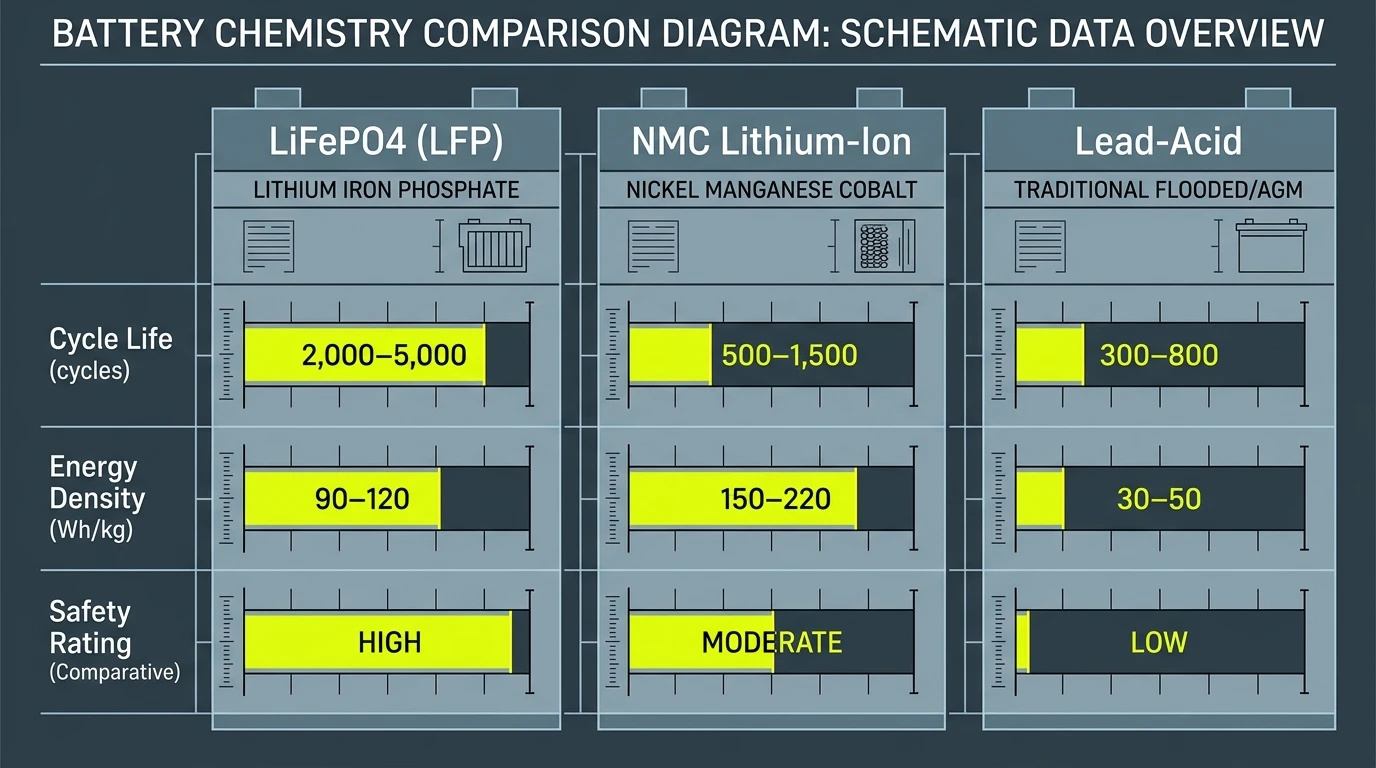
- 2,000–5,000+ cycles to 80% capacity, compared to 500–1,000 for lead-acid and 500–1,500 for typical NMC
- Thermal runaway threshold above 270°C, versus roughly 150–200°C for NMC — a margin that makes LiFePO4 the safest lithium chemistry available. The olivine crystal structure's strong phosphorus-oxygen bonds resist decomposition at high temperatures, a property documented in battery chemistry research and validated across decades of commercial deployment.
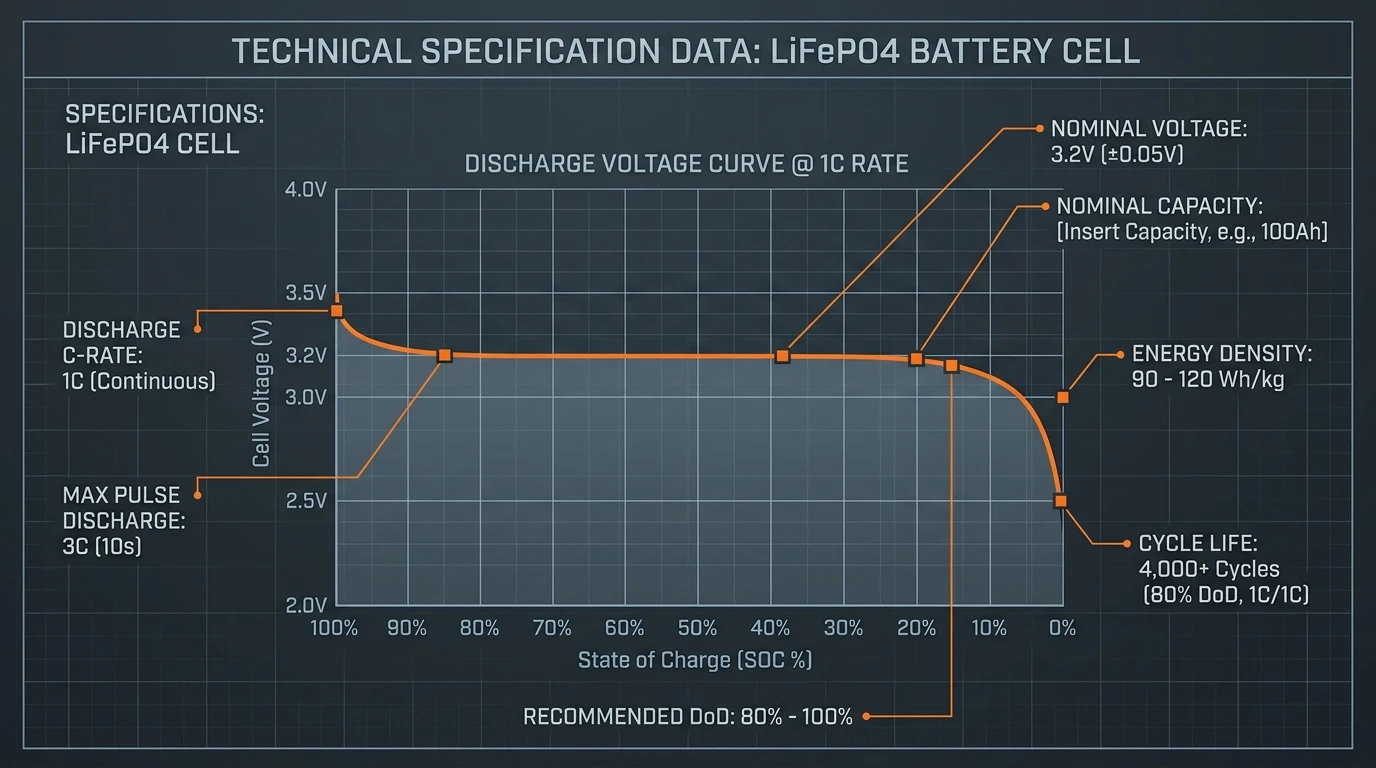
- Nearly flat discharge curve at 3.2V, meaning the battery delivers consistent power from 90% down to 20% state of charge
Safety is the headline advantage. Independent testing consistently shows LiFePO4 cells can withstand overcharge, short circuit, and puncture without fire or explosion. This is why LiFePO4 is the only lithium chemistry widely accepted for indoor residential storage and why it dominates the commercial BESS (Battery Energy Storage System) market.
The tradeoff is energy density. LiFePO4 packs roughly 90–120 Wh/kg, compared to 150–220 Wh/kg for NMC. For a stationary battery sitting in a basement or a container, that rarely matters. For an electric car where every kilogram counts, it does — which is why most EVs still use NMC, though LFP adoption is growing fast in standard-range models.
Here is how the three major battery types stack up:
Specification | LiFePO4 (LFP) | NMC / Lithium-Ion | Lead-Acid |
|---|---|---|---|
Nominal voltage | 3.2V/cell | 3.6–3.7V/cell | 2.0V/cell |
Cycle life | 2,000–5,000+ | 500–1,500 | 300–800 |
Energy density | 90–120 Wh/kg | 150–220 Wh/kg | 30–50 Wh/kg |
Thermal runaway risk | Very low | Moderate | Low (but vents hydrogen) |
Cost per kWh (cell) | $70–100 | $90–130 | $50–80 |
Maintenance | None | None | Requires watering |
Key LiFePO4 Specifications Explained
If you are reading a LiFePO4 battery datasheet, these are the numbers that matter:
Nominal voltage (3.2V/cell). This is the battery's "operating voltage." A 12.8V battery is four cells in series (4S). A 51.2V battery is 16 cells (16S). The voltage stays nearly flat for most of the discharge — meaning your equipment sees stable power.
Depth of discharge (DoD). LiFePO4 batteries can be discharged to 80–100% DoD repeatedly without significant degradation. Lead-acid batteries, by contrast, should rarely go below 50% DoD or their lifespan drops sharply. A 100Ah LiFePO4 battery at 100% DoD delivers as much usable energy as a 200Ah lead-acid bank at 50% DoD.
C-rate. The C-rate describes how fast you can charge or discharge relative to the battery's capacity. A 1C rate on a 100Ah battery means 100A of current. Most LiFePO4 cells are rated for 1C continuous discharge and 0.5C charge, with some high-power cells reaching 3C or more.
Cycle life. Measured to 80% of original capacity at a specified DoD and temperature. A cell rated "4,000 cycles at 80% DoD, 25°C" will deliver roughly that many full charge-discharge rounds before its capacity drops to 80% of the original rating. How manufacturers calculate cycle life varies — understanding how the spec is measured matters more than the headline number.
Where LiFePO4 Batteries Are Used
LiFePO4's combination of safety, long life, and falling costs has pushed it into nearly every stationary energy storage application:
- Residential solar storage. Wall-mounted and stackable LiFePO4 home batteries — from 5 kWh to 30 kWh — are the standard for pairing with rooftop solar. They charge during the day and power the home at night.
- RV, marine, and off-grid. The 12V LiFePO4 drop-in replacement market has exploded. A 100Ah LiFePO4 battery weighs roughly 13 kg and delivers twice the usable energy of a 100Ah lead-acid battery that weighs 30 kg.
- Commercial and industrial BESS. From 50 kW peak-shaving cabinets to 5 MWh containerized systems, LiFePO4 is the dominant chemistry for grid-connected and behind-the-meter storage. The commercial and industrial energy storage market runs almost entirely on LFP.
- Telecom and UPS. LiFePO4 48V racks are replacing lead-acid in telecom base stations and data center UPS systems, where floor weight and maintenance intervals matter.
- Electric vehicles and material handling. LFP is gaining share in standard-range EVs (Tesla, BYD) and is already dominant in electric forklifts, AGVs, and golf carts — applications where weight is less critical than safety and cycle life.
How to Evaluate LiFePO4 Battery Quality
Not all LiFePO4 batteries are built the same. If you are sourcing cells or complete battery packs — whether for a single home installation or a container-scale project — here is what separates a quality product from a liability:
Cell grading. LiFePO4 cells are graded A, B, or C at the factory based on capacity matching, internal resistance, and self-discharge rate. Grade A cells meet the manufacturer's full specification; Grade B and C cells are production rejects sold into secondary markets at steep discounts. A "too good to be true" price almost always means B or C cells inside.
Certifications. For commercial and industrial projects, look for:
- UL 1973 — Safety standard for stationary battery systems (required in North America)
- IEC 62619 — International safety standard for industrial batteries
- UN 38.3 — Transport safety testing (mandatory for shipping lithium batteries)
- CE / UKCA — Conformity marks for the European and UK markets
Battery Management System (BMS). The BMS is the brain of any LiFePO4 pack — it handles cell balancing, overcharge protection, temperature monitoring, and short-circuit protection. A pack with high-quality cells and a cheap BMS will fail early. Look for BMS units with active balancing (not just passive), configurable protection thresholds, and communication interfaces (CAN bus, RS485) for integration with energy management systems.
Manufacturing transparency. A supplier who cannot tell you the cell manufacturer, the BMS brand, and the assembly quality control process is not a supplier you want to depend on.
What to Read Next
Understanding LiFePO4 is the foundation. For more depth on battery technology and energy storage systems, explore our battery energy storage fundamentals hub — it covers chemistry, sizing, selection, and procurement for buyers at every level.