

Outdoor vs Indoor Battery Energy Storage Cabinet: Which One Fits Your Site?
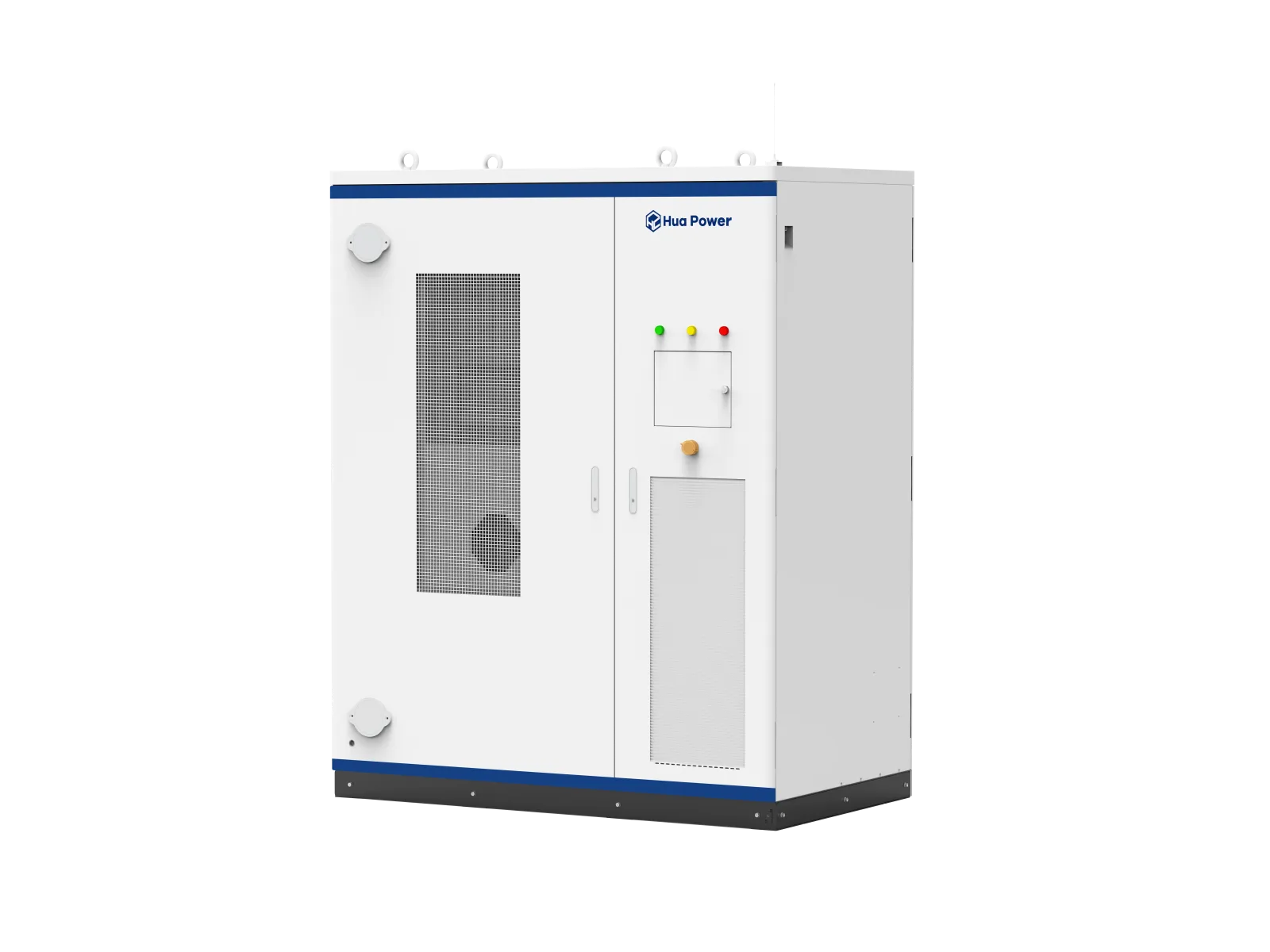
The enclosure you choose — outdoor or indoor — is set by your site, not just where the box ends up.
When you specify a commercial battery cabinet, one of the first forks in the road is enclosure type: outdoor or indoor. It sounds like a question about where you'll park the box. It's actually a question about your site constraints, climate, civil-works budget, and permitting — and getting it wrong is expensive in a way you don't discover until installation day.
Pick an indoor cabinet because the quote was cheaper, then find you have to build a ventilated, fire-rated room for it, and the "savings" evaporate. Pick an outdoor cabinet for a site that has a perfectly good empty plant-room, and you've paid for IP54 weatherproofing and corrosion protection you'll never use.
This guide compares the two on the dimensions that actually decide the call — IP rating, installation, cost, climate, fire safety, and footprint — and ends with a decision framework you can apply to your own site.
The short version: An outdoor cabinet (IP54) is self-contained — it handles weather, dust and corrosion so you can drop it on a pad outside with no building. An indoor cabinet (IP21) is cheaper and more compact but needs a suitable, ventilated room. Choose outdoor when you lack indoor space or want the fastest deployment; choose indoor when you already have a protected room and want to minimize enclosure cost and footprint exposure.
The core difference: what the enclosure is built to survive
Every other trade-off flows from one number: the IP rating (IEC 60529), which describes how well an enclosure keeps out solids and water.
- Outdoor cabinets are rated IP54 — protected against dust and water spray from any direction. They add anti-corrosion treatment (commonly C4-grade) and a wide operating-temperature window so they can sit exposed to rain, sun, coastal salt air, and desert dust.
- Indoor cabinets are rated IP21 — protected against fingers and dripping water only. The enclosure is lighter and more compact because it's not doing weatherproofing; it assumes a building is doing that job.
That single distinction — "the cabinet protects itself" vs "the building protects the cabinet" — is the whole comparison in miniature. Everything below is a consequence of it.
In Hua Power's C&I line this shows up as a naming convention: a model with an I suffix is the indoor variant. The HC-UPSAP112 (50 kW / 112.5 kWh) is the IP54 outdoor cabinet; the HC-UPSAP112I is the same electrical system in a compact IP21 indoor enclosure. Same cells, same BMS/EMS, same capacity — different shell for a different home.
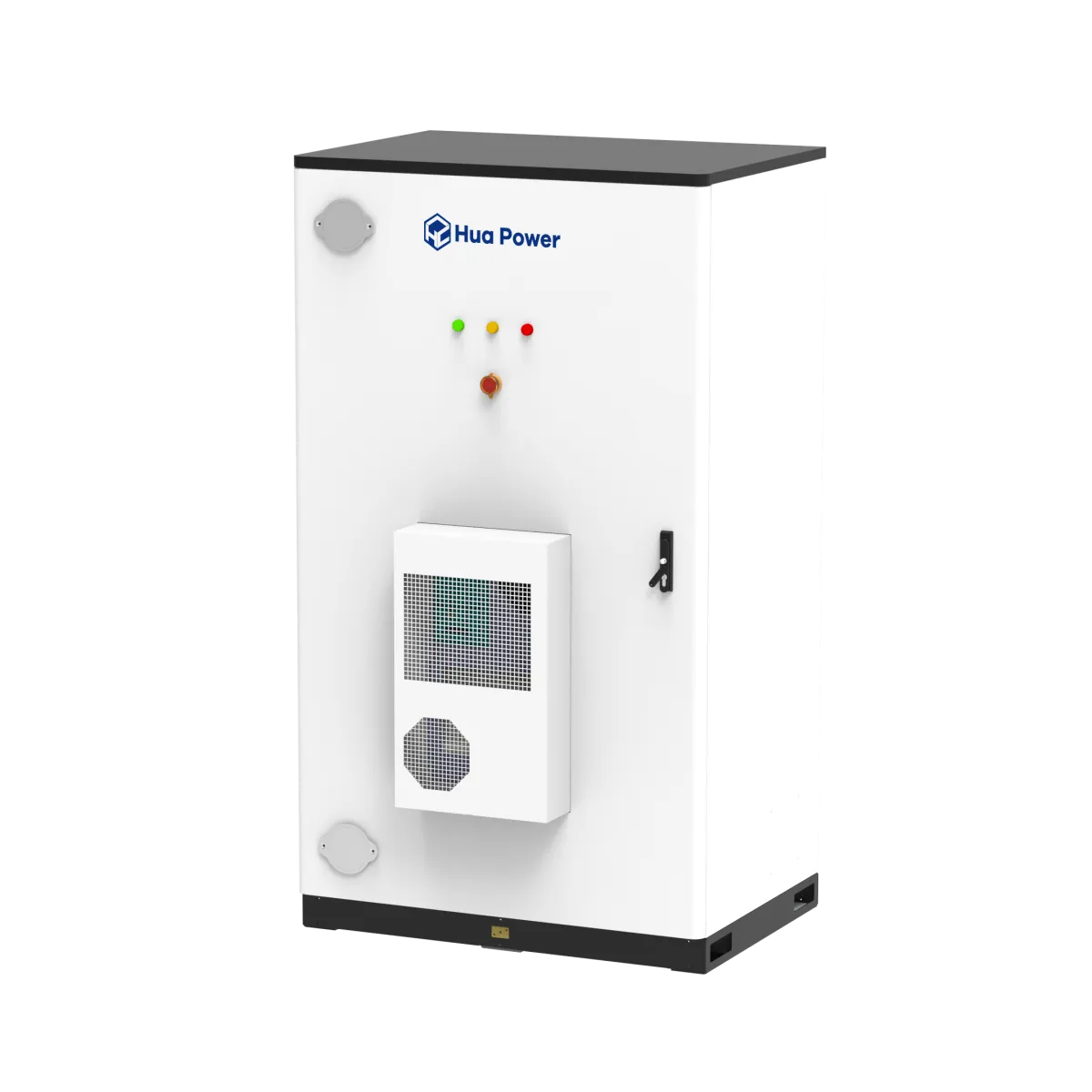
The indoor (I) variant: the same electrical system in a compact IP21 shell, built to live in a protected room.
Side-by-side comparison
Dimension | Outdoor cabinet (IP54) | Indoor cabinet (IP21) |
|---|---|---|
Protection | Dust + water spray, anti-corrosion (C4) | Drips/fingers only — relies on the room |
Operating climate | ~ −30 °C to +50 °C, coastal/desert OK | Needs a climate-stable room |
Where it goes | Concrete pad outside, no building | Plant room, basement, dedicated ESS room |
Civil works | Pad + clearances + lightning/earthing | Often none if a suitable room exists |
Building cost | None | Must have / build a ventilated, fire-rated room |
Enclosure cost | Higher (weatherproofing built in) | Lower (simpler shell) |
Footprint | Uses outdoor land, frees interior space | Uses interior floor space |
Deployment speed | Fast — set, anchor, connect | Fast if the room exists; slow if you must build it |
Security / noise | Exposed; needs fencing; fans audible outdoors | Inside a controlled, lockable space |
Best when | No spare indoor space; quick rollout | You already have a protected room |
Use this to see which way your site leans, then read the two sections below for the details that tip close calls.
When the outdoor cabinet wins
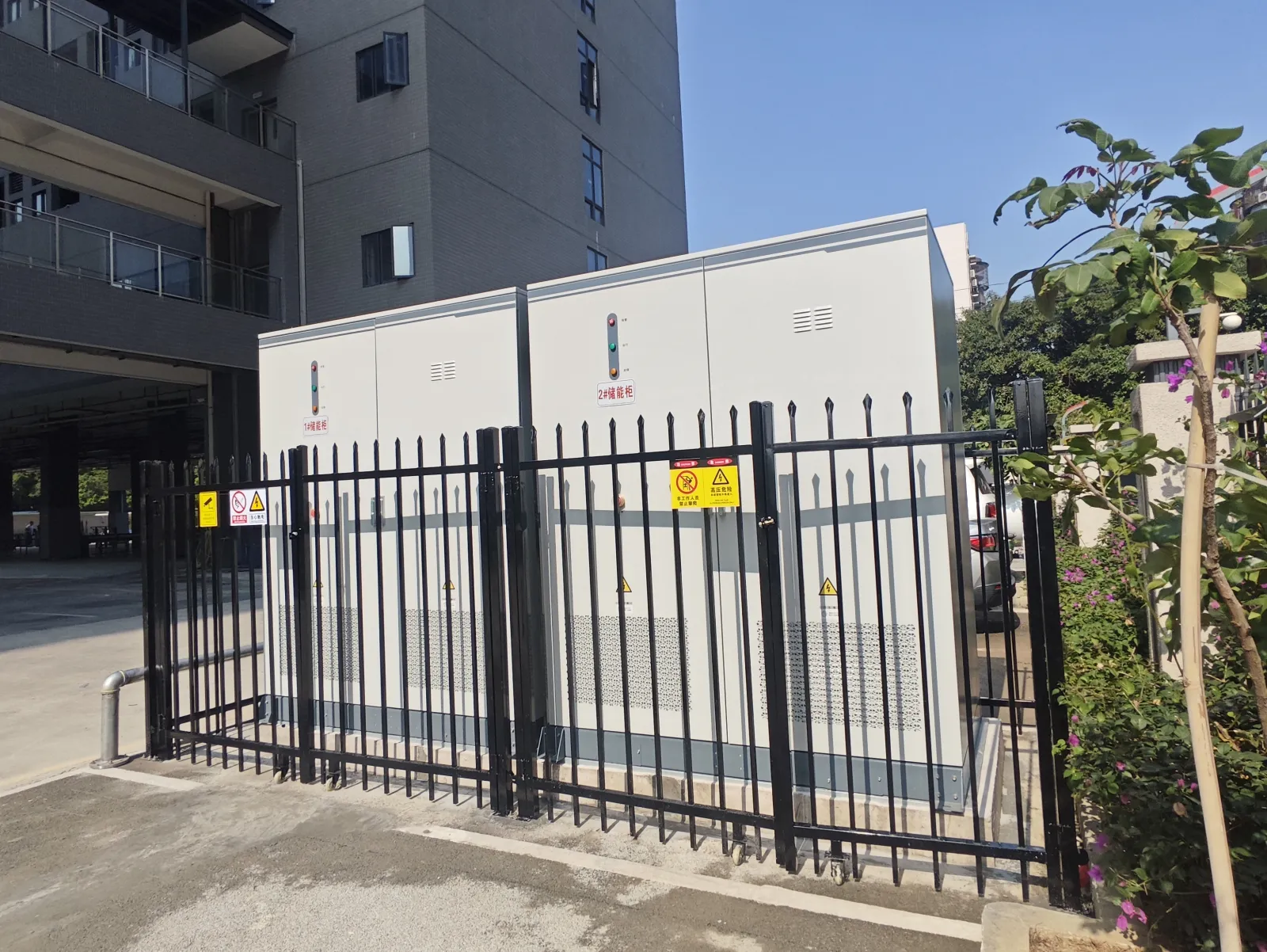
Outdoor IP54 cabinets sit on a pad in the open — no building required, just clearances and fencing.
An outdoor cabinet is the right call when you don't have — and don't want to build — a room for the battery. Most greenfield C&I sites, car-park and EV-charging installations, and factories with yard space fall here.
Reasons it wins:
- No building, no waiting. The cabinet is the weatherproof room. You pour a pad, set clearances, run earthing and lightning protection, anchor it, and connect. There's no architect, no fire-rated room build, no HVAC for a battery room.
- Hostile environments are fine. IP54 plus C4 corrosion protection and a −30 °C to +50 °C range means coastal salt, desert dust, and cold climates are in-spec. The HC-UPSAP112, HC-UPSAP241 and liquid-cooled HC-UPSAP261L are all IP54 for exactly this.
- It frees your interior space. Floor area inside a working plant is valuable; pushing the battery outside keeps it for production.
The costs you take on: a concrete foundation and site civil works, fencing for security, and exposure of fans/noise to the surroundings. The enclosure itself also costs more than an indoor shell — you're paying for the weatherproofing. For most sites without a spare room, that's still cheaper than constructing one.
When the indoor cabinet wins
.jpg)
Indoor IP21 cabinets in a plant room — the building provides the weather protection, so the enclosure is lighter and more compact.
An indoor cabinet is the right call when a suitable protected space already exists. Retrofits in buildings with a basement, plant room, or spare industrial hall are the classic case.
Reasons it wins:
- Lower enclosure cost. You're not paying for IP54 weatherproofing or C4 corrosion treatment. The IP21 shell is simpler and cheaper. With Hua Power, the
HC-UPSAP112I/HC-UPSAP64Iindoor variants drop straight into an existing room. - Compact and tidy. Indoor enclosures are smaller and lighter, easier to maneuver through a plant, and the install looks clean inside a controlled space.
- Physical security and stable conditions. A locked, roofed room protects against weather extremes, vandalism, and tampering, and keeps fan noise contained.
The costs you take on: you must have a room that can take the battery — adequately ventilated, with the right fire detection/suppression and code-mandated clearances, and able to handle heat rejection. If you'd have to build that room, the indoor cabinet's lower price is a mirage: the construction usually costs far more than the enclosure you saved on. Indoor battery rooms also carry their own fire-code requirements (e.g. NFPA 855 spacing and, in the US, UL 9540A test data for the system) that an outdoor pad install can sometimes avoid or simplify.
Three factors that quietly decide it
1. Fire safety and permitting. Indoor battery installations face stricter scrutiny — ventilation, gas detection, suppression, and spacing rules inside an occupied building. Outdoor pad installs with separation distances are often the path of least regulatory resistance. Whichever you choose, the system should carry the right certifications for your market; in the US that means UL 9540A test data so the authority having jurisdiction (AHJ) can sign off. (For the full market-by-market view, see our EU grid-connection compliance guide.)
2. Thermal Management — and it's a separate choice. Outdoor vs indoor decides the shell; air vs liquid cooling decides the thermal system inside it. They're independent: you can have an outdoor liquid-cooled cabinet or an indoor air-cooled one. In a hot indoor room, cooling load matters even more. Decide the enclosure here, then settle cooling in liquid-cooled vs air-cooled BESS.
3. Expansion. If you plan to grow capacity later, think about where the next cabinet goes. Outdoor pads are easy to extend; an indoor room has a hard ceiling once it's full. Because Hua Power's cabinets share one BMS/EMS across the whole capacity ladder, you can add units in either setting — but the space has to be there. Size the site, not just today's cabinet (we cover this in 100, 200 or 500 kWh capacity selection).
A simple decision framework
Answer these in order and the choice usually settles itself:
- Do you already have a suitable, ventilatable room? No → outdoor. Yes → keep going.
- Would using that room displace valuable production/operational space? Yes → outdoor. No → keep going.
- Is the climate harsh (coastal salt, desert dust, extreme cold) and the room not climate-stable? Yes → outdoor. No → keep going.
- Do you want the lowest enclosure cost and a tidy, secured, low-noise install? Yes → indoor.
If you're still torn, default to outdoor for speed and flexibility on greenfield sites, and indoor for retrofits where a protected room already exists. And remember the variant trick: with a model line like Hua Power's, you can spec the same electrical system as either an IP54 outdoor (HC-UPSAP112) or IP21 indoor (HC-UPSAP112I) cabinet — so the enclosure decision doesn't lock you out of any capacity or cooling option.
How to get a site-specific recommendation
The framework above gets you to outdoor or indoor. Turning that into a final spec — exact model, cooling, pad or room requirements, and clearances — depends on your site survey, climate, and local fire code.
That's where talking to an integrator helps: Hua Power has deployed 400+ ESS projects across 30+ countries in both outdoor and indoor configurations, so the recommendation is grounded in what actually passes inspection and survives the environment. Start with the C&I energy storage overview to scope the project, or if you're evaluating a project, our engineering team can help assess your load profile, installation environment, and long-term expansion plan before recommending a suitable cabinet configuration.
Frequently asked questions
What's the difference between an outdoor and indoor energy storage cabinet? The enclosure. An outdoor cabinet is rated IP54 with anti-corrosion treatment and a wide temperature range, so it can sit exposed to weather on a pad with no building. An indoor cabinet is rated IP21 — lighter and more compact — and relies on a protected, ventilated room to handle weather. The battery cells, BMS and capacity can be identical; only the shell differs.
What does IP54 vs IP21 mean for a battery cabinet? IP ratings (IEC 60529) describe protection against solids and water. IP54 means dust-protected and shielded from water spray from any direction — suitable for outdoor use. IP21 means protected against fingers and vertical dripping water only — it assumes a building provides weather protection, so it's for indoor use.
Is an outdoor cabinet more expensive than an indoor one? The outdoor enclosure costs more because of its weatherproofing and corrosion protection, and it needs a concrete pad plus fencing. But an indoor cabinet only saves money if you already have a suitable room. If you'd have to build a ventilated, fire-rated battery room, that construction usually costs far more than the outdoor enclosure premium — making outdoor cheaper overall.
Can I install an outdoor battery cabinet indoors (or vice versa)? You can place an outdoor (IP54) cabinet indoors — it's over-specified but works, just larger and pricier than needed. You should not place an indoor (IP21) cabinet outdoors: it isn't sealed against dust, water, or corrosion and will fail prematurely. Better to spec the correct variant — many product lines (e.g. Hua Power's HC-UPSAP112 vs HC-UPSAP112I) offer both for the same electrical system.
Does outdoor or indoor affect fire safety requirements? Yes. Indoor battery installations face stricter requirements — ventilation, gas detection, suppression, and spacing inside an occupied building (e.g. NFPA 855). Outdoor pad installs with separation distances are often simpler to permit. In all cases, look for system-level fire certifications such as UL 9540A so your local authority can approve the install.
Is the outdoor/indoor choice the same as air-cooled vs liquid-cooled? No — they're independent. Outdoor vs indoor is about the enclosure; air vs liquid is about the thermal management inside it. You can combine them freely (e.g. an outdoor liquid-cooled cabinet). Decide the enclosure based on your site, then choose cooling based on how hard the system cycles and your climate.