

If you are developing a commercial or industrial battery energy storage system (BESS) anywhere in the EU, the hardest part of your project is not the battery. It is the paperwork that proves the battery will behave when the grid has a bad day.
Europe runs on a shared rulebook — the Requirements for Generators (RfG) network code — layered with harmonised standards and, underneath those, a different set of national forms, certificates, and test protocols in every member state. A system that is fully compliant in Germany cannot simply be trucked to Italy and switched on. Miss a requirement and you don't get a fine — you get something worse: no connection agreement, no energisation, and a stalled project burning interest.
This guide is written for the people who have to get the system connected: C&I developers, EPCs, energy managers, and international manufacturers entering EU markets. It explains how your BESS gets classified, what the grid code actually demands of it, the standards that turn those demands into test criteria, the step-by-step approval process, and where the rules diverge country by country.
The short version: EU grid connection for storage is governed by the RfG (Regulation (EU) 2016/631), which sorts your plant into Type A/B/C/D by capacity and connection voltage. Each type must prove technical capabilities — fault ride-through, reactive power, frequency response, controllability. The harmonised standard EN 50549 turns those into testable criteria for distribution-connected plants. Compliance is proven with type-test certificates plus a plant certificate, submitted to your grid operator to earn an operational notification (EON/FON) before you can energise. Every country adds its own layer — Germany's VDE-AR-N 4105/4110, Italy's CEI 0-16/0-21, Spain's NTS — and a grid-forming requirement for storage above 1 MW is now coming under NC RfG 2.0.
Why grid connection is the real bottleneck
A BESS is, from the grid's point of view, a generator that can also absorb power. When it discharges into the network it changes voltage, contributes to (or resists) frequency, and can either help or hurt the grid during a fault. That is why grid operators don't ask whether you have a battery — they ask you to prove it will do the right thing automatically, in milliseconds, without a human in the loop.
That proof is the project's critical path. Procurement, civil works, and installation are predictable. Grid connection is where projects slip, because it depends on:
- A classification you may not control (it follows your capacity and connection point).
- Documentation and certificates that must exist before you energise, some of which take months to produce.
- A grid operator's queue and approval, which you don't set the pace of.
Treat compliance as a day-one workstream, not a closeout task. The rest of this guide is the map.
The rulebook: RfG and how your BESS gets classified
The Requirements for Generators (RfG) — Commission Regulation (EU) 2016/631 — is the EU-wide network code that harmonises what any generating facility must do to connect to the grid. It has applied to new plants since 2019, and it is the document every national grid code is built on top of (ENTSO-E maintains the code and its 72 articles).
The first thing RfG does is sort your plant into one of four types, by maximum capacity and connection voltage. The type sets how demanding the requirements are — a rooftop system and a 100 MW plant are held to very different standards. For the Continental Europe synchronous area, the maximum thresholds are:
Type | Capacity (Continental Europe max) | Connection voltage | Roughly who this is |
|---|---|---|---|
Type A | ≥ 0.8 kW, below Type B | < 110 kV | Residential / very small commercial |
Type B | ≥ 1 MW, below Type C | < 110 kV | Most C&I and mid-scale BESS |
Type C | ≥ 50 MW, below Type D | < 110 kV | Large industrial / small utility |
Type D | ≥ 75 MW or any plant at ≥ 110 kV | ≥ 110 kV | Grid-scale |
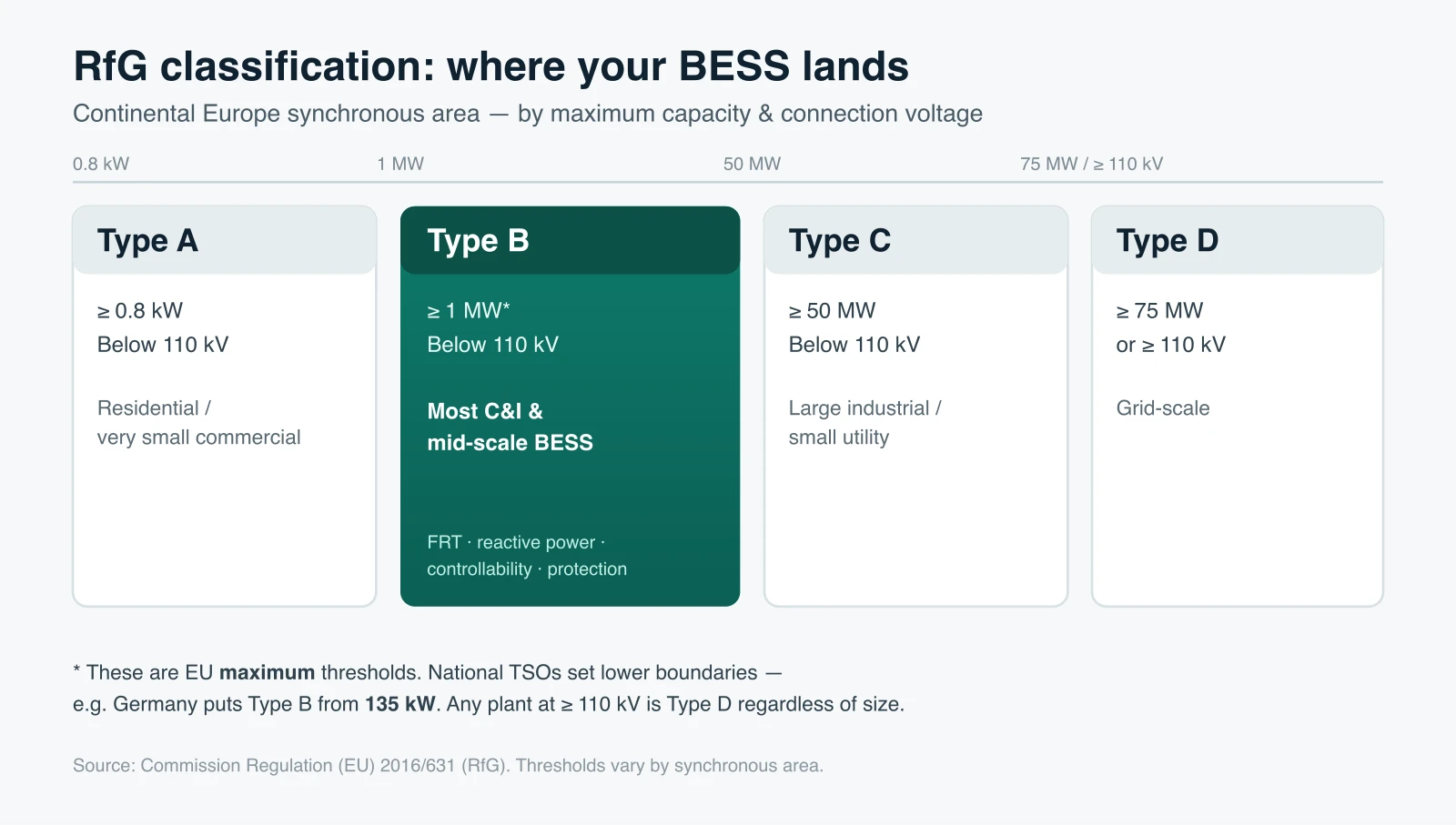
Most C&I batteries land in Type A or Type B — but the national threshold, not the EU ceiling, decides which.
Two things trip people up:
- These are ceilings, not fixed numbers. RfG lets each country's TSO set lower national boundaries. Germany, for example, puts the Type B threshold at 135 kW, far below the 1 MW ceiling — so a mid-sized German C&I battery is Type B, with the heavier obligations that brings. Always confirm the national threshold, not the EU maximum.
- The thresholds differ by synchronous area. Great Britain uses 1 / 50 / 75 MW; the Nordic area 1.5 / 10 / 30 MW; Ireland just 0.1 / 5 / 10 MW; the Baltic area 0.5 / 10 / 15 MW. A project's classification is a function of where it connects.
Where storage sits. RfG was written around generators, and storage was originally handled by analogy — an inverter-based BESS is treated as a power park module (PPM). That ambiguity is closing: EU network codes are being amended to name electricity storage explicitly, and the distribution-level standard EN 50549 already carries storage-specific clauses (more below). For a C&I project today, the practical answer is: your BESS is almost always Type A or Type B, and you comply as a power park module.
What the grid code actually requires
Classification tells you how strict the rules are; the grid code tells you what the system must physically do. These are capabilities engineered into the power conversion system (PCS) and its controls, then proven by test. The core requirements that rise in stringency from Type A to Type D:
Capability | What it means | Typically required from |
|---|---|---|
Frequency response — LFSM-O | Automatically curtail active power when frequency rises above a set threshold. | Type A up |
Frequency response — LFSM-U | Raise active power when frequency falls below a threshold. Under RfG this is a Type C+ obligation — but EN 50549 makes it a firm requirement for storage at LV/MV, because a battery (unlike most generators) can increase output on demand. | Storage: yes (EN 50549) · RfG Type C up |
Frequency Sensitive Mode (FSM) | Continuous, droop-based active-power/frequency control across the normal band. | Type C up |
Fault ride-through (FRT / LVRT) | Stay connected through voltage dips from grid faults instead of tripping off — preventing a local fault from cascading. | Type B up |
Reactive power / voltage support | Inject or absorb reactive power (Q) to help hold voltage at the connection point, across a defined P-Q envelope. | Type B up |
Active power controllability | Accept a setpoint and remote control signal from the operator; ramp within limits. | Type B up |
Protection & anti-islanding | Interface protection (over/under voltage and frequency) and reliable disconnection so the plant never energises a dead network section. | Type A up |
Power quality | Keep harmonics, flicker, and DC injection within limits. | All |
Information exchange / telemetry | Provide real-time signals and, at higher types, remote dispatch. | Type B up |
For a Type B C&I battery — the most common case — the four that dominate your design and testing are FRT, reactive-power capability, controllable active power, and interface protection. Get the PCS and EMS right on these and most of the compliance case writes itself.
EN 50549: the standard that makes RfG testable
RfG says what a plant must achieve; it doesn't hand you pass/fail test criteria. That layer is the EN 50549 series — the harmonised European (CENELEC) standard for connecting generating plants, including storage, to distribution networks. It is what most C&I projects are actually tested against, because most C&I plants connect at low or medium voltage:
- EN 50549-1 — connection to the low-voltage (LV) network, up to and including Type B.
- EN 50549-2 — connection to the medium-voltage (MV) network, up to and including Type B.
- EN 50549-10 — conformity-assessment tests for generating and storage units.
EN 50549 spells out the protection functions, ride-through behaviour, reactive-power and power-factor capability, and anti-islanding logic your system must demonstrate — and it explicitly brings electrical energy storage systems into scope, with storage-specific obligations (for example, LFSM-U is a firm requirement for storage). A PCS that carries an EN 50549 type-test certificate has already cleared most of the technical bar; national codes then adjust settings on top.
Don't confuse the two layers. RfG (and its national codes) is the legal requirement your grid operator enforces. EN 50549 is the technical standard used to prove you meet it. You need both: a standard-compliant product and a country-compliant installation.
The compliance process, step by step
The sequence below is the Type A/B pattern used across most of the EU. Names differ by country, but the logic is the same: apply → design → prove → notify → test → operate.
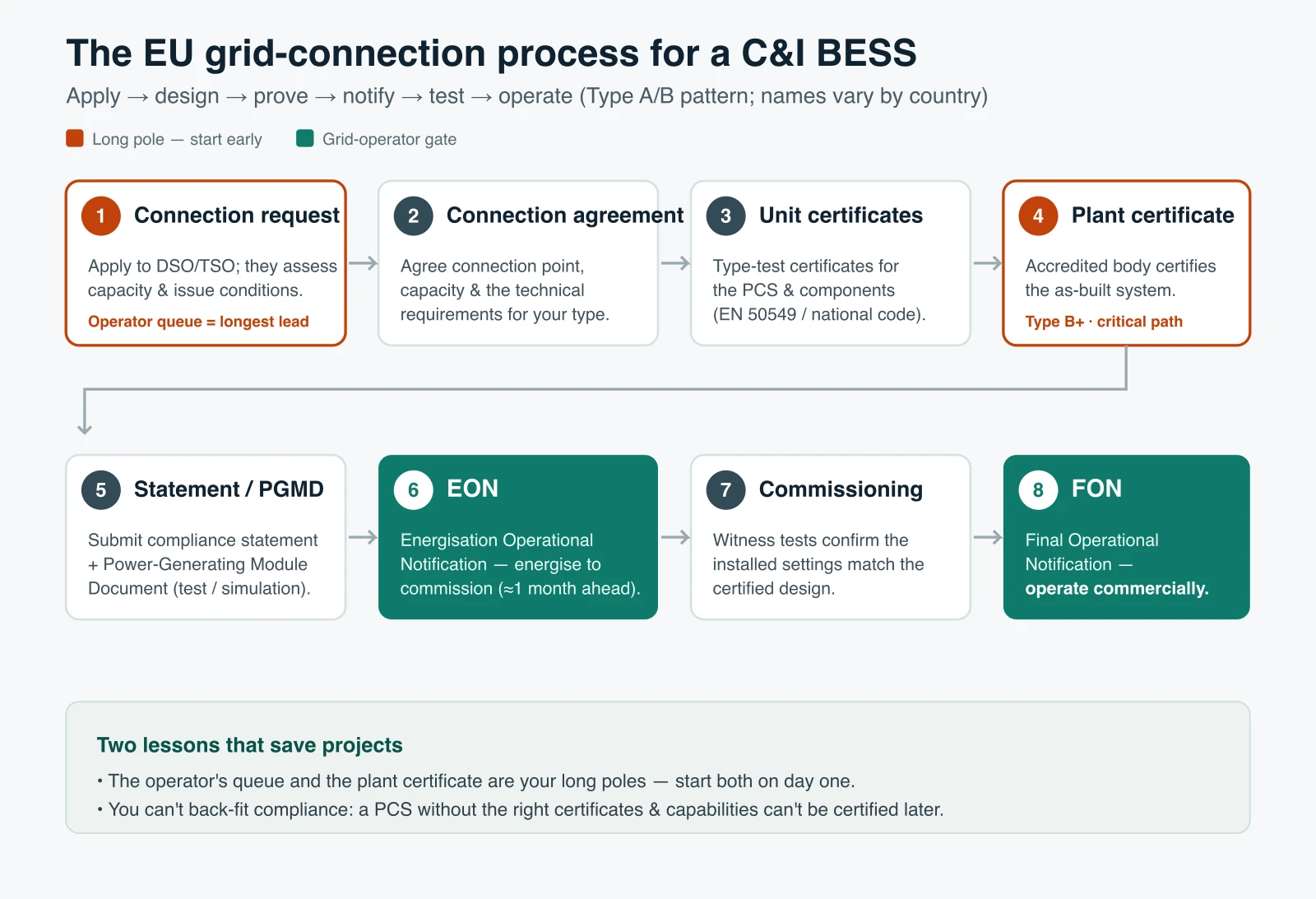
The two red steps are your long poles; the two green steps are the grid operator's gates. Everything hinges on certificates that must exist before you energise.
- Connection request & grid study. Apply to your DSO/TSO. They assess available capacity at the connection point and issue connection conditions (and, for larger plants, a grid study). Queues here can be the single longest lead time — start early.
- Connection agreement. You and the operator agree the connection point, capacity, and the technical requirements your plant must meet (driven by your RfG type).
- Design & unit certificates. Your engineered design references unit (type-test) certificates for the PCS and components — evidence they meet EN 50549 / national code at the device level. A reputable manufacturer supplies these; without them, the project cannot proceed.
- Plant certificate. For Type B and above, an accredited certification body issues a plant (installation) certificate confirming the as-built system — PCS, protection, controls, EMS settings — meets the code as a whole. This is the document that most often sits on a project's critical path.
- Compliance statement / PGMD. You submit a Power-Generating Module Document (or national equivalent) with a statement of compliance to the operator, evidenced by testing and/or simulation studies (FRT and reactive-power capability are commonly demonstrated by simulation for larger plants).
- Operational Notification (EON → FON). With the statement accepted, the operator issues an Energisation Operational Notification (EON) — permission to energise for commissioning — typically required at least a month before energisation. After successful on-site commissioning tests, you receive the Final Operational Notification (FON): permission to operate commercially.
- Commissioning & witness tests. On-site tests confirm the installed protection settings and control behaviour match the certified design and the single-line diagram. Only after these pass does the plant run for real.
The two lessons that save projects: the plant certificate and the operator's queue are your long poles, and you cannot back-fit compliance — a PCS without the right certificates and capabilities can't be certified after the fact.
Same rules, different paperwork: country by country
RfG harmonises the what; each member state owns the how. If you sell or build across borders, budget for a distinct compliance package per country — the technical requirements overlap heavily, but the certificates, forms, and registries do not transfer.
Country | Core connection rules | Notable extras |
|---|---|---|
Germany | VDE-AR-N 4105 (LV) · VDE-AR-N 4110 (MV, 1–60 kV) — 4110 explicitly covers storage | NELEV ordinance mandates unit + plant certificates (Anlagenzertifikat); ZEREZ component-registry entry now required to connect |
Italy | CEI 0-21 (LV) · CEI 0-16 (MV), both aligned to RfG | Anti-islanding and interface-protection (SPI) rules are strict; storage explicitly addressed |
Spain | NTS (Normas Técnicas de Supervisión) implementing RfG | Conformity assessment runs as an accredited certification scheme under the national accreditation body |
France | Connection rules under the arrêté framework (Enedis for DSO) | Documentation-heavy; confirm current storage provisions with the DSO |
Netherlands | RfG implemented via Netbeheer Nederland codes | Standardised RfG compliance-verification document and PGMD process |
This table is a starting map, not a substitute for the live national code — versions get revised (Germany's VDE-AR-N 4110 is currently the 2023-09 edition), and a DSO can impose site-specific conditions. Confirm the current edition with the local grid operator before you finalise the design.
Note the parallel, non-grid requirement running alongside all of this: CE marking and the EU Battery Regulation (2023/1542) govern the product's safety, labelling, and recycling. Grid-code compliance gets you connected; CE and the battery regulation get you legally on the market. You need both.
Grid-forming: the requirement coming for storage above 1 MW
The biggest change on the horizon is grid-forming capability. Today most inverters are grid-following — they need a stable grid voltage to sync to. Grid-forming inverters can actively set voltage and frequency and behave more like a synchronous machine, providing inertia-like support the grid increasingly needs as it decarbonises.
Europe is moving to mandate grid-forming for new storage and renewable plants above 1 MW under the forthcoming NC RfG 2.0. ENTSO-E published its Phase II Technical Report on Grid Forming Requirements in November 2025, consolidating the technical definition that will feed the amendment. As of now the obligation is not yet formally adopted, and it will apply only to new connections and substantial modifications — but the direction is set.
The practical takeaway for anyone specifying a C&I or larger BESS now: ask whether the PCS is grid-forming-capable, or upgradeable to it. A system bought today for a 1 MW+ site may face this requirement within its operating life, and retrofitting grid-forming control is far harder than choosing a capable platform up front.
A pre-connection compliance checklist
Run this before you commit to hardware or a connection point:
- Confirm your RfG type using the national thresholds for the country and voltage level, not the EU ceiling.
- Get the connection request in early — the operator's queue is often the longest lead time in the whole project.
- Demand the certificates. Require EN 50549 / national unit (type-test) certificates for the PCS as a condition of purchase. No certificates, no bid.
- Confirm the capabilities your type needs — FRT/LVRT, reactive-power (P-Q) range, controllable active power, LFSM-U, interface protection — are native to the PCS, not "roadmap."
- Plan the plant certificate for Type B+; identify your accredited certification body and its lead time now.
- Check national registries (e.g. Germany's ZEREZ) and product-market rules (CE, Battery Regulation 2023/1542).
- Ask about grid-forming for any plant near or above 1 MW — capable, or upgradeable?
- Line up commissioning — witness tests and the EON→FON sequence, at least a month before target energisation.
If you can tick every box before signing, grid connection stops being the thing that blows your schedule.
Where the right hardware makes compliance easy
Every requirement above ultimately lives in one place: the power conversion system and its controls. Fault ride-through, reactive-power range, frequency response, and controllability are PCS capabilities — proven by the certificates that carry your project through approval. Choosing a platform built for European grid codes is the difference between compliance as a formality and compliance as a project-killing scramble.
This is where Hua Power's background is directly relevant. The company's control technology originated in European grid-frequency regulation — millisecond-level grid-response control developed for exactly the frequency and voltage support that grid codes now demand. That heritage is built into the PCS and the Visual Energy Management Platform across the C&I range (the HC-UPSAP and HC-UPSSP cabinets), which support the grid-following capabilities RfG and EN 50549 require and connect grid, PV, and generator inputs simultaneously. The exact type-test certificates that apply to your target market and voltage level are worth confirming with the team when you scope a purchase — because, as this guide stresses, the certificates are what carry a project through connection.
With 400+ ESS projects deployed across 30+ countries — including on-grid C&I and PV+storage sites in Europe such as a 500 kW / 1 MWh installation in Portugal — the systems arrive with a track record of clearing real grid-connection processes, not just a datasheet. When you're scoping a purchase, confirm the certificates and capabilities before you commit — and the choice of PCS itself, where every grid-code capability ultimately lives, is covered in commercial battery inverter selection.
Once a system is connected and compliant, the same grid-code capabilities become revenue: the reactive-power and frequency-response functions you certified for connection are the foundation for demand response and ancillary services, and the connected asset can run commercial peak shaving day to day. For the full system context, see the C&I energy storage overview.
To scope a compliant connection for a specific site and country, talk to our team with your connection voltage, target capacity, and member state — the requirements fall out of those three.
Frequently asked questions
What regulation governs BESS grid connection in the EU? The core framework is the Requirements for Generators (RfG) — Commission Regulation (EU) 2016/631 — a network code that harmonises grid-connection requirements across the EU. Each member state implements it through national grid codes (Germany's VDE-AR-N series, Italy's CEI 0-16/0-21, Spain's NTS, and so on), and the harmonised standard EN 50549 provides the testable technical criteria for distribution-connected storage.
How is a battery storage system classified under RfG? By maximum capacity and connection voltage, into Type A, B, C, or D. In Continental Europe the ceilings are Type B ≥ 1 MW, Type C ≥ 50 MW, and Type D ≥ 75 MW or any plant connecting at 110 kV or above — but each TSO can set lower national thresholds (Germany's Type B starts at 135 kW). Most C&I batteries are Type A or Type B, complying as power park modules.
What is EN 50549 and do I need it? EN 50549 is the European standard for connecting generating plants — including storage — to LV (Part 1) and MV (Part 2) distribution networks, with conformity tests in Part 10. It turns RfG's requirements into pass/fail criteria. A PCS with an EN 50549 type-test certificate has cleared most of the technical bar; you'll still need country-specific settings and a plant certificate.
What certificates do I need to connect a BESS to the grid? Typically unit (type-test) certificates for the PCS and key components, and — for Type B and above — a plant (installation) certificate confirming the as-built system meets the code. These support a statement of compliance / PGMD submitted to the grid operator to earn an operational notification before energisation.
What is an operational notification (EON/FON)? It's the grid operator's formal permission relating to your plant. An Energisation Operational Notification (EON) allows you to energise for commissioning (usually required at least a month ahead); after successful commissioning tests, the Final Operational Notification (FON) grants permission to operate commercially.
Is grid-forming capability required for storage in Europe? Not universally yet. Europe is moving to mandate grid-forming for new storage and renewables above 1 MW under the forthcoming NC RfG 2.0, informed by ENTSO-E's 2025 grid-forming technical work. It is not yet formally adopted and will apply to new connections and major upgrades — but if you're specifying a plant near or above 1 MW, choose a PCS that is grid-forming-capable or upgradeable.
Are grid-code rules the same in every EU country? The requirements are harmonised by RfG, but the implementation is national — different certificates, forms, registries (e.g. Germany's ZEREZ), and test protocols. A compliance package doesn't transfer across borders; budget for a per-country process. Note too that grid-code compliance is separate from CE marking and the EU Battery Regulation (2023/1542), which govern putting the product on the market at all.