

A liquid-cooled battery container packs megawatt-hours onto a single shipping-container footprint — which is exactly why the spec sheet deserves more scrutiny than the price.
You've already made the two big decisions. You want liquid cooling, not forced air. And you want it in a container, not a cabinet — because you're buying megawatt-hours, not kilowatt-hours, and you want it to arrive on a truck and land on a pad.
Good. Those decisions narrow the field to maybe two hundred suppliers, most of whom will send you a datasheet that looks remarkably like everyone else's: 5 MWh, LFP, liquid-cooled, 20-foot container. The specs that separate a system that earns money for fifteen years from one that becomes a liability in year four are almost never the ones printed in the largest font.
This guide is the spec-and-vetting checklist. It walks the decision chain a buyer actually has to close — capacity and C-rate, cells, the cooling loop, certifications, how the PCS is integrated, what happens as the batteries fade, and how to tell a real factory from a trading company — and ends with a checklist you can take into a supplier call.
The short version: Size the container by duration, not just megawatt-hours — a 2.089 MWh box at 0.25C and the same box at 0.5C are different products. Insist on certification evidence for your market, not certificates for someone else's: UL 9540A test data and NFPA 855 for North America, IEC 62619/63056 for Europe. Get the warranty curve (guaranteed SOH by year), not just "8,000 cycles." Decide DC block vs AC block before you compare prices, because the two aren't comparable. And plan augmentation on day one — the cheapest container is often the one that leaves room to add capacity in year eight.
The ten checks, at a glance
# | What to check | The question that exposes a weak supplier |
|---|---|---|
1 | Capacity + C-rate | "What's the usable energy at my duration — 2h or 4h?" |
2 | Cell + DC block | "Which cell, what Ah, and who made it?" |
3 | Cooling design | "Cold plate or immersion? Where's the leak detection?" |
4 | Certifications | "Show me UL 9540A test data — not a UL 9540 listing." |
5 | Fire protection | "What suppresses, and what does NFPA 855 require on my site?" |
6 | PCS integration | "Is this a DC block or an AC block? What's not in the price?" |
7 | Grid code | "Has this exact configuration been interconnected in my market?" |
8 | Warranty curve | "Guaranteed SOH at year 10 — as a number, in the contract." |
9 | Augmentation | "How do I add capacity in year eight without replacing the box?" |
10 | Supplier + lead time | "Do you own the factory? Can I audit it next month?" |
What a liquid-cooled battery container actually is
Briefly, because you're past this: it's a shipping-container enclosure holding battery racks, a liquid thermal-management loop, a battery management system (BMS), fire detection and suppression, and — sometimes — the power conversion system (PCS) that turns DC into grid-frequency AC.
The liquid loop is what makes the density possible. Coolant circulates through cold plates pressed against the modules, pulling heat out at the source instead of blowing conditioned air past it. Because the cells stay in a tighter, more uniform temperature band, you can pack them closer together without cooking the ones in the middle.
That density is the whole reason the container class has moved so fast. A 20-foot box that held around 2 MWh a few years ago now routinely holds 5 MWh, and the frontier keeps moving — Powin's Pod Max, for instance, put 6.26 MWh into a 20-ft liquid-cooled container, a roughly 25% density gain over its own 5 MWh predecessor. For comparison, an air-cooled container of the same 20-foot footprint typically lands near 1.2 MWh.
If you haven't actually settled the cooling question and landed here by accident, read liquid-cooled vs air-cooled BESS first — this guide assumes the answer is liquid. And if your project is genuinely sub-megawatt, a cabinet may serve you better than a container; outdoor vs indoor energy storage cabinet covers that fork.
1. Start with capacity and C-rate — not megawatt-hours alone
The single most common specification error is treating a container as a bucket of energy. It isn't. It's a bucket of energy with a maximum flow rate, and the flow rate is set by the C-rate.
C-rate is simply how fast the system can charge or discharge relative to its capacity. A 0.5C system delivers its full energy in two hours; a 0.25C system takes four. Same box, same cells, different power electronics and different thermal duty — and, critically, different applications.
Hua Power's HC-UPSA2089L makes this concrete. It's a 20-foot, 2.089 MWh liquid-cooled container available in two configurations:
- 500 kW at 0.25C → roughly 4 hours of discharge. This is the shape you want for solar shifting, energy arbitrage, and long-duration peak shaving.
- 1,000 kW at 0.5C → roughly 2 hours. This is the shape you want for demand-charge management, backup, and faster grid services.
Same nameplate energy. Twice the power in one, twice the duration in the other. If you buy the 2-hour configuration for a 4-hour application, you've bought power you'll never use and you'll still run short of energy in the evening peak.
How to size it properly:
- Start with your load profile, not your budget. How many kWh do you need to move, and over how many hours? Duration comes first.
- Derive the power. Energy ÷ duration = the power rating you need. That determines your C-rate.
- Then pick the capacity band. 20-foot containers cluster around 2 MWh (older/lower-C-rate) and 5–6 MWh (current generation). 40-foot units push higher.
- Add margin for degradation — see the augmentation section below. Sizing to exactly today's requirement means falling short of it in year six.
If the C-rate question is the one you're stuck on, choosing a battery C-rate works through it in depth. For sub-container projects the same logic applies one tier down — 100, 200 or 500 kWh capacity selection covers it at cabinet scale.
2. The cells and the DC block
Everything downstream — cycle life, warranty, fire behavior, resale — is determined by a component most datasheets mention in one line.
Chemistry. For stationary storage the answer is LFP (lithium iron phosphate), and if a supplier offers you NMC in a container in 2026, ask why. LFP has a higher thermal-runaway onset temperature, doesn't use cobalt, and degrades more gracefully. It is the default for a reason.
Cell format. The industry has consolidated on large-format prismatic cells — 314Ah is the current volume standard (Hua Power's liquid-cooled containers use a 3.2 V / 314 Ah LFP cell), having displaced the 280Ah generation. Larger cells mean fewer connections, fewer failure points, and better volumetric efficiency.
Questions that separate integrators from assemblers:
- Who made the cell, and can I see the grade? There is a real quality gap between A-grade cells and downgraded stock. A supplier who won't name the cell manufacturer is telling you something.
- Is the cell certified to IEC 62619? That's the industrial lithium cell safety standard, and it's separate from any system-level certification.
- What's the module and rack architecture? Ask what happens when one pack faults. In a well-designed system, a single pack failure doesn't take down the other clusters.
- What's the rated cycle life, and at what conditions? "8,000 cycles" is meaningless without the test conditions attached. Hua Power's liquid-cooled line is rated ≥8,000 cycles to 80% state of health, which at one cycle per day implies a design life in the 15–20 year range. Every supplier's number assumes a specific depth of discharge, temperature, and C-rate — compare them at the same conditions or don't compare them at all.
3. The cooling system itself
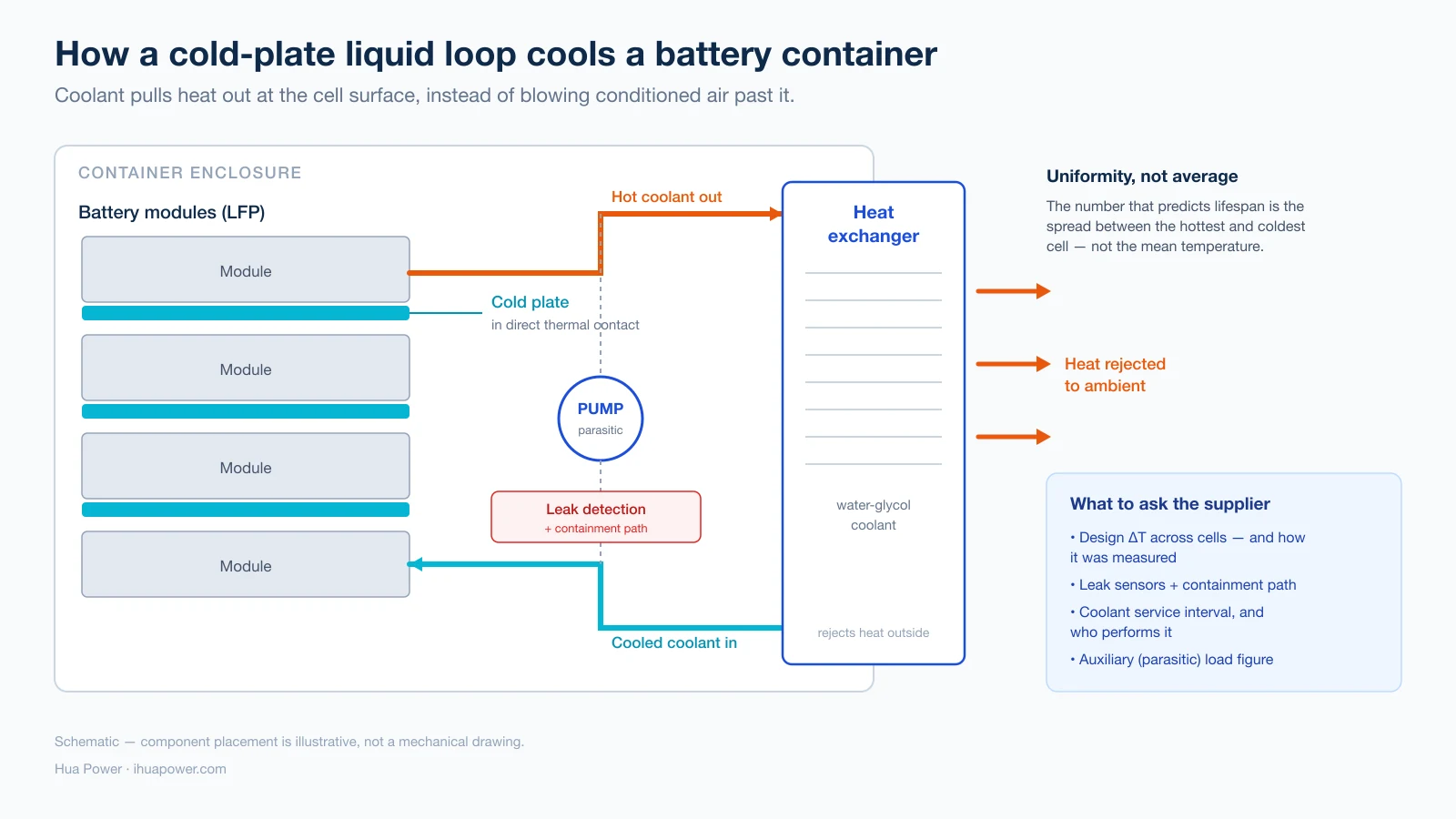
The loop in principle: coolant meets the heat at the cell surface, a pump moves it, a heat exchanger rejects it outside. The failure mode air cooling doesn't have is the one to interrogate — leaks.
You chose liquid. Now choose which liquid architecture, and interrogate how it fails.
Cold plate vs immersion. Virtually every container you'll be quoted uses cold-plate cooling: a water-glycol coolant circulates through plates in thermal contact with the modules, and a heat exchanger rejects the heat outside. Immersion cooling — submerging modules in a dielectric fluid — offers even tighter temperature control and excellent fire performance, and it's drawing genuine interest for data-center-adjacent storage. It is also more expensive, heavier, harder to service, and supported by a much smaller supply chain. For essentially all C&I and utility projects being specified today, cold plate is the practical answer and immersion is a technology to watch, not to buy.
What actually matters in a cold-plate design:
- Temperature uniformity. The number that predicts lifespan isn't the average cell temperature, it's the spread between the hottest and coldest cell. Well-designed liquid systems hold cells within a few degrees of each other; ask for the design ΔT and how it was measured. (Industry-typical liquid systems target roughly ≤3 °C; air-cooled racks commonly run wider.)
- Leak detection and containment. This is liquid cooling's one genuine failure mode that air cooling doesn't have. A serious system has leak sensors, a containment path that keeps coolant away from live busbars, and an alarm that reaches your EMS. Ask to see it. A supplier who waves this off has not thought about it.
- Coolant specification and service interval. Water-glycol needs the right freeze protection for your climate, periodic replacement, and proper disposal. Ask for the service interval and who performs it. Ask what happens to the warranty if you service it yourself.
- Operating envelope — and read it per SKU, not per brochure. These figures are model-dependent, and a line-wide claim is a small warning sign in itself. Hua Power's all-in-one HC-UPSA2089L is rated −20 °C to +50 °C, derating above 45 °C; the container-class HC-UPSB4180L and HC-UPSB5010L extend down to −30 °C. Enclosure protection is IP54 or IP55 depending on model, with a C4 corrosion rating. If your site is coastal, desert, or genuinely cold, get the envelope for the exact SKU on your quote — including the derating threshold, which is the number that quietly costs you summer capacity.
- Parasitic load. The pump loop consumes power. It consumes far less than an HVAC unit, and — unlike an HVAC unit — its draw barely rises with ambient temperature. That gap is the subject of the cooling comparison article; here it's enough to ask for the auxiliary load figure and include it in your energy model.
4. Safety and certifications — the section your competitors' datasheets skip
This is where most container procurement goes wrong, and it's the axis on which almost no supplier blog will help you. Certifications are not interchangeable badges. They test different things, they belong to different markets, and a supplier who conflates them is either careless or hoping you are.
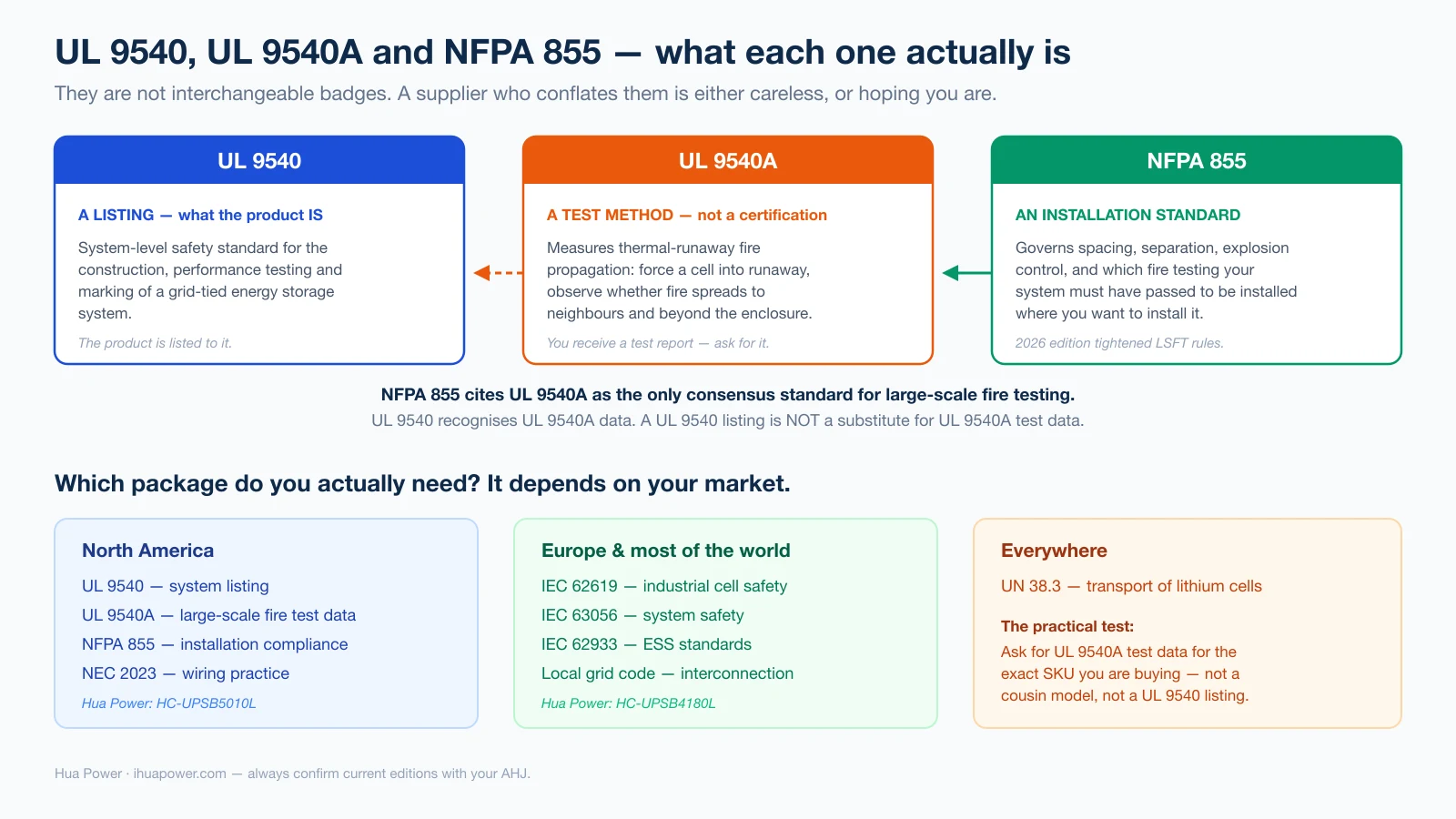
The three names get used interchangeably in sales decks. They are not interchangeable — and the difference decides whether your project passes inspection.
Get the vocabulary straight:
- UL 9540 is the system-level safety standard for the construction, performance, and marking of a grid-tied energy storage system. It's a listing of the product.
- UL 9540A is not a certification at all — it's a test method. It measures thermal-runaway fire propagation: force a cell into runaway and observe whether, and how, fire spreads to its neighbors and beyond the enclosure. UL describes it as the American and Canadian national standard for assessing fire propagation related to thermal runaway, and — the part that matters for your permit — the only consensus standard explicitly cited in NFPA 855 for large-scale fire testing.
- NFPA 855 is the installation standard. It governs spacing, separation, explosion control, and what fire testing your system must have passed to be installed where you want to install it. It cites UL 9540A. The relationship between the two is the single most useful thing to understand before an AHJ conversation, and the 2026 edition of NFPA 855 tightened large-scale fire-testing requirements and expanded the chemistries covered — so confirm your supplier's documentation is current, not vintage. EVLO's guide to storage safety certifications is a clear primer on how the pieces fit together.
- IEC 62619 / IEC 63056 are the cell- and system-level safety standards that matter in Europe and much of the rest of the world. UN 38.3 governs transport — every cell that ships by sea or air needs it.
The practical test. Ask for UL 9540A large-scale fire test data for the specific product you are buying, not for a cousin SKU, and not a UL 9540 listing offered as if it were the same thing. Ask which AHJ has already approved this exact configuration. A supplier with real US certification will hand you a report; a supplier without one will send you a paragraph.
This is expensive ground to hold — the testing runs into seven figures and takes many months — which is why most container suppliers simply don't. Note how the language should work, because it's the tell: on the HC-UPSB5010L, the SKU built for North America, Hua Power holds UL 1973 and UL 9540 listings and UL 9540A test data, and the system is built compliant to NFPA 855, NEC 2023 and NFPA 70E — listings and test data are things you hold; installation and electrical codes are things you comply with. A supplier who says they "have an NFPA 855 certification" has just told you they don't understand their own paperwork. The utility-scale HC-UPSB4180L is certified to IEC 62619 / 63056 / 62933 for European and international markets. If you're buying for the US, that difference is 6–12 months of project schedule and a materially easier interconnection.
Fire protection inside the box. Certification tells you the system was tested; the suppression system tells you what happens at 3 a.m. Configurations vary by model and market — aerosol, clean-agent, and water-based suppression all appear in the container class, and water is a genuinely effective heat sink for cooling a runaway cell and arresting cell-to-cell propagation. Hua Power's 4.18 and 5.01 MWh containers ship with dry-pipe sprinklers, with aerosol available as an option. Ask what's fitted, ask what NFPA 855 requires for your site's spacing and occupancy, and confirm the two match before you sign.
5. Integration: DC block, AC block, and the PCS
Here is a trap that catches experienced buyers: two quotes that look 30% apart are often quoting different products.
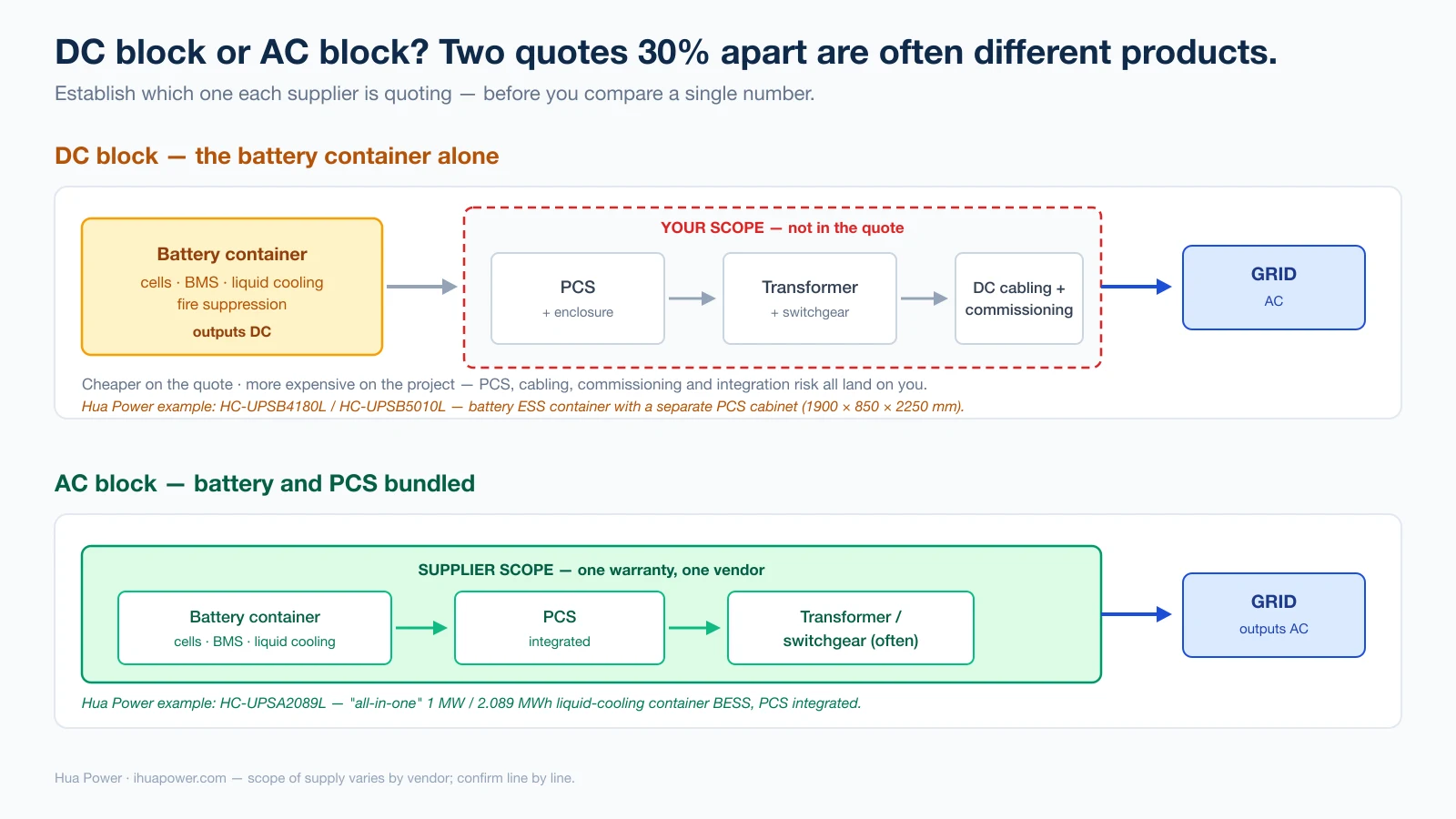
The dashed box is the part that isn't in the DC-block quote — and the part that lands on your budget, your schedule, and your integration risk.
- A DC block is the battery container alone. It outputs DC. You buy, site, and commission the PCS separately.
- An AC block bundles the PCS (and often the transformer and switchgear) into or alongside the container. It outputs grid-frequency AC.
The DC block is cheaper on the quote and more expensive on the project, because the PCS, its enclosure, the DC cabling, the commissioning, and the integration risk all land on you. Neither is wrong. But you cannot compare their prices, and a supplier who lets you try is not helping you.
The distinction is usually buried in a product name. In Hua Power's own catalog, the HC-UPSA2089L is described as an all-in-one liquid-cooling container BESS — the PCS is inside, so it's an AC block. The HC-UPSB4180L and HC-UPSB5010L are battery ESS containers, quoted alongside a separate PCS cabinet (1900 × 850 × 2250 mm) — DC blocks. Same manufacturer, same cooling architecture, fundamentally different scope of supply. Read every datasheet with that question in mind.
What to pin down:
- Is the PCS included, and whose is it? A container from one factory with a PCS from another means two warranties and, when something goes wrong, two vendors pointing at each other.
- Who owns the EMS and does it talk to your SCADA? Ask for the protocol list.
- Who owns system-level commissioning, and is it in the price?
- What's the interface — DC voltage window, communications, protection coordination?
Grid code and interconnection. A container that has never been interconnected in your market is a science project. Grid codes govern fault ride-through, reactive power, frequency response, and anti-islanding, and they differ meaningfully between ERCOT, the European synchronous area, and everywhere else. Ask for a reference project in your market, on your grid operator, and call it. Our EU grid-connection compliance guide walks the European requirements in detail.
6. Lifetime economics: warranty curve, TCO, and augmentation
Batteries fade. Every financial model that ignores this is wrong, and most container quotes encourage you to ignore it.
Demand the warranty curve, not the cycle count. "≥8,000 cycles to 80% SOH" describes a lab result at specified conditions. What you need contractually is a guaranteed state of health by year, under your duty cycle and your climate, with a defined remedy when the system misses it. That curve is the number your lender will underwrite. If a supplier won't put it in the contract, the cycle count on the datasheet is marketing.
Then plan for augmentation. Augmentation is the practice of adding battery capacity mid-life to offset degradation and keep the system meeting its contracted output. It's one of the largest and most consistently ignored line items in a storage project's lifetime cost.
Work it through — illustratively, with round numbers, because the real answer comes from your supplier's warranty curve:
Suppose you need 5 MWh delivered in year 10. If the system holds roughly 90% SOH at that point under your duty cycle, sizing to exactly 5 MWh on day one leaves you about half a megawatt-hour short — every day, for the rest of the project. You have three options: oversize on day one (buy ~5.6 MWh of nameplate, pay for capacity you won't use for a decade), augment in year eight (add racks — cheaper per kWh by then, but only if the container was designed with the space, the DC bus headroom, and the BMS addressing to accept them), or accept the shortfall (and re-run your revenue model honestly).
The third option is what happens by default when nobody asks. The second is almost always the best economics — provided you bought a container that permits it. So ask, before you buy: is there physical space for additional racks, does the DC bus have headroom, will the BMS address new modules, and will mixing cell vintages void the warranty? Ask whether augmentation is DC-coupled or requires new AC-side equipment; the two have very different costs.
The lens to compare on is not the sticker price but LCOS (levelized cost of storage) — total lifetime cost (capex, O&M, charging energy, augmentation) divided by total energy delivered over the life, in $/MWh. LCOS captures parasitic load, cycle life, and augmentation timing. Sticker price captures none of them. A container that costs 12% more and defers augmentation by four years usually wins, and only LCOS shows you that.
7. Supplier due diligence and lead time
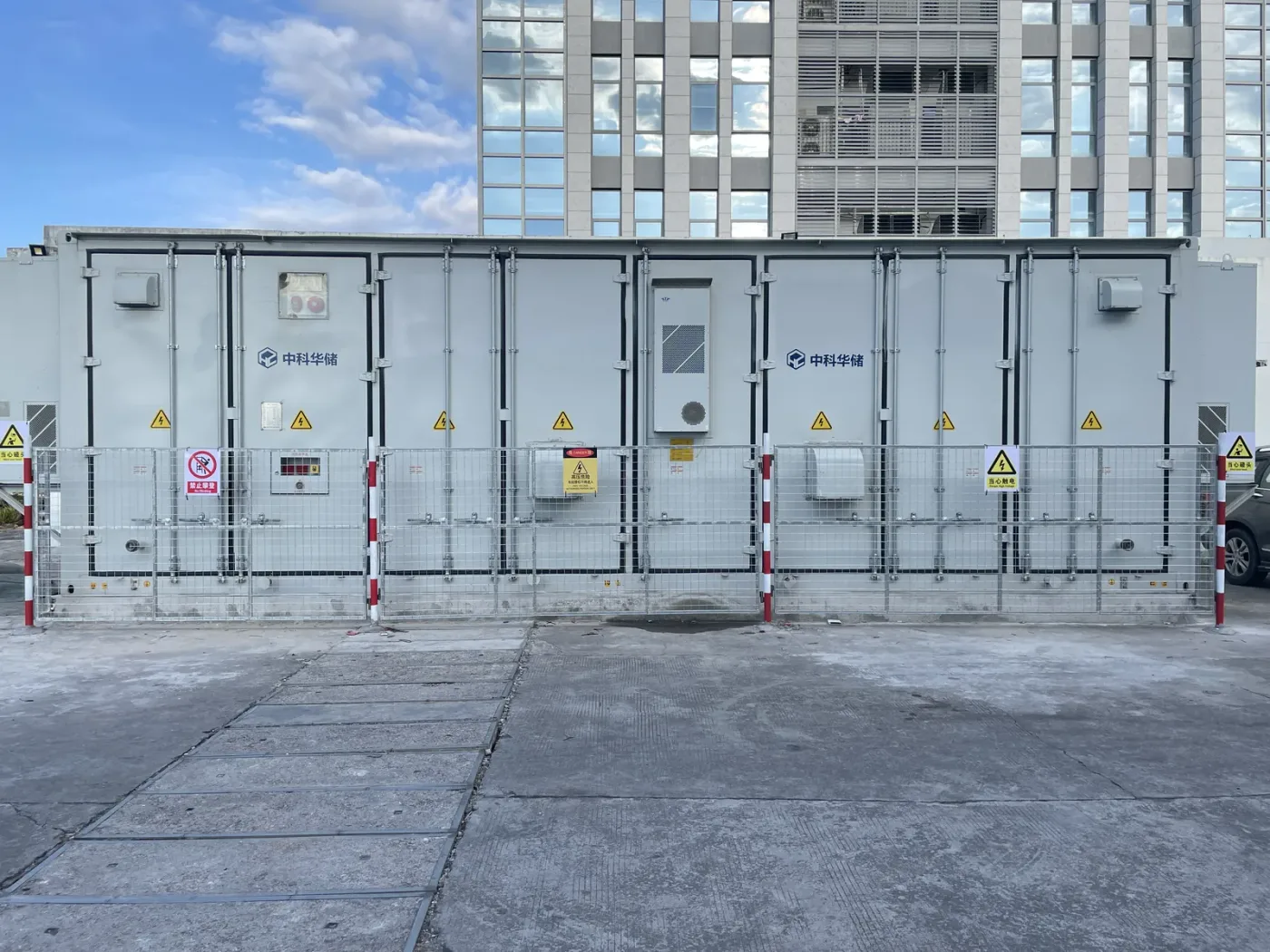
Ask to see the product installed, not rendered. A commissioned system — fencing, signage, clearances — tells you more than any brochure.
The container market has a large population of trading companies that will happily sell you someone else's hardware with their logo on it. Some are perfectly good. You should still know which kind you're dealing with.
Establish what they actually are:
- Do you own the factory? Then: can I audit it? A real manufacturer says yes and names a week. Ask for annual production capacity in GWh — it tells you whether your order is meaningful or marginal to them.
- How many of this product have shipped, and where? Not "400 projects" in aggregate — how many of this container, in a climate and grid like mine. Then ask for a reference you can call.
- What's the R&D footprint? A supplier who writes their own BMS and EMS can fix firmware problems. One who integrates someone else's files a ticket.
- Who honors the warranty in my country, and what's the response time? A 15-year warranty from an entity with no local presence is a 15-year hope.
On documents, ask for: the full certification package for your market (with test reports, not just certificate numbers), the warranty curve, the O&M manual, the augmentation plan, the transport and lifting drawings, and the FAT (factory acceptance test) protocol. Ask to witness the FAT.
On lead time, current container-class lead times generally run in the range of a few months for standard SKUs, extending materially for customization or market-specific certification work. Get it in writing with liquidated damages, and ask what the shipping plan is — a 20-foot BESS container is a standard-footprint object, which is precisely why it moves through ports and onto cranes without special arrangements. That's an underrated part of the form factor's appeal.
If you want the full commercial framework — payment terms, incoterms, penalty clauses — our C&I BESS procurement guide covers the contract layer this article deliberately skips.
The selection checklist
Take this into the supplier call. Score each dimension; the pattern of weak answers matters more than any single one.
Dimension | What "good" looks like | Red flag |
|---|---|---|
Capacity & C-rate | Configurations offered by duration (2h/4h); usable energy stated at your duty | Only nameplate MWh quoted |
Cell | Named manufacturer, A-grade, 314Ah LFP, IEC 62619 | "High-quality lithium cells" |
Cycle life | ≥8,000 cycles to 80% SOH with test conditions stated | A number with no conditions |
Cooling | Cold plate, stated design ΔT, leak detection + containment, service interval | "Advanced liquid cooling" |
Certification | UL 9540A test report for this SKU; IEC 62619/63056; UN 38.3 | UL 9540 listing offered as UL 9540A |
Fire protection | Suppression type stated; matches NFPA 855 for your site | Unspecified "fire system" |
Integration | Explicit DC block or AC block; PCS ownership clear; EMS protocols listed | Ambiguous scope of supply |
Grid code | Reference project on your grid operator, callable | "Compliant worldwide" |
Warranty | Guaranteed SOH by year, in contract, with remedy | Cycle count only |
Augmentation | Rack space, DC bus headroom, BMS addressing confirmed | Question never considered |
Supplier | Owns factory, auditable, local warranty entity | Cannot host an audit |
How Hua Power builds its liquid-cooled containers
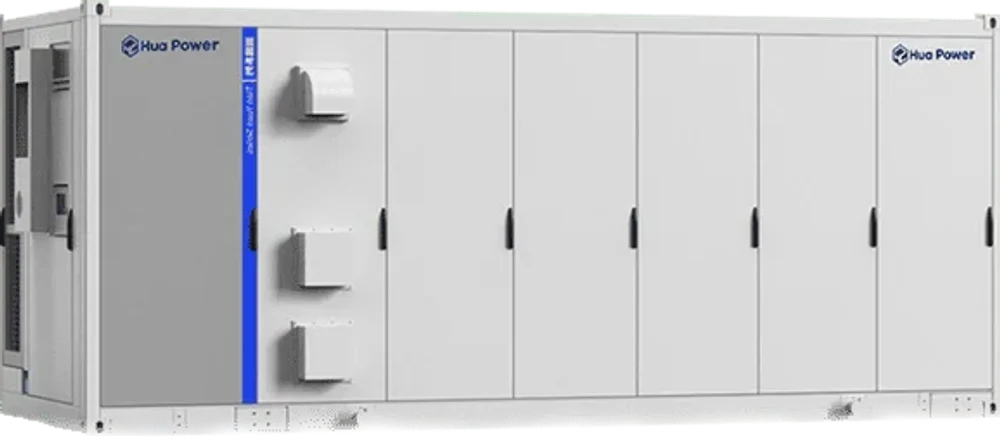
The HC-UPSB5010L — 5.01 MWh, and the SKU that carries the North American certification package.
Hua Power is an energy storage system and microgrid integrator founded in 2015, with 400+ ESS projects deployed, over 2.4 GWh of annual production capacity, and roughly 45% of staff in R&D — which is why the BMS and EMS are developed in-house rather than bought in. The liquid-cooled container line spans three tiers:
- HC-UPSA2089L — an all-in-one 20-foot container: 2.089 MWh with the PCS integrated, offered at 500 kW (0.25C, ~4h) or 1,000 kW (0.5C, ~2h). This is an AC block — it is the dual-C-rate platform, so one piece of hardware serves both long-duration and power-dense applications. RTE ≥85%, IP54, −20 °C to +50 °C (derating above 45 °C). CE and UN 38.3.
- HC-UPSB4180L — 4.18 MWh at 0.5C for utility-scale deployment. A battery container paired with a separate PCS cabinet (1900 × 850 × 2250 mm) — a DC block. Certified to IEC 62619, IEC 63056 and IEC 62933. RTE ≥87%, ≤37 t, down to −30 °C.
- HC-UPSB5010L — 5.01 MWh (0.5C/0.25C), the North American SKU and also a DC block. Holds UL 1973 and UL 9540 listings plus UL 9540A test data, and is built compliant to NFPA 855, NEC 2023 and NFPA 70E; UN 38.3 for transport. RTE ≥87%, IP54, ≤44 t. This is the package that removes 6–12 months of AHJ friction from a US project.
Note that the lineup itself demonstrates the distinction from section 5: the A-series 2089L is an integrated AC block, while the B-series 4180L and 5010L are battery containers expecting an external PCS. Compare their prices without accounting for that and you'll reach the wrong conclusion.
Across the line: 3.2 V / 314 Ah LFP cells, ≥8,000 cycles to 80% SOH, C4 corrosion protection, dry-pipe sprinkler suppression with optional aerosol on the container class, and a standard 20-foot (6058 × 2438 × 2896 mm) footprint that ships and lifts like any other container.
Depth in the field, not just the catalog: 100+ MWh deployed across Europe — including a 6 MW / 10.32 MWh liquid-cooled project in the Czech Republic — with particular experience in grid-frequency regulation, where response time and interconnection compliance are the entire product. If your project sits below container scale, the same liquid-cooled architecture appears in the HC-UPSAP261L (125 kW / 261 kWh) and HC-UPSAP522L (250 kW / 522 kWh) C&I cabinets.
Getting a site-specific spec
The checklist above gets you to a shortlist. Turning that into a signed specification — exact model, C-rate configuration, certification package, PCS topology, and augmentation plan — depends on your load profile, your climate, your available pad, and your grid operator's code.
Start with the C&I energy storage overview to scope the project, or talk to our team with your load profile, site constraints, and target market, and we'll come back with a specific capacity-and-certification recommendation rather than a datasheet.
Frequently asked questions
How much does a liquid-cooled battery container cost? Pricing moves with cell prices, capacity, C-rate, certification package, and whether the PCS is included — which is why a like-for-like comparison requires first establishing whether you're quoting a DC block or an AC block. Rather than anchoring on a per-kWh figure that will be stale within a quarter, compare suppliers on LCOS (total lifetime cost ÷ total energy delivered), which captures parasitic load, cycle life, and augmentation. Ask every supplier to quote the same scope and the same duration.
How do I size a 20ft vs 40ft liquid-cooled BESS container? Start with duration, not energy. Work out how many kWh you need to move and over how many hours; energy ÷ duration gives the power rating, which sets your C-rate. Current-generation 20-foot liquid-cooled containers cluster around 2 MWh at lower C-rates and 5–6 MWh at the high end; 40-foot units go higher. Then add margin for degradation so the system still meets its contracted output in year ten.
What cycle life and warranty should a liquid-cooled container have? Expect ≥8,000 cycles to 80% state of health at stated test conditions from a credible LFP system — Hua Power's liquid-cooled line is rated at that level, implying a 15–20 year design life at one cycle per day. But the cycle count is a lab number. What you should contract for is a guaranteed SOH-by-year curve under your duty cycle and climate, with a defined remedy if the system misses it.
What certifications should a liquid-cooled BESS container have? It depends entirely on your market. For North America: UL 9540 (system listing), UL 9540A large-scale fire test data for the specific SKU, NFPA 855 compliance, and NEC 2023 wiring practice. For Europe and much of the world: IEC 62619 (cell), IEC 63056 (system), IEC 62933. Everywhere: UN 38.3 for transport. Note that UL 9540A is a test method, not a certification — a UL 9540 listing is not a substitute, and any supplier offering it as one should be pressed.
Cold plate vs immersion cooling — which should I choose? Cold plate, for essentially every C&I and utility container being specified today. Immersion cooling gives tighter temperature control and strong fire performance, but it costs more, weighs more, is harder to service, and has a much thinner supply chain. It's a technology worth tracking, particularly for data-center-adjacent storage — not yet the default purchase.
What are the dimensions and weight of a 5 MWh 20ft liquid-cooled container? It occupies a standard 20-foot high-cube footprint — 6058 × 2438 × 2896 mm — which is the point: it ships on ordinary vessels and lifts with ordinary cranes. Weight scales with capacity: Hua Power rates the 4.18 MWh HC-UPSB4180L at ≤37 tonnes and the 5.01 MWh HC-UPSB5010L at ≤44 tonnes. Confirm the exact figure against your pad's bearing capacity and your crane's rating before delivery, and ask for the lifting drawings.
DC block vs AC block — how is the PCS integrated? A DC block is the battery container alone; you procure, site, and commission the PCS separately. An AC block bundles the PCS (often with transformer and switchgear) and outputs grid-frequency AC. The DC block quotes cheaper and costs more at the project level. Establish which one each supplier is quoting before you compare prices — otherwise you are comparing different products.
How does augmentation and SOH degradation affect my sizing decision? Directly, and most buyers discover it too late. As cells fade, delivered energy falls below the contracted figure. You either oversize on day one, augment mid-life by adding racks, or quietly under-deliver. Augmentation is usually the best economics — but only if the container was designed to accept it. Before purchase, confirm there is physical rack space, DC bus headroom, BMS addressing for new modules, and that mixing cell vintages won't void the warranty.
What lead time should I expect, and what should I ask a supplier? Standard SKUs typically ship in a few months; customization or market-specific certification work extends that materially. Get the date in writing with liquidated damages. During due diligence ask: do you own the factory, can I audit it, how many of this container have shipped into a market like mine, who honors the warranty locally, and may I witness the factory acceptance test?
Can a liquid-cooled battery container be used for a home? No — and if you're asking, the form factor is wrong for you. Containers start in the megawatt-hour range and are built for commercial, industrial, and utility-scale deployment. Residential storage is a kilowatt-hour-scale product with entirely different safety codes. For smaller commercial loads, a cabinet rather than a container is the right class of product.