

If your site relies on diesel generation, the two numbers that hurt most are fuel consumption and fuel price. A PV battery diesel hybrid system — combining solar PV, a battery energy storage system (BESS), and a diesel generator set (genset) — is designed to reduce both. By putting solar first, a battery second, and the diesel generator last, sites in mining, telecom, agriculture, and island power routinely cut fuel consumption by 40–70% — and in high-solar deployments, run the genset only a few hours a day.
The idea is simple. The engineering that makes it reliable is not. This guide walks through how the three power sources coordinate, why the battery is the component that actually unlocks the savings, how to size each part, and what payback to realistically expect.
What is a PV battery diesel hybrid system?
A PV battery diesel hybrid system, also known as a solar diesel hybrid system with BESS, is an on-site power plant that combines a solar PV array, a battery energy storage system (BESS), and a diesel generator set (genset) under a single energy management system (EMS). The EMS determines, second by second, which source supplies the load, how surplus solar energy is stored, and when the genset should start or stop.
During sunny periods, the PV array supplies the load directly and charges the battery with excess energy. When solar output falls or the load increases, the BESS discharges to maintain stable power. The genset operates only when solar and stored energy are insufficient, providing firm backup power and supporting extended low-solar periods.
The result is a microgrid-style power system that delivers continuous, grid-like reliability while reducing diesel fuel consumption, operating hours, maintenance requirements, and carbon emissions compared with a diesel-only power plant.
How a PV + battery + diesel hybrid system works
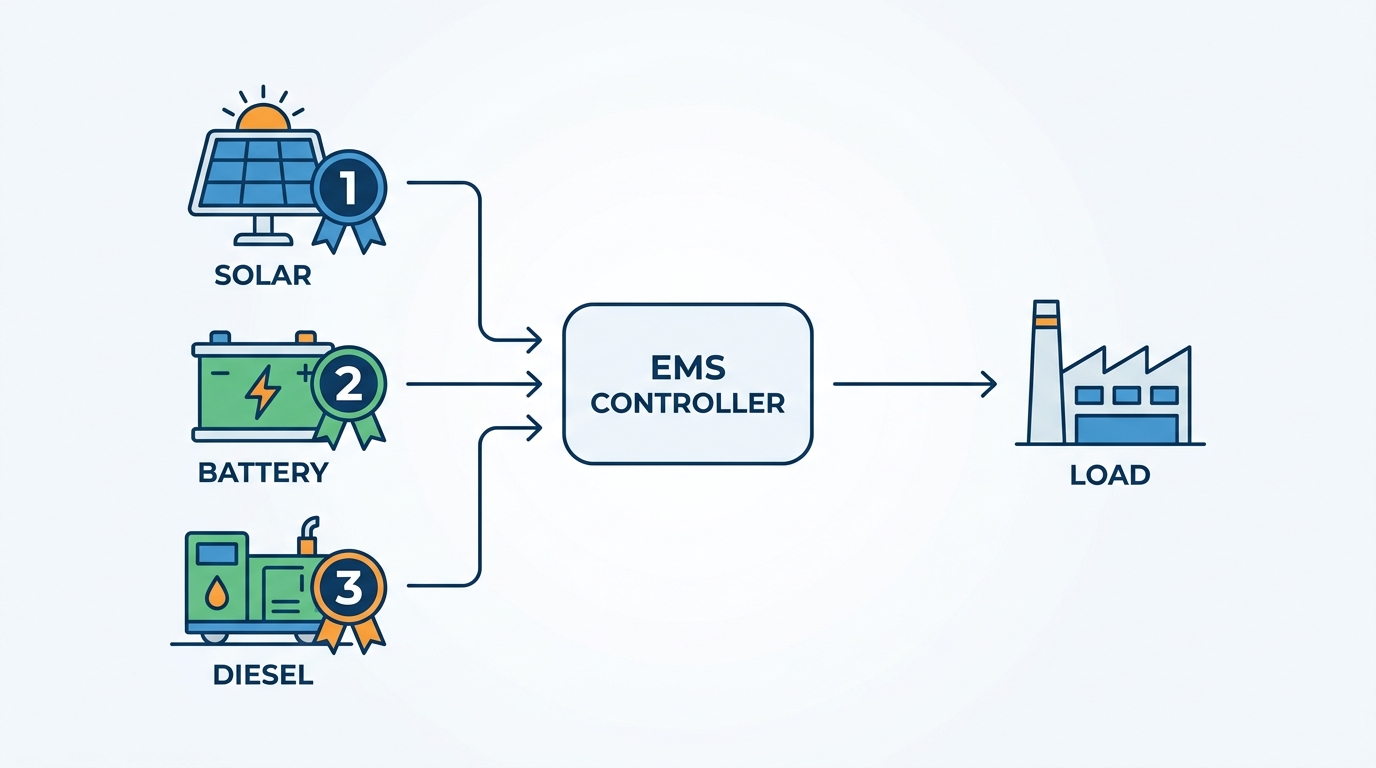
The whole system operates according to a dispatch priority (merit-order dispatch) enforced by the energy management system (EMS):
- Solar first. Whenever irradiance is available, PV serves the load directly. It is the cheapest kilowatt-hour on site, so the controller always takes it first.
- Battery second. Surplus solar charges the battery. When the load exceeds PV output — a passing cloud, the evening peak, or overnight — the battery discharges to cover the shortfall.
- Diesel last. The genset starts only when solar and stored energy together cannot meet demand, or when the battery's state of charge (SoC) drops below a set threshold.
The battery's state of charge is the trigger that governs the genset. A typical control scheme starts the diesel when SoC falls to, say, 30–40% and stops it once the battery is recharged to a target level — so the engine runs in efficient bursts at high load rather than idling inefficiently around the clock. This SoC-tiered dispatch is the single biggest difference between a hybrid that saves 20% and one that saves 60%.
Two operating modes sit on top of this logic:
- Fuel optimization mode — the genset runs continuously but at reduced output, with PV and battery trimming its load. Simpler, but leaves fuel savings on the table.
- Zero-diesel operation mode — the genset shuts down entirely for hours at a time while PV and battery carry the site. This is where the big savings live, and it depends entirely on having enough battery capacity to bridge the gaps and hold the grid stable.
System architecture and components
Six building blocks make up a hybrid system:
Component | Role |
|---|---|
PV array | Generates solar energy; sized in kWp against site load and sunlight |
Battery / BESS | Stores surplus solar, buffers load swings, enables diesel-off mode |
Hybrid inverter / PCS | Converts DC↔AC and synchronises all sources on one AC bus |
Diesel generator (genset) | Firm backup and, if needed, grid-forming reference |
EMS / microgrid controller | Enforces the loading order and genset start/stop logic |
Dry-contact genset interface | Lets the controller start and stop the engine automatically |
Systems are built in one of two coupling topologies:
- AC-coupled — PV and battery each have their own inverter and tie into a shared AC bus. Easier to retrofit onto an existing diesel plant, and the usual choice when adding solar to a site that already has gensets.
- DC-coupled — PV and battery share a DC bus and a single bidirectional inverter. Slightly higher round-trip efficiency because solar can charge the battery without an extra AC conversion, and generally more cost-effective for new-build C&I installations.
For containerized deployments, the battery, inverters, and controls arrive pre-integrated in a single enclosure — a format that has become the default for commercial and industrial sites because it compresses months of on-site integration into a plug-and-connect install. iHuapower's liquid-cooled vs air-cooled BESS guide covers how to choose the enclosure and cooling design for hot, dusty, off-grid environments.
Why BESS enables high renewable penetration: with vs without storage
You can build a solar-plus-diesel system without a battery. Many early "hybrids" did exactly that — solar trimmed the daytime genset load, and that was it. The problem is what happens the moment a cloud passes: PV output can drop 50% in seconds, and with no storage to absorb the swing, the diesel generator has to ramp instantly to catch it. To stay safe, the controller caps how much solar it will accept (the PV penetration limit), often to 30% or less of the genset's rating, and forces the engine to keep spinning as reserve. Savings stall.
Add a battery, and three things change at once:
- The battery becomes the spinning reserve. It responds in milliseconds to load and solar swings, so the diesel no longer has to idle as backup — it can switch off entirely.
- Solar penetration climbs past 60–80%+. With storage smoothing the fluctuations, the system can accept far more solar without destabilising.
- The genset runs loaded, not idling. When it does start, it runs near its efficient 70–85% loading band and recharges the battery in a short, high-efficiency burst.
PV + diesel (no battery) | PV + battery + diesel | |
|---|---|---|
Solar penetration | Capped ~20–30% | 60–80%+ |
Genset at night | Runs continuously | Can be off entirely |
Response to cloud cover | Diesel must ramp | Battery absorbs instantly |
Typical fuel savings | 10–25% | 40–70% |
Diesel-off operation | Not possible | Core capability |
The battery is not an add-on to a solar-diesel system. It is the component that turns "some solar savings" into a genuine hybrid. Its chemistry matters too: lithium iron phosphate (LFP) has become the C&I standard for its cycle life, thermal stability, and tolerance of the daily deep cycling a hybrid demands — a very different duty than the shallow float service of older lead-acid banks.
Fuel savings, emissions, and real-world results
The economics are driven by one fact: diesel is an expensive way to make electricity. Off-grid diesel power typically lands between $0.30 and $0.60+ per kWh once fuel, delivery to remote sites, and maintenance are counted — and every litre burned also emits roughly 2.7 kg of CO₂. Solar-plus-storage displaces both.
Two flagship mining projects show the scale:
- DeGrussa (Australia) — a 10.6 MW solar array paired with a 6 MW battery was integrated with the mine's 19 MW diesel station. It displaced roughly 20% of the mine's diesel and saved on the order of 5 million litres of fuel per year, per the Australian Renewable Energy Agency.
- Fekola (Mali) — B2Gold added around 30 MW of solar and a 15.4 MWh battery to a large thermal plant. During daylight it supplies up to 75% of the mine's electricity from renewables and saves roughly 13 million litres of heavy fuel oil a year.
For a typical commercial or industrial site, a well-designed hybrid displaces 40–70% of annual diesel — and the emissions reduction tracks the fuel reduction almost one-for-one. Those are the numbers that turn a sustainability line item into a straightforward cost decision.
How to size a PV battery diesel hybrid system
Sizing is where hybrids succeed or disappoint. A rough first-pass framework:
- PV array (kWp). Start by sizing solar to cover a large share of daytime load — often 1.5–3× the site's average daytime demand — so there is genuine surplus to store, not just enough to shave the midday peak. Oversizing PV modestly is cheap insurance against cloudy days.
- Battery (kWh). Size storage for the autonomy you need through the evening peak and into the night — commonly 2–6 hours of average load for a fuel-save design, more for extended diesel-off operation. Also check the C-rate: the battery must be able to discharge fast enough to cover peak power, not just store enough energy. See our guide on choosing the right battery C-rate.
- Genset (kW). Keep the diesel sized to carry the full peak load on its own as firm backup, but expect it to run in short, high-load bursts. Avoid oversizing the engine — a genset that only ever runs at 20–30% load wet-stacks and wastes fuel.
- Renewable fraction. Decide your target upfront. A 50–60% renewable fraction is an easy, low-risk win; pushing toward 80–90% multiplies battery and PV cost and is worth modelling carefully.
Serious projects model all of this in software such as HOMER or an equivalent techno-economic tool, running a full year of hourly load and irradiance data against fuel price to find the least-cost mix. The rules of thumb above get you to a credible concept; the model gets you to a bankable design.
Cost, ROI, and payback
Upfront cost varies with site size and renewable ambition, but the trend since 2020 has been decisively in the buyer's favour: LFP battery prices have fallen dramatically. BloombergNEF puts average lithium-ion pack prices at around $108/kWh, with LFP packs below that and stationary-storage packs lower still — while solar module costs sit at historic lows. That has pushed hybrid economics from "green premium" to "cheaper than the status quo" for most diesel-heavy sites.
The payback math is straightforward because the saving is a hard cash line — diesel not bought:
- Fuel avoided is the main return: cut 40–70% of a site's diesel bill and the annual saving is often enormous, especially where fuel is trucked or flown to remote locations.
- Maintenance avoided adds to it: a genset running a few hours a day instead of 24/7 needs far fewer oil changes, overhauls, and eventually replacements.
- Payback for well-designed C&I and mining hybrids commonly lands in the 2–5 year range, after which the solar and battery produce near-free energy for the rest of their 10–20 year life.
A worked example
To make it concrete, take an off-grid site that burns 500,000 litres of diesel a year at a delivered price of $1.20/litre — a $600,000 annual fuel bill:
Value | |
|---|---|
Diesel displaced by hybrid | 55% |
Litres avoided per year | ~275,000 L |
Annual fuel saving | ~$330,000 |
Genset maintenance saving | ~$30,000/yr |
Installed cost (PV + containerized LFP BESS) | ~$1.3 million |
Simple payback | ~3.6 years |
After payback, that site keeps roughly $360,000 a year for the 10–20 year life of the assets. Framed as levelised cost of energy (LCOE), the solar-plus-storage kilowatt-hours land around $0.10–0.15/kWh against $0.30–0.50+/kWh for diesel — which is why the switch pays for itself. (These figures are illustrative; your real payback depends on your load profile, local diesel price, and solar resource — model them before committing.)
Because the largest single cost — and the largest lever on savings — is the storage layer, matching battery chemistry, C-rate, and enclosure to the duty cycle has an outsized effect on lifetime ROI.
Applications: where hybrids pay off fastest
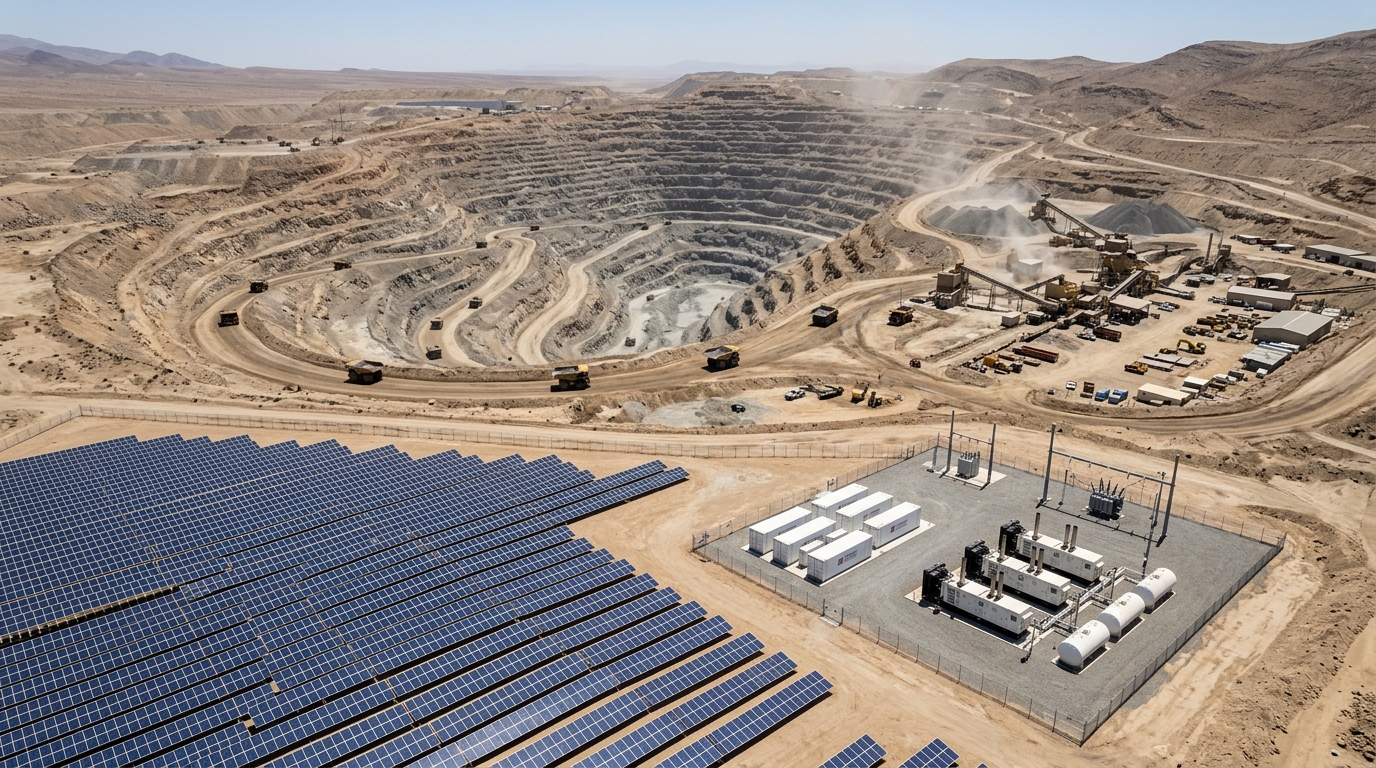
The best candidates are sites that burn a lot of diesel and pay a lot to get it there:
- Mining and resources — large, steady loads in remote locations with sky-high diesel logistics costs. The flagship use case.
- Telecom towers — thousands of off-grid and weak-grid sites where diesel theft and refuelling trips dominate opex; a battery-led hybrid slashes both.
- Islands and remote resorts — where power is often 100% diesel and fuel arrives by barge, hybrids cut cost and noise at once.
- Agriculture and food processing — poultry farms, irrigation, and cold storage with strong daytime loads that align well with solar.
- Construction and temporary sites — containerized hybrids drop in, run quietly, and move on.
- Weak-grid C&I facilities — factories on unreliable grids can add solar and storage to a backup genset and turn a liability into a cost-saving asset, including peak shaving against demand charges. See how storage enables demand response and peak shaving.
Control and EMS: the brains of the system
Everything above depends on the EMS making the right call, fast. A capable microgrid controller manages:
- Genset start/stop on SoC thresholds — starting the engine before the battery is depleted and stopping it once recharged, all automatically via a dry-contact interface.
- Minimum genset loading — never letting the diesel run below ~30–40% load, to protect the engine and preserve efficiency.
- Grid-forming control — in diesel-off mode, the battery inverter forms the grid (sets voltage and frequency) so the site stays stable with no engine running.
- Solar smoothing and ramp control — using the battery to absorb PV fluctuations so penetration can stay high.
- Priority and safety logic — protecting critical loads, managing faults, and keeping the whole system inside safe operating limits.
The quality of this control layer is what separates a hybrid that quietly saves money for 15 years from one that trips, wet-stacks, or under-delivers.
Limitations and when a hybrid isn't the answer
A hybrid is not a free lunch, and it is not right for every site. The honest trade-offs:
- Upfront capital. Even with fast payback, the CAPEX is real and has to be financed. Sites with tight capital or short remaining life (a mine with two years left) may not recover it.
- Space and solar resource. PV needs unshaded land or roof area, and the economics soften in low-irradiance or heavily seasonal climates where winter or monsoon output drops.
- You still need the genset. Solar and storage cut fuel, but firm backup for extended cloudy spells, night loads, and outages still comes from the diesel — a hybrid reduces diesel, it rarely eliminates it.
- Control complexity and commissioning. The savings depend entirely on a well-tuned EMS. A poorly integrated system can chase its own tail, wet-stack the genset, or trip on power-quality and harmonic issues — get the controls and commissioning right, or the payback evaporates.
- O&M over time. Panels need cleaning (especially in dusty environments), and the battery has a finite cycle life and an eventual replacement cost that belongs in the TCO.
Where a hybrid doesn't pay: sites already on cheap, reliable grid power; very small or highly intermittent loads; or locations with poor sun and cheap local fuel. If you burn a lot of expensive diesel around the clock, though, the case is usually straightforward.
How to choose and deploy your system
A practical path from diesel-only to hybrid:
- Log your load and fuel. A year of hourly load data and your real diesel price are the two inputs that decide everything. Guess these and the design will be wrong.
- Set a renewable-fraction target. 50–60% for a fast, safe payback; higher if fuel is very expensive or emissions targets demand it.
- Model it. Run the numbers in HOMER or with a supplier who will share a transparent techno-economic model — not just a quote.
- Right-size the battery. This is the highest-leverage decision. Match energy (kWh), power (C-rate), chemistry (LFP for cycling duty), and cooling to your climate and duty cycle.
- Choose an integrated, containerized system where possible, to compress installation time and de-risk commissioning.
iHuapower designs and manufactures LFP commercial and industrial battery storage — from cabinet-scale systems to containerized liquid-cooled units — built for exactly this duty: deep daily cycling, hot and dusty off-grid conditions, and tight integration with solar and diesel gensets. If you are scoping a PV battery diesel hybrid system, talk to our engineering team about sizing the storage layer to your load and fuel profile.
Frequently asked questions
How does a PV battery diesel hybrid system work? It serves the load in a fixed priority: solar first, battery second, diesel generator last. An energy management system watches the battery's state of charge and starts the genset only when solar and storage together cannot meet demand — then runs it at high, efficient load to recharge the battery.
How much fuel does a hybrid system save? A well-designed PV + battery + diesel hybrid typically displaces 40–70% of annual diesel, and high-solar mining deployments have saved millions of litres per year. Emissions fall roughly in step with fuel use.
Do I really need a battery — can't I just add solar to my generator? You can, but without storage the diesel must idle as spinning reserve and solar penetration is capped around 20–30%. The battery absorbs solar and load swings in milliseconds, lets the genset switch off entirely, and is what unlocks 40–70% savings rather than 10–25%.
What's the payback period? For most diesel-heavy commercial, industrial, and mining sites, payback lands in the 2–5 year range, driven mainly by avoided fuel and reduced generator maintenance. Remote sites with expensive fuel logistics pay back fastest.
AC-coupled or DC-coupled? AC-coupling is easier for retrofitting solar and storage onto an existing diesel plant; DC-coupling is slightly more efficient and often more cost-effective for new-build C&I systems.
How do I size the battery? Size it for the hours of autonomy you need through the evening and night (commonly 2–6 hours of average load, more for extended diesel-off operation), and check that its C-rate can deliver peak power — not just store enough energy.
What is the difference between a solar-diesel system and a solar-diesel-battery hybrid system?
A solar-diesel system uses PV to reduce daytime generator output, but the genset must continue running as spinning reserve. A solar-diesel-battery hybrid system adds a BESS that absorbs PV and load fluctuations, allows the genset to shut down for extended periods, and typically increases fuel savings from 10–25% to 40–70%.
Can a battery inverter operate in grid-forming mode without a diesel generator?
Yes. In zero-diesel operation mode, a grid-forming battery inverter can establish voltage and frequency for the microgrid, allowing critical loads to operate without the diesel generator running.
How many hours of battery storage are recommended for a diesel hybrid microgrid?
Most commercial and industrial diesel hybrid microgrids use 2–6 hours of battery autonomy. Sites targeting extended zero-diesel operation may require 6–12 hours or more, depending on the load profile and solar resource.