

A mining microgrid project is a localized power system that combines solar PV, battery energy storage, and backup diesel generators to supply reliable electricity to remote mining sites. It can operate fully off-grid or switch seamlessly between grid-connected and islanded modes, cutting fuel costs, outage losses, and carbon emissions. The stakes are concrete: electricity can account for 15-40% of a mine's operating costs, and a single hour of blackout at a 10 MW off-grid mine can cost hundreds of thousands of dollars in lost production, according to Huawei's 2025 mining microgrid white paper. This guide walks through how these projects work, what they really cost, which design decisions decide success, and how to buy one.
What Is a Mining Microgrid Project?
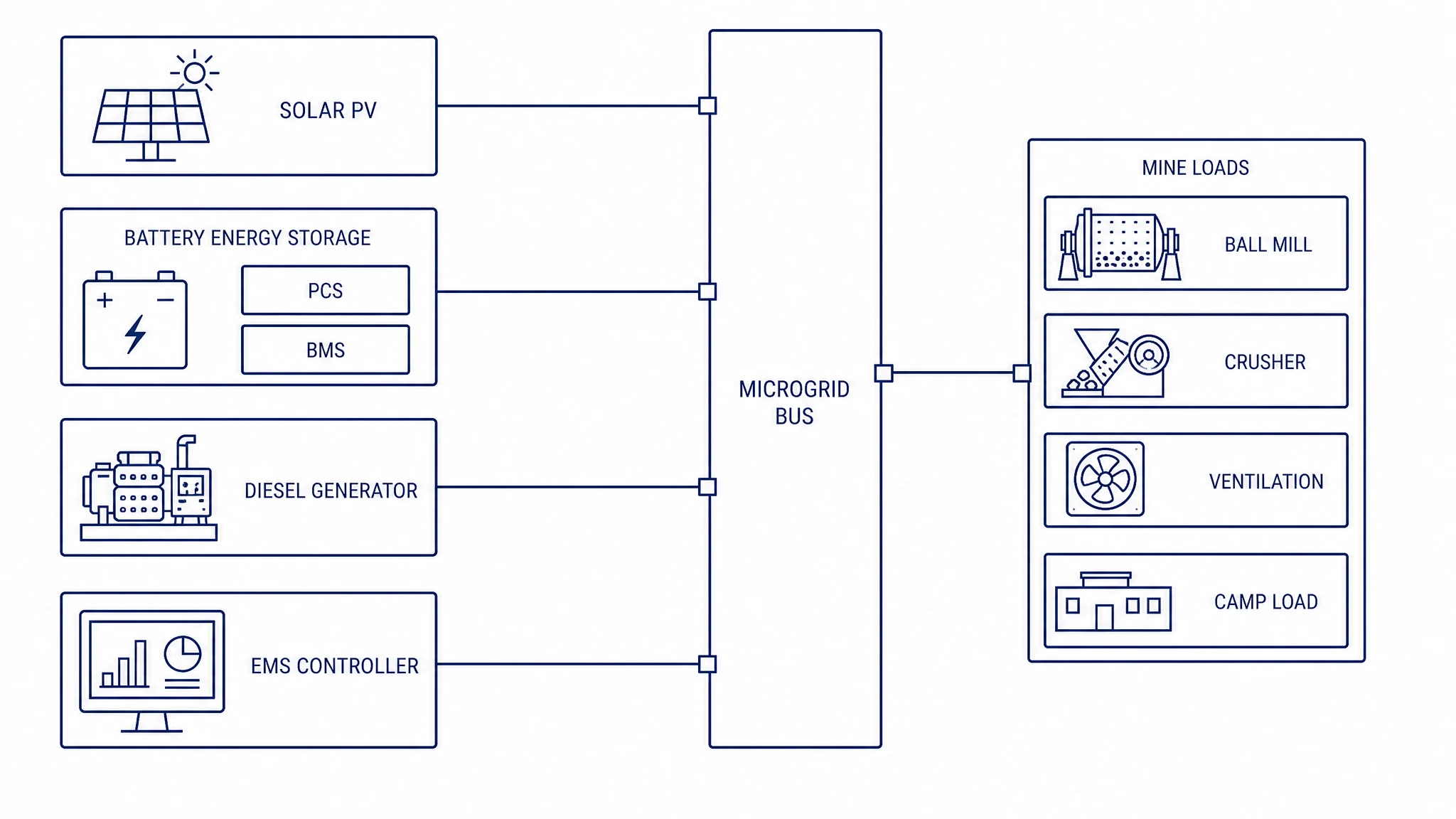
A microgrid is a small power system with a clear electrical boundary that can run connected to the main grid or as an independent island. In a mining context, the system typically pairs three generation resources — solar PV, battery energy storage, and diesel gensets — under one control layer that keeps voltage and frequency stable no matter what the mine's equipment does.
The core components are:
- Solar PV arrays and inverters — the primary energy source in most projects, sized to the site's irradiance and daytime load.
- Battery energy storage (BESS) — the system's anchor. It absorbs PV oversupply, discharges at night, and reacts to load swings in milliseconds. Most mining deployments use LFP chemistry in containerized or cabinet form, with a power conversion system (PCS) and battery management system (BMS).
- Diesel generators — backup or supplementary power. In well-designed systems they run only during extended bad weather or extreme peaks, which is what cuts fuel bills.
- Microgrid controller and energy management system (EMS) — the brain that dispatches all three sources and handles the switch between grid and island mode.
What makes the mining version different from a village or campus microgrid is the load profile. Ball mills, crushers, and semi-autogenous mills start with inrush currents six to eight times their rated current; a single mill motor can draw megawatts. The system has to hold voltage through those events, which is why grid-forming storage — storage that acts as a voltage source rather than a follower — matters more in mining than in almost any other microgrid application. For a deeper look at how these systems fit into the wider microgrid energy storage solutions landscape, the hub page covers the full architecture family.
Why Remote Mines Are Moving Off Grid
Three forces are pushing mines away from their traditional power options, and they reinforce each other.
The grid is not there — or not reliable. Many of the world's highest-grade deposits sit far from transmission lines. Where a grid connection exists, it is often weak. Zambia, for example, is facing a power deficit of 600-750 MW amid drought and rising demand, with the mining sector consuming roughly half of national electricity, per Sungrow's 2026 mining microgrid white paper release; the DRC has one of the world's lowest electricity access rates — roughly one in five people (about 20%) has electricity, per World Bank data — with long outages common where supply exists. In that environment, a mine that depends on the grid accepts production risk as a fact of life.
Diesel is expensive, and the price keeps climbing. Remote mines historically relied on diesel gensets, paying US$0.40-0.50 per liter for fuel that must be trucked over long distances. On top of the fuel bill, generators need overhauls every few years and lose efficiency at partial load. When electricity prices rise sharply — as southern Mongolia's did in recent years — mines feel it directly in their cost per ton.
Carbon pressure has become financial pressure. Export markets, lenders, and customers are all tightening. The EU's Carbon Border Adjustment Mechanism (CBAM) and standards from the International Council on Mining and Metals (ICMM) are pushing mines to publish and shrink their emissions, and major banks have made decarbonization progress a condition of project financing. A microgrid that displaces diesel with solar and storage is one of the few mine-side investments that cuts both operating cost and reported emissions at once. An overview of microgrid challenges in mining published in IEEE journals frames the same pressures from the operator side.
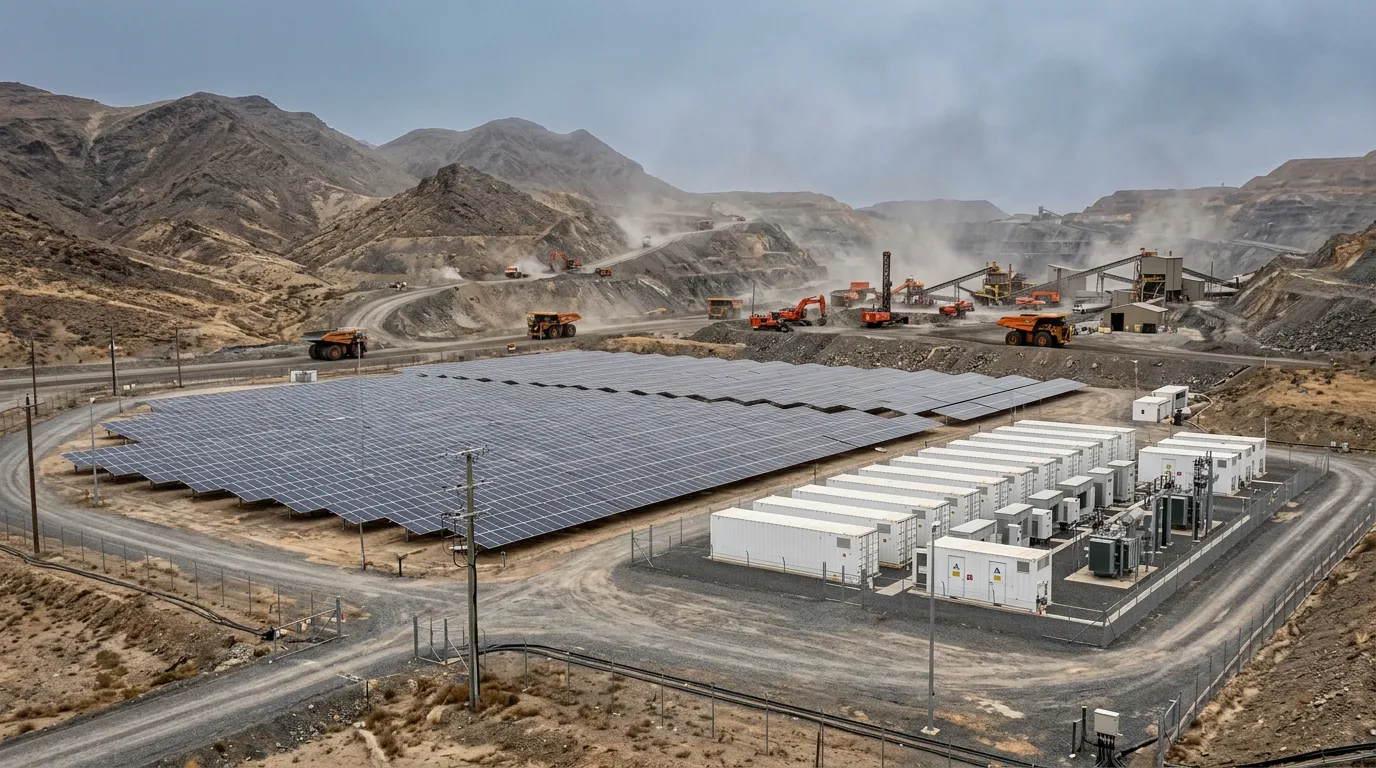
The result is visible in the project pipeline: across Africa, Australia, and Mongolia, mine owners are commissioning solar-storage-diesel microgrids not as pilot projects but as core infrastructure.
Mining Microgrid Projects in Action: Real Results
The fastest way to understand what a mining microgrid project delivers is to look at operating projects with published numbers. The table below pulls together verified configurations and outcomes from government and vendor sources.
Project | Location | Configuration | Reported outcome |
|---|---|---|---|
Agnew gold mine | Leinster, Western Australia | Wind + solar + battery + gas microgrid, total project cost A$111.6m (A$13.5m ARENA-funded) | First Australian mine powered by high-penetration renewables; 50-80% renewable fraction achieved via managed curtailment |
Ruida mine | Zambia | 13 MWp PV + 39 MWh BESS + diesel backup | Africa's largest single-unit hybrid microgrid for mining; PPA to commissioning in four months |
M Mine | Democratic Republic of the Congo | 18 MWp PV + 10 MWh ESS + six 1.8 MW gensets | Equipment-to-commissioning in 10 days; PV+ESS supply up from 35 to over 75 MWh/day; daily copper output up 12.3 tonnes (~US$120,000/day) |
Naipu mine | Zambia | 1.38 MW / 2.26 MWh microgrid | Offsets 8-12 hours of daily grid outages; ~1.9 million kWh of renewable energy per year |
HyIron Oshivela | Namibia | 12 MW / 13 MWh, fully off-grid | ~36 million kWh of clean electricity per year, meeting 100% of site demand |
Two patterns stand out. First, scale ranges from 1 MW to 50 MW+ — the word "microgrid" covers a wide band, and sizing follows the mine's load, not a template. Second, delivery speed is a selling point: the DRC project went from equipment arrival to plant-wide power-on in ten days (as reported in Huawei's white paper, alongside the M Mine production gains above), and the Zambia project went from power purchase agreement (PPA) signature to commissioning in four months, per International Mining's coverage. The Agnew figures come from ARENA's official project record.
The technology behind these projects — coordinating PV, storage, and gensets as a single PV-battery-diesel hybrid system — is now standardized enough that the engineering challenge has shifted from "can it work" to "how should it be configured."
What a Mining Microgrid Project Costs
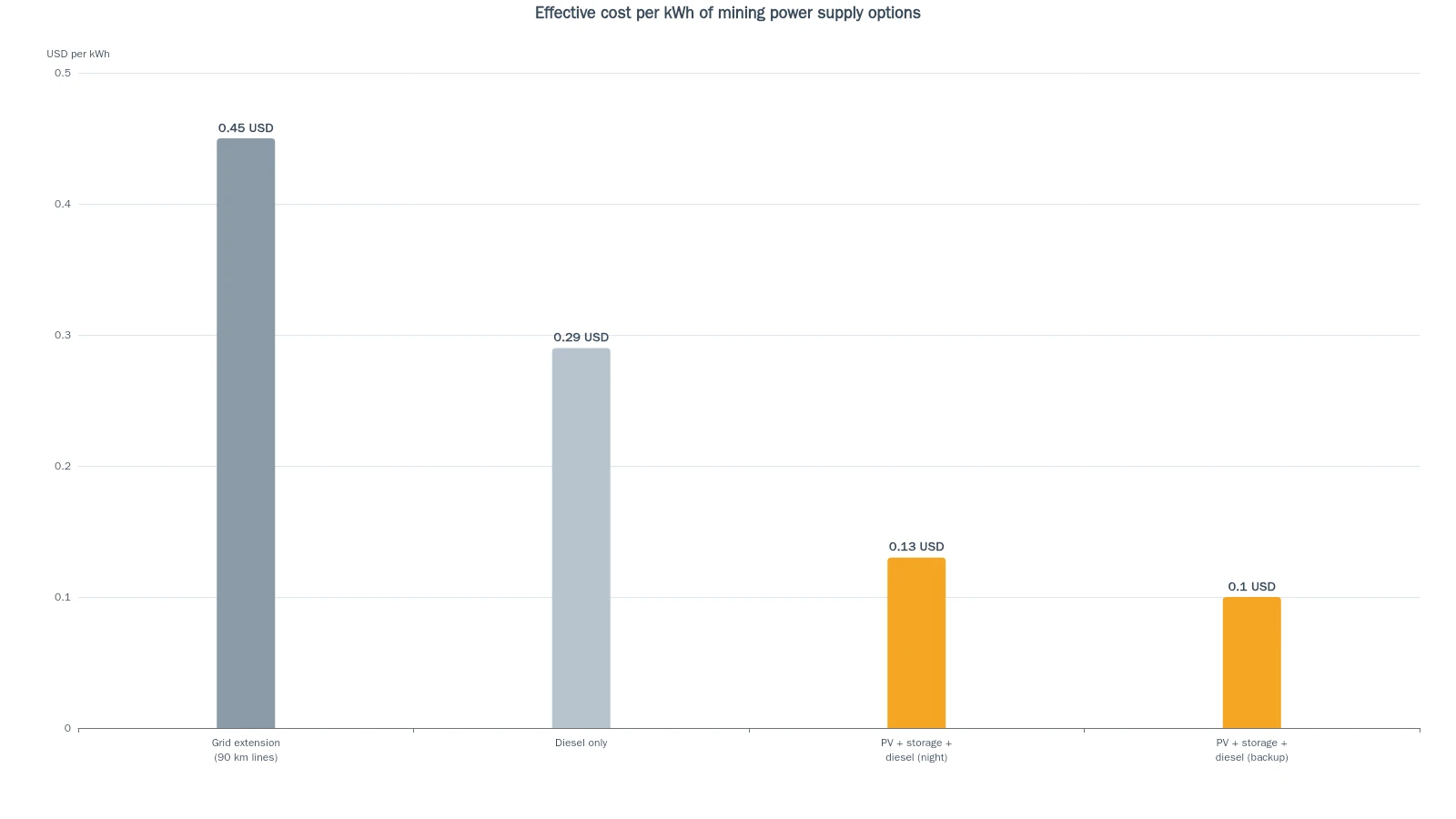
Cost is the question every mine owner asks first, and the answer depends heavily on the alternative being replaced. A useful way to frame it is cost per kWh over the project life. One published engineering analysis of a remote mining load (300 kW average, 24-hour operation) compared four supply options on exactly this basis, and its figures are reproduced in this mining microgrid case study:
Supply option | Effective cost per kWh |
|---|---|
New overhead lines + substation (90 km, 33 kV) | ~US$0.45 |
Diesel generators only | ~US$0.29 |
PV + storage + diesel (diesel as emergency backup only) | ~US$0.10 |
PV + storage + diesel (diesel covering night load) | ~US$0.13 |
The numbers are indicative — the author flags them as preliminary estimates for investment screening, not final engineering quotes — but the ordering is robust and matches the economics reported by equipment vendors. The PV+storage+diesel configuration with diesel as backup wins on cost because it maximizes the share of energy delivered at near-zero marginal cost. The caveat is that it requires the largest storage investment, so it suits sites with stable long-term production plans.
Two cost trends are moving in the buyer's favor. Solar module prices have fallen sharply since the mid-2010s, and lithium-ion battery prices dropped from about US$350/kWh in 2015 to US$80/kWh in 2025 — with cycle life now exceeding 8,000 cycles — according to Huawei's white paper. Lower storage cost per kWh is what makes high-storage designs economically viable, and it is also what shifts the levelized cost of storage (LCOS) math for whole projects.
Beyond hardware, the three biggest cost drivers are site remoteness (logistics for construction and fuel), the renewable fraction target, and the business model. A mine that self-funds pays less overall but carries the capital; a third-party developer under a PPA pays a per-kWh rate and avoids the balance-sheet hit. Both models are active in the market.
Key Design Decisions That Decide Project Success
Not all microgrid designs perform equally at a mine, and the differences show up in uptime, not in the brochure. These are the decisions that separate a project that runs for years from one that trips on the first ball-mill start.
Grid-forming vs. grid-following storage. A grid-following inverter can only inject power that matches an existing voltage and frequency reference — fine when a grid or genset is present, useless when it isn't. Grid-forming storage (often implemented with virtual synchronous generator, or VSG, control) creates the voltage reference itself, which is what lets a microgrid ride through faults, run at high renewable penetration, and black-start after an outage. For a fully off-grid mine, this is the single most important specification.
Black start capability. After a plant-wide outage, the mine must restore power from internal sources — there is no utility to call. Grid-forming ESS plus synchronized multi-PCS starting rebuilds system voltage from zero within about a minute. The capability is increasingly written into mining microgrid specifications rather than treated as optional — Huawei's white paper expects wind-PV-ESS microgrids to become mandatory for newly built mines by 2030.
PV-to-ESS ratio and curtailment strategy. High PV penetration lowers energy cost but creates stability questions when clouds pass or night falls. There is no universal ratio: it trades levelized cost against stability for a specific load shape. ARENA's Agnew findings, for example, show that up to a point, accepting some curtailment is cheaper than adding storage — the right ratio depends on how much the mine is willing to shed.
Environmental adaptation. Mining sites combine heat, dust, altitude, and vibration. Systems should be specified for the site's real temperature range — some deployments run at -40°C — with thermal management that keeps battery cells in their operating band, plus IP-rated enclosures for dust. If you are sizing the hardware itself, a guide to containerized battery storage is a practical starting point.
EMS and remote operation. A mine microgrid runs 24/7 with limited local technical staff. The EMS must handle generation-load-storage dispatch automatically, and the operator should be able to monitor and adjust the system remotely. The stronger the EMS, the smaller the on-site team required — mature platforms consolidate monitoring into a remote operations center that can supervise several sites at once.
Battery safety and chemistry. For industrial sites, LFP chemistry with multi-layer protection (cell-level monitoring, thermal management, active balancing) is the mainstream choice. Verify that the vendor's safety design covers cell, pack, rack, and system levels rather than just quoting a UL or IEC certificate.
How to Plan and Procure a Mining Microgrid Project
A mining microgrid project has a repeatable lifecycle. Working through it in order prevents the two classic failures: oversizing (paying for capacity the load never uses) and underspecifying stability (discovering on day one that the system cannot handle the mine's equipment).
1. Survey and feasibility. Collect the load profile — every piece of equipment, its power, and when it runs. Distinguish critical loads (those that must never drop: emergency lighting, communication, ventilation) from adjustable loads. Establish the site's solar resource and any grid connection reality. This phase decides whether the project is a full off-grid build or a hybrid that keeps the grid as backup.
2. Design and simulation. Size PV, storage, and gensets against the load, then simulate the system's behavior under the hard cases: motor starts, cloud cover, worst-case weather. High-quality vendors verify designs with hardware-in-the-loop or physical test platforms before shipping. Ask for the simulation results — they are the best evidence that the design will hold voltage through your specific equipment starts.
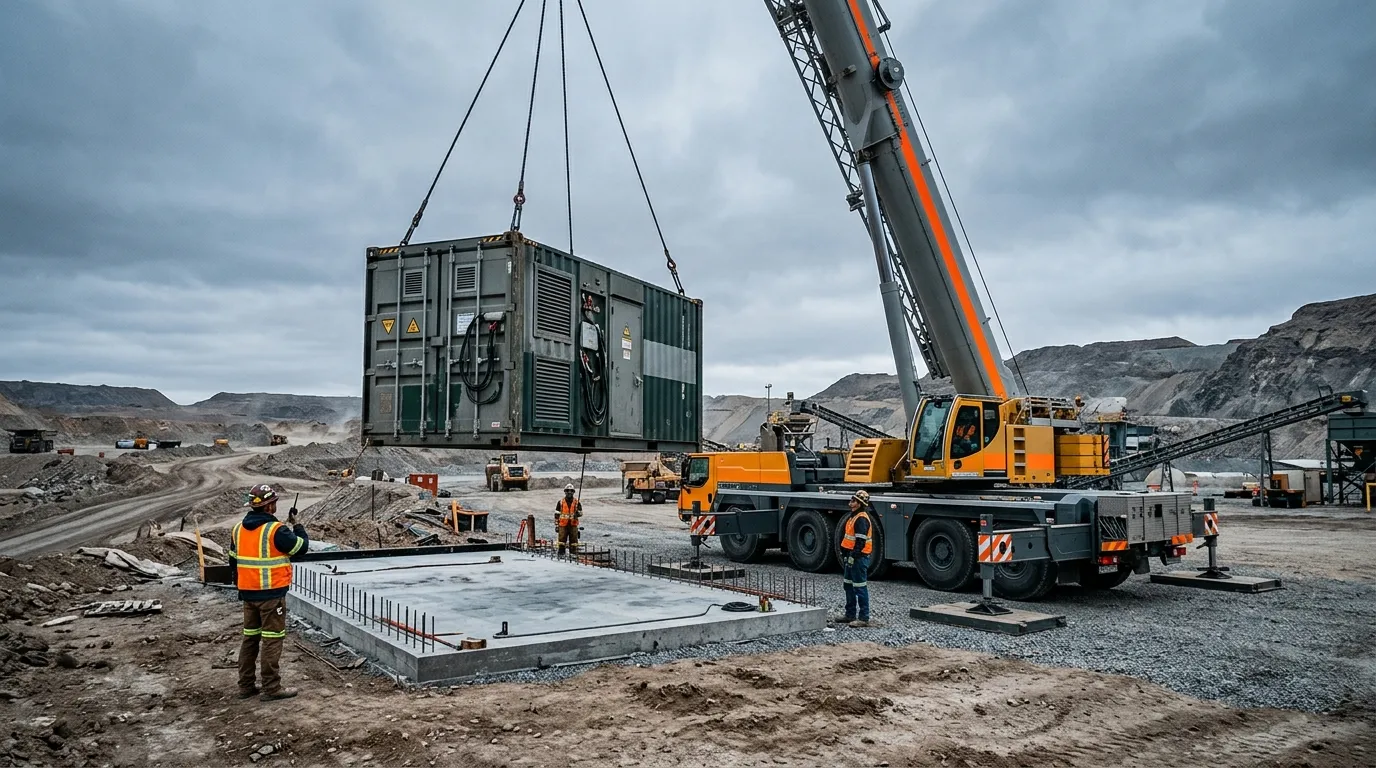
3. Delivery and commissioning. Containerized systems cut site construction time and logistics risk in remote locations, which is why most mining microgrids today are container- or cabinet-based. Commissioning speed matters more than it looks on paper: every week of delay is a week of continued diesel burn.
4. Operation and maintenance. Confirm the O&M model before signing: remote monitoring, spare parts stocking, response times, and the battery warranty's throughput terms. A 10-year storage warranty is only worth what the vendor's local service footprint can deliver.
When you evaluate suppliers, the checklist maps directly to the design decisions above: grid-forming capability and black start, demonstrated performance at your site's temperature and altitude, EMS maturity and remote access, containerized delivery experience, commissioning track record, and safety certification at component and system level. The same checklist applies whoever the vendor is — Hua Power's engineering team included — and it is deliberately strict enough that passing it means something. A structured approach to vendor selection is covered in our BESS supplier procurement guide.
On the commercial side, decide between self-funding, a PPA with a developer, or a build-own-operate structure. PPAs remove capital risk and shift performance risk to the developer, which suits mines that want predictable per-kWh pricing; self-funding captures more upside if energy prices keep rising. Either way, put the performance obligations — availability, renewable fraction, response time — into the contract in numbers, not adjectives.
Mining microgrid projects are now proven infrastructure rather than experiments. The projects above show what is achievable; the design decisions and procurement steps in this guide are the path to getting there at a predictable cost. If you are evaluating a hybrid microgrid solution for a remote mining site, a conversation with Hua Power's engineering team starts with your load profile — and the sizing, architecture, and commercial model all follow from that.