

An island energy storage system is a battery-based power system that stores electricity — usually from solar or wind — and dispatches it to keep a remote island's grid stable around the clock. It pairs a battery energy storage system (BESS) with inverters, a controller, and often a diesel genset as backup, replacing fuel-hungry generation with stored renewable power. For islands that import diesel at high cost and live with blackout risk, this is the fastest way to cut fuel bills, keep the lights on through storms, and meet clean-energy targets.
What Is an Island Energy Storage System?
An island energy storage system is a microgrid built around batteries, sized for the island's load rather than for the mainland grid. At the small end, a fishing village might run on a 100 kWh cabinet. At the large end, a utility on a Caribbean or Pacific island may deploy megawatt-scale containerized systems that serve the whole network.
The system usually has five parts:
- Renewable generation — solar PV or wind, sized to the island's irradiance or wind resource.
- Battery energy storage (BESS) — the anchor. It absorbs renewable oversupply, discharges at night, and reacts to load swings in milliseconds.
- Power conversion (PCS) and battery management (BMS) — the equipment that converts DC to AC safely and keeps cells within their operating limits.
- An energy management system (EMS) or microgrid controller — the brain that dispatches generation and storage, and switches between grid-tied and island modes.
- Diesel gensets — backup or transitional generation that runs only when renewables and storage cannot cover demand.
One boundary worth clearing up: an island energy storage system is not the same as islanding. Islanding (or anti-islanding protection) is an inverter feature that disconnects a solar system from the grid during an outage. An island grid — the kind this guide covers — is a power network that runs independently by design, and the storage system is what keeps its voltage and frequency alive.
These systems sit inside the wider family of microgrid energy storage solutions, which covers everything from campus microgrids to full utility island grids.
Why Remote Islands Are Moving Off Diesel — and What Storage Fixes
Three pressures push islands off diesel, and they reinforce each other.
Fuel is expensive and its price is volatile. Diesel on a remote island carries import, shipping, and handling costs that mainland utilities never see. Every liter travels by sea, so the delivered price is a multiple of the wholesale price. When global fuel prices spike, the island's electricity cost spikes with them.
Storms take the grid down for months. Hurricane Maria's 2017 landfall in Puerto Rico left much of the island without power for months in what Utility Dive called the longest and largest power outage in US history. A fuel-dependent grid is fragile exactly when it matters most: the fuel supply chain is also what the storm disrupts.
Governments are mandating renewable share. The Kingdom of Tonga, for example, ordered that 50% of its grid power come from clean energy; the island of Lifuka went from diesel-only to a solar-plus-storage microgrid with 480 kW / 495 kWh of battery storage to meet that mandate.
There is also a commercial layer beneath the engineering case. Islands that depend on tourism sell reliability as much as scenery: a week of rotating blackouts during high season hits hotel bookings, desalination, and cold chains at once. For communities, the same outage is a public-health event. Storage is one of the few island investments that improves the balance sheet and the resilience story at the same time.
Storage answers all three. It absorbs solar and wind that would otherwise be curtailed, holds frequency and voltage steady as renewable penetration climbs, shifts daytime energy to the night peak, and provides black-start and reserve capability when generation drops out. For a deeper look at how diesel and battery systems share the work, our guide to PV-battery-diesel hybrid systems walks through the transition in detail.
Anatomy of an Island Energy Storage System: Components That Matter
Buyers tend to fixate on the battery cells and skim past the rest. On an island, the components around the cells decide whether the system survives.
Battery chemistry. Lithium iron phosphate (LFP) dominates island deployments because of its cycle life, thermal stability, and tolerance for high operating temperatures. LFP cells routinely exceed 6,000 cycles at moderate depth of discharge — enough for a decade-plus of nightly cycling.
Grid-forming inverters, not grid-following. This is the single biggest difference between an island BESS and a mainland one. Grid-following inverters track an existing voltage and frequency source; grid-forming inverters create the voltage and frequency. On a mainland grid, storage can follow. On an island, something must form the grid when renewables are the only generation online — and that job usually falls to the battery inverter, with the diesel genset as a secondary source.
EMS and microgrid control. The controller dispatches PV, battery, and diesel against the load in real time. On a hybrid system it also handles mode transitions — grid-tied, off-grid, and back — without dropping critical loads. Whether your generation is coupled on the AC or DC side changes how the controller and inverters are configured; the difference is explained in our knowledge-base entry on AC-coupled vs DC-coupled architectures.
Thermal management and packaging. Batteries are temperature-sensitive: sustained heat accelerates aging, and dense container layouts make heat removal harder. Liquid cooling handles tropical ambient temperatures and high charge/discharge rates better than air cooling, which is why containerized island systems increasingly ship with it as standard. Packaging also matters for transport — a 20-foot container footprint that can be lifted by modest port equipment beats a bespoke skid that needs specialist handling.
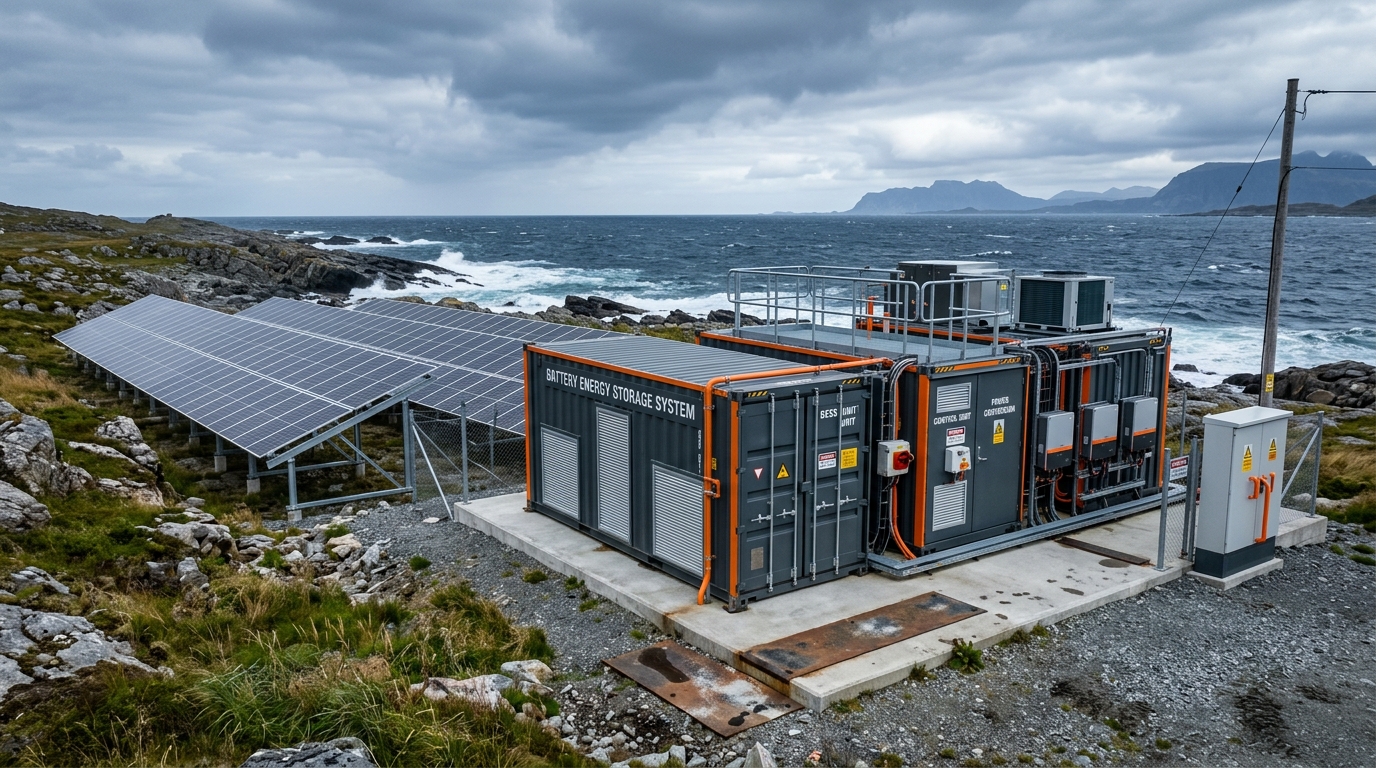
Containerized BESS paired with solar at a coastal island site. The inverter, controller, and thermal management share the container with the battery.
Island-Specific Engineering Constraints Most Guides Skip
Most island storage content stops at "batteries plus solar save diesel." The engineering realities that decide whether a project delivers are the ones nobody writes down — and they are exactly what you should probe with every supplier.
Salt and humidity corrode everything. Marine air attacks enclosures, busbars, connectors, and cooling fins. A mainland-rated cabinet can develop contact corrosion within two years in a coastal installation. Ask what marine-grade protection the enclosure carries — coating systems, IP ratings, and sealed connection bays — and check whether the supplier has installed in coastal sites before. The same corrosion logic that separates outdoor-rated cabinets from indoor models applies at island scale, so make the enclosure specification a contractual line item, not a brochure bullet.
Logistics are a project risk, not an afterthought. The equipment must cross the ocean, clear port handling, and reach a site that may have no crane and no heavy transport. Containerized systems ride standard shipping containers and can be lifted with modest equipment — which is why container form factors dominate island projects. Ask for a delivery and installation plan that names the port, the cranage, and the commissioning crew before you sign.
Hurricane wind loads and flooding. Island installations face wind speeds mainland sites never see, plus storm surge. Anchoring, foundation design, and the placement of electrical enclosures relative to flood levels all need to be engineered for the local hazard — not copied from a temperate-climate template.
Heat, humidity, and cooling. Battery life shortens as operating temperature rises. In tropical climates, thermal management is a first-order design decision: liquid cooling handles sustained high ambient temperatures and dense container layouts better than air cooling. A BESS that throttles on hot afternoons is a BESS that fails the island's evening peak.
Two more site realities round out the list. Tropical islands are lightning-prone, so grounding and surge protection need to be engineered for the local thunderstorm season, not copied from a template. And if the system replaces diesel generation, the fuel storage area — tanks, piping, and fire separation — still has to be decommissioned or repurposed safely; a good supplier will include that transition in the project plan rather than leaving it for the owner to discover later.
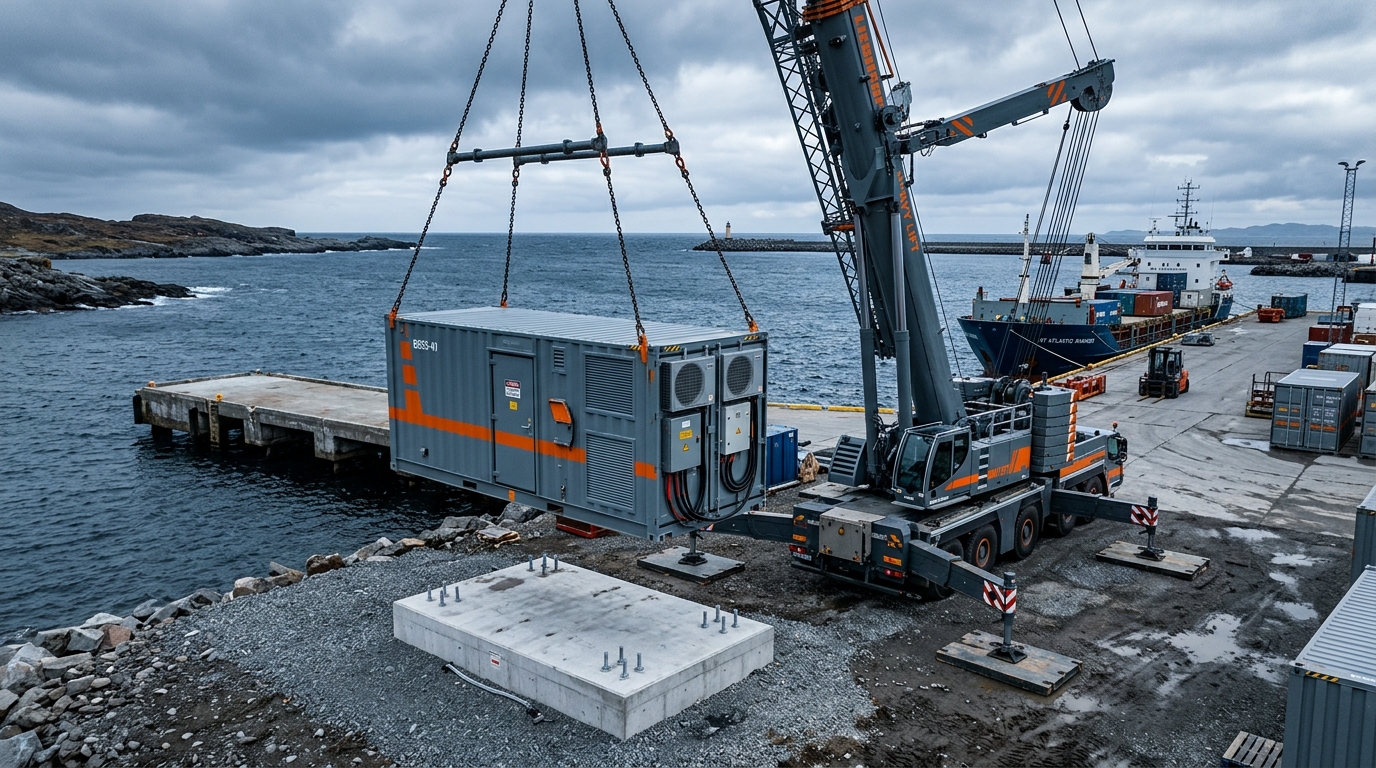
Sea freight and site positioning are part of the engineering plan on islands — containerized BESS units are designed to travel as standard cargo.
Sizing an Island Energy Storage System: A Practical Method
Sizing is a four-step exercise. Do it before you compare quotes, or every quote will be a guess.
- Establish the peak load and load profile. Measure or estimate the daily curve — including seasonal swings. Tourist islands can see demand double in high season, and that peak drives the system size.
- Set the energy duration. Most island systems shift two to four hours of renewable energy to the evening peak. If the island must survive multi-day weather events with little sun or wind, budget for longer duration — six, eight, or more hours — which changes the cost picture substantially.
- Define the state-of-charge operating band. Batteries last longer when cycled between, say, 20% and 90% rather than 0–100%. The usable capacity, not the nameplate, is what your sizing math should use.
- Allocate reserve. A share of stored energy stays in reserve for frequency support and black start. Treat it as an operating cost, not a rounding error.
The table below shows indicative scales for three common island archetypes:
Project type | Typical load | BESS size | Notes |
|---|---|---|---|
Village / fishing community | 50–200 kW | 100–500 kWh cabinet | Daily solar shifting; diesel backup for bad weather |
Resort / agritourism | 200 kW–1 MW | 0.5–2 MWh | High seasonal variance; blackout protection is a selling point |
Small-island utility | 1–10 MW | 2–20 MWh containerized | Grid-forming operation, reserve allocation, grid code compliance |
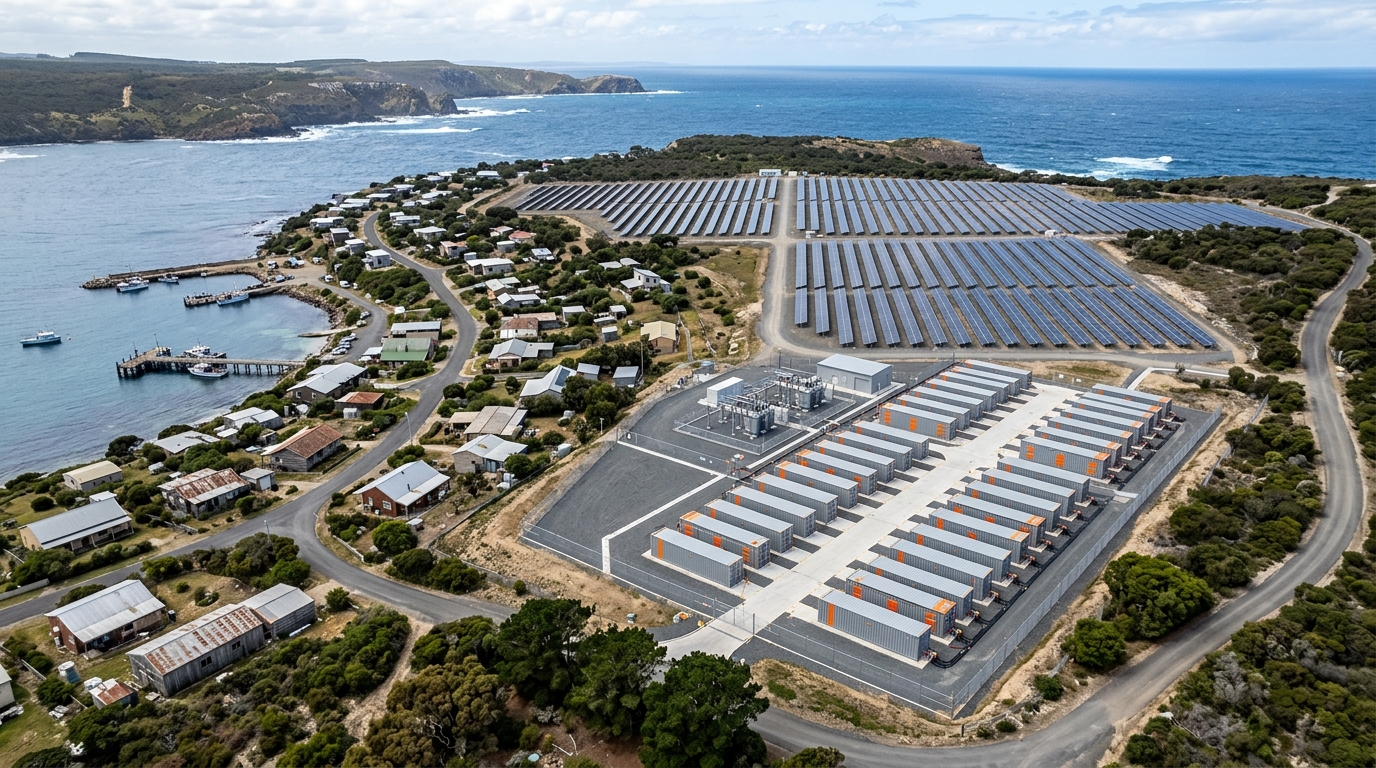
Aerial layout of a containerized island storage site. The site plan — setback distances, service access, and future expansion space — is part of the sizing package.
A quick worked example makes the method concrete. A resort pulling a 400 kW evening peak with a 2,000 kWh daily energy gap would start with roughly 2 MWh of usable capacity at a 2-hour-plus duration, then add reserve and de-rate for the operating band — landing near 2.5–3 MWh of installed capacity. These are illustrative figures, not a quote: the load profile, irradiance, and diesel strategy all move the answer. What the exercise buys you is a number to test every supplier against, instead of accepting their first proposal.
Free engineering calculators — including a battery sizing calculator — can turn your load numbers into a first-pass size while you wait for supplier quotes.
Island Energy Storage Cost vs Diesel: What the Numbers Say
The honest way to compare is lifetime cost, not sticker price — and diesel's lifetime cost is higher than most project owners initially calculate.
The capex side keeps falling. Battery pack prices have fallen roughly tenfold since 2010, and BloombergNEF projected the decline to continue as manufacturing scales. Storage is now a mainstream procurement category rather than a pilot technology.
The diesel side is bigger than the fuel invoice. Beyond the liters burned, diesel costs include ocean freight and handling, fuel storage tanks, generator overhauls every few thousand hours, and partial-load inefficiency — gensets run least efficiently exactly when they are providing standby duty. Add carbon pricing in markets that have it, and the gap widens further.
IRENA's analysis of electricity storage and renewables for island power laid out the methodology for this comparison over a decade ago: model renewable penetration, storage dispatch, and avoided fuel against the capital cost, over the system lifetime. The method still holds — only the numbers have improved, sharply, in storage's favor. When a supplier quotes you a payback, ask to see the fuel-price assumption behind it; that single input drives the whole business case.
Financing matters as much as the numbers. Island projects often stack grant and resilience funding from national programs or development agencies with commercial debt, and lenders increasingly discount fuel-price risk in their underwriting — both of which improve the case for storage. Ask your supplier which funding structures they have seen work on similar projects; a partner who knows how island projects get financed will save you months.
Safety, Standards, and Certification for Island BESS
Battery storage is safe when engineered and installed to standards — and the standards exist precisely because thermal runaway is a real failure mode. In a thermal runaway, one cell releases heat that can propagate to neighboring cells. Two frameworks govern how that risk is managed:
- NFPA 855, the US standard for stationary energy storage installation, sets requirements for siting, spacing, ventilation, and fire protection for energy storage systems.
- UL 9540A is the test method that evaluates whether fire propagates between battery units under thermal runaway — the evidence behind spacing and suppression decisions.
For island projects, ask for the certification list, not just the biggest brand name: UL 9540 / UL 9540A, IEC 62619, and the relevant grid code for the target market. LFP chemistry plus certified thermal management plus a tested enclosure is a defensible safety posture; any one of the three missing is a red flag. Our guide to UL 9540A-compliant battery cabinets covers what the test results actually mean on a spec sheet.
How to Evaluate an Island Energy Storage Supplier
The supplier, not the cell chemistry, is the biggest variable on an island project. Score candidates against six dimensions:
- Island and remote-site track record. Have they delivered to sites reachable only by sea? Ask for project references with site names, not anonymized case studies.
- Engineering depth. Do they size the system, specify the EMS, and support grid-code coordination themselves — or do they sell boxes and hand you a manual?
- Certifications, in writing. Request the certificate numbers for the exact models quoted, not a blanket "we have UL."
- Warranty and cycle-life commitments. Compare guaranteed cycles at a stated depth of discharge, and what the warranty actually covers on a remote site.
- Logistics and service reach. Who commissions the system? Who responds when something fails on an island, and how fast can spares arrive?
- OEM flexibility. Can they adapt container layouts, voltage architecture, and EMS behavior to your project — or are you fitting your island to their catalog?
Two red flags should end a conversation early: a supplier who cannot name three island or remote-site projects with locations, and one who quotes a price before asking for a load profile. Both indicate the system will be sized for their convenience, not for your island.
An example of the profile this framework selects for: Hua Power builds hybrid microgrid solutions that coordinate PV, battery, grid, and diesel under one control layer, with liquid-cooled containers from 2 to 5 MWh, sub-20 ms transfer between grid and island mode, cloud-based EMS monitoring, and deployments across 30+ countries since 2015. Whether you evaluate them or another manufacturer, run every candidate through the same six questions — the answers separate a storage vendor from a project partner.
If you have a load profile and a target island, send a one-page project brief to our engineering team and you will get a configuration and certification list back — no sales pitch attached.
Island Energy Storage in the Field: Documented Projects
Three projects show what working systems look like at different scales.
El Hierro, Canary Islands. The Gorona del Viento project couples wind turbines with a pumped-hydro storage plant on a volcanic island, and has powered El Hierro for long stretches on renewables alone — proof that storage-plus-renewables can carry an island through sustained operation.
Flinders Island, Tasmania. An ARENA-supported hybrid energy hub pairs solar, wind, and battery storage with the island's existing diesel generation, aiming to lift renewable penetration far beyond what diesel-only operation allowed. It is one of the most closely documented island hybrid projects in the English-speaking world.
Lifuka, Kingdom of Tonga. Lifuka, the Tongan island whose project was covered earlier in this guide, converted from diesel-only to solar-plus-storage to meet the kingdom's 50% clean-energy mandate — a small-island case that shows how fast a government target can become a signed project.
These are the kinds of references a supplier should be able to point you to. For more depth on how the same architecture serves remote industrial sites, see our guide to remote-site microgrid projects.
Your Next Step: From This Guide to a Working System
You now have the full picture: what an island energy storage system is, why islands are adopting them, what engineering constraints decide success, how to size one, what it costs against diesel, how safety is certified, and how to evaluate suppliers. The next three moves are yours:
- Build the load profile. A month of hourly demand data — or a well-reasoned estimate for a new site — is the input everything else depends on.
- Get a first-pass size. Run the numbers through the battery sizing calculator linked above, or ask an engineer to sanity-check them.
- Brief two or three suppliers with the same information, and score them on the six dimensions above before comparing prices.
Done in that order, the project stops being a vendor pitch and becomes a decision you control — and that is how every successful island storage project actually starts.