

If you are evaluating a battery storage project and a supplier offers an EMS platform demo, take it — but treat it as a test, not a tour. In the energy storage industry, EMS stands for energy management system, the software that decides when your battery charges, discharges, or sits idle. A good demo shows you whether that software can actually run the economics of your site. Most buyers walk in without a plan and walk out having watched a screen. This guide is the plan: what an EMS demo can and cannot prove, what to prepare before you request one, and the five checks that separate real optimization from threshold logic.
Why an EMS demo beats a datasheet
A datasheet tells you the battery's capacity, efficiency, temperature range, and certifications. It cannot tell you whether the battery will actually discharge into your evening peak, hold charge for backup, or chase a frequency signal — and that behavior, not the hardware, is what determines whether the project pays for itself. Two systems with the same cells and the same inverter can deliver very different results because their energy management system logic is different.
The stakes are visible in the numbers. Commercial tariffs in many markets charge not only for energy but for the highest 15-minute demand peak of the month, a cost that EIA's monthly electricity data tracks as a growing share of commercial bills, and the IEA's grid-scale storage analysis charts a parallel expansion at utility scale. Behind-the-meter projects are chasing the same dispatch value. The same hardware with different scheduling logic can produce very different monthly bills, so an EMS battery evaluation belongs on your checklist alongside cell chemistry and cycle life. A demo is the only place where you can watch the scheduling logic against a real tariff structure instead of trusting a block diagram. For a closer look at how a peak-shaving use case pays off in practice, our commercial peak shaving guide walks through the tariff mechanics.
What a storage EMS demo can and can't show you
Set expectations before the call, or you will judge the wrong things. A live demo can show you:
- Dispatch behavior — what the EMS does with the battery under a given tariff, load curve, and price signal.
- User interface — how you read the dashboard, set priorities, and override a schedule.
- Data flow — which meters and signals feed the optimization, and how fast they update.
- Integration — how the EMS talks to the inverter, the battery management system (BMS), and site SCADA.
It cannot show you: long-term forecast accuracy (that only shows up in operation), real project economics (those depend on your load and tariff), or how the software behaves after a year of firmware updates. Treat the demo as evidence about design, not a guarantee about outcomes. The diagram below shows where the EMS sits in a storage site — above the BMS protection layer, issuing power setpoints to the power conversion system (PCS), and reading meters and forecasts from the site.
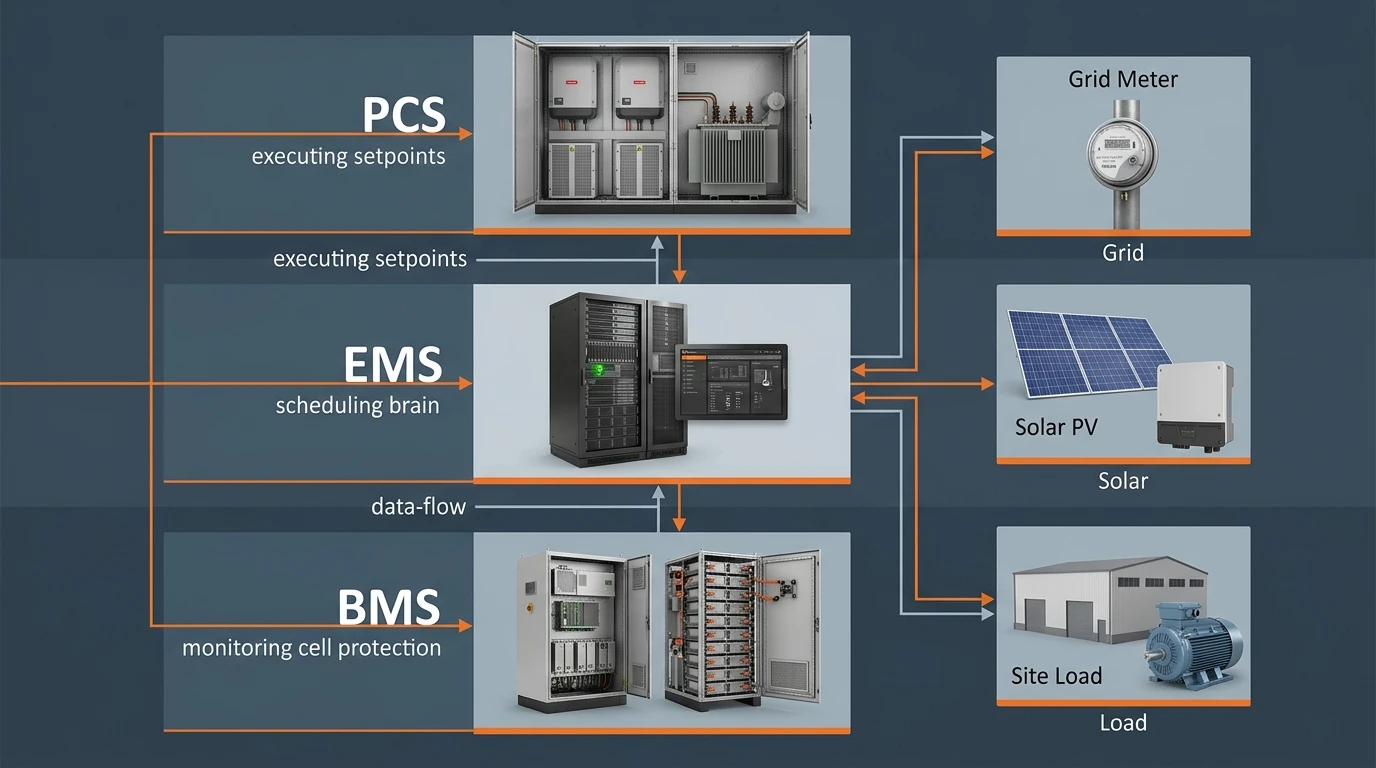
Where the EMS sits: scheduling layer above BMS protection, setpoints down to the PCS, meters and forecasts up from the site.
If the boundary between the BMS and the EMS is still fuzzy, our knowledge base article on energy management systems draws the line in detail — it is the same vocabulary you will hear in the demo.
How to prepare for an EMS demo
A focused demo needs three inputs from you. Bring them to the first call, and the session becomes a technical review instead of a sales pitch.
1. Your project parameters. Capacity and power rating of the battery, the site's load curve (15-minute intervals if you have them), the tariff structure (energy rates, demand charges, time-of-use blocks), and the grid connection terms. No EMS can be evaluated against a hypothetical — the demo is only meaningful with your numbers on the screen.
2. Your priority order. What must the battery do first: cut the demand charge, shift energy to cheaper hours, store surplus solar for evening use, carry the site through an outage, or earn revenue from frequency regulation? These goals conflict — holding reserve for backup means less energy available for arbitrage. The demo should show you how the EMS resolves that conflict, not just that it can do each thing individually.
3. Your question list. Write the questions you would ask a control engineer, not a salesperson. The next two sections give you the ones that matter most.
When you request an energy management system demo, ask the supplier to run it against a representative tariff and load profile rather than their demo dataset. That single request tells you how much flexibility the platform actually has.
Rule-based dispatch or real optimization: the question to ask
Every EMS on the market can be put in one of two buckets, and the demo is where you find out which bucket it is in.
A rule-based controller runs a fixed ladder of if-then logic: if load exceeds 200 kW, discharge; if it is after 10 pm, charge; if solar exceeds load, store the surplus. It is cheap, predictable, and adequate for simple single-purpose sites. But it is reactive — it fires when a threshold is crossed and cannot plan for a peak it can see coming in the forecast, or weigh two conflicting goals against tomorrow's prices.
An optimizing EMS is forward-looking. It forecasts the load, the solar output, and the price signal over a rolling horizon — often the next 24 hours in 15-minute steps — then solves a scheduling problem: the charge and discharge plan that minimizes cost subject to the battery's limits and your priority order. It reads the state of charge and active limits from the BMS and plans strictly inside them, and it re-solves every few minutes as new data arrives, so when reality diverges from the plan, it corrects instead of committing to a bad schedule for the rest of the day. The difference is not cosmetic; it is the difference between a battery that shaves the peaks the forecast says are coming and one that only reacts to peaks that have already happened.
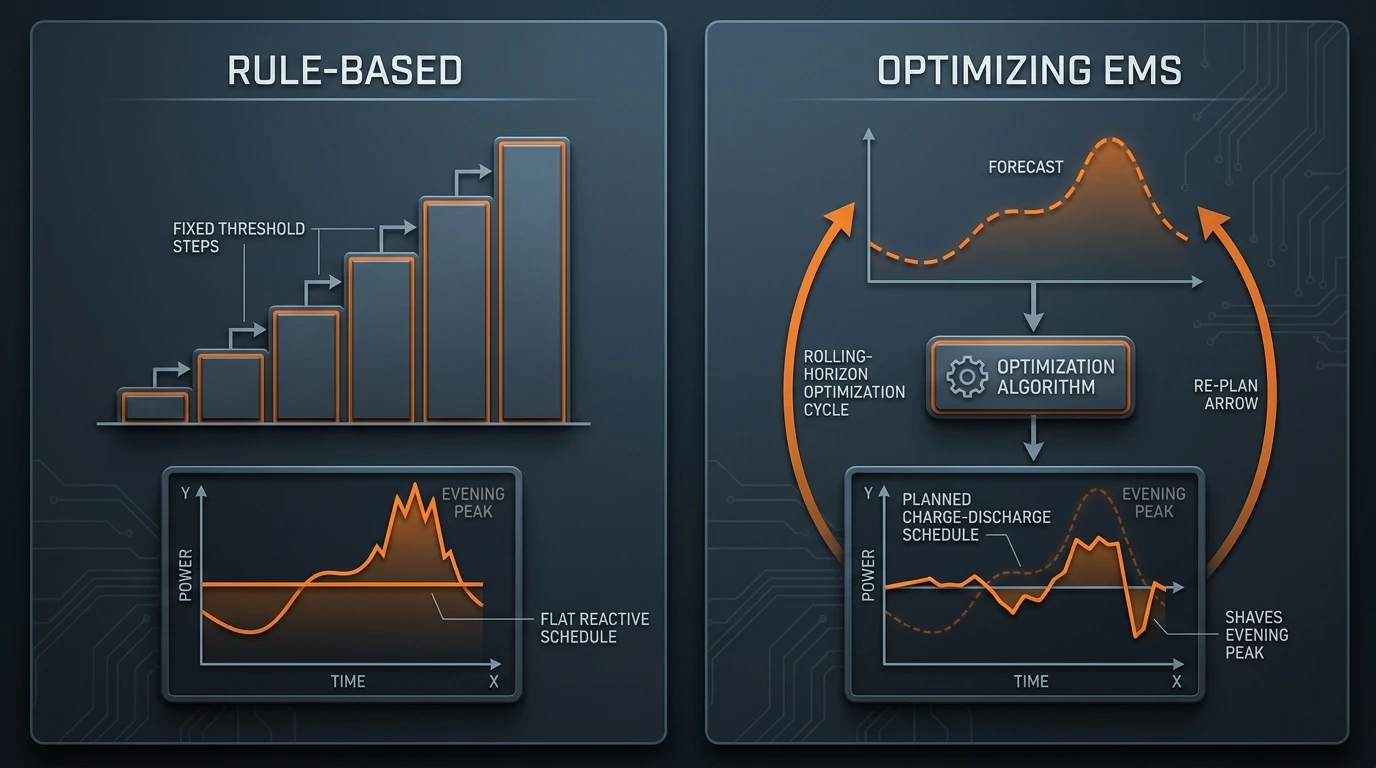
Rule-based logic reacts to thresholds; an optimizing EMS plans against forecasts and re-solves as data updates.
Watch for this in the demo: ask what happens when two objectives compete, and ask to see a forecast overlaid on the dispatch plan. The DOE's energy storage program describes grid services like frequency regulation and peak management that demand this planning behavior — if the demo cannot show a horizon-based plan, what you are looking at is a threshold script with an EMS label. On a BESS EMS platform, the distinction shows up as: does it plan against tomorrow's tariff blocks, or only react to today's? For more on how competing revenue streams interact, see our demand response with energy storage explainer.
The platform that runs our storage systems — Visual EMS — is built around this forecast-driven, rolling-horizon approach, with the EMS, BMS, and PCS designed together so the scheduling layer and the protection layer agree on the operating window.
Integration, data, and the questions buyers skip
Most demo evaluations stop at the dashboard. The expensive failures live one layer deeper, in integration and data.
Ask what protocols the EMS speaks to the rest of the site. Industrial sites commonly expose data over Modbus, DNP3, or IEC 61850, and the EMS has to talk to the meters, the PCS, and the plant SCADA in the formats those systems already use. In the demo, ask for the integration list — which devices were actually connected, over which protocol, and what happens when a meter poll fails or a setpoint is rejected. Projects fail on exactly these handshakes, not on the algorithm. Our mining microgrid project write-up shows what integration complexity looks like on a real site with PV, diesel, and battery assets.
Second, ask about data quality. An EMS is only as good as its inputs: a meter polled too slowly to catch a peak, or a forecast fed by stale weather data, will degrade the best optimization. Ask how often the EMS reads the meter, what happens when the connection drops, and whether the platform falls back to safe defaults or keeps optimizing on stale data.
Third, ask about the boundary cases you will actually hit: a grid outage during an arbitrage cycle, a manual override, a firmware update mid-operation. The demo should include at least one fault scenario — if the supplier cannot simulate one, that is an answer in itself.
A checklist for scoring the demo
Bring a scorecard. Rate each of the five checks from 1 to 5 during the session, and compare the totals across suppliers instead of relying on how the presentation felt.
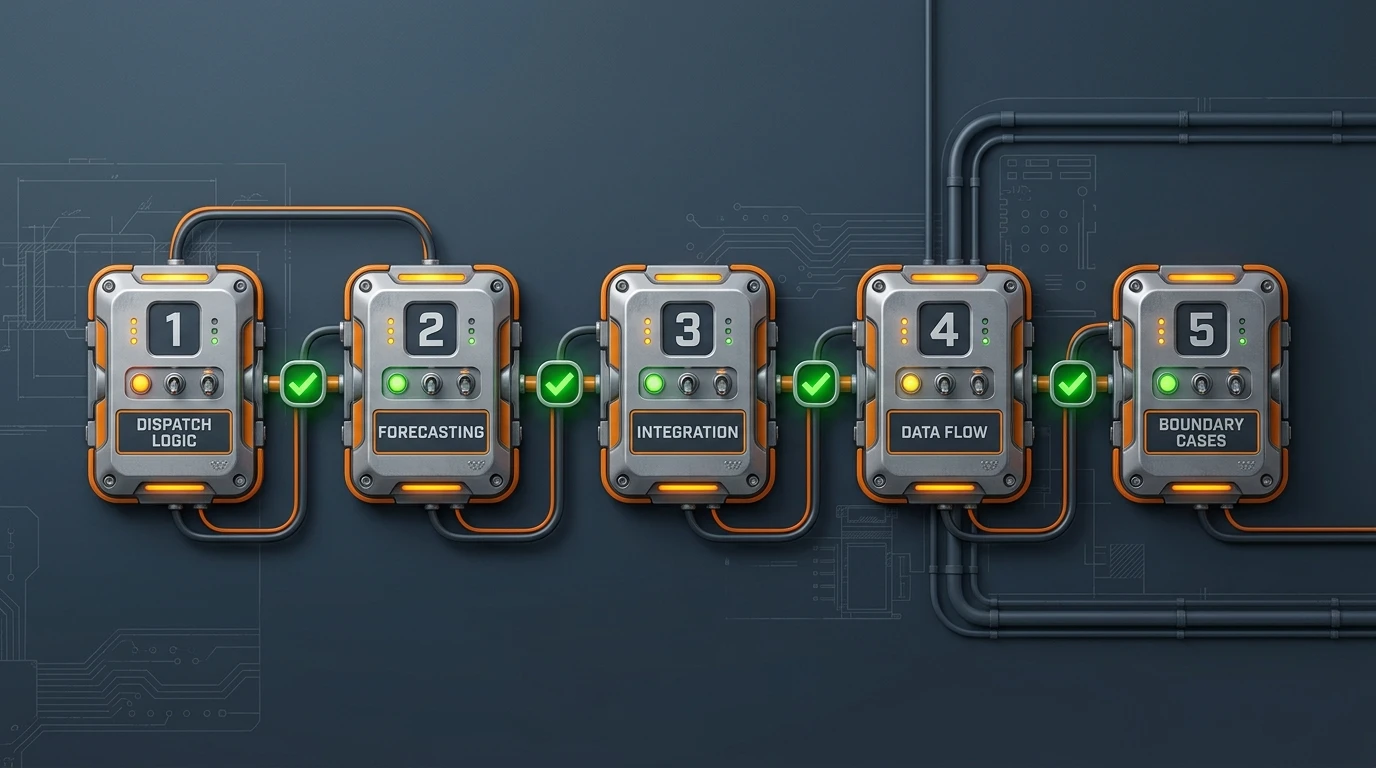
The five checks to score during a storage EMS demo: dispatch logic, forecasting, integration, data flow, and boundary cases.
Check | What to watch | Ask |
|---|---|---|
Dispatch logic | Horizon-based plan vs threshold reactions | Show me the schedule for tomorrow, overlaid on the tariff |
Forecasting | Load, solar, and price forecasts visible in the UI | What happens when the forecast is wrong? Show me a recovery |
Integration | Real protocols, real devices, named interfaces | Which devices were connected, over which protocol? |
Data flow | Meter polling speed, failover behavior | What does the system do when the meter connection drops? |
Boundary cases | Outage, override, firmware scenarios | Run a fault scenario with the battery mid-cycle |
A score of 4 or 5 across all five checks is rare and worth taking seriously. A BESS energy management system that cannot show you a forecast, a recovery from a bad forecast, or a live integration list is a demo of a mockup, not a product. The checklist above is deliberately short — five checks you can complete in one hour, then compare apples to apples between vendors. It is the same discipline our buyers use when they evaluate a battery energy management system against a real site plan.
After the demo: what to ask for next
If the demo holds up, ask for three things before you move forward: a recorded session or detailed demo report you can share with your team, a reference project with a similar tariff structure and use case, and the technical documentation for the integration interfaces (not just the datasheet). Then compare the proposals with the C&I BESS procurement guide, which covers the rest of the supplier evaluation from warranty terms to delivery.
If you want to see how Visual EMS runs a live tariff and load profile for your site, brief our engineering team — send a one-page summary of your application, capacity, and grid connection, and an application engineer will set up a session against your numbers. That is what a demo request should be: not a form fill, but the start of a technical conversation about what your battery will do every hour of the day.