

What an EMS Platform Does in a Battery Storage System
Searching for an "EMS architecture whitepaper" usually means you are past the "what is a battery" stage and into the harder question: will this storage system actually run the way the economics spreadsheet says it will? That answer lives in the software layer that decides when the battery charges, discharges, or sits idle — the energy management system (EMS).
An EMS platform is the control software that orchestrates a whole energy site: the battery, solar generation, the grid connection, on-site loads, and the tariffs that meter them. It sits above the hardware. It reads meters and forecasts, then issues power setpoints to the power conversion system (PCS) or inverters that physically move the energy. It does not push electrons itself, and it does not watch individual cells — that is the battery management system's (BMS) job. The BMS enforces safety limits at the cell level; the EMS optimizes how the whole battery is used inside that safe window. The distinction matters because it decides who you hold accountable when a project underperforms, and it is drawn in detail in our guide to how an EMS differs from a BMS.
What you are actually buying when you buy an EMS is an architecture: a set of layers, protocols, and control logic that has to survive contact with a real site for fifteen years. The rest of this article walks through what that architecture looks like, why it determines project economics, and how to read the whitepaper that is supposed to prove it. Our energy management system platform hub collects the related material in one place.
The Four Layers of an EMS Platform Architecture
Vendors describe their EMS in different numbers of layers — some say three, some say five — but a BESS EMS architecture is always the same four functions stacked on top of each other. Knowing the four-layer model lets you translate any vendor's diagram into the same vocabulary.
1. The device layer. This is the physical equipment the EMS talks to: battery modules and their BMS, PCS units, smart meters, HVAC, and fire suppression systems. Nothing here runs the EMS; it is the source of the data the EMS lives on. A site with poor metering — a meter polled too slowly to catch a demand peak — starves every layer above it.
2. The communication layer. This is how the EMS moves data and commands between devices and the control layer. Industrial sites speak industrial protocols, and a real EMS platform speaks several: IEC 61850 for substation automation, IEC 60870-5 for telecontrol, plus Modbus TCP and DNP3 for meters, PCS units, and plant SCADA. The communication layer is also where redundancy lives — dual networks, hot-standby servers — because a control system that goes offline mid-discharge is worse than no control system at all.
3. The control and optimization layer. This is the brain. It ingests real-time measurements, runs the scheduling logic, and produces the power setpoints that go back down to the PCS. It is also where the two very different kinds of "EMS" diverge: a rule-based controller fires when thresholds are crossed, while an optimizing EMS forecasts load, solar, and price over a rolling horizon and solves a scheduling problem every few minutes. Everything that follows in this article depends on which of these you are looking at.
4. The application and cloud layer. This is the user-facing surface: dashboards, alarms, reporting, remote monitoring, and the interfaces that connect the site to a fleet-level operations platform or a grid dispatch center. It is the layer your operations team sees every day and the one most likely to be judged in a demo — which makes it the easiest layer to over-weight in an evaluation.
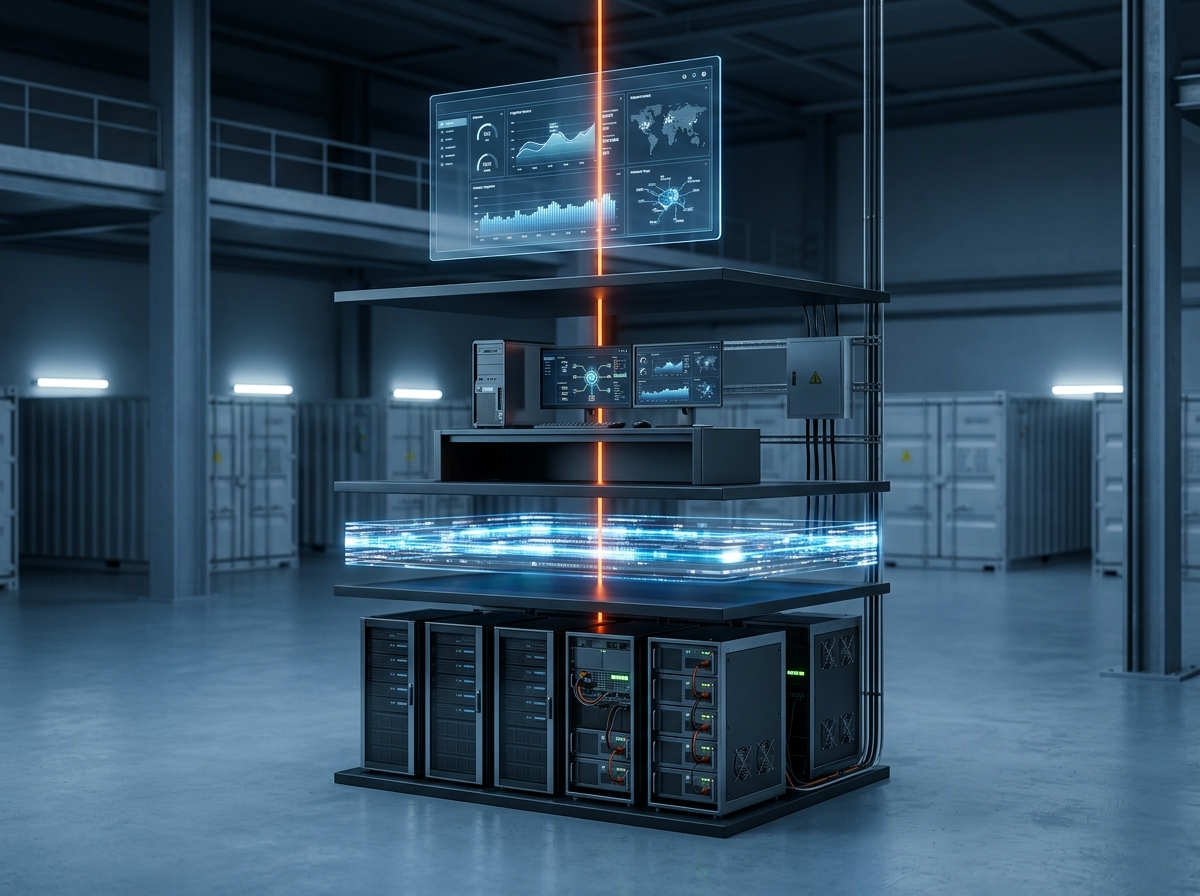
An EMS platform stacks four functions — devices, communication, control and optimization, and the application/cloud surface — and every project decision touches at least two of them.
Why the Architecture — Not the Feature List — Decides Project Economics
Two storage systems can share the same cells, the same inverter, and the same datasheet, and still deliver very different returns, because their EMS architecture decides how well the battery chases value. The connection runs through three layers.
The communication layer sets how fast the system can react. Frequency regulation pays for sub-second response, and grid services like this are exactly what the U.S. Department of Energy's energy storage program describes when it lists the jobs storage can do for the grid. If the architecture routes every decision through a slow cloud round-trip, the system simply cannot participate in those markets — the latency is the disqualifier, not the algorithm.
The control and optimization layer sets how much of the predictable value the project captures. Peak shaving and time-of-use arbitrage are forecasting problems dressed up as hardware problems: the battery earns the most when it discharges into the peaks the forecast says are coming, and holds charge when a bigger peak is behind it. A rule-based controller that only reacts to thresholds already crossed leaves that money on the table. The mechanics of these revenue streams are covered in our commercial peak shaving guide and our frequency regulation explainer, and the tariff structures that drive them — including demand charges based on the highest 15-minute peak of the month — are tracked in the EIA's monthly electricity data.
The redundancy layer sets the cost of failure. A hot-standby controller, dual communication networks, and a deterministic fallback plan cost money on the bill of materials but protect against the much larger cost of a storage asset that stops dispatching on a summer peak. When you compare EMS quotes, you are comparing these three trade-offs, not comparing checkboxes.
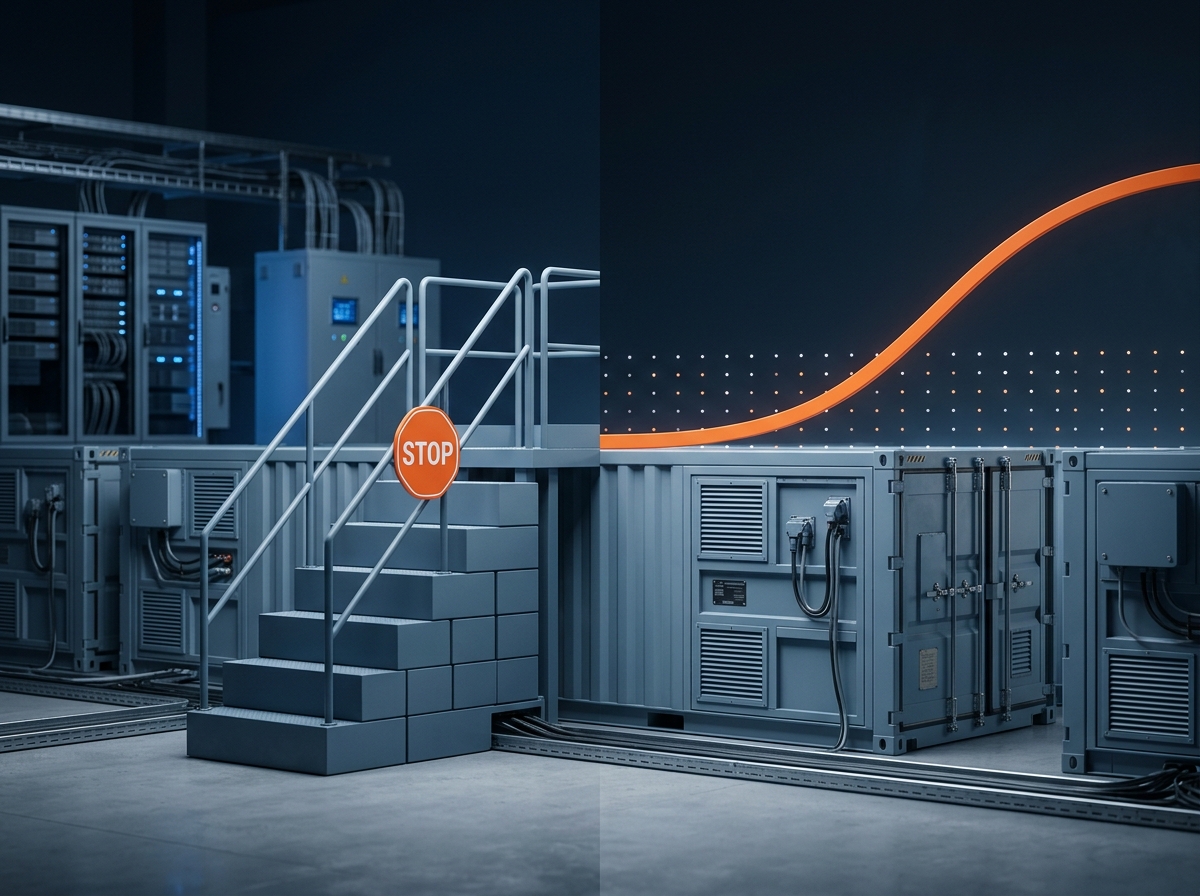
Rule-based logic reacts to thresholds that have already been crossed; an optimizing EMS plans against forecasts and re-solves as reality diverges from the plan.
What to Look For When You Read the Whitepaper
An EMS architecture whitepaper is a vendor's claim that its architecture is real. Read it like an auditor, not like a brochure. Five things to pull out of it:
Layer coverage. Does the whitepaper address all four layers, or only the dashboard? A whitepaper that is all application layer and no control logic is a UI brochure.
The protocol list. The whitepaper should name the protocols the EMS actually speaks — IEC 61850, IEC 60870-5-104, Modbus, DNP3 — and, more importantly, which devices it has proven them against. Vague "industry-standard connectivity" language is a red flag; a named device list is evidence.
Redundancy and failure behavior. What happens when a server dies, a network link drops, or a meter poll fails? The whitepaper should describe fallback behavior. If the answer is only "cloud monitoring," the architecture has a single point of failure. Look for how it handles the growing threat surface of connected energy assets — the IEC 62443 family is the reference framework for security in industrial automation, and a serious platform should engage with it.
Deployment model. Where does the control logic run — on-site at the edge, in the cloud, or both? On-site control is what keeps the system dispatching when connectivity drops; cloud layers add fleet visibility and analytics. The whitepaper should be explicit about which decisions happen where.
The upgrade path. Storage projects live fifteen years, and software dies faster than batteries. Can the platform add new optimization features, new protocols, or new market participation without a hardware swap? Architecture is what makes that possible or impossible.
Reading a whitepaper is the desk work; seeing the claims move is the field work. Once you have pulled these five items out of the document, the natural next step is to run an EMS platform demo against your own tariff and load profile — that is where architecture claims meet your numbers.
How Architecture Shapes Integration, Commissioning, and Operations
Architecture is not just a procurement question; it is what you live with from factory acceptance to year ten of operations.
During factory acceptance testing (FAT), the EMS is the tool the whole system is validated with. If the EMS, BMS, and PCS come from different vendors, FAT becomes a negotiation between three parties' protocols and fault definitions. If they were designed together, the acceptance test is checking one system instead of arbitrating three.
On site, integration is where projects actually fail: a meter that polls too slowly to catch a peak, a PCS that rejects the setpoint format, a SCADA handshake that was never tested. The EMS architecture determines how many of these handshakes exist and who owns them. Complex multi-asset sites — PV, diesel, and battery together, or islanded microgrids — stress this harder than anything else, which is why our island energy storage system and mining microgrid project write-ups spend so much time on the control layer.
In operations, the architecture decides how much of your team's week is spent on the system. A platform with a clean application layer and remote visibility turns daily checks into exception handling; one without it turns every alarm into a site visit.
EMS Architecture in a Real C&I Project
To make this concrete, consider how one platform carries across a product range. Hua Power develops its EMS, BMS, and PCS in-house, and the platform — called Visual EMS — runs the company's standardized C&I systems from 64 kWh up to 1.2 MWh on the same software, scaled by configuration rather than reinvented per size. It is also mature enough to be licensed white-label to other manufacturers.
Three architecture facts from that setup are worth testing any vendor against. First, forecast-driven scheduling over a rolling horizon — typically the next 24 hours in 15-minute steps, re-planned as meter and forecast data update — rather than a fixed ladder of thresholds. Second, control logic that reads the state of charge and active limits from the in-house BMS and plans strictly inside them, which is what makes EMS and BMS from the same design team an operational advantage rather than a marketing phrase. Third, one platform across many SKUs, which means the optimization logic you validate on one project ships on the next one unchanged. The hardware it runs on — from containerized BESS systems to cabinet-level units — is documented on the company's products page.

The EMS platform in a real C&I deployment: containerized BESS hardware on site, with the control and monitoring layer running the same optimization logic across the product range.
EMS Architecture Evaluation Checklist
Before you request the whitepaper — and before you sign anything — run this list against the answers you get:
Check | What a passing answer looks like |
|---|---|
Layer coverage | All four layers addressed, not just the dashboard |
Protocol openness | Named protocols (IEC 61850, Modbus, DNP3, IEC 60870-5-104) with proven devices |
Control engine | Forecast-driven rolling-horizon optimization, not threshold rules |
Redundancy | Dual networks, hot-standby controllers, defined failure fallback |
Cybersecurity | Engages with IEC 62443, not a single line about "secure cloud" |
Deployment model | Explicit about what runs at the edge vs. in the cloud |
Upgrade path | New features and protocols without a hardware swap |
Track record | Same platform proven across multiple projects and SKUs |
Each of these maps to a line in the whitepaper. If a whitepaper cannot answer one of them in a page, that is information too.
Download the EMS Architecture Whitepaper
If you are specifying a storage system — a demand-charge site, a solar-plus-storage retrofit, a project chasing several revenue streams at once — the EMS architecture will determine whether the economics hold in year three, not just in the proposal. When you request an architecture whitepaper from a vendor, use the checklist above to verify it covers the four layers, the optimization engine, the redundancy and security posture, and how the platform scales across projects — before you commit to a hardware decision.
Request a copy and a walkthrough from an application engineer — the demo request page runs the platform against your tariff and load profile, and the contact form goes straight to engineering. The whitepaper tells you what to expect; the demo shows you whether the architecture does what the document claims.