

If your battery gets cycled most days — solar storage, marine, RV, or backup fleets — LiFePO4 wins on lifetime cost per usable kilowatt-hour, and it wins by a wide margin. If your battery mostly sits on float charge in a cold building, and the purchase price is the only number that matters, lead-acid is still a perfectly rational choice. That's the honest version of the endless "lifepo4 vs lead acid battery" debate, and this guide shows you how to get there with your own numbers instead of trusting a vendor's chart.
This comparison is published by Hua Power Engineering, a manufacturer of LiFePO4 battery systems. That's a conflict of interest worth naming before anything else: we sell one of these two technologies. So the rest of this article shows you exactly where lead-acid genuinely wins and where LiFePO4 loses — using the same figures either way, with sources and dates you can check.
LiFePO4 vs Lead-Acid at a Glance
Dimension | LiFePO4 | Lead-Acid |
|---|---|---|
Cycle life | 3,000–6,000+ cycles | 500–1,000 cycles |
Usable capacity | ~80–90% of rated Ah | ~50% of rated Ah |
Round-trip efficiency | ~95% | ~80% |
Weight (same usable energy) | About a quarter of lead-acid | Roughly 4–5× heavier for the same usable energy |
Maintenance | None | Watering, cleaning, equalization |
Charge below 0°C | Blocked by the BMS unless the battery has an appropriate low-temperature charging strategy | Possible under specified conditions, usually at a reduced rate |
Upfront cost (100Ah class, retail) | $300–$1,000+ | $100–$200 |
Cost per usable kWh over life | Lower (illustrated below) | Higher |
The short version: lead-acid is cheaper at the cash register and more forgiving in cold weather; LiFePO4 is cheaper per unit of energy actually delivered, for the lifespan of the system. The rest of this guide is about which of those two facts matters more in your application. If you're new to battery energy storage, our battery energy storage basics hub walks through the fundamentals (voltage, capacity, C-rate) that the rest of this page assumes.
What You're Actually Comparing: Two Chemistries, One Job
A lead-acid cell stores energy through a chemical reaction between lead dioxide, sponge lead, and sulfuric acid; discharge converts the plates to lead sulfate, which is why deeply discharged batteries "sulfate" and lose capacity. It has been doing this job, largely unchanged, for over 150 years. A LiFePO4 (lithium iron phosphate, LFP) cell stores energy by shuttling lithium ions between an iron-phosphate cathode and a graphite anode. LFP is one member of the lithium-ion family, but its phosphate cathode behaves differently from the nickel-cobalt chemistries you may have read about — it does not release oxygen during thermal breakdown, which is the core reason its runaway risk is far lower (Wikipedia, Lithium iron phosphate battery).
Both chemistries are sold in the same 12V/24V/48V form factors and both can power the same loads. The differences are not about what they can do, but about how much of their rated capacity you can safely use, how many times they can do it, and what each cycle costs. Those three questions structure the rest of this comparison.
Usable Capacity: Why a 100Ah LiFePO4 Is Not a 100Ah Lead-Acid
The single most common mistake in this comparison is comparing ampere-hours (Ah) as if they were equal. They are not. A 100Ah battery gives you 100Ah only under specific discharge conditions, and the two chemistries define those conditions very differently.
Lead-acid should not be discharged below about 50% if you want it to survive many cycles — depth of discharge below that accelerates sulfation and shortens life sharply. So a 100Ah lead-acid bank really offers you about 50Ah of usable capacity before you start damaging it. A LiFePO4 battery is routinely rated to 80–90% depth of discharge, so the same 100Ah offers roughly 80–90Ah usable. That alone is nearly a 2× difference in delivered energy for the same sticker rating.
Then there is discharge rate. Lead-acid suffers from the Peukert effect: the faster you draw current, the less total energy the battery actually delivers — a battery rated 100Ah at a 20-hour rate may deliver only 60–70Ah at a 1-hour rate. Lithium iron phosphate holds its rated capacity across much wider discharge currents (Wikipedia, Lead–acid battery documents both the chemistry and the rate-dependence). This matters enormously in real loads — an inverter drawing 1kW from a 12V bank pulls ~83A, which is deep into Peukert territory for lead-acid and trivial for LiFePO4.
The practical sizing rule: to replace a 100Ah lead-acid battery with LiFePO4 and get at least the same usable energy, a 50Ah LiFePO4 usually suffices; to replace a 100Ah LiFePO4 with lead-acid, you need roughly a 200Ah bank. Size by usable kilowatt-hours (rated Ah × system voltage × usable DoD), not by Ah.
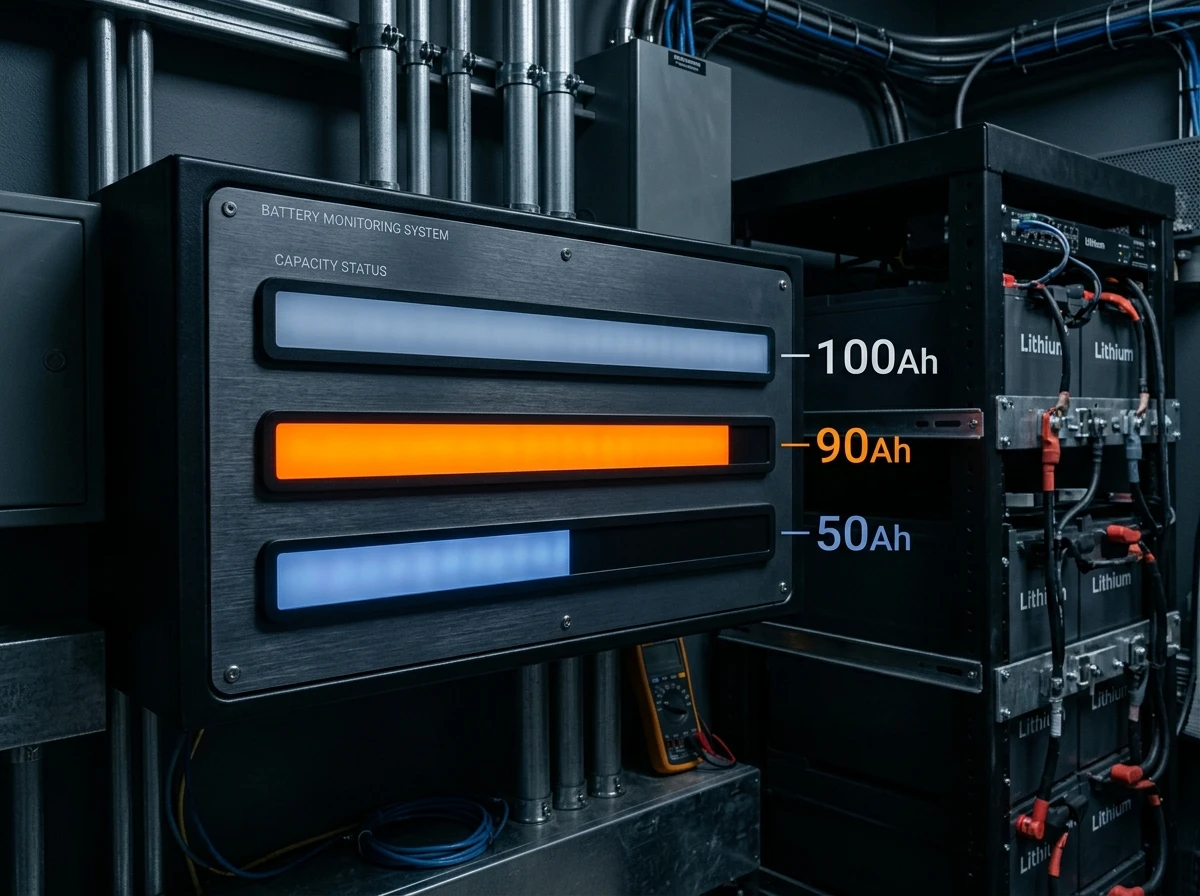
Usable capacity is the number that matters: same 100Ah rating, nearly double the deliverable energy on the LiFePO4 side.
Cycle Life and Lifespan: 500 Cycles vs 6,000 Cycles
Cycle life is the number of full charge–discharge cycles a battery can deliver before its capacity drops below a defined threshold (usually 80% of rated). This is where the two chemistries diverge most:
- Lead-acid deep-cycle: roughly 500–1,000 cycles to 50% DoD in realistic service. Cycle life falls fast if you discharge deeper or leave the battery partially charged for long periods — sulfation quietly accrues during storage and float.
- LiFePO4: 3,000–6,000+ cycles at 80% DoD is the range commonly quoted by cell makers (LFP cells are spec'd by the manufacturer at 3,500–6,000 cycles at 1C/80% DoD; system-level ratings depend on the BMS and inverter). At typical daily cycling that is 8–15 years before a battery wears out — at which point most installations will be replaced for other reasons first.
There is a second, less appreciated difference: calendar life. Lead-acid degrades even when unused — a flooded battery left on float for two years is measurably weaker. LiFePO4 also ages with time and temperature, but far more slowly; a battery that sits for a year at 50% state of charge loses only a few percent of capacity. That makes LFP the sensible choice for seasonal systems (a summer cabin, a weekend boat, a hurricane-season backup) that might otherwise "die of boredom."
Warranties reflect this gap: lead-acid warranties are typically 1–3 years; quality LiFePO4 systems carry 5–10 year warranties. A warranty is not a prediction, but it is a manufacturer's own estimate of how long the product should last — and the two chemistries' estimates differ by a factor of three.
Round-Trip Efficiency and Charging Speed
Round-trip efficiency measures how much of the energy you put in comes back out. Lead-acid sits around 75–85%: the rest is lost as heat and internal chemical losses, and the losses get worse at high charge/discharge rates and at partial states of charge. LiFePO4 typically delivers 92–97% round-trip. On a solar system, that difference means a lead-acid bank needs more panel capacity to deliver the same nightly energy — the inefficiency taxes your generation, not just your battery.
Charging speed differs just as much. A lead-acid battery charges slowly by design: a typical deep-cycle bank accepts only about 0.1–0.2C (10–20A per 100Ah), and the absorption phase stretches on for hours as the battery forces current down. LiFePO4 accepts 0.5C–1C without damage — most 100Ah LFP batteries will take a full charge in 2–3 hours versus 8–12+ for the same usable energy in lead-acid. If your solar day is short, your generator runs at night, or your vehicle needs to recharge between trips, that speed difference is a hard requirement, not a convenience.
There's a quieter operational difference too: lead-acid must be returned to full charge regularly or it sulfates; LiFePO4 tolerates partial state-of-charge operation for long stretches without damage. For "opportunity charging" applications — a shuttle that charges for 40 minutes between runs, a forklift that never quite finishes a charge — LFP's indifference to partial charge is a real reliability win.
Weight, Size, and Installation
For the same usable energy, a LiFePO4 bank weighs roughly a quarter of a lead-acid bank and takes about half the volume. Concretely: a 100Ah LiFePO4 (roughly 90Ah usable) is ~12–13kg, liftable with one hand; matching that usable energy in lead-acid means roughly a 200Ah bank — two 100Ah units — which typically weighs 50–70kg (a single 12V 100Ah deep-cycle lead-acid battery is usually 25–35kg, so a two-person lift is realistic for the pair).
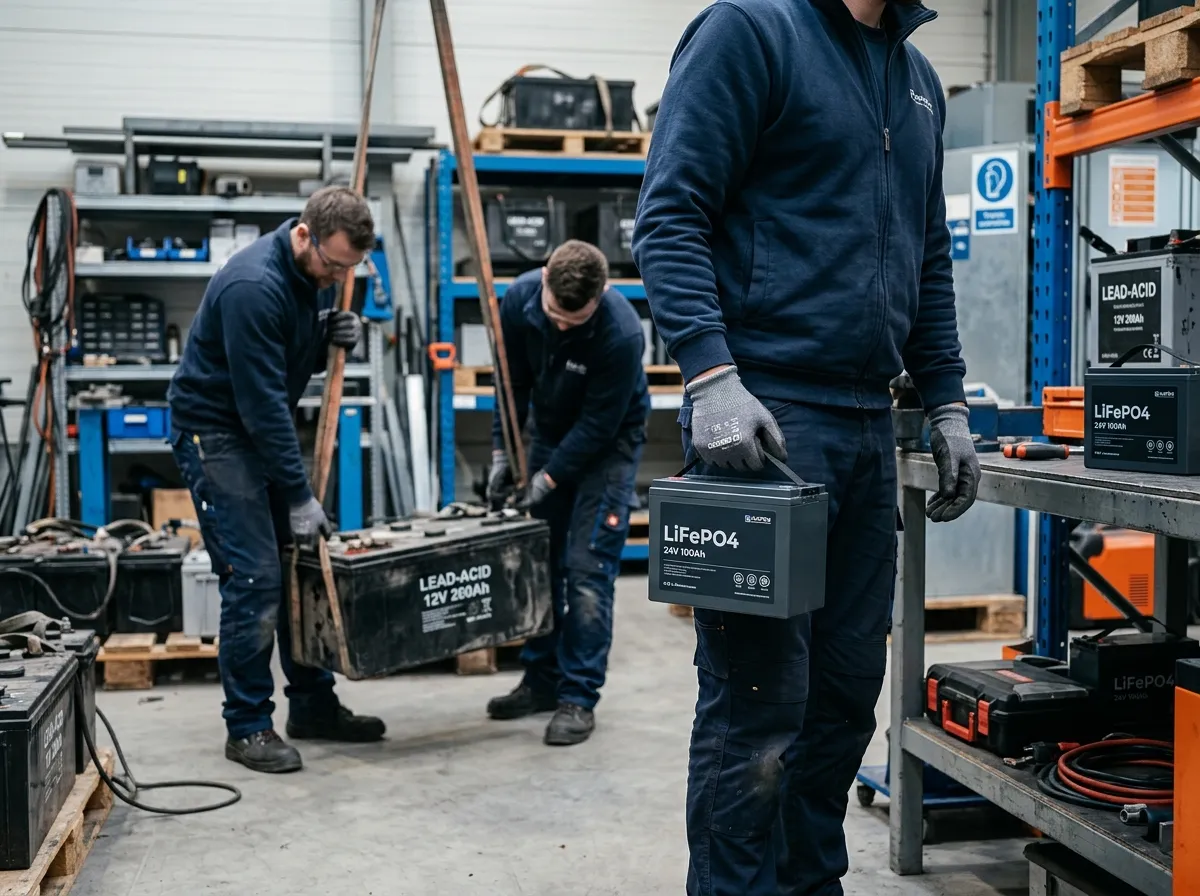
Equivalent usable energy, roughly a quarter the weight — the difference shows up in every installation, truck, and boat.
Installation rules differ too, and this is where lead-acid costs more than its sticker price. Flooded lead-acid batteries vent hydrogen and oxygen during charge — they need ventilation, often a dedicated battery compartment, and upright mounting with acid containment. AGM and gel variants are sealed and safer, but still heavier and still temperature-sensitive. LiFePO4 is sealed, can be mounted in any orientation (except inverted), and needs no ventilation — which is why you'll find LFP batteries inside RVs, boats, and cabinet systems where a lead-acid compartment would be impractical.
Cold Weather: The One Place Lead-Acid Still Shines
Here is the honest section. Cold is lead-acid's strongest territory, and anyone selling LiFePO4 who tells you otherwise is selling you a problem.
- Charging below 0°C: lead-acid can be charged below freezing, at a reduced rate. LiFePO4 must not be charged below 0°C — lithium plating during low-temperature charging permanently damages cells. Every proper LFP system enforces this via its battery management system (BMS), which simply refuses to accept charge current below the cutoff. An unheated LFP battery in a -15°C garage will not charge until it warms up.
- Discharging below 0°C: both chemistries lose capacity and deliver less power in the cold. LiFePO4 still discharges (typically down to -20°C, with reduced capacity); lead-acid's advantage here is modest.
- What this means in practice: an LFP system in a cold climate needs either a heated battery (many manufacturers now offer self-heating versions), a heated enclosure, or installation indoors where temperatures stay above freezing. If none of those is possible, lead-acid — which will charge at -20°C, slowly — may genuinely be the more robust choice.
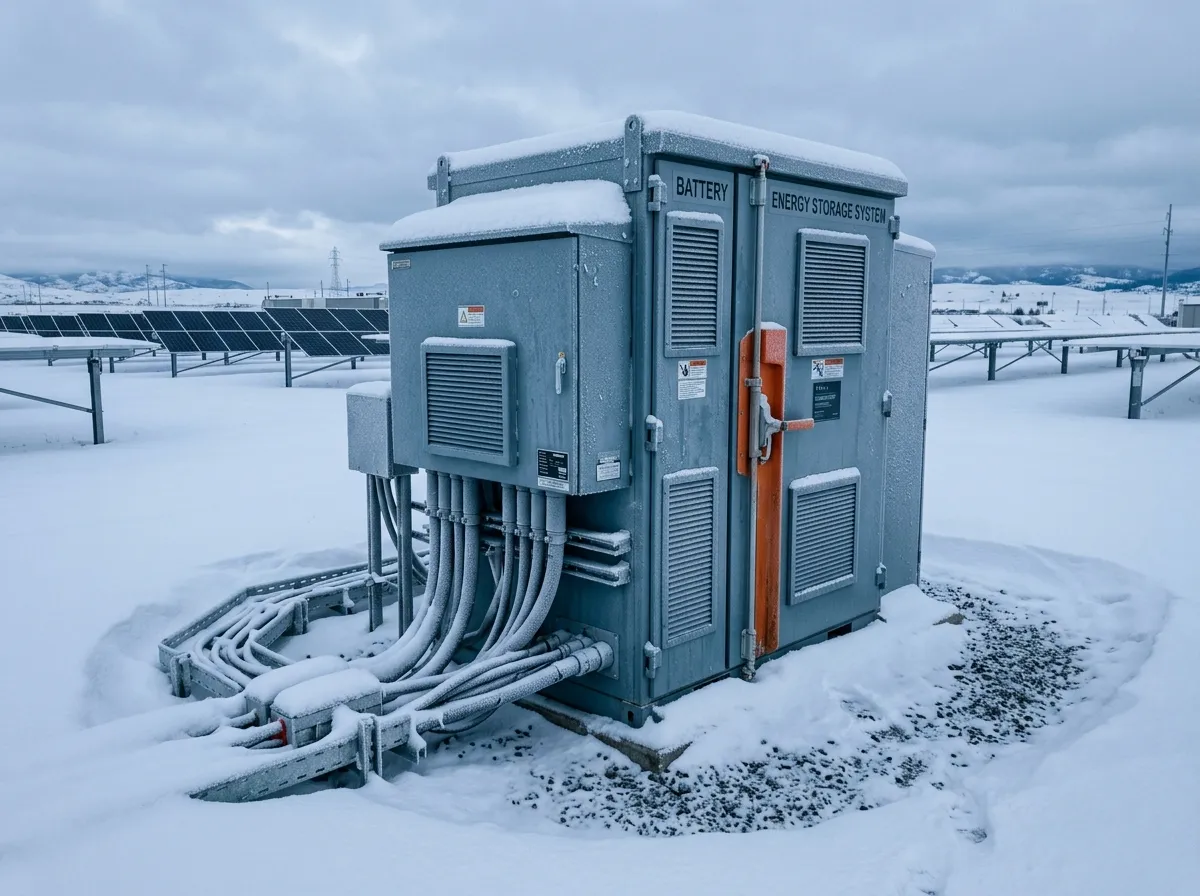
Cold is where lead-acid keeps an honest edge: it will charge below freezing, while LiFePO4 charging is blocked by the BMS until the pack warms up.
The nuance most comparison articles skip: "can't charge below 0°C" is not "doesn't work below 0°C." An LFP battery inside a heated equipment room, or with self-heating, delivers full performance year-round — the constraint is about where the battery lives, not about the climate outside.
Charging Compatibility: Can You Use a Lead-Acid Charger?
A frequent question — and a dangerous one. The short answer: a lead-acid charger will usually "work" with a LiFePO4 battery, in the sense that current flows, but it will not charge it correctly, and it can shorten its life.
The reason is the charging profile. On a 12V system:
Charging stage | Lead-acid (typical) | LiFePO4 (typical) |
|---|---|---|
Bulk/absorption voltage | 14.4–14.8V | 14.2–14.6V |
Float voltage | 13.5–13.8V (continuous) | None — BMS balances instead |
Equalization | 15–16V (flooded) | Never — damages cells |
Temperature compensation | Required (charger must derate in cold/heat) | Not needed (BMS handles protection) |
Two failure modes follow. First, a lead-acid charger's float stage holds 13.5–13.8V indefinitely; LiFePO4 does not need or want float, and a permanently floating LFP pack slowly stresses the cells (modern BMSs mitigate, but it's a needless tax). Second, and worse, older "smart" chargers with an equalization stage can push 15–16V into an LFP pack — past the cell's safe ceiling and into BMS-protection territory, repeatedly.
The rule of thumb: use a charger with a LiFePO4 profile (or a plain CC/CV supply set to the right voltage). A lead-acid charger set to AGM/Gel mode with no equalization is acceptable in a pinch for a 12V LFP battery — the BMS will refuse truly dangerous conditions — but it will not fully charge the pack, and you should treat it as temporary. When replacing a lead-acid battery with LiFePO4 in an existing system, budget for a charger or inverter-charger with an LFP setting; it is a small line item that protects a large one.
Safety and Maintenance
Safety is where LFP's chemistry earns its reputation. Because the iron-phosphate cathode does not release oxygen under thermal stress, LiFePO4 cells are markedly more resistant to thermal runaway than nickel-based lithium chemistries, and they tolerate overcharge, puncture, and crush far better — the property is well documented in the chemistry's public literature. They still contain significant energy — a shorted, physically destroyed pack can still fail — which is why every quality LFP product ships with a BMS and fusing, and why installers should follow the manufacturer's mounting and clearance guidance. When you compare products, the compliance signals worth checking are UL 1973 (stationary storage systems) or IEC 62619 (industrial cells and packs) plus UN38.3-tested cells — quality LFP vendors publish these, and they are the shorthand B2B buyers use to separate engineered packs from assembled cells.
Lead-acid's risks are different and easier to underestimate: sulfuric acid that burns skin and corrodes terminals, hydrogen gas that accumulates in unvented compartments (a real explosion risk around sparks), and lead, a cumulative toxin that makes disposal and recycling a regulated obligation in most jurisdictions.
Maintenance follows the same pattern. Flooded lead-acid needs regular water top-ups, terminal cleaning, periodic equalization charges, and state-of-charge management — skipped maintenance is the #1 cause of early lead-acid failure. AGM/gel reduce the watering chore but still need voltage discipline and have finite shelf lives. LiFePO4 is genuinely maintenance-free in operation: no watering, no equalization, no monthly checks — the BMS handles balancing and protection. The maintenance you do owe an LFP system is an annual check of connections and firmware, which is less work than a lead-acid battery's monthly rounds.
Both chemistries should be recycled, and the infrastructure differs: lead-acid has a mature, near-universal recycling chain (most of a battery's lead is recoverable), while LiFePO4 recycling is younger but growing fast, driven by exactly the volume this comparison is about. Neither chemistry belongs in a landfill.
Cost of Ownership: Upfront Price vs Cost per Cycle
This is the section where most comparisons go vague, so let's do actual arithmetic. All figures below are retail price observations from vendor listings and published comparisons (2023–2026), not quotes — prices vary by brand, capacity, and region, so treat them as ranges and check current pricing before you buy (Goldenmate comparison, 2023; Eway comparison, 2026).
Illustrative example — a 12V 100Ah bank, typical retail:
Lead-Acid | LiFePO4 | |
|---|---|---|
Purchase price (typical retail) | ~$150 | ~$600 |
Usable capacity (Ah × DoD) | 100Ah × 50% = 50Ah | 100Ah × 90% = 90Ah |
Usable energy per cycle | 0.6 kWh | 1.15 kWh |
Realistic cycles to 80% capacity | ~800 | ~4,000 |
Lifetime usable energy | ~480 kWh | ~4,600 kWh |
Cost per usable kWh | ~$0.31 | ~$0.13 |
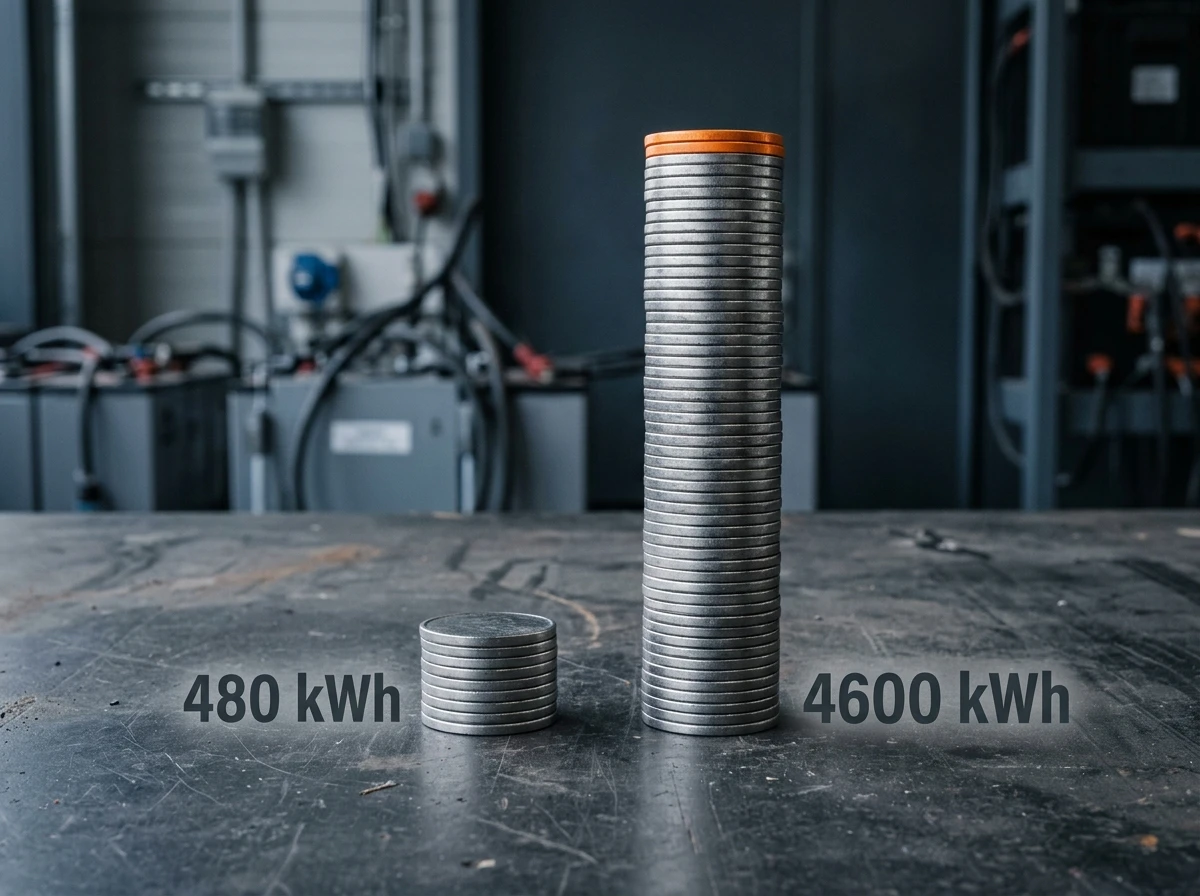
Same 100Ah rating, different economics: the LiFePO4 battery costs more at the register and less per kilowatt-hour it actually delivers.
Run the same numbers with a $250 lead-acid battery and a $1,000 LiFePO4 and the ratio barely moves — lifetime usable energy is the dominant term, and it favors LFP by roughly an order of magnitude. The one assumption that flips the result is cycle count: if your application truly cycles the battery only a handful of times a year (emergency lighting, a rarely-used backup pump), lead-acid's 500–1,000 cycles may outlast the installation, and its low first cost wins outright.
A few caveats in the same spirit of honesty. LiFePO4 prices assume the battery lasts as spec'd — cheap LFP cells with weak BMSs do not. Lead-acid prices do not include the extra panels required to overcome its efficiency loss in solar systems, the labor of multiple replacements over a decade, or the ventilation work it imposes. If you're sizing a solar or backup system, our guide to 48V LiFePO4 batteries walks through real module specs and system pricing in the sizes installers actually buy.
Where Lead-Acid Is Still the Right Choice
Being honest about the case for lead-acid is not a courtesy — it's the difference between a useful comparison and a sales pitch. Buy lead-acid if:
- The battery mostly floats. UPS units, emergency lighting, and standby pumps cycle rarely. Lead-acid was designed for float duty; its 500–1,000 cycles will outlast the equipment, and the low first cost is pure win.
- The location is cold and unheated. Below-freezing charging, day after day, with no practical way to heat the battery: lead-acid charges, LFP refuses until warmed.
- First purchase price is the binding constraint — and you know the battery will be replaced. On a hard budget, a $150 lead-acid battery that delivers two or three seasons of partial service can be the financially correct choice, especially when the alternative is a $600+ LFP battery you can't afford to buy at all.
- You need high cranking current. Starter batteries are a lead-acid stronghold for good reason: brief, enormous current pulses that are hard on deep-cycle LFP sizing and easy on automotive lead-acid.
- Your region's service infrastructure assumes lead-acid. Local recycling, rebuilders, and familiar installers can be worth more than the chemistry's spec sheet.
None of these are strawmen — they're the applications where a LiFePO4 seller should honestly say "buy the other one."
Where LiFePO4 Wins — and Where We Still Lose
For the applications that cycle daily, the decision is not close: solar self-consumption, off-grid homes, boats, RVs, telecom backup, forklift and AGV fleets, and commercial peak shaving. LiFePO4 delivers more usable energy per dollar over the system's life, charges in a fraction of the time, tolerates partial charge, needs no maintenance, and weighs roughly a quarter as much for the same usable energy. That is why, in the commercial and industrial segment, LFP has become the default chemistry for new stationary storage designs over the past decade (as of 2026), and why even automotive manufacturers moved to LFP for entry models (Tesla's standard-range vehicles have used LFP cells since 2021).
And now our own limitations, since we manufacture LiFePO4 systems and you should read this with that in mind: LiFePO4 still costs more upfront; it cannot charge below freezing without heating; it requires a compatible charger and a functioning BMS (which adds a component that can fail — though modern BMSs fail safe); and it does not match the absolute power density of nickel-based lithium chemistries, so it is heavier than NMC for the same energy. We do not claim otherwise, and you should be suspicious of anyone who does.
If you're sourcing batteries in volume — for a solar installer's stock, a marine OEM's BOM, or a backup-fleet refresh — the procurement math (cost per usable kWh, warranty terms, BMS integration, and batch consistency) is exactly the conversation Hua Power Engineering has every week; our engineers will work your numbers rather than argue with them. Talk to our engineers with your duty cycle and climate, and you'll get a straight answer — including, when it's warranted, "buy lead-acid."
How to Choose: A Decision Framework
Rather than a rule of thumb, score your own situation against the four variables that actually drive the choice:
Your situation | Choose | Why |
|---|---|---|
Battery cycles most days (solar, off-grid, fleet, marine) | LiFePO4 | Lifetime cost per usable kWh is 2–3× lower; charges in hours, not overnight |
Battery floats for months, used rarely (UPS, emergency) | Lead-acid | 500–1,000 cycles outlasts the application; lowest first cost |
Unheated location below 0°C, no heated battery option | Lead-acid | It charges below freezing; LFP refuses until warmed |
Budget is the first-cost ceiling, replacements expected | Lead-acid | $100–$200 today beats $600+ you cannot spend today |
10-year total cost matters (any cycling application) | LiFePO4 | One battery vs 2–4 replacements; less solar needed for the same output |
Two checks before you finalize any choice: size by usable energy (Ah × voltage × usable DoD), never by sticker Ah, and confirm your charger or inverter-charger has a compatible profile. Both apply regardless of which chemistry you pick — they're just the two mistakes that turn the right battery into the wrong installation. For a deeper dive on the winning side of this comparison, our LiFePO4 battery guide covers cell construction, specs, and what to look for in a datasheet.
FAQ: LiFePO4 vs Lead-Acid
Is LiFePO4 better than lead acid? For daily-cycled applications, yes — more usable capacity, 5–10× the cycle life, higher efficiency, no maintenance, and a lower cost per usable kWh over the system's life. For cold, unheated, rarely-cycled float applications on a tight first budget, lead-acid is still the rational choice. "Better" depends on the duty cycle.
Can I replace my lead-acid battery with LiFePO4? In most cases, yes: same 12V/24V/48V form factors, same wiring basics. Check three things first — the charger/inverter-charger must have a LiFePO4-compatible profile (or be settable to it), the BMS must be rated for your peak current, and you should re-size by usable energy (a 100Ah lead-acid can usually be replaced with a 50Ah LiFePO4 for equal usable capacity). The physical size will be smaller; the mounting hardware will almost certainly need adjusting.
Can I charge LiFePO4 with a lead acid charger? Only in a pinch, and only with a lead-acid charger that has no equalization stage and a voltage ceiling within the LFP range (see the charging section above). A permanent setup should use a LiFePO4 profile; an equalizing charger can damage the pack, and a float-only charger will never fully charge it.
Are LiFePO4 batteries safer than lead-acid? In the ways that matter most, yes: no acid, no hydrogen off-gassing, no ventilation requirement, and a cathode chemistry that is highly resistant to thermal runaway. Lead-acid's hazards (acid, hydrogen, lead toxicity) are more familiar but not smaller. Both must be recycled and both deserve respectful installation — neither is a toy.
Is Tesla using LiFePO4? Yes — Tesla moved its standard-range Model 3 and Model Y to LFP cells starting in 2021, which is a useful real-world signal that the chemistry's cost, safety, and cycle life are credible at automotive scale. It also illustrates LFP's trade-off: slightly lower energy density than nickel chemistries, accepted in exchange for cost, safety, and longevity.
LiFePO4 vs lithium-ion — same thing? No. LiFePO4 is one type of lithium-ion battery. The broader "lithium-ion" family also includes NMC and NCA chemistries with higher energy density but different safety and cycle characteristics; our lithium-ion battery knowledge base page explains the family tree.
Bottom Line
Choose LiFePO4 when the battery works for a living — daily cycling, partial charge, real discharge current, a decade of service in one box. Choose lead-acid when the battery mostly waits — cold, unheated, float duty, or a first-cost ceiling that makes lifetime math irrelevant. For everything in between, run the five-line cost-per-usable-kWh calculation from this guide with your own quotes; it takes two minutes and it settles more arguments than any spec sheet.
And if you're evaluating batteries for a project in volume, bring us your numbers: duty cycle, climate, and budget, and our engineers will tell you which chemistry fits — even when the answer isn't ours.