
What Is an NMC Battery?
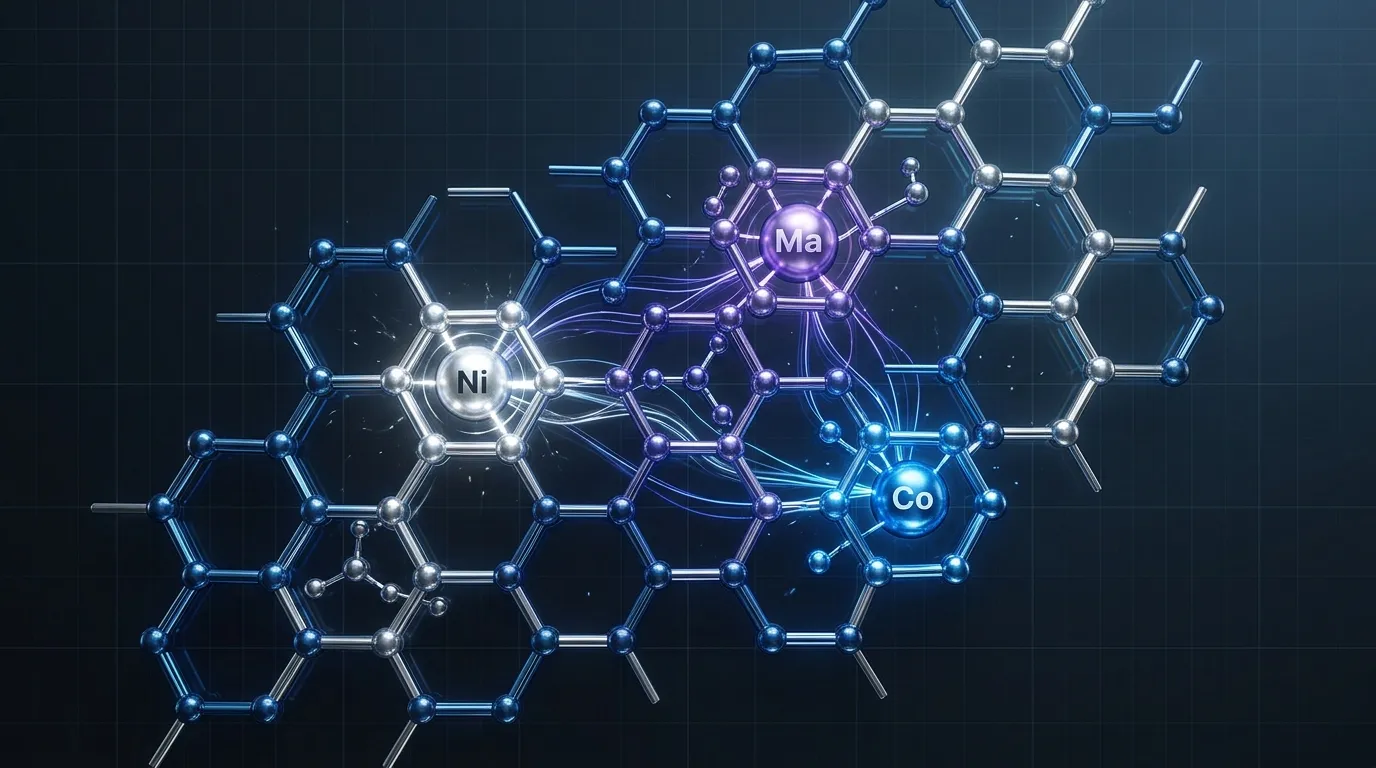
An NMC battery is a type of lithium-ion battery whose cathode is made from a mixture of nickel (Ni), manganese (Mn), and cobalt (Co) oxides. The abbreviation "NMC" refers to these three metals — Nickel Manganese Cobalt — and their ratios in the cathode determine the battery's performance characteristics.
NMC batteries are the dominant chemistry in electric vehicles. Research published in Nature Energy confirms that high-nickel layered oxide cathodes remain the most viable path to 250+ Wh/kg at the cell level. A typical NMC cell stores 150 to 250 watt-hours per kilogram — roughly 30% to 50% more than an equivalent LFP cell. If you are evaluating battery chemistries for an EV powertrain, a drone, or a space-constrained energy storage system, NMC is almost certainly on your shortlist.
But NMC is not a single chemistry. It is a family of formulations — NMC 111, 532, 622, and 811 — each tuned for a different balance of energy density, cycle life, cost, and thermal stability. Understanding the differences between them is what separates a well-engineered battery pack from one that overheats, degrades early, or costs more than it should.
NMC Battery Chemistry — How It Works
At the heart of every NMC cell is a layered oxide cathode. The nickel, manganese, and cobalt atoms sit in alternating layers with lithium ions, forming a crystal structure that lithium can move in and out of during charge and discharge.
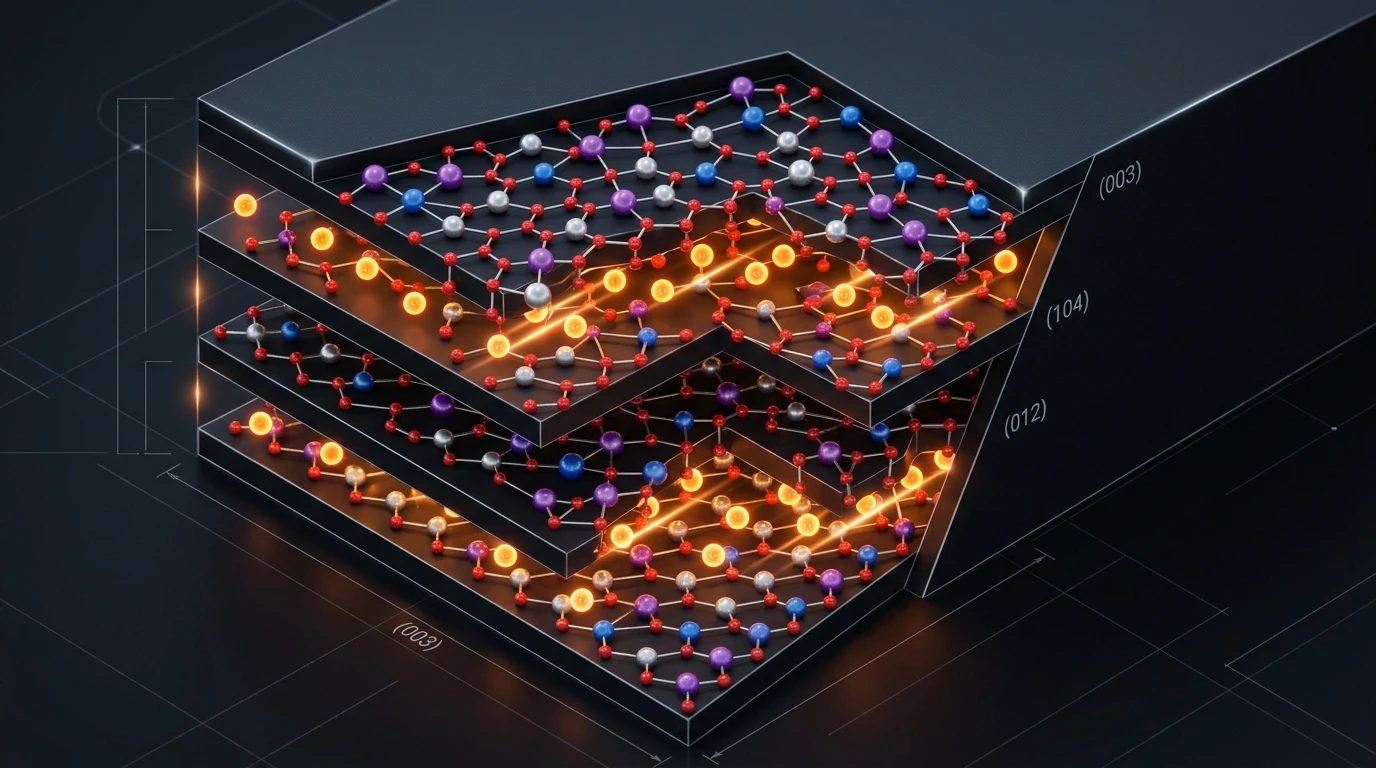
Each metal plays a specific role:
- Nickel (Ni) is the energy driver. More nickel means higher capacity — that is why NMC 811 (80% nickel) delivers over 200 Wh/kg while NMC 111 (33% nickel) delivers around 160 Wh/kg.
- Manganese (Mn) provides structural stability. It stays in a Mn⁴⁺ oxidation state throughout the charge-discharge cycle, acting as an inert scaffold that prevents the cathode lattice from collapsing.
- Cobalt (Co) stabilizes the layered structure and improves rate capability. It suppresses the cation mixing that occurs when nickel ions migrate into lithium sites — a degradation mechanism that reduces capacity over time. The trade-off: cobalt is expensive, and its supply chain carries well-documented ethical and geopolitical risks.
During discharge, lithium ions move from the anode through the electrolyte and intercalate into the cathode layers. During charging, the process reverses. The cathode's nominal voltage is 3.6–3.7 V, with an operating window of 3.0–4.2 V per cell.
This chemistry has been refined over three decades, building on John B. Goodenough's foundational work on lithium cobalt oxide in the 1980s and the first NMC reports by Liu et al. and Yoshio et al. around 1999–2000. Today's commercial NMC materials are produced primarily through coprecipitation — a process that co-precipitates nickel, manganese, and cobalt hydroxides before blending with a lithium source and calcining at up to 900 °C.
NMC Battery Types — 111, 532, 622, and 811 Explained
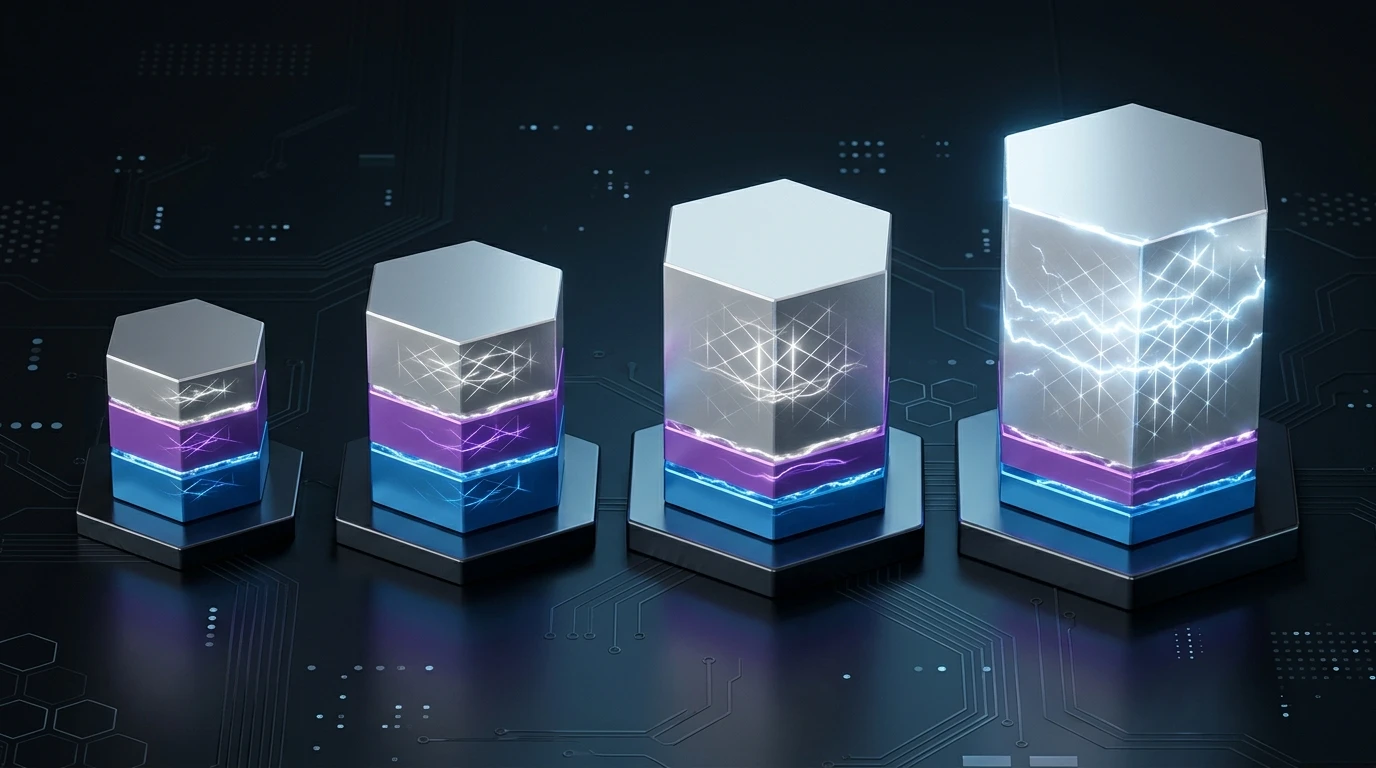
The three numbers after "NMC" tell you the molar ratio of nickel to manganese to cobalt in the cathode. These numbers are not marketing labels — they define the cell's performance envelope.
Variant | Ni:Mn:Co | Energy Density | Cycle Life | Thermal Stability | Typical Use |
|---|---|---|---|---|---|
NMC 111 | 1:1:1 | ~160 Wh/kg | 1,000–2,000 cycles | Highest | Power tools, medical devices |
NMC 532 | 5:3:2 | ~180 Wh/kg | 1,000–2,000 cycles | High | Entry-level EVs, e-bikes |
NMC 622 | 6:2:2 | ~200 Wh/kg | 800–1,500 cycles | Moderate | Mid-range EVs, drones |
NMC 811 | 8:1:1 | 200–250 Wh/kg | 500–1,000 cycles | Lowest | Premium EVs, aerospace |
NMC 111 is the most balanced formulation. Equal parts of each metal give it the best thermal stability and the longest cycle life in the NMC family. It is the safest NMC variant and the go-to choice for applications where reliability trumps energy density — medical devices, power tools, and backup power systems.
NMC 811 sits at the other end of the spectrum. With 80% nickel, it achieves the highest energy density in the family — but that nickel-rich cathode begins releasing oxygen at temperatures as low as 200 °C, compared to 300 °C for NMC 111. This lower thermal runaway threshold means NMC 811 packs require more sophisticated thermal management and battery management systems.
The industry trend is toward higher nickel content to push energy density further, but this comes at the cost of safety margin. For stationary energy storage — where weight and volume are less constrained than in an EV — the optimal choice is often NMC 532 or 622, which deliver sufficient energy density with much better thermal headroom.
NMC Battery Performance — Key Specifications
When you evaluate an NMC cell for a project, four specifications matter most.
Energy Density
NMC's defining advantage. Depending on the variant, energy density ranges from 150 Wh/kg (NMC 111) to 250 Wh/kg (NMC 811) at the cell level. At the pack level — after accounting for casing, cooling, and BMS hardware — expect roughly 70–80% of the cell-level figure. This metric directly determines how much energy you can store in a given volume or weight budget, and it is the reason NMC dominates weight-sensitive applications like drones and passenger EVs.
Nominal Voltage and Discharge Curve
NMC cells operate at a nominal 3.6–3.7 V, with a working range of 3.0 V (fully discharged) to 4.2 V (fully charged). The discharge curve is relatively flat between 3.9 V and 3.5 V, meaning the cell delivers a stable voltage for most of its discharge window before dropping off sharply near depletion.

This flat profile is desirable for applications that need consistent power delivery — unlike some chemistries whose voltage sags continuously as the battery drains, an NMC-powered device performs nearly identically at 50% state of charge as it does at 90%.
Cycle Life
NMC cycle life varies significantly by variant and operating conditions. NMC 111 can reach 2,000 cycles at 80% depth of discharge. NMC 811 typically delivers 500–1,000 cycles under the same conditions. Across the family, higher nickel content trades cycle life for energy density — a trade-off that makes sense for an EV (where the battery may be replaced with the vehicle) but less so for a stationary BESS designed for 15-year operation.
Factors that accelerate NMC degradation include:
- High C-rates during charging (above 1C)
- Sustained operation above 40 °C
- Cycling to 100% depth of discharge
- Calendar aging at high state of charge (storing cells at 100% SOC for extended periods)
Power Density and Fast Charging
NMC cells support discharge rates of 1C–3C continuous and up to 5C pulse. This makes them suitable for applications that need bursts of high power — power tools, electric motorcycles, and grid frequency regulation. Charging at rates above 0.5C, however, accelerates degradation through lithium plating on the anode, so most BESS applications charge at 0.25C–0.5C to maximize lifespan.
NMC vs LFP Battery — How to Choose
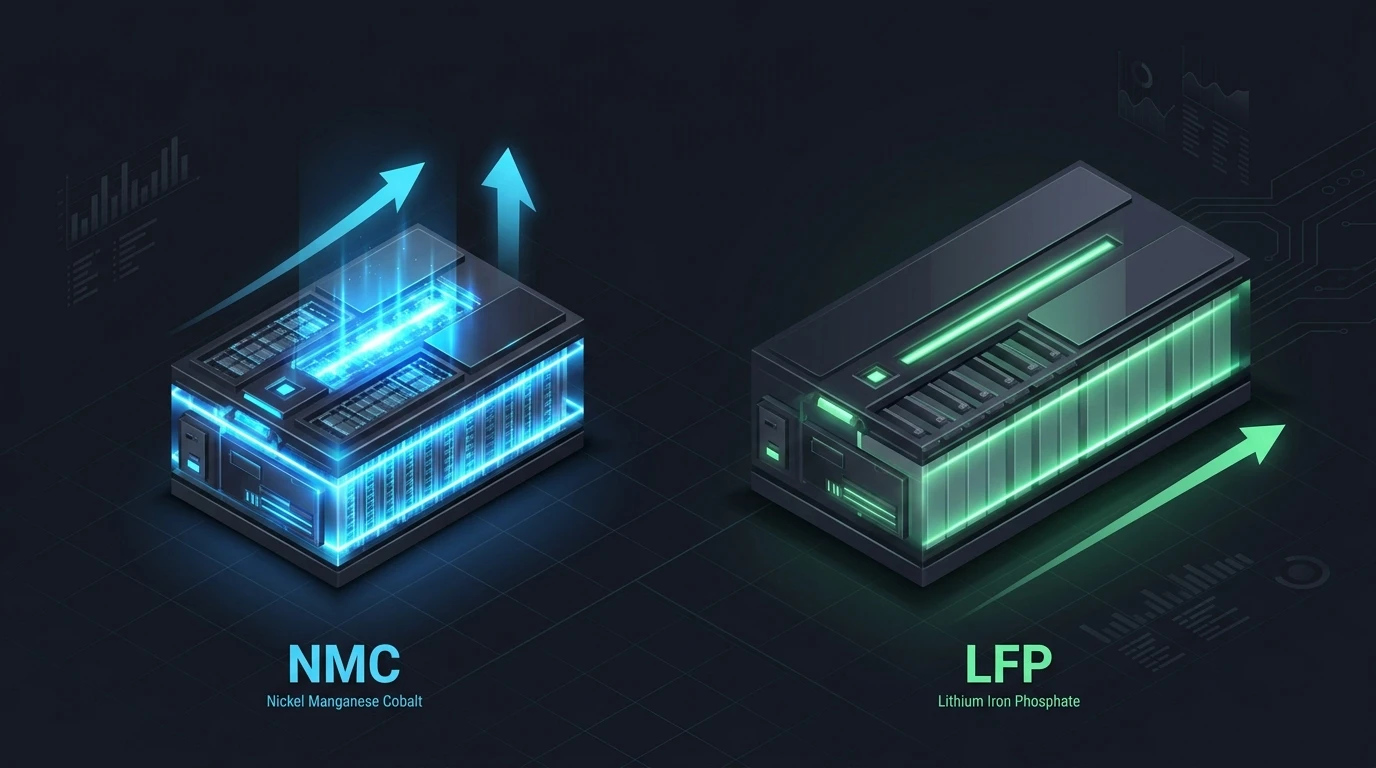
The comparison between NMC and LFP (lithium iron phosphate) is the most common question battery buyers ask — and the first PAA question in the SERP for "nmc battery."
Dimension | NMC | LFP |
|---|---|---|
Energy density | 150–250 Wh/kg | 90–140 Wh/kg |
Cycle life | 500–2,000 cycles | 3,000–6,000+ cycles |
Thermal runaway threshold | 200–300 °C | 270–400 °C |
Cost per kWh (cell, 2025) | $60–$90 | $40–$60 |
Cold-weather performance | Better (less capacity loss below 0 °C) | Worse (significant derating below 0 °C) |
Cobalt content | 10–33% | 0% |
Best for | Weight/volume-constrained, cold climates | Long-life stationary storage, safety-critical |
Choose NMC when energy density and cold-weather performance are the primary constraints — EVs in cold regions, drones, portable medical equipment, and space-constrained BESS installations.
Choose LFP when cycle life, safety, and upfront cost matter more than weight — grid-scale storage, residential batteries, and applications where the battery sits in an unconditioned enclosure for 10+ years.
In stationary energy storage, the pendulum has swung toward LFP in recent years — it is cheaper, safer, and lasts longer. But NMC still holds an edge in specific scenarios: high-latitude installations where LFP capacity fades in winter, weight-limited containerized systems, and applications that need the higher discharge rates NMC can deliver.
NMC Battery Safety and Thermal Management
The single most important thing to understand about NMC safety is that higher nickel content directly reduces thermal stability. An NMC 811 cathode begins releasing oxygen — the fuel for thermal runaway — at around 200 °C, while NMC 111 stays stable past 300 °C. This is not a design flaw; it is the unavoidable physics of the nickel-oxygen bond.
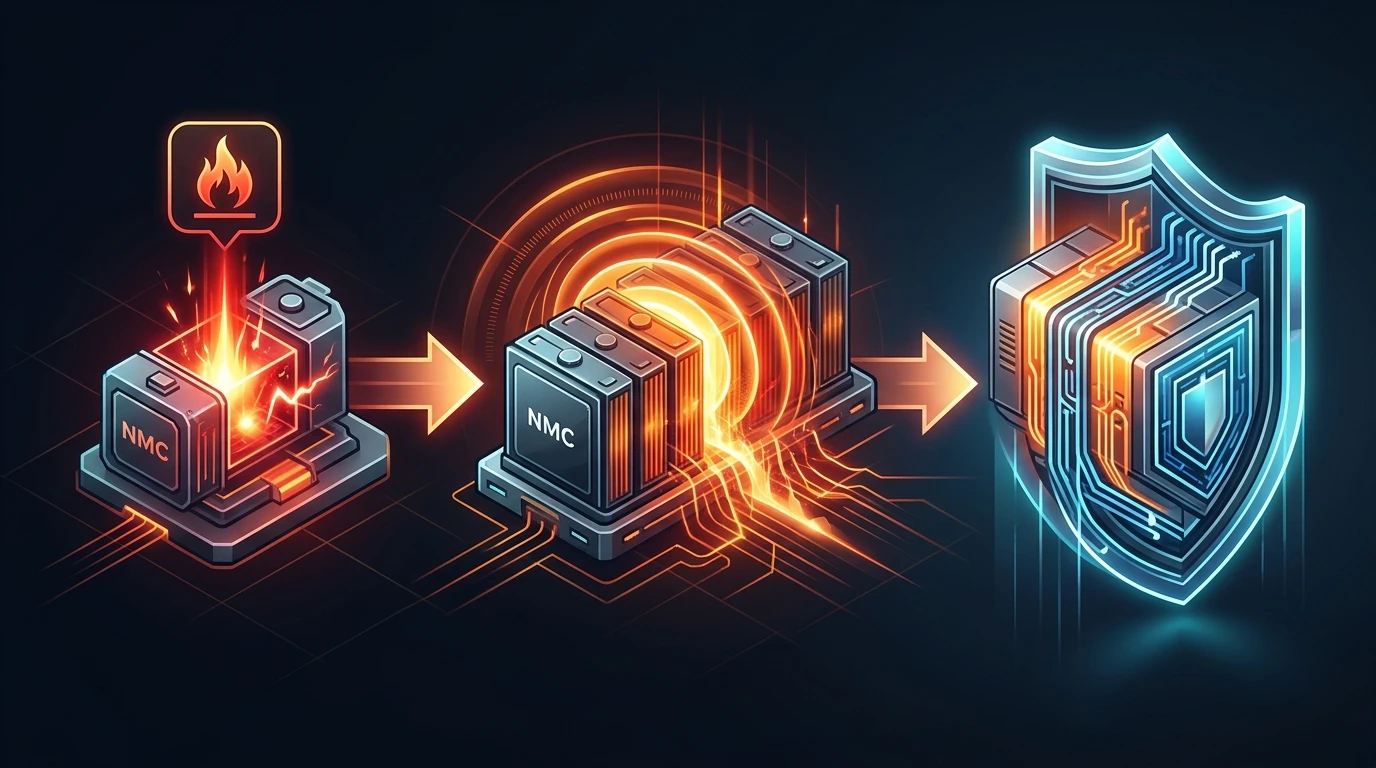
A battery management system (BMS) is the first line of defense. It monitors cell voltage, temperature, and current in real time, and it disconnects the pack if any parameter exceeds its safe operating area. But a BMS alone is not enough for nickel-rich NMC — active thermal management is essential.
Effective thermal management for NMC systems includes:
- Liquid cooling for packs above 10 kWh — air cooling is inadequate for nickel-rich cells under sustained load
- Temperature monitoring at the cell level, not just the module level — thermal runaway can propagate from a single cell in under 60 seconds
- State-of-charge derating at high ambient temperatures — limiting charge to 90% SOC above 35 °C ambient can extend calendar life by 30–50%
- Physical cell separation — fire-retardant barriers between cells slow propagation if a single cell does go into runaway
NMC batteries are safe when properly managed. The safety incidents that make headlines almost always trace back to inadequate thermal management, physical damage, or a BMS that failed to disconnect — not an inherent flaw in the chemistry itself.
NMC Battery Applications — Beyond Electric Vehicles
Electric vehicles account for the largest share of NMC battery demand, but the chemistry serves a much broader range of applications.
Grid-scale energy storage is an underappreciated use case for NMC. While LFP dominates new utility-scale installations in warm climates, NMC is deployed in regions where space efficiency and cold-weather performance tip the balance. Korea's 56 MW Kokam installation (2016) and the 35 MW Newman BESS in Western Australia (2017) are early examples of NMC in grid storage. For peak shaving applications in urban substations — where land costs make physical footprint a real economic variable — NMC's higher energy density translates directly into lower real estate costs.
Commercial and industrial (C&I) storage is another growing market. Factories and data centers deploying behind-the-meter storage for demand charge management benefit from NMC's power density — a compact NMC system can deliver the same kW output in less floor space than an equivalent LFP installation. The energy management system (EMS) plays a particularly important role here, optimizing charge-discharge schedules to maximize both bill savings and battery lifespan.
Consumer electronics — smartphones, laptops, tablets — rely almost exclusively on NMC and its close relative NCA (nickel cobalt aluminum). These applications demand maximum energy in minimum volume, and no mainstream lithium chemistry beats NMC on that metric.
Drones, robotics, and portable industrial equipment use NMC for its combination of light weight and high discharge capability. A drone cannot afford the weight penalty of LFP; an industrial robot needs the burst power NMC delivers at 3C–5C discharge.
Advantages and Disadvantages of NMC Batteries
Advantages
Highest energy density in its class. At 150–250 Wh/kg, NMC stores more energy per kilogram than any widely deployed lithium-ion chemistry except NCA — and the gap between NMC 811 and LFP can exceed 100%.
Excellent cold-weather performance. NMC cells retain 85–90% of their rated capacity at −10 °C, compared to 60–70% for LFP. This makes NMC the chemistry of choice for EVs sold in Nordic markets and for BESS installations at high latitudes.
High discharge rate capability. With continuous discharge ratings of 1C–3C, NMC supports applications that need quick bursts of power without oversizing the battery.
Proven supply chain at scale. NMC has been manufactured in gigawatt-hour volumes for over a decade. The supply chain — from precursor materials to cell assembly — is mature, and multiple qualified suppliers exist globally.
Disadvantages
Higher cost. Cobalt and nickel are expensive. A 2025 NMC cell costs $60–$90/kWh compared to $40–$60/kWh for LFP. At the system level — adding thermal management, BMS, and enclosure — the premium can reach 30–50%.
Shorter cycle life than LFP. The best NMC cells reach 2,000 cycles; typical LFP cells reach 4,000–6,000. Over a 15-year BESS project, replacing NMC modules midway through the asset's life can erase any upfront space savings.
Cobalt dependency. Roughly 70% of the world's cobalt comes from the Democratic Republic of Congo, where mining practices raise serious ethical and environmental concerns. The EU Battery Regulation (effective 2027) will require battery manufacturers to conduct supply chain due diligence and report the carbon footprint of their products — requirements that disproportionately affect cobalt-containing chemistries.
Thermal sensitivity. High-nickel NMC variants require active cooling above 35 °C ambient and are more susceptible to thermal runaway than LFP. The cost of the thermal management system is part of the NMC premium.
Lower round-trip efficiency at high C-rates. NMC's RTE is typically 90–95% at 0.5C, but it drops to 85–88% at 2C due to increased internal resistance. For frequency regulation applications that cycle rapidly, this efficiency loss translates into real revenue reduction over the asset's life.
Choosing an NMC Battery for Your Project
The right NMC variant depends on what you are optimizing for. There is no "best" NMC — only the best fit for your specific constraints.
If weight or volume is your binding constraint — drones, portable medical equipment, space-constrained BESS — start with NMC 811. Accept the shorter cycle life and invest in thermal management. The energy density gain is worth the engineering overhead.
If you need a balanced solution with decent energy density and manageable thermal requirements — mid-range EVs, e-bikes, C&I storage — NMC 622 or 532 is the sensible choice. These formulations have been deployed at scale for over a decade, and the supply chain is deep.
If safety and longevity are non-negotiable — medical devices, backup power for critical infrastructure, unconditioned installations — use NMC 111 or consider whether LFP might be a better fit entirely. A lower energy density battery that lasts 15 years is often cheaper in total cost of ownership than a higher-density one that needs replacement at year 8.
Three procurement questions that will sharpen your decision:
- What is the operating temperature range? If the battery will see sustained ambient temperatures above 35 °C or below −10 °C, factor in the cost of HVAC or the capacity loss in cold — both change the NMC vs LFP math.
- What is the expected lifetime in cycles and years? Divide your project lifespan by the cell's expected cycle life. If the result is greater than 1, you are budgeting for at least one replacement — and that replacement cost belongs in your TCO model.
- Are there regulatory requirements? If you are selling into the EU, the upcoming Battery Regulation will mandate carbon footprint declarations, recycled content minimums, and supply chain due diligence. NMC's cobalt content makes these requirements more complex to satisfy than for cobalt-free chemistries.
If you are evaluating NMC batteries for a BESS, C&I storage, or industrial project, working with a manufacturer who understands the full system — not just the cells — can shorten your engineering timeline significantly. Reach out to our team with your project parameters, and we will help you navigate the NMC variant selection, thermal design, and BMS integration.
Published July 2026. NMC battery costs and supply chain dynamics change rapidly; verify current pricing and regulatory requirements with your supplier before procurement.