

What "battery storage temperature range" actually refers to
Ask three suppliers for a battery storage temperature range and you get three numbers that differ by 20 °C, each honestly labeled "the operating range". One is a cell window. One is an enclosure ambient rating. One is the ambient where full power ends. They are not interchangeable, and the gap between them is where projects get into trouble.
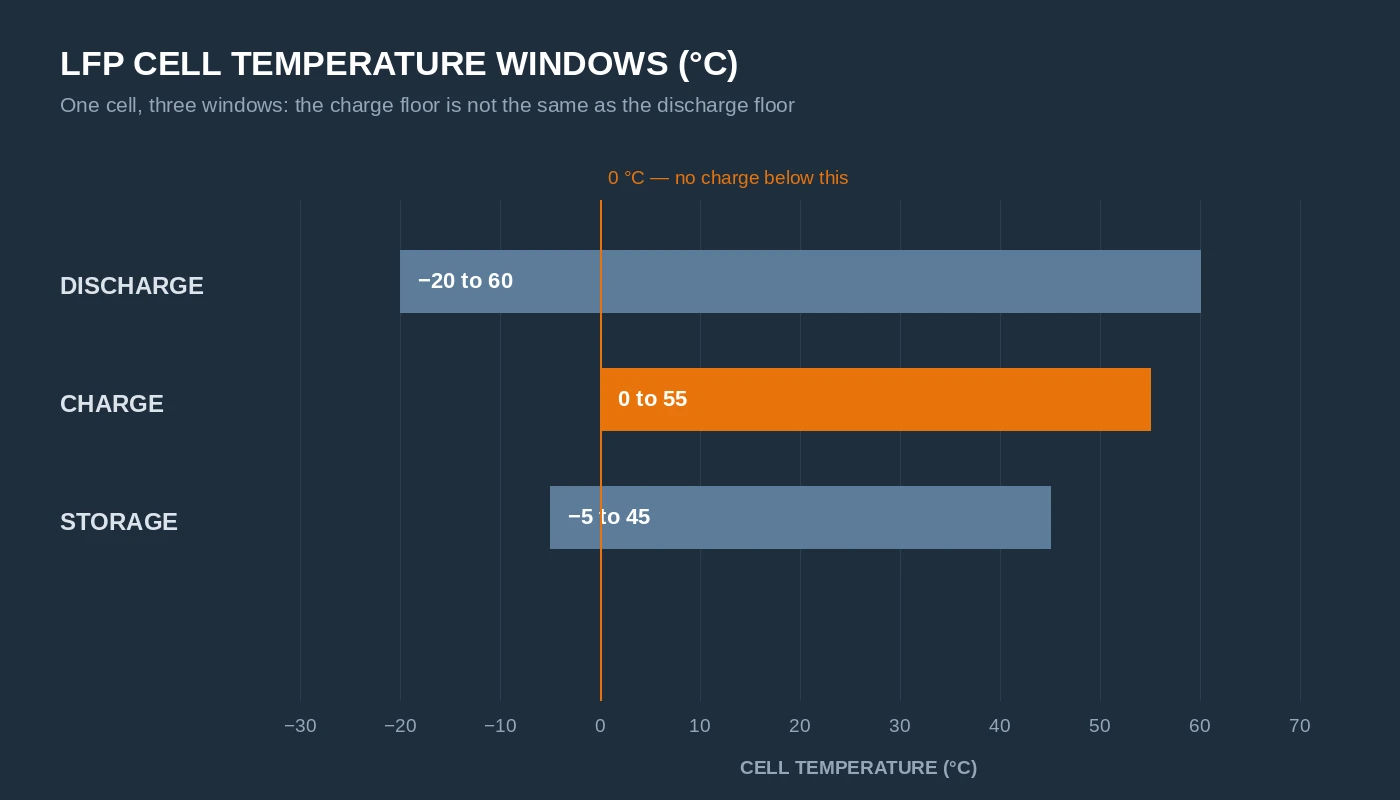
Start at the cell, because everything else is downstream of it. The Rolls R24-150LFP datasheet publishes three separate windows: charge 0 °C to 55 °C, discharge −20 °C to 60 °C, and storage −5 °C to 45 °C (Rolls Battery). Three windows for one product, and none of them is the range.
That already answers the question most people arrive with. A 12 V LFP pack in a shed can be discharged down to −20 °C, though not to nameplate capacity: under 10 °C, rising internal resistance drags the terminal voltage to cut-off early, so usable capacity falls before anything derates. Nothing in that box will accept charge below 0 °C unless it has a heater. The lithium battery storage temperature window is the narrowest of the three: calendar aging, not power delivery, sets it. For a pack stored over the winter, the practical routine follows: leave it at roughly half charge rather than full, keep it dry, and top it up every few months before self-discharge takes it somewhere the charger refuses to recover from.
Then the system. A cabinet or container datasheet normally gives a single ambient figure, something like −20 °C to 50 °C, and that figure describes the enclosure rather than the cells inside it. The cells are held near 25 °C by air conditioning or a coolant loop, so the ambient rating is really a statement about whether the thermal system can keep up.
The third number is the one that gets lost. It is the point where the system stops delivering full power, it is usually absent from the summary table, and it decides whether a 500 kW unit is a 500 kW unit in July.
Why the charge window is narrower than the discharge window
Discharge pulls lithium ions out of the anode. Charge pushes them back in. The second direction is the fragile one.
Below roughly 0 °C, intercalation kinetics slow enough that at normal charge current the anode potential can fall below 0 V versus Li/Li+. At that point lithium deposits as metal on the graphite surface instead of entering the lattice. The process is well characterized: modeling published through NREL and OSTI reproduces the plating-stripping behavior at low temperature and shows how it can be detected from the post-charge voltage plateau (OSTI / NREL). The consequences are not cosmetic. Plated lithium consumes electrolyte, removes usable capacity, and can grow into dendrites that threaten the separator.
That asymmetry is why the charge floor sits at 0 °C while the discharge floor sits at −20 °C on the same cell. It is not conservatism. It is a different physical process.
The hot end has its own asymmetry. Charging a cell that is already warm accelerates growth of the solid electrolyte interphase (SEI), and a parametric study of graphite anodes found that pushing charge into a higher temperature band does not remove the loss, it relocates it to another degradation mechanism (OSTI). Current and temperature compound each other; neither is a free variable.
In a system, this is enforced by the battery management system, which reads cell-level temperature sensors and blocks or limits charge through the contactor or by instructing the power conversion system (PCS). If a supplier cannot tell you which of those two mechanisms acts, they have not described the protection.
Temperature limits by chemistry: LFP, NMC and lead-acid
The shapes differ between chemistries, not just the numbers.
Chemistry | Typical charge window | Typical discharge window | What actually sets the limit |
|---|---|---|---|
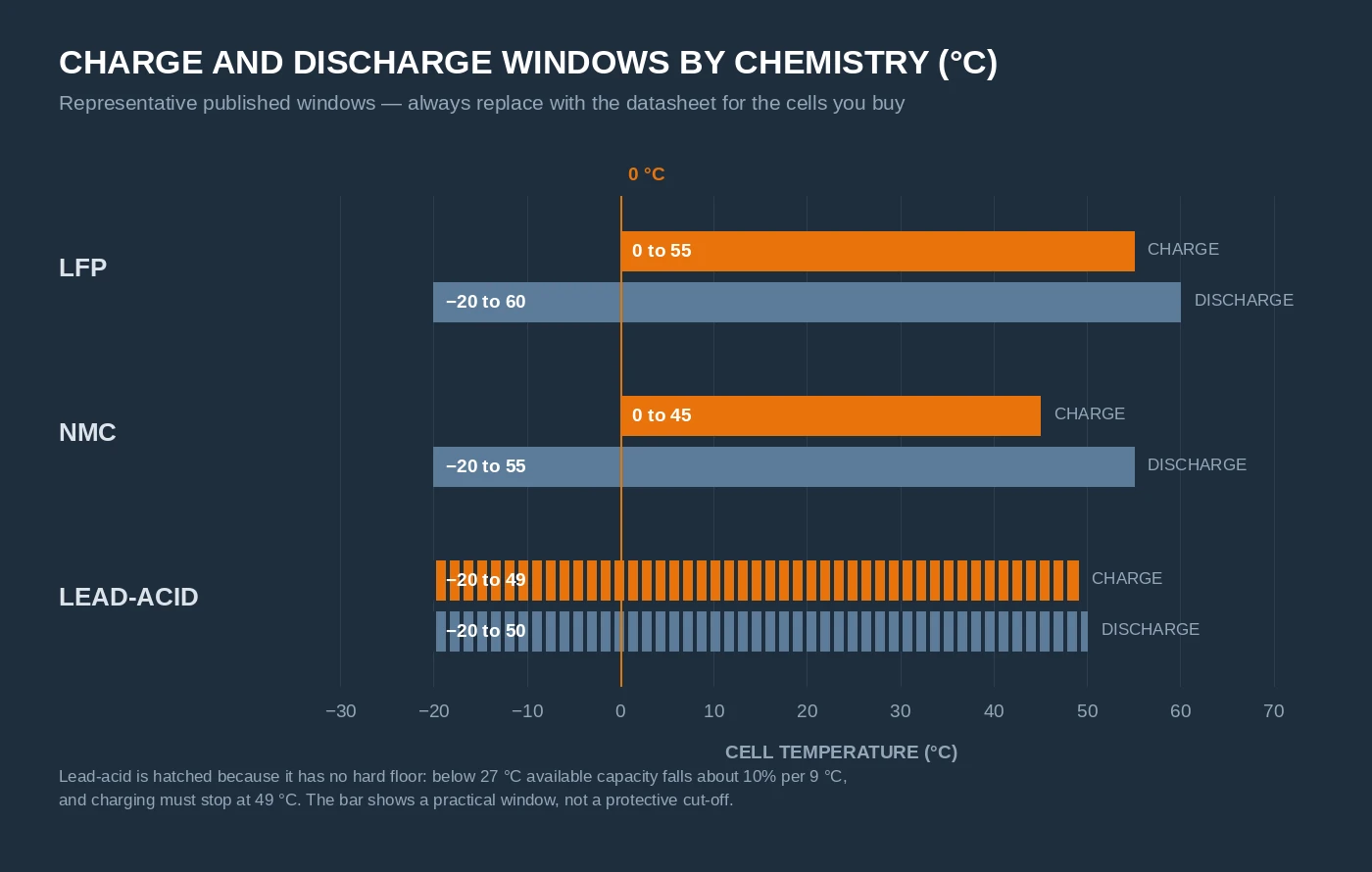
LFP (LiFePO4) | 0 °C to 55 °C | −20 °C to 60 °C | Plating at the bottom end; SEI growth and electrolyte oxidation at the top |
NMC | 0 °C to 45 °C | −20 °C to 55 °C | Same low-end mechanism, less thermal margin at the top, so cooling design carries more weight |
Lead-acid (flooded / VRLA) | No fixed 0 °C floor; charge voltage must be temperature-compensated | −20 °C and below, with capacity loss | Available capacity, not chemistry: roughly 10% lost per 9 °C below 27 °C |
The LiFePO4 temperature range is taken from a published product datasheet. The NMC row is representative of what cell makers publish and must be replaced with the datasheet for the cells you are buying — blends differ, and the charge floor is the one number never to generalize.
Lead-acid behaves differently. Trojan's published guidance is that capacity rises about 10% for every 9 °C above 27 °C and falls about 10% for every 9 °C below it, and that charging must stop if the battery reaches 49 °C (Trojan Battery). Applied to a −18 °C night, that rule gives roughly half the rated capacity, which is why lead-acid systems are sized with a temperature correction factor while lithium systems are sized with a derating curve. The failure shapes still differ: a cold lead-acid bank gives up usable energy and gets it back when it warms, while a cold lithium pack gives up some usable capacity in the same way and, on top of that, loses life if it is charged there.
What happens between rated, derated and cut-off
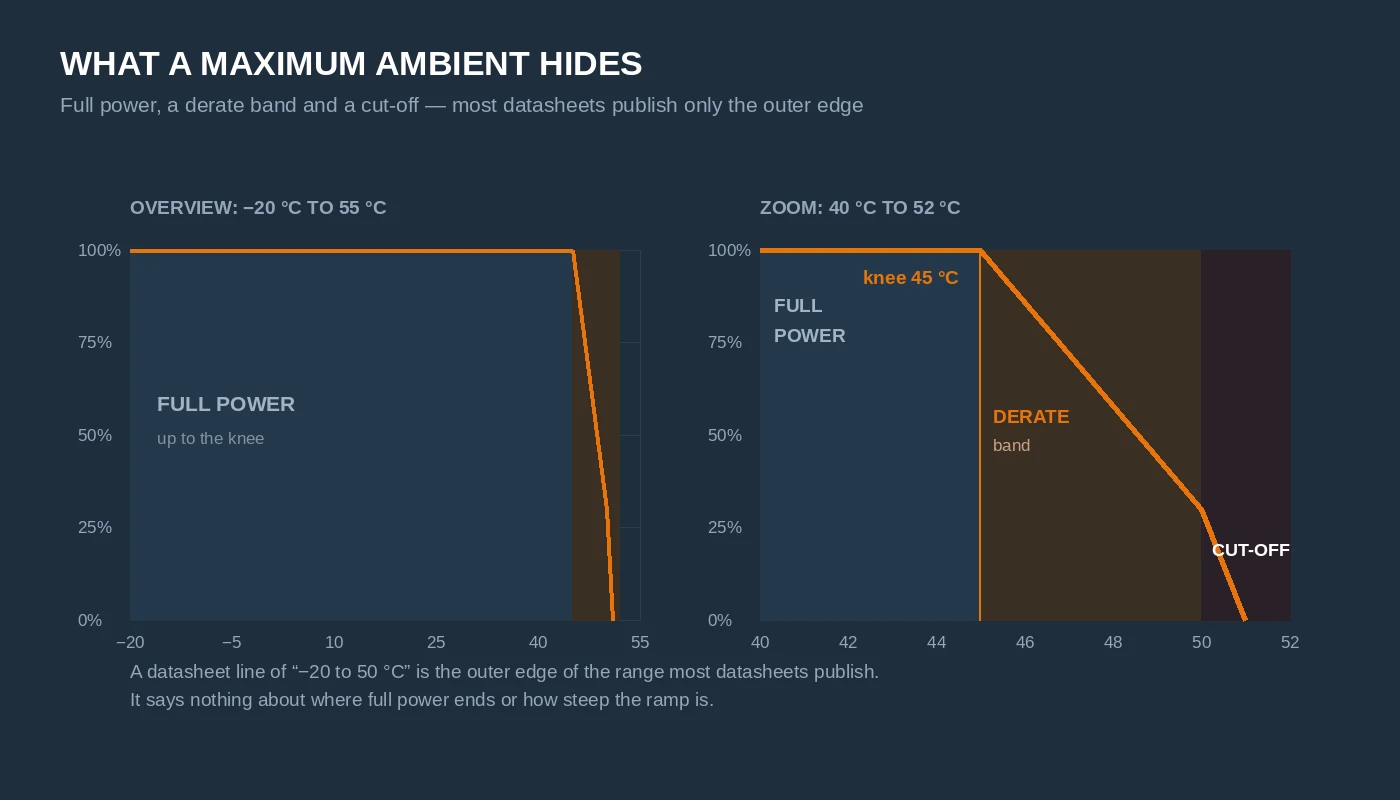
A BESS operating temperature range built from a single maximum ambient compresses three zones into one number.
The first zone is full power. In C&I equipment this usually runs from the cold floor to somewhere around 45 °C ambient.
The second is derating. Above that knee, output current is reduced, either linearly toward zero or to a floor, because the cooling system is already at its design point. A cabinet rejecting heat into 45 °C air is already at the edge: with a 10–15 K cell-to-ambient rise at 0.5C, cells would sit at 55–60 °C, at or past the LFP ceiling. That is why the battery derating temperature lands near 45 °C ambient rather than at the 50 °C cut-off.
The third is cut-off, where the BMS or the PCS stops the unit rather than let cell temperature run away.
The knee placement is an aging decision as much as a power decision. Degradation is widely said to double for every 10 °C. A 2018 study in Applied Sciences tested that against measured Li-ion aging data and found the doubling factor is not constant with temperature — the "decade rule" — which the authors call, in their words, "rarely correct", and advise against using to estimate life (MDPI). Use it to compare designs. Do not use it to predict a warranty.
Safety sits outside the derating curve entirely. UL 9540A is the test method for evaluating thermal runaway fire propagation in a battery energy storage system (UL Solutions), and NFPA 855, in its current 2026 edition, is the installation standard that covers fire detection and suppression, explosion control, ventilation, gas detection and thermal runaway for stationary systems (NFPA). Both matter here for a specific reason: what the authority having jurisdiction approves is the configuration that was tested — cell type, unit size, spacing — so a change in cooling architecture is not a detail you can swap after approval.
Where the heat inside a container actually comes from
Heat in a BESS is not weather. It is current.
A 125 kW discharge from a 261 kWh cabinet at roughly 97% battery-side efficiency sheds somewhere around 3 to 4 kW as heat inside the enclosure. That is arithmetic from stated assumptions, not a specification, and it is enough to warm a sealed box quickly. Double the C-rate and the loss rate roughly quadruples, because I²R scales with current squared — and the heat per MWh delivered still doubles, because the discharge finishes in half the time. The design case is therefore peak discharge on the hottest afternoon of the year, not an average operating day.
The enclosure then has to move that heat somewhere. In Hua Power's own line the air-cooled 20 ft container carries 25 kW of cooling and 9 kW of heating, while a split cabinet carries 2 kW of cooling and 1.5 kW of heating per cluster. That difference in installed thermal capacity is the real reason ambient ratings vary by enclosure type: a container has the volume and the auxiliary power for a chiller, and a cabinet does not.
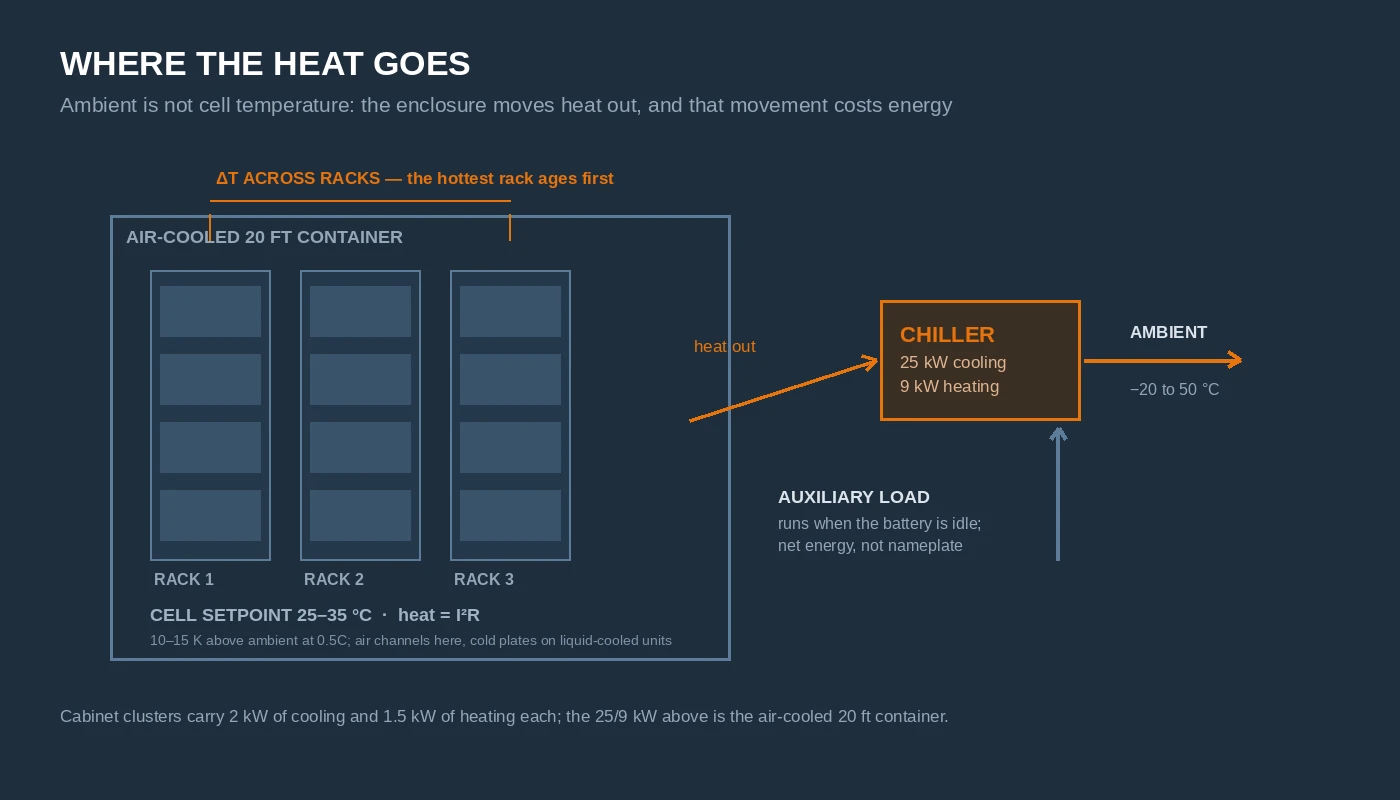
Auxiliary load is the part buyers underestimate. The cooling system runs when the battery is idle and overnight. On a hot site it is the largest continuous consumer, and it reduces net energy delivered rather than nameplate capacity, so it never appears in the headline number. Ask for auxiliary consumption at the project's ambient and duty cycle; a figure quoted at 25 °C and one cycle per day says very little about a site at 45 °C.
Then there is spread. Average cell temperature is a comfortable metric and a misleading one. The hottest rack ages first, the BMS derates on the hottest sensor, and usable capacity ends up set by the worst position in the container rather than the mean. Ask for the measured spread at rated power, not the design target — a 3 K target and a 7 K measurement are different products.
Reading a BESS datasheet without being misled
Most confusion comes from four lines that look unambiguous.
What the sheet says | What it usually means | What to ask |
|---|---|---|
"Operating temperature −20 °C to 50 °C" | Enclosure ambient, with full power ending somewhere inside that band | Where does full power end, and what is the derate slope to cut-off? |
"Charge temperature 0 °C to 45 °C" | Cell temperature, not ambient | Is there a heater, what is its capacity, and how long from a −20 °C soak to charge-ready? |
"Storage temperature −5 °C to 45 °C" | Non-operating, and often a transport limit | Does the warranty survive a winter in an unheated container? |
"Capacity 261 kWh, round-trip efficiency ≥85%" | Measured at 25 °C, usually excluding auxiliary load | What is retained at 45 °C ambient, and does the efficiency figure include HVAC? |
Published ranges also differ by enclosure family, and the differences are structural rather than arbitrary. Hua Power's C&I cabinets are rated −20 °C to 50 °C with derating above 45 °C, and the catalog's wording for the liquid-cooled variants is "full-power operation to 45 °C" — a claim about the coolant loop pulling heat straight off the modules rather than about a different cut-off point. The battery-only containers go further, to −30 °C at the cold end, because they have the auxiliary power and the insulation to heat the compartment with nothing but cells inside it; the integrated 20 ft units, which must also protect a PCS, stay at −20 °C. Three envelopes, three trade-offs — the product line shows the pattern at product level. Residential wall-mount units keep the same asymmetry in miniature: discharge −20 °C to 60 °C, charge 0 °C to 45 °C.
The last line to check is the warranty: capacity retention is normally specified at a reference temperature, usually 25 °C, over a stated cycle count. A site running 8 K hotter does not void that on day one. It consumes the margin, and the augmentation schedule moves — which is a cost, not a failure.
Specifying a range for a real project
Seven inputs decide whether a quoted range is adequate. Most of them are not on the datasheet.
Design ambient, not the climate average. Use an extreme design dry-bulb — the ASHRAE 0.4% cooling value and the 99.6% heating value are the usual convention — because the derating event is a few dozen hours a year, and those hours are when the asset is paid to dispatch.
Solar gain and placement. A dark container skin in direct sun runs above air temperature, and a roof-mounted unit has a different profile from one in shade. Placement is a design input, not a site detail to settle after the equipment is ordered.
Cold soak. At −20 °C ambient overnight, the cells are at −20 °C in the morning. Heaters take time and draw power. If the dispatch profile requires charging in the first hour, the heater has to be sized for that, not for a steady-state average.
The coincident worst case. Maximum ambient, maximum C-rate and full solar gain happen together, not one at a time. Ask for the derate curve at the C-rate the project will actually run, not at 0.5C by default.
Altitude. Air-cooled equipment loses cooling capacity as air density falls. Check the published altitude limit — 2,000 m is common, some containers reach 4,000 m — and whether the derating at that altitude is already in the curve or an extra correction.
Humidity and coastal exposure. Condensation on cold surfaces and salt spray corrosion are separate ratings from temperature, and both are commonly underspecified in coastal projects.
Commissioning verification. A thermal step test at site, a temperature map at rated power, and a recorded charge-inhibit setpoint turn a datasheet claim into a measured fact. If the site can be dispatched to full power during commissioning, do it then.
For the aging side of the same question — how many cycles a range is worth — the cycle life reference covers the relationship between depth of discharge, temperature and retained capacity.
Questions that make a supplier commit
Nine questions, phrased so that a vague answer is visible.
- Is the quoted range ambient or cell temperature, and at what C-rate?
- Where does full power end, and what is the derate slope from there to cut-off?
- What maximum cell temperature spread is guaranteed at rated power, and measured how?
- What is auxiliary consumption at 45 °C ambient and one cycle per day?
- What is the charge floor at cell level, and is it enforced by the BMS, the PCS, or both?
- What heating capacity is installed, and how long from a −20 °C soak to charge-ready?
- At what reference temperature is capacity retention guaranteed, and how does the guarantee change at the project's ambient?
- Which UL 9540A configuration was tested, and does the proposed layout match it?
- What altitude and corrosion ratings apply, and are they already reflected in the derate curve?
A supplier who answers 1, 2 and 5 without a follow-up has given you a specification. A supplier who answers with a single range has given you a marketing number, and the difference will show up in year three, in the augmentation budget, not in the commissioning report.
The rest of the fundamentals behind these numbers — C-rate, depth of discharge, cycle life, BMS behavior — sit in the Battery Energy Storage Basics hub, and the LFP versus lead-acid comparison covers the chemistry choice that decides which of these windows you are working inside.