

Most "all-in-one home battery" pages you'll land on are product listings that never answer the two questions you actually have: what does this thing really do, and is it the right one for my house? This review does. We build the full residential storage range — battery-only wall units, stackable towers, and all-in-one cabinets — so we have no reason to steer you toward any one of them. That's exactly why we can review our own HC-UPSRAP16I honestly, including the places where it's the wrong choice.
The HC-UPSRAP16I is a 6 kW / 16 kWh all-in-one home battery: one indoor cabinet that packs a hybrid inverter, an MPPT solar charger, a 16 kWh lithium iron phosphate (LiFePO4) battery, and the control electronics into a single enclosure you plumb in once. This guide walks through what that integration buys you, what it costs you, how to size it, what it competes with, and — the part every rival page skips — who should buy something else instead.
The short version. The HC-UPSRAP16I is a fixed 16 kWh indoor cabinet with a 6 kW hybrid inverter and integrated solar charging built in. It's a strong fit if you want one box, one install for whole-home essential backup plus solar self-consumption, and you have an indoor spot (garage, utility room, basement) for a 126 kg floor-standing unit. It's the wrong pick if you need an outdoor-rated battery, expect to grow well past 16 kWh, or need to run very heavy simultaneous loads. If any of those apply, a modular/stackable system is the better path.
What is an all-in-one home battery?
An all-in-one home battery is an energy storage system that combines, in a single enclosure, the three things a solar-plus-storage home normally buys separately:
- a hybrid inverter (converts battery DC to household AC, and manages grid, solar and battery power),
- a solar charge controller (an MPPT tracker that harvests power from your panels), and
- the battery itself, with its battery management system (BMS).
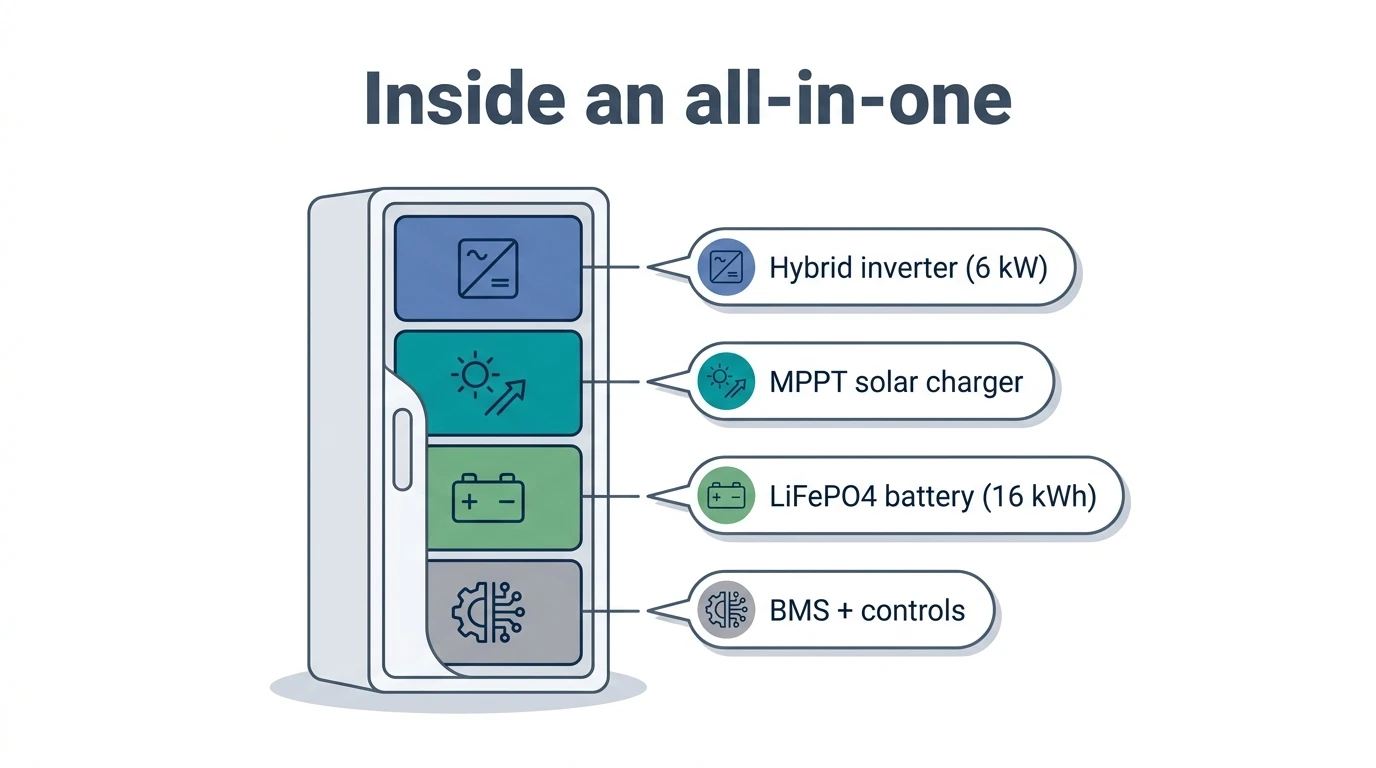
The everyday alternative is a battery-only unit — a box of cells you wire to a separate hybrid inverter you buy and mount yourself. Both approaches work. The all-in-one just does the integration at the factory instead of on your wall. Because the inverter and battery are matched and pre-wired, an all-in-one is inherently DC-coupled and arrives as one commissioned system rather than a set of components an installer has to make talk to each other.
So yes — to answer the most common question outright — an all-in-one home battery includes the inverter. That's the whole point of the category. If a product is described as "all-in-one" but you still need a separate inverter, it isn't one; it's a battery. (Our own wall-mounted battery-only line, the HC-UPSRB series, is the battery-only counterpart — great when you already have, or want to choose, your own inverter.)
The HC-UPSRAP16I at a glance
Here's the whole system on one page. Everything below is from the HC-UPSRAP16I product datasheet.
Spec | HC-UPSRAP16I |
|---|---|
Type | Indoor all-in-one (inverter + MPPT + battery) |
Rated energy | 16.08 kWh (LiFePO4, 1P16S, 51.2 V) |
Usable energy | ~14.5 kWh (at ≈90% depth of discharge) |
Continuous AC output | 6 kW |
Surge power | 12 kVA |
Backup switchover | 10 ms (UPS-grade) |
Max efficiency | 93% (battery mode) |
Solar input (MPPT) | Up to 9 kW / 27 A, 80–520 V |
Max charge current | 120 A (PV, grid, or combined) |
Battery chemistry | Lithium iron phosphate (LiFePO4), 3.2 V / 314 Ah cells |
Monitoring | LCD + Wi-Fi |
Enclosure rating | IP20 (indoor only) |
Operating temperature | −15 °C to 50 °C |
Dimensions (W×D×H) | 436 × 420 × 750 mm |
Weight | 126 kg |
Three numbers do most of the work in this review: 16 kWh (how much energy it stores), 6 kW (how much power it can push at once), and 10 ms (how fast it takes over when the grid drops). The next two sections unpack the first two, because getting them straight is where most buying mistakes happen.
kW vs kWh: the two numbers that decide everything
If you take one thing from this review, take this: kW and kWh are not the same number, and mixing them up is the single most expensive home-battery mistake. (The U.S. EIA puts it plainly: watts measure power at a moment in time, watt-hours measure energy used over time.)
- Kilowatt-hours (kWh) = the size of the tank. This is energy — how much the battery stores, and therefore how long it can run your loads. The HC-UPSRAP16I holds 16 kWh.
- Kilowatts (kW) = the width of the pipe. This is power — how much the system can deliver at any instant. The HC-UPSRAP16I's inverter does 6 kW continuously, with a 12 kVA surge to cover the momentary spike when a motor starts.
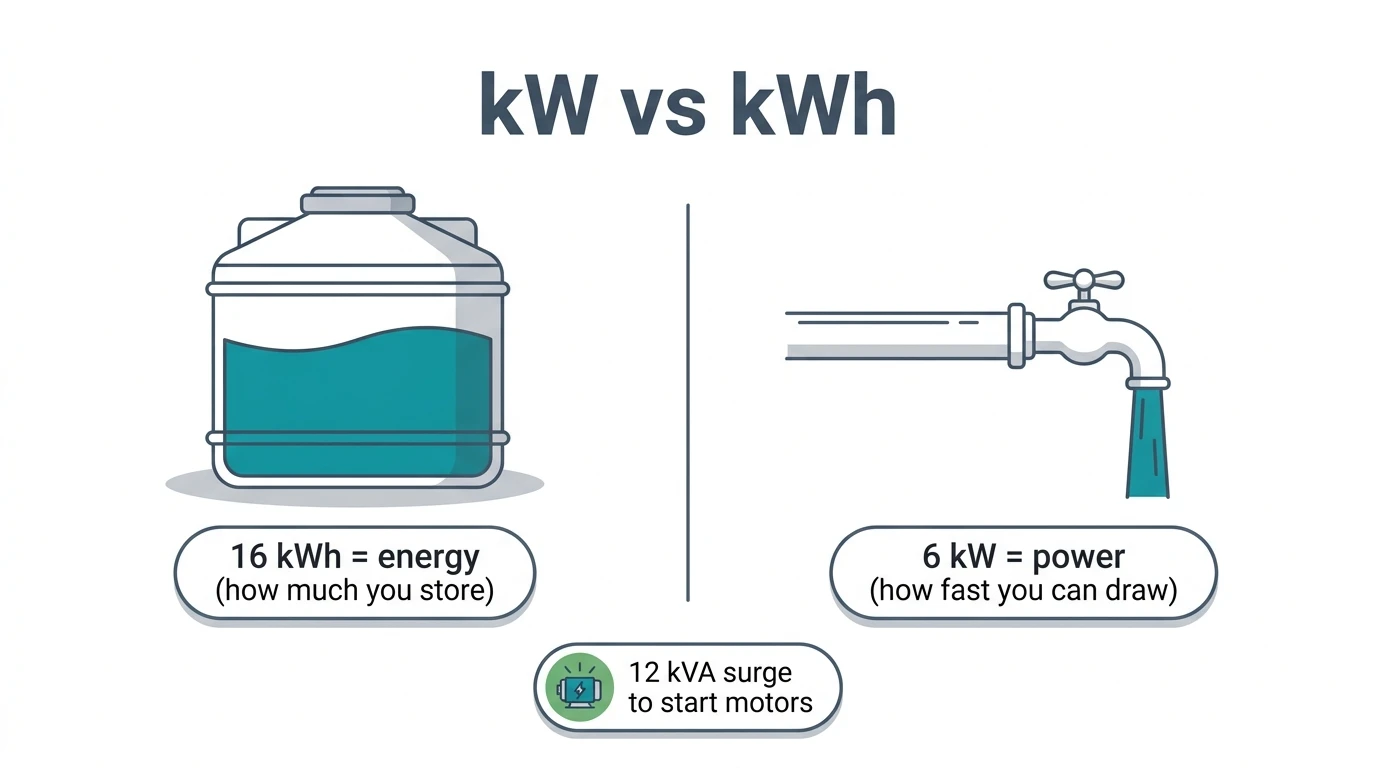
A big tank with a narrow pipe still can't run heavy loads; a wide pipe with a small tank drains fast. You need both matched to the job. The HC-UPSRAP16I pairs a fairly large 16 kWh tank with a moderate 6 kW pipe — a combination tuned for whole-home essential-load backup and solar self-consumption, not for running an entire all-electric mansion at full tilt.
The 12 kVA surge matters more than it looks. Motors — air-conditioner compressors, well pumps, fridges — draw two to three times their running wattage for a fraction of a second at startup. A battery that can only surge to its continuous rating trips on those loads; the HC-UPSRAP16I's headroom to 12 kVA is what lets it actually start them. (If you want to translate your battery's amp-hours into usable kWh, our Ah-to-kWh calculator does the arithmetic.)
What 16 kWh actually powers — and for how long
Runtime is usable energy divided by your load. The HC-UPSRAP16I's 16 kWh nameplate works out to roughly 14.5 kWh usable at about 90% depth of discharge — still a genuinely large home battery. Here's what that looks like in practice:
What you're running | Approx. load | Runtime (~14.5 kWh usable) |
|---|---|---|
Fridge + lights + Wi-Fi + phones (critical loads) | ~0.4 kW | ~28–36 hours |
Above + a few outlets, TV, small well pump cycling | ~1 kW | ~13–15 hours |
Essential loads + one efficient AC zone | ~2.5 kW | ~5 hours |
Whole-home average (all-electric, no big HVAC) | ~4 kW | ~3.5 hours |
Those are approximations — real numbers depend on your appliances, and a realistic backup rarely runs everything at once. The honest framing is essential-loads backup that lasts through an overnight outage, and often a full day if you're careful, rather than "run the whole house indefinitely." For a runtime estimate against your own load list, use our battery backup duration calculator.
Two capabilities make the HC-UPSRAP16I a backup system and not just a solar buffer:
- 10 ms switchover. When the grid fails, the HC-UPSRAP16I takes over in about ten milliseconds — fast enough that your lights don't flicker and computers stay on. That's UPS-grade, and it's the difference between "backup" and "you still lose power for a second every time."
- 6 kW continuous / 12 kVA surge. Enough to carry the essential circuits of a typical home simultaneously and start motor loads — but not enough to run several large AC units plus an electric range plus an EV charger at the same time. If your simultaneous demand routinely exceeds 6 kW, size up or split loads.
All-in-one vs stackable: the honest trade-off
This is the comparison the keyword is really about, and it's where an honest manufacturer review earns its keep. All-in-one vs stackable is not a "which is better" question — it's a "which trade-off fits you" question.
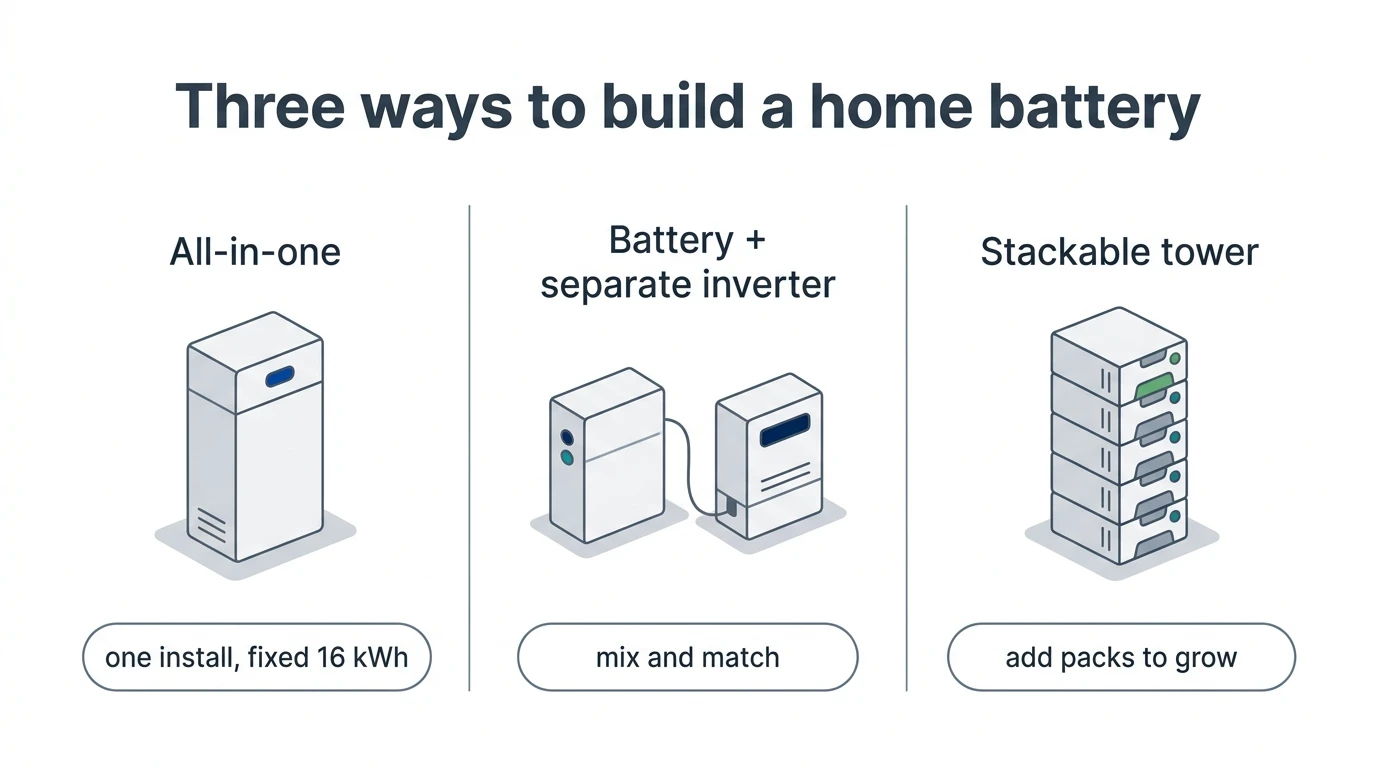
What the all-in-one HC-UPSRAP16I gets right:
- One install, one commissioning. Inverter, charger and battery arrive matched and pre-wired. Your installer mounts one cabinet and makes far fewer field interconnections — less labor, fewer failure points, faster sign-off.
- Factory-matched components. No guessing whether this battery talks to that inverter. Compatibility is settled at the factory.
- Tidy footprint. One cabinet instead of a battery and a wall-mounted inverter and the conduit between them.
Where it costs you — stated plainly:
- Fixed capacity. The HC-UPSRAP16I is a 16 kWh system. You don't grow it internally the way you add packs to a stackable tower. If there's a real chance you'll want 25–40 kWh in a few years, that ceiling matters — a modular/stackable system that expands pack-by-pack is the better long-term path.
- Integrated means coupled. Because the inverter and battery share one enclosure, a fault in one part takes the unit out of service as a whole, where a separates-based system lets you service or swap the inverter independently.
- Indoor only (more on this next).
If open-ended expansion or outdoor mounting is on your wishlist, look at a stackable or battery-only-plus-inverter approach instead — both are covered across our residential energy storage guides. The all-in-one wins on simplicity; the modular systems win on flexibility. Pick the axis you care about.
Indoor-only: a siting decision you make before you buy
The HC-UPSRAP16I is rated IP20, which in plain terms means indoor installation only — a garage, utility room, basement, or plant room. This is a real constraint and worth naming clearly, because several well-known rivals (the Tesla Powerwall among them) are outdoor-rated and can hang on an exterior wall.
What that means for you:
- You need an indoor location that stays within −15 °C to 50 °C and isn't exposed to rain or hose-down.
- At 126 kg, the HC-UPSRAP16I is floor-standing, not wall-hung. Plan for a 436 × 420 × 750 mm footprint on a solid floor near your consumer unit, with clearance for airflow.
- Like any inverter-plus-fans product, it isn't silent. Indoors, put it somewhere a low hum won't bother anyone — not against a bedroom wall.
None of this is a flaw; it's a fit question. If you have the indoor space, an indoor-rated cabinet is actually better protected from weather and temperature swings than an outdoor unit. If you don't have indoor space, this is a genuine reason to choose a different, outdoor-rated product — and we'd tell you so.
Solar and off-grid: the MPPT half of the box
The "all-in-one" in the HC-UPSRAP16I isn't just battery-plus-inverter — it's battery-plus-inverter-plus-solar-charger. The built-in MPPT tracker accepts up to 9 kW / 27 A of PV across an 80–520 V range, so for many homes the HC-UPSRAP16I is the solar system's brain as well as its battery.
That enables the three jobs most homeowners actually want:
- Solar self-consumption. Store the midday solar you'd otherwise export cheaply, and use it in the evening peak. The HC-UPSRAP16I can charge from PV and grid up to 120 A combined.
- Time-of-use bill shifting. On a TOU tariff, charge when power is cheap (or free from your roof) and discharge during expensive peak hours.
- Backup and off-grid operation. With solar feeding the MPPT and the battery buffering it, the HC-UPSRAP16I can run as a grid-tied backup system or, with enough panels and sensible load discipline, keep essential loads going through extended off-grid stretches. Its wide AC input window (90–280 V normal, 170–280 V in UPS mode) also makes it tolerant of weak or generator-backed grids.
Chemistry, safety and lifespan
The HC-UPSRAP16I uses lithium iron phosphate (LiFePO4) cells — the same 3.2 V / 314 Ah cell family used across our residential line. For home installation, LFP is the chemistry you want: compared with the nickel-based (NMC) chemistry in some older home batteries, LFP is markedly more resistant to thermal runaway, which is exactly the property you care about for a battery living in your garage or basement. In U.S. federal fire-safety lab testing, LFP recorded the lowest heating rate during thermal runaway of the common lithium chemistries — the most thermally stable of the set.
On longevity, LFP home cells are rated for thousands of full cycles — our 314 Ah residential cells carry a cycle rating in the 6,000+ range at standard test conditions, which at one cycle a day is well over a decade of daily use before meaningful capacity fade. Two practical notes, stated honestly:
- Warranty terms vary by market and change over time — confirm the exact years-and-throughput warranty for your country with us or your distributor before you buy, rather than trusting a number in a blog post.
- A managing BMS balances the cells, manages temperature, and enforces the safe voltage window (43.2–57.6 V) — it's what turns good cells into a safe system.
A word on certifications. Our residential battery line is built to the CE, IEC 62619 (cell safety) and UN 38.3 (transport) standards, and the HC-UPSRAP16I is designed as a UPS-class all-in-one system. Required marks differ by country, though — UL 9540 and NEC compliance matter for the US, CEI 0-21 for Italy, and so on — so ask us for the HC-UPSRAP16I's full, current certificate list for your specific market rather than assuming. It's part of any serious quote, and it's the one area where you should hold any manufacturer (us included) to concrete paperwork, not a logo on a page.
What it costs — and how to think about $/kWh
Here's the thing almost every competing product page refuses to do: talk about money. We'll be straight with you about how to think about it, even though the exact figure depends on your market and installer.
Home battery systems are usefully compared on cost per usable kilowatt-hour ($/kWh installed). Marketplace data from EnergySage puts a typical installed home battery at roughly $1,000 per usable kWh in 2025–26 — commonly somewhere in the ~$700–$1,300/kWh range depending on brand and region, or about $15,000–$16,000 for a 13.5 kWh system before any incentives. An all-in-one like the HC-UPSRAP16I changes that math in two ways versus buying separates:
- You don't buy a separate inverter, and
- you pay for less installation labor, because there are far fewer components to mount, wire and commission.
Against a stackable system, the trade runs the other way over time: you pay less to start with fewer parts, but you can't spread future capacity purchases across years the way a modular tower lets you.
For the HC-UPSRAP16I specifically, pricing is quote-based and sold through us and our installer/distributor partners, because the installed number depends on your location, electrical work, and any solar scope — contact us for a system quote rather than a placeholder figure.
One more money lever: incentives — but read this carefully, because it's where old articles will steer you wrong. Many regions offer tax credits, rebates or feed-in arrangements for home storage, and these programs change frequently. A pointed, current example: the U.S. federal 30% residential clean-energy credit (Section 25D) that used to cover home batteries was ended by 2025 legislation and no longer applies to systems placed in service after 31 December 2025 — so any page still promising you that 30% credit in 2026 is out of date. Confirm what actually applies where you live before you count on it, and — since we can't give tax advice — check the specifics with a qualified advisor.
HC-UPSRAP16I vs the alternatives
No product wins on every axis. Here's the HC-UPSRAP16I next to the archetypal all-in-one (Tesla's Powerwall 3) and the two other ways to build a home battery, on the attributes that actually drive the decision:
HC-UPSRAP16I (all-in-one) | Tesla Powerwall 3 | Battery-only + separate inverter | Stackable tower | |
|---|---|---|---|---|
Inverter | Integrated, 6 kW | Integrated, up to 11.5 kW | You choose & buy | You choose & buy |
Usable energy | ~14.5 kWh (16 nameplate) | 13.5 kWh | Per battery | 20–50 kWh, expandable |
Expandable? | No (fixed 16 kWh) | By adding units (up to 4) | By adding batteries | Yes, pack by pack |
Siting | Indoor (IP20) | Indoor / outdoor | Depends on unit | Usually indoor |
Solar charger | Integrated MPPT (9 kW) | Integrated | Via the inverter | Via the inverter |
Install complexity | Lowest (one box) | Low | Highest (match parts) | Medium |
Best for | Indoor whole-home essential backup + solar, one-box simplicity | Outdoor, higher continuous power | Custom/retrofit builds | Growing capacity over time |
Powerwall 3 figures (13.5 kWh usable, up to 11.5 kW continuous, integrated inverter, 10-year warranty) are from Tesla's official Powerwall 3 datasheet.
The honest read: if you want one cabinet, indoors, sized right for whole-home essential backup with solar, the HC-UPSRAP16I is a strong, well-integrated choice. If you need outdoor mounting or higher continuous power, the Powerwall's outdoor rating and bigger inverter are the reason it's the benchmark. If you want to grow past 16 kWh later, go stackable. If you're a hands-on builder or retrofitting around gear you already own, battery-only plus your own inverter gives the most control.
Who the HC-UPSRAP16I is for — and who should look elsewhere
Buy the HC-UPSRAP16I if you:
- have an indoor spot for a 126 kg floor-standing cabinet;
- want whole-home essential-load backup (fridge, lights, network, a well pump, a modest AC zone) that rides through outages with a 10 ms switchover;
- want solar self-consumption and TOU bill-shifting from an integrated MPPT;
- value one-box simplicity — fewer parts, one install, factory-matched components.
Look at something else if you:
- need an outdoor-rated battery → choose an IP65 outdoor unit;
- expect to grow well beyond 16 kWh → choose a stackable modular system;
- must run very heavy simultaneous loads (multiple large AC units + range + EV charging at once) → you need more than 6 kW continuous;
- want to retrofit around an inverter you already own → choose a battery-only unit.
FAQ
Does an all-in-one home battery include an inverter? Yes. That's the defining feature — the HC-UPSRAP16I integrates a 6 kW hybrid inverter, an MPPT solar charger and the battery in one enclosure. If a "battery" needs a separate inverter, it isn't an all-in-one.
Is 16 kWh enough to power a house? For essential-load backup, comfortably — 16 kWh rated (about 14.5 kWh usable) runs a fridge, lights, networking and a few key circuits for well over a day, and an essential-plus-one-AC-zone load for several hours. For running an entire all-electric home with heavy HVAC indefinitely, no single 16 kWh battery does that; you'd size up or add capacity.
Is the HC-UPSRAP16I indoor or outdoor? Indoor only (IP20). It needs a garage, utility room or basement within −15 °C to 50 °C. Outdoor-rated alternatives exist if you have no indoor space.
What's the difference between kW and kWh? kWh is stored energy (the HC-UPSRAP16I's 16 kWh tank); kW is instantaneous power (its 6 kW pipe, 12 kVA on surge). You size a battery on both — enough energy for the duration you need, and enough power for the loads you'll run at once.
Can I expand an all-in-one home battery? Not internally — the HC-UPSRAP16I is a fixed 16 kWh cabinet. That's the core trade-off versus a stackable tower, which grows pack by pack. If future expansion is likely, choose modular from the start.
How hard is it to install? An all-in-one is the simplest battery to install — one cabinet, far fewer interconnections than matching a separate battery and inverter. It is still a professional, permitted install by a qualified electrician, not a DIY job.
Is LiFePO4 safe for an indoor/garage installation? LFP is the preferred home chemistry precisely because it resists thermal runaway far better than nickel-based cells, and the BMS enforces safe operating limits. It's well suited to indoor installation.
Can it run off-grid? Yes — with enough solar into its MPPT and sensible load management, the HC-UPSRAP16I can run essential loads off-grid or through extended outages, in addition to grid-tied backup and self-consumption.
The bottom line
The HC-UPSRAP16I does what an all-in-one home battery should: it collapses a battery, a hybrid inverter and a solar charger into one indoor cabinet you install once, sized for whole-home essential backup and solar self-consumption. Its honest limits — fixed 16 kWh, indoor-only, 6 kW continuous — are the flip side of that simplicity, and they point cleanly to who should buy a stackable or outdoor system instead. If the fit is right, few systems are this tidy.
See full specifications on the HC-UPSRAP16I product page, or tell us your loads and location for a sized quote.
Reviewed by Hua Power Engineering · 2026-07-25