

Almost everyone starts here with the same number in their head: 10 kWh. It's the figure that shows up in every ad and every quote, so it feels like the default. The honest answer is that 10 kWh is right for a lot of homes, too small for some, and money wasted on others — and you can't tell which group you're in until you do about fifteen minutes of arithmetic.
This guide gives you that arithmetic. It's written for homeowners comparing quotes and for the installers who size these systems every week. We'll work through the three-step method the good sizing guides agree on — daily use → the job → usable capacity — and then do the part most of them skip: map the result onto real capacity tiers of 5, 10 and 16 kWh, check it against your inverter (the number people undersize far more often than the battery), and lay out how to start small and expand later.
The short version: Size a home battery from three inputs — your daily energy use (read it off your bill), the job (essential-loads backup, whole-home backup, or solar self-consumption), and a usable-capacity correction for depth of discharge and efficiency. As a rough map: 5 kWh covers an apartment or a few critical circuits, 10 kWh runs the essential loads of a typical home through an evening and overnight, and 16 kWh starts to cover a larger all-electric home or a full day off-grid. Always size the inverter (kW) alongside the battery (kWh) — and pick a modular system so you can add capacity as your needs grow.
First, the two numbers sizing turns on: kWh vs kW
Before any math, get these two units straight, because mixing them up is the single most common sizing mistake — and the one that leaves people with a battery that has plenty of stored energy but trips the moment the air conditioner starts.
- Kilowatt-hours (kWh) = the size of the tank. This is energy — how much your battery can store and therefore how long it can run your loads. A 10 kWh battery holds roughly ten times what a 1 kW load draws in an hour.
- Kilowatts (kW) = the width of the pipe. This is power — how much the battery (and its inverter) can deliver at any instant. If your loads try to pull more kW than the system can supply, it doesn't matter how many kWh are in reserve; the system can't serve them.
A useful test: energy decides how long you last, power decides what you can turn on. You need to get both right. A battery sized for a whole day of energy but wired to an undersized inverter will brown out under a well-pump or an EV charger; a big inverter on a tiny battery will run everything — for twenty minutes.
Most of this guide is about kWh, because that's the number in the keyword and the number on the quote. But we come back to kW in its own section below, because it's where sizing quietly goes wrong.
Step 1 — Find your daily energy use
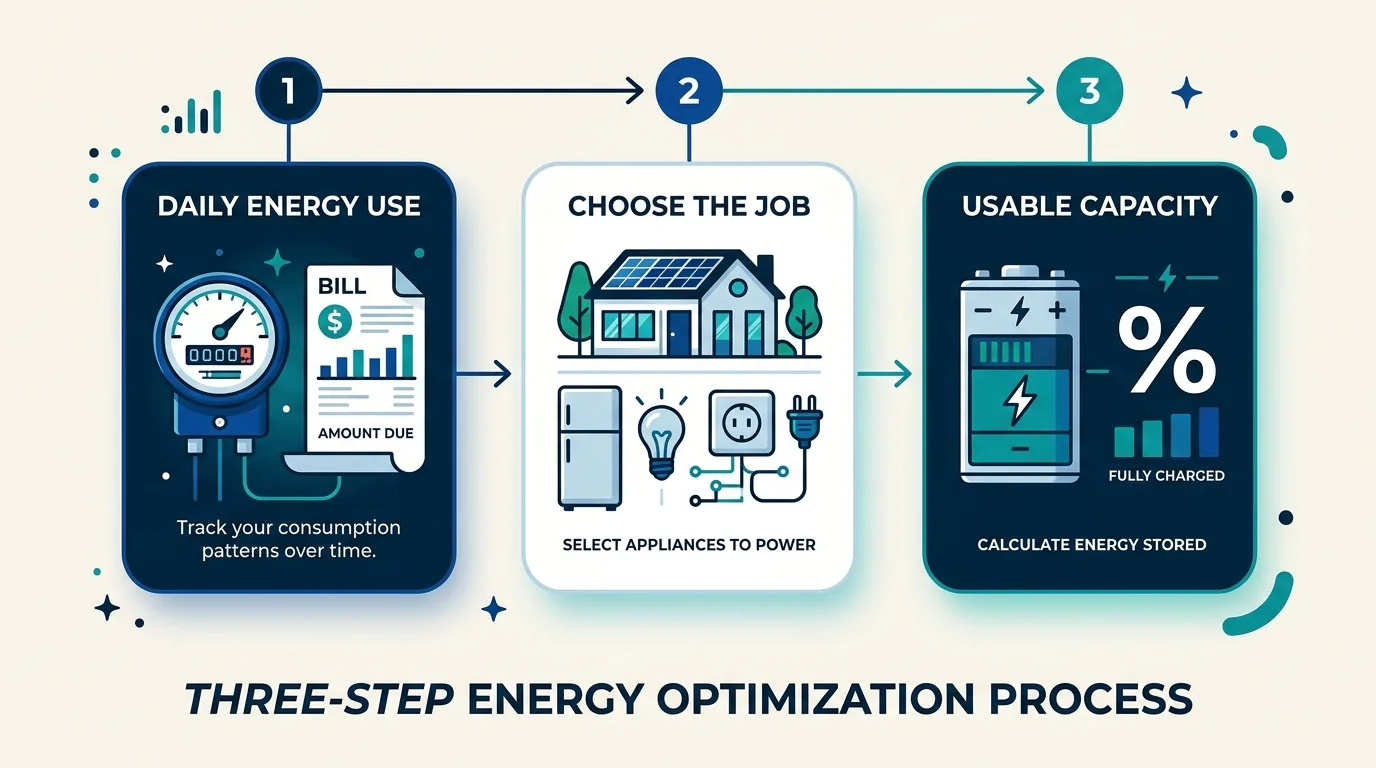
The whole method in three moves: start from daily use, pick the job, then correct nameplate down to usable capacity.
Everything downstream depends on one number: how many kilowatt-hours your home uses in a day. You have two ways to get it, from roughest to best.
The fast way — from your utility bill. Find your monthly kWh (every bill shows it) and divide by 30. For context, the U.S. average residential customer buys about 10,791 kWh a year — roughly 899 kWh a month, or ~30 kWh a day, according to the U.S. Energy Information Administration. Your own number is what matters; a small efficient home might be 12–18 kWh/day, an all-electric home with AC and an EV can top 50.
The accurate way — add up the loads you actually care about. You rarely want a battery to run everything. You want it to run a chosen set of loads for a chosen stretch of time. So list those loads, and for each one estimate watts × hours per day ÷ 1,000 = kWh/day.
Appliance | Typical power | Hours/day | Energy/day |
|---|---|---|---|
Refrigerator | 150 W (avg) | 24 | ~1.5 kWh |
LED lighting (whole home) | 200 W | 5 | 1.0 kWh |
Wi-Fi, router, phones, laptops | 100 W | 12 | 1.2 kWh |
TV + entertainment | 150 W | 5 | 0.75 kWh |
Microwave / small kitchen | 1,200 W | 0.5 | 0.6 kWh |
Well pump or sump pump | 800 W | 1 | 0.8 kWh |
Gas-furnace blower | 500 W | 6 | 3.0 kWh |
Central AC (3-ton) | 3,500 W | 4 | 14 kWh |
Electric water heater | 4,000 W | 3 | 12 kWh |
Two things jump out of a table like this. First, the "keep-the-lights-on" essentials — fridge, lighting, internet, a few outlets — usually add up to only 5–10 kWh a day. Second, the big electric loads — air conditioning, electric water heating, electric heat — dwarf everything else, which is why the EIA notes heating, cooling and water heating dominate home energy use. Whether you put those big loads on the battery is the decision that moves you between the 5, 10 and 16 kWh tiers.
If you'd rather not build the table by hand, our free Ah ↔ kWh converter helps translate battery and appliance specs into the same units so your daily-use math stays consistent.
Step 2 — Decide the job: backup, whole-home, or self-consumption
The same house needs a very different battery depending on what you're buying it to do. There are three common jobs, and they scale from small to large.
Job A — Essential-loads (partial) backup. You want the fridge, lights, internet, phones and maybe a furnace blower to ride through an outage. This is the most popular job and the most economical, because you're only sizing for 5–10 kWh/day of carefully chosen circuits — not the whole house. A 5–10 kWh battery fits here.
Job B — Whole-home backup. You want the house to behave normally during an outage, air conditioning and all. Now you're sizing against your full daily use (often 30–50+ kWh/day) and you'll usually need 16 kWh and up, frequently stacked into the 20–40 kWh range — plus an inverter big enough for simultaneous heavy loads. Be honest about this one: true whole-home backup for an all-electric house is a multi-battery project, not a single 10 kWh box.
Job C — Solar self-consumption / time-of-use. No outage in sight — you want to store cheap or self-generated daytime solar and use it in the expensive evening peak. Here the battery should be big enough to soak up your typical daily solar surplus and cover your evening load, which for most homes lands in the 10–16 kWh range. Size it to your surplus, not to your whole bill; a battery bigger than your daily surplus just sits half-empty.
A single input decides most of this: days of autonomy — how long you need to run without a recharge. Grid-tied backup usually assumes the sun or the grid returns within a day, so one day of autonomy is normal. Off-grid or storm-prone areas may want two or three, which multiplies the capacity you need.
Planning for the whole house rather than a few circuits is its own, larger calculation — run your full daily use through the steps below rather than just your essential circuits, and expect the answer to point at stacked capacity.
Step 3 — Convert to usable capacity (nameplate ≠ what you get)
Here's the correction that separates a real sizing estimate from a guess, and that the thinnest competitor articles skip: the kWh on the label is not the kWh you can use. Three factors shrink it.
- Depth of discharge (DoD). You shouldn't drain a battery to zero. Modern lithium iron phosphate (LiFePO4 / LFP) batteries allow a deep 90% DoD, so a 10.24 kWh nameplate gives about 9.2 kWh usable. (Older lead-acid chemistries were limited to ~50%, which is why LFP has taken over home storage.)
- Round-trip efficiency. Storing and retrieving energy loses a little to heat and conversion — typically 90–95% for a good LFP system. Some of your usable kWh disappears here.
- A safety/growth buffer. Sensible sizing adds 10–25% headroom for cold-weather derating, gradual capacity fade over the battery's life, and the loads you'll inevitably add later.
Put together, the working formula is:
Required nameplate kWh = (daily kWh for your target loads × days of autonomy × safety factor) ÷ (DoD × round-trip efficiency)
Worked example. Say you've chosen essential-loads backup (Job A) and your table came to 8 kWh/day. You want one day of autonomy, a 1.15 safety factor, and you're using LFP at 90% DoD and 92% round-trip efficiency:
8 kWh × 1 day × 1.15 = 9.2 kWh9.2 kWh ÷ (0.90 × 0.92) = 9.2 ÷ 0.828 ≈ 11.1 kWh nameplate
So this household wants roughly 11 kWh of nameplate capacity — which is why a nominal "10 kWh" battery (10.24 kWh) is a close fit for trimmed essential loads, and a 16 kWh unit is the comfortable choice if you want margin or expect to add loads. Run the same formula with your daily number and you'll land on your own tier.
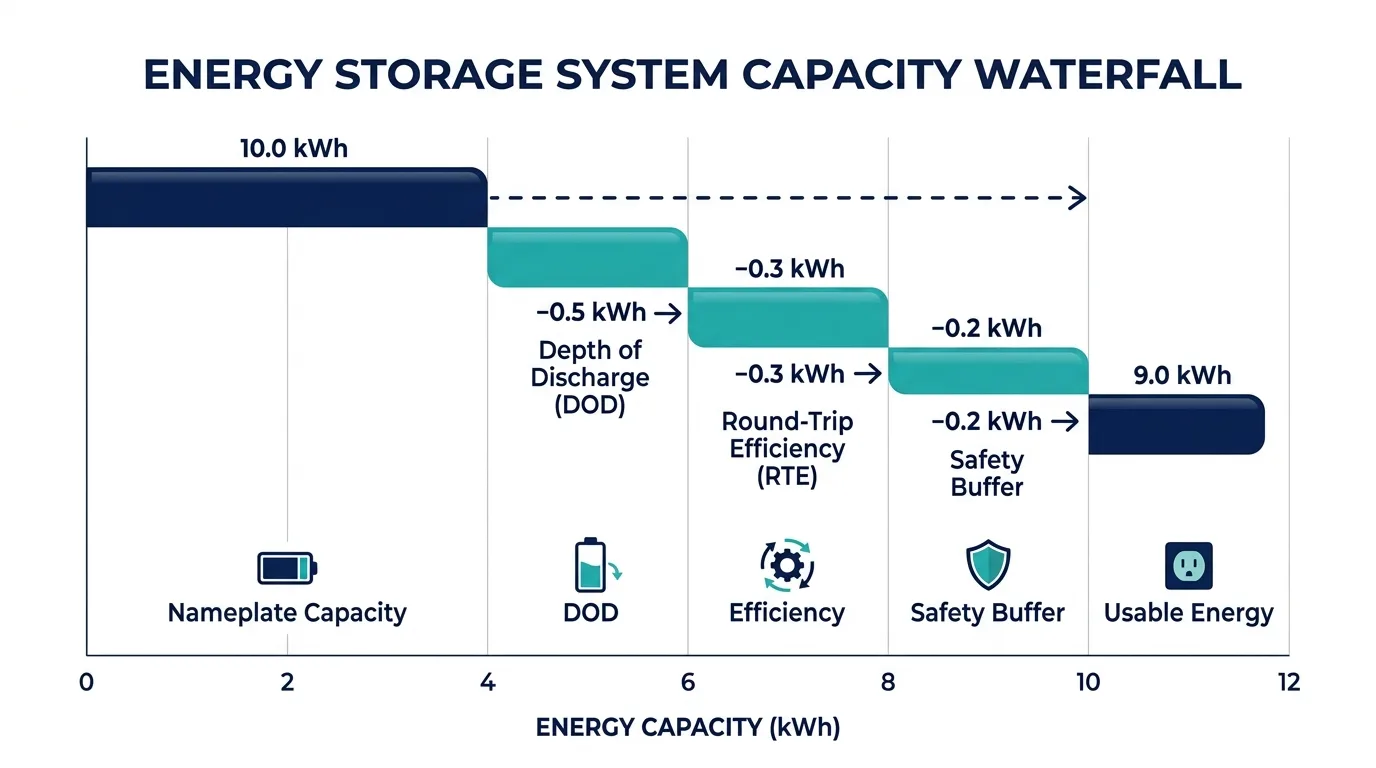
A 10 kWh nameplate battery delivers roughly 9 kWh usable after depth of discharge, and a little less again after round-trip losses.
5, 10 or 16 kWh? Match the tier to the household
Now the payoff. Most guides leave you in a vague "10–15 kWh" band; here's how the three real tiers map to real homes. These aren't arbitrary — they're the actual capacity steps of a modular wall-mounted line, so you can size to the tier and start ordering. For a familiar reference point, a single Tesla Powerwall 3 is about 13.5 kWh — which lands right between the 10 and 16 kWh tiers below.
Tier | Usable ≈ | Fits this household | Typical job |
|---|---|---|---|
5 kWh (5.12 nameplate) | ~4.6 kWh | Apartment, condo, small or efficient home; a few critical circuits; evening/overnight-only loads | Light essential backup · shave one TOU peak |
10 kWh (10.24 nameplate) | ~9.2 kWh | Typical 3-bed home running fridge, lights, internet, outlets and a gas-furnace blower through the night | Essential-loads backup · daily solar self-consumption |
16 kWh (16.08 nameplate) | ~14.5 kWh | Larger or all-electric home, home with an EV, or anyone wanting a full day of autonomy on core loads | Extended backup · heavier self-consumption · near-whole-home when stacked |
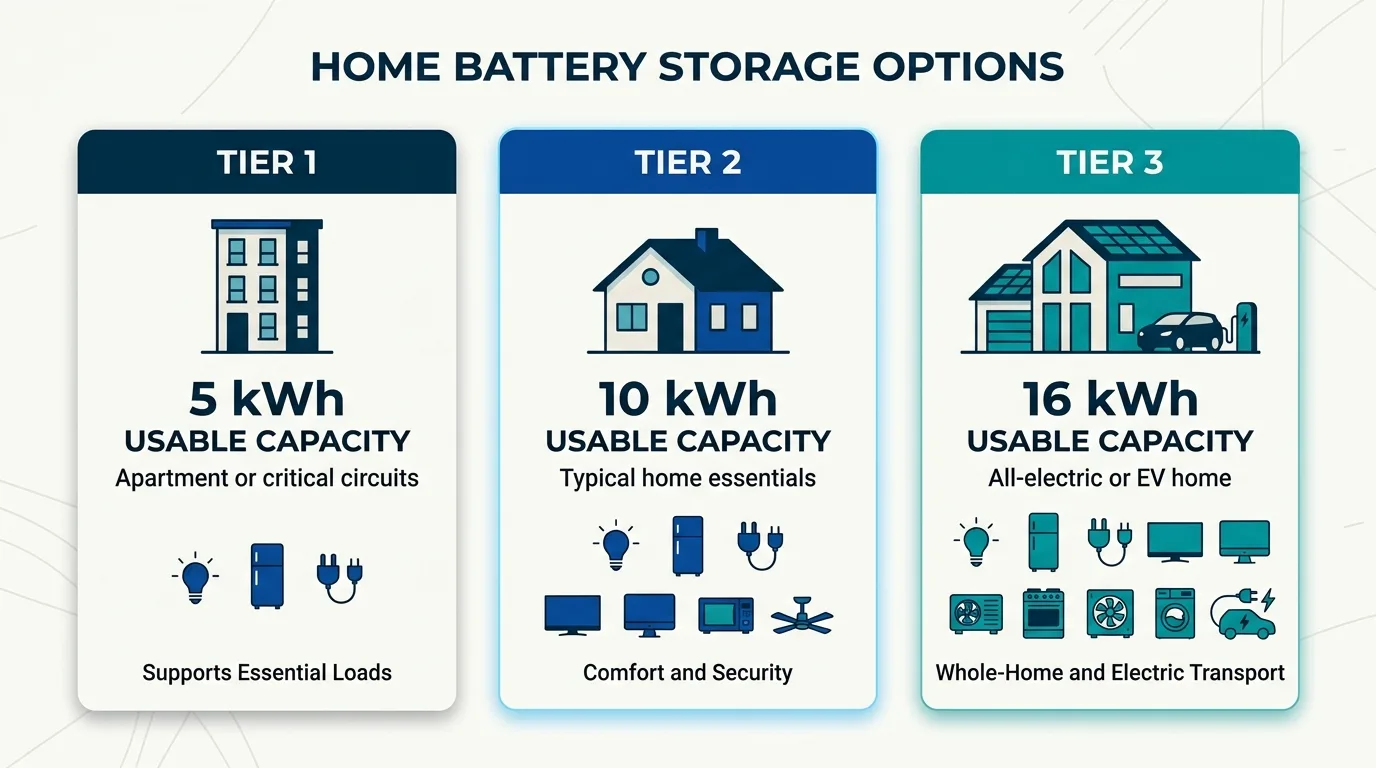
Each tier is a distinct answer to a distinct job — from a single-circuit apartment setup to a near-whole-home system.
Three quick household pictures to place yourself:
- "5 kWh" — the apartment / night user. A two-person condo with gas heat and cooking. The battery only ever runs lights, electronics, a fridge and the occasional microwave, mostly in the evening. 4–5 usable kWh covers a night comfortably.
- "10 kWh" — the typical home essentials. A family in a 3-bedroom house wants the fridge, freezer, Wi-Fi, lights and the furnace fan to survive a winter evening outage without thinking about it. ~9 usable kWh does exactly that, and doubles as an evening solar battery.
- "16 kWh" — the all-electric / EV home. Heat pump, induction cooking, an EV that trickle-charges overnight, and an owner who doesn't want to ration during a longer outage. 14–15 usable kWh is the floor here — and the point where you start thinking about stacking a second unit.
This is also where honesty beats marketing: if your daily target is above ~14 kWh, a single 16 kWh battery is a starting point, not the finish line. Plan to stack.
How long will it actually last? Runtime by tier
"How long will a 10 kWh battery last?" is the most-asked follow-up, and the answer is just usable capacity ÷ average load — but the load you pick changes everything. Here's each tier against three realistic load profiles.
Average load (what's running) | 5 kWh (~4.6 usable) | 10 kWh (~9.2 usable) | 16 kWh (~14.5 usable) |
|---|---|---|---|
~0.5 kW — fridge, Wi-Fi, LED lights, phones | ~9 hours | ~18 hours | ~29 hours |
~1 kW — above + TV, small kitchen use, furnace fan | ~4.5 hours | ~9 hours | ~14 hours |
~2 kW — most of the house incl. intermittent heavy loads | ~2.3 hours | ~4.5 hours | ~7 hours |
Read this table as ranges, not stopwatches — real loads cycle on and off, so a fridge-and-lights setup that averages 500 W will comfortably beat the "hours" shown when nothing heavy is running, and fall short when the microwave and hair dryer overlap. If you're pairing with solar, every sunny hour recharges the battery, so daytime outages last far longer than any battery-only figure suggests.
To pressure-test a specific set of circuits, our free battery backup duration calculator lets you enter your own loads and battery size instead of reading off an average.
Don't undersize the inverter (the mistake nobody warns you about)
You can get every kWh right and still end up with a system that disappoints — because you sized the energy and forgot the power. Undersizing the inverter is, in practice, more common than undersizing the battery.
Three power facts to check before you buy:
- Continuous power. The inverter's continuous kW rating is the ceiling on what you can run at once. A single 5 kWh wall battery paired with a 5 kW inverter can comfortably run a home's essential loads; a whole-home ambition needs 7–10 kW of inverter, which usually means a bigger inverter and often more than one battery module feeding it.
- Surge / peak power. Motors — well pumps, AC compressors, refrigerators, power tools — draw 3–7× their running wattage for a split second at startup. A 1 kW pump can spike to 5 kW. If the inverter can't supply that inrush, the load won't start, full battery or not. Check the surge rating, not just the continuous one.
- Battery-to-inverter matching. The battery has to be able to deliver the current the inverter asks for. Our 16 kWh wall unit supports up to a 7 kW inverter and 155 A continuous discharge precisely so it can feed heavier loads; the 5 and 10 kWh units are matched to 5 kW inverters.
There's a compatibility trap here too. Many all-in-one systems lock the battery to one brand's inverter. If you already own — or want to choose — your inverter, that matters. iHuapower's residential batteries are 48 V (51.2 V) LFP units compatible with 20+ hybrid-inverter brands, including Deye, Solis, Growatt, Luxpower, Victron, Goodwe, SMA and Afore, so the battery fits your inverter rather than dictating it. Check your inverter's continuous and surge rating against the battery's before you commit to either.
Sizing for solar: how much PV to feed the battery
If the battery is part of a solar system, one more ratio matters: enough PV to refill the battery each day. A common rule of thumb is 2–3.5 kW of solar per 10 kWh of battery, but you can derive it from your own location.
To refill 10 usable kWh in a day, divide by your peak sun hours (the daily equivalent hours of full-strength sun — often 3–5 in the U.S.) and add ~20% for system losses:
10 kWh ÷ 4 peak sun hours ÷ 0.8 ≈ 3.1 kW of PV
That's roughly 3 kW of PV — about 7–8 modern 400 W panels — to reliably top a 10 kWh battery back up each day while also serving daytime loads. Scale it: a 5 kWh battery wants ~1.5 kW of PV, a 16 kWh battery ~5 kW. NREL's free PVWatts calculator will give you the peak-sun-hours figure for your exact address if you want to tighten the estimate. Undersize the array and the battery never fully recharges; oversize it and you're simply exporting more to the grid.
Buy for today, scale for tomorrow
The best defense against sizing anxiety is not needing to get it perfect on day one. This is the real advantage of a modular, stackable battery over a single sealed box: you size for today's job and keep a clear upgrade path.
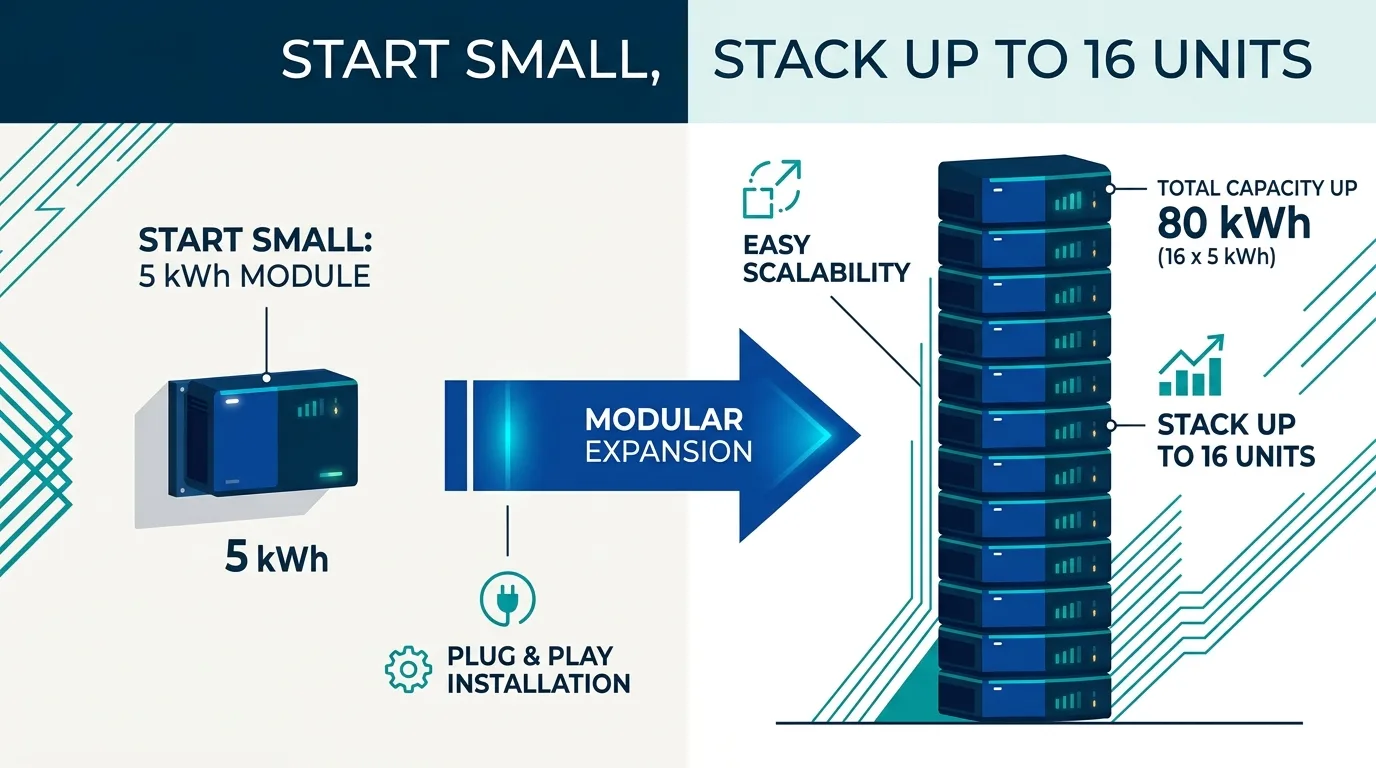
A modular line lets you start at 5 kWh and add matched modules as your loads — or your EV — arrive.
With iHuapower's residential line you can start with a 5 or 10 kWh unit and add modules later, up to 16 units in parallel (8 recommended for a typical home), using quick-connect terminals rather than a re-engineered install. Practically, that means:
- Buy a 10 kWh now for essential-loads backup; add a second module when you get an EV or a heat pump.
- Start a solar home at 5 kWh to shave the evening peak; grow it as your self-consumption habits settle.
- Reach for the stackable 20–50 kWh range (or high-voltage modules) when you've genuinely moved to whole-home or off-grid.
Sizing stops being a one-shot bet and becomes a starting point you can revise — which is exactly how it should be when your electricity use is changing every few years. If you're deciding between a single wall unit and a stackable tower, weigh floor space and your realistic top-end capacity: wall units keep it simple up to 16 kWh, stackable clusters make more sense once you're heading past it.
What about cost and incentives?
Two questions decide the money side, and both should follow sizing, not lead it.
Cost. Installed price scales mostly with three things: the battery capacity (kWh) you chose above, the inverter (kW) it pairs with, and installation (labor, wiring, permits). That's why sizing first matters financially — an oversized battery is the most expensive line item you can add for capacity you'll rarely use. Whether the system pays back depends on what job you bought it for: bill savings (time-of-use spread × how much you cycle daily), backup value (what an outage costs you), or solar self-consumption (how much export you avoid). Get a quote against your tier rather than a generic per-kWh figure — installed pricing varies too much by region and inverter to be useful as a single number here.
Incentives. These change often and vary by country, state and utility, so treat any figure in a competitor guide as possibly stale. In the U.S., the federal residential Clean Energy Credit (25D) that historically offset 30% of a home battery expired at the end of 2025 under 2025 tax legislation — so as of 2026 there is generally no federal residential credit for a home battery, though state and utility programs still exist in many areas. Confirm the current picture for your address at the **DSIRE database (Database of State Incentives for Renewables & Efficiency, run by N.C. State University), and re-check at purchase since policy keeps shifting. Outside the U.S., many Australian states and several European countries run their own home-battery rebates or feed-in schemes. The rule of thumb: **size for your real needs first, then let any incentive improve a well-sized system — never let a rebate talk you into the wrong capacity.
Which iHuapower battery fits your size?
Bringing the tiers together with the actual products, so you can move from "what size" to "which model":
Your situation | Model | Nameplate | Inverter | Notes |
|---|---|---|---|---|
Apartment / light essentials | HC-UPSRB5 | 5.12 kWh | up to 5 kW | Wall-mounted, IP65, ≥6,000 cycles |
Typical home essentials / evening solar | HC-UPSRB10 | 10.24 kWh | up to 5 kW | Wall-mounted, IP65, 90% DoD |
Larger / all-electric / EV home | HC-UPSRB16 | 16.08 kWh | up to 7 kW | Wall-mounted, ≥8,000 cycles, 155 A |
Want battery + inverter in one box | HC-UPSRAP16I | 16.08 kWh | 6 kW built-in | All-in-one with 9 kW MPPT solar input, 10 ms UPS switchover |
Whole-home / off-grid (stacked) | HC-UPSSLV 20–50I (low-V) / SHV 20–40I (high-V) | 20.5–51.2 kWh | high/low-voltage | Stackable clusters for the biggest jobs |
All of the wall-mounted units share the fundamentals that make the sizing math above hold up: LiFePO4 cells, 90% depth of discharge, IP65 wall-mount enclosures, and compatibility with 20+ inverter brands so you're never locked to one ecosystem. The low-voltage residential battery range covers the 5/10/16 kWh wall units and the stackable systems in one place; the all-in-one residential system bundles the inverter for a simpler install.
Not sure which tier your numbers point to? Run Step 1–3 above, then send us your daily figure and target loads and our application engineers will confirm the fit — the same people who size and commission these systems every week.
FAQ
How much battery storage do I need for a house? For essential-loads backup (fridge, lights, internet, a few outlets), most homes need 5–10 kWh. For whole-home backup including AC and electric heat, plan on 16 kWh and up, often stacked into the 20–40 kWh range. Size from your own daily kWh, not a rule of thumb.
Is 10 kWh enough to run a whole house? Usually not a full all-electric house continuously — 10 kWh (about 9 kWh usable) is sized for essential loads through an evening and overnight, not for running central AC and electric water heating all day. It's plenty for the critical-circuits job most people actually want.
How long will a 10 kWh battery last? Roughly 9 usable kWh ÷ your average load. On ~0.5 kW of essentials (fridge, lights, Wi-Fi) that's about 18 hours; on ~1 kW it's about 9 hours; running most of the house at ~2 kW, closer to 4–5 hours. Solar recharging extends all of these.
What's the difference between a 5 kWh and 10 kWh battery? The 10 kWh stores about twice the energy, so it runs the same loads twice as long — or runs more loads for the same time. Choose 5 kWh for an apartment or a few evening circuits, 10 kWh for the full essential-loads set of a typical home.
Should I get 10 kWh or 16 kWh? Go 16 kWh if you have an all-electric or larger home, own or plan an EV, want a full day of autonomy on core loads, or expect your usage to grow. Go 10 kWh if you're backing up essential circuits in a typical home. With a modular line you can start at 10 and add capacity later.
How many solar panels do I need to charge a 10 kWh battery? About 2.5–3 kW of PV — roughly 7–8 modern 400 W panels — to reliably refill 10 kWh a day while also serving daytime loads, assuming ~4 peak sun hours. More panels in cloudier climates.
Can I expand a home battery later? Yes, if you buy a modular system. iHuapower's residential batteries add matched modules via quick-connect terminals, up to 16 units in parallel — so you can size for today and scale as your needs change.