
The power electronics that convert and control energy flow in a battery storage system — a bidirectional DC-to-AC converter that charges the battery from the grid or solar and returns stored energy as grid-compatible AC power.
That one-sentence version is the definition you will find on any spec sheet, but the power conversion system deserves more attention than it usually gets. It is the component that decides how fast a storage system responds to the grid, how much energy is lost in every cycle, and whether the project passes interconnection review in the first place. For engineers, installers, and distributors evaluating a PCS battery for a commercial or utility project, understanding this box is where good system design starts.
What Is a Power Conversion System (PCS)?
A power conversion system is the power electronics interface between the DC side of a battery and the AC side of the grid or building. The battery stores energy as direct current; the grid, the building loads, and most generators run on alternating current. Something has to convert between the two, in both directions, continuously and safely — that something is the PCS.
"Bidirectional" is the word that separates it from simpler converters: on charge, the PCS rectifies AC from the grid into DC for the battery; on discharge, it inverts DC back into AC that matches the grid's voltage, frequency, and phase. It does this within milliseconds of a command from the energy management system — and, in grid-forming designs, it can even create the voltage reference itself.
Storage's role has expanded with grid complexity. The U.S. Department of Energy's energy storage program positions storage as a critical grid technology for integrating renewables, shaving peak demand, and providing resilience — and every one of those jobs runs through the power conversion layer. Without a PCS, a battery is just a box of DC; with one, it becomes a grid asset that can charge, discharge, hold frequency, and island a facility during an outage.
What Does "PCS" Mean in Electrical?
Before going further, the acronym needs disambiguation, because "PCS" is one of the most overloaded abbreviations in the industry. In an electrical or energy-storage context, PCS stands for power conversion system — the equipment discussed in this article. In procurement spreadsheets, the same three letters usually mean "pieces" ("PCS: 100"), and in IT conversations they mean a personal computer.
The context makes the meaning clear: when the letters follow a power rating and appear alongside words like inverter, battery, grid, or converter, they refer to the power conversion system. When they follow a quantity, they mean pieces. If you search for a "pcs battery," you are looking for a battery system paired with a power conversion system — not a pack of batteries sold by the piece.
How Does a PCS Work in a Battery Storage System?
The working cycle of a PCS has two directions, and the unit manages both thousands of times over its service life.
Charging (AC → DC). When the site has surplus solar, cheap grid power, or a low-tariff window, the PCS rectifies AC to DC and pushes it into the battery at a controlled current. The charging profile is set by the battery management system (BMS), which protects cells from over-voltage, over-current, and temperature limits — the PCS executes those limits as electrical commands.
Discharging (DC → AC). When the building needs power or the grid needs support, the PCS inverts DC to AC, synchronizes to the grid (or forms its own island in off-grid mode), and delivers power at the commanded rate. Response time matters here: frequency-regulation duty can require a full power step within milliseconds.
Between those two states, the PCS also does the finer work: voltage and frequency control, reactive power (VAR) support, power-quality conditioning, anti-islanding protection, and — in larger installations — communication with SCADA or a plant controller. Protection runs continuously: the unit monitors current, temperature, insulation, and grid anomalies, and disconnects within milliseconds of a fault.
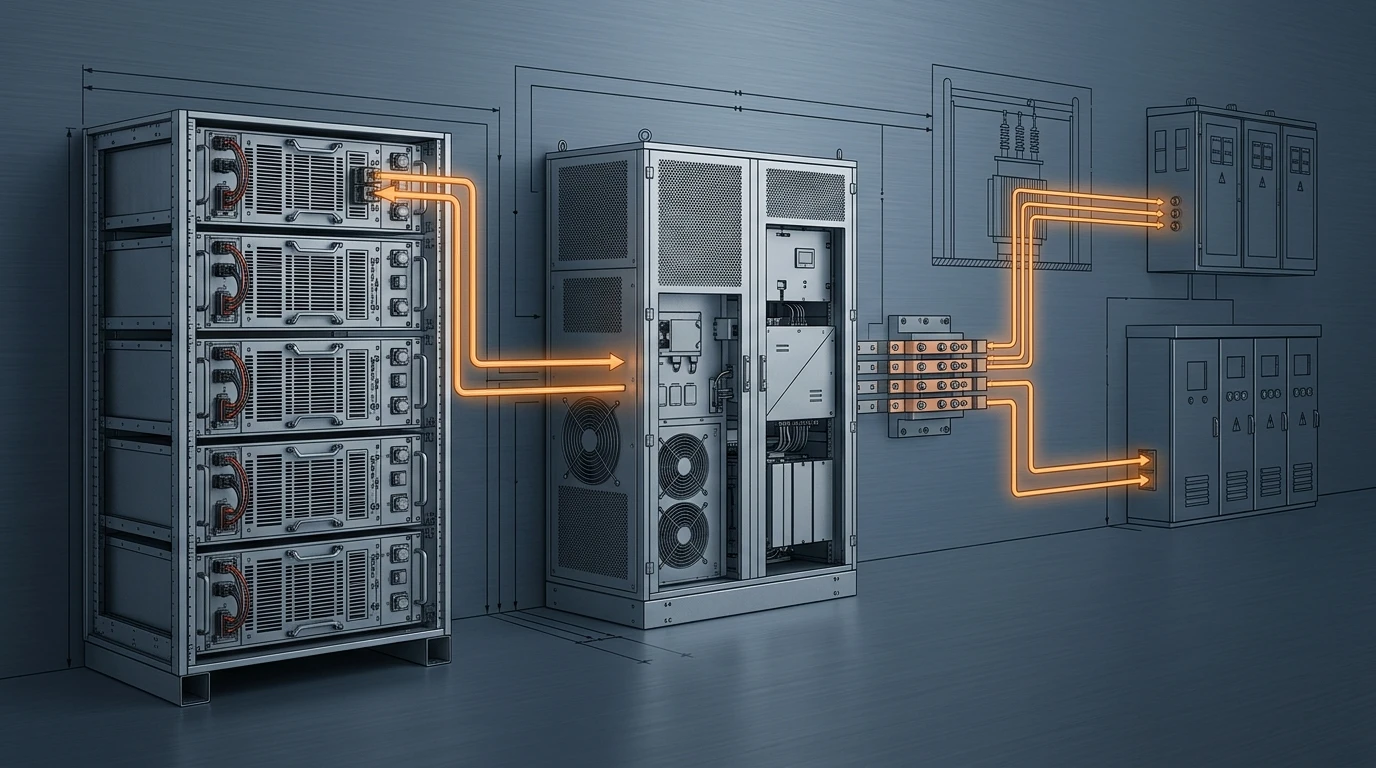
Image: the two power paths every PCS manages — AC to DC on charge, DC to AC on discharge.
One efficiency point deserves emphasis: every charge-discharge cycle crosses the converter twice, so conversion efficiency compounds. A PCS with 97% conversion efficiency yields roughly 94% round-trip efficiency once both directions are counted — which is why system-level round-trip efficiency, not single-direction conversion efficiency, is the number that belongs in your economic model.
PCS vs Inverter: What's the Difference?
"PCS" and "inverter" are used almost interchangeably in marketing copy, but they are not the same equipment. An inverter converts DC to AC in one direction. A power conversion system converts both ways and layers control functions on top — grid synchronization, frequency response, power factor control, protection, and communications. On a single spec sheet, a PCS, an inverter, and battery storage all appear side by side; the difference is in what each one is asked to do.
Dimension | Solar inverter | Storage PCS |
|---|---|---|
Conversion direction | DC → AC (one way) | DC ↔ AC (bidirectional) |
Input source | PV array only | Battery, or PV + battery |
Grid services | Export / curtail | Charge, discharge, frequency & voltage support |
Islanding / backup | No (grid-tied only) | Yes — grid-forming models |
Communications | Inverter monitoring | EMS / BMS / SCADA integration |
Efficiency spec | Peak / Euro efficiency | Peak + round-trip efficiency |
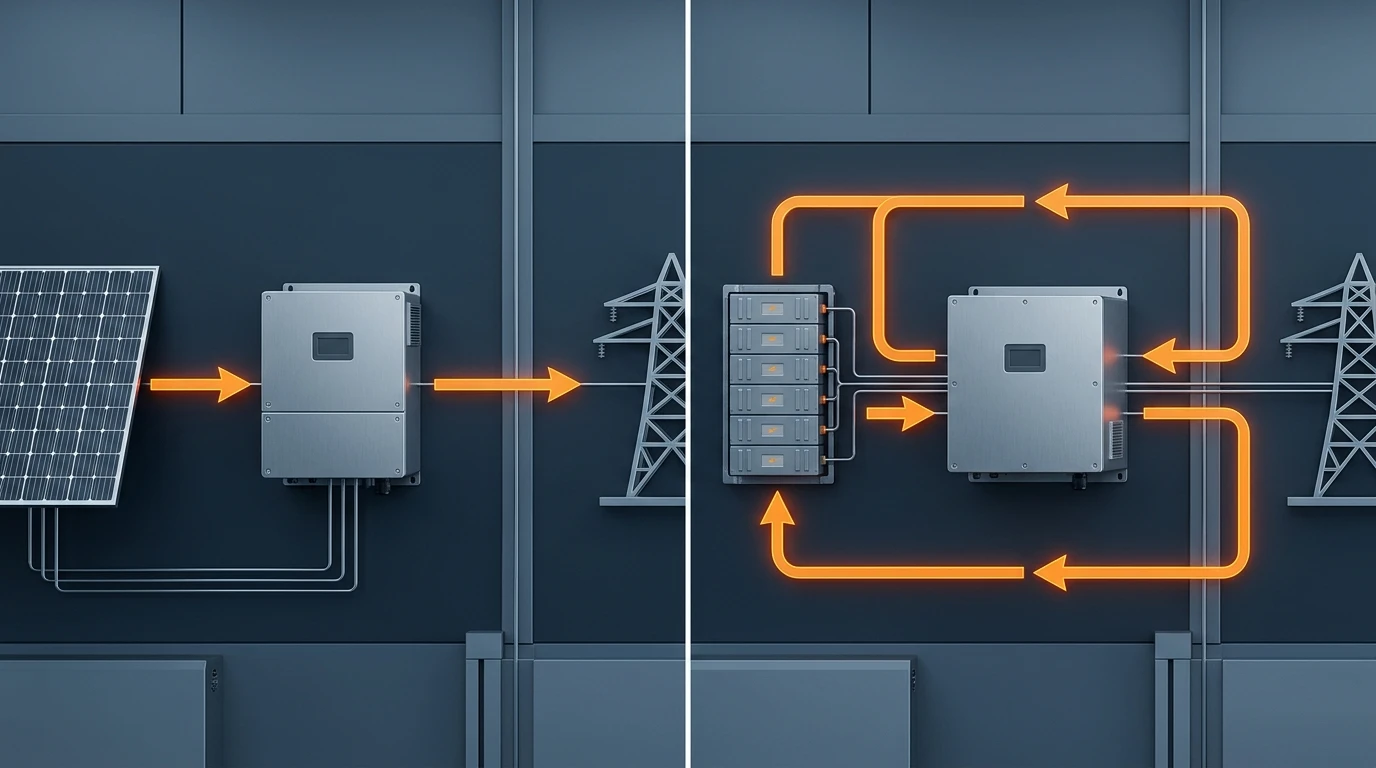
Image: one-way solar inverter versus bidirectional storage PCS.
The hardware overlap is real — a storage PCS contains inverter stages that look similar to a solar inverter's — and hybrid inverters merge both roles into one unit. In solar-plus-storage systems, the same converter family serves both AC-coupled and DC-coupled architectures, each with different efficiency and retrofit trade-offs. But when a spec sheet says "PCS," expect bidirectional conversion, grid-service capability, and the control interfaces of a grid asset rather than a solar appliance.
Key PCS Components and Specifications
Reading a PCS datasheet is easier when you know what is inside the cabinet:
- Power stage. The DC-AC (and AC-DC) conversion circuits built on IGBT or SiC power semiconductors. SiC switches run cooler and more efficiently at high frequency, which is why newer C&I units advertise them.
- Control unit. The processor that runs the conversion algorithm, follows grid voltage and frequency, and executes EMS commands.
- Protection. DC breakers, fuses, surge protection, insulation monitoring, and anti-islanding logic — the hardware and firmware that keep a battery from feeding the grid during an outage.
- Cooling. Air or liquid, sized to power density; liquid-cooled units dominate above roughly 500 kW.
- Communications. Modbus TCP/RTU, CAN, and sometimes IEC 61850, linking the PCS to the EMS, BMS, and site SCADA.
- Voltage class. Residential and small commercial units work at 48 V battery voltage; larger C&I and utility systems use DC links of 1,000 V or 1,500 V, which raises conversion efficiency and lowers cabling cost.
These are the components behind the headline numbers buyers compare across vendors — efficiency, response time, and total harmonic distortion (THD).
PCS in Different Storage Applications
The same core hardware appears in very different configurations depending on the application:
- Commercial & industrial. A C&I cabinet in the 100 kW–500 kW class pairs a PCS with a battery bank to cut demand charges and run peak shaving against the tariff. Here, cycle life and efficiency matter more than response time.
- Utility-scale and grid services. Containerized systems in the MW class (1,000–1,500 V DC) handle frequency regulation, spinning reserve, and renewable firming. The PCS is chosen for millisecond response and grid-forming capability — the same territory covered by Sandia National Laboratories' energy storage research.
- Off-grid and microgrids. In a hybrid microgrid, the PCS must hold voltage and frequency on its own, synchronize a diesel genset, and manage black start — see our hybrid microgrid solutions for the system-level view.
- Residential and behind-the-meter. Smaller units in the 5–15 kW class integrate with a home battery and rooftop solar; many are combined inverter-PCS hybrids designed for whole-home backup.
- Solar-plus-storage. DC-coupled architectures share one converter for PV and battery; AC-coupled ones add storage on the AC side. Both are valid — the choice changes the efficiency and retrofit math.
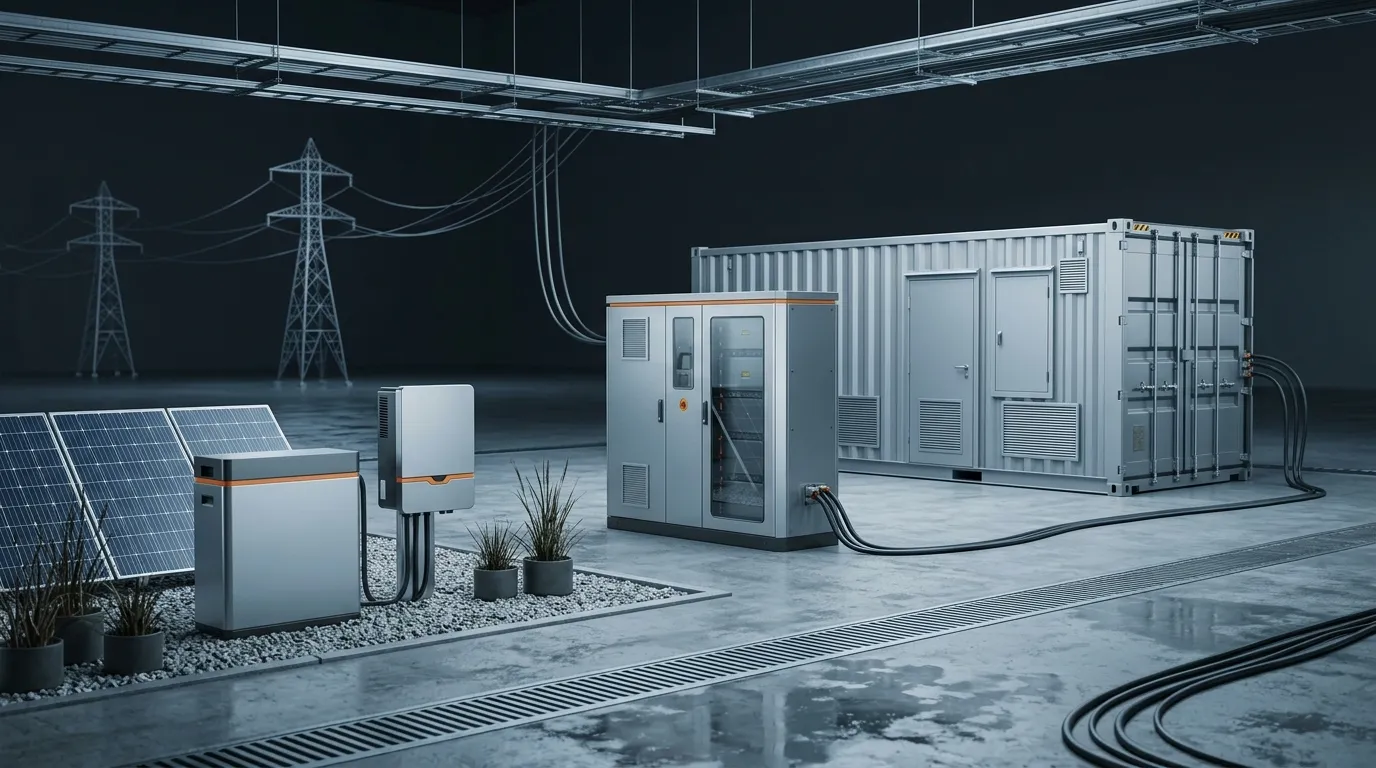
Image: one converter family, five application contexts — C&I, utility, microgrid, residential, and solar-plus-storage.
How to Choose a PCS for Your Battery System
Sizing a PCS is a five-step exercise that most datasheet comparisons skip:
- Match power to the battery's C-rate. A battery rated 0.5C can sustain a charge/discharge power equal to half its capacity — a 1 MWh bank delivers 500 kW. The PCS AC rating should match that power rather than exceed it, or you pay for converter capacity the battery cannot feed. The battery's C-rate sets this bound.
- Check voltage compatibility. The PCS DC voltage window must contain the battery bank's nominal and operating voltage range. A 48 V residential battery cannot connect to a 1,500 V utility PCS.
- Set the efficiency bar with round-trip numbers. Compare system-level round-trip efficiency (both directions), not peak conversion efficiency. Two points of RTE difference over twenty years of daily cycling is real money.
- Verify grid-code and safety compliance. In North America, the unit needs UL 1741 listing and IEEE 1547 interconnection compliance; internationally, IEC 62109 safety certification and the local grid code apply — and large systems also face NFPA 855 fire-safety and IEC 62443 cybersecurity requirements. These are inspection gatekeepers, not nice-to-haves.
- Read the warranty and service terms. A PCS is the most stressed component in the system. Ask about the warranty term, the service network in your region, and what a replacement unit costs to ship — gaps here surface years later as downtime.
The five steps above cover the system-level view; for a product-level walkthrough at C&I scale, our commercial PCS selection guide works through real 50–500 kW configurations.
A well-matched PCS also protects the battery: charge and discharge limits, temperature management, and depth-of-discharge control all run through the converter. Specifying too aggressively shortens battery life; an oversized converter wastes capital.
PCS Cost and Payback Considerations
"PCS battery cost" is one of the most searched questions about this equipment, yet almost no public content answers it — because pricing is configuration-specific. What is predictable is the cost structure:
- The PCS is one of the largest hardware line items in a BESS, after the battery cells themselves. In containerized systems, the converter with its transformer and switchgear can rival the battery bank in cost.
- Price scales with AC power rating and voltage class, not capacity. A 500 kW / 1 MWh system and a 500 kW / 2 MWh system use similar converters — which is why higher energy density amortizes the PCS cost over more capacity.
- Certification carries a real premium: UL-listed, IEEE 1547-compliant units cost more than uncertified imports, and that premium is the price of passing inspection.
- Payback logic follows the application. Frequency regulation pays for fast, certified response; peak shaving pays for reliable cycling against the tariff; backup pays for uptime. Run the payback on the use case's revenue, not on the hardware price.
The honest summary: a cheap PCS is usually expensive by the time compliance, downtime, and replacement are counted. Compare total cost of ownership — hardware, certification, service, and efficiency losses — rather than sticker price.
How Hua Power Implements PCS Technology
Hua Power builds the PCS into its storage products rather than treating it as an off-the-shelf add-on — the converter, the battery management system, and the EMS are designed as one system.
On the commercial and industrial side, the PV + Battery ESS all-in-one cabinets (30 kW–250 kW, 64 kWh–522 kWh) integrate the PCS and MPPT with the battery bank in one outdoor enclosure, switching between on-grid, off-grid, and hybrid modes automatically. The air-cooling distributed cabinets (300 kW–500 kW, 723–1,205 kWh) and the liquid-cooling containers (2.03 MWh up to 5.01 MWh at utility scale) extend the same architecture to larger sites — see the integrated PV-battery storage systems and the energy storage cabinet range for configurations.
The grid-services pedigree is part of the design brief: Hua Power's team has delivered 10+ grid-frequency-regulation projects in Europe with sub-30 ms response and 100 MWh+ of accumulated capacity, backed by an EMS platform that manages devices, alarms, and firmware across the fleet. For microgrid and island applications, the same PCS-based architecture integrates PV, storage, EV charging, and diesel generation — 50+ complex projects to date.
Whatever the application, the starting point is the site's duty cycle and grid requirements. Contact Hua Power with your project context and the engineering team will match a PCS-based configuration to it.