
A flow battery is a rechargeable battery that stores its energy in liquid electrolyte held in external tanks, not inside the cell. Two liquids are pumped through a stack of cells separated by a membrane, where ions cross and electricity is released. The tanks set the energy; the stack sets the power.
Most batteries are sold as one package: kilowatt-hours bundled with power. A flow battery — also called a redox flow battery, or simply a redox battery — separates the two. That explains why it is competitive past roughly eight hours of storage and expensive below four, and why the electrolyte is an asset a buyer can move, top up or sell on.
How a Flow Battery Is Built
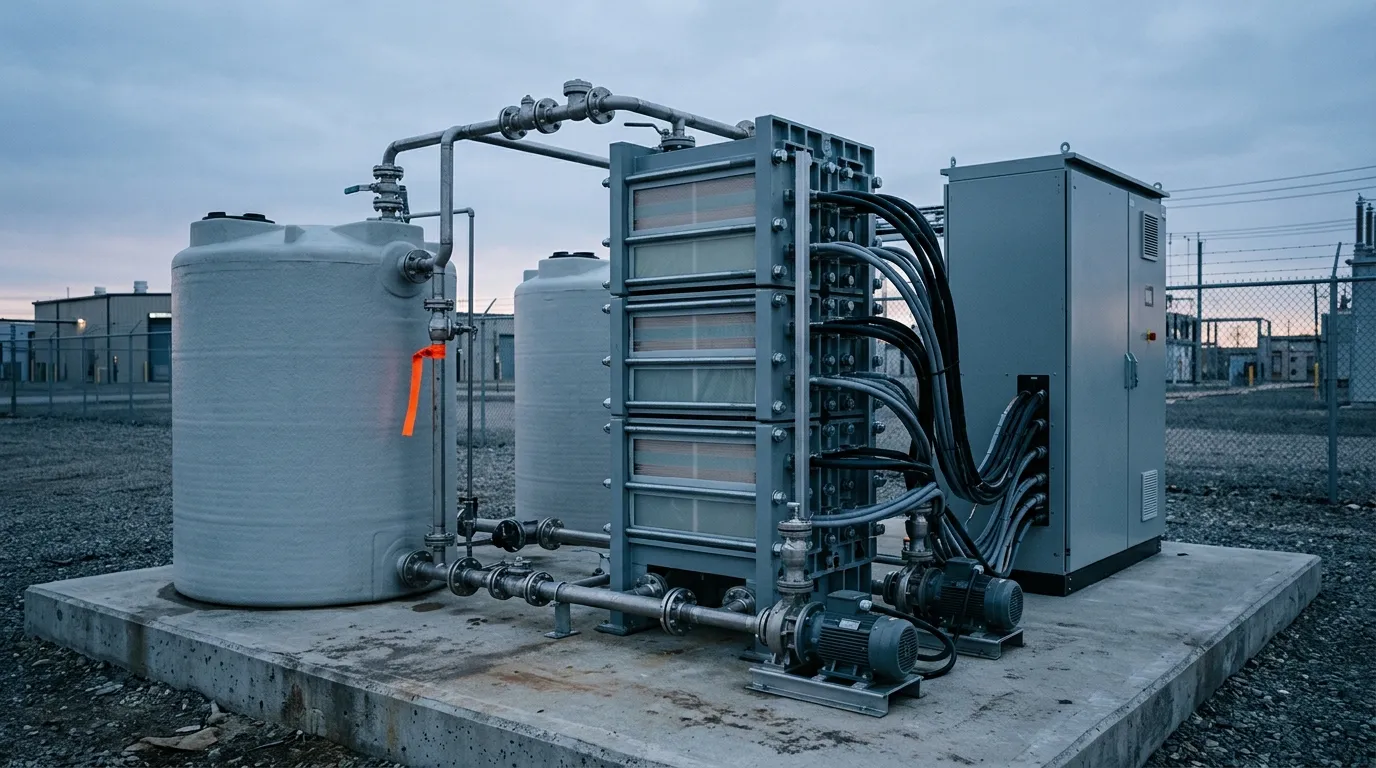
A cell is two electrodes separated by a membrane. Liquid from a positive tank (the catholyte) and a negative tank (the anolyte) is pumped along either side of that membrane, and while the pumps run, redox reactions at the electrodes push current through an external circuit (Wikipedia, Flow battery). Cells are bolted into a stack, much as they are in a fuel cell.
In a conventional (non-hybrid) flow battery, charge moves by electron transfer at the electrode surface rather than by ions entering and leaving a solid material, so no solid-to-solid phase change cracks the electrodes (hybrid chemistries such as zinc–bromine, which deposit a solid layer on the electrode, are the exception), and cell voltage lands between roughly 1.0 and 2.4 volts. Two components decide how a plant behaves. The membrane is usually the costliest and least reliable part: it must resist corrosion while separating the electrolytes, and stacks are run at 100 mA/cm² or more precisely to limit the effect of crossover, at some cost in voltage efficiency. Pumps and power conversion sit between the tanks and the grid.
Why Power and Energy Are Bought Separately
Power capacity and energy capacity are different ratings: the first is maximum instantaneous output in kilowatts or megawatts, the second the total that can be stored or discharged in kilowatt-hours or megawatt-hours (EIA). A flow battery draws them from different hardware — the stack sets the power, tank volume and electrolyte concentration set the energy.
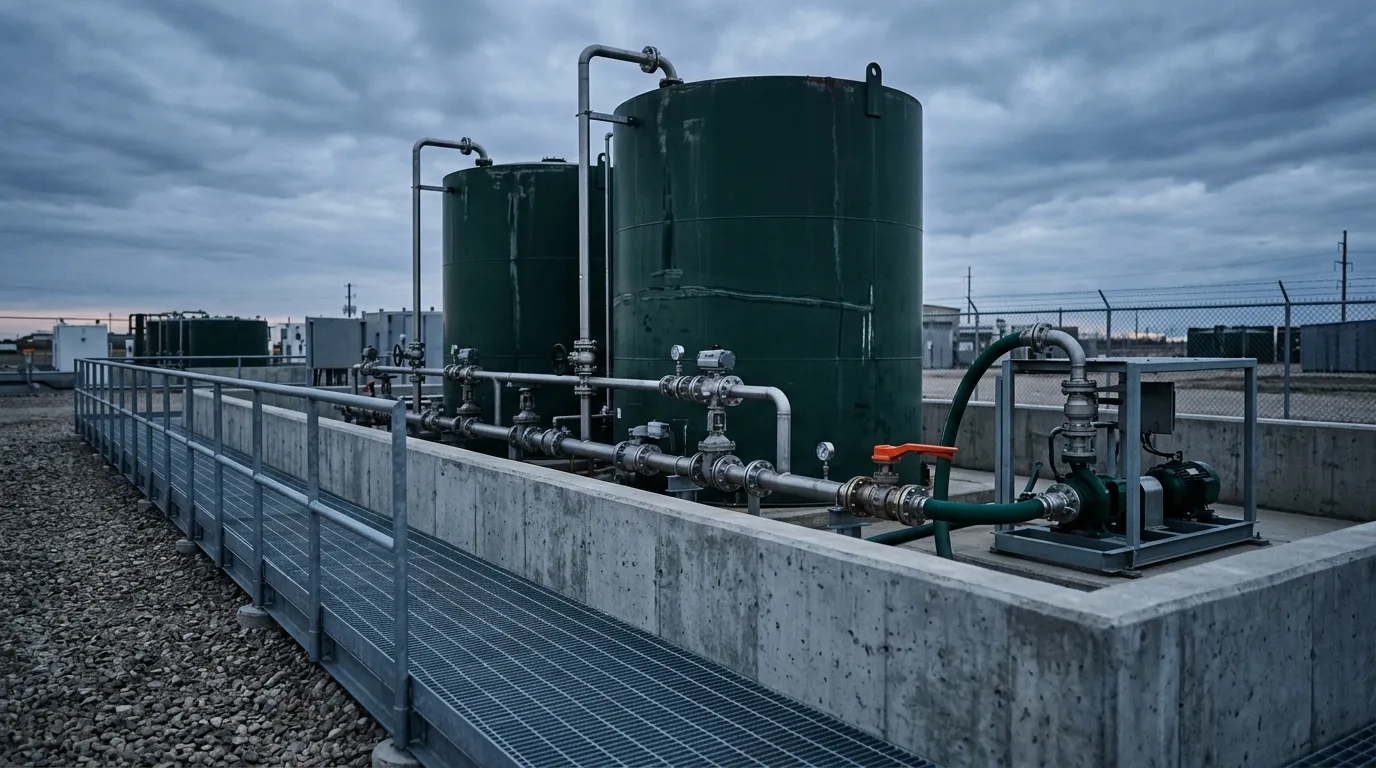
That split changes what an extra hour costs: more electrolyte and more tank, not a second battery, so hour five is cheaper than hour one; on a battery that stores energy inside its cells, every added megawatt-hour means more cells. The reactants sit outside the stack, so electrolyte can be stored away from the power conversion equipment and the power and energy blocks can be sited and expanded independently.
The Chemistries Behind Commercial Flow Batteries
Chemistry | How it works | Where it stands |
|---|---|---|
Vanadium (VRFB) | Vanadium in four oxidation states in sulphuric acid, on both sides of the membrane | The commercial leader; both half-cells use vanadium, so crossover does not degrade capacity |
Zinc–bromine | Zinc plates onto the electrode while bromine stays in solution | The original flow battery, patented in 1879; hybrid, so energy is partly limited by electrode area |
All-iron | Iron salts in both electrolytes | Cheaper raw material, lower energy density |
Organic | Quinones and other redox-active molecules instead of metals | First demonstrated in 2009; poor durability has kept it off commercial scale |
Hydrogen–bromine | Gaseous hydrogen against liquid bromine | Strong laboratory power and specific energy, not a volume product |
Vanadium is what most buyers will be quoted. Because both electrolytes use the same element, a tank that drifts out of balance can be rebalanced rather than replaced, and cell life runs into tens of thousands of cycles. The cost sits in the electrolyte. Vanadium pentoxide is a traded commodity rather than a manufactured input, so its price follows supply news and has swung by multiples; published assessments that cite costs above $30 per kilogram should be checked against the market at the time of quotation (vanadium price assessments). A vanadium system reaches roughly 20 Wh/kg of electrolyte, about 35 Wh/kg with precipitation inhibitors, a line of work that runs back to the chemistry's origins at the University of New South Wales. Adjacent routes continue: mixed-acid electrolytes and organic additives have been a focus at Pacific Northwest National Laboratory. Zinc–bromine systems trade life for a cheaper electrolyte: older cells reach about 70 Wh/L, against 325 Wh/L for lithium iron phosphate.
What Flow Batteries Do Well, and What They Cost You
Aspect | What it means on a project |
|---|---|
Fire risk | Not flammable; can be stored away from the stack |
Idle losses | Little or no self-discharge while idle |
Cycles | Cycling wears the stack slowly |
Response | Fast; suits frequency regulation and backup |
Energy density | Low, so tanks must be large |
Power density | Low; electrodes and membranes carry much of the capital cost |
Efficiency | Lower than lithium-ion, structurally rather than by defect |
Own consumption | Pumps and thermal control draw power whenever the system is online |
Parasitic load is real: pumps and thermal control consume power whether or not the system is delivering energy. Footprint is real too: the energy sits in tanks on a pad. A site with a tight boundary and a four-hour duty is usually better served by another technology.
Flow Battery vs Lithium-Ion: Where the Duration Line Falls
Metric | Flow battery | Lithium-ion |
|---|---|---|
Energy density | About 20 Wh/kg of electrolyte, up to 35 with inhibitors | 80–200 Wh/kg |
Round-trip efficiency | 50–80% cycle energy efficiency | Typically above 90% at system level |
Cycle life | 15,000–20,000 cycles and 10–20 years | Thousands of cycles at depth |
Cost shape | High cost per kW, low marginal cost per added kWh | Cost rises with every added kWh |
Best duty | Energy-oriented, multi-hour shifting | Power-oriented, fast cycling |
The cost shapes produce a practical rule. Below about four hours a flow battery is usually beaten on capital cost, because the buyer pays for power conversion and tanks without using the cheap part of the design. Beyond roughly eight hours the arithmetic flips: flow batteries are not cost-efficient for short charge and discharge times and are normally considered for multi-hour stationary duties (Wikipedia, Flow battery).
Inside that band the duties are familiar: shifting midday solar into the evening peak, absorbing wind output at night, firming a connection that would otherwise be curtailed. A lithium-ion plant can serve them too, which is why the choice is usually financial — and why the lithium-ion battery entry is the right comparison at the power-oriented end.
The Numbers Buyers Ask For
Vendors quote their best number; the basis it is measured on matters more. Cycle energy efficiency for flow batteries is documented at 50–80%; the figure moves with the boundary it is measured at — stack, DC bus, or whole plant including pumps — and with current density, which trades crossover loss against voltage efficiency. Compare a flow quotation with a lithium-ion quotation on one basis, and round-trip efficiency — the same quantity the flow literature reports as cycle energy efficiency — is where the two are most often made to look closer than they are (Wikipedia, Flow battery).
Vanadium systems are quoted at 15,000–20,000 cycles over 10–20 years, well beyond what most lithium-ion cells promise, and that is what lets a flow project amortize a higher capital cost. Fade comes from electrolyte imbalance rather than electrode degradation, which is why rebalancing features in any cycle life plan.
On energy density the flow figure should be quoted honestly: 15–25 Wh/L and roughly 20 Wh/kg of electrolyte for vanadium, against 80–200 Wh/kg for lithium-ion; the cost is footprint and transport. On lifetime cost, the vanadium literature reports a levelized cost in the low tens of cents per kilowatt-hour, against five-cent-per-kilowatt-hour targets cited for U.S. and European agencies (Wikipedia, Vanadium redox battery), while the U.S. Department of Energy's own Long-Duration Storage Shot sets out to cut grid-scale storage costs by 90% within the decade for systems delivering ten hours or more (DOE Office of Electricity). A single per-kilowatt-hour figure also hides duration: the same stack spread over four hours and over ten produces very different numbers, so quotations are only comparable at the intended duration.
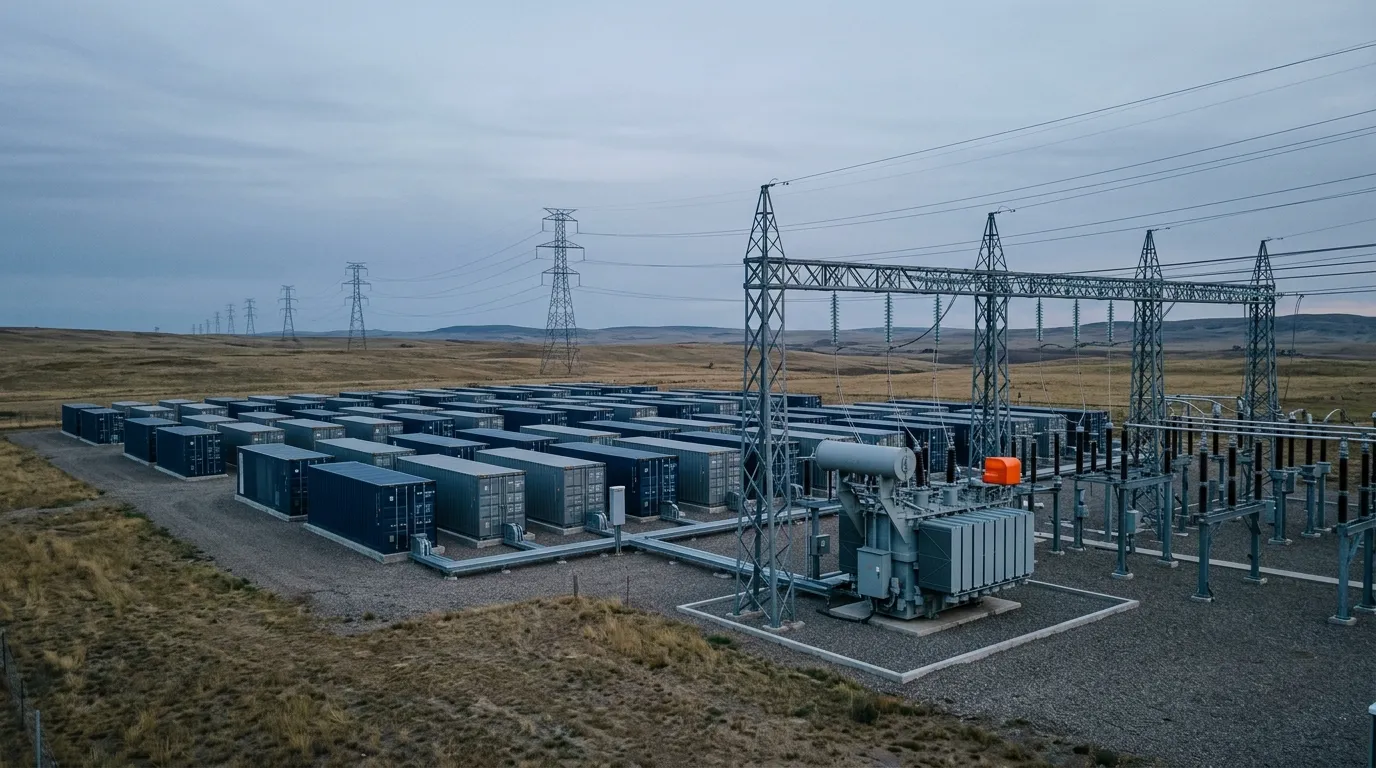
Public statistics rarely split the fleet by chemistry, and flow batteries remain a small share of the 8,842 MW and 11,105 MWh of utility-scale battery storage reported for the United States in 2022. The same department flags non-uniform performance data across projects as a problem its Rapid Operational Validation Initiative is meant to fix.
Projects, Suppliers and the Form Factors on Offer
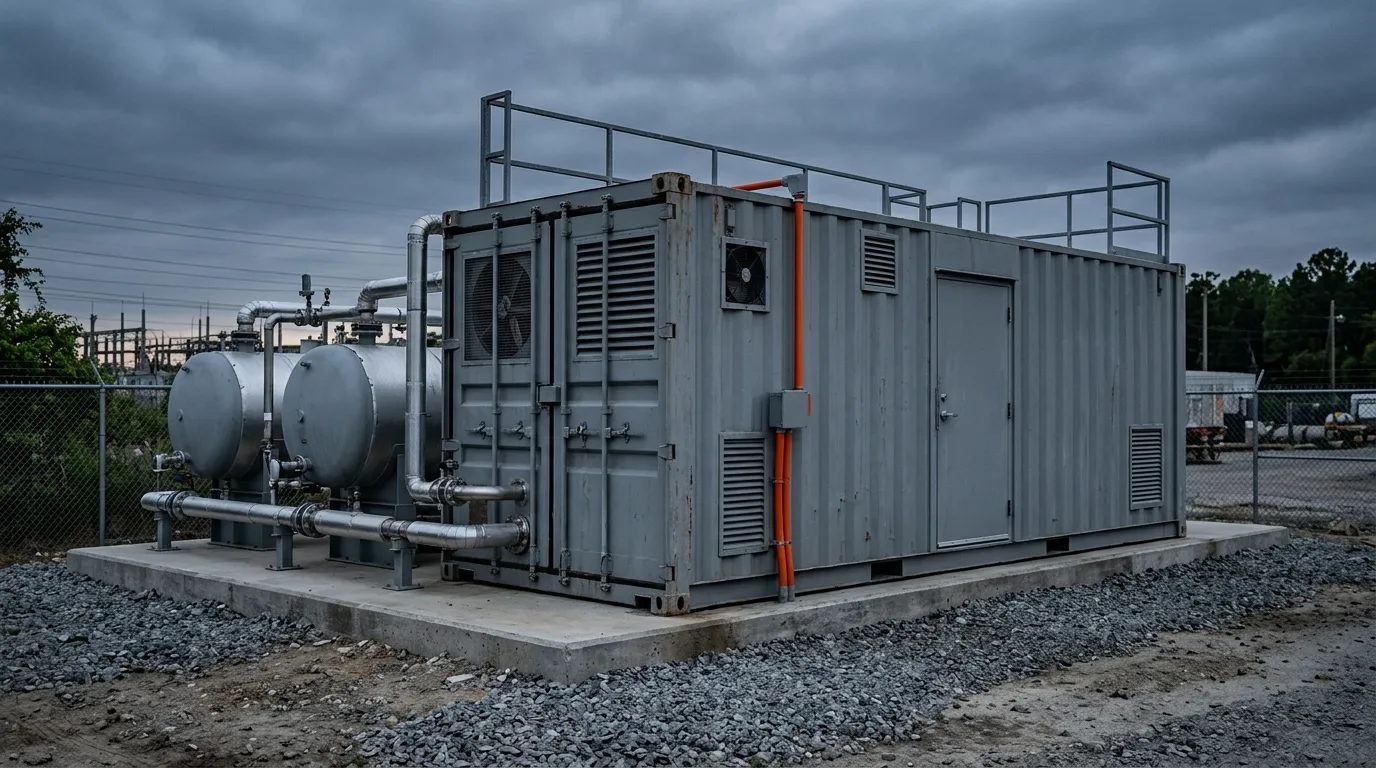
Dalian in China connected a 100 MW / 400 MWh vanadium system in October 2022, with a second phase taking it toward 200 MW / 800 MWh, and a 175 MW / 700 MWh project followed in 2024. Sumitomo Electric has built systems in Taiwan, Belgium, Australia, Morocco and California. A separate 1 MW containerized unit (3.2 MWh nameplate, 4 MWh vendor-stated maximum), owned by Avista Utilities and built by UniEnergy Technologies, was installed in 2015 at a utility in Pullman, Washington.
Form factor follows from the tanks. A flow battery arrives as a container or skid with separate tank modules, plus pipework, bunding and pumps — which means civil works, electrolyte containment, and a footprint per megawatt-hour. A project can therefore be staged: install the stack for the power you need now, and add electrolyte and tanks later, which is how utility-scale storage projects often build out.
Residential flow batteries exist, but electrolyte volume and code requirements make them a poor fit for most homes; a self-assembled cell is no substitute for an acid-handling, warranty-backed asset.
On supply, the market splits into vanadium specialists, chemistry challengers working with iron, zinc–bromine and organic molecules, and integrators who assemble cells, tanks and power conversion. Ask each for rated power and energy, AC-to-AC round-trip efficiency, parasitic load at idle, the year-ten augmentation plan, who owns the electrolyte, and the standards the installation is certified against.
Safety and the Standards That Apply
Flow batteries are often called safer than lithium-ion, and that holds as far as it goes: the electrolytes are not flammable, and the tanks can sit away from the stack, so a fault in the power conversion equipment does not have the same fuel load in one enclosure.
It does not change the paperwork. Stationary storage is governed by codes that apply regardless of chemistry, and NFPA 855 is the installation standard most U.S. projects are reviewed against (NFPA 855). A flow system also carries requirements a sealed cabinet does not: electrolyte containment and bunding, ventilation where bromine is involved, and acid-compatible pipework. Confirm the applicable edition and local amendments with the authority having jurisdiction.
How Hua Power Supports Long-Duration Storage Projects
Hua Power does not manufacture flow batteries, and this entry will not pretend otherwise. What we supply is the other half of a long-duration project: lithium-ion battery storage, power conversion and the controls that decide how a site is dispatched.
Hua Power is a battery energy storage system integrator founded in 2015 and headquartered in Shenzhen, with more than 400 projects deployed and annual production capacity above 2.4 GWh. Where a flow battery is the chosen long-duration asset, our scope is the shorter-duration layer around it: the fast power that covers interconnection limits and site auxiliaries, and the energy management layer that schedules both technologies against one set of rules. Where a project needs one technology, our energy storage container range is specified by usable energy, round-trip efficiency, cycle life and available power margin — the same four numbers this entry asks flow suppliers to quote.
The duration decision drives everything downstream, so settle it early: four evening hours needs one architecture, a windless week needs another. Contact us with the duty cycle and the grid connection, and we will tell you which part of the requirement sits with a flow battery supplier and which sits with the storage system.