
What a Battery Energy Storage System Is
A battery energy storage system (BESS) is a complete assembly — battery cells and racks, a battery management system, a power conversion system, thermal control, fire protection and site controls — that takes electricity from an AC source, holds it as chemical energy, and returns it to an AC bus on command, as one rated and certified unit. The word doing the work is "system": the cells set how much energy is inside the box, but the equipment around them decides whether that energy can be dispatched, measured, insured and permitted.
Most explanations stop at "a large rechargeable battery that stores grid electricity". That fails the first practical test, comparing two quotes. Two systems sold as 5 MWh can be different products: one counts energy at the cell terminals, the other where the plant connects; one includes cooling load in its efficiency figure; one ships certified, the other as components to wire on site.
Two quantities underpin the term, and they are not interchangeable. Power capacity is the maximum power the system can deliver continuously, in kW or MW. Energy capacity is the total energy it can store or discharge, in kWh or MWh (EIA). A BESS makes both true at once, at one connection point — which is why the sector quotes the pair.
Where the Battery Stops and the System Starts
A battery energy storage system is built from six levels, each carrying its own rating. Procurement confusion usually comes from quoting one level and comparing it with another.
Level | What is rated there | What it decides |
|---|---|---|
Cell | Capacity in Ah, voltage window, cycle life | Energy per kilogram, aging rate |
Module | Cells in series and parallel | Serviceability, fault behavior |
Rack | Series string, fuse, contactor | DC voltage, string isolation |
DC block | Racks, BMS master, thermal, fire protection | The DC energy figure |
AC block | DC block plus conversion, sometimes a transformer | Power at the AC terminals |
Plant | Blocks plus medium-voltage step-up and metering | What the offtaker or utility settles |
The DC-block figure almost always exceeds the AC-block figure on the same hardware, because it excludes conversion losses and the auxiliary load that keeps the enclosure alive. That explains most "identical capacity, different price" arguments in a tender. A container is only a delivery format for a DC or AC block — see containerized ESS for how that choice moves the responsibility line between supplier and installer.
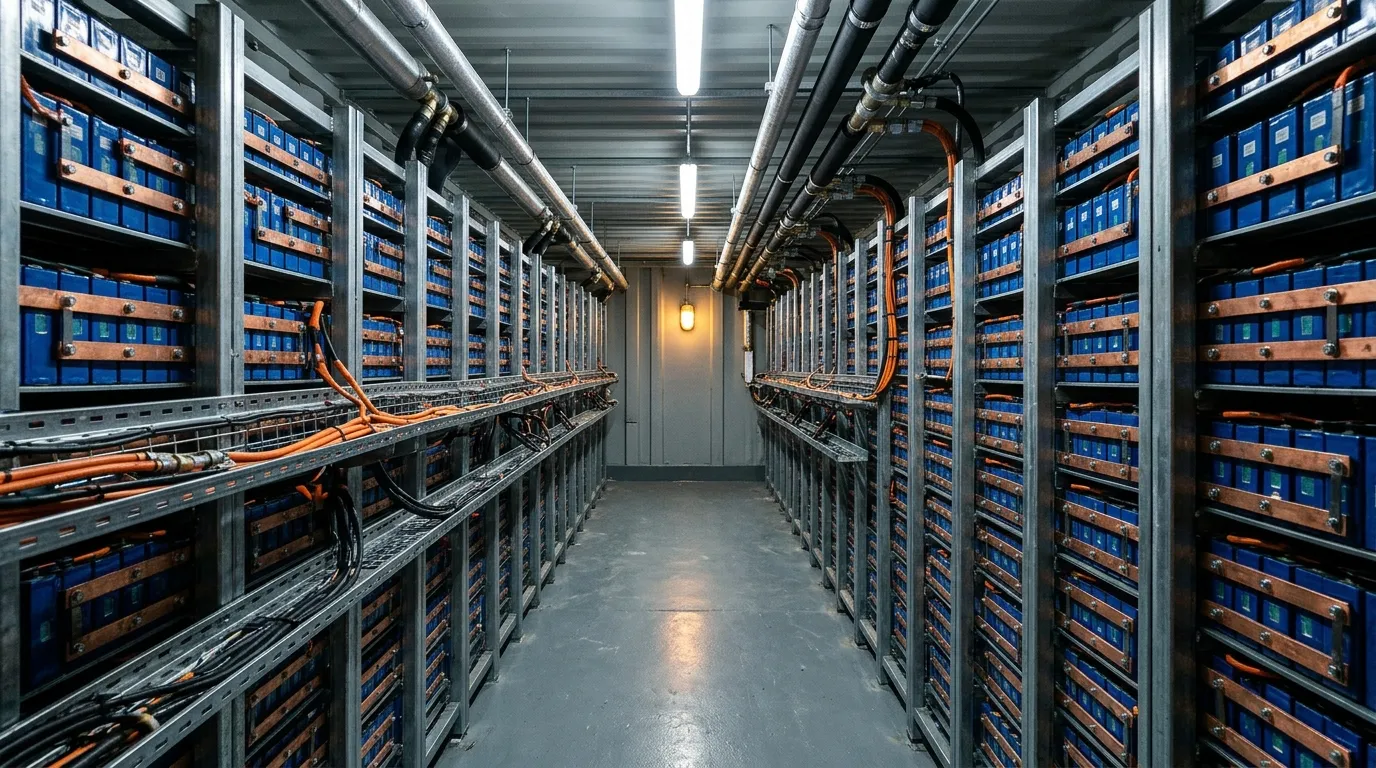
A DC block is racks, busbars and coolant pipework in one enclosure — the boundary energy is quoted against.
The Four Numbers a BESS Is Sold On
Four quantities carry the commercial offer, each hiding something specific.
Quantity | Unit | Measured where | What it hides |
|---|---|---|---|
Power | kW / MW | AC terminals, at a stated ambient | Derating above that temperature |
Energy | kWh / MWh | DC side, usable only inside a DoD window | Nameplate-to-usable gap |
Duration | hours | Energy divided by power | Whether the pair holds for the whole discharge |
Round-trip efficiency | percent | PCS terminals by default | Auxiliary load, measurement boundary |
Duration becomes a separate idea through simple arithmetic, and EIA illustrates it with two systems that each hold 2 MWh: one delivers 2 MW for seconds to minutes, the other less than 1 MW for four hours (EIA). Same energy, different machine, different market. A comparison that stops at the megawatt-hour figure is comparing tanks without asking about the tap.
Usable energy is the second trap. A warranty is written against a depth-of-discharge window and a temperature band, and energy outside that window is not energy the owner can sell (nameplate vs usable capacity). Battery energy storage system cost follows the same logic: a dollar-per-kilowatt-hour figure means nothing until it says whether it is DC or AC, nameplate or usable, and whether augmentation is included.
The Subsystems That Make It a System
The battery energy storage system components below turn a rack of cells into a dispatchable asset; each decides something the datasheet cannot.
- Battery and racks decide how much energy exists and how it degrades. Chemistry sets cycle life, format sets density; neither differentiates at system level any more.
- The battery management system (BMS) decides whether a fault is caught while it is still a data point: cell voltage, temperature and insulation monitoring, balancing, and the authority to open a contactor.
- The power conversion system (PCS) decides power rating, response time and grid behavior. It has a power rating and no energy of its own, which is why a converter is not a BESS (power conversion system).
- Thermal management decides whether the temperature spread across a rack stays inside the band the warranty assumes. Cells age at the rate of their hottest neighbor, so holding the average but not the spread still shortens life.
- Fire detection and suppression decides how the unit behaves in a failure: gas detection, per-rack suppression, deflagration venting, and the separation distances that follow.
The energy management system sits above all five, scheduling dispatch against tariffs and operator signals and owning the reporting settlement runs on. Excellent hardware with a thin EMS is a battery that cannot prove what it did.
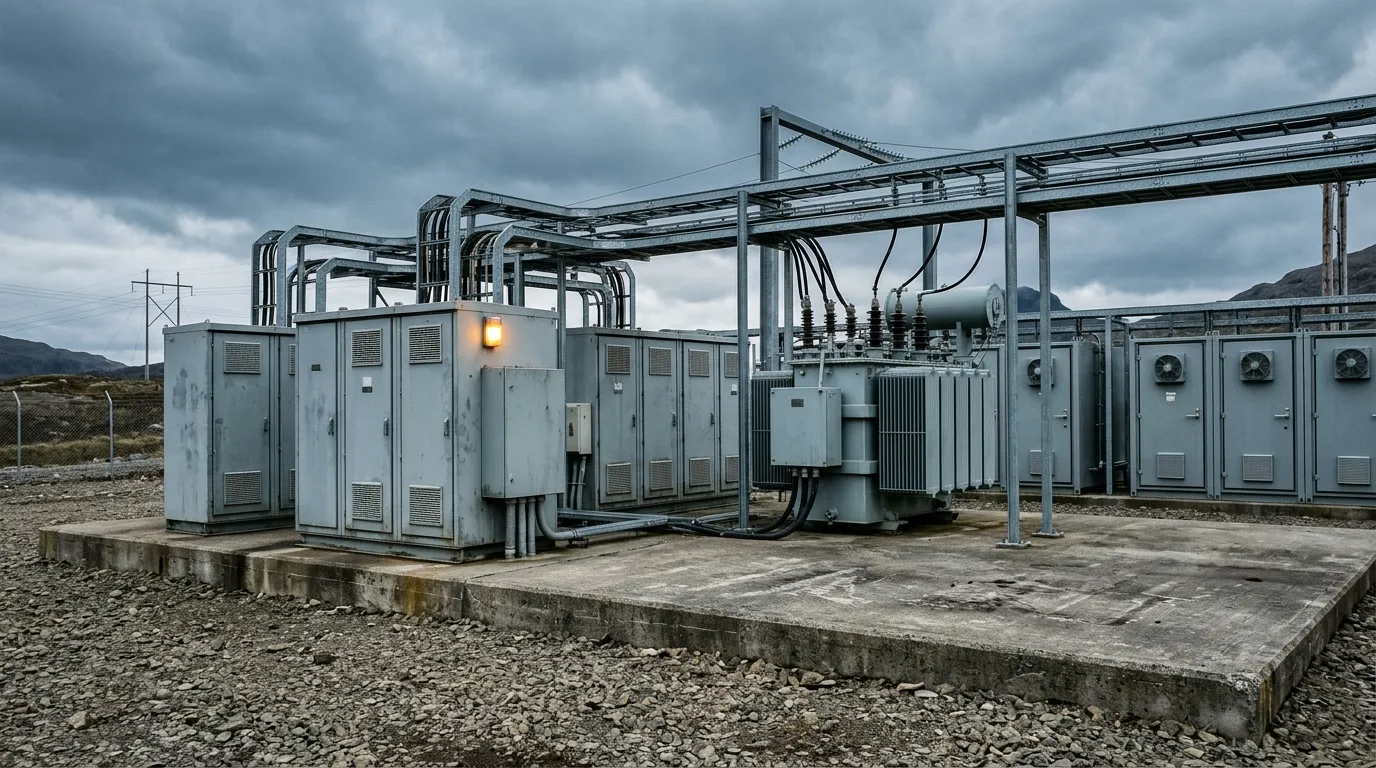
Conversion and step-up sit between the DC block and the grid; the transformer often marks where a supplier's scope ends.
How One Cycle Moves Through the Plant
Charging starts at the point of interconnection. AC arrives at the transformer, drops to the converter's voltage, and the PCS rectifies it onto a DC bus held in the low-kilovolt range by series strings of modules. Current enters the cells as chemical energy while the BMS holds each string inside its voltage and temperature limits. Discharging reverses every step, and the plant exports at the setpoint the controller asked for.
Losses appear at each step, which is why efficiency needs a boundary rather than a number. There is conversion loss in the PCS both ways, resistive loss in cabling and busbars, and a continuous auxiliary load — pumps or fans, controls, heaters in cold climates — that runs whether the plant is charging, discharging or idle. A figure taken at the converter terminals always beats one taken at the revenue meter; round-trip efficiency is the name for the end-to-end version, and the only version an owner can bank.
The control path is short but not instant. Telemetry reaches the BMS, the BMS reports to the energy management system, the EMS sends a setpoint, and the PCS ramps. Each link has a scan rate and a deadband. For a fast-response product, the number that matters is the time from measurement to delivered power at the meter.
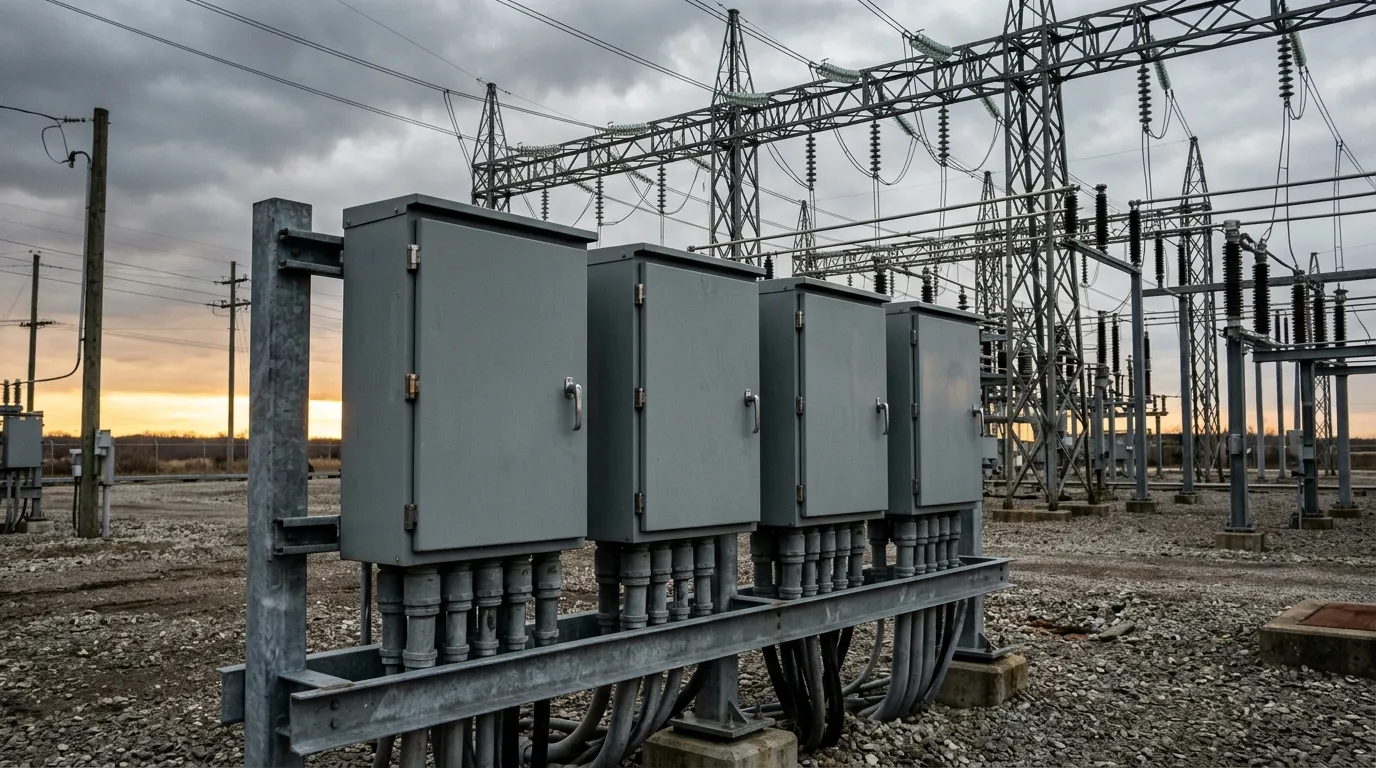
Settlement happens at the revenue meter, not at the converter; that distance is where efficiency figures diverge.
Duration Decides the Application, Not the Chemistry
EIA splits storage into short-duration systems, measured in minutes and power-oriented, and diurnal systems, measured in hours and energy-oriented. That split maps onto what a buyer is trying to do. One to four hours covers evening load shifting, peak shaving, demand-charge management and frequency response. Beyond that window the same hardware competes with technologies whose cost scales differently, and grid-scale battery storage becomes a different procurement conversation.
The installed fleet shows how narrow the current answer is. At the end of 2022, utility-scale battery storage in the United States totaled 8,842 MW of nameplate power capacity against 11,105 MWh of energy capacity (EIA). Divide one by the other and the average system held about 1.3 hours at full power. The largest single battery is the 409 MW Manatee Solar Energy Center in Florida, in service since November 2021. Both figures are nameplate and fleet-wide; they show that the market cleared at a short duration.
Chemistry is not the variable here. Most new grid projects use lithium iron phosphate, but swapping chemistries does not change the duration a project needs, the interconnection it must pass, or the way its energy is measured; that is a chemistry argument, not a system one.
The Standards Layer That Certifies the Boundary
The clearest evidence that a BESS is a system rather than a pile of parts is that certification is written at system level. UL 9540 is the listing for an energy storage system and its equipment as an assembly (UL 9540); UL 9540A is the test method for how thermal runaway propagates in that assembly, and its results justify the separation distances a site is permitted with (UL 9540A). NFPA 855 governs the installation — siting, separation, detection and suppression requirements that follow tested behavior rather than a datasheet (NFPA 855).
Below that sit the component standards: IEC 62619 for industrial lithium cells, IEEE 1547 and UL 1741 for the converter's interconnection function. A supplier can hold every component certificate and still fail a system listing, so the useful question is not what each part carries but who holds the system certificate, and against which edition.
The safety record is improving as deployment grows. EPA's 2025 guidance notes that despite high-profile incidents, improvements in quality and design have reduced failure incidents per gigawatt-hour deployed (a figure it sources to EPRI), while still recommending an isolation zone of at least 330 feet for a large commercial system during an incident (EPA). The risk is real enough to shape site layout, and it is falling as a rate rather than rising with capacity.
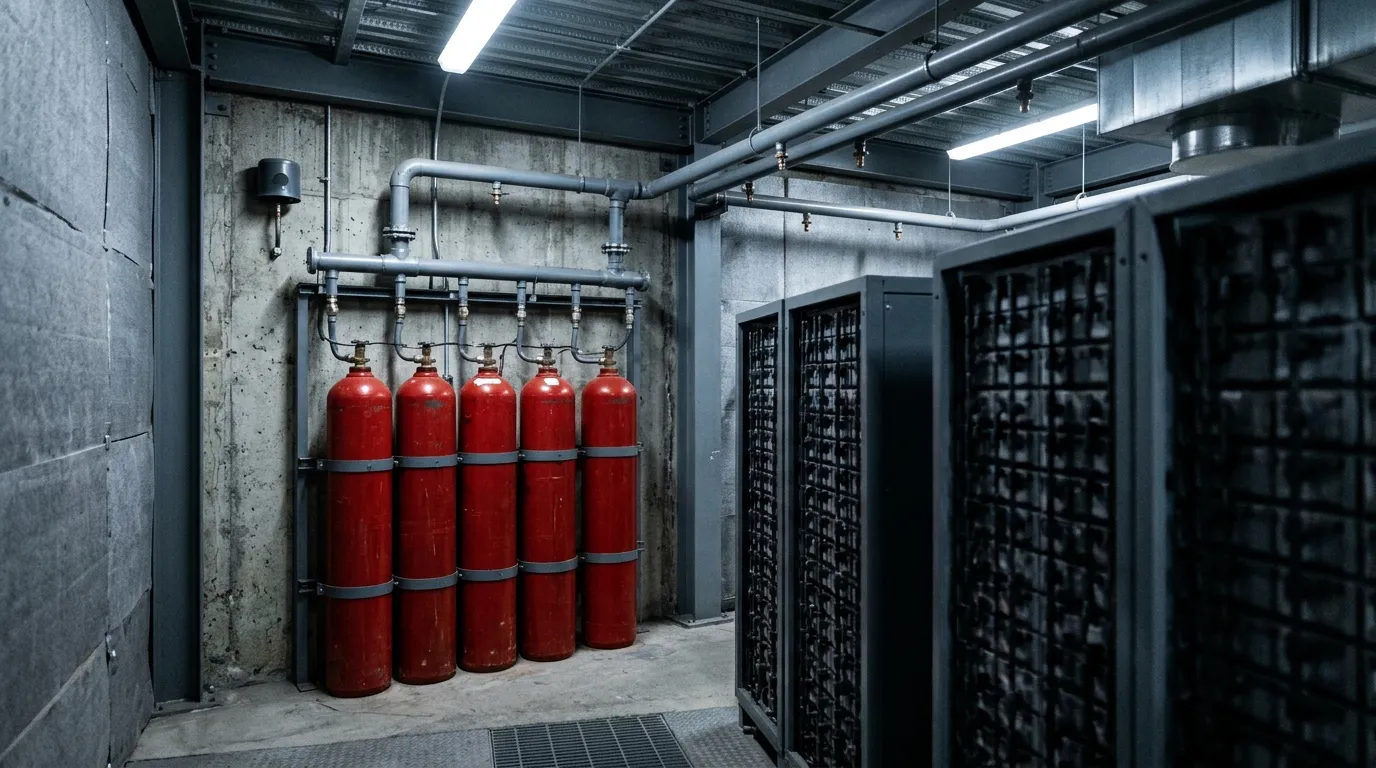
Detection and suppression inside the boundary are what a system listing is tested against.
What a BESS Is Not
Five confusions account for most mismatched expectations in early project meetings.
It is not a battery pack. A pack has cells, a case and a monitoring board: no grid interface, no energy management, no system certificate.
It is not a PCS product. A converter carries a power rating and a grid behavior, and stores nothing. Pairing it with batteries is what creates a system.
It is not a UPS. An uninterruptible power supply rides through outages for minutes at high availability. A BESS is built for repeated cycles and energy throughput; sizing one like the other yields an overbuilt UPS or an unreliable plant.
It is not a virtual power plant. A VPP is a commercial and control layer aggregating many small resources. A BESS is one of the resources it may aggregate.
It is not a container. Container, cabinet and skid are delivery formats; the same boundary can arrive in any of them.
How Hua Power Draws the System Boundary
Because the boundary is the product, it has to be stated before it can be quoted. We describe a system on five lines, all taken at the AC terminals: the power it delivers for a stated duration at a stated ambient temperature; the energy usable inside the warranty's depth-of-discharge and temperature window; round-trip efficiency including auxiliary load; the standards the assembly is listed to, with editions; and what is inside the delivery — converter, transformer, energy management and fire protection, or not.
That framing lets a cabinet, a split-cabinet system with the converter outside the battery enclosure, and a containerized unit be compared honestly, since each moves a different amount of equipment inside the line. It also keeps a tender from comparing a DC figure against an AC figure and calling the difference a price gap. For systems in front of the meter, the same five lines carry through to utility-scale energy storage, where the interconnection sets the schedule as well as the cost.