
UL 9540 is the product safety standard for complete energy storage systems. Officially the ANSI/CAN/UL Standard for Energy Storage Systems and Equipment, it certifies the battery cells, battery management system, inverter, enclosure, and controls as one integrated system — not as individual parts. Fire marshals, insurers, and interconnecting utilities treat a UL 9540 listing as the baseline proof that a battery energy storage system (BESS) is safe to install.
If you are buying or integrating battery storage for a commercial, industrial, or utility project in North America, this single document sits behind most permitting conversations. Understanding what the certificate covers — and what it does not — is the difference between a smooth plan review and a project stalled on a missing document.
What Is UL 9540?
UL 9540 is a product safety standard published by UL Standards & Engagement, the standards body behind the UL mark. The current edition is the third, published in 2023, and it carries the ANSI/CAN dual designation — meaning it is recognized as a national standard in both the United States and Canada. The standard's scope covers energy storage systems for stationary indoor and outdoor installations, as well as mobile energy storage.
The defining principle of UL 9540 is that certification applies to the system, not the parts. The standard requires that "the energy storage system shall be constructed either as one unitary complete piece of equipment or as matched assemblies that, when connected, form the system." A cell, a battery pack, or an inverter on its own is not a UL 9540-listed energy storage system. Only when the components are engineered, integrated, and evaluated as one unit does the listing exist.
That system-level view is why the standard spans every storage technology — electrochemical (lithium-ion, lead-acid), chemical, mechanical (flywheels, compressed air), and thermal. In the B2B market, lithium-ion dominates, but the standard itself is technology-neutral.
What Does UL 9540 Cover?
A UL 9540 evaluation looks at the integrated system across three hazard domains: electrical (wiring, protection, fault handling), mechanical (enclosure strength, thermal management, hazardous moving parts), and thermal (heat generation, thermal runaway containment, fire response). It also covers controls, signage and instructions, piping, and utility grid interaction — including walk-in enclosures large enough to enter for service.
Rather than re-testing every component from scratch, UL 9540 references component-level standards that are evaluated as part of the system certification. The UL Solutions energy storage testing and certification page lists the key ones: UL 1973 for batteries used in stationary applications, UL 1741 for inverters, converters, and controllers, IEEE 1547 for grid interconnection, plus NFPA 70 and other codes depending on configuration.
This is the architecture buyers should understand: the battery management system (BMS), the inverter, and the cells each have their own safety pedigree, and UL 9540 is the layer that proves they work safely together.
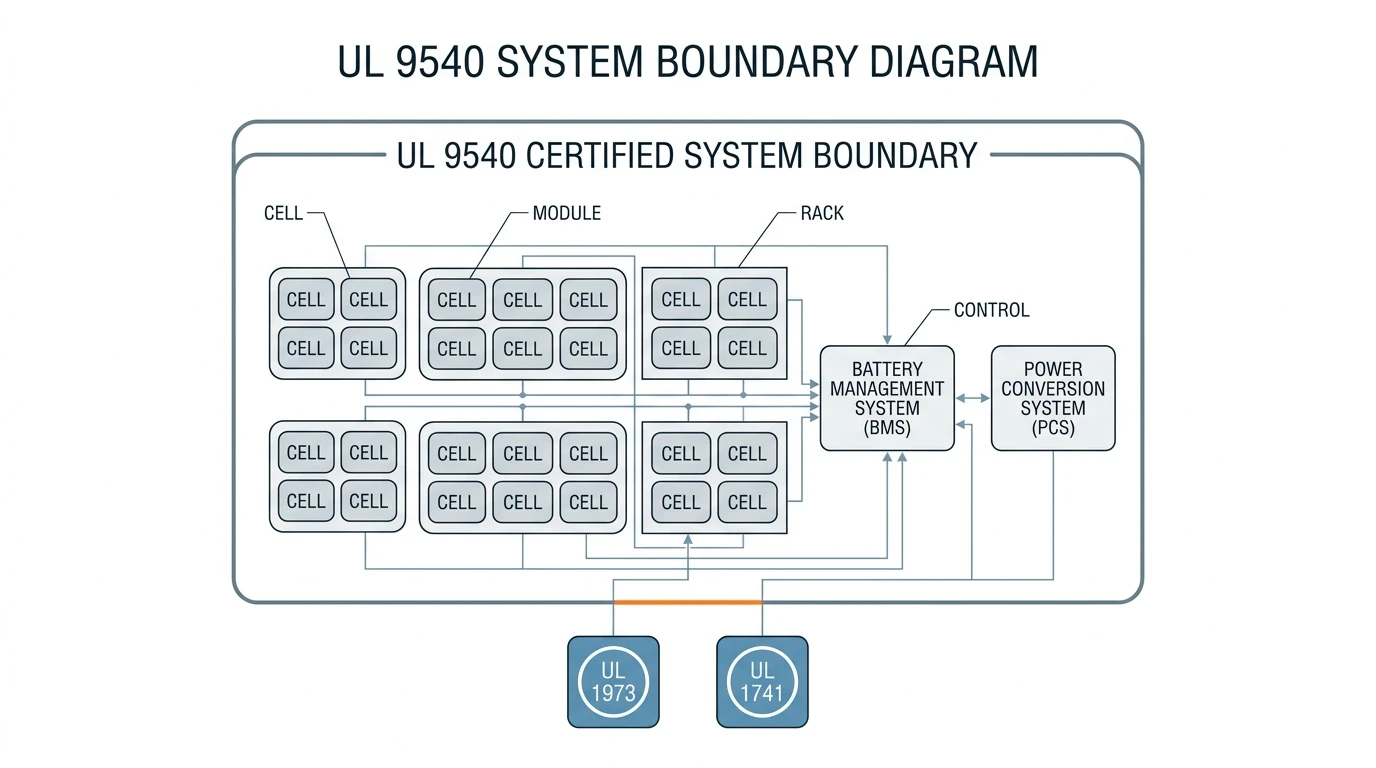
Image: UL 9540 certifies the complete system — individual components have their own standards (UL 1973 for batteries, UL 1741 for inverters).
Why UL 9540 Certification Matters for BESS Buyers
The practical weight of UL 9540 comes from the codes and approval processes that reference it. The most important is NFPA 855, the U.S. installation standard for stationary energy storage: it requires any lithium-ion system above 20 kWh of stored energy to be certified to UL 9540. Almost every commercial and industrial BESS clears that threshold, which makes the listing effectively mandatory for the market.
Three parties check the certificate in practice:
- The authority having jurisdiction (AHJ) — your local fire marshal or building official reviews it during plan review and permitting.
- Your insurer — underwriters price coverage against the documented safety evidence, and a missing listing can change whether a project is insurable at all.
- Your interconnecting utility — interconnection agreements increasingly reference the safety certification as a condition of grid connection.
The reason the standard exists is thermal runaway: a lithium-ion cell can generate heat faster than it sheds it, igniting neighboring cells and escalating into a rack-wide fire. UL 9540 is the product-level barrier that says a system's electrical, mechanical, and thermal protections have been tested as an integrated whole — which is exactly what the permitting chain wants to see before the system is energized.
UL 9540 vs UL 9540A vs UL 1973: Which Standard Is Which?
The standards in this space are routinely confused, and the difference decides which document proves what. This is the highest-frequency question in every search on the topic, so here is the full picture:
Standard | Type | What it covers | What it does NOT do |
|---|---|---|---|
UL 9540 | Product safety standard / listing | The complete ESS as an integrated system — electrical, mechanical, thermal safety | Does not certify individual cells or components on their own |
UL 9540A | Test method | Thermal runaway fire propagation, tested at cell, module, unit, and installation level | Not a pass/fail product listing by itself; it generates data |
UL 1973 | Component standard | Battery modules and packs for stationary applications | Does not cover the inverter, enclosure, or system integration |
IEC 62619 | International standard | Safety of industrial lithium cells and battery packs | Not a U.S. or Canadian system listing; AHJs do not accept it in place of UL 9540 |
UN 38.3 | Transport regulation | Safe shipping of lithium batteries | Nothing to do with installation or operation safety |
NFPA 855 | Installation / fire code | Siting, separation distance, detection, suppression at the site | Not a product certification |
The relationship between the two UL documents matters most: UL 9540A is the test method that measures how far a fire propagates when a cell goes into thermal runaway. UL 9540 references it — for larger systems, acceptable UL 9540A test results are a condition of the listing. But the reverse is not true: good UL 9540A results do not automatically make a system UL 9540-listed. One is the fire test, the other is the full system certification. For a concrete look at what 9540A testing involves on a real product, see our walkthrough of UL 9540A testing on a battery cabinet.
How UL 9540 Certification Works
Getting a UL 9540 listing is a factory-and-test process, not a paperwork exercise. The components are first evaluated against their referenced standards — UL 1973 for the battery, UL 1741 for the inverter, and so on. The integrated system is then tested as a whole, including charge and discharge cycling, fault conditions, and thermal stress.
Where the testing happens matters for buyers: for containerized energy storage systems, the system is often assembled at an integrator's facility or even at the end customer's site, and UL conducts the evaluation and inspection there. The manufacturer's listing is extended to that site as a temporary manufacturing location, and the UL label is applied to the finished system.
Two capacity rules from the current edition shape system design. Individual nonresidential electrochemical systems above 50 kWh — or units installed with less than 3 ft of separation — must meet UL 9540A fire-test performance criteria to qualify for listing, per the standard text. In practice this means a container or a large cabinet needs strong propagation-test data to be listed at all; that is why UL 9540A reports appear so often in procurement conversations.
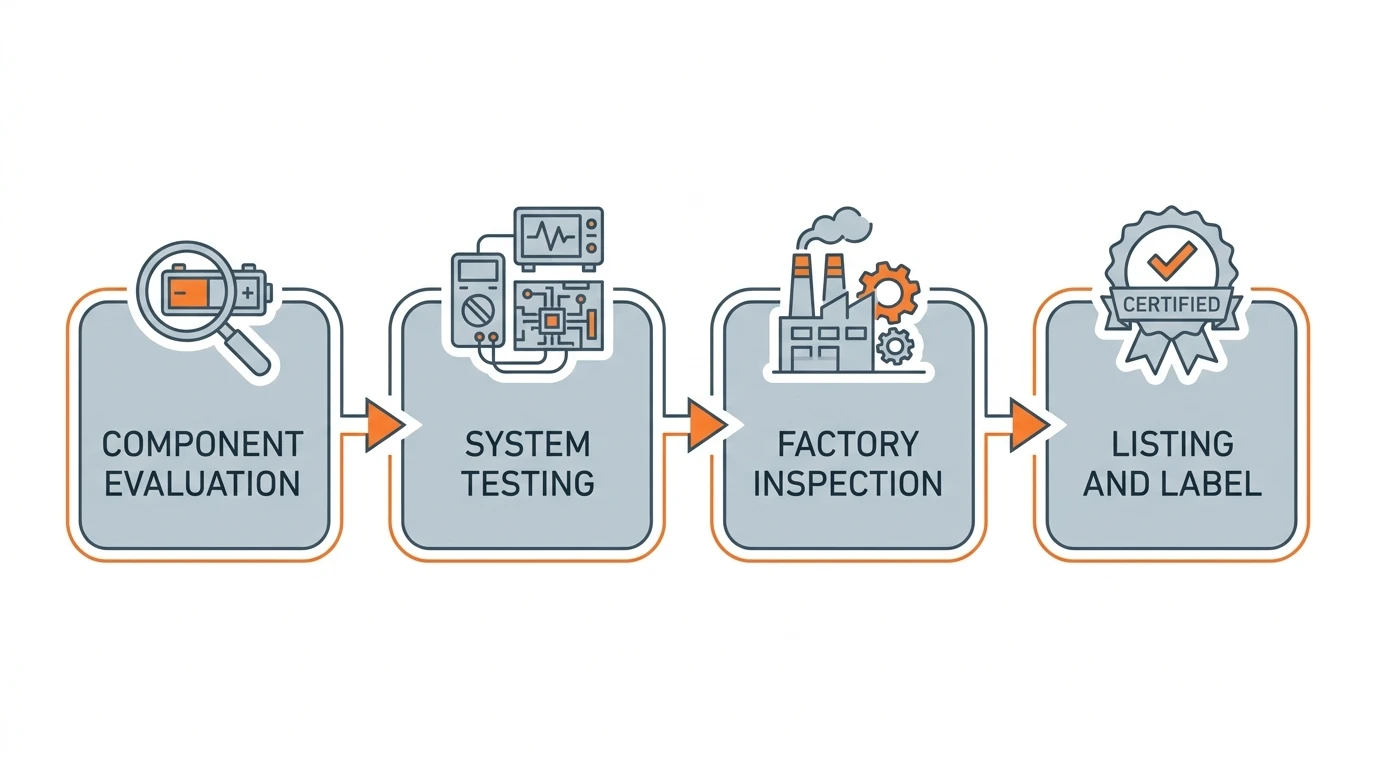
Image: certification moves from component evaluation to integrated-system testing, then on-site inspection and listing.
Finally, a listing is not a one-time stamp. UL performs periodic follow-up inspections at the manufacturing site to confirm the listed configuration still meets the standard, and any change to the system's design can require re-evaluation. When a supplier's product line grows, the certificate does not automatically grow with it — a point that matters for the verification steps below.
UL 9540 vs NFPA 855: Product Standard vs Installation Code
UL 9540 and NFPA 855 answer two different questions, and they work as a pair. UL 9540 asks: is this product safe as built? NFPA 855 asks: is this installation safe at this site? The product certificate proves the first; the fire code governs the second — separation distances, fire detection and suppression, ventilation, and explosion control.
They connect through the 20 kWh threshold mentioned earlier: because NFPA 855 requires UL 9540 certification for lithium-ion systems above that size, UL 9540 compliance is baked into the permitting pathway for nearly every commercial BESS. And UL 9540A fire-test data — the propagation results generated during certification — is the evidence AHJs use to apply NFPA 855's spacing rules. Product standard, test method, and installation code form a chain: the certificate proves the system, the test data sizes the safeguards, and the code governs the site.
How to Verify a Supplier's UL 9540 Claim
"UL 9540 certified" appears on datasheets everywhere, but the claim is only as good as the document behind it. Before you commit, ask for and check these six things:
- The certificate itself. A genuine UL certificate names the manufacturer, the standard, the product, and a certificate number. A marketing page that says "certified" is not evidence — the certificate is.
- The scope of the listing. Certificates cover specific models and configurations. A listing for a 100 kWh cabinet does not cover a 200 kWh version or a different inverter pairing. Match the certificate to the exact configuration you are buying.
- The UL Product iQ directory. UL's public certification database lets you look up a company's listings directly. If the supplier's model number is not there, the claim is not verifiable.
- UL 9540A test reports. Ask for the propagation data covering your configuration — ideally cell, module, and unit level. This is also the document your AHJ will want for spacing decisions.
- Ongoing compliance. Ask how design changes are handled — whether new configurations are re-listed and whether follow-up inspections are current.
- The AHJ's requirement. Confirm with your local authority which edition it enforces and which documents it wants in plan review, since adoption varies by jurisdiction.
The same discipline applies across your whole procurement, not just certification documents: a structured BESS procurement guide covers how to evaluate vendors end to end.
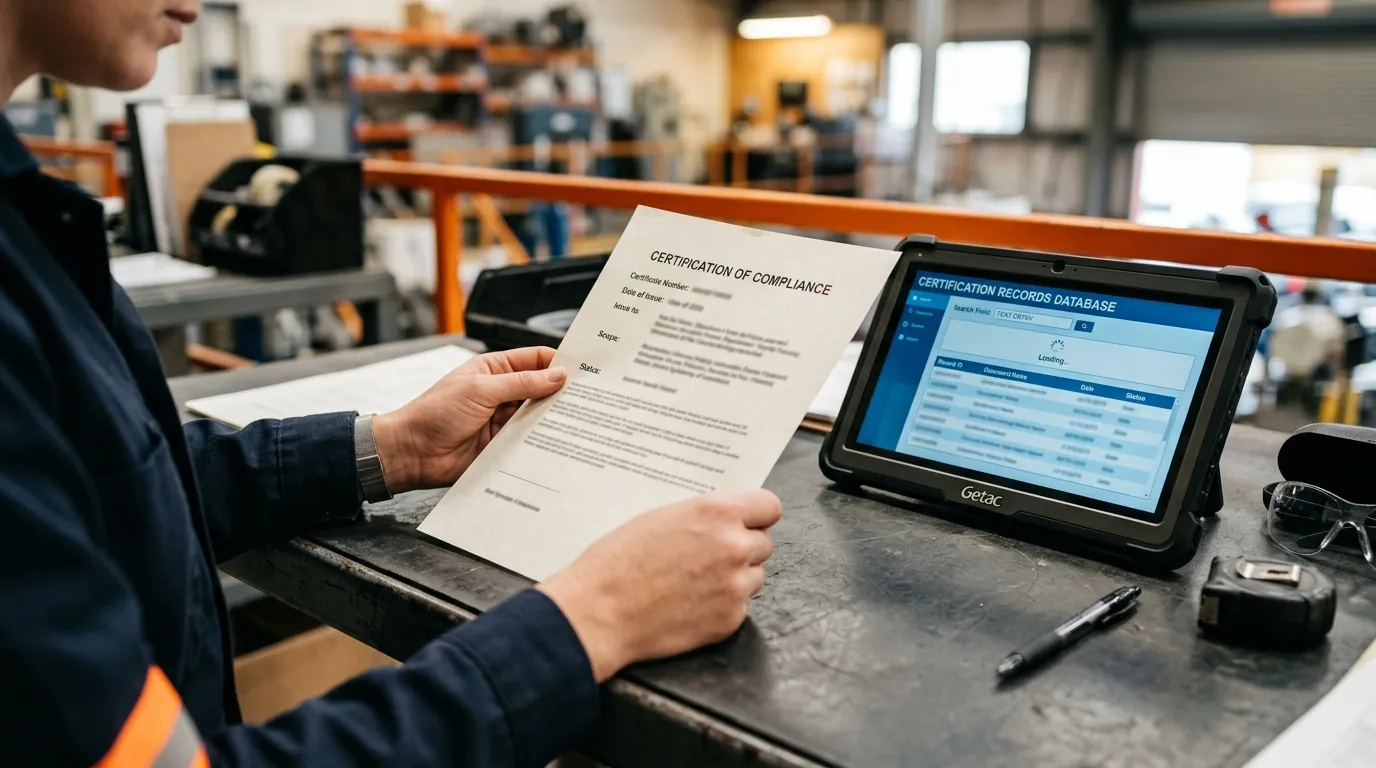
Image: verification means checking the certificate, its scope, and the listing database — not trusting the marketing page.
How Hua Power Builds UL 9540-Ready Energy Storage Systems
Hua Power designs storage for the U.S. and European markets, which means certification evidence is engineered in from the start rather than chased at permitting time. Our C&I battery storage cabinets and containerized systems pair cell-level protection with multi-layer safety — thermal warning algorithms, gas detection, aerosol and FK-5-1-12 fire suppression, and deflagration venting — so the system architecture supports the fire-test data and documentation package buyers need for AHJ review.
When you evaluate any supplier, UL 9540 is the first document to ask for — and the verification steps above are the same ones we expect buyers to apply to us. If you are sizing a project and want to talk through certification requirements, our engineering team is available to walk through what the standard means for your configuration and what evidence to demand from any vendor.