
NFPA 855 is the U.S. fire code for stationary battery energy storage. Officially the Standard for the Installation of Stationary Energy Storage Systems, it sets the minimum requirements for siting, separation distance, fire detection and suppression, ventilation, and explosion control. First published in 2020 and revised on a three-year cycle, its current edition is 2026.
If you are buying, integrating, or permitting a battery energy storage system in the United States, this standard is the compliance baseline. Your fire marshal, your insurer, and your interconnecting utility will all check it — usually before anything else.
What Is NFPA 855?
NFPA 855 is a consensus standard published by the National Fire Protection Association. It covers the full lifecycle of a stationary energy storage system — design, installation, commissioning, operation, maintenance, and decommissioning — with the stated purpose of mitigating the hazards associated with energy storage systems.
The standard applies by chemistry and stored energy, not by project type. For lithium-ion, an aggregate stored energy of 20 kWh or more triggers the full requirements; valve-regulated lead-acid crosses the threshold at 70 kWh. Below those levels a system may fall outside the standard's requirements entirely, though the authority having jurisdiction (AHJ) makes the final call.
That scope is why the code matters to nearly every storage buyer: a residential home battery, a commercial cabinet, and a utility-scale container all clear the thresholds, so the same framework governs them all.
Why NFPA 855 Matters for BESS Projects
The standard exists because lithium-ion storage introduced a fire hazard that older fire codes did not address. Thermal runaway — a cell generating heat faster than it can shed it, then igniting its neighbors — can turn a single failed cell into a rack-wide event. Battery fires are no longer rare enough to ignore: New York City recorded lithium-ion battery fires rising from 30 in 2019 to 268 in 2023, according to FDNY data reported by the New York Post, and utility-scale incidents have triggered evacuations and damage claims.
NFPA 855 is the answer at the installation level. It is not a law by itself — it gains force when a jurisdiction adopts it, typically through NFPA 1 or the International Fire Code, which jurisdictions across most U.S. states have adopted. In practice, the AHJ enforces it, insurers underwrite against it, and interconnection agreements reference it. A project without a defensible compliance story stalls at permitting.
Key NFPA 855 Requirements
The code organizes its requirements around the failure chain of a thermal event. Every control targets one stage:
Requirement | What it targets |
|---|---|
Separation and spacing | Distances between battery units and between the system and structures, property lines, and other exposures — giving a failing unit room to burn without igniting its neighbors |
Fire detection | Smoke, gas, or thermal detection inside the enclosure, wired to alarm and response |
Fire suppression | Suppression systems sized to the installation, designed to cool cells and interrupt the cascade before it propagates |
Ventilation | Exhausting flammable gases before they reach dangerous concentrations |
Explosion control | Deflagration venting or prevention for enclosed spaces where gas can accumulate |
Documentation | Safety data sheets, commissioning plans, and maintenance manuals — enforceable deliverables; missing them can halt plan review |
Two capacity figures from the 2023 edition still shape many projects: 50 kWh per group or array before extra separation applies, and 600 kWh per fire area inside occupied buildings, above which dedicated battery rooms and emergency power-off circuits are typically required. The 2026 edition reworks how these limits interact with hazard analysis — covered below.
Container-scale systems implement the same layers at rack and enclosure level: rack-level fire suppression, container-level gas detection, and explosive venting with emergency power-off circuits. See how containerized BESS enclosures are built around them.
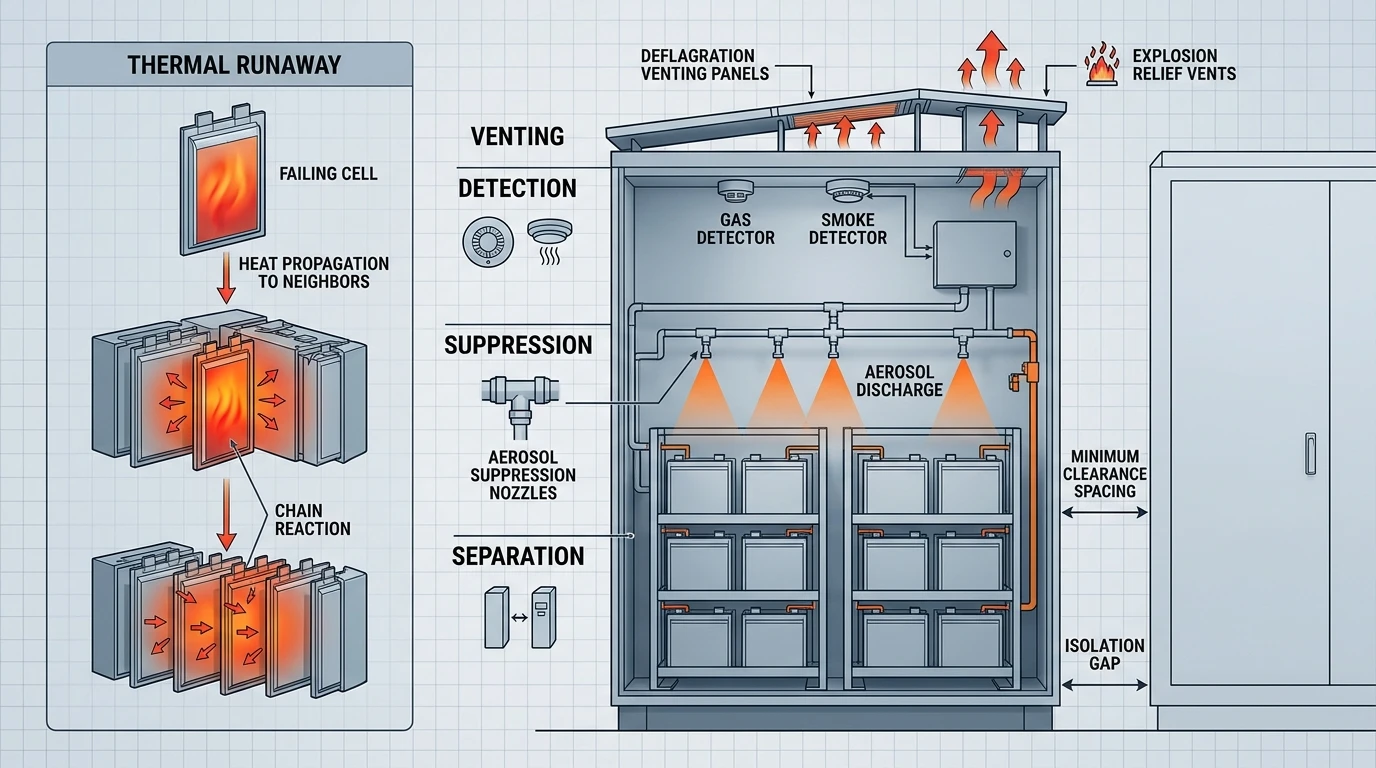
Image: each NFPA 855 requirement targets a different stage of the thermal runaway chain.
NFPA 855 Separation Distance Rules
Separation distance is the requirement that most directly changes site layout. Under the 2023-edition framework still enforced by most jurisdictions, the default separation between ESS units is 3 ft — and between the system and exposures such as buildings and property lines, larger distances apply. What makes the rule workable is the escape hatch: where UL 9540A test data demonstrates limited thermal runaway propagation, the AHJ can grant reduced distances.
That is the single most useful fact for a buyer: a container or cabinet with solid UL 9540A installation-level test data is not just a safer product, it is a product that frees up real estate and simplifies siting. Units without that data face the full prescriptive distances, which can push a project outside its available footprint.
Indoor systems follow a parallel set of rules: above the capacity thresholds, dedicated battery rooms with explosion venting and emergency power-off take the place of outdoor spacing. Outdoor arrays, by contrast, live or die by their site layout — which is why separation distances are usually the first item a fire marshal checks in plan review.
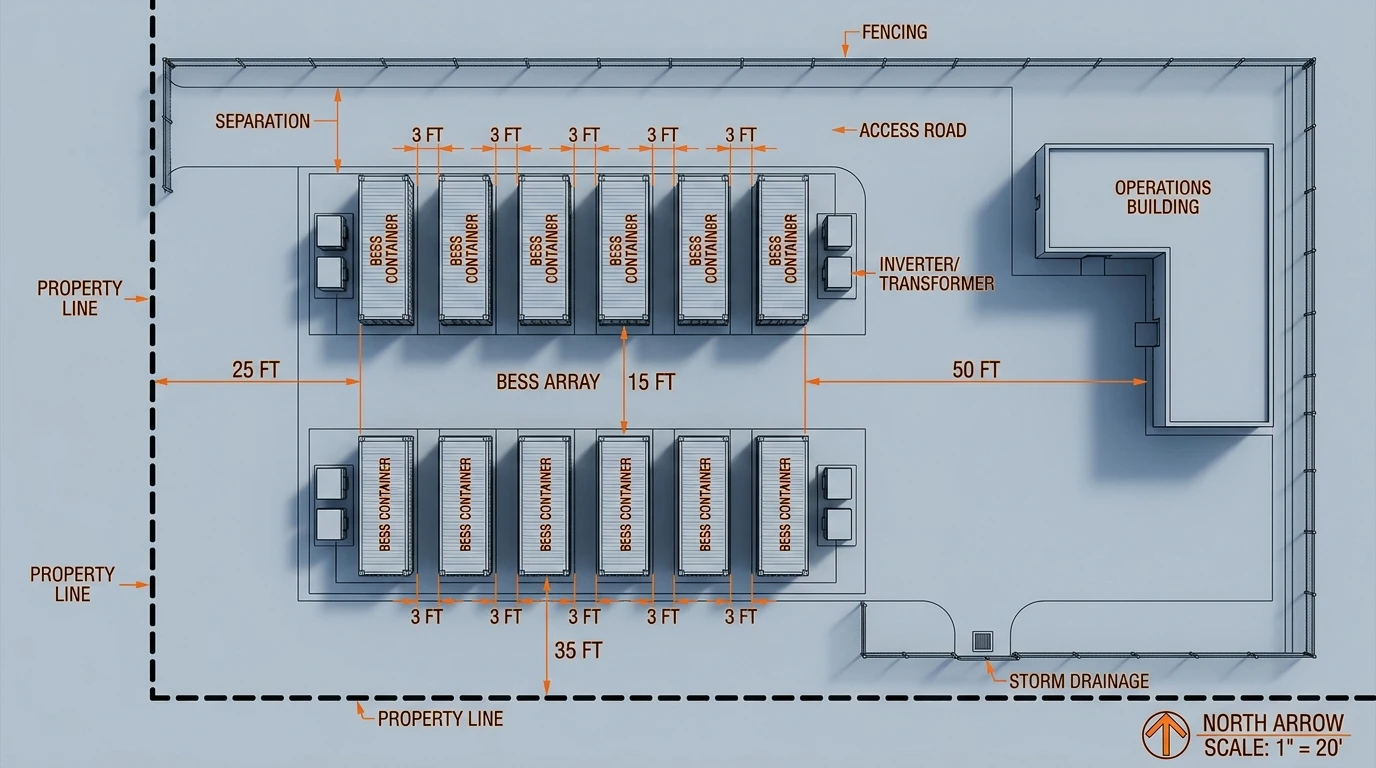
Image: separation distances scale with stored energy and are reduced where UL 9540A data supports it.
NFPA 855 vs UL 9540 vs UL 9540A: Who Regulates What
Buyers routinely confuse the three standards in this space, and the difference decides which document proves what:
Standard | Type | What it covers | Who uses it |
|---|---|---|---|
NFPA 855 | Installation/fire code | Siting, separation, fire protection, ventilation, explosion control | AHJ, fire marshal, permitting |
UL 9540 | Product safety listing | The complete energy storage system — electrical, mechanical, thermal safety | Third-party certifiers, AHJ, buyers |
UL 9540A | Test method | Thermal runaway fire propagation at cell, module, unit, and installation level | Test labs, engineers sizing spacing and suppression |
NEC Article 706 | Electrical code | Electrical installation of energy storage systems | Electrical inspectors |
They form a chain, not alternatives. UL 9540 is the product-level certification for a complete ESS. UL 9540A is the test method that measures how far a fire propagates; its results are the engineering basis the AHJ uses to apply NFPA 855's spacing and suppression rules. A supplier's UL 9540A report is therefore the document that connects product testing to installation approval — see our walkthrough of what a UL 9540A battery cabinet actually proves.
What Changed in the 2026 Edition
The 2026 edition, published in fall 2025, is the most significant revision since the standard's debut. Five changes matter most to project teams:
- Hazard Mitigation Analysis (HMA) is now the default. Earlier editions let a project exceed prescriptive limits under a maximum stored energy cap in Chapter 9; the 2026 edition removed that cap. If your system crosses the applicability threshold, an HMA is required — with limited exceptions for well-understood chemistries such as lead-acid.
- A licensed professional leads the risk assessment. Annex G now specifies that the HMA must be directed by a registered design professional — a licensed PE with fire protection and energy storage experience.
- Thermal Runaway Propagation Prevention (TRPP) systems are required. A new active safety layer (Section 9.7.6.6), TRPP detects early precursors — off-gassing, abnormal temperature — and triggers a targeted suppression or cooling response. Passive spacing and barriers alone no longer count.
- Large-scale fire testing joins UL 9540A testing. Section 9.2.1.2 requires unit-level fire testing under real-world conditions, witnessed by an accredited lab, proving a single-unit fire does not spread to adjacent units.
- New requirements around emergency response and power. A formal Emergency Response Plan with annual review and training, and backup power for critical safety systems (detection, suppression, ventilation controls) under NFPA 110/111.
The edition also adds chapters for flow batteries and marine installations, expands detection options to include smoke, thermal imaging, and radiant-energy detection per NFPA 72, and allows batteries stored temporarily at 50% state of charge or below to skip full Chapter 14 compliance.
One caution before you design to the new edition: the 2026 changes, as summarized by fire-protection engineers, are not yet what every jurisdiction enforces. The 2024 International Fire Code still references the 2023 edition, so confirm with your AHJ which edition governs your permit today.
How Buyers Verify NFPA 855 Compliance
NFPA 855 compliance is not a sticker on a datasheet — it is a set of documents, and most of them are the supplier's to provide. When you evaluate a BESS vendor, ask for these five:
- UL 9540 certificate — proof the complete system carries a product-level safety listing.
- UL 9540A test report — the propagation data covering your configuration (cell, module, and installation level).
- Hazard Mitigation Analysis — for 2026-edition projects, the documented risk assessment led by a licensed PE.
- Commissioning report — evidence the installed system performs as designed.
- Emergency Response Plan — the plan your site team and local fire department will operate under.
Is NFPA 855 mandatory? As a consensus standard, not on its own — it becomes mandatory where the AHJ adopts it, which is nearly everywhere storage is installed. Where can you get the standard? NFPA sells the print and digital editions, and offers free online access through NFPA LiNK; no legitimate free PDF of the full text exists, and third-party PDF copies are almost always outdated editions.
Beyond the documents, ask the supplier how their thermal design supports detection and propagation prevention — off-gas monitoring and TRPP are only as good as the thermal design beneath them.
Engage the AHJ early, ideally before the design is final. Local adoption varies by state and city: some jurisdictions enforce the 2023 edition while others have moved to 2026, and your spacing and suppression requirements depend on which one governs your permit.
How Hua Power Builds NFPA 855-Ready Energy Storage Systems
Hua Power designs storage for the U.S. and European markets, which means fire safety is engineered in from the start rather than retrofitted at permitting. Our C&I cabinets and containerized systems pair cell-level protection with multi-layer safety — thermal warning algorithms, gas detection, aerosol and FK-5-1-12 fire suppression, explosive venting — and the documentation package buyers need for AHJ review: UL 9540A test data, commissioning records, and system-level safety documentation.
NFPA 855 is a design constraint before it is a paperwork exercise. If you are evaluating energy storage cabinets or containerized BESS for a U.S. project, talk to our engineering team — we can walk through how the requirements apply to your site and what compliance evidence to expect from any supplier.