
Air vs liquid cooling are the two main ways a battery energy storage system (BESS) removes the heat its cells generate while charging and discharging. Air cooling pushes conditioned air across the modules with fans and HVAC units; liquid cooling circulates a water-glycol coolant through cold plates against the modules and rejects the heat at an outdoor chiller. Neither is inherently better: air cooling wins on first cost and simplicity for smaller commercial systems, while liquid cooling wins on temperature uniformity, footprint, and running economics past roughly one megawatt or under heavy daily cycling.
The rest of this article compares them on the parameters that show up on a project budget and sets out a decision framework — because "which is best" has no answer until your duty cycle is on the table.
What "Air vs Liquid Cooling" Means in Battery Storage
Both technologies serve one goal: holding lithium-ion cells in their preferred operating band. Manufacturers typically target a cell range of roughly 15–35 °C, with performance and calendar life degrading as temperature climbs beyond it (typical industry guidance, not a product rating). The difference is the medium that moves the heat.
Air cooling removes heat by convection: fans or HVAC units blow conditioned air through the cabinet, across the racks, and out through ducts. The system is essentially a precision air conditioner pointed at the battery. Liquid cooling removes heat by conduction into a fluid: a water-glycol mixture runs in a closed loop through metal cold plates mounted beneath or between the modules, then carries the heat to a chiller or dry cooler outside the enclosure. The coolant never touches the cells. Immersion cooling — cells submerged in dielectric fluid — offers the best uniformity, but cost and fluid handling keep it niche today, so the practical decision is between air and liquid.
Why Cooling Decides Battery Life, Performance, and Safety
Resistance losses turn part of every charge and discharge into heat, and the heat rate rises with current. A system running at higher C-rate, in a hot climate, or in a tightly packed enclosure generates more heat per cell — which makes cooling a first-order design input rather than an accessory. Three consequences follow:
- Heat accelerates aging. Elevated temperature is among the fastest drivers of lithium-ion battery capacity loss; Battery University's guide to prolonging lithium-based batteries identifies heat as the main stressor and recommends moderate temperatures to protect cycle life.
- The pack is only as good as its hottest cell. Series cells share current, so one hot module throttles or ages the whole string. Temperature uniformity matters as much as average temperature.
- Cooling is one safety layer among several. Poor thermal management raises thermal runaway and cell-to-cell propagation risk. In the US, stationary storage siting and fire safety are addressed by NFPA 855, and UL 9540A is the standard test method for thermal runaway fire propagation (grid-integrated system safety is covered internationally by IEC 62933-5-2). Cooling, suppression, and venting work together; no single layer carries the risk alone.
Because cell temperature ties life, performance, and safety together, the thermal management system is supervised continuously by the battery management system (BMS), which reads cell temperatures and derates or alarms before limits are exceeded.
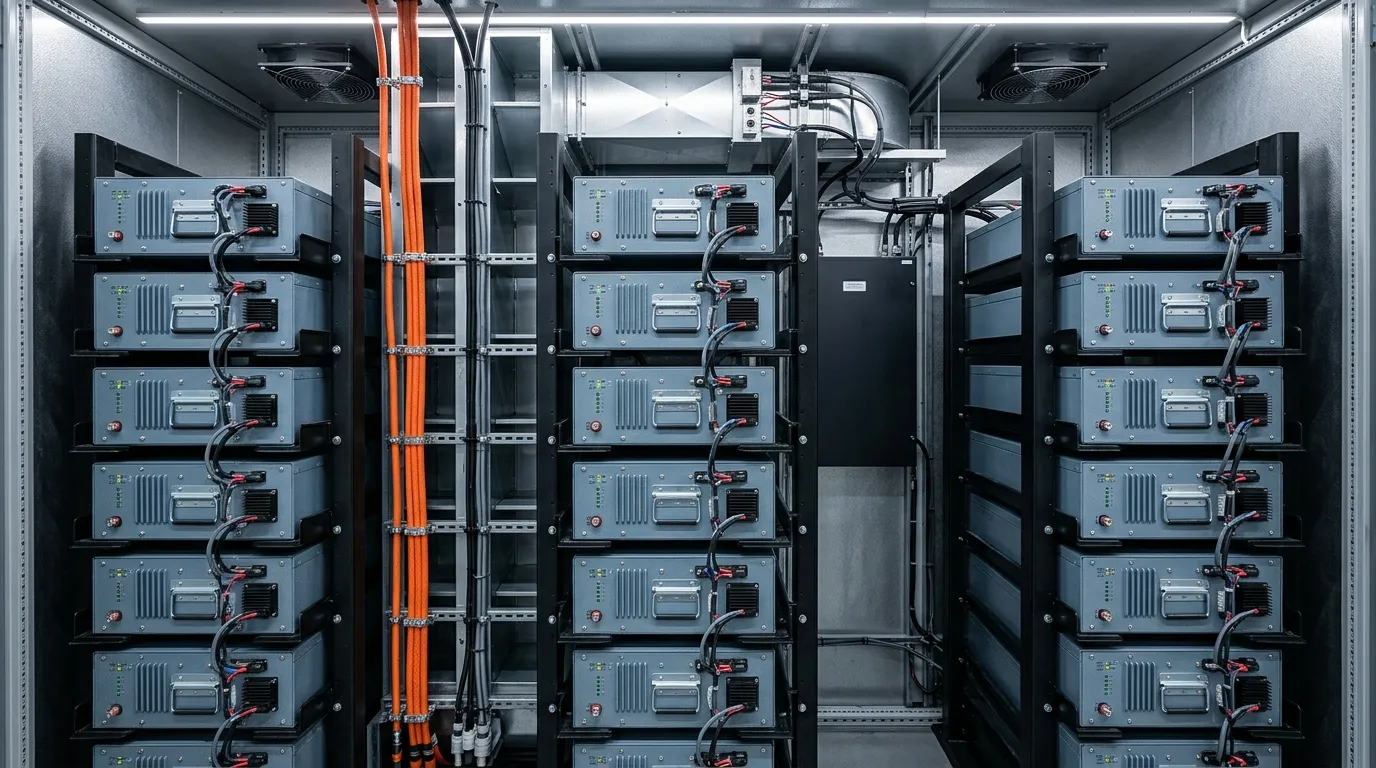
Image: inside a battery cabinet, cooling ducts and module layout decide how evenly every cell stays in its operating band — illustrative render, not a specific product.
Air-Cooled Systems: How They Work and Where They Fit
An air cooled battery energy storage system moves heat with moving air. Small systems use natural convection or simple fans; commercial systems use HVAC units that condition and circulate air through the enclosure, with ducting arranged so the flow reaches every rack.
Its strengths keep it in the market: the lowest first cost (fans and HVAC are commodity components — no fluid loop, pump skid, or leak management); simple maintenance (filter cleaning and fan checks); no liquid inside the enclosure; and a design every technician understands.
The limits show up under load. Air is a poor heat carrier, so holding the hottest cells cool in a high-power pack needs large airflow — more fan energy and more duct volume. In hot ambient conditions the cooling effect weakens exactly when it is needed most, and temperature spread across the pack grows. That is why air cooling dominates the middle of the market — distributed C&I cabinets in the hundreds-of-kWh range — rather than the multi-megawatt container segment.
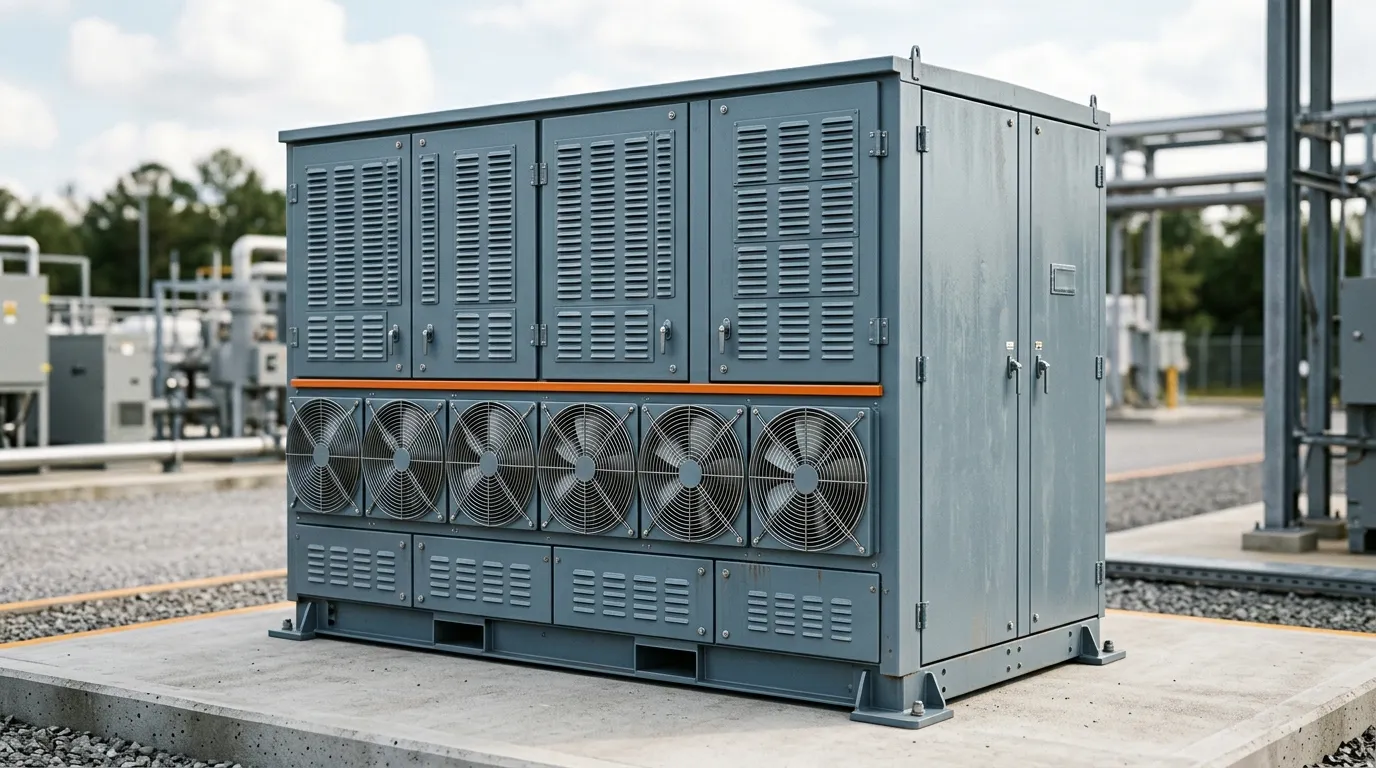
Image: a typical air-cooled C&I storage cabinet, where HVAC and fans are the entire thermal plant — illustrative render, not a specific product.
Liquid-Cooled Systems: Cold Plates, Coolant Loops, and Containers
Liquid cooling for energy storage is almost always indirect cold-plate cooling: a sealed water-glycol loop runs through metal plates in contact with the modules, and the heat is rejected outside the enclosure by a chiller or dry cooler. Because the plates touch the heat source directly, the system cools the cells rather than the whole room.
At scale, the properties buyers care about follow directly:
- Tight uniformity. Cold-plate systems typically hold cell-to-cell spread near ±2 °C (industry-typical claim), keeping every cell in the same aging regime.
- Higher packaging density. No large ducts or aisle space means more energy per enclosure — the reason liquid cooled energy storage containers reach the 5 MWh-plus class in a 20-ft footprint.
- High-rate capability. Removing heat at the source lets the pack sustain higher C-rates without the hottest cells drifting out of band.
- Quieter, with a cold-weather bonus. Pumps are quieter than large fans, and the loop can warm cells for winter charging — something air systems need separate heaters for.
The costs sit on the other side of the ledger: a higher upfront price, and maintenance covering fluid levels, coolant quality, leak detection, pump condition, and corrosion protection. A leak is a serious event, so fittings, seals, and monitoring get design attention an air system never needs.
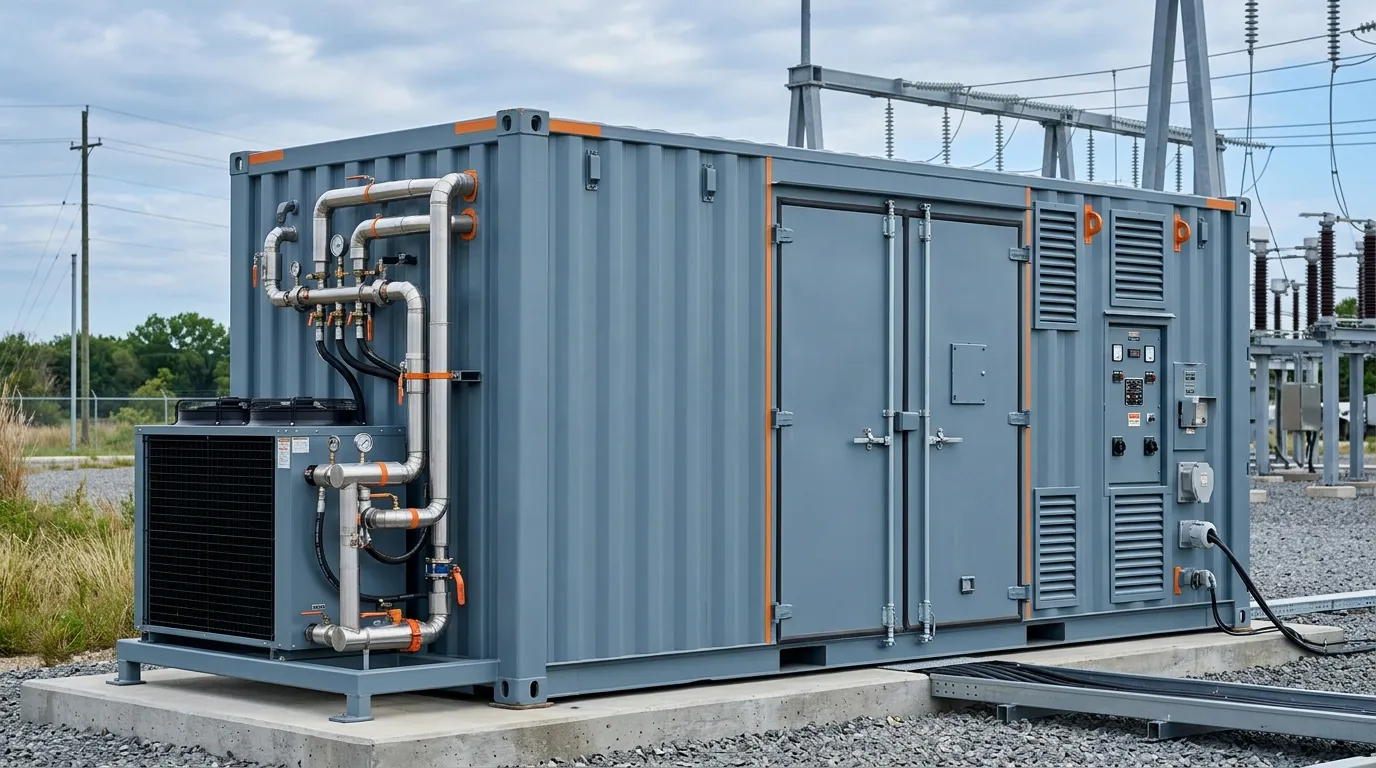
Image: a liquid-cooled container pairs the battery enclosure with chiller and coolant-loop hardware — illustrative render, not a specific product.
Air vs Liquid Cooling: Side-by-Side Comparison
The table below compares both approaches on the parameters that drive a procurement decision. Values are industry-typical and indicative — what the market commonly delivers, not measurements of any specific Hua Power product. Verify against the vendor's datasheet and your own site conditions.
Parameter | Air cooling | Liquid cooling |
|---|---|---|
Cooling medium and principle | Fans / HVAC circulate conditioned air (convection) | Water-glycol loop through cold plates at the modules (conduction into fluid) |
Cell temperature uniformity | Several °C of spread; grows with heat load and hot ambient | ≈ ±2 °C typical (industry claim, indicative) |
Peak heat removal / high-rate behaviour | Limited; sustained high C-rate pushes fans hard | High; built for sustained >1C duty |
Auxiliary (parasitic) energy | Higher — air is a poor heat carrier | Lower — roughly 40% less in utility-scale comparisons |
Footprint / energy density | Larger per kWh; ducts and airflow volume | Compact; 5 MWh+ per 20-ft container class |
Upfront cost | Lowest | Higher; premium repaid on high-utilisation sites |
Maintenance | Simple: filters, fans | Coolant checks, leak detection, pump and corrosion care |
Noise | Louder (fans) | Quieter (pumps) |
Typical deployment | C&I cabinets below ~1 MWh | Containers and high-cycle C&I at 1 MWh and above |
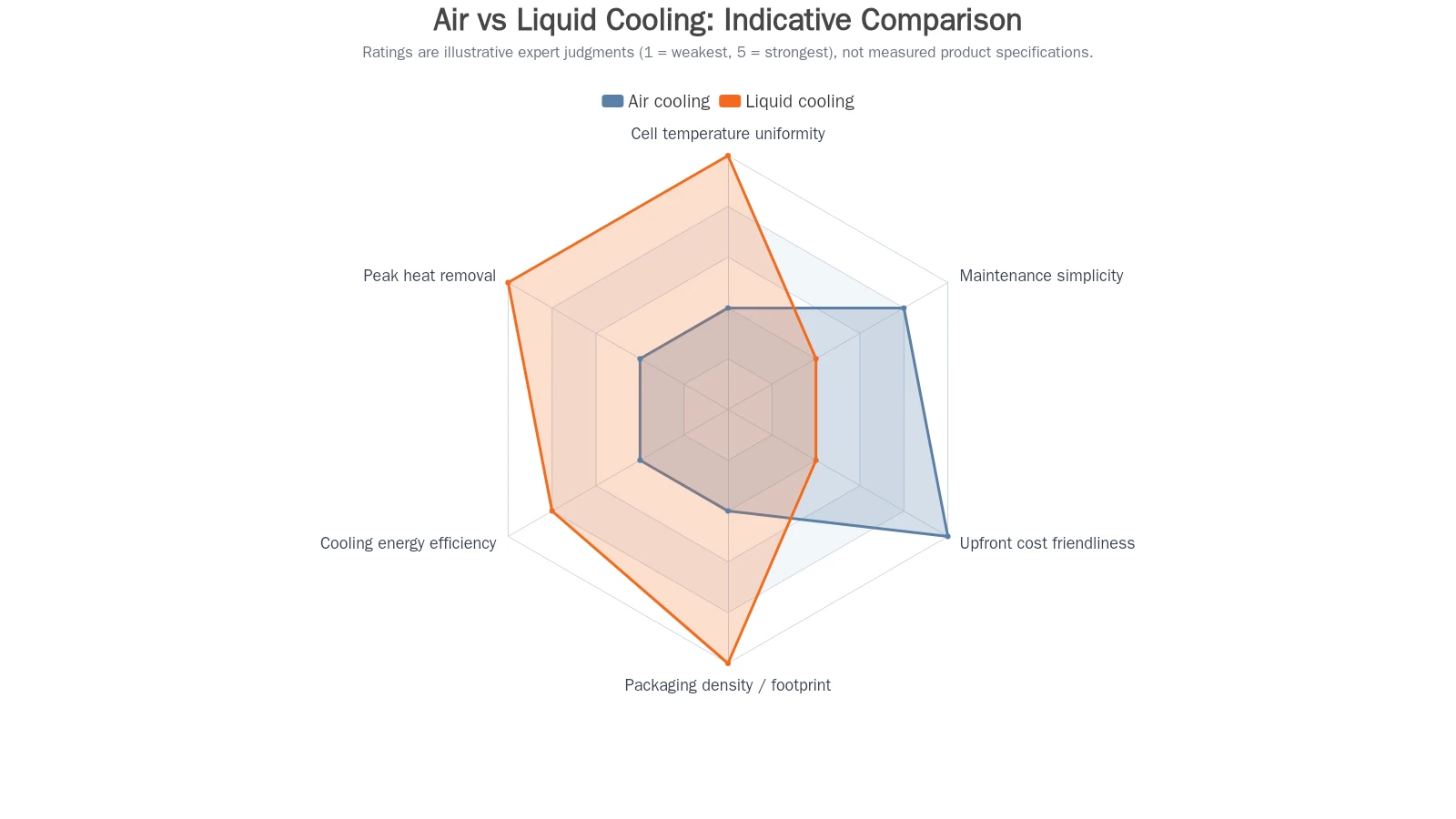
Image: indicative comparison — the ratings are expert judgments for illustration (1–5), not measured product specifications.
Two caveats keep the table honest: "typical" hides real spread (a well-designed air-cooled cabinet in a mild climate can beat a poorly installed liquid loop), and cost comparisons only mean something over the asset's life — which is why the next section quantifies the running-cost difference.
What the Data Says: Efficiency, Footprint, and Life
The physics is not controversial: air carries roughly 1.2 kJ of heat per cubic metre per kelvin against water's ~4,180 — more than three orders of magnitude apart. No duct design closes that gap; it only decides how much air you must move.
Peer-reviewed and industry sources put numbers on the consequence:
- A 2016 study in Applied Thermal Engineering comparing cooling methods for large lithium-ion cells found that air cooling needs 2–3 times more energy than liquid or fin-based methods to hold the same average pack temperature (Chen et al.).
- A 2021 study on a 48 V NMC module discharged at 2C reached the same conclusion in temperature terms: at equal parasitic power, the hottest cell in the liquid-cooled module ran about 3 °C lower, with better uniformity (Akbarzadeh et al.).
- At commercial scale, Wood Mackenzie's analysis of Sungrow's liquid-cooled PowerTitan container cites roughly 40% lower auxiliary power consumption and about 10% longer battery service life than the equivalent air-cooled design, plus a container around 32% smaller — savings that compound through cheaper transport, installation, and siting.
None of this makes air cooling obsolete: the 2–3× penalty matters most when the system runs hard and often, and a lightly cycled C&I cabinet may spend so little on cooling that the simpler air system wins on total cost of ownership. The more the battery works, the more the efficiency gap is worth.
How to Choose: Match Cooling to Duty Cycle and Site
Work through four variables in order and the choice usually makes itself.
1. Duty cycle and C-rate. If the system mostly cycles below roughly 0.5C with occasional peaks, air cooling is often sufficient and cheapest overall. If it sustains 1C or higher — frequency response, fast EV charging buffers, aggressive arbitrage — the heat load is continuous and liquid cooling earns its premium. Our C-rate explainer covers how discharge rate maps to heat generation.
2. System size and density target. Below roughly 1 MWh, air-cooled cabinets are the market default and easy to site and service. At 1 MWh and above — especially where land or enclosure space is tight — the footprint and density advantages of liquid cooling tend to flip the economics.
3. Climate and site conditions. Hot sites (ambient above roughly 40 °C), dusty or coastal-corrosive environments, and noise-sensitive urban locations all favour liquid cooling or premium air design. Cold climates do not rule out either, but a liquid loop doubles as heating, which simplifies winter operation.
4. Budget and maintenance capability. Air wins on first cost and on sites with minimal technical staff; liquid wins on lifecycle economics for heavily cycled systems, provided the owner can support fluid and leak maintenance. If your team cannot service a coolant loop, that alone is a legitimate reason to stay with air.
So which is better — air-cooled or liquid-cooled? For a small, lightly cycled commercial system in a moderate climate, air cooling is frequently the right answer. For a utility container, a high-C-rate application, or any site where energy density and running cost matter more than first cost, liquid cooling is where the industry has landed. Chemistry matters at the margin: LiFePO₄ (LFP) cells tolerate higher temperatures than NMC but still age faster when hot — cooling changes the economics of life, not the laws of chemistry.
How Hua Power Deploys Air and Liquid Cooling
Hua Power builds both architectures, and the product line maps onto the split above. The distributed air-cooled cabinets — the HC-UPSSP range, from 300 kW / 723 kWh to 500 kW / 1.2 MWh — use CCS modular architecture with intelligent HVAC control over a −20 °C to +55 °C operating range, IP54 outdoor protection, and multi-layer fire suppression (aerosol plus FK-5-1-12), as described on the energy storage cabinet page. They suit medium-scale C&I peak shaving, demand response, and distributed clusters where simplicity and deployment speed matter.
For higher energy and heavier cycling, the liquid-cooled container range — the HC2000L at 2 MWh through the HC5010L at 5 MWh-plus — uses cold-plate liquid thermal management with a published cell temperature delta within ±2 °C across the pack, a rated cycle life beyond 8,000 cycles, and millisecond-level PCS response for frequency regulation (FCR, aFRR, mFRR) under European grid-code prequalification, per the energy storage container page. These are the manufacturer's published specifications, not independent measurements.
Because we build both, there is no internal incentive to push one cooling method: the engineering conversation starts from your duty cycle, tariff, climate, and maintenance capability, and the recommendation follows the framework above. If you are evaluating a storage project and want the cooling decision checked against your actual load profile, talk to our engineering team.