
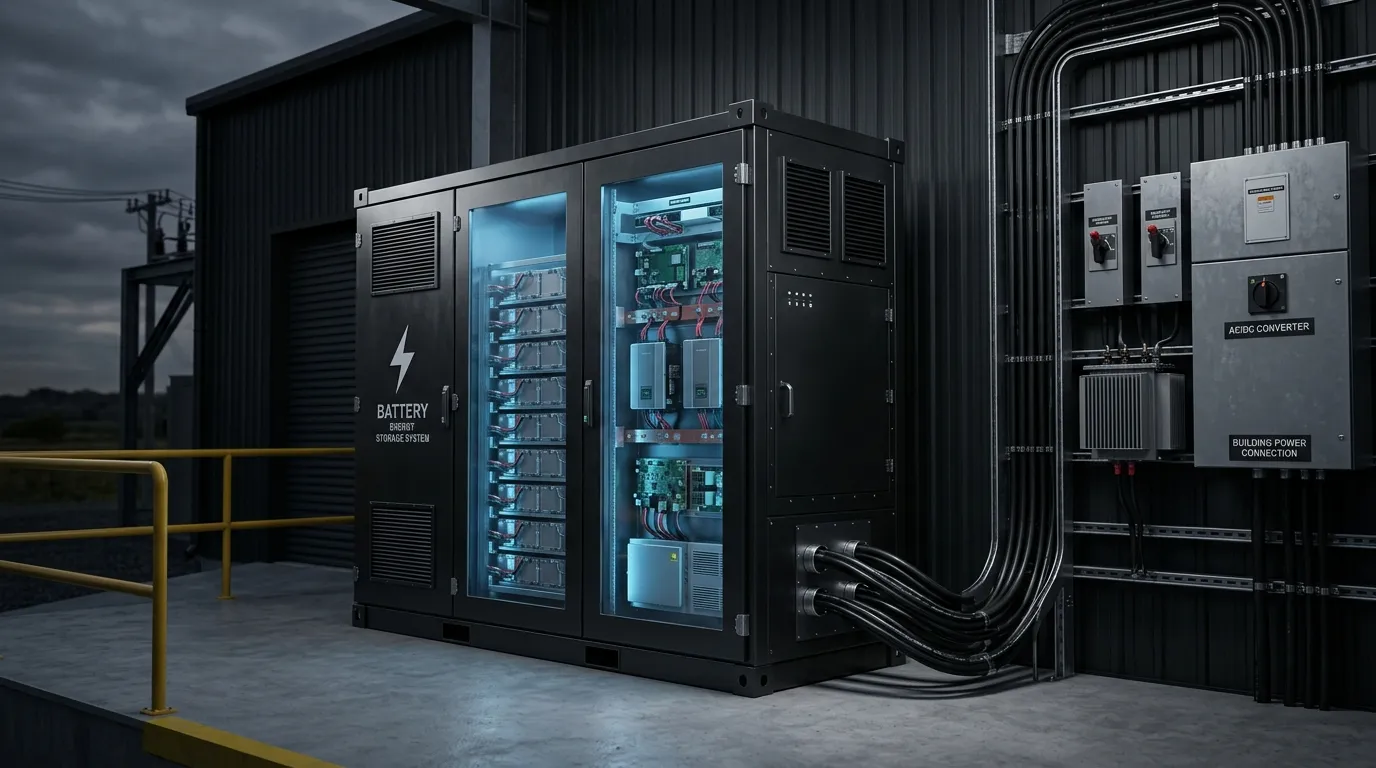
AC coupling connects a battery energy storage system to the AC side of a photovoltaic installation. The battery has its own inverter/charger and shares the building's AC bus with the solar inverter, rather than wiring into the DC path between the panels and the inverter.
That single design decision — where the battery connects — determines how a storage system is installed, how efficient it is, and whether it makes sense for a retrofit or a new build. It is also the first question an engineer asks when scoping a project, because the answer changes the equipment list.
How AC Coupling Works
In an AC-coupled system, the solar array feeds a standard PV inverter that produces AC power. That power goes onto the building's AC bus — the same bus that serves the loads. The battery sits on that bus too, but through its own dedicated inverter/charger.
The path looks like this: PV panels → DC → PV inverter → AC bus ← battery inverter/charger ← battery.
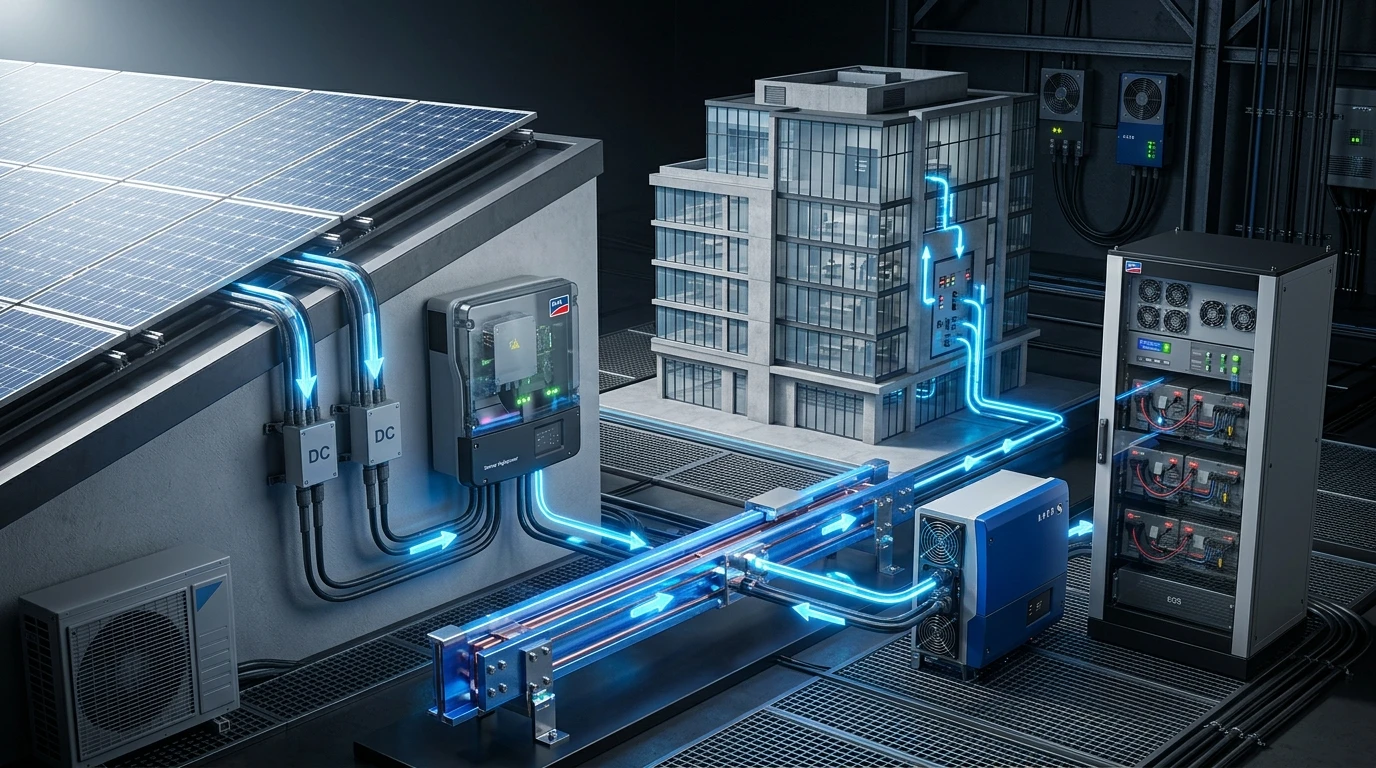
When the solar array produces more power than the site needs, the battery inverter/charger rectifies AC back to DC and stores it. When the site needs more power than the solar array is producing — or during a peak-demand window — the battery inverter reverses direction and discharges onto the AC bus.
The energy management system watches the bus in real time. It decides when to charge, when to discharge, and how hard, based on the site's tariff structure, the state of charge, and, in a C&I setting, the 15-minute demand window the utility is measuring.
This is also why "ac coupling" gets its name: the coupling point is the AC bus. Both sources — the PV inverter and the battery inverter — feed the same AC side, independently.
AC Coupling vs. DC Coupling
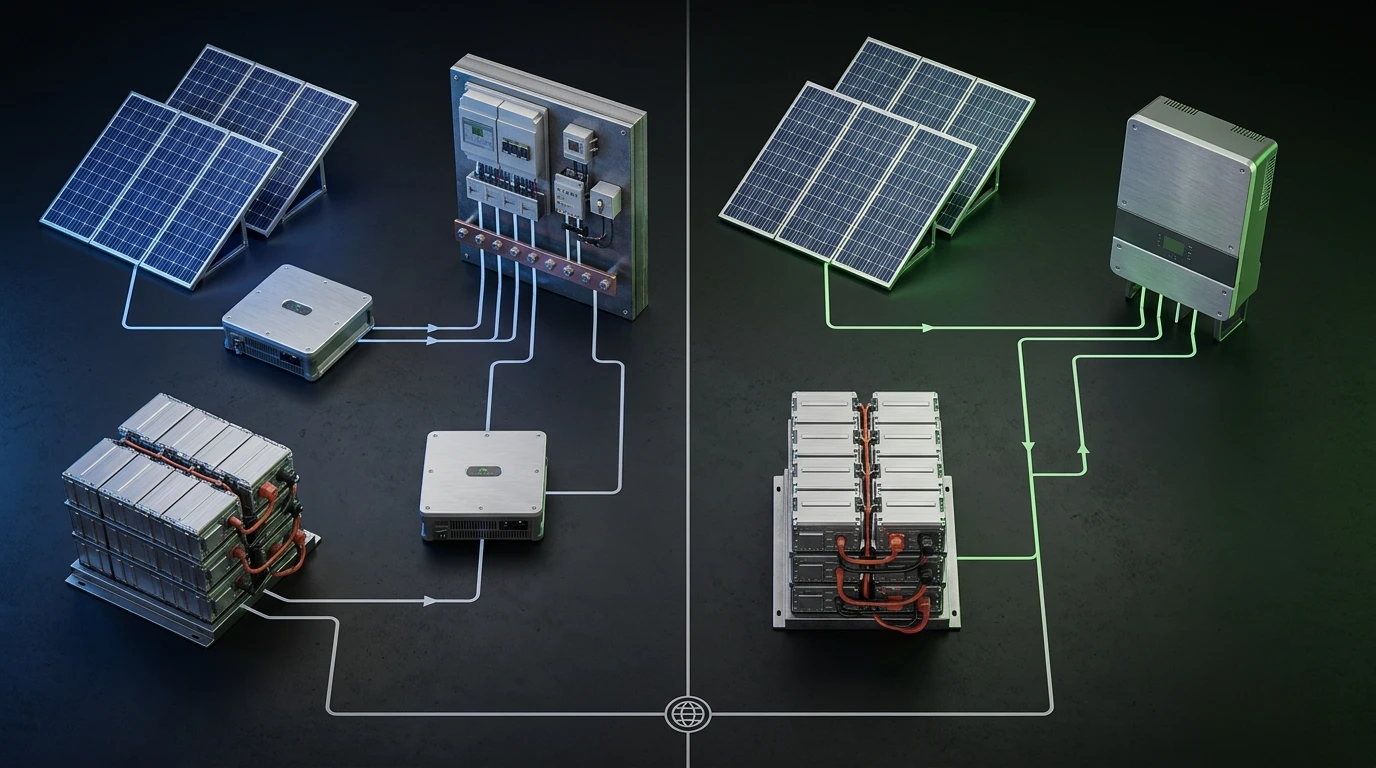
The alternative is DC coupling: the battery connects to the DC side of the system, sharing the same inverter that serves the PV array.
AC Coupling | DC Coupling | |
|---|---|---|
Connection point | AC bus (after the PV inverter) | DC bus (before the inverter) |
Inverters | Two — one for PV, one for battery | One shared inverter |
Conversion steps | PV DC→AC→DC (charge), DC→AC (discharge) | PV DC→DC (charge), DC→AC (discharge) |
Round-trip efficiency | Lower (extra AC-DC step) — see how round-trip losses work | Higher (fewer conversions) |
Retrofit | Excellent — add battery to existing PV without touching the array | Requires DC-side rework |
New build | Works, but DC coupling is often more efficient | Preferred when starting from scratch |
Generator integration | Easier — generator ties into the same AC bus | More complex |
The efficiency gap is real but its practical significance depends on the application. An AC-coupled system typically achieves 90–94% round-trip efficiency, while a comparable DC-coupled system reaches 96–98% — the extra AC-to-DC conversion step accounts for most of the difference. In a residential system cycling once a day, a few percentage points of round-trip loss are noise. In a C&I system discharging twice a day against a demand charge, that gap compounds into real money — but the flexibility of an AC-coupled retrofit can outweigh it.
When AC Coupling Wins
- Retrofitting storage onto existing solar. The array and its inverter stay as they are. The battery and its inverter are added in parallel on the AC side. No rewiring of the DC side is needed.
- Systems that need generator backup. A generator connects to the AC bus by design. Adding a battery to the same bus means the generator, the solar, and the battery can all work together through the same AC architecture.
- Projects where phased deployment matters. You can install solar today and add storage next year without revisiting the original inverter sizing.
When DC Coupling Wins
- New-build systems where every percentage of efficiency matters. Fewer conversion steps mean less energy lost as heat.
- Systems where the inverter is the single point of control. One inverter doing both PV MPPT and battery management simplifies the control logic and, in some jurisdictions, the permitting path.
Where AC Coupling Is Used

Residential Solar-Plus-Storage Retrofits
This is the most common deployment. A homeowner with an existing rooftop PV system adds a battery — often an AC-coupled unit like a Tesla Powerwall or a FranklinWH aGate — without touching the original PV inverter. The AC bus in the main panel is where everything meets.
Commercial and Industrial Peak Shaving
In a C&I setting, AC coupling lets a facility add battery storage to an existing solar installation without disrupting operations. More importantly, it lets the battery operate independently: the battery inverter can discharge during a demand peak even when the PV array is producing nothing — at 7 PM on a winter evening, for example. That independence is what turns storage into a peak shaving tool, not just a solar accessory.
For sites with no solar at all, an AC-coupled battery can still shave peaks — it charges from the grid during off-peak hours and discharges during the demand window. The "coupling" is to the AC bus; the solar is optional.
Microgrids with Existing Generation
A microgrid that already has diesel generators and solar inverters running on an AC bus can add battery storage without redesigning the bus architecture. The battery inverter synchronizes to the same AC waveform and participates in frequency regulation and load following alongside the generators.
What Makes a Good AC-Coupled System
Three things decide whether an AC-coupled system performs or disappoints:
Inverter compatibility. The PV inverter and the battery inverter must agree on the grid-forming rules. In an off-grid or islanded scenario, one of them must act as the grid reference. Not all PV inverters can follow an external reference, and not all battery inverters can provide one. This is decided at the specification stage, not the installation stage.
Communication between the battery inverter and the EMS. The energy management system needs real-time data from both the PV side and the battery side to make the charge/discharge decisions that save money. A battery inverter that only talks to its own app, not to the site's EMS, turns a programmable asset into a dumb one.
Sizing for power, not just energy. An AC-coupled battery for peak shaving must be sized for the kilowatts the site will draw during its peak interval, not just the kilowatt-hours it needs to store. Undersizing the inverter on the battery side means the battery has the energy to cover a peak but not the power output to actually serve it.
Limitations to Know
AC coupling is not the right answer for every project. Two limitations are worth understanding before you spec:
Double conversion losses. Power that goes from PV DC → AC (PV inverter) → DC (battery charger) → AC (battery inverter) passes through three conversion stages. Each one loses a few percent. In a DC-coupled system with a single inverter serving both the array and the battery, that path is DC → DC → AC — one fewer conversion. For a site that cycles storage daily, DC coupling's efficiency advantage is real.
More equipment, more failure modes. Two inverters instead of one means two cooling systems, two sets of power electronics, and two firmware stacks to keep updated. In a mission-critical C&I application, that redundancy can be a feature — one inverter failing does not take down the whole system. In a cost-sensitive residential project, it is more hardware to buy and maintain.
Finally, not every existing PV inverter plays well with a battery inverter added later. Frequency-shift control — the most common method for AC-coupled systems to signal the PV inverter to throttle — works on some inverter models and not others. Checking compatibility before buying the battery is not optional.
Next: Round-Trip Efficiency to see where AC coupling's conversion losses actually go, Peak Shaving for the C&I use case where AC coupling's independence from solar matters most, and Energy Management Systems for the controller that decides when the battery charges and discharges.