
Operations and maintenance (O&M) is the contracted set of services that keeps an installed battery storage plant running at its designed performance: operations covers how the asset is run day to day, maintenance covers the physical work that prevents and repairs failures, and the O&M agreement fixes who does which, to what standard, and at whose cost.
Most explanations stop there. The budget question is narrower. In year four, when a rack runs two degrees hotter than its neighbors and the capacity test lands a few percent under the warranted curve, whose job is it — and who pays for the parts? That answer lives in the O&M scope, not in the datasheet.
What Operations and Maintenance Means for a Storage Plant
The O&M Best Practices Guide from Pacific Northwest National Laboratory frames it as "the decisions and actions regarding the control and upkeep of property and equipment" — "routine, preventive, predictive, scheduled and unscheduled" work aimed at preventing "equipment failure or decline" (PNNL, O&M Best Practices Guide).
That splits into two jobs that marketing merges and a work order separates. Operations is running the asset: charge and discharge windows, dispatch response, who answers the alarm at 02:00. Mostly decisions and software. Maintenance is the intervention: inspections, torque checks, coolant service, firmware, module replacement, testing. Mostly hands and parts.
Storage makes the split harder: a plant is one revenue asset assembled from thousands of cells, power conversion, thermal management, fire detection, and a controller talking to the grid operator. The Department of Energy's storage safety strategy states the consequence: the O&M phase "constitutes the majority of the BESS lifecycle" (DOE, Energy Storage Safety Strategic Plan, 2024). The contract governing those years moves lifetime cost more than the equipment price.
O&M, Asset Management, EPC and Warranty: Four Different Contracts
Buyers use these four words interchangeably; they buy different things.
Contract | What you are buying | The blind spot |
|---|---|---|
EPC | A plant built and commissioned to a specification | Ends at completion; the O&M provider inherits what was left |
Warranty | A remedy for defects: repair, replacement, or a capacity floor | The part, not the labor, diagnosis, or downtime |
O&M | Labor, procedures, spares, monitoring, reporting, response times | Only the tasks somebody wrote down |
Asset management | Dispatch, market bidding, budgeting, insurance | Does not turn a wrench |
The middle two rows cost the most. A warranty is a promise about a component's behavior; O&M is a promise about what happens on a Tuesday when it misbehaves. A plant can hold a valid ten-year warranty and a signed O&M contract, and still lose a week of revenue to a failed cooling fan — a wear part the warranty excludes and the scope never names.
What a Storage O&M Scope Contains — and What It Leaves Out
BESS O&M scopes are written as task lists because task lists are billable. A serious one gives every line a frequency or a target.
Usually inside the O&M scope | Usually outside it |
|---|---|
Inspections and preventive tasks at fixed intervals | Capital replacement and augmentation |
Corrective work with a stated response and restoration time | Revenue lost while the plant is down |
Condition monitoring, alarm triage, remote diagnostics | Utility charges, insurance, land lease |
Firmware updates, spares holding, performance testing | Grid compliance penalties, trading strategy |
Warranty administration and operator training | Site security, decommissioning |
Two clauses decide more disputes than the rest: the exclusion list (what the provider may decline) and the definition of the event (whether a fault starts at the alarm, at dispatch, or when the site becomes accessible). A clause naming neither a task, a frequency, nor a target is not a scope; it is an intention.
Preventive, Corrective and Predictive Work
Preventive maintenance runs on a calendar; predictive maintenance runs on measured condition. The same PNNL guide reports that a functioning predictive program returns roughly 8% to 12% more than one built on preventive tasks alone, and considerably more where a site still leans on reactive repair.
The Department of Energy's preventive set for storage is modest: semi-annual visual inspections, regular software updates, alarm and safety-system testing, and annual refresher training for everyone in the emergency response plan. Note what is absent — no capacity test, no torque campaign, no thermographic survey. Those come from electrical-equipment practice, which NFPA 70B codifies: it details "preventive maintenance for electrical, electronic, and communication systems and equipment" to prevent "equipment failures and worker injuries" (NFPA 70B).
Corrective maintenance is the other half of the budget: a fault appears, someone diagnoses it, a part is ordered, a technician attends, the plant returns. The engineering is small; the logistics are large, which is why the corrective clause is mostly a clock.
Work on an energized DC bus is governed by energy-isolation procedure before it is governed by the maintenance manual: OSHA's rule covers equipment where "unexpected energization or start up... or release of stored energy could cause injury" (OSHA 29 CFR 1910.147). A rack holds stored energy after the breaker opens.
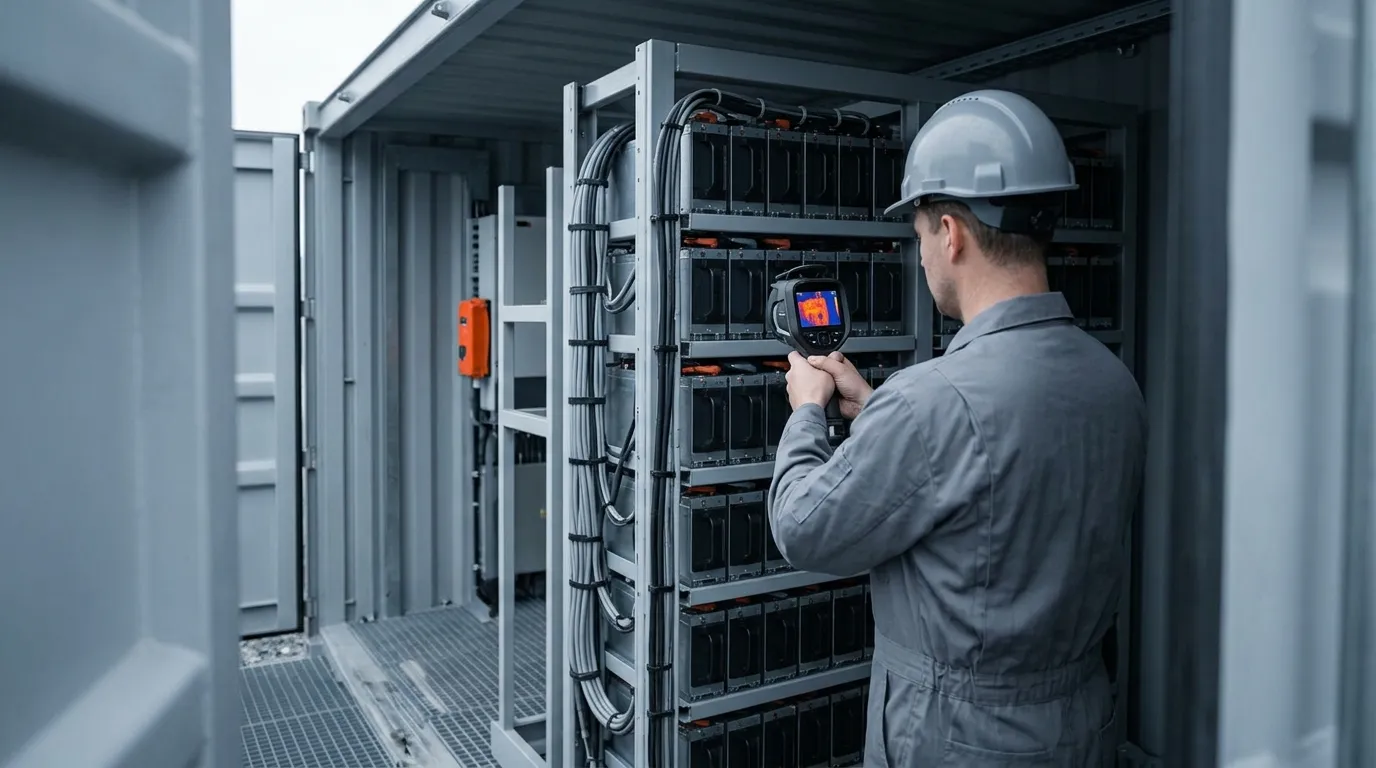
A loose termination shows up as a hot spot long before it shows up as a fault.
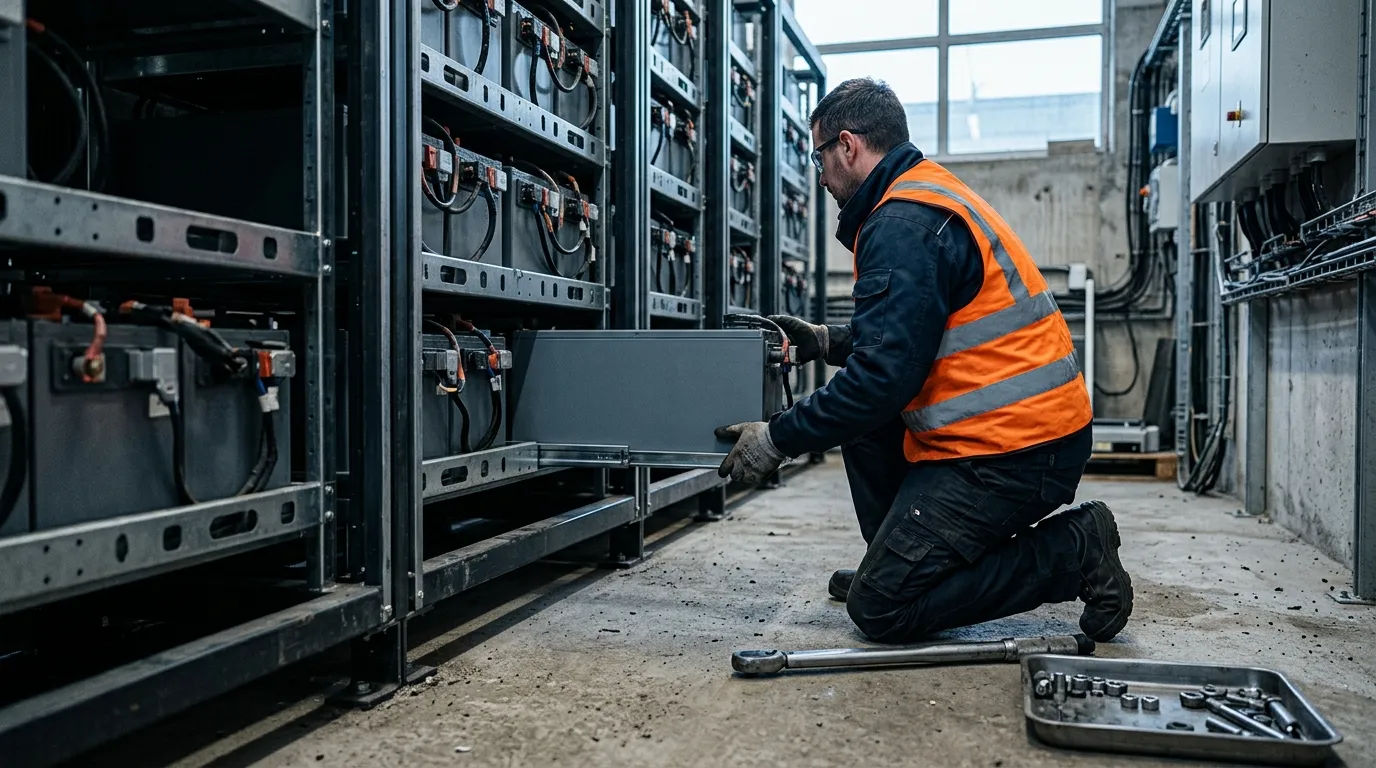
Module replacement is the routine task most often missing from a scope that lists only inspections.
What Monitoring Actually Delivers
A modern plant streams cell voltages, isolation resistance, state of charge and converter alarms — thousands of points, most uninteresting on any day. The value is not the volume; it is which points are compared against which thresholds, and what happens when one crosses.
Two layers do different jobs. The battery management system protects: it balances cells, reports state of health, and trips the system at a limit. The energy management system operates: it sets dispatch and setpoints, and it is where a remote engineer can tell whether a temperature rise is a thermal management fault, a duty-cycle problem, or a sensor drifting. Neither replaces a person walking the row with a camera, which is why serious scopes carry both.

The test of a monitoring service is whether an alert arrives with the evidence attached — the trend, the comparator, the last change made.
The KPIs an O&M Contract Is Judged On
If a contract promises availability, it has to define it: several definitions circulate, and they differ by points that translate into revenue.
IEC TS 62933-2-3 specifies how to assess storage performance in operation: key performance indicators, data requirements, and intervals from daily to annual with at least three samples each (IEC TS 62933-2-3:2025). Its reliability items — planned outage factor, unplanned outage factor, and availability factor as available hours over counted hours — come from the same document. IEC 62933-2-1 supplies the other half: the unit parameters and the measurement methods a reference test runs against (IEC 62933-2-1:2017).
KPI | What it measures | How it gets softened in drafting |
|---|---|---|
Availability | Time able to serve its duty, over time required to | Excludes grid outages, owner-caused delay, spare-part lead time, weather |
Response time | Clock from fault detection to acknowledgement | Starts at "notification", not at the alarm |
Restoration time (MTTR) | Clock from dispatch to return to service | Stops at "temporarily repaired" |
Capacity retention | Delivered energy against the warranted curve | Tested at a favorable temperature, rate and SOC window |
Round-trip efficiency | AC out against AC in over a defined cycle | Measured at part load, auxiliaries excluded |
Reporting | Whether the owner can verify any of the above | A monthly PDF is not a data set |
Exclusions are where availability figures are made. A contract guaranteeing 98% availability and then excluding grid outages, force majeure, owner-caused delays and any period waiting for a spare has not guaranteed 98% of the year. It has guaranteed 98% of the hours it chose to count.
Capacity has the same problem. A test at 25 °C, at a low C-rate, across a narrow state-of-charge window reports a healthier number than a test at site ambient on a summer afternoon — which is why the standard separates a reference test from an operational assessment.
Spare Parts Decide the Response Time
A four-hour response is credible for a fuse or a controller card in a regional warehouse. It is not credible for a battery module that crosses an ocean, because lithium cells are regulated dangerous goods and rarely fly (FAA).
That constraint reorganizes the spares strategy. Three arrangements cover most contracts.
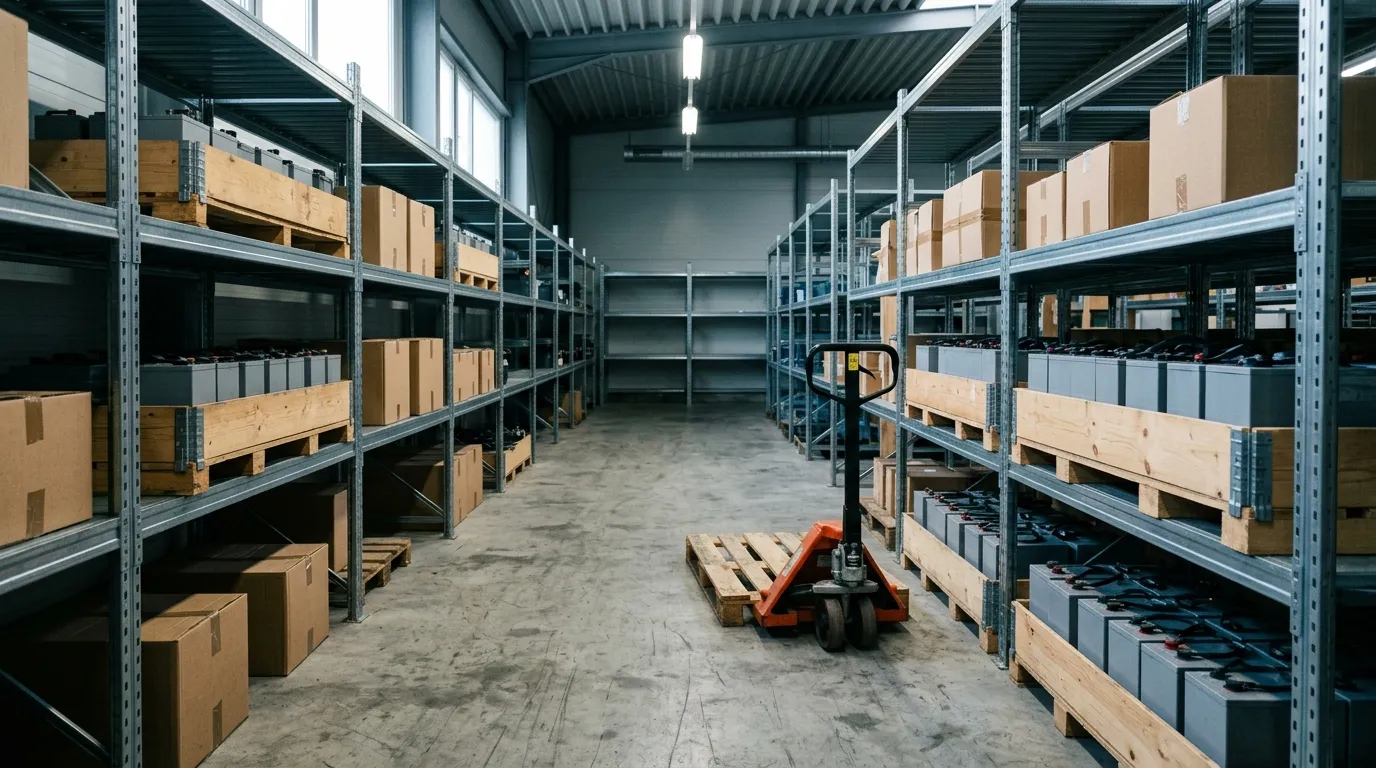
- Consignment stock at site. The provider owns modules, BMS boards and contactors in the owner's store, invoiced when used. Highest holding cost, shortest restoration.
- Regional depot. Parts within road-freight distance, with a stated delivery commitment. The usual compromise for a portfolio.
- Factory order. Cheapest to hold, and the reason a "four-hour response" becomes a six-week outage.
Make the critical-spares list part of the contract, not an appendix to the manual: name the parts, the quantity, where they sit, who pays for holding them, and what happens when one is consumed. It should follow a failure-modes exercise, not a bill of materials — the question is which single part stops the plant.
Warranty Is Not O&M
Warranty and O&M fail differently, and conflating them is how owners pay twice.
A product warranty responds to a defect: a module underperforms, the manufacturer repairs or replaces it. A performance warranty responds to a shortfall: the plant delivers under the warranted curve, and the manufacturer makes it up in energy, capacity, or money. Neither obliges anyone to attend on a Sunday, diagnose the cause, hold the spare, or document the fix.
Four costs sit outside a warranty almost every time: labor to remove and refit a component, consumables, diagnostic time, and the test proving performance was restored — the O&M budget.
Most warranties are also conditional on maintenance being performed as specified — the manual names inspection intervals, firmware versions, thermal limits. An O&M regime is therefore not only what keeps the plant running; it is what keeps the warranty valid. When a claim is rejected, it is usually rejected on maintenance records rather than on the failure.
Pricing allocates the same risk. A fixed annual fee per MW leaves utilization risk with the owner; an availability-based fee puts it on the provider and makes the exclusion list the most valuable page in the contract; time and materials look cheap to sign and turn expensive in a bad year. Distance and site count, cooling duty, cycle throughput, and whether spares are held move the number more than anything else.
How Hua Power Supports Operations and Maintenance
Hua Power's service model is organized around those boundaries: 24/7 cloud-based monitoring through the EMS platform with real-time fault detection and remote troubleshooting; field engineering for commissioning and on-site maintenance; regional spare-parts warehousing; OTA firmware updates across the project life; operator training and multilingual documentation; and warranty and SLA packages scoped per project (Technical Support & After-Sales Service).
The escalation path is short by design. The platform detects an anomaly, engineers pull logs, BMS data and sensor readings to find root cause, the fix is applied remotely by OTA update or an on-site visit is scheduled with parts pre-staged, and closure is confirmed by post-fix monitoring with an incident report. Sites keep at least a year of data locally, with unlimited cloud history under a subscription.
For containerized plants that model maps onto the equipment directly: the same energy storage container platform is monitored, updated and serviced as one system rather than through separate battery, thermal and converter contracts. If you are scoping O&M and want the exclusion list argued rather than assumed, send us the site configuration and duty cycle and we will mark up the boundaries with you.