
Energy throughput is the total amount of energy a battery charges and discharges over its working life, measured in kilowatt-hours (kWh) or megawatt-hours (MWh). It captures how much useful work a storage system actually performs before it reaches end of life — and it is the number hiding behind battery warranties, lifetime cost, and the difference between a good quote and a bad one.
The short definition
Energy throughput is a cumulative measure, not a rate. A battery rated 100 kWh that completes one full cycle moves 100 kWh through its terminals; after 5,000 full cycles it has processed roughly 500 MWh — that accumulated figure is its throughput. The unit is always an amount of energy (kWh or MWh), never a power rating (kW).
The term has a precise metering boundary that most explanations skip. Industry tooling such as HOMER's battery model defines throughput as the change in stored energy, counted after charging losses and before discharging losses. That means "energy delivered to the load" and "energy drawn from the grid to charge" are two different numbers, and which one a contract measures changes the result by the system's efficiency — typically several percent.
Why throughput matters more than cycle life
Cycle life counts cycles; throughput counts work. A cycle life claim of "6,000 cycles" says nothing about how much energy each cycle moves — two batteries with identical cycle ratings can deliver very different lifetime energy because usable capacity, depth of discharge, and efficiency differ.
This is why a growing part of the industry argues throughput should replace cycle life as the headline lifetime metric. The residential-solar discussion around it is instructive: Solar Choice's widely-cited analysis makes the case that warranty terms expressed in throughput (MWh) are more honest than warranty years or cycle counts, because they are tied to the actual energy the system is asked to move.
For a commercial buyer, the practical effect is direct: a 1 MWh cabinet cycled daily for ten years will see roughly 3,600 full-equivalent cycles and move several gigawatt-hours. Whether the contract protects that work with a throughput clause — or just with "5 years" — determines who carries the degradation risk.
Energy throughput vs. power: kW is not kWh
Power (kW) is how fast energy flows; energy (kWh) is how much flows; throughput is how much accumulates over a lifetime. A 500 kW / 1 MWh system can deliver 500 kW for two hours — the same throughput regardless of whether it delivers in 1C bursts or 0.5C continuously.
The relationship to C-rate matters here because it changes what "one cycle" costs. Cycling at higher C-rates moves the same kWh but stresses the cell harder, which feeds back into degradation — the topic of a later section. When comparing quotes, keep the three numbers separate: rated power (kW), rated energy (kWh), and the lifetime throughput the warranty actually covers (MWh).
How to calculate energy throughput
The full formula, in the form used by storage spec sheets and the round-trip efficiency literature:
Lifetime throughput ≈ nominal capacity × depth of discharge × cycle count × round-trip efficiency
Work through an example. A 10 kWh battery cycled to 90% DoD, 6,000 times, at 90% round-trip efficiency:
10 kWh × 0.9 × 6,000 × 0.9 ≈ 48.6 MWh delivered over life
The same battery at 50% DoD delivers roughly half — not because the cell is worse, but because the contract is measuring a smaller window of each cycle. Depth of discharge is the single most common source of inflated throughput claims: a warranty that quotes "throughput at 100% DoD" is worth more than one that quotes a lower depth.
Round-trip efficiency (RTE) is the term most calculators leave out. Wikipedia's round-trip efficiency entry covers the underlying definitions: RTE is the ratio of energy delivered to energy absorbed across a full charge-discharge cycle, and typical lithium systems sit in the mid-to-high 90s. It belongs in the formula because it converts energy absorbed (what you pay for) into energy delivered (what you sell or consume) — and it is exactly the metering boundary from the first section.
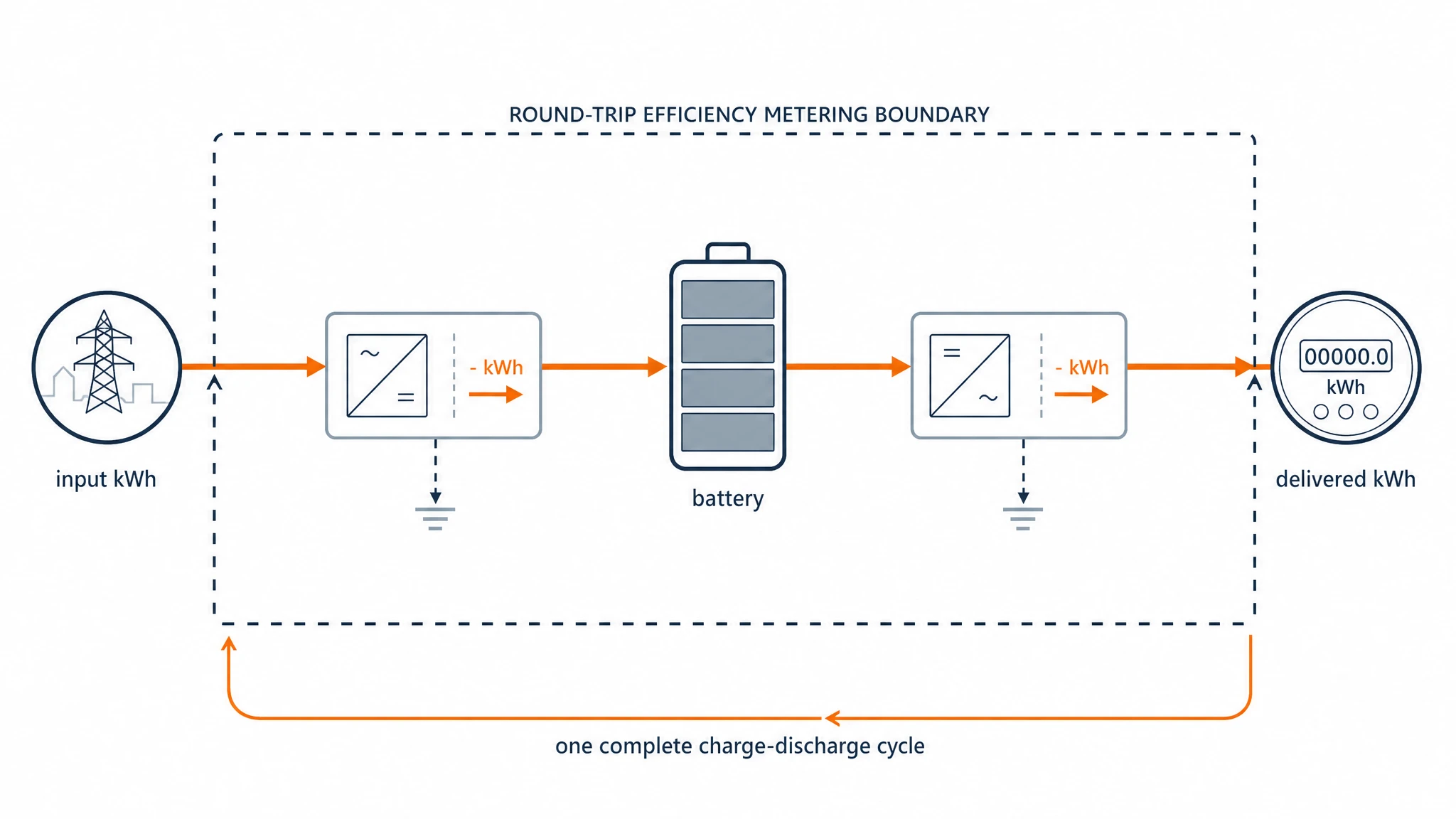
The metering boundary matters: throughput can be counted at the input or at the delivered side, and the two differ by the system's round-trip efficiency.
What limits throughput in practice
Four factors decide how much of the theoretical lifetime throughput a system actually reaches:
- Depth of discharge — shallower cycling extends cycle life but reduces throughput per cycle; the trade-off is an optimization problem, not a fixed rule.
- Temperature — heat accelerates capacity fade; thermal management that keeps cells in their operating band preserves throughput. This is why liquid-cooled and actively managed systems carry their efficiency and life claims.
- C-rate and duty profile — aggressive cycling increases losses and fade.
- System efficiency — the battery management system (BMS), inverter, and auxiliary loads consume part of every cycle. A system that burns 5% of each cycle on cooling and controls delivers 5% less throughput, every cycle, for life.
Degradation also compounds: as capacity fades toward end of life (commonly defined at 80% of rated capacity), each cycle moves less energy, so the degradation-adjusted lifetime throughput is lower than the nameplate formula suggests. The honest number for a procurement decision is the adjusted one.
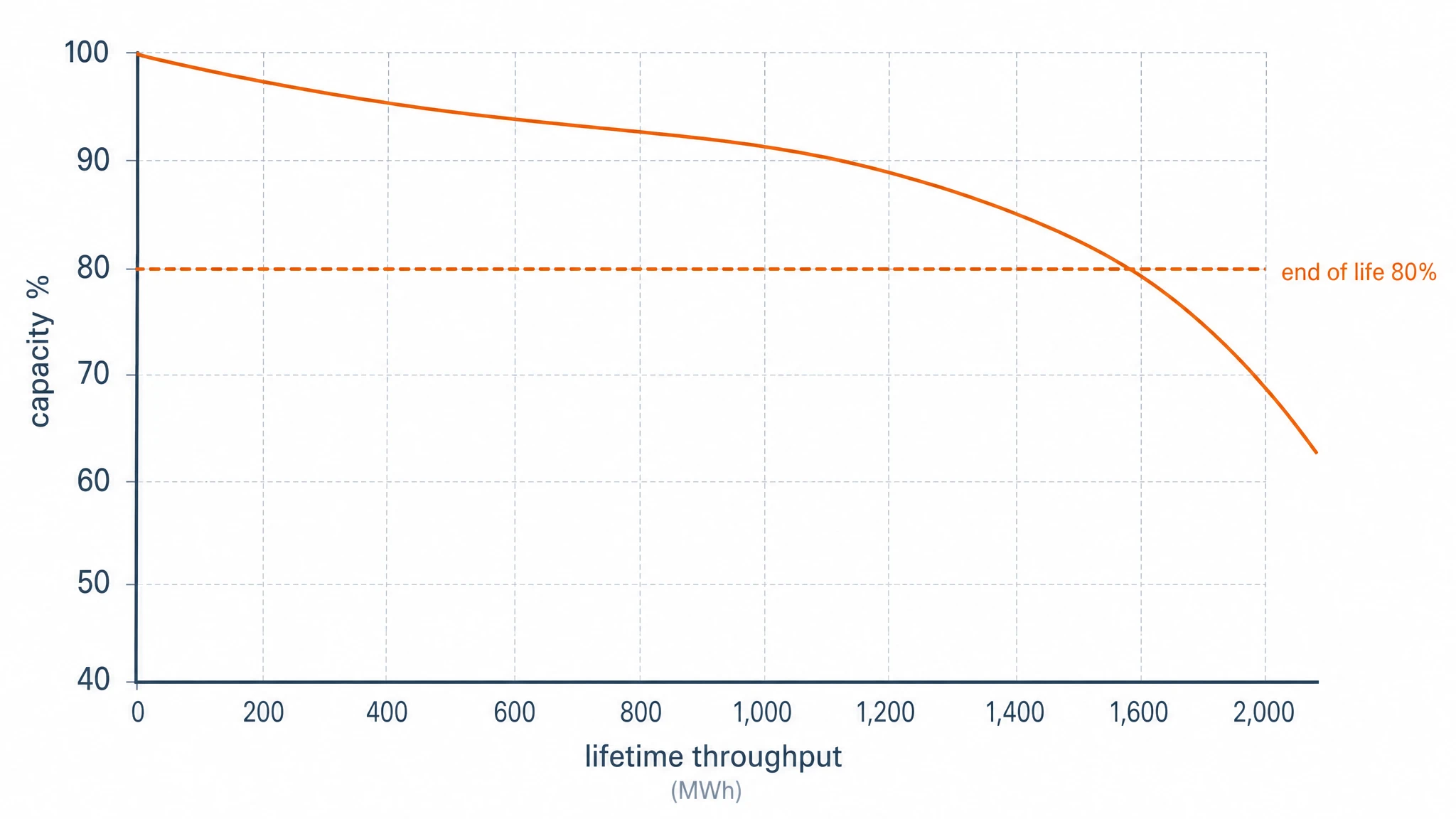
As capacity fades, each cycle moves less energy — the real lifetime throughput sits below the nameplate calculation.
Throughput in BESS vs. other contexts
The term "throughput" appears in several adjacent industries, and the definitions are not interchangeable:
- EV charging — measured per connector as kWh dispensed; it is an operational KPI, not a battery-life metric.
- Residential solar — usually discussed as cycles vs. years, with throughput as the newcomer concept.
- Academic and regulatory work — researchers use amp-hour (Ah) throughput and, in heavy-vehicle regulation, full-cycle equivalents (FCE) to normalize battery wear across duty cycles.
In a battery energy storage system (BESS), the definition is the cumulative energy cycled through the storage bank. The context that matters for buyers is the grid-scale one: as EIA's energy storage explainer documents, utility-scale storage is increasingly operated daily, which makes lifetime throughput the metric that governs both revenue stacking and replacement timing.
How buyers use throughput: warranties and lifetime cost
On a real spec sheet, throughput appears in the warranty section, usually as a MWh guarantee with a "whichever comes first" cap alongside years. Read it as the manufacturer's engineering estimate of how much work the system is built to do.
That number also feeds lifetime cost. Divide the system price by the warranted throughput and you get a $/kWh-throughput figure that is directly comparable across vendors — a more honest basis than price-per-kWh alone, because it folds efficiency, DoD assumptions, and expected life into one denominator. Research institutions working on storage economics use the same logic in levelized cost of storage (LCOS) analyses; PNNL's energy storage program is a solid reference point for how these metrics are used in practice.
Two questions to ask every vendor: At what depth of discharge is the throughput warranty quoted? and Is throughput measured at the battery terminals or at the grid connection? The first changes the number by up to 2×; the second shifts it by the round-trip efficiency.
Common questions about energy throughput
How do you calculate energy throughput? Multiply nominal capacity by depth of discharge, cycle count, and round-trip efficiency (see the worked example above).
What is total energy throughput? The lifetime sum of energy cycled through the battery — the cumulative figure the warranty caps and the economics run on.
What is the 40-80 rule? A common operating guideline in residential and some commercial deployments to keep batteries between roughly 40% and 80% state of charge, trading some available capacity for reduced stress and longer life. It is an operating convention, not a standard.
Is throughput the same as capacity? No. Capacity (kWh) is how much the battery holds per cycle; throughput (kWh over life) is the accumulated total. Two batteries with the same capacity can have very different lifetime throughput.
How Hua Power helps you evaluate energy throughput
Every storage quote deserves the same scrutiny: what is the warranted throughput, at what DoD, measured where, and what does it imply for lifetime cost. Hua Power's engineering team works with buyers to read those numbers before the contract — clarifying metering boundaries, DoD assumptions, and how system efficiency shapes delivered throughput.
Start with the related knowledge-base entries on round-trip efficiency and depth of discharge (linked above), then look at how throughput is stated on our energy storage cabinet range. If you want a walkthrough of a specific spec sheet or a throughput comparison across vendors, contact our team — we can help you translate the numbers into a defensible procurement decision.